← The Daily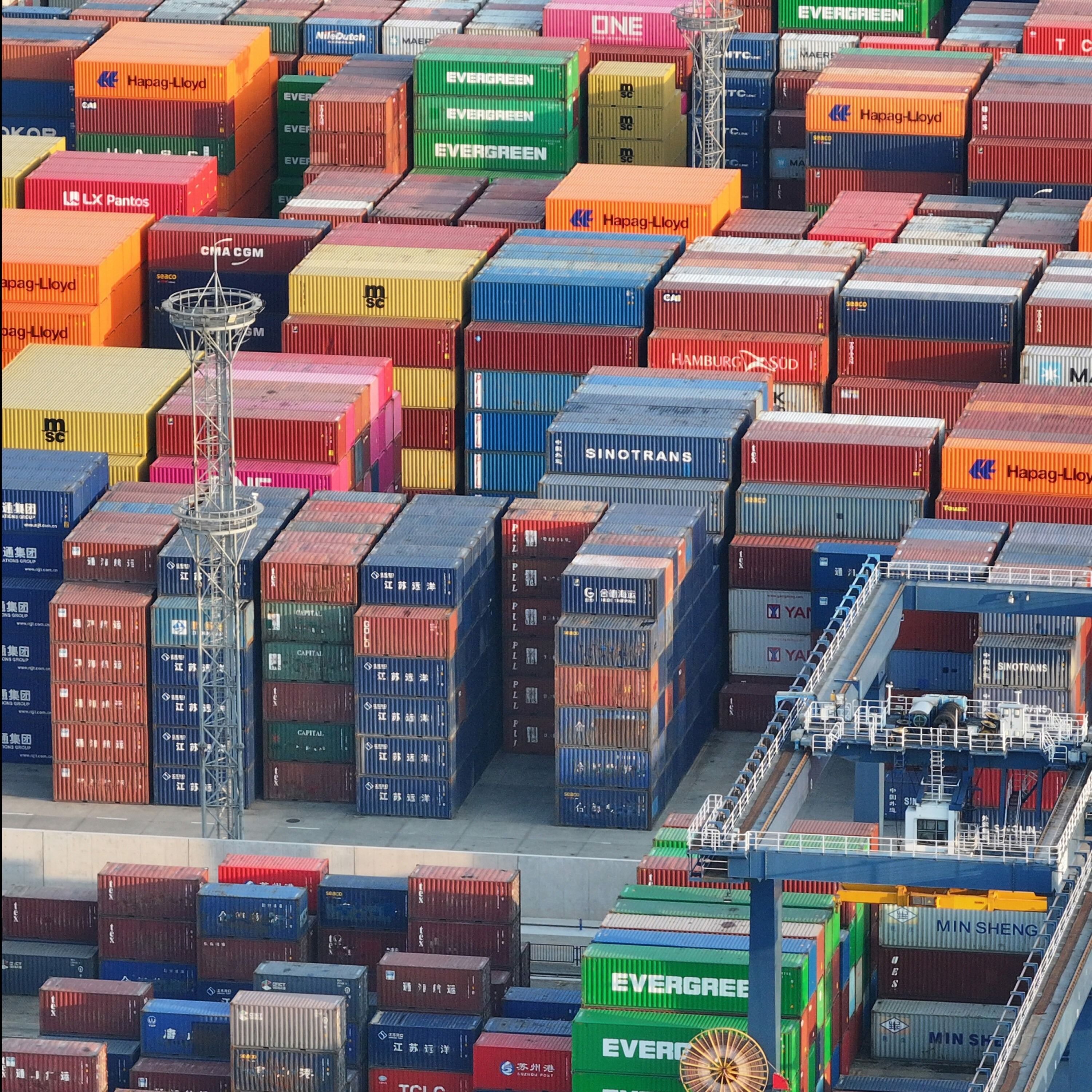
The Daily
China Seems Unstoppable. Trump Thinks Otherwise.
00:27:21
Over the past week, President Trump avoided a trade war with Canada and Mexico. But he escalated a trade war with China. His reasoning? China has become more powerful in domestic manufacturing than the United States, Japan, Germany, South Korea and Britain combined. Keith Bradsher, the Beijing bureau chief for The New York Times, explains why China’s dominance as a trading partner has become a threat to Trump’s agenda — and asks whether America will ever be able to catch up.
Loading summary
Transcript60 lines
- [00:01]
A
My name is Thomas Gibbonsnev. I'm a journalist at the New York Times. I served in the Marine Corps as an infantryman. When it comes to reporting on the front line, I think nothing is more important than talking to the people involved, hearing their stories, and being able to connect that with people thousands of miles away. Anything that can make something like this more personal, I think is well worth the risk. New York Times subscribers make it possible for us to keep doing this vital coverage. If you'd like to subscribe, you can do that@nytimes.com sl subscribe.
- [00:32]
B
From the New York Times. I'm Natalie Kitroeff. This is the Daily. Over the past week, President Trump avoided a trade war with Canada and Mexico, but he actively escalated one with China. That's because when it comes to domestic manufacturing, China has become more powerful than the United States, Japan, Germany, South Korea, and Britain combined. Today, my colleague Keith Bradshaw explains why China's dominance as a trading partner has become such a threat to Trump's agenda and whether the United States will ever be able to catch up. It's Monday, February 10th. Keith, I knew you were one of the OG economics reporters at the New York Times, but in preparing for this conversation, I learned a few amazing facts about you that I just want to share.
- [01:48]
A
Okay.
- [01:48]
B
You've covered dozens of trade deals, including writing 150 times about the negotiation of NAFTA alone. I want to call you the Bill Nye of trade. I don't know if they'll let me do that. You've been reporting in China for 23 years. You were one of the very few American journalists who stayed there through the pandemic. And for some reason, this is your first time on the show. So welcome, Keith.
- [02:12]
A
Thank you. And by OG you mean old guard, original gangster? Okay, I don't know the term. Okay.
- [02:21]
B
It's an honor. It's a distinction you've earned.
- [02:23]
A
I appreciate it.
- [02:25]
B
Okay, so where we find you now is that a trade war between the US And China escalated last week with Trump imposing new tariffs on China. And we thought this would be a good time to really try to understand the nature of this problem between the US And China with one single number at the core.
- [02:45]
A
Yes, It's a big number, and the number is nearly $1 trillion. And that's how big China's trade surplus was last year with the rest of the world.
- [02:56]
B
And just quickly explain for me why a $1 trillion trade surplus is such a big deal.
- [03:03]
A
A trade surplus means that you are sending far more containers of goods far More cars, far more solar panels and drones and all the other things that China makes in such abundance, you're sending far more of those to other countries than you're buying. And it's important because China right now is swamping the world with manufactured goods, and that's beginning to cause factories all over the rest of the world to close. So if you look, for example, at December, China's Exports were up 17% from one year earlier.
- [03:46]
B
Is that a big deal?
- [03:48]
A
Well, that's a big deal because global trade is only growing 3%. So if the world's biggest exporter is growing 17%, then you know that everybody else is losing market share in a hurry to China's exports.
- [04:04]
B
Right?
- [04:04]
A
And so that's beginning to cause a lot of concern, as we've seen, not just with Trump, but in many developing countries and many other industrialized countries, a lot of concern now in in Europe, Brazil, India, Indonesia, Turkey, and so forth about what is going to become of their industrial sector now that China is ramping up its exports of factory goods so quickly.
- [04:26]
B
We're going to get into how China's done that. But I just want to pause on Trump for a second here, because what I'm hearing is that when Trump talks about China and the US Trade deficit, he's actually wrong to highlight it.
- [04:40]
A
He isn't wrong to highlight the US Trade deficit. The US Is importing huge quantities of goods and not exporting nearly as much. This is not a new issue for the United States, and it's not a new issue for Trump. They come over here, they sell their cars, their VCRs, they knock the hell out of our companies. Trump was among the first prominent Americans to really focus on rising imports and the undermining of the American industrial base. They are beating the hell out of this country. I don't know how your audience feels, but I think people are tired of seeing the United States ripped off. In 1988, he warned strongly on Oprah Winfrey's show about the torrent of imports coming in then from Japan. We let Japan come in and dump everything right into our markets and everything. It's not free trade between China's leaders and our leaders. They are ripping us. We are rebuilding China. And in 2016, when he ran for president, we could turn off that spigot by charging them tax until they behave properly. He made it a centerpiece of his platform. Then we have all the cards, but we don't know how to use them.
- [05:59]
B
Okay, so Trump has been complaining about this since the 1980s, but aren't there advantages to free trade? I'm thinking of lower prices for consumers, for example, which have come specifically from free trade with China.
- [06:14]
A
Yes, most Americans have benefited from lower prices for a lot of imported goods, whether it's an electric fan or an air conditioner or toys or clothing or furniture. A lot of these goods are less expensive now because China now plays such a big role in their global manufacture. But the danger for the United States is what happens during international crises. What happens if there's a confrontation or even military standoff between the United States and China? Can the United States keep relying on China for everything? For example, in the early days of the pandemic, the United states really needed N95 masks, right? But the United States had very little capacity to produce N95 masks. And China even briefly halted any export of N95 masks to make sure that it had enough to use for its own medical personnel, rescue personnel, and so forth. So the United States found itself really stuck. China then even put restrictions on the export of N95 manufacturing equipment because China is now the world's leading maker of factory equipment. And the United States found itself turning to domestic industries. Even the underwear industry ended up making masks, for example, for a while.
- [07:44]
B
Wow.
- [07:44]
A
But the United States just didn't have the ability to ramp up quickly or even slowly its own domestic production of masks. And so the concern is that the United States is relying on, on a country like China that is increasingly a geopolitical adversary for crucial supplies, like, for example, the main ingredients of antibiotics and drones. Warfare has been transformed in the last few years, as we've seen in the conflict between Russia and Ukraine. And China makes almost all of the world's drones and drone components. So there is a nervousness about having the United States rely on them for that.
- [08:24]
B
Got it. So that's the background here, just how reliant the US Is on China for things that we might need in a crisis. Now, let's get into the trillion dollar trade surplus. I think a lot of people might think of that made in China label as being associated with some of the goods you already mentioned, toys and clothes, but not some of the more advanced products that, you know, you would think of as bringing a country to this level of dominance.
- [08:50]
A
That's right. A decade or two ago, China was exporting toys, clothes, furniture, and so forth. But you had a very concerted national policy of moving towards higher value products that would create a lot of better paid jobs. And particularly in the last five years, that policy has taken off. And now you See them making huge quantities of solar panels, wind turbines, all but the fastest semiconductors are now made in vast quantities in China. But where you see China's most impressive progress is in the car industry.
- [09:33]
B
What do you mean by that?
- [09:35]
A
Well, five years ago, China only exported a few cars and they were very cheap, junky cars that went to markets like Syria's market. They weren't competitive on an international market. Today, China has very quickly, just in five years, passed Japan, South Korea, Germany, to become by a wide margin, the world's largest car exporter. And the cars that China is selling overseas are no longer junky. They are good quality cars at very affordable prices. And a quarter of these cars being exported by China are electric cars, which may be the future.
- [10:21]
B
And why was China so keen on dominating an industry like the car industry?
- [10:28]
A
The car industry is very important to economies all over the world. In China and the United states, it's around 6% or so of the entire economy. It creates millions of well paid jobs, whether it's in making and designing the auto parts, whether it's in assembling the cars, whether it's marketing and distributing the cars, whether it's maintaining the cars. So there's just a tremendous amount of value in this industry, a tremendous number of high paid jobs. On top of that, the industry is also important to national security because making cars makes you better at making other kinds of vehicles like tanks and armored personnel carriers.
- [11:15]
B
So you have a bunch of reasons why you might want to be a juggernaut in the car industry. Can you tell me how exactly China went from exporting barely any cars to now being the world's number one exporter of cars? How did that happen?
- [11:33]
A
It really took four ingredients. It took a plan that was Developed more than 15 years ago, it took money, it took people, and it took a carefully designed regulatory environment. Let's start with the plan. Every five years, China has been setting a plan, and that plan includes where they want to go in particularly categories like electric cars. So in 2007, the Premier of China chose a former Audi engineer who was not even a member of the Communist Party, but was a Chinese professor at a university and made him the Minister of Science and Technology and gave him essentially a blank check to spend whatever it took to turn China into a powerhouse in electric cars. Part of becoming a powerhouse then meant that the banking system backed these car companies pretty much regardless of how much money they lost. They kept shoveling enormous loans into the car industry. And with one or two exceptions, the automakers have made in China have made almost no money.
- [12:50]
B
The banks didn't care about making money.
- [12:53]
A
Well, the Chinese government, in close coordination with the Communist Party, sets quotas for where the banks are going to lend their money. And so because the banks, also in China control almost all of the financing in the country, when the government gives them a target by sector for how much they're going to lend, they go ahead and lend it.
- [13:15]
B
Okay, so we understand the money part. You have banks pouring investment into this industry in part because the government is encouraging them to do so. What about the other ingredients you mentioned? The people and the regulation?
- [13:28]
A
The people and the regulations are crucial. China now, each year graduates more engineers and people in related fields, scientific fields, than the entire number of graduates in the United States. Wow.
- [13:42]
B
It's remarkable.
- [13:43]
A
It's extraordinary. Only one in five American graduates is in these STEM areas, science, technology, engineering, and math. In China, it's more than two in five. Plus they have a lot more graduates. So China has ended up with vast numbers of engineers, which means that they're not too expensive for the companies to hire, and they can put them to work on designing ultra modern factories, ultra modern cars. The final piece of the puzzle here, where China's been very successful, is the regulatory environment. And what I mean is that China has a very streamlined permitting process. It's very easy to get things started. It's easy, for example, to get industrial parks set up. It puts in the roads, the electricity, the water lines, even the water purification is done at one great big complex for all the water coming out of all the factories in the complex. And the factories can be built in a year instead of four years or more in the West. And then there's housing. China largely prohibits single family housing. And when factories build a new complex, they also put in rows of 30 story apartment buildings, beautifully landscaped, with extensive parks around them so that you have people have nice views. And the zoning rules allow so much housing construction that people will pay as little as a couple hundred dollars a month to rent an apartment. And that means that even if they're earning $20,000 a year, their standard of living is quite good.
- [15:25]
B
It's amazing. The approach you're describing is so comprehensive. You're really witnessing this authoritarian regime pushing on all the levers available to it to achieve this aggressive goal. And it seems as though having complete control over so many elements of society was, in a way, key to China's success.
- [15:47]
A
China's authoritarian regime has been linked to many human rights violations over the last several decades. But it has also produced an extraordinarily efficient export machine and an industrial policy to encourage those exports on a scale the world has never seen before. And on top of industrial policy, China has also engaged in considerable protectionism over the past several decades. Direct, like what President Trump has been doing lately, and also in much more indirect or less visible ways that have proved equally effective in discouraging imports to China.
- [16:33]
B
What do you mean? What Was that?
- [16:35]
A
In 2008, China raised its taxes on large imported Cadillacs, Mercedes, Lexus and so forth cars and sport utility vehicles to over 100%. So you had to pay twice as much. Incredibly high. You had to pay. Well, even now a Cadillac Escalade in the United States costs $85,000 because of these taxes. General Motors doesn't even try to sell it in China, but you can buy it through an importer. But with the taxes, you pay $185,000 for it in China.
- [17:08]
B
Wow.
- [17:08]
A
So more than twice as much. So, not surprisingly, almost nobody buys big American cars, big German cars, big Japanese gasoline powered cars here in China. China has very successfully used these industrial policies to build itself into the world's dominant producer, not just of cars, but of drones, solar panels, so many other manufactured products that together have given it a trillion dollar trade surplus. And the question everybody is starting to ask is how in the world can anybody else catch up?
- [18:03]
B
We'll be right back.
- [18:08]
C
Hey, it's Noah Chestnut from the Athletic. If you're into games and sports, pay attention. I'm gonna give you four sports terms. You tell me the common thread. Ready? Axel Loop, Lutz Sow Cow. That's Axel Loop, Lutz Salchow. This one's like medium hard. The answer is figure skating jumps. Now, what if I gave you 16 different terms and you figure out how they come together into four different groups? If you're up for the challenge, you'll want to check out Sports Edition. It's a new daily game for sports fans. There'll be some that are going to stump you, some that make you laugh, and some that remind you when you were a kid watching sports for the first time. Connections, Sports Edition. To play today's puzzle, go to theathletic.com connections.
- [19:03]
B
So, Keith, I want to talk about what Trump's answer to China's dominance has been. And that's tariffs, which I covered back when they started in 2018 when Trump put a slew of tariffs on China and the Biden administration continued, a lot of them added some new ones. And now Trump has just added a new 10% tariff on China, which went into effect last week. What is the goal of these tariffs?
- [19:28]
A
Trump uses tariffs in several different ways. He, more than his predecessors, likes to use them as a general purpose negotiating tool. But part of his goal also with tariffs on goods from China, is to stabilize what's left of American manufacturing. So many of the tariffs that he imposed on China in 2018 and 2019 are still there today. These are tariffs that are meant to change the playing field of international trade between the United States and China to help America still have a viable manufacturing sector.
- [20:10]
B
The idea is, in the case of China, tariffs are being used to achieve a really long term goal, which is, as you said, the revival of American manufacturing. Perhaps another way of putting it is to achieve economic independence from China, our adversary.
- [20:27]
A
That's right. But the question is, are tariffs enough by themselves to turn around the decline in American manufacturing, or are they just part of a much broader, longer list of measures that need to be taken to stabilize this very important part of the American economy and of American society?
- [20:50]
B
And what do you think the answer to that question is, Keith? I mean, you've been studying and reporting on China and trade for decades.
- [20:58]
A
Many experts now argue that tariffs are necessary but not sufficient for an American industrial revival. A lot more is gonna be needed because China has a much broader approach to trade than just tariffs. China also used industrial policy and education policy, and China used zoning and housing and regulatory policy. And the United States can learn a lot from how China reached the point where it is today, where it is, by such a wide margin, the world's sole manufacturing superpower.
- [21:38]
B
But knowing how slow the US Is to act on all of these different fronts, it seems like a long shot, honestly, to imagine that the US Would be able to follow through on this kind of comprehensive approach. And in the meantime, tariffs could drag us into this protracted trade war that could raise prices on consumers.
- [21:59]
A
There is going to be a price in all of this. President Trump has acknowledged that there will be slightly higher prices for some products. However, he and his advisors seem to feel that that price is worth paying to make sure that the United States remains a country that can not just consume a lot, but also manufacture and produce a lot.
- [22:26]
B
Keith, from what you're saying, there are a lot of economists and national security experts that have come around at this point to the idea that Chinese trade dominance, potentially a real problem. Why do you think it took so long? Why are we in this position now where we're potentially too far behind to even catch up?
- [22:45]
A
There were several factors. First of all, many Americans loved the availability of very cheap manufactured goods from China. Second was that there were powerful interest groups in favor of continuing open trade with China, particularly Wall street, with financial interests seeing benefits from trade and also investments in China. You also had a perhaps naive expectation of what trade and economic advances in China would mean for China itself. There was in many places an expectation in that a more affluent China would mean a more democratic China that would be an increasingly positive contributor to the global community of nations. What practically nobody expected was for China to take a very sharp shift towards a much more authoritarian structure at home and also a very sharp shift in Chinese foreign policy towards close cooperation with Russia and Iran, which has alarmed a lot of the geopolitical experts. And so China's return in some ways to its geopolitical stance in the 1950s has made many experts reconsider whether the United States should be almost totally dependent on China for practically every category of manufactured goods.
- [24:30]
B
The fact that that's shifted, that there's much more skepticism now about the trade relationship with China, how much credit can Trump take for that?
- [24:41]
A
Trump has really changed the American dialogue. The Clinton administration, the George W. Bush administration and the Obama administration were just not very interested in tariffs. They saw them as a throwback to economic policies that the world had moved beyond. But Trump has now put tariffs once more at center stage as, at least for him, the key component of trying to stop the decline of American manufacturing.
- [25:15]
B
So you're there. Is China afraid of Donald Trump, or do they feel at this point that they're so far ahead and were given a pass by the US and its allies for so long that it's actually just too late for anyone to really challenge their place as what you said was the world's sole manufacturing superpower.
- [25:40]
A
Leaders here in Beijing are certainly concerned about higher American tariffs, but I would not go so far as to say they are afraid. Trump imposed some tariffs in 2018 and 2019 of 25%, and those are still in place. And yet China's exports overall are still growing. A lot of them are just going through other countries to reach the United States. So it's possible that almost nothing can really slow down this very fast moving freight train of China's rising exports, although it seems as though Trump is determined to try.
- [26:33]
B
Keith, thanks so much.
- [26:36]
A
Thank you very much for having me.
- [26:46]
B
We'll be right back. Here's what else you need to know today. In back to back rulings, federal courts threw a wrench in President Trump's plans to remake the government bureaucracy. On Friday, a federal judge ordered the white House to temporarily pause some parts of its attempt to shut down usaid, which distributes foreign aid, calling it, quote, unconstitutional and illegal. The ruling halts the plan to put 2,200 employees on administrative leave and recall all of the agency's workers who are overseas. Then on Saturday, another federal judge temporarily blocked Elon Musk's team from accessing the payment systems at the Department of Treasury. The judge said giving so called special government employees like Musk access to such highly sensitive information raises the risks of leaks and makes the financial system more vulnerable to hacking. If the Trump administration refuses to comply with the rulings, it could pose a serious test for America's rule of law. Today's episode was produced by Mary Wilson, Mooj Zaidy, Claire Tennisketter and Alex Stern with help from Nina Feldman. It was edited by Lisa Chow. Contains original music by Marian Lozano, Pat McCusker and Rowan Nimisto and was engineered by Alyssa Moxley. Our theme music is by Jim Brunberg and Ben Landsverk of Wonderly. Special thanks to Paula Schumann and Larissa Anderson. That's it for the Daily I'm Natalie Kitroweth. See you tomorrow.