← The Daily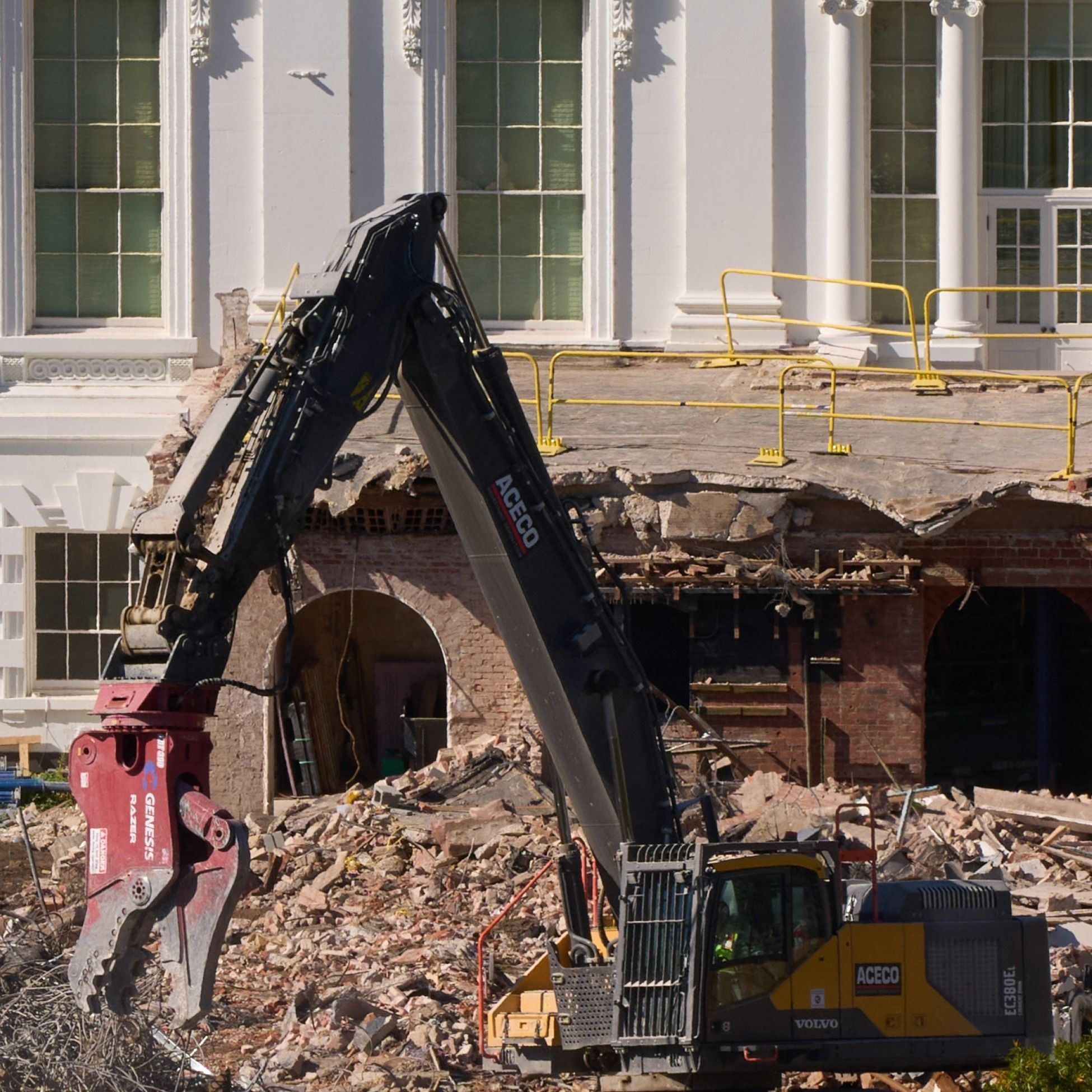
The Daily
Demolition at the White House
00:27:19
The Trump administration completed its demolition of the East Wing of the White House on Thursday to make way for a new presidential ballroom. Luke Broadwater, who covers the White House, explains who is paying for President Trump’s latest construction project and why the demolition is striking a nerve.
Loading summary
Transcript68 lines
- [00:00]
Schwab Advertiser
We all have moments when we could have done better. Like cutting your own hair. Yikes. Or forgetting sunscreen so now you look like a tomato. Ouch. Could have done better. Same goes for where you invest. Level up and invest smarter with Schwab. Get market insights, education, and human help when you need it. Learn more@schwab.com.
- [00:27]
Rachel Abrams
From the New York Times, I'm Rachel Abrams, and this is the.
- [00:31]
Luke Broadwater
Daily.
- [00:34]
Rachel Abrams
On Thursday, the Trump administration completed its demolition of the East Wing of the White House to make way for a new presidential ballroom.
- [00:42]
Luke Broadwater
Nobody's actually seen anything quite like it. I think it'll be one of the great ballrooms anywhere in the world.
- [00:50]
Rachel Abrams
And like so much of the administration's agenda, the decision to turn the 123-year-old annex into a pile of rubble has attracted a mixture of reactions.
- [01:00]
Bank of America Advertiser
That is not your building.
- [01:04]
Rachel Abrams
Condemnations. He is tearing down the house. He is tearing down the people's house. Praise.
- [01:11]
Luke Broadwater
I saw it today. It looks fantastic. I'm delighted he's doing it. And I love seeing these liberals melt down.
- [01:19]
Rachel Abrams
And ethics concerns.
- [01:20]
Luke Broadwater
Trump can apparently hit up his donors to bankroll the demolition of the literal edifice of our Democratic government.
- [01:28]
Rachel Abrams
Today, my colleague Luke Broadwater explains who's paying for Donald Trump's latest construction project and why the demolition is striking a nerve. It's Friday, October 24th. Luke, when this news broke, I have to confess I did not know what to make of it. Like, I did not understand how big of a deal it was to demolish the East Wing or to build a giant ballroom. And I have felt a little bit surprised by the reaction. I'm curious if you did also.
- [02:09]
Luke Broadwater
Yeah, I mean, this story in some ways sort of came out of nowhere. I mean, we knew that Donald Trump wanted to build a big, impressive ballroom, and he had sort of waved around pictures of what it might look like. And we knew at some point that was going to happen. But what he had said was that the existing structure wouldn't be touched, that it was going to be an addition that would just bump out the East Wing and build in addition to what was already there. And so when excavators started crashing into the East Wing and tearing it apart, that really struck everybody by surprise. I mean, here was essentially a whole wing that's been built onto the White House over time that was being completely ripped apart with no public notice without anybody knowing about it. And historians started speaking out against it. People who work in the sort of historic architecture space were crying foul. And obviously Democrats were up in arms. You know, Elizabeth Warren's calling it illegal. At the same time, we're hearing from Republicans who are saying all this outcry is much ado about nothing. You know, every construction project at some point doesn't look very good. Right. While you're tearing things up before they're built and just trust the process and wait till the end. President Trump is the master builder. You Democrats are just looking for anything to criticize. We were hearing a lot of back and forth, and so we wanted to find out what the facts are. Were they taking down the entire East Wing, or they're going to leave a little bit of it up? Like, what was the plan here, and why hadn't anybody been told about it? And so I went down to the White House to try to get some answers from the people behind this.
- [03:58]
Rachel Abrams
Okay, so speaking of the facts, what is this project exactly? Where did this come from?
- [04:04]
Luke Broadwater
Right. So President Trump, he always is looking around the White House looking for things to improve. He's in his second term. He's looking to leave a legacy. He has already renovated what used to be the Rose Garden and turned that into what they're calling the Rose Garden Club. He's built a patio out there. He's hosting dinners and DJing and hosting parties there.
- [04:29]
Rachel Abrams
He's DJing?
- [04:31]
Luke Broadwater
Yeah. That's, like, one of his favorite things to do. He has a playlist. It's full of, like, show tunes and oldies and, you know, Gloria. He loves Gloria. And he loves to entertain and have people over. And honestly, he's trying to make the White House as much like Mar a Lago as possible. He's trying to leave his stamp on the White House. If you look at what's been done in the Oval Office, there's been so much gold added, and this is the latest step of that. He has felt that the East Room, where they often have dinners, is not big enough. It holds about 200 people, 250 people, perhaps, and he wants to quadruple that, essentially. He wants to have a place where he could have about a thousand people, have a really grand big dinner. And he has started looking at the East Wing, and he thinks the East Wing is too small and unimpressive, in his view. He doesn't like the idea of having to put up a tent if there's going to be a big party and seat people out outdoors. He wants a grand ballroom, and he thinks this is the best place on the White House campus to put it. And so he's proposed initially building onto the East Wing to create this grand ballroom, which would be essentially about twice as big as the White House residence. So it's going to be a huge addition. But what we didn't know is that along the way, as they started to evaluate this plan for the ballroom, President Trump made the decision that it wasn't going to be cost effective. It wasn't going to be smart to just build an addition onto the East Wing, that the entire East Wing needed to be demolished to clear the way for this grand Ballroom.
- [06:16]
Rachel Abrams
Well, let's talk about that, because what exactly is being bulldozed that people are upset about? Like, what are they replacing?
- [06:24]
Luke Broadwater
Yeah, so traditionally, the East Wing is the home of the first Lady. That is where the first lady's offices are. That is where the social office is. The calligrapher. It's known as sort of the softer side of the White House. It's where state dinners are planned. It's where parties are planned. It's not as well represented in sort of American lore as, like, the West Wing. You know, there aren't that many famous scenes that have happened in the East Wing.
- [06:56]
Rachel Abrams
Right. There's no TV show called the East Wing.
- [06:58]
Luke Broadwater
Exactly. I mean, I've walked through it, I think once when I was invited to a White House Christmas party. But for the people who work there, you know, the East Wing has been around since about 1900. It is a part of history. And the White House does say they have taken steps to take certain things from the East Wing and preserve them ahead of the destruction of the East Wing.
- [07:21]
Rachel Abrams
You said you had been there, and I'm wondering what kind of condition it was in. Like, in other words, is the president right, that it could use a renovation?
- [07:32]
Luke Broadwater
Well, look, the White House has been renovated over time. I mean, you know, in the 1940s, when Truman renovated the White House, it was in such bad shape that Congress got involved. They had to appropriate money. They had to appoint a commission to oversee the renovations of the White House. And so over time, you know, the White House can use upkeep, right? Of course. But it didn't appear to me when I walked through it like it was, like, structurally deficient and needed to be torn down immediately. That's not what I observed.
- [08:03]
Rachel Abrams
Anyway, so you've explained to us that people are upset that this renovation, at least in scope, is a little unusual. Did the president actually break any rules in. In any of this?
- [08:16]
Luke Broadwater
You know, that's a real interesting question, because I think a lot of people have asserted that this is illegal. But what makes this interesting, or at least somewhat tricky, is that there is a National Historic Preservation act of 1966, and that requires a strict review process on federal projects that may affect historic buildings. But the White House is actually exempt from from that ordinance. And that's something the White House staff has highlighted. And I think what makes things even a little bit more confusing is that although we've seen some drawings and some designs come out, no official plans have ever been submitted to the commission that's supposed to oversee this. So we haven't seen a final plan yet of what's exactly going to be in store here. And Trump has appointed one of his personal lawyers to oversee that commission, and they've said no such plan is needed for the demolition of the East Wing, but that we will see a plan before they start to actually build. So it does seem like they're pressing up against the limits of what's legal or what normally would be allowed when demolishing or renovating a historic project of significance in D.C. but it does seem like the White House is exempt here from the normal planning process because of the way the law is written. You know, and one thing Trump has always done is that he moves very quickly, and he moves very quickly in all sorts of policy areas and all sorts of actions. And oftentimes that leaves his critics or lawyers or the courts or Congress scrambling to try to keep up with him. And by then, it may be too late. The building is now rubble. Right. When you walk down there, the East Wing is literally rubble. And so if you now try to get an injunction or go to court to stop this, it's too late.
- [10:13]
Rachel Abrams
Right. What are they going to say? Build it the exact same way it was.
- [10:17]
Luke Broadwater
Right.
- [10:17]
Rachel Abrams
In terms of the aesthetics, though, like, he's not proposing, as far as I know, that it's going to be some kind of, like, brutalist architecture. Right. He's promising to, at least from what I can see, adhere to the style, whatever that means, of the rest of the White House. And I just sort of wonder what you make of that and how you interpret that.
- [10:36]
Luke Broadwater
Yeah, they've said they're going to keep the style consistent. Now, I do think it's going to be a glamour to the max version of White House style. You know, as we're seeing with what he's doing with the Oval Office, we're bringing in all the gold and all the glamour. And once this is built, and he's promising that it will be built during his administration, you know, future presidents are going to have to live with this. Now, could a future president go in and order it to be toned down some and order all the gold to be removed and to be like a more humble ballroom. Maybe, I don't know. But he's certainly leaving his mark on the White House in a way that is as bold as any president in U.S. history.
- [11:18]
Rachel Abrams
Do you think that the architects and the historians that are upset would be this upset if they liked his aesthetic better? Like if Trump wasn't known for being so, as you put it, bold, some might call it garish. Do you think that they would have as big of an issue with him knocking down the East Wing and proposing a ballroom of this size?
- [11:38]
Luke Broadwater
I think that's definitely a factor. If you're looking at his designs, I think that they're gaudy or showy or over the top or ostentatious. Like, yeah, that's going to affect your view of the project, right? And you're going to like that. That's not representative of who we are as Americans. We're not in your face showy. We're not over the top. And so I do think that affects how people view it. It looks in some ways like somewhat out of step with sort of a more humble vision of the presidency. But perhaps a more central concern about this project is the money aspect. Where is the money coming from to build this new grand ballroom that the president wants so much? Who is paying for it and what are the implications of that?
- [12:40]
Schwab Advertiser
We'll be right back. We all have moments when we could have done better. Like cutting your own hair. Yikes. Or forgetting sunscreen. So now you look like a tomato. Ouch. Coulda done better. Same goes for where you invest. Level up and invest smarter with Schwab. Get market insights, education and human help when you need it. Learn more@schwab.com Support for this podcast comes from GoodRx. GoodRx can keep your family protected this cold and flu season with discounts on flu shots. And if you do get sick, GoodRx offers savings on cold and flu meds. GoodRx compares prescription prices and instantly finds discounts of up to 80%. GoodRx is not insurance, but it works with or without it and could beat your co. Pay price save on flu shots plus everyday medications with GoodRx. Go to GoodRx.com the Daily this podcast.
- [13:51]
Bank of America Advertiser
Is supported by bank of America Private Bank. Your ambition leaves an impression. What you do next can leave a legacy. At bank of America Private bank, our wealth and business strategies can help take your ambition to the next level. Whatever your passion, unlock more powerful possibilities at Private bank bankofamerica what would you like the power to do? Bank of America, official Bank of the FIFA World Cup 2026. Bank of America private bank is a division of bank of America, NA member, fdic, and a wholly owned subsidiary of bank of America Corporation.
- [14:26]
Rachel Abrams
So, Luke, let's talk about the money and the cost of this project. What is the price tag?
- [14:33]
Luke Broadwater
Well, when President Trump first announced the ballroom project, he put the price tag at 200 million. But this week, White House officials said the new price is 300 million.
- [14:45]
Rachel Abrams
Oh, wow.
- [14:46]
Luke Broadwater
Yeah. Significant inflation, I guess. But they say they have raised all of the money for this project. They don't need to go to Congress to get an appropriation to ask the taxpayers for any money. It will all be from donors, people. President Trump is calling his friends.
- [15:06]
Rachel Abrams
Wait, so who are these people? Who are the friends? The donors.
- [15:10]
Luke Broadwater
So we've been asking the White House about that, and today they put out a list of donors.
- [15:18]
Rachel Abrams
You want to read through some of these names?
- [15:20]
Luke Broadwater
Yeah, sure. I mean, it's. It's a mix of powerful, influential and wealthy people and powerful, influential and wealthy corporations. You have the tech companies on there. Almost all the big tech companies are on. You have Amazon, Apple, Google, Microsoft. You have the traditional defense contractors like Lockheed Martin. You have cryptocurrencies. You've got, you know, Stephen Schwarzman, the CEO of Blackstone. It is a combination of people who many times want things from the government or at least want to stay on good terms with the government, and perhaps also don't want the Trump administration going after them or their businesses.
- [16:08]
Rachel Abrams
You know, I actually took a look at this list of donors before you and I got on the phone, and some of the companies are recognizable, like some of the ones you mentioned. And it seems obvious why they might want to curry favor with the White House, because at least some of them have business in front of the federal government, or you can imagine that they will have business in front of the federal government. But there were also a lot of names on here that, frankly, I did not even recognize. Like, for example, who are Pepe and Emilia? Fan jewel, if I'm saying that right.
- [16:36]
Luke Broadwater
My understanding is the fan jewels are historically big Republican donors, but I don't know. I haven't spoken to them directly about that donation.
- [16:47]
Rachel Abrams
I guess what I'm just getting at is some of these people seem kind of out of left field, and I'm wondering, is that just because I'm unfamiliar with them, or did it also strike you as a little bit of a hodgepodge?
- [16:57]
Luke Broadwater
So a lot of them were invited to a dinner to raise money for this ballroom. And the person that is in charge of all this fundraising is Meredith O', Rourke, the Trump 2024 campaign's leading donor or leading fundraiser, I should say. So they brought in their campaign infrastructure to raise money for this project, and I assume they relied on a lot of the same people they typically hit up for donations in a presidential campaign.
- [17:28]
Rachel Abrams
Is it typical that a White House renovation would be funded in this way by private donors, companies and individuals, and that on top of that, it was actually solicited?
- [17:38]
Luke Broadwater
It's not how things were done traditionally. If you look back at the last major renovation, which was undertaken by Harry Truman, that was a big gutting of the White House. The White House was in bad shape at that time. They had to do a lot of serious construction, but everything was done completely through Congress. It was funded through a congressional appropriation. After a lot of debate on the floor, the plans were laid out for debate about what should be done and how it should be done. And so it was a much more, what I would say, public process with more input and a lot of debate before anything was ever built. So we knew exactly how much money was going where. Right. In this case, the Trump administration has had Meredith O' Rourke raise money that's going to go to a 501c3 tax exempt entity called the Trust for the National Mall. So the money's going into that trust and then they're using the money from that trust to do the project. What that does is it makes it so we can't independently verify how much money everyone gave and who gave. And it does shield the process from some levels of transparency. You know, that said, on the other side, if you don't think taxpayer money should be going to build a new ballroom, maybe you're happy that it's being paid for through private donations and that, you know, taxpayer dollars aren't being used here.
- [19:09]
Rachel Abrams
Well, okay, but let's talk about this for a second, because just to state something really obvious, I can understand why you might not want an Amazon or a company that might have business in front of the government now or in the future to be making donations to what appears to be the President's pet project. Right? Like that is an inherent conflict of interest. How big of a deal is that? Is that part of this outcry that we've been talking about?
- [19:37]
Luke Broadwater
Yeah, I think so. I mean, look, the Trump White House has faced a lot of allegations about the way it has conducted its relationships with businesses and business interests. You know, he's had this fundraising dinner at the White House for donors to his son's crypto company. Right. So if you have questions about coziness or transactions between business interests and the president, that's only going to raise more concerns about these relationships and whether people are trying to donate money in order to get closer access to the president.
- [20:19]
Rachel Abrams
You also mentioned the other side of this argument, though, this idea that maybe it's good that this is not being funded by taxpayers and instead by private donors. How strong of an argument is that?
- [20:31]
Luke Broadwater
You know, according to my email inbox, it's really breaking down along political lines. People who are Democrats and don't like President Trump are pretty much outraged about what's going on here. They're outraged by the demolition, and they're outraged by this fundraising practice and how it's not going through Congress. But the Republicans in my inbox say this is great. Like, more presidents should raise money from private corporations to fund things and not rely on the taxpayers all the time. He's showing hustle, he's showing ambition, he's leveraging business connections for the American people. So they, you know, it's. It's definitely being interpreted along partisan lines.
- [21:15]
Rachel Abrams
I referred to this earlier as a pet project of Donald Trump's because he has been talking about this ballroom for a little while now. But I wonder if it's actually fair to call it a vanity project. And even if it is, and people don't like that, maybe it actually doesn't matter all that much, unless you are a historian or a presidential architect or a Democrat.
- [21:41]
Luke Broadwater
Well, what I do think is true is that every upgrade at the White House at its time was criticized as wasteful, as unnecessary, and that over time, people came to appreciate those parts of the White House and, in fact, can't even imagine the building without them anymore.
- [22:00]
Rachel Abrams
Like what? Can you give us an example?
- [22:02]
Luke Broadwater
Yeah. Like, if you go through history, look at the different renovations, when the East Wing was added, when the Oval Office was added. Now, we haven't seen the ballroom and how it's going to be at the end, maybe it will be in 100 years. People will look back at this and think it's the grandest, best part of the White House. But also people could also look at it as a time of excess, of superfluous spending. So we don't really know how history will judge President Trump's transformation of the White House property yet. But we do know that sometimes history looks back on projects more fondly than people did at the current time.
- [22:45]
Rachel Abrams
What you're talking about is basically, what is the legacy of this project going to be? And I just sort of wonder more broadly if there are clues that would answer that in how Donald Trump has seemed to think about his legacy so far.
- [23:00]
Luke Broadwater
Yeah, I think this project is completely intertwined with President Trump's desire to leave a lasting legacy on American society. He wants to be remembered as one of the great presidents in history. He sometimes talks, and his staff sometimes talk, about him being added to Mount Rushmore. He has openly coveted a Nobel Peace Prize and a huge renovation at the White House. Whether or not it creates outrage in the current day, that will be a lasting signature of Donald Trump's on American society. If in a century from now, people are going on tours of the White House and they're saying, and here is the grand ballroom that was built by President Donald J. TRUMP In 2025, you know, that gives him even more of a hold on American history than he does currently.
- [23:57]
Rachel Abrams
And that's probably why this has struck such a nerve with people. Right? Like, if if you hate Donald Trump and you think he is the worst, then you are offended at the idea that he might undergo this enormous renovation project that would turn part of the White House into what looks like Mar a Lago, which is the symbol to many of his critics of his excess and gaudiness and waste. But if you love President Trump, then you are looking at this and thinking, he does deserve a 90,000 square foot ballroom, and this is exactly the type of project he should undergo. So it feels like everybody's feelings about this presidency are projected onto this demolition and construction project right now.
- [24:38]
Luke Broadwater
You know, they say in politics that the anecdote or the image that sticks with people is the one that reinforces what they already thought about the politician. And in this case, the symbol of literally the East Wing being torn down like rubble, demolition, debris, is to many Americans on the left, the perfect metaphor for the Trump presidency. They are watching him literally tear down history, tear down the government, and tear down an important piece of America, and that's what they think he's doing to the country right now. On the other hand, if you are one of Trump's supporters and you kind of think America hasn't been working for you, and you elected Trump to tear down some of the status quo and rebuild this new America that's more to your liking and more in the mold of President Trump, then you don't have a problem with this.
- [25:43]
Rachel Abrams
It also just all makes me think of this other question that people have about this administration, which is how much of what is happening is permanent and will endure after Donald Trump, and how much of it could change with a new Congress or a new president. And smashing the East Wing of the White House certainly sends one very specific answer to that question.
- [26:09]
Luke Broadwater
You know, Rachel, I think I actually hadn't thought about it that way, and I think you hit the nail on the head there. It's the permanency of it, right? Like if you're a liberal American, you're thinking you can grit your teeth through the Trump years, you can win the next election and things can go back to normal. But if the east wings a bunch of rubble and there's the Trump Ballroom standing in its place, that's a permanent reminder of what it was like in Trump's America. And that's going to stand the test of time and can't be erased.
- [26:51]
Rachel Abrams
Luke, thank you so much.
- [26:53]
Luke Broadwater
Thank you.
- [27:01]
Rachel Abrams
We'll be right back.
- [27:05]
Schwab Advertiser
We all have moments when we could have done better. Like cutting your own hair. Yikes. Or forgetting sunscreen. So now you look like a tomato. Ouch. Coulda done better. Same goes for where you invest. Level up and invest smarter with Schwab. Get market insights, education and human help when you need it. Learn more@schwab.com Support for this podcast comes from GoodRx. GoodRx can keep your family protected this cold and flu season with discounts on flu shots. And if you do get sick, GoodRx offers savings on cold and flu meds. GoodRx compares prescription prices and instantly finds discounts of up to 80%. GoodRx is not insurance, but it works with or without it and could beat your co. Pay price, save on flu shots plus everyday medications with GoodRx. Go to GoodRx.com the Daily this podcast.
- [28:00]
Bank of America Advertiser
Is supported by bank of America Private Bank. Your ambition leaves an impression. What you do next can leave a legacy at bank of America Private Bank. Our wealth and business strategies can help take your ambition to the next level. Whatever your passion, unlock more powerful possibilities@private bank.bankofamerica.com what would you like the power to do? Bank of America Official bank of the FIFA World Cup 2026 bank of America Private bank is a division of bank of America, NA member FDIC and a wholly owned subsidiary of bank of America Corporation.
- [28:35]
Rachel Abrams
Here's what else you need to know. Today, an NBA hall of Famer and head coach and a veteran player with the Miami Heat. Heat were among more than 30 people charged with crimes associated with rigging basketball games, gambling and the Mafia in a scandal that has rocked the sports world and cast doubt on the integrity of NBA games. The defendants were accused of earning tens of millions of dollars by providing non public information to their co conspirators who then placed rigged bets. The accusations, which included extortion and wire fraud, spanned years and Vice President J.D. vance said on Thursday that an international security force, one that has yet to be formed, would take the lead on disarming Hamas, which has been one of the thorniest issues when it comes to reaching a lasting peace in Gaza. The vice president spoke from Israel at the end of a visit aimed at shoring up the fragile ceasefire between Israel and Hamas. Mr. Vance cautioned that disarming Hamas, which the group has long opposed, was, quote, going to take some time and it's going to depend a lot on the composition of that force. Today's episode was produced by Alex Stern, Anna Foley and Eric Krupke. It was edited by Chris Haxel with help from Paige Cowett and Devin Taylor, with research help by Susan Lee. Contains music by Marianne Lozano and Dan Powell and was engineered by Chris Wood. That's it for the Daily I'm Rachel Abrams. See you on Monday.
- [30:42]
Schwab Advertiser
We all have moments when we could have done better. Like cutting your own hair. Yikes. Or forgetting sunscreen so now you look like a tomato. Ouch. Coulda done better. Same goes for where you invest. Level up and invest smarter with Schwab. Get market insights, education and human help when you need it. Learn more@schwab.com.