← The Daily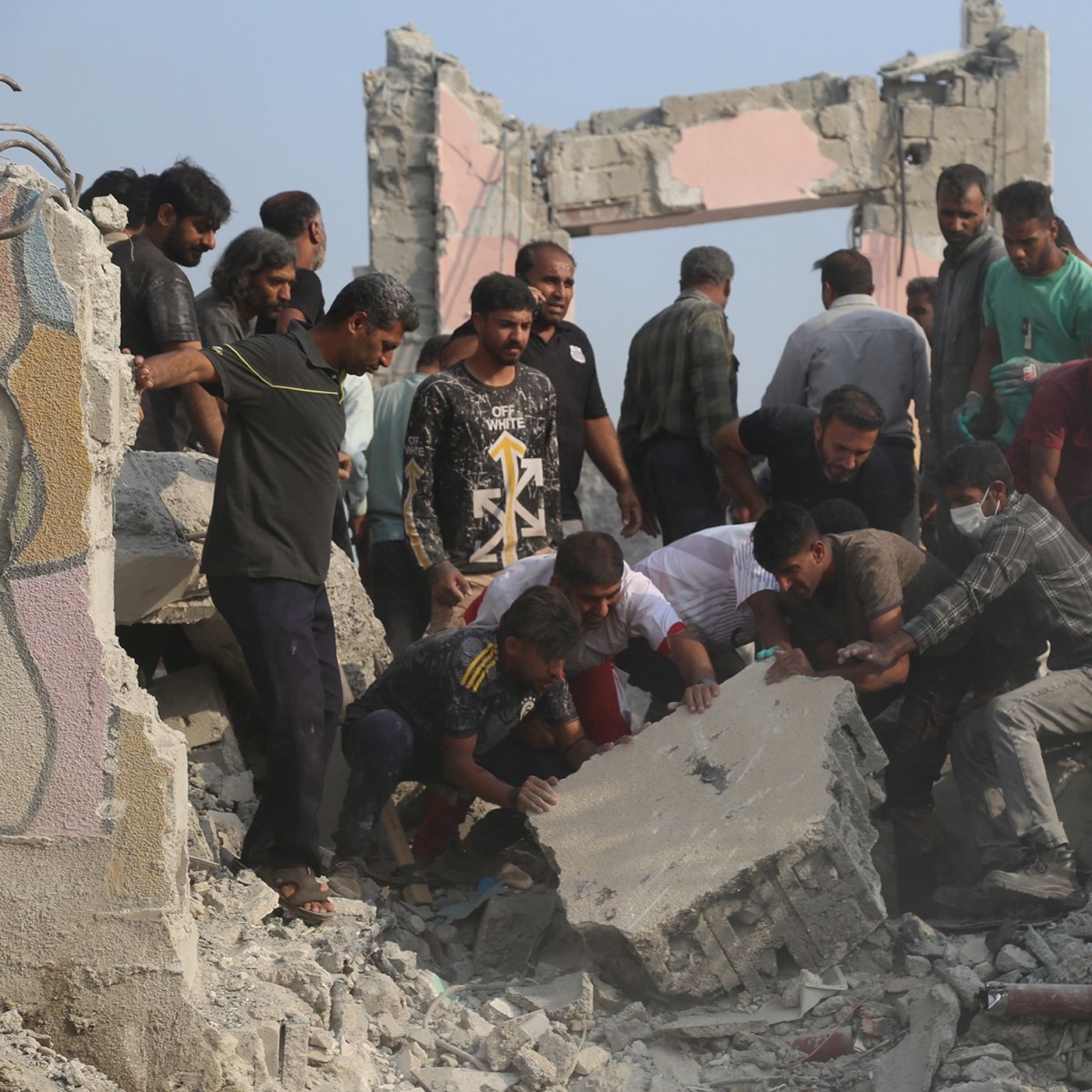
The Daily
The U.S. Errors That Led to the Airstrike on an Elementary School
00:30:46
A continuing military investigation has determined that the United States is responsible for a strike that hit an elementary school in Iran, according to U.S. officials and others familiar with the preliminary findings. Iranian officials have said the death toll was at least 175 people, most of them children. Malachy Browne and Julian E. Barnes, who have been covering the strike, discuss what probably led to one of the most devastating military errors in decades.
Loading summary
Transcript83 lines
- [00:00]
A
This podcast is supported by Edison Electric Institute. Behind every moment, there's a team working to make it happen. Deepening connections, strengthening the energy grid, and preparing for tomorrow. We are America's electric companies and our commitment is simple. Provide energy as affordably as possible, build a stronger tomorrow, and deliver for the people who depend on us, America's electric companies, the energy of every day. From the New York Times, I'm Michael Balbaro. This is the Daily. On Wednesday, American officials conceded what's become increasingly clear from investigative reporting by the Times that the United States military was responsible for the airstrike that destroyed an elementary school in Iran, killing at least 175 people, most of them small children. Today, my colleagues Maliki Brown and Julian Barnes on what led to one of the most devastating military errors in decades. It's Thursday, march 12, Malachi. It feels like in a very real sense, you were among the first people in the world, perhaps outside the military, to understand that this devastating airstrike was likely carried out by the United States, a determination that has now been confirmed preliminarily by an American military investigation.
- [01:53]
B
Well, Michael, I'm not sure about that, but we suspected that something went terribly wrong as soon as we started looking at it.
- [02:00]
A
Well, now that this is no longer a suspicion, but something that feels so more or less firm, I want to go back to when this all happened, because the timing of it is important. It happened around the same moment that the US And Israel killed Iran's supreme leader, and all the world's eyes were on that. And this other airstrike was more or less in parallel, but getting a lot less attention at first. But once we all realized what had happened, it was shocking. This was a elementary school blown up by a missile and 175 civilians, mostly children, were killed. So I just want to talk for a moment about the scale of this.
- [02:48]
B
Yes, it has devastated Minab, the town where this school was located. Saturday morning is the start of the week and the school week in Iran. So school was in session. The teachers union there said that over 260 students were in the school at the time. And most of these kids are age 7 to 12. And according to health officials and the local governor there, most of them were killed in the strike along with teachers. And it really is absolutely horrific what has happened.
- [03:24]
A
Right. It's kind of hard to fathom just how many lives were affected by this. It's just an enormous tragedy.
- [03:34]
B
It's absolutely hard to understand and to put yourself in their position. I mean, Manab is a Small town in southern Iran. This has affected the entire community there. Obviously the direct relatives. But just the pictures coming out of there of the streets thronged for the funerals of these children and their teachers are really heartbreaking. You know, there are pictures of mothers throwing themselves over the open coffins of their children as they're saying goodbye to them, scores of coffins brought on a procession through the streets. You know, people throwing rose petals at them, showering them with sweets. There were thousands of people out there. And of course, that aerial photograph that many listeners may have seen of the freshly dug graves, a hundred of them in a plot in a cemetery just five miles away from the school, it kind of spoke to the scale of the loss for the community there. And whatever happened here, it was clearly one of the most devastating incidents in an American war in decades.
- [04:36]
A
Which is why you and a team of people on the Visual Investigations desk here in our newsroom set about trying to get to the bottom of what happened and why it happened and who was responsible. Can you talk us through what you did from the very beginning to figure that out?
- [04:57]
B
Well, the incident was flagged to us by our colleagues on International. There was a video circulating showing the immediate aftermath of the school building reportedly struck and people rummaging through the rubble outside, smoke billowing from it. So the first challenge was to verify that the building that we were seeing in videos of the aftermath of the strike was in fact a school. And then where it is in the video, you can see bright pastel colored walls with paintings drawn by children. Other images were taken from the inside of the building that showed classroom settings and also colorful drawings. So it looked like a school from the outset. And then secondly, where is it? We're not in Manab and I never have been there.
- [05:43]
A
You're in fact in Ireland?
- [05:45]
B
Yeah, I'm outside Limerick in Ireland. But we've access to satellite imagery, recent satellite imagery of Manab. And I'm able to look around the area and see, you know, find schools that are identified in Google Earth and whatnot. This one actually wasn't marked on Google Earth, but we had heard that it was near a military base. And so by finding the military base, we were able to identify a building and then compare the contours of that building, the size of it, the trees around it, with what we were seeing in the video. And the video was clearly taken at that location and showed the school. And then in the satellite imagery, there were all other details that suggested to us that this was a school. You could see a hopscotch area, other play areas marked in the asphalt there. There's a sports field beside it. And I suppose one of the things was that one of the most striking things for us was that around the school, amid the rubble, you could see school books and small little school bags and backpacks and bright shoes of children who attended the school, and then parents rifling through these books to see if it belonged to their loved one.
- [06:56]
A
Well, from the images that you're describing, it's quite obviously a school with children actively attending it. And so, in theory, that should be obvious to whoever struck it. And the question is, why wasn't it obvious? Why was it hit and who did it?
- [07:12]
B
That's right. Well, we were also able to determine that it was located beside a naval base of the Islamic Revolutionary Guard Corps, which is Iran's most powerful military, and it was once a part of it. We could see in historic satellite imagery that back in 2013, the building that the school was in was once encompassed within that broader rectangular military base. Yeah, and then by 2016, it was walled off. The area was cleared, watchtowers were removed, public entrances were opened into it, and the ground was cleared for playing areas. It was painted all these bright colors, so it had become, you know, it looked like a school and definitely was used for civilian purposes, but it was sitting right beside a military site, and they were being targeted in these early hours of the war on Iran.
- [08:05]
A
So knowing that at this point, you're still very early on in your investigation, what does this suggest exactly to you? The fact that 10 years ago it was part of an IRGC military complex.
- [08:19]
B
It suggested that this might be a massive intelligence failure, and somebody identified a school as being a legitimate military target. Because we could see from other videos that we also verified that buildings inside in the base had been hit. And by timelining out all of those reports, we knew that the school and the base were hit around the same time. So it looked like that opening wave of attacks mistakenly hit the school alongside the military targets in the base.
- [08:47]
A
Just to get this out of the way, did anything suggest that even if this has been a school for the past 10 years, that the IRGC was using any part of the building as a military facility?
- [09:02]
B
No, there was no evidence of any military function in that school compound.
- [09:08]
A
So then how do you go about determining which one of the combatants in this conflict strikes this quite clearly? School? Because it feels like there's two obvious candidates, the United States or Israel. But of course, I'm guessing you can't entirely discount the possibility because this has happened in previous Middle Eastern conflicts and all conflicts, that perhaps Iran itself may have misfired and been responsible for this.
- [09:35]
B
Absolutely, that was a possibility in the early stages of the investigation. And part of it was trying to identify what was hit in the base, how it was hit, were these precise strikes, were there craters littering the base? We couldn't look inside it, and it's not open to the public. And so there were no videos emerging from there, but we have access to satellite imagery providers. And so we ordered a high resolution image that would give us a look inside the basin and see what damage was wrought and how.
- [10:08]
A
And what did that reveal?
- [10:10]
B
So it showed that several buildings had been destroyed very tidily by precise strikes. And you could even see that there were holes punched through right the centre of these large warehouses and buildings inside in the military base. And the school also was hit. You could see that more than half of it had been destroyed. There was a wide, gaping hole, almost circular in shape. And so that indicated that these buildings were hit with precision guided missiles. And that's characteristic of Israeli and US capabilities, but it's also characteristic of intelligence planning to take out infrastructure ahead of time in these early strikes hitting the country.
- [10:55]
A
Got it. So this was not accidental based on what you're seeing at that point, and probably not a byproduct of some other strike. It's not a case, it seems, of shrapnel from one strike hitting the school, based on what you just described. And so it feels like Iran, in your mind, is being taken out of the category of likely candidate. And so now you're left with Israel and the us. So how do you figure out which of those two are responsible?
- [11:24]
B
Ask them questions. A spokesperson for the Israel Defense Forces said the day afterwards, on the Sunday that they weren't operating in the area at that time. And my colleague Aaron Boxerman questioned U.S. central Command and they said their investigation was ongoing. So we didn't get much information from them, however, on Wednesday of last week.
- [11:47]
A
And with that I turn it over to the Chairman.
- [11:49]
B
Thank you, Mr. Secretary, and good morning, everyone. There was a press conference with Secretary Pete Hegseth and General Dan Kaine, the Joint Chiefs Chairman.
- [11:58]
A
Let me flip to the map here.
- [12:00]
B
And General Kaine held up a map showing the US and Israeli operations in the first 100 hours of the conflict. And using a laser pointer, he swung by the south of Iran. And he said the US was primarily striking targets in the south.
- [12:17]
C
Ballistic missile capabilities as well as integrated
- [12:20]
B
air defense capabilities along the southern axis. Along the northern axis, Israel and the Israeli Air Force has predominantly been working. And Israel was operating in the north and the west. And even on that map, there was a strike location. And that strike location is in the area around Manab. So from what Israeli officials were saying and what General Dan Kaine was saying, and based on the type of weaponry used, the evidence was pointing more and more towards a US Strike.
- [12:49]
A
Right, because the school is in the south of Iran.
- [12:52]
B
That's right, Michael. And then we obtained this really critical piece of video evidence. It was filmed across the street from the naval base at a construction site. And it shows a missile coming in, not hitting the school, but hitting the base. And in the milliseconds before impact, you can see the silhouette of the weapon against the blue sky, which opens the possibility of identifying what type of weapon this is. Now, Trevor Ball, who's a weapons expert with the research group Bellingcat, he identified it as a Tomahawk missile. And we also did. We spoke to other weapons experts, and my colleague John Ismay, who himself is a weapons expert, analyzed it. And based on the dimensions and the design of it, it was clearly a Tomahawk cruise missile. And that's significant because the only party in this war with Tomahawks is the United States. And so the evidence is really pointing towards US Culpability.
- [13:50]
A
Right. Missile strike in a Tomahawk missile likely destroyed that Iranian girls school. So will the Americans, will the US Accept any responsibility? Well, I haven't seen it.
- [14:00]
B
And then at a news conference on Monday, President Trump posited the idea that Iran fired the Tomahawk is used by,
- [14:07]
A
you know, is sold and used by other countries. You know that. And whether it's Iran who also has some Tomahawks, I wish they had more. Once again, despite all the information we
- [14:18]
B
have, yeah, we don't know where he's getting his information from. And our colleague Sean McCreesh, who covers the White House for the Times, is there and asks President Trump, you just
- [14:28]
C
suggested that Iran somehow got its hands on a Tomahawk and bombed its own
- [14:32]
A
elementary school on the first day of the war. But you're the only person in your government saying this. Even your defense secretary wouldn't say that
- [14:38]
B
when he was asked, standing over your shoulder on your plane on Saturday.
- [14:42]
A
Why are you the only person saying this? Because I just don't know enough about it.
- [14:45]
B
I think it's something that I was told is under investigation. And President Trump says, well, we're waiting for the results of an investigation. And if the investigation finds that it's us, I'm willing to live with that.
- [14:57]
C
But I will certainly whatever the report shows, I'm willing to live with that report.
- [15:02]
A
Which is in a couple of days, precisely what starts to happen.
- [15:07]
B
Correct. Officials that our colleagues in Washington, D.C. spoke to who are close to the investigation say that the preliminary findings find that the US Is responsible for the school strike.
- [15:35]
A
Well, Maliki, thank you very much. We appreciate it.
- [15:38]
B
Thanks, Michael.
- [15:43]
A
After the break, my colleague Julian Barnes on exactly what the US Government investigation has found. We'll be right back. Support for this podcast comes from GoodRx. Tired of paying too much for prescriptions? GoodRx can help you take control of your health and your budget. GoodRx lets you compare prescription prices at over 70,000 pharmacies and instantly find discounts up to 80% plus access telehealth and wellness tips all in one place. GoodRx is not insurance, but even if you have Insurance or Medicare, GoodRx may beat your co pay. Save time and money on prescriptions. Go to goodrx.com thedaily so we're breaking up.
- [16:38]
B
Why?
- [16:38]
A
You're a great fitness app, but I've forgotten about you. What's your name again? All pain, some gain. $9 a month right with my new big financial friend. Excuse me, Experian. I can see my subscriptions right in the app and cancel all the ones I don't use anymore but still pay for like you.
- [16:54]
B
Wow.
- [16:54]
A
So goodbye. More like good savings. Cha Ching. Get started with the Experian app now. Results will vary. Not all subscriptions eligible. Savings not guaranteed Paid membership with connected payment account required. See experian.com for details. Experian in 10 minutes or less, the Opinions podcast brings you a fresh way to understand the news with voices from New York Times Opinion. I've got a break for you. I'm actually going to tell you some good news news today. One idea, one analysis, one perspective at a time. Featuring David Brooks, Tressy McMillan Cottam, Michelle Goldberg, Thomas Friedman and many more.
- [17:31]
B
Find the opinions in your podcast player.
- [17:39]
A
Julian, you and a team of our colleagues at the Times broke the story on Wednesday morning that a preliminary investigation by the US Government has determined that the United States military was responsible for the airstrike on this elementary school that we have been talking about with Maliki. So tell us what you've come to understand about that investigation.
- [18:03]
C
Well, what we've learned is that the US Officials who have been looking into this have come to the conclusion that the US Was responsible for the military took old information and used it to make the targets on the day of the strike. And they did not update the data, they did not verify it, and realize what we've all come to know now, that this became a school a decade or more ago.
- [18:37]
A
Right. And 10 years is a very long time ago. So you're suggesting that whether it was maps or coordinates, what exactly was it that they were using that was this outdated?
- [18:50]
C
So the Defense Intelligence Agency is one of the agencies that gathers information and they do it from maps and they do it from other pieces of data. And they, they put it into a big database that they will push forward
- [19:06]
A
as basically a target list.
- [19:08]
C
As a target list or what? You will draw your target list. Right. Making a target is a complicated process. And that's the next stage of the military investigation to figure out, did the verification not take place, did it fail to reveal the truth? Where did that process break down? Because there's old data that's entered all the time and there are safety nets that are meant to catch it, but they didn't catch it in this place.
- [19:38]
A
I do think we should linger for a moment on how seemingly straightforward verification would have been. And I say that because our colleague Maliki used commercially available satellite photos to determine that this was a school. And that's not to mention the fact that the US has drones and planes capable of monitoring a place like a school from very far away and determining even if the original data was 10 years old, who's coming in and out of a building. And that work might not have taken very long. And so it gets hard to understand how the US military could only be reliant on 10 year old data without doing any of the very simple forms of follow up that would have shown that it was out of date.
- [20:33]
C
The system for picking targets and verifying targets is, is very complex. There is supposed to be a double check, there is supposed to be a triple check. You get data from the Defense Intelligence Agency, you cross check it with satellite imagery from the National Geospatial Intelligence Agency, the people who look at the satellite pictures. You have all kinds of computer programs that are supposed to help you, the analyst do this. You have AI that's supposed to review it, you have your own expertise. And then the intelligence officer is supposed to take it and then give it to the operations officer, who is hopefully doing a last check that it is what they say it is. There are levels built into the system that are supposed to catch this. But we are in an era when they want the military to move fast. They want the military to be willing to break things and the system of checks broke down. We do not fully know how and when, but the bottom line is 10 year old data was used and it resulted in a catastrophe.
- [21:47]
A
I want to zero in on something you said, cuz it does feel important. We now have a defense secretary in Pete Hegseth who routinely talks about how cumbersome old processes were, is dismissive of the old rules and very focused on lethality. I mean, he literally said no more rules of engagement. So is there an understanding, and perhaps at this point it's an assumption rather than a determination that that ethos played a role here?
- [22:20]
C
So this is the question I am asking. This is the question my colleagues are asking. It's the obvious question. Secretary of Defense Pete Hegseth has been saying that these rules are too cumbersome, that they make a weak woke military. Right. So this is the environment that the US Military is operating in. That said, we do not have reporting that the elimination of the civilian casualty rules played a part here.
- [22:52]
B
Right.
- [22:53]
A
I'm curious, Julian, what you think, based on your many years covering these kinds of incidents, what accountability might look like in a case like this. Do you think that it's likely anyone will be fired for this? Will there be any effort to hold individuals or an entire chain of command responsible? Will there be any effort to compensate the families of those killed? I mean, compensation's a very inadequate word given that we're talking about small children who were killed. But what do you think happens as a result of this?
- [23:27]
C
In a different administration, this would have been handled in the complete opposite way. We would be having a president not blaming the opponent. We would not have a president rushing to judgment. And then you'd have the US looking to potentially make an apology, potentially to do compensation to the families. In Afghanistan, there was regular compensation when civilians were wrongly targeted or when there was a civilian casualty in an otherwise correct military operation. But this is a very different administration. They do not like to apologize. This is not the kind of thing that gets you fired. On the other hand, we still have a professional military. They operate under ethos, they do investigations. And so there will be a measure of lessons learned, accountability. The military will try to prevent this from happening again.
- [24:34]
A
What we know is that President Trump, in response to a question from our colleague Sean McCreesh, said that he would go along with the findings of this investigation. And so I'm curious what, if anything, he or the White House has said about what you have all learned this investigation preliminarily has found.
- [24:52]
C
Well, Carolyn, Levitt, the press secretary, in her statement to us, you know, emphasized that these are preliminary findings. But later in the day,
- [25:07]
A
and as
- [25:08]
C
you know, as President Trump was walking to Marine One, he stopped to talk to the reporters there, and one of them shouted out a question about our story.
- [25:22]
A
A new report says that the military investigation has found that the United States struck his pool in Iran. As commander in chief, you take responsibility for that.
- [25:31]
C
That is what you could see him take a step back, I don't know about it. And then he said, I don't know about that. It was a kind of a distancing from the story. So I don't know if we can expect Donald Trump to engage with these findings or the final military investigation. It is an uncomfortable subject. It is not the kind of example of winning that he wants to talk about.
- [26:00]
A
Julian, you had mentioned a few moments ago Afghanistan. And the reality is that what happened here, the idea that the US Would make a mistake and that it would kill civilians, it's not a new phenomenon. We talk about it a lot on the show. War right now, as the United States largely conducts it, is from the air, and it's through drones or warships firing missiles from very far away, which is what we think happened in the case of this school. And the idea is that it insulates American soldiers from harm that would come from being on the ground. But the risks are now very plain. And we somewhat regularly as a military kill civilians because we aren't close enough to the targets to understand who's there. That was especially true a few years back, and we did an episode about it when the US Military killed a man in Afghanistan who we believed was a suspect of an attack, when in fact he was an aid worker. And we killed nine members of his family, including his seven children. Is this form of modern American warfare just gonna be far more error prone?
- [27:14]
C
No matter what war you're in, there are going to be errors. There are gonna be human errors. There are gonna be machine errors. You can't get away from mistakes in warfare. But what you say is true, right? If this was a different kind of war, we would have had a spotter on the ground. They are that ultimate check. And that person would have said, wait, there are school children here, There are playgrounds here. This is not the right target. And when you are at a remove hundreds of miles away, firing Tomahawk missiles, making orders from half a world away in Tampa, Florida, like you are at a remove from the battlefield, and that does create an opportunity for these kind
- [28:05]
A
of errors just to end Our conversation here, Julian, it is very hard to say what will ultimately define any war. And we are now a week and a half into this one. A lot could happen, but it feels like a mistake of this magnitude with the death of so many innocent children, feels like it will be remembered on all sides as a signature moment of this war. How do you think that this mistake, this tragedy, this killing of all of these children at this elementary school in the early hours of this war is gonna be remembered?
- [28:49]
C
When you think about this war, you know that no matter what policy goals are achieved in this war, the death of the supreme leader, the weakening of the Iranian regime, or the elimination potentially of its nuclear program, whatever is to come, this war is still going to be remembered, defined by this mistake as well. It's too big an error. It's too big a tragedy. And if we think back on other American wars, we do think of the things that go wrong, right? If we go back to Vietnam, we think of the. We think of the use of napalm that killed children. If we go to the Iraq war, we think of Abu Ghraib and the abuse of prisoners there, we think of that terrible military mistake and the consequences it had. And no matter what is to come in this war in Iran, the killing of the school children, the mistaken targeting of a school by the US Military is going to color how we look at it.
- [30:23]
A
Well, Julian, I appreciate your time. Thank you.
- [30:26]
C
Thank you.
- [30:33]
A
We'll be right back.
- [30:38]
B
Hi, I'm Ivan Penn. I'm an energy reporter for the New York Times. I think a lot of people take electricity for granted, but it's an essential piece of some of the biggest stories right now. The rise of artificial intelligence, the threat of climate change, and the real challenges that everyday people are facing with increasing electricity bills. I spend my days talking to experts, sometimes traveling to really remote places and investigating the role that energy plays in these huge issues. I'm just one of hundreds and hundreds of journalists at the Times, experts in what they cover, who carry the same level of commitment to their reporting. And that's the beauty of the New York Times. We're all working together to help you better understand and make sense of the. The world today. So if that sounds like something that connects with you and you're not a subscriber yet, you can go to nytimes.com subscribe
- [31:34]
A
here's what else you need to know.
- [31:37]
C
Today,
- [31:40]
A
on the 12th day of the war, Israel's bombardment of Lebanon intensified Israel's attacks aimed at Hezbollah, which has fired rockets into Israel in support of Iran has killed more than 600 people and displaced more than 800,000, according to Lebanese officials in Iran. The Times reports that the country's new supreme leader, Mujtaba Khamenei, has yet to make a public appearance, in part because he was wounded during the opening days of attacks by the US And Israel. Meanwhile, with the Strait of Hormuz still closed to most shipping, oil prices rose again on Wednesday. That was despite a pledge by the 32 countries of the International Energy Agency to release 400 million barrels of oil from their strategic reserve. It was the largest release in the agency's history. It was the latest economic disruption from the war. On Wednesday, Iran struck three commercial ships around the Strait of Hormuz, and several major banks, including Citi and hsbc, said they would temporarily close their offices in the Persian Gulf out of fear for the safety of their workers. Today's episode was produced by Shannon Lynn and Michael Simon Johnson. It was edited by Patricia Willins and Paige Cowett. Contains music by Rowan Evisto and Sophia Landman. Our theme music is by Wonderly. This episode was engineered by Alyssa Mox. That's it for the Daily I'm Michael Balboro. See you tomorrow.
- [33:41]
B
Amazon presents Jamal vs. The Shih Tzu Descending from the Gray Wolf.
- [33:48]
C
Shih Tzus live by their own untamed primal code of not giving a single Shih Tzu.
- [33:55]
B
But Jamal shopped on Amazon and bought dog treats, chew toys and 32 ounces of carpet cleaner. Hey Jamal, you've been promoted to pack leader. Save the everyday with Amazon.