← The Daily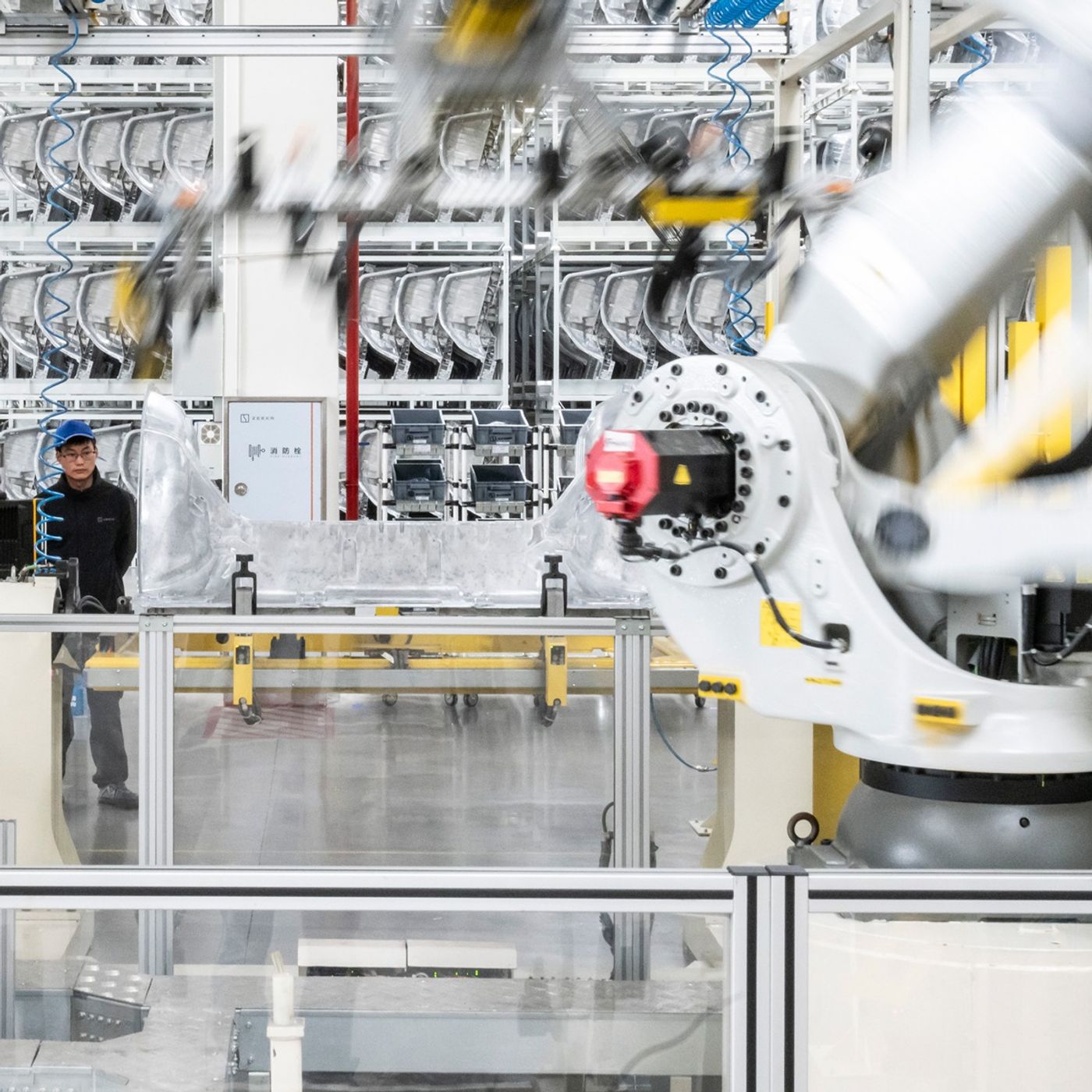
The Daily
How China Made Itself Tariff-Proof
00:31:36
About a year into President Trump’s global trade war, China hasn’t just survived. It has emerged stronger than ever on the world stage. Keith Bradsher, the Beijing bureau chief for The New York Times, discusses the domination of China’s robot-powered superfactories and how the country essentially made itself tariff-proof.
Loading summary
Transcript85 lines
- [00:02]
Natalie Kitroeff
Welcome back to your wallet.
- [00:04]
Experian Advertiser
Just fainted. The next challenge, dialing for discounts. Enough is enough. Don't lose another second. Save time by letting Experian negotiate rates on your bills. The best part, you keep 100% of your savings. That sound you hear? It's your old Internet bill finally admitting defeat. Get started in the Experian app and see how much you could save. Results will vary. Not all bills eligible savings not guaranteed available with eligible paid memberships.
- [00:30]
Sponsor/Advertisement Voice
See experian.com for details.
- [00:31]
Experian Advertiser
Experian
- [00:35]
Natalie Kitroeff
from the New York Times, I'm Natalie Kitroweff. This is the Daily. About a year into Trump's global trade war, China hasn't just survived, it's emerged stronger than ever on the world stage. And that's because after years of careful planning, China has essentially made itself a tariff proof. Today, my colleague Keith Bradshaw explains how despite Trump's best efforts, China's robot powered super factories are taking over the world. It's Tuesday, march 24th. Keith, it's been about one year of tariffs on China, one year of, I think it's fair to say, economic war on China, a crazy year, honestly, which was capped off by a Supreme Court ruling saying many of these tariffs were illegal. And what we're here to do today is figure out what did the last year amount to. And you are here because you've been covering trade for approximately 1 billion years, is that right?
- [01:59]
Keith Bradshaw
Since 1991? Yes. Thank you.
- [02:02]
Natalie Kitroeff
Okay. Close to a billion. And so what we want is for you to help us understand what these tariffs have wrought when it comes to China.
- [02:12]
Keith Bradshaw
These tariffs are changing China's trade in important ways, but not nearly as much as the Trump administration expected. Yes, China, China's not shipping as much to the United States as it was before, but China's also not buying as much from the United States as it was before. The overall trade surplus of China, how much its exports exceed how much it's buying from the rest of the world, is still growing. It became even more immense last year when it reached $1.2 trillion.
- [02:48]
Natalie Kitroeff
1.2 trillion. Just put that in context. How big of a deal is that?
- [02:53]
Keith Bradshaw
1.2 trillion is bigger than the economies of most of the countries in the world. And what was particularly striking about it was that the trade surplus for China in manufactured goods, which create a lot of jobs, a lot of high skilled, well paid jobs, that trade surplus was even bigger. China's truly become the factory of the world, the dominant producer of everything from basic materials like steel and chemicals all the way through electric Cars and solar panels.
- [03:28]
Natalie Kitroeff
The upshot of what you're saying, Keith, is that the most aggressive tariffs against China in decades didn't really stop China from dominating in manufacturing. Why? What explains that?
- [03:46]
Keith Bradshaw
There are four reasons. One, China ramped up its sales in a hurry to other markets, not just in Asia, but in Africa, Latin America, and in Europe. Second, China ramped up sales of goods that are indirectly reaching the United States, like exporting the parts of a vacuum cleaner or some other system that then gets assembled in another country and then shipped into the United States. So a lot of indirect shipments to the United States through other countries. Third, China has managed to weaken its currency a lot. That makes China's goods much cheaper in foreign markets. And it makes foreign goods, like American goods or European goods very expensive in China. But the last reason, and in some ways the most important reason why China is producing such enormous trade surpluses is that it is years ahead. Right now in advanced manufacturing. Pretty much anything can be made less expensively in China than anywhere else. They're not just least expensive place to make clothing or furniture now. They're the least expensive place to make cars, batteries, all these other technologies. And a big part of that is because they're making them in very advanced factories with more robots than anyone else in the world.
- [05:16]
Natalie Kitroeff
Okay, just to spell this out, you're saying because China's factories are just so automated, the country's able to produce a ton of stuff, even advanced products, extremely cheaply. So cheaply that China has become almost immune to Trump's tariffs.
- [05:34]
Keith Bradshaw
They're not completely immune, but they are a lot more resistant than anyone else expected.
- [05:41]
Natalie Kitroeff
Okay, so I want to understand, what exactly does that automation inside China's factories look like?
- [05:50]
Keith Bradshaw
Let me tell you about a car factory I visited some months ago in eastern China. The very start of the process is making the car body components, which used to be made mostly out of steel. This was making it out of aluminum, which is lighter weight, works better with an electric car. It's much harder to do. But they were doing it in a more advanced way than you see practically anywhere else. There were robotic sleds carrying bars of aluminum to an automated elevator. Up, up, up, up to the top of a machine the size of a McMansion in the United States.
- [06:32]
Natalie Kitroeff
Wow.
- [06:32]
Keith Bradshaw
I mean, this piece of apparatus was enormous. And the elevator automatically dumps the alumina ingots in a furnace, and that furnace turns them into molten aluminum that is then poured into precisely the shapes of the various car body components that are needed. And then those car parts are taken still by human drivers with forklifts, Although that will be automated at some point as well into a very large warehouse from which they then feed the assembly line. The assembly line is 820 robots. It's a so called dark factory.
- [07:13]
Natalie Kitroeff
Dark factory because humans aren't involved and robots don't need light to function.
- [07:19]
Keith Bradshaw
That's exactly right. You can turn out the lights. They keep making whatever they're making and they are assembling all these components into the skeleton of the car. Now some of that you find elsewhere in other car factories elsewhere in the world. But the integration of everything is very impressive. It was also using artificial intelligence. Cameras were taking lots of pictures of the finished car and comparing them in detail to a database of other cars that were viewed as very well put together and identifying if there were any flaws that needed to be corrected.
- [07:58]
Natalie Kitroeff
So AI is doing quality control in
- [08:00]
Keith Bradshaw
this case, AI is doing quality control. AI is involved in tracking practically every step in the process. What you're seeing in China more than any other country is the adaptation of of AI to manufacturing.
- [08:17]
Natalie Kitroeff
And how does that compare to what you see in the rest of the world, to the rest of the world's factories?
- [08:23]
Keith Bradshaw
So other countries are no longer as automated. In fact, Germany, Japan, the United States now have factories that are less automated, that have fewer robots than China. China now has a a higher number of robots for every 10,000 manufacturing workers than any of those three countries. China also is installing more factory robots each year now than the entire rest of the world combined.
- [08:55]
Natalie Kitroeff
How did China get to the point where it is more advanced at manufacturing than the US Than Germany, than Japan? These are countries that were all known at one point for being manufacturing titans, for specializing in this. How did China get here?
- [09:11]
Keith Bradshaw
The rise of advanced manufacturing in China is a remarkable story. It's not just an economic story, it's also an education story. It's a culture story, It's a demographic story. You have to go back to the mid 2010s. China had really already emerged as the world's number one manufacturing power. But that wasn't all they wanted to do. They didn't want to just be the manufacturing power that made the most things, they wanted to make the best things, the most advanced technology products. At the same time, though, the supply
- [09:51]
Natalie Kitroeff
of young Chinese workers has peaked and is rapidly dropping thanks to stringent family planning policies.
- [09:58]
Keith Bradshaw
China was starting to realize that its so called one child policy had produced an unintended result.
- [10:07]
Sponsor/Advertisement Voice
The policy significantly reduced birth rates, especially in rural areas. The source from which the Bulk of China's floating labor population comes.
- [10:16]
Keith Bradshaw
China had been restricting families from having more than one child for several decades by then, and the policy had gone too far. The birth rate was collapsing.
- [10:28]
Sponsor/Advertisement Voice
As Americans struggle with pink slips, Chinese factories are putting up red signs seeking workers.
- [10:35]
Natalie Kitroeff
Right now, there are just too many factories looking for laborers. This recruiter says the pressure is on to fill spots.
- [10:42]
Keith Bradshaw
So much of a drop, they began worrying, are we going to have enough young people coming into the workforce? And so that put a lot of pressure on China to find ways to get the same work done, particularly at the factories, without having nearly remotely as many workers. With fewer young people available for work, there are concerns the country may not be able to sustain the fast economic growth that has transformed China into the world's second largest economy after the United States. In the United States, immigration has offset a falling birth rate. But China allows almost no immigration whatsoever. In the US it's over a million green cards a year. In China, it's several thousand ten year residency cards, which isn't even a full green card. It's just 10 years. In a vast country, China has fewer foreigners per capita living in it than even North Korea.
- [11:44]
Natalie Kitroeff
Essentially what you're saying is without immigration and with a rapidly falling birth rate, China just doesn't have enough bodies to sustain itself as the world's factory, especially as their ambitions are growing.
- [11:58]
Keith Bradshaw
China doesn't have enough workers unless it does an extraordinary amount of automation. Because this is not just about a declining number of workers. This is also about fewer and fewer workers who are willing to work on an assembly line.
- [12:15]
Natalie Kitroeff
And why, why don't people want these jobs?
- [12:18]
Keith Bradshaw
People don't want these jobs because they are much, much better educated than the previous generation. With the one child policy, couples put everything they had into making sure that child has the best possible education. Families like one that I know in northwestern China, the father is an illiterate coal miner working for almost nothing in illegal coal mines. The mother, also illiterate, works as a checkout clerk in a corner store. But they put everything into training their daughter. And when I first started going every two years to meet that family in 2006, I noticed in seventh grade she was already doing algebra. That was ahead of of the algebra in many American schools. And here she was in a tiny village going to a school for the children of the illiterate. And she did go off to college. And so the result is a nation of not just high school graduates, but now more than half the young people are college graduates as well. And the last thing they want to do is a rote job on a factory floor, doing the same assembly day after day. There's also a Confucian tradition that working with your hand is somehow inferior to other forms of work, such as writing. That tradition has made many families reluctant to see their only child take a factory job, and often their only child shares that reluctance. So while the manufacturing sector is still growing, is still producing a vast cornucopia of goods, there is a mismatch between these vast, numerous factories and a labor force of only children who went to college and are often wary of factory work. The result, as the 2010s unfolded, was a real anxiety among business leaders and government leaders. Where were the factory workers of tomorrow going to come from? And their response was to create a very ambitious program to automate the nation's factories.
- [14:42]
Natalie Kitroeff
We'll be right back.
- [14:47]
Sponsor/Advertisement Voice
This podcast is supported by E Trade from Morgan Stanley. Now that E Trade is part of Morgan Stanley, there's even more to love. Get the freedom to invest on your own with $0 commissions on stocks, options, ETFs and mutual funds, plus account types for every investor. And when you're ready, speak with a pro to help guide you on your financial journey. Discover more ways to make the most of your money and get up to $1,000 when you open a brokerage account with a qualifying deposit today. Learn more@etrade.com offer terms and other fees apply. Investing involves risks. Morgan Stanley Smith Barney LLC Member SIPC E Trade is a business of Morgan Stanley.
- [15:21]
Not every sale happens at the register before AT&T business Wireless. Checking out customers on our mobile POS systems took too long. Basically a staring contest where everyone loses. It's crazy what people will say during an awkward silence. Now transactions are done before the silence takes hold. That means I can focus on the task at hand and make an extra sale or two. Sometimes I do miss the bonding time.
- [15:45]
Sometimes AT&T business Wireless Connecting changes everything
- [15:52]
Savor mornings with Nespresso Virtuo up and make your coffee ritual irresistible with the Nespresso Coffee plus range. With added ingredients, it's easier than ever to brew coffee coffee your way over ice or milk at the click of a button Shop now exclusively@nespresso.com
- [16:08]
Natalie Kitroeff
okay Keith, so what exactly does China do? How did China become, I think it's fair to say, the automation capital of the world.
- [16:17]
Keith Bradshaw
China had a plan for this. China's big on plans. It's a country that still does five year plans. And what happened in 2015 was they did a 10 year plan for good measurements. And that was called Made in China 2025. To make China globally competitive in 10 major sectors, whether it was semiconductors, electric cars, advanced materials like rare earth magnets. Perhaps most important, China decided it really wanted to move ahead in robotics.
- [16:50]
Natalie Kitroeff
And why was there such an emphasis on robotics? Just explain that to me.
- [16:55]
Keith Bradshaw
China doesn't want only to be the country that makes advanced products. China also wants to be the country that makes all the equipment to produce advanced products. And the equipment, whether it's for semiconductors, whether it's for electric cars, whether it's for solar panels, the equipment for all of these categories involves a lot of automation. And so China put the investments into doing the robotics, the factory automation needed to manufacture those advanced products.
- [17:30]
Natalie Kitroeff
So they're not just investing in building EVs or building planes or semiconductors. They're investing in building factories and the equipment and the technology that you need to build all these other things like building advanced factories was an end in and of itself. And robotics, you're saying was essential to that, that.
- [17:54]
Keith Bradshaw
That's exactly right. They are really trying to make sure that the whole supply chain of advanced manufacturing happens in China. It's not enough for them to take delivery of the latest factory equipment from the West. Now they want to be making all of the latest factory equipment themselves and all of the latest automation themselves.
- [18:19]
Natalie Kitroeff
And so how did China execute this Made in China plan?
- [18:24]
Keith Bradshaw
They threw money at these projects in incredible sums. Hundreds of billions of dollars in government investment funds going into many different tech startups in all kinds of areas.
- [18:37]
Experian Advertiser
Well, China has been on a worldwide buying spree, as we all know, announcing an unprecedented $207 billion worth of mergers and acquisitions this year.
- [18:47]
Keith Bradshaw
And a crucial step in China's advances in the latest manufacturing came at the start of 2017.
- [18:55]
Experian Advertiser
Some breaking news coming through on the Chinese attempts to buy Kuka. Kuka says that the US has given a green light to the takeover by midday. This is, of course, the Chinese company that wants to buy the robotics firm.
- [19:05]
Keith Bradshaw
A Chinese company was allowed by the United States and Germany to buy Kuka, a German company that in many ways led the world in making factory robots. People didn't realize at the time how important this was.
- [19:20]
Sponsor/Advertisement Voice
If you want an example of a company that's moving up the food chain here in China from low value manufacturing to high end manufacturing, innovation, robotics. And really Midea is the one to watch. It bought Kuka, the German robot maker, about a year ago.
- [19:35]
Keith Bradshaw
I've been going to car factories all over the world for 30 years, Kuka robots are everywhere in those factories. And since the start of 2017, all of a sudden, that know how that manufacturing capability shifted to China. Today, many, many, many Kuka robots are made in Shanghai. And the knowledge associated with that, not just of how to build robots, but everything the robots build, like cars, has moved to Shanghai and to the rest of China as well.
- [20:10]
Natalie Kitroeff
They essentially just imported that expertise wholesale.
- [20:14]
Keith Bradshaw
They bought the company and imported and transferred the expertise to China. Exactly right. And this helped China become very strong in robotics. What's remarkable is that China has become so good at making factory automation and makes it in such enormous quantities that nowadays you don't just find advanced robots in car factories, you find them even in small back alley operations. So last year, for example, I was in a gritty industrial neighborhood of small storefront workshops in Guangzhou in southern China, and I went to a small operation that was just welding together sheets of steel to make backyard barbecues for sale to local canteens in developing countries.
- [21:15]
Natalie Kitroeff
So something pretty basic.
- [21:17]
Keith Bradshaw
Very basic. 10 workers, no air conditioning, open to the street, even though the temperature was approaching 100 degrees. Several guys with welding torches, big stacks of steel sheets around. It was very basic. And yet the owner said, I'm about to get a robot. I said, how does that work out? How does that make sense for you? And he said, well, a couple years ago, if I wanted to buy a robot to automate part of my business here, it would have cost me $140,000. Now it costs me a quarter of that. And all that needs to happen is one of my workers does the motions for welding together these sheets of steel to make the sides of the oven. A camera on the Chinese supplied system watches exactly how the worker welds the steel, and it then automatically programs the robot to do exactly the same welds.
- [22:17]
Natalie Kitroeff
Amazing. Incredible.
- [22:19]
Keith Bradshaw
Even in China, with wages much lower than in the United States, and it's now cost effective, he said, to replace a worker, or actually several workers with a robot, because he said, look, this robot can do this 24 hours a day. The workers are eight hours a day. And it's hard to find workers these days who want to work when it's 95 degrees welding, which is hot work in a storefront workshop with no air conditioning.
- [22:45]
Natalie Kitroeff
How do workers feel about this? Keith, obviously, in the United States, the idea of automating all these factory jobs has produced a ton of anxiety. And I can imagine in China it also might not feel great to see a robot take over, but at the same time, you've said there's a reluctance among the Chinese to take these factory jobs. So how's it playing?
- [23:11]
Keith Bradshaw
There is far less hostility to automation than in any other country I know about, because right now there are more factory jobs than there are factory workers. The total output of these factories is just going up and up and up with exports. So what you're seeing with automation is often the same number of workers making more and more and more. And where are all these goods going? They're going into exports. They're going to other countries. So the workers who are losing their jobs because of China's rise in automation are not in China. They're often in other countries that have not invested as much in the latest automation and in the latest quality control and in the latest inventions. Germany, for example, is losing close to 10,000 factory jobs a month right now. And a big, big part of that is the rapid rise of China's exports, taking away business from Germany's factories. And that's an issue in Germany, but that's not an issue for factory workers in China.
- [24:19]
Natalie Kitroeff
Right. It makes sense that if you're not actually seeing the main downside of automation, you might not be as opposed to it. Keith, where does the US Stand in terms of catching up? And is it fair to assume that in order to genuinely compete with China, we'd have to make factories more like China's, heavily automated as much as possible?
- [24:43]
Keith Bradshaw
The US Is going to have trouble being competitive if it doesn't start investing very heavily as well in factory automation. There has been some replacement of workers through automation in the car industry in the United States as well. But the car industry in the United States is an interesting example of how dependent the rest of the world is becoming on China.
- [25:03]
Natalie Kitroeff
How so?
- [25:04]
Keith Bradshaw
Car factories in the United States now buy a lot of their automation from China. There is a product that is more than two thirds the length of a football field that stamps steel sheets into the shapes for various car body components. So those huge, highly automated pieces of equipment that are installed in Chinese factories are also being shipped by China, in some cases to American factories, because the United States doesn't make anything that really is competitive in that category.
- [25:34]
Natalie Kitroeff
It's interesting. You're basically saying either way, China wins. If we want to compete, we have to buy their equipment to do that.
- [25:41]
Keith Bradshaw
That's increasingly true. There is good Swedish, German, Japanese and Korean equipment, but a lot of the least expensive equipment these days is made in China. So China now has a broad lead in a wide range of automation technologies and is determined to hold on to that lead and is continuing to invest in preserving that lead.
- [26:06]
Natalie Kitroeff
I want to ask about what all this says about the purpose of competing with China on manufacturing, because what you've said makes me wonder, if we actually do succeed in bringing manufacturing back to the U.S. will that mean that we actually get the kind of jobs that people seem to want? In China, you've said many people don't want factory jobs anymore, but in the US a lot of people do. It was a big reason people voted for Trump, because they thought he was going to bring those high quality jobs back. But what you've described is a future where any factory job that comes here is probably going to look a lot different. Right.
- [26:47]
Keith Bradshaw
Today's factories are much more pleasant to work in than they were even 10 years ago, and certainly much more pleasant than 20 or 30 years ago. Their ergonomics are better, the noise is less, the air quality is much better. All of this automation does mean that factory jobs are very attractive jobs if you can get them now. And the question is going to be whether the US can catch up enough to be competitive. And it's a question not just for the United States, but also for Europe, for Japan, for South Korea, and for emerging industrialized economies like Brazil, India, Mexico and Indonesia. It's a big question for the whole rest of the world. What kind of factory jobs will they be able to offer their people?
- [27:38]
Natalie Kitroeff
Well, and how many? Right.
- [27:40]
Keith Bradshaw
And how many? Yes. But if you have a lot of production, if you have a large market, automation will gradually erode the total number of jobs. But you end up with different kinds of jobs. You end up with jobs in designing the robots that make things. Instead of doing a rote task again and again, you end up with jobs creating new products. China has that industrial chain, and the question is whether the U.S. which to some extent had that chain 30 and 40 years ago, can manage to revive it.
- [28:13]
Natalie Kitroeff
I'm wondering, Keith, just to turn back to Trump's tariffs on China, if so far they haven't stopped the country from exporting so much stuff across the world, why is the Trump administration still trying to reinstate tariffs against China? We've heard of these new investigations into unfair trade practices that supposedly will put the US on the path to slapping new tariffs on China. Why do that if it doesn't actually seem that tariffs stood a chance?
- [28:46]
Keith Bradshaw
It's very hard for American manufacturers to compete at all if they face a constant flood of very low priced Chinese goods. So the goal of having tariffs is to provide some shelter from this vast influx of Chinese goods. While American manufacturing begins to find its feet again. But that is a very difficult task. What we've learned from Trump's year of steep tariffs on imports is that tariffs by themselves have not yet produced a big, broad revitalization of the American manufacturing sector. But that doesn't mean that tariffs are a bad idea. What it means is that many economists now say tariffs should only be part of a broader range of measures. Strengthening the training of American workers, helping companies invest in the latest technologies, working with other countries to prevent their being used as simply pass throughs for inexpensive Chinese goods. Taking a broader look at what is needed to revitalize American manufacturing at a time when the United States does have very real national security concerns, given China's very close relationships with Russia, with Iran, with North Korea, with many governments that the United States is worried about.
- [30:33]
Natalie Kitroeff
Well, Keith, thanks so much for coming back on the show.
- [30:37]
Keith Bradshaw
Thank you so much. Always good to talk to you. Natalie.
- [30:52]
Natalie Kitroeff
We'll be right back.
- [30:55]
Sponsor/Advertisement Voice
Your new home is now ready. Dr. Horton, America's Builder has new homes that are ready today with new construction communities throughout the Puget Sound and Central Washington areas and more coming. Dr. Horton has the right home for you at Dr. Horton. We're still building with more construction, more communities and more homes available every day. Tap your screen now or visit drhorton.com to find your new home now ready. Dr. Horton, America's builder and equal housing opportunity builder.
- [31:25]
Not every sale happens at the register before AT&T business Wireless checking out customers on our mobile POS systems took too long. Basically a single staring contest where everyone loses. It's crazy what people will say during an awkward silence. Now transactions are done before the silence takes hold. That means I can focus on the task at hand and make an extra sail or two. Sometimes I do miss the bonding time.
- [31:50]
Sometimes AT&T business Wireless connecting changes everything.
- [31:56]
Experian Advertiser
Get in the game with the college branded Venmo debit card. Rep your team with every tap and earn up to 5% cash back with Venmo Stack a new rewards program from Venmo. No monthly fee, no minimum balance. Just school pride and spending power. Get in the game and sign up for the Venmo debit card@venmo.com collegecard. The Venmo MasterCard is issued by the Bancorp Bank N.A. select schools available. Venmo stash terms and exclusions apply at venmo me stashterms max $100 cash back per month.
- [32:27]
Natalie Kitroeff
Here's what else you need to know today. On Monday, President Trump said he was postponing strikes on Iran's power plants until at least Friday because the US And Iran were engaging in, quote, very good and productive conversations. But Iran denied any direct talks with the US and cast the claim as a ploy by Trump to soothe markets and buy time for more military action. Whatever the truth, the war continued to rage on multiple fronts. The US And Israel said they'd carried out new waves of strikes on Iran, and Israel continued its offensive in Lebanon. And the Senate voted Monday to confirm Senator Mark Wayne Mullen, a Trump ally, to run the Department of Homeland Security. He'll be replacing Kristi Noem. Two Democrats joined Republicans to confirm Mullen, who stressed his willingness to work with both parties. Mullen is taking the reins of dhs, which oversees immigration enforcement, at a critical moment. Thousands of employees are working without pay during a partial government shutdown that began more than a month ago after Democrats held up funding for the agency over their demands to rein in immigration officers. The shutdown has led to long security lines and scenes of chaos at airports across the country. Finally, the Federal Aviation Administration is investigating whether an air traffic controller was distracted by a separate incident at the time of a deadly crash at LaGuardia Airport on Sunday night. The collision between an Air Canada jet and a fire truck killed two pilots, injured dozens of people and temporarily shut down LaGuardia, one of the busiest airports in the nation. Today's episode was produced by Ricky Novetsky, Stella Tan and Claire Tennisketter. It was edited by Lisa Chow and contains music by Diane Wong, Marion Lozano and Elisheba Etoupe. Our theme music is by Wonderly. This episode was engineered by Chris W. That's it for the Daily I'm Natalie Kitroweth. See you tomorrow.
- [35:00]
Sponsor/Advertisement Voice
This podcast is supported by the American Petroleum Institute. Energy is all around today. America's natural gas and oil keeps the country moving, growing and building, and makes every day a little easier. But energy demand is growing and the infrastructure built today will help secure a more affordable, reliable future with enough energy to go around. When America builds, America wins.