← The Daily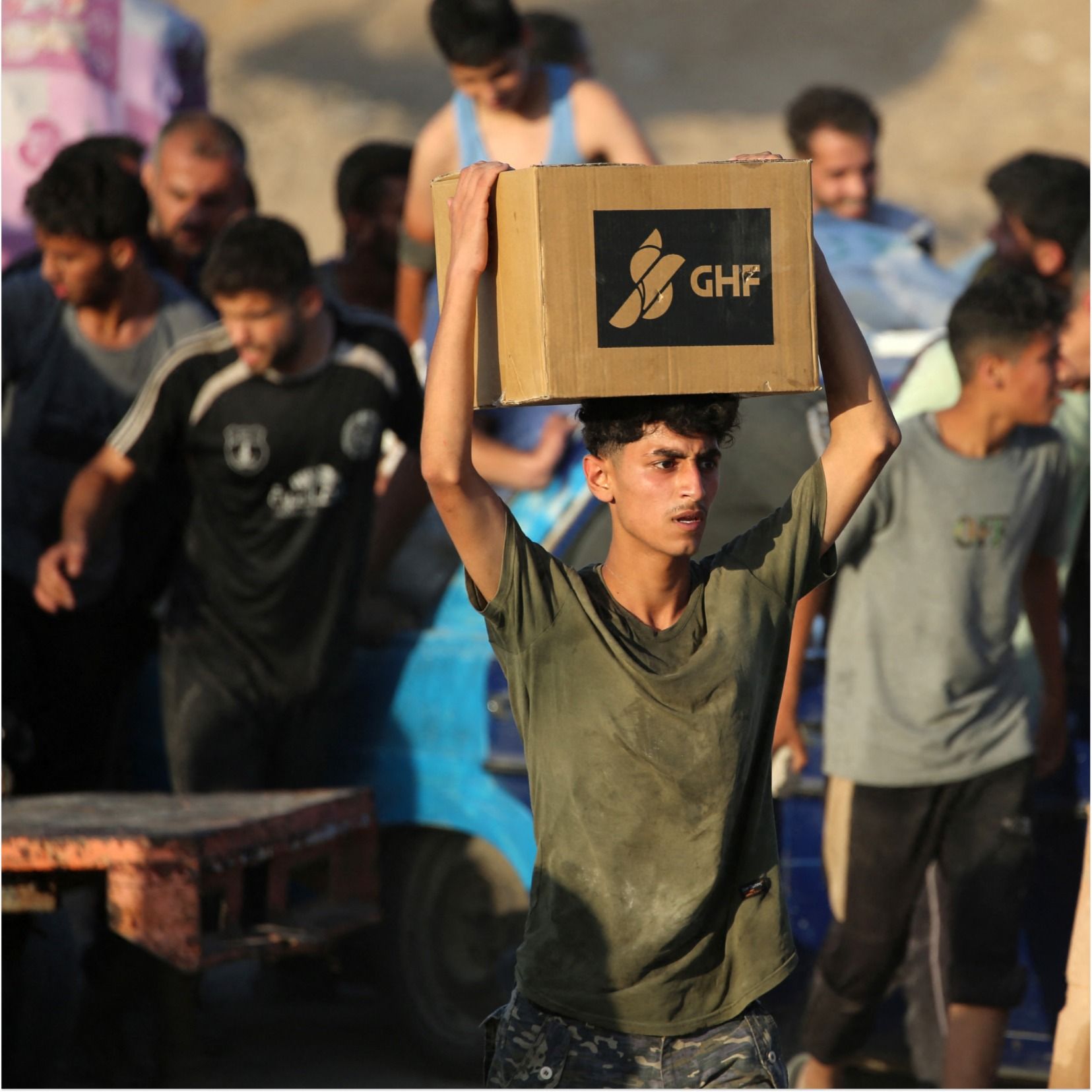
The Daily
How Seeking Food in Gaza Has Become So Deadly
00:32:21
The suffering in Gaza has reached new depths, and now finding food, which was already scarce, has become a deadly endeavor. Israeli forces have opened fire on crowds of desperate and hungry people who were trying to reach aid sites established by a new and controversial humanitarian group. Hundreds of people have been killed, according to Gaza health officials. Aaron Boxerman, who covers Gaza for The Times, explains who is behind the distribution system and why it has been so deadly.
Loading summary
Transcript75 lines
- [00:00]
Advertiser
You just realized your business needed to hire someone yesterday. How can you find amazing candidates fast? Easy. Just use Indeed. Join the 3.5 million employers worldwide that use Indeed to hire great talent fast. There's no need to wait any longer. Speed up your hiring right now with Indeed and listeners of this show will get a $75 sponsored job credit. To get your jobs more visibility at Indeed.com NYT. Just go to Indeed.com NYT right now and support our show by saying you heard about Indeed on this podcast. Indeed.com NY Terms and Conditions apply. Hiring Indeed is all you need.
- [00:38]
Ghada Al Kord
Well, this is Ghada Al Kord from Gaza. We are really starving. Honestly, there is nothing to be eaten here in Gaza. I'm not eating anything. We are losing too much weight for me. Maybe I lost more than 10 kilos now. And my bones, you can see my bones now. Soon I'll be skeleton. It's very hard. I couldn't imagine in my life that I'll be in this situation like starving in 2020.
- [01:24]
Rachel Abrams
From the new York Times, I'm Rachel Abrams and this is the Daily.
- [01:30]
Aaron
The.
- [01:30]
Rachel Abrams
Suffering in Gaza has reached new depths and now finding food, which was already scarce, has become a deadly endeavor. Israeli forces have opened fire on crowds of desperate, hungry people who are trying to access aid sites established by a new and controversial humanitarian group. Hundreds of people have been killed, according to Gaza health officials today. My colleague Erin Boxerman on who is behind the distribution system and why it's been so deadly. It's Thursday, July 24th.
- [02:12]
Erin Boxerman
Aaron, welcome back to the show. It's about 7pm where you are in Jerusalem, I think. So we really appreciate you making the time for us.
- [02:20]
Aaron
Always great to be here.
- [02:21]
Erin Boxerman
So Aaron, to start the humanitarian situation in Gaza has obviously been dire since the start of the war, but in recent weeks the situation seems to have deteriorated even further. Specifically, we've been hearing reports about hundreds of Palestinians that have been killed by the Israeli military while trying to reach what limited aid has actually gotten into Gaza. So can you explain what has been going on at these aid sites and why have these people been killed?
- [02:49]
Aaron
So, first of all, you're absolutely right, Rachel. We've seen for many months now that for many, many Gazans, finding food and water has been an endless daily struggle. And the situation was really exacerbated earlier this year when Israel put a blockade on basically all food, medicine and fuel entering Gaza for nearly three months. Since then, the blockade was eased. Aid is going back into the Gaza Strip. But the way that it's being Distributed has been totally upended. And so we're seeing a situation on the ground that we haven't really seen during the course of this nearly two year war. In less than two months, hundreds of Palestinians have been killed and wounded near new aid distribution sites that are under the control of of the Israeli military. And Palestinians in Gaza who've spoken to us have described how, you know, just getting a box of food for themselves and their family has become a life threatening endeavor.
- [03:54]
Rachel Abrams
Do we know exactly how many people have died?
- [03:57]
Aaron
All of these incidents are difficult to assess from the outside. The Israeli military doesn't allow international journalists into Gaza so that we could report and investigate these incidents freely. But according to Gaza health officials, over a thousand people have been killed, more than 600 of them near these new aid distribution sites. Israeli officials have broadly disputed those figures. They've suggested that they're exaggerated, but they also haven't provided any alternative death toll.
- [04:28]
Erin Boxerman
So this new aid system, what about it, is resulting in all of these deaths.
- [04:33]
Aaron
So there's a number of factors, and if we want to understand the sort of new aid system, we have to understand what it replaced. So much of the international aid that was entering the Gaza Strip that was reaching its 2 million people was going through a system coordinated by the United nations, which ran or coordinated a big network of hundreds of sites across the Gaza Strip where aid would be distributed to Gazans, more or less where they were. And Israel had long been critical of that system.
- [05:07]
Erin Boxerman
Why?
- [05:08]
Aaron
Israeli officials said that Hamas was profiting off the existing system either by diverting aid or by selling aid. And they essentially said that as the current aid system was set up, they were essentially providing a lifeline to Hamas, that these hundreds of trucks of aid that were going in were undermining Israel's ability to topple the Palestinian armed group that had launched the deadliest attack on its civilians in Israeli history on October 7, the attack that triggered the war.
- [05:39]
Erin Boxerman
Is that credible, the idea that Hamas was basically seizing on this food, this aid that was coming in?
- [05:45]
Aaron
As far as we know, there have been incidents where, for example, gunmen have hijacked aid convoys, where they've stolen bags of flour from aid trucks. But it's really hard to tell whether this is Hamas or other gangs. And then there's the bigger question of whether this is systemic, if it's happening on a large scale. The United nations says that they haven't seen a lot of evidence of that. And Israel as well hasn't presented a lot of evidence publicly to back up that claim. And another reason that Israel was, you know, sort of frustrated and skeptical with the old UN dominated system was long standing tensions between Israel and the un. Many Israeli leaders have called the United nations biased. And there's a fundamental mistrust between Israel and the United nations about the humanitarian situation as a whole.
- [06:36]
Erin Boxerman
Israel has consistently said that the UN is exaggerating or is not correct or saying that it's worse than it is. Right.
- [06:42]
Aaron
Yeah. Israel has frequently said that UN officials are distorting the reality on the ground. At various points, Israeli officials also said that there was no wide scale humanitarian crisis in Gaza, even as UN officials and aid workers on the ground were describing a very different picture. And so many of our listeners have probably seen videos of people in need of food in Gaza, you know, videos that show crowds of hungry Gazans trying to get aid. But Israel and the UN have been at odds really throughout much of the war about the nature and the depth of the crisis in Gaza.
- [07:19]
Ghada Al Kord
Mm.
- [07:20]
Aaron
So we see that there are these long standing tensions between Israel and the United nations. And Israel basically wanted to make a new aid distribution system in a way that officially was described as neutral and independent.
- [07:35]
Erin Boxerman
So talk about that new system. Describe it for us.
- [07:39]
Aaron
So earlier this year in the spring, we started hearing about how Israel was starting to brief the aid community. They were starting to brief UN workers and tell them there's going to be a huge overhaul in terms of how aid is done in Gaza. And then about a month later, we started to understand that there was a separate group that was going to be involved that circumvented the United nations, and that really circumvented every existing aid organization that we were aware of. It was going to be carried out by a totally new organization which had been established seemingly for this purpose, called the Gaza Humanitarian Foundation. But who was behind this organization? How was this organization formed? All of that was murky. There were not a lot of public details about who and what and how this organization was going to function. And so my colleagues and I, Patrick Kingsley, Natan Odenheimer and Renen Bergman, began looking into it.
- [08:38]
Erin Boxerman
So what did you all find?
- [08:41]
Aaron
So what my colleagues found was that even though the project was billed as neutral and independent, it was actually an Israeli creation as far back as the earliest weeks of the war. A whole host of people, businessmen, tech people, military officials, they all started meeting and they came up with this plan that would basically replace the aid system in Gaza as we knew it to that point. And all throughout 2024, they lobbied for the idea. They met with Israeli leaders, and they really built up a coalition of support for the project. Essentially, the idea that they had was that private contractors would distribute aid in Gaza. These would be in areas that were controlled by the Israeli military, where Israel would sort of be overseeing what was going on, even though Israel would not be responsible for handing out the aid. And that would circumvent what Israeli officials saw as a problematic United nations and enable Israel to exert more control over the flow of aid. And eventually they decided that those private companies would be American ones.
- [09:49]
Erin Boxerman
American companies? Why American?
- [09:53]
Aaron
Well, it appears Israel didn't want this to be a project that had an Israeli face, so they looked abroad for help. The people behind the idea tried to bring on board respected humanitarians who would really provide legitimacy to the project. The Israeli government even reached out to the UN to see if they would work under these new conditions. But they, as well as much of the international aid community, really wanted nothing to do with this. They said that working so closely with Israel would compromise their independence. And they were really worried that the combination of Israeli soldiers and crowds of Palestinians desperate for aid would lead to violence. And so many of the people whose names were floated to potentially help with the project, including a former head of the World Food Program, said no. But one of the people they did manage to get was someone named Jake Wood, who's a former U.S. marine. He becomes the executive director of the Gaza Humanitarian foundation, which is set up as a nonprofit in the United States and which basically serves as the public face of the group. And it raises funding to fund the group's operations. And it's not really clear who is actually providing much of the funding to this group. We know that the US government has said publicly that they've provided $30 million. The foundation has said that they've received more than $100 million from an unnamed European country. But a lot about the group's finances, a lot about how this group has been operating is still very murky and has not been disclosed to the public.
- [11:32]
Erin Boxerman
Do we have any sense about whether.
- [11:34]
Rachel Abrams
Israel is providing any funding for it?
- [11:37]
Aaron
That's another big mystery. There's been a lot of speculation about it, but at the end of the day, we really don't know for sure whether Israel has provided financial backing. We know that they support it, that they've advocated for it, but in terms of financial backing, we just don't know for sure yet.
- [11:53]
Rachel Abrams
I see.
- [11:54]
Aaron
So the Gaza Humanitarian foundation, that's the public facing element, but there's also the people that are really carrying this out on the Ground, that's a different company. It's called Safe Reach Solutions, and it's run by Phil Riley, who's an ex CIA officer. And under this system, Riley and the contractors who work for him are basically going to be the ones who are overseeing security at the aid sites themselves.
- [12:24]
Erin Boxerman
And what would that look like?
- [12:26]
Aaron
So, really, the idea was that there would be four sites, at least to start, and they would be in southern and central Gaza. And that's a huge reduction. Remember, the UN had about 400 distribution sites across the Gaza Strip. These four new sites would be in areas that are under Israeli military control. So Palestinians, if they wanted to get aid from the sites, would have to walk through areas with armed Israeli soldiers, and only after that, they would arrive at these aid sites, which were run by American contractors. And again, that was really one of the biggest issues for the humanitarian community.
- [13:04]
Erin Boxerman
What specifically was the complaint or the concern?
- [13:08]
Aaron
Well, they thought it was going to be really dangerous, basically. I mean, they thought that Gazans would have to walk really long distances to get to these places, that there was going to be huge amounts of crowding as desperate people tried to get to a small number of sites. And they were really worried about the potential for Israeli soldiers or contractors to use force to control these large crowds of people arriving. And another concern that the United nations and other people raised about this was that Israeli leaders at the time were already suggesting that they wanted to move a huge number of Palestinians in Gaza from the north to. To the south. And they worried that this whole idea of creating a new aid system was actually just a strategy for forcibly displacing huge numbers of Palestinians by ensuring that the only place where they could get aid was going to be in this very small area of southern Gaza. And so they saw this as not really an aid system, but as a military strategy, as a way for the Israeli military to sort of conveniently hem off a large number of people in a small area by using food essentially, as a way to keep people in a small part of Gaza. And so there's been all this criticism before the Gaza Humanitarian foundation even opens its doors at the end of May, and just hours before it's set to start distributing aid for the first time. When Jake Wood, the organization's public face who defended it, then resigns suddenly in the middle of the night, he puts out a statement which says, it is clear that it is not possible to implement this plan while also strictly adhering to the humanitarian principles of humanity, neutrality, impartiality and independence, which I will not abandon. He essentially repeats many of the criticisms which the United nations and which other people had made of the foundation. And this is really another blow to the Gaza Humanitarian foundation, which was set to open its first site for aid distribution just hours later.
- [15:36]
Erin Boxerman
We'll be right back.
- [15:40]
Carol Rosenberg
I'm Carol Rosenberg from the New York Times. Right now I'm sitting alone in the press room at the U.S. navy base at Guantanamo Bay. I've probably spent around 2,000 nights at this Navy base. I've been coming here since four months after the 911 attacks. I watched the first prisoners arrive in those orange jumpsuits from far away Afghanistan. Some of these prisoners, they still don't have a trial date. It's hard to get here. It's hard to get news from the prison often. You know, I'm the only reporter here. If you build a military court in prison out of reach of the American people, it should not be out of reach of American journalism. We have a duty to keep coming back and explain what's going on here. The New York Times takes you to difficult and controversial places. It keeps you informed about unpopular and hard to report developments. And that takes resources. You can power that kind of journalism by subscribing to the New York Times.
- [16:42]
Erin Boxerman
So, Erin, before the break, you talked about how this new aid distribution system launched, despite what sounds like a lot of criticism from many different quarters. Talk to us about the early days. How did the launch go?
- [16:55]
Aaron
So it started in late May and it's been difficult to really get a sense of what's going on because Israel doesn't allow us to freely move around in Gaza and visit and see the sites for ourselves in an independent way. And so my colleagues and I managed to speak to several people who tried to get aid from those sites during those first few extremely chaotic days. So I got on the phone with a man named Mohammed Sagar. He's 43 years old. He lives in a half destroyed apartment in the southern Gaza City of Khan Yunus with his three kids and his mom. And he went to one of the Gaza Humanitarian foundation sites on June 1st. So that was just a few days after it opened. He told me that he learned that the site was going to be open at 5am and he wanted to get there as early as possible so that he'd be at the front of the line. So Muhammad told me that he left his house in the middle of the night and began walking to the distribution site, which is several kilometers away from his house in Khan Younis. He arrived in the area at about three in the Morning it was still dark. And he waited along with other people near the distribution site inside the perimeter controlled by the Israeli military. Everybody was pushing, you know, pushing. They're trying to get forward. A lot of Gazans, including Muhammad, were worried that if they weren't at the front of the line, there wouldn't be any food left, and they would have walked for hours in the dark, basically for nothing. And then he said there was an announcement from a drone, basically telling people to get back, but there were so many people, and basically nobody could move back. And then he said he started hearing what he described as warning shots, but the crowd was still pressing forward. And that's when, according to Muhammad, people started getting shot, and everybody dropped to the ground out of fear. And he says there was an old woman next to him who got shot in the leg. He remembers someone yelling, my grandma. My grandma. But he says there was basically nothing they could do. People were just too scared to move so no one could help them. And later the sun came up. It started to grow light out. He said he could see bodies from people who had been shot. And despite all of this, Muhammad actually goes to the site. He says that he ran as fast as he could. He grabbed one of the boxes that was on the floor, and he tried to run away as quickly as possible because he was scared that after all of that, that somebody might attack him on the way back and steal the food that he fought so hard to get. And he said the situation at the aid site was a kind of race for food. It was almost like, you know, everybody sort of out for themselves. You know, everybody racing each other to try to get a box of food. That's the level of chaos and desperation that Muhammad said he saw.
- [21:03]
Erin Boxerman
That is just a horrific story. What details from it have you been able to confirm? And what do we know about how many people died that day?
- [21:12]
Aaron
It's absolutely a horrific story. And when we heard stories, both Muhammad's and stories like it, we try to verify and confirm them as much as possible, which is often difficult to do in Gaza. But here's what we do know. We know that on that morning early on June 1, the Red Cross, which has a field hospital in Rafah nearby, had a mass casualty influx. Shortly after the shooting near the aid site began, more than 170 people arrived. Most of them had gunshot wounds or shrapnel wounds. 21 of them were declared dead upon arrival. And the patients who survived the wounded said that they'd been trying to reach an aid distribution site. So the Red Cross in its statement doesn't say who shot them, but Muhammad and other Palestinians who we spoke to who were there that day said that it was Israeli soldiers. Now this was an extremely contested incident. The Israeli military denied shooting civilians near or at the aid site. But an Israeli military official later briefed reporters and told them that Israeli troops had fired what the official described as warning shots at, quote, several suspects as the crowds of Palestinians had approached them during a period when the Gaza Humanitarian foundation site wasn't open yet.
- [22:39]
Rachel Abrams
Okay, so that's what the Israeli military said. What about the Gaza Humanitarian Foundation? What did they say?
- [22:45]
Aaron
The Gaza Humanitarian foundation said that it was unaware of any attacks in or around its site and that all the aid was distributed between 5am and 6am which is when the site was open. But according to Palestinian witnesses and the Israeli military official who spoke to reporters, the incident seemed to have been about a kilometer away from the site.
- [23:10]
Unnamed Reporter
And today there was another deadly shooting involving civilians at a food distribution center in Gaza.
- [23:18]
Aaron
We've seen similar episodes recur.
- [23:20]
Unnamed Reporter
Palestinian health officials say four people were killed this morning at a food distribution center in Gaza. Again, medics and at least 38 Palestinians were killed today in new shootings near food distribution centers in.
- [23:33]
And again, at least 49 people have been killed while waiting for a trucks across Gaza over just 24 hours, according to Palestinian health officials.
- [23:42]
Aaron
We've seen incidents where crowds of Palestinians seeking aid from these sites in southern Gaza have repeatedly come under fire.
- [23:50]
Unnamed Reporter
At least eight people have been killed in the last 24 hours and 74.
- [23:54]
Aaron
Injured, including as recently as this week.
- [23:56]
Carol Rosenberg
32 people are confirmed dead after they tried to reach an aid site in southern Gaza.
- [24:02]
Aaron
This is according to Gazan hospital officials.
- [24:05]
Unnamed Reporter
Israeli troops say they've had to control rowdy crowds trying to get to these sites. The foundation says there's been no violence in or near the sites themselves.
- [24:19]
Rachel Abrams
Aaron, you mentioned that the Gaza Humanitarian foundation only has four aid distribution sites set up and that's compared with 400 sites that were in place before this new system took over. I think that everybody can understand why crowded situations can be more dangerous generally, but especially in a place like Gaza. But in these situations that we've been talking about, people are actually getting shot near these aid sites. Right. So it, it feels like there's probably something else going on besides simply that these sites are incredibly crowded.
- [24:52]
Aaron
You're absolutely right to point to crowding as an issue, but really, I think the fundamental problem goes back to what the original critics, you know, from the United nations and from the Aid community said at the beginning, which is that thousands of people are crossing Israeli military lines in a war zone and they're going to aid sites which, unlike in the past, are now surrounded by Israeli soldiers. That is the deadly combination that we've seen. Now it's important to point out the United nations and other aid organizations are still bringing some aid into Gaza. And there have also been some shootings linked to their distribution. But the majority of the deaths reported by Gaza officials took place in the vicinity of the Gaza Humanitarian foundation sites.
- [25:42]
Erin Boxerman
Obviously, live ammunition is not an accepted form of crowd control.
- [25:46]
Rachel Abrams
Has Israel explained why this has happened over and over again?
- [25:51]
Aaron
At times they've said that Israeli soldiers fired warning shots at people who approached them and who posed a kind of threat. They've also basically disputed the casualty tolls that come out of Gaza. They say that casualties that are released by the Gaza Health Ministry, which is a branch of the Hamas run administration in the Gaza Strip, are not reliable. And at times they've accused people that have echoed these, you know, reports of mass casualties, of distorting reality.
- [26:27]
Erin Boxerman
So it basically sounds like Israel is denying that this is a huge issue.
- [26:31]
Aaron
So the Israeli military says that they've learned lessons, that they're working on renovating some of the sites, that they're trying to ensure that whatever incidents there have been don't recur. But just last weekend we saw two deadly incidents, one related to the Gaza Humanitarian foundation, another related to the World Food Program convoy where Israeli soldiers reportedly opened fire, killing and wounding dozens of people. And so unfortunately, we've seen these deadly shootings are continuing. The Gaza Humanitarian foundation has also rejected a lot of these reports. But at the same time, they've said that mostly they're speaking about what happens at their sites or immediately around their sites. So they're not really commenting as much on what happens to people on the way to the site, which is when you know, at least in our reporting, when a lot of the deadly shootings unfortunately have taken place.
- [27:25]
Erin Boxerman
And what about the US and all of this? Has the US Said anything? Because as you mentioned, the US Is providing at least a chunk of funding to this effort.
- [27:33]
Aaron
So the US has emerged as a staunch defender of the Gaza Humanitarian Foundation. After Jake Wood, the former executive director, left the initiative, they brought in a new head, an evangelical leader named Johnny Moore, who's seen as quite close to President Trump. And in fact, the $30 million in funding from the State Department was actually authorized weeks after these reports of shootings began to emerge. So that certainly feels like a real vote of confidence in the new system, even as the Trump administration was actually cutting foreign aid elsewhere in the government.
- [28:10]
Erin Boxerman
Obviously, this war has invited international condemnation, and I'm curious whether we have heard from the international community in response to this effort specifically.
- [28:21]
Aaron
So it's been condemned by many, including Israel's own allies. You know, countries that are historically supportive of Israel, like the United Kingdom and Germany and France, have expressed a lot of skepticism about the Gaza Humanitarian Foundation. And just earlier this week, a coalition of around 30 countries issued a joint statement where they really condemned this new system, which they said deprived Gazans of their human dignity.
- [28:47]
Erin Boxerman
Have any of those condemnations moved the needle at all? Just in terms of Israel acknowledging any kind of problem or conceding that this aid distribution system had issues that perhaps it didn't earlier recognize so publicly?
- [29:00]
Aaron
At least Israeli officials have defended the initiative, but there's also reason to believe that they're not totally thrilled with how it's turned out. After all, Israel promised that this was going to be an orderly system, not just for the sake of Gazans, but also because the whole reason behind this overhaul was to prevent the aid from going to Hamas or benefiting Hamas. But the rollout has been so messy and so disorganized that it doesn't really seem like anyone is checking who's coming to pick up these boxes of aid. So some officials and analysts have suggested that even by the Israelis own standards, it's not clear whether they've been so successful. But at the end of the day, this is all really symptomatic of a much bigger problem with Israel's whole approach to Gaza.
- [29:52]
Erin Boxerman
How do you mean?
- [29:53]
Aaron
All these scenes of desperation and chaos, they all really underscore that right now, nobody is really responsible for governing in Gaza, for providing for the welfare of Gazans, and for instituting law and order. The Israeli military has decimated the Hamas government, which used to run Gaza, and it hasn't allowed anything to come up in its place. So the result has been anarchy. Now, this might be the result of bad planning, but there are also critics of Israel who have argued that for Israel, the chaos in Gaza could also be part of a larger strategy, either to further weaken Hamas or just to make the situation in Gaza so unlivable that Palestinians might volunteer to leave on their own. So we're now nearly two years into this war. We're at almost 60,000 Palestinians killed. According to Gaza health officials, there's rising malnutrition. The Israeli military now controls much of the Gaza Strip, and ordinary Gazans are still just trying to survive from one day to the next.
- [31:12]
Erin Boxerman
Erin, thank you so much.
- [31:15]
Aaron
Thank you.
- [31:19]
Rachel Abrams
On Wednesday, more than 100 aid agencies and human rights groups, including Save the Children and Doctors Without Borders, warned that, quote, mass starvation was spreading across Gaza. The joint statement adds to growing calls for Israel to lift restrictions on humanitarian aid and for the war to end. Israel's foreign ministry rejected the group's claims, saying that the organizations were echoing Hamas talking points. We'll be right back.
- [32:01]
Susan Burton
This is Susan Burton, host of the podcast the Retrievals. Cutting someone's body open and then operating when they can feel it, that is not supposed to happen. That's something from history or from war. It can't be happening to 100,000 women a year, can it? From Serial Productions and the New York Times, it's the Retrievals, Season two, the C Sections. Listen wherever you get your podcasts.
- [32:33]
Rachel Abrams
Here'S what else you need to know today. Columbia University has agreed to pay a $200 million fine to settle allegations from the Trump administration that it failed to do enough to stop the harassment of Jewish students. The settlement is part of a sweeping deal to restore the university's federal research funding, which the White House had canceled. Columbia had been the earliest target of the Trump administration's efforts to overhaul the country's most elite academic institutions. As part of the settlement, the university also agreed to a number of different terms, including the appointment of a provost to oversee Middle Eastern studies and the appointment of three dozen public safety officers with arrest powers. And on Wednesday, a judge sentenced Bryan Kohberger, who was convicted of killing four Idaho college students in 2022, to life in prison with no chance of parole. Friends and family members of the victims spoke of their loss, with one telling the killer to, quote, go to hell. Others demanded to know why he had committed his crimes. Mr. Kohberger declined to speak or explain his motives. Today's episode was produced by Claire tennisketter, Rochelle Banja and Mooch Zaidie. It was edited by Maria Byrne with help from Paige Cowett and Ben Calhoun. Fact Checked by Susan Lee, contains original music by Dan Powell and Pat McCusker and was engineered by Chris Wood. Our theme music is by Jim Brunberg and Ben Landsberg of Wonderly. That's it for the Daily I'm Rachel Abrams. See you tomorrow.
- [34:27]
Unnamed Representative
This podcast is supported by Business Roundtable. Business Roundtable member companies support over 37 million US jobs. These employers play a critical role in strengthening America's workforce. From creating jobs in skilled trades to developing industry focused initiatives, they are setting a new standard for investing in employees. Learn how Business Roundtable member companies are carving new paths and developing a thriving workforce@BRT.org opportunityunlocked.