Loading summary
Transcript79 lines
- [00:00]
TikTok Narrator
On TikTok, entire communities are turning curiosity into connection. History lovers share stories that bring the past into focus. Scientists and educators break down big ideas with experiments and insights that make discovery feel approachable. And across art, language, and everyday tips, people on TikTok give fresh perspectives on the world we share. TikTok is a place for curiosity where learning is fun, connection is meaningful, and discovery never stops.
- [00:29]
Rachel Abrams
From the New York Times, I'm Rachel Abrams, and this is the Daily. Two fatal shootings by federal immigration agents in Texas and in Maine have once again put a spotlight on the Trump administration's deportation tactics. Today, my colleague Hamed Alaziz explains how these killings signal a return to a more aggressive form of immigration enforcement, one that can easily turn a routine moment like a traffic stop into a deadly confrontation. It's Thursday, july 16th. Ahmed. In the six months since two Americans were killed by federal agents in Minnesota, the government's deportation crackdown has felt a little bit quieter. Federal agents, of course, withdrew from cities. The protests that we saw after Minnesota really died down. We stopped seeing these gruesome confrontations between law enforcement and civilians that people have been capturing on video. And so all of this put together, I think, made these two recent shootings in Houston and then in Maine feel, at least to some people, like. Like they almost came out of nowhere.
- [01:56]
Hamed Alaziz
Yeah, I mean, I think that's a fair assessment as far as the public's view, because in the months after Minneapolis, arrest numbers dropped pretty dramatically across the country. But that kind of came to an end in late June when suddenly, at least at ice, there was this sense that the White House wanted more arrests, that the enforcement it needed to go up dramatically.
- [02:20]
Rachel Abrams
Okay, we're gonna talk about what has led to all of that, but I just wanna talk about the two sh. Shootings first. We are still learning the details of what happened both in Maine and in Houston. But can you just tell us, Hamed, what do we know so far about both of those incidents?
- [02:34]
Hamed Alaziz
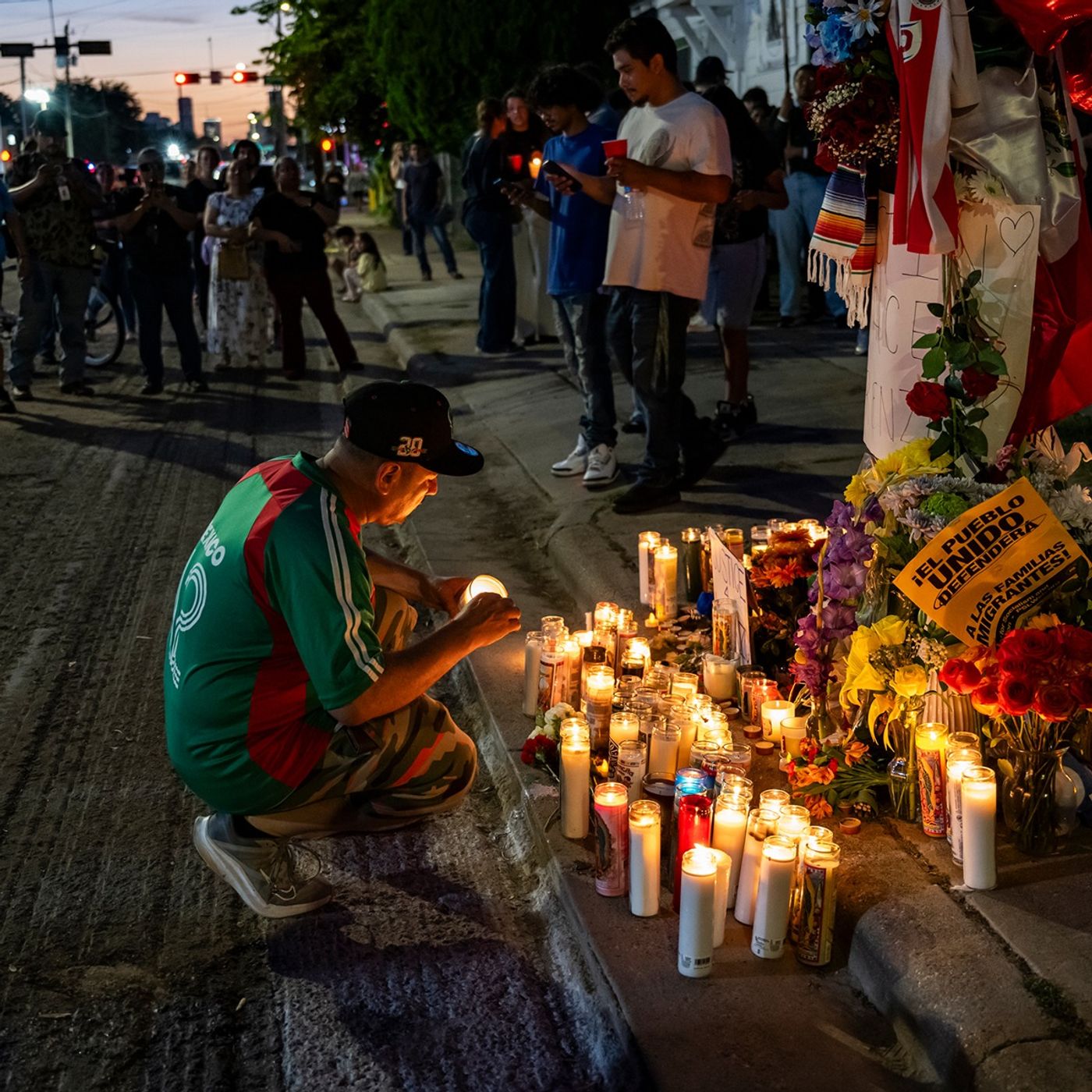
Yeah, so the first shooting was on July 7th in Houston. And in that incident, ICE was looking for two individuals that they wanted to come and arrest. And as they're doing that surveillance, as they're looking for those two individuals, they come across a van to them that seemed suspicious. And in fact, inside this van, they believe individual in the car resembled one of the targets that they were looking for. And so they start to look up the license plate information of this van, and they find that it's registered to somebody who is undocumented. And so they decide to go after
- [03:13]
Rachel Abrams
the car they're basically thinking, oh, even if it's not the people we're looking for, maybe we could pick up another person who's here illegally.
- [03:21]
Hamed Alaziz
Yeah, essentially. I mean, you're at a point now that you have created this level of reasonable suspicion that ICE officers need to pursue individuals. And it's at this point, really, during this attempt to stop this van, where the narratives really start to diverge. Where the passengers and the witnesses in this van say that the van was not doing anything dangerous, and where ICE says the van was actually putting their officers in danger, that it was being weaponized, that the officers essentially feared for their safety and needed to use that lethal force. That's at this point, what we know. But we don't have a clear video of this incident.
- [04:06]
Rachel Abrams
But we do know, of course, that they shot into the vehicle, killing this person in Houston. So what do we know about the victim at this point?
- [04:13]
Hamed Alaziz
Yeah, Lorenzo Salgado Arauo. He lived in the country for more than 30 years. He's undocumented, and he actually had his own construction crew. His brother was part of it. His brother was in the van. And this story took off for many reasons, but one of them was, I
- [04:33]
Ronaldo Salgado
want to tell you about my dad.
- [04:34]
Hamed Alaziz
Really, this impassioned speech from his son Ronaldo.
- [04:38]
Ronaldo Salgado
He wanted nothing else in life but to provide for his wife and see his sons become great people who just
- [04:45]
Hamed Alaziz
really spoke glowingly about his father.
- [04:47]
Ronaldo Salgado
I saw a video posted on Facebook that he had been shot. I recognized him immediately, not from his appearance, but from his voice crying for help as he lay on the street bleeding out.
- [05:04]
Hamed Alaziz
You could see in his tears how saddened he was about what had happened to him and something that they never expected.
- [05:11]
Ronaldo Salgado
He did not deserve to be reduced to a headline of Mexican Man Shot and Killed by ice. He deserved to live a quiet life as Lorenzo Salgado Araujo, a husband, a father, and a job creator for dozens of men who also wanted the American dream.
- [05:30]
Hamed Alaziz
So this story, I think, really resonated for people because when this administration talks about immigration enforcement, they often talk about and they highlight individuals who have horrific criminal convictions and the type of criminal histories that they really want to put on display. But in this case, this was a man going to work.
- [05:52]
Rachel Abrams
As we mentioned, there were two incidents. The second one was in Maine. Tell us about the details in that case. What do we know there?
- [05:59]
Hamed Alaziz
So on Monday in Biddeford, Maine, this really sleepy, small town, ICE agents were targeting an individual who had a deportation order, and they decided to target somebody going into a vehicle and they decided to try to stop that vehicle.
- [06:18]
Advertisement Voice
But.
- [06:18]
Hamed Alaziz
But according to ice, the vehicle tried to flee the scene and it was during this time they felt there was a fear. Actually the way they put it was they were fearing for public safety and the ICE officer decided to shoot into the vehicle. This man, Joan Sebastian Guerrero, a 25 year old Colombian immigrant, was killed.
- [06:42]
Rachel Abrams
And just to be clear, do we know for certain whether he was or was not somebody that ICE was looking for?
- [06:49]
Hamed Alaziz
They don't clearly say that. In the statement, Senator Angus King said that he spoke with DHS Secretary Mark Wayne Mullen who told him that Mr. Guerrero was not the target of the ICE officers. So if that is the case, it is very similar in some ways to what happened in Houston.
- [07:11]
Rachel Abrams
Can you tell us what do we know about him, Guerrero, the victim at this point?
- [07:15]
Hamed Alaziz
Mr. Guerrero, he lived in Biddeford. He worked as a food delivery driver. He was also a cleaner at a veterinary clinic. He has a three year old child and his wife shared a photo of their family on social media and she wrote that I will love you all the days of my life. His father actually gave an interview with a Colombian news outlet and in it he said that his son had work authorization and was in the United States legally. The Trump administration though, said that Mr. Guerrero had illegally entered the country in 2023 and was released into the United States by the Biden administration.
- [08:03]
Rachel Abrams
So we don't necessarily have clarity yet on his status. It sounds like we do not have
- [08:07]
Hamed Alaziz
any clarity on that. Yeah.
- [08:09]
Rachel Abrams
What has the public reaction been to these two cases that we've just talked about?
- [08:14]
Hamed Alaziz
Yeah, I think there is a lot of anger.
- [08:24]
Rachel Abrams
These agents have no business drawing their guns. They aren't judge, jury and executioner.
- [08:29]
Advertisement Voice
He wasn't even the guy that they were looking for.
- [08:32]
Hamed Alaziz
And so now an innocent people are asking for investigations. They're asking for accountability. As I was making my way through Biddeford on Monday, there was a pretty large protest outside of the office of Senator Susan Collins. The local residents, pet signs, anti ICE signs surrounding that office just hours after that shooting. And I think a lot of this stems from public distrust of ice, of dhs, of this administration and their narrative as to what happened. We've seen incidents before in which there is a explanation of what happened and video comes out and ends up contradicting the facts presented by the government. I mean, we can look to January when Alex Preddy was shot by Border Patrol agents. And the DHS secretary at the time, Christine Ohm, came out that same day and said that Mr. Preddy was planning to harm the agents, that he was brandishing his weapon. And Americans actually saw that video, and they saw that none of the things that she was saying were reflected in that video. So I think there is a lot of distrust of the official narra.
- [10:03]
Rachel Abrams
I think there's probably a few things about these incidents that remind people of what happened back in Minneapolis back in January. And as you described, though, since then, the administration's tactics have at the very least, become less visible. And so I wonder whether the events of the last week represent some kind of return to that earlier, more aggressive phase of enforcement, or whether the federal government has had more of a presence in American cities this entire time than people perhaps realized.
- [10:32]
Hamed Alaziz
Yeah, I mean, if you go back to January in Minneapolis, it really comes at a time when Stephen Miller is pushing for more arrests, more deportations. He's put out this goal of 3,000 arrests a day, a figure that I was never able to reach. And they really went on a string of targeting major American cities and states. And Minneapolis became a major target after a series of stories about the Somali community there.
- [11:05]
Rachel Abrams
That's right.
- [11:06]
Hamed Alaziz
So thousands of DHS agents are there. They are trying to arrest as many people as possible. There are videos of people with legal status being pulled over. It seems like this is chaotic. Two American citizens are shot dead in the streets. And at the end of all this, President Trump decides to quiet down the situation in Minneapolis, and he puts his border czar, Tom Homan, in charge, and ultimately the DHS agents leave the state. Then DHS Secretary Kristi Noem, is ultimately fired, and in comes Mark Wayne Mullen, this senator from Oklahoma, who in his confirmation hearing, actually sets out this goal that he wants to keep his agency out of the headlines. He wants them to be quieter than they have been. And enforcement, after the time he takes over, really starts to drop. You start seeing around a thousand arrests a day.
- [12:11]
Advertisement Voice
Right.
- [12:11]
Rachel Abrams
Which is probably why this felt a little bit less present to a lot of people.
- [12:16]
Hamed Alaziz
Exactly. I mean, it kind of, in many ways, was a situation in which ICE really tried to stay out of the public's view. But even though it seems like things have quieted down, Stephen Miller has continued to push for more numbers. He has always wanted more arrests, more deportations.
- [12:40]
Rachel Abrams
He never wanted to quiet things down.
- [12:42]
Hamed Alaziz
Exactly. And by June, Miller and this administration is in a position to where they can get what they've always wanted.
- [12:56]
Rachel Abrams
We'll be right back.
- [13:05]
TikTok Narrator
This podcast is supported by the American Petroleum Institute. Energy Security affects how Americans live, work, travel, and stay Connected America has abundant oil and natural gas, but resources alone are not enough. The country needs modern infrastructure like pipelines and transmission lines that can affordably and safely bring energy to families, communities and businesses. That's how to build a stronger, more reliable energy system for the future. Learn more@energysecurityframework.org Investing with Schwab is like
- [13:38]
Advertisement Voice 2
spending a Saturday at a great farmer's market. You can fill your reusable tote with a bit of everything. Maybe you go for some free range, self directed investing or perhaps you pick up a few farm fresh trades while you peruse. You can even get help from a dedicated advisor. That's full service wealth management. Mix, match and change your mind whenever you want. Because at Schwab you can invest your way. No matter your goals or appetite for investing, Schwab has everything you need all in one place. Visit schwab.com to learn more.
- [14:10]
Advertisement Voice
Startup founders around the world are using Anthropic's Claude to solve problems, build faster, and create things that have never existed before.
- [14:17]
Hamed Alaziz
By getting to work with Anthropic, we've been able to help bring folks to a new era of software engineering. We are a very small startup, so Anthropic model actually changed everything about how we work together as a team. The very cool thing for us is that with each new model, new capabilities are unlocked.
- [14:34]
Advertisement Voice
To watch the full series, go to claude.com problemsolvers that's claude.com problemsolvers
- [14:44]
Rachel Abrams
Ahmed, what happened in June that, as you said, allowed Stephen Miller to once again pursue his deportation strategy as aggressively as he's been wanting to?
- [14:53]
Hamed Alaziz
You know. Well, we know that this administration has really been making this push to dramatically grow ICE for the last year. But June is really when we saw those efforts come to fruition. You'll remember that DHS was funded with an extra 170 billion by the big beautiful bill and a lot of that going toward ice, allowing them to hire these thousands of new officers. But the process of getting them out on the street, that takes time. There's training, there's all kinds of different administrative tasks that are necessary. So by the time June rolled around, it was almost a year since that hiring push. And they're in a position now where they're able to on their own, make this push for more enforcement, make it a reality. They have thousands of new officers to send out into American streets to arrest people and ramp their numbers up. And in fact, in late June, there was this idea within ICE, this perception within ICE that 2000 arrests a day that that is the new goal. That that is the new actually not even goal expectation.
- [16:10]
Rachel Abrams
So there's a new quota, you're saying? And while it's lower than the original quota that Stephen Miller set out earlier on, it sounds like this 2000 number is maybe a firmer expectation. Like ICE never really met that 3000 a day quota, but the expectation now is that 2000 should be an achievable number.
- [16:29]
Hamed Alaziz
Exactly. And in late June, in a period of five days, they arrested more than 10,000 people, averaging more than 2,000 arrests a day. And one DHS official told me that that was the highest 5 day stre of arrests by ICE during the Trump administration. I mean, this is really unprecedented territory. We're in 10,000 people picked up by this agency in just a five day swing. I think there was a sense at the time, you know, is this just a minor blip? Is this just kind of a momentary enforcement blitz? But we've seen on several occasions after that five day stretch, ice again hitting that 2,000 number.
- [17:13]
Rachel Abrams
You know, I think hamed for people listening to this and hearing how ICE has really grown its ranks, a natural question is, well, how well trained could these people be? And did training or a lack of training contribute to the end results that we saw this past week? So what do we know about that?
- [17:31]
Hamed Alaziz
Yeah, you know, as the administration as ICE was trying to push out these thousands of new officers, they really cut down on the days for these ICE officers to go through their training. And in fact, there was a whistleblower, an individual who was a former ICE lawyer, who came out and said that they had cut more than 200 hours of classes involving firearms training, use of force, lawful arrests, the limit of their authority. And so that raised a lot of questions about exactly what these officers were being trained on and whether or not they were really capable of handling these really high stress situations.
- [18:18]
Rachel Abrams
Sure.
- [18:19]
Hamed Alaziz
And I think what's happening now is that as this agency and as the officers are being pushed to do more, they're being pushed to get that number of 2,000 arrests a day. In fact, ICE has ordered their field offices to send out more officers every single day to ramp up operations. What that means is you're going to see more of these confrontations, more of these situations where ICE is in a. They have a sense of urgency to get as many arrests as possible. And what they're being met with in many cases is immigrant communities who are incredibly fearful of what's going to happen to them. You know, they have seen the videos, they have seen the News of people being deported to Africa to detention in El Salvador. And so that tension is very high. And so these officers in some cases are running into situations where the immigrants themselves, they want to flee the situation, they do not want to be arrested, they are terrified. And in many ways it's a recipe for disaster. And on Tuesday morning I reported on a case of a 28 year old man who came across ICE at a gas station in St. Augustine, Florida. And he ran away from them and he ran into the street and was struck and killed by a truck. These are the types of situations where we've seen this before in California, people fleeing in panic to immigration enforcement and there being lethal consequences.
- [20:04]
Rachel Abrams
And so this is the kind of recipe for disaster that can make a routine interaction like a traffic stop, a really combustible situation like what we saw happen in Houston and Maine. The public outcry over those shootings has been mounting and hamed. I wonder what the reaction from the administration has been so far to the reaction that we've seen from the public.
- [20:25]
Hamed Alaziz
Yeah, it's been really interesting to see the way they've made their argument. We saw the administration pause vehicle pursuits, vehicle stops, except for, you know, certain situations. And that seemed to be kind of this moment where, you know, the administration was taking a beat to evaluate what they were doing and then move forward by. But President Trump on Truth Social on Wednesday morning, he said not only was ICE doing a great job, but that they should continue to do the vehicle stops, that there was no pause. So you have a situation in which perhaps the agencies are looking at it one way and the President has decided for them that they should continue with their aggressive approach.
- [21:15]
Rachel Abrams
Right. I mean, just to read a couple lines from the President's true social post, he said, quote, we cannot give up on one of ice's most important and effective crime fighting tools, the traffic stop. Once we do, we are playing right into the criminal's hands. He went on to say in the same post, keep those crime stat records coming. So I think it seems pretty clear that the President is walking back any kind of attempt to maybe moderate the tactics that we saw over the past week being deployed in Houston and in Maine.
- [21:43]
Hamed Alaziz
100%.
- [21:45]
Rachel Abrams
Both of these incidents right now, both of these shootings are currently under investigation. But, but in the past when civilians have been shot by federal law enforcement agents conducting these kinds of immigration crackdowns, we did not see indications from the administration that they were very eager to pursue thorough investigations. And I sort of wonder what we know about these investigations, whether they are being run any differently. And if you have any indication at this point, Hamed, when and what we may ultimately learn.
- [22:13]
Hamed Alaziz
Yeah, I mean, these types of investigations, typically any type of officer involves shooting, even at a local level. It takes a long period of time. A lot of resources go into figuring out what happened with the shooting, whether or not the officer was in the right. And case in point, we can look at the shootings of Alex Preddy and Renee Goode in Minneapolis. You know, we are six months out from those shootings. We don't have any indication when those investigations will be concluded. So I think what we can expect is in this instance, like past instances, the D Inspector general taking a long period of time to come up with their analysis and to finally decide what they concluded on these shootings. The FBI is also involved with the investigation, but is primarily just involved with the threat to the officer. So dhs IG is the one that is really directing this entire investigation.
- [23:15]
Rachel Abrams
Hamed, if it is true that more violent interactions are basically all but inevitable, and do you think it's fair to assume that the President has basically decided that whatever the cost is of these stops of reaching this quota, that that cost is ultimately worth it to execute the agenda that they have wanted to execute when it comes to deportations?
- [23:36]
Hamed Alaziz
Yeah, the first thing that comes to mind is an interview that J.D. vance gave recently in which he said that law enforcement and the work of law enforcement, it's not a very pretty process. And I think for this administration, the thing that I look at actions, and I think actions matter. And this administration, since these shootings, they have not relented in their push for more arrests. They have gotten days in which they've arrested more than 2,000 people a day. They paused car stops for seems like a matter of hours before President Trump stepped in and said they needed to continue. So I think it's fair to say at this point that this administration believes that the mass deportation campaign, it hovers above everything, above the protests, above the calls for accountability, the calls to defund the agency, the push to stop ICE from doing what it's doing. The goal is mass deportation, and nothing is going to stand in that way.
- [24:47]
Rachel Abrams
Hamed Alaziz, thank you so much.
- [24:50]
Hamed Alaziz
Thank you for your time.
- [24:56]
Rachel Abrams
The FBI is investigating whether there were drugs in the van driven by Lorenzo Salgado Ariujo at the time that immigration agents killed him in Houston. That's according to a search warrant application reviewed by the New York Times. There has been no indication that agents pursuing the van that day suspected that drugs were present. We'll be right back.
- [25:24]
Advertisement Voice
Matching outfits, extravagant birthdays, many nicknames, a few classic moves of a dog obsessed parent. Ollie is obsessed with how obsessed you are with your pup so they strive to give your dog the best. From fresh human grade dog food to in app health. Check ins to track your dog's well being. You could say Ollie Feeds the obsession. Visit ollie.com daily and use code daily to get 70% off your welcome kit. Ollie Feed the Obsession this podcast is supported by bank of America Private Bank.
- [25:59]
Bank of America Advertisement Voice
You're cut from a different cloth and with bank of America Private bank you have an entire team tailored to your needs with wealth and business strategies built for the biggest ambitions like yours. Whatever your passion, unlock more powerful possibilities@privatebank.bankofamerica.com what would you like the power to do? Bank of America Official bank of the FIFA World Cup 2026 bank of America Private bank is a division of bank of America, NA member FDIC and a wholly owned subsidiary of bank of America Corporation.
- [26:29]
Advertisement Voice 2
This podcast is supported by Memorial Sloan Kettering Cancer Center. What if cancer could be treated without surgery, radiation or chemotherapy? At MSK, it's already happening. In a groundbreaking clinical trial, 100% of participants saw their cancer completely vanish using immunotherapy alone this MSK Giving day, your gift will be triple matched to make the seemingly impossible breakthrough possible. Bring hope to people impacted by cancer. Give now@msk.org thedaily
- [27:05]
Rachel Abrams
here's what else you need to know today.
- [27:07]
Hamed Alaziz
To clarify, Mr. Blanche, do you believe
- [27:10]
TikTok Narrator
it is the president's right and duty to order the investigation or prosecution of his perceived enemies? Yes or no?
- [27:20]
Hamed Alaziz
I can't answer that. Yes or no?
- [27:22]
Rachel Abrams
The confirmation of President Trump's choice for Attorney general, Todd Blanche, remained uncertain on Wednesday after his testimony before a key Senate committee failed to win over crucial Republicans, including John Cornyn of Texas.
- [27:36]
Hamed Alaziz
But just to be clear, the president of the United States has not agreed
- [27:40]
Rachel Abrams
in writing to delete the weaponization fund. And there's no in what was widely seen as a revealing slip up, Blanch, Trump's former personal lawyer, suggested that he still sees himself in that capacity. Are you and President Trump friends?
- [27:56]
Hamed Alaziz
I'm his lawyer. Was his lawyer and now I'm the deputy attorney general. So met.
- [28:04]
Rachel Abrams
And in a vote on Wednesday, almost half of House Democrats supported a measure to eliminate US Aid to Israel. The measure ultimately failed, but the vote reflected a rapid and dramatic shift within the Democratic Party away from decades of unequivocal support for the Jewish state. Today's episode was produced by Adrienne Hurst, Ricky Novetsky and Chris Benderev. It was edited by Michael Benoit and Rob Zipko and contains music by Marian Lozano and Dan Powell. Our theme music is by Wonderly. This episode was engineered by Chris Wood. Special thanks to Zolan Kano Youngs and Caitlin Ruthman. That's it for the Daily I'm Rachel Abrams. See you tomorrow.
- [29:11]
Advertisement Voice 2
What's the one thing in business that's spreading as fast as AI? AI risk. Every new tool your team signs up for, every vendor that turns on AI features, every new integration. Each one is an opportunity for something to go wrong. And most security programs weren't built for AI's pace of growth. Enter Vanta. Whether you're a fast growing startup or a global enterprise, Vanta is here to help you automate your security and compliance and earn and prove trust. Get started today@vanta.com daily that's V A N T A dot com daily.