← The Daily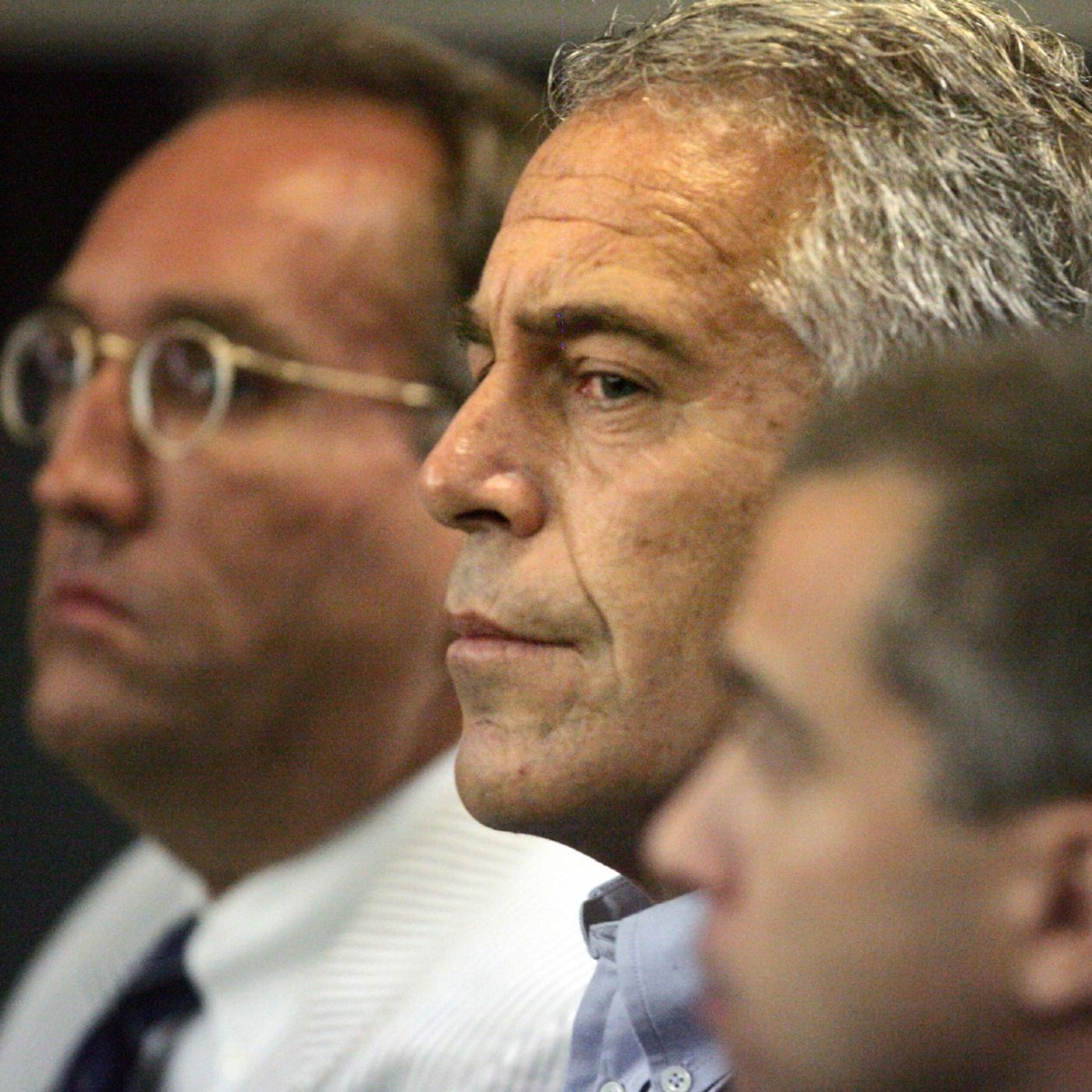
The Daily
Inside Jeffrey Epstein’s 50th Birthday Book
00:24:53
For months, President Trump has tried to dismiss questions about his relationship with Jeffrey Epstein, notably denying that he had been the author of a lewd birthday message to the financier and sex offender. On Monday, Congress released the message — and many more like it. David Enrich, a deputy investigations editor at The Times, explains how the book, and an investigation into Mr. Epstein’s finances, reveal how Mr. Epstein leveraged his rich and powerful friends to fund a yearslong criminal conspiracy.
Loading summary
Transcript51 lines
- [00:00]
Capital One Advertiser
Brought to you by the Capital One Venture X card. If you love to travel, Capital One has a rewards credit card that's perfect for you. With Venture X, earn unlimited double miles on everything you buy and turn all of your purchases into extraordinary travel. And you get premium benefits at a collection of luxury hotels when you book through Capital One Travel. Plus, you'll get access to over 1,000 airport lounges worldwide. Capital One what's in your wallet? Terms apply seecapital1.com for details from the.
- [00:31]
Rachel Abrams
New York Times, I'm Rachel Abrams and this is the Daily for months, President Trump has tried to dismiss questions about his relationship with Jeffrey Epstein, notably denying that he'd authored a lewd birthday message to the convicted sex offender. On Monday, Congress released the message and many more like it. Today my colleague David Enrich explains how the book and an investigation into Epstein's finances reveal how Epstein leveraged his rich and powerful friends to fund a years long criminal conspiracy. It's Wednesday, September 10th. So, David, on Monday we saw firsthand the release of this now very infamous birthday book to Jeffrey Epstein. It's for his 50th birthday. It's from 2003. It's filled with notes from a lot of well known, some rich, some powerful people, many of whom wrote kind of sexually explicit messages. And there's one note in particular that by now a lot of us have heard about or seen that seems to be from President Trump. It seems to be alluding to some secret that Trump and Epstein have beyond, though being in some cases lewd or sexually suggestive. I'm just sort of wondering what we should be making from this book overall.
- [02:06]
David Enrich
Yeah. So I mean, to back up for a second, one of the enduring mysteries of Jeffrey Epstein is who surrounded him, why they were surrounding him and what they were doing around him. And we've known for a long time that there was a whole band of very rich, very powerful people who spent a lot of time and money with Epstein. What most of those people have said is that they did not have any indication about what Epstein was up to and they've really downplayed the extent of their relationships. But on Monday, because of a bipartisan and fairly belated effort by Congress to really dig into what's been going on with Epstein, we finally got this birthday book that has been talked about for months now. And what this 238 page book reveals is that first of all, there were a ton of rich, powerful and famous people in his orbit, including people like Donald Trump and Bill Clinton. And it also shows that A lot of the people in the book clearly had some level of awareness that Epstein was compulsively pursuing young women, because over and over again, in the pages of this book, we see direct and indirect references to that.
- [03:17]
Rachel Abrams
Let's go over some examples of actually what's in the book. And I think to do that, it would be helpful, actually, if you could read some examples of some of these notes that people left.
- [03:26]
David Enrich
So the right place to start is this letter or note that apparently was sent by Donald Trump. It looks like a script or something that is written in type over the rough outlines of a naked woman. And it starts by saying, voiceover. There must be more to life than having everything. And then it goes into this imagined conversation between Trump and Epstein. It says, donald, we have certain things in common. Jeffrey. Jeffrey. Yes, we do, come to think of it. And it wraps up with Trump referring to enigmas, and then says, a pal is a wonderful thing. Happy birthday, and may every day be another wonderful secret. And then Trump signs his name in his distinctive kind of squiggly sharpie signature where the woman's pubic hair would be.
- [04:17]
Rachel Abrams
And obviously, we should note here that the White House has first denied that this note even existed, and now they're denying that it is, in fact, Trump's signature.
- [04:26]
David Enrich
Yeah, that's right. Although I've gotta say, it either is a very effective forgery or it is Trump's signature. And we and others have found other signatures that Trump made around that same time, and this appears to be virtually an identical match.
- [04:43]
Rachel Abrams
Okay, so obviously, that drawing and that inscription does not prove that Trump knew that Epstein was having sex with underage girls. But it does raise a lot of questions about what on earth their relationship was and what Donald Trump did know about his proclivities. I mean, what do you make of that?
- [05:00]
David Enrich
Look, there's no question that Epstein and Trump in the 1990s and early 2000s were close and were traveling in very similar circles. There are a lot of pictures of the two of them together during that time period. We and others have reported on an incident in which a woman said that Trump sexually assaulted her in Epstein's presence. And at least one young woman was lured into his sex trafficking network after being recruited by his associate Ghislaine Maxwell, at Mar? A Lago.
- [05:29]
Rachel Abrams
Oh, really?
- [05:30]
David Enrich
So the relationship between these two goes back years and years, and Trump has said that he cut ties with Epstein before Epstein was initially criminally charged. And one of the big takeaways from this birthday book finally being public is that it really makes it much harder for Trump to argue, as he had, that this letter doesn't exist or is a complete lie. We can now all see with our own eyes what is in this letter and what very clearly appears to be Trump's signature.
- [05:59]
Rachel Abrams
And all of this is relevant, we should be clear, because there is this huge and growing question about Trump's association with Epstein among his space. Right. A lot of President Trump's supporters seem to have turned on him over this issue. You have right wing influencers like Nick Fuentes who are openly calling Trump a liar. It feels like this is the one issue that has really caused a split within maga and it's one of the reasons why there's such urgency behind answering questions about what these two men's relationship was to begin with.
- [06:30]
David Enrich
Yeah, I think that's fair. I mean, the backlash on the right is not because MAGA folks are upset about Trump's relationship with Epstein so much as it is that the Trump administration has backpedaled furiously on their pledges during the campaign to provide full transparency about the Epstein investigation. And Trump has gone from being supportive of that to being the single leading obstacle to full transparency. And I think my best guess, based on the reporting that my colleagues and I have done over the past few months, is that a big part of that is that in the files the various investigators have and that Epstein's estate has, there are repeated references to Donald Trump, given his years long close association with Epstein and the birthday book. And Trump's apparent message in the birthday book is just one very clear indication of that.
- [07:23]
Rachel Abrams
Right. It's one thing for him to campaign on. Release the files. Release the files. Jeffrey Epstein. We need to know everything about Jeffrey Epstein. What seems sort of clear now is that the book at least suggests that one reason why Trump might not want to actually release all information relating to Jeffrey Epstein is that he's in there in some capacity, even if it's not implicating him in a crime. It's at the very least embarrassing in a way that he does not want to feed.
- [07:45]
David Enrich
I think that's right. And what's more is that this is kind of emblematic of the broader issue with transparency here. I mean, Trump does not want to release all the investigative files related to Epstein apparently, because he is concerned that he will be embarrassed by some of what's in there. And the birthday book is kind of a microcosm of that because in addition to the letter from Trump, there are a lot of other letters and materials from other rich and powerful people. That in some ways are even more revealing.
- [08:14]
Rachel Abrams
Could you give us a couple other examples from the book? What did other people say? Who were they? What gave you that impression?
- [08:20]
David Enrich
Well, I'm just flipping through this right now on my computer, and I'm looking at one page in the book where someone submitted a bunch of photos that they had taken on a recent trip to Africa that shows all manner of wild animals with erect penis or engaging in sex. And those photos are from a very prominent person in Silicon Valley. And look, the book is filled with other examples like that, where you have bold faced household names singing Epstein's praises. And one of those people is Bill Clinton, who doesn't have any innuendo that we can see about sex or anything like that, but refers in a very positive way to Epstein's childlike curiosity. And you've also got Leon Black, the private equity billionaire, who refers to Ernest Hemingway's the Old man and the Sea and notes that Epstein is catching not fish, but women, whom he refers to as blondes, redheads, and brunettes. You have Les Wexner, the founder of the Limited, and Victoria's Secret, who is another of Epstein's longtime benefactors, who says that I wanted to get you what you want. So here it is. And then has a sketch of a pair of breasts. And then you have a strange one from a guy named Joel Paschkow, who is a longtime member of Mar a Lago. And it shows what appears to be a doctored picture of Pashkow, Jeffrey Epstein, and a couple other unidentified people, including what appears to be a young woman. And they're holding up this novelty check for something like $22,000 that is kind of fake signed by Donald Trump. And it refers to Epstein having early talents with money and women and claims that the photo shows Epstein selling a fully depreciated woman to Trump. And again, it's important to note here that there's no indication that Trump was in on this joke or part of it. But it shows once again that the worlds of Jeffrey Epstein and Donald Trump often collided and overlapped in those days in the early 2000s and late 1990s.
- [10:23]
Rachel Abrams
I also just want to point out that, like, when I have been asked to, for example, sign some sort of congratulatory book, it's not like I'm seeing what other people are writing, right? Like, I'm just writing my own entry or like, sending something via email to be included in, like, happy 50th anniversary or whatever. And it's not like when you do those things, you typically see what other people are submitting, especially 2003 pre Internet. It's not like something's being emailed around. And so it feels worth noting that like all of these people who presumably are not seeing what each other is submitting, are sending stuff that is at the very least, thematically connected.
- [10:57]
David Enrich
Right?
- [10:57]
Rachel Abrams
Like they're all kind of saying the same thing, which is this wink and a nod toward Jeffrey Epstein's sexual proclivities.
- [11:05]
David Enrich
Yeah, that's exactly right. And what we can see really clearly here is that it was totally out in the open that Epstein was obsessed with young women. And they are not talking about this in a pejorative way. They're describing this in a laughing, kind of charming way that they think is really adorable. And what's also clear in looking at this 238 page book is that he was not just pursuing women and girls, he was also pursuing power and wealth. And a lot of the people he surrounded himself with were very wealthy and very powerful and they enabled him to build connections and networks that ended up fueling his criminal enterprise.
- [11:56]
Rachel Abrams
We'll be right back.
- [12:01]
My Mochi Ice Cream Advertiser
This podcast is supported by My Mochi Ice Cream. We all have those moments. Midday, late night. And we want something cool and sweet. But not just anything. Something better. Like My Mochi Ice Cream. My Mochi is scoops of rich, creamy ice cream wrapped in soft, chewy dough. It's like a sweet little ice cream dumpling that will curb your cravings and keep you feeling joyfully chill. My Mochi comes in tons of amazing flavors like strawberry. It's bursting with real berry flavor that's deliciously refreshing and mango. Talk about rich and tropical. It tastes like a mini vacation in your mouth. Feeling extra indulgent. Try My Mochi Cookies and Cream. It's everything you love about the classic with a fun handheld twist. My Mochi ice cream is gluten free and only around 70 calories per piece. It's made for mindful snacking for a bite sized treat that's a little different and a lot satisfying. Look for the purple box of My Mochi Ice Cream at Walmart or go to mymochi.com to find a store near you.
- [12:59]
Capital One Advertiser
We all have moments when we could have done better. Like cutting your own hair. Yikes. Or forgetting sunscreen so now you look like a tomato. Ouch. Coulda done better. Same goes for where you invest. Level up and invest smarter with Schwab. Get market insights, education and human help when you need it. Learn more@schwab.com.
- [13:27]
Rachel Abrams
David before the break you said that Epstein's network basically enabled him in a way that powered his criminal enterprise. What exactly did you mean by that?
- [13:36]
David Enrich
Well, Jeffrey Epstein's sex trafficking operation required a lot of things. One of the most important things was money, so that he could procure young women and girls, really from all over the world. And Epstein was very good at leveraging the personal connections that he had built up over the years, including with many prominent people in the business community, to be able to move his money all over the world. And as my colleagues and I have been trying to understand the flow of those finances over the past six years, the name that keeps coming up over and over again is his longtime bank, J.P. morgan. The relationship between Epstein and J.P. morgan started in the late 1990s. Epstein at the time was a money manager who was sitting on a tremendous amount of wealth, something in the neighborhood of $300 million. We think he advised some very rich people, including Les Wexner, who we spoke about earlier. He's the founder of the Limited and Victoria's Secret, who drew the pair of breasts in Epstein's 50th birthday book. And so Epstein arrives at JP Morgan, and very soon he becomes a really lucrative client. He's generating millions of dollars in fees for the bank. And just as important, he is introducing bank executives to a whole roster of wealthy people that the bank can try to convert into clients. And one of the big names there in 2003 is Sergey Brin, the co founder of Google, who starts to move what would become $4 billion of assets into JP and I would imagine that.
- [15:08]
Rachel Abrams
JP Morgan was quite grateful for that kind of an introduction. I mean, there's very few people on planet Earth that could bring $4 billion into a bank, obviously.
- [15:15]
David Enrich
Yeah. And so it is not a surprise that Epstein quickly becomes one of the most prized clients at JP Morgan because of his ability to bring in people like Sergey Brin. And the most important person at JP Morgan in terms of fostering this very lucrative relationship with Epstein is an executive named Jess Staley. And Epstein helps kind of vault his career up to a new plane. Staley at the time, is an up and coming executive, and he really hitches his wagon to Epstein, who in 2004 helps orchestrate this acquisition in which JP Morgan and Staley buy this prominent hedge fund. And it was a transaction that was transformative for JP Morgan, but even more so, it was transformative for Jess Staley.
- [16:04]
Rachel Abrams
Okay, so basically, if I'm understanding you right, not only is Jeffrey Epstein making money for JP Morgan, but he's also enriching this one executive by bringing in his rich and powerful friends. Right. Like basically these two men's fortunes are sort of becoming more and more intertwined.
- [16:18]
David Enrich
Yeah, that's exactly right. And Epstein is getting out of this quite a bit of value. He gets the legitimacy and credibility of being affiliated in a close way with one of the world's largest and most prestigious banks. He is getting this whole suite of banking services from JP Morgan. He's getting loans, he's getting wire transfers. He's even getting J.P. morgan to open accounts for some of his associates, including some who turn out to be Epstein's victims and whom the bank didn't even meet before agreeing to create accounts for them. And he's also with Jess Staley, building a relationship that for years will protect him when people at the bank start getting concerned about how Jeffrey Epstein is using his money and the role that the bank is playing in his enterprise.
- [17:07]
Rachel Abrams
When you say concern, like, what do you mean by that? What is he doing that raises concerns?
- [17:11]
David Enrich
There are a lot of things Epstein was doing that raised red flags within the bank. And one of the biggest is that he was on a very regular basis withdrawing huge sums of money from the bank in cash. And that is typically a warning sign of potential illicit activity, because criminal enterprises tend to be financed by cash, not by things that leave a paper trail. And he was also wiring money all over the world. And anti money laundering experts and compliance officers, as well as some really high ranking executives within the bank saw a lot of these transactions and became really concerned pretty early on that what Epstein was doing deserved greater scrutiny. And in some cases, they even argued that he should be kicked out of the bank as a client. This was ultimately, though, a dead end because executives like Jess Staley repeatedly went to bat for him and overrode those concerns voiced by people elsewhere in the organization. And this was happening not just when it came to people's concerns about the transactions and the activity they were seeing within the bank. It also happened when, starting in 2006 and going on through 2008, Epstein was indicted, arrested, and ultimately pleaded guilty to soliciting prostitution from a minor and went to jail and registered as a sex offender. Even then, just Staley, among other executives, successfully managed to keep him as a client of JP Morgan, because Staley's career.
- [18:32]
Rachel Abrams
Is hugely tied to not just Epstein, but Epstein's network.
- [18:36]
David Enrich
Yeah, that's right, and there's more to it. And Epstein and Staley over the years became quite close personally. So, for example, when Epstein was incarcerated in Florida in 2008 and 2009. Staley went to visit him. They exchanged a ton of emails. Staley even went and spent time at some of Epstein's properties in various parts of the world, including sometimes when Epstein wasn't even there. On at least one occasion, Staley had sex with a young woman whom he met in Epstein's townhouse and who later said that Epstein had been sexually abusing her and farming her out for sex with some of his friends. So this was an extraordinarily close and multifaceted relationship between Epstein, who at this point is a convicted sex criminal and a registered sex offender on the one hand, and one of the highest ranking executives on Wall street on the other.
- [19:27]
Rachel Abrams
It's kind of amazing that this one executive, just Staley has so much power. Like he's basically almost single handedly able to keep him at the bank, despite the fact that he is a very public criminal at this point.
- [19:40]
David Enrich
And I think this speaks to the degree to which JP Morgan and its executives were really blinded by greed here. Epstein was helping them in a lot of really important ways. Not just making them money directly, but the clients that he was introducing. And this continues for years. By the way, we found emails in which Epstein appears to be introducing JP Morgan bankers to Israeli Prime Minister Benjamin Netanyahu. He's trying to foster a relationship between the bank and Bill Gates. Epstein's working as essentially as a middleman for Leon Black, the private equity billionaire who was also a contributor to the Birthday Book. He's bringing him to the bank as well. And so there are all these reasons to keep doing business with Epstein.
- [20:23]
Rachel Abrams
So this relationship goes on for years. How does it actually end? I presume it ends eventually.
- [20:29]
David Enrich
Yeah, it does break. And this starts in 2012 when the bank's CEO, Jamie Dimon, demotes Staley, who by this point is essentially the number two executive at the bank, which then prompts Staley to leave the bank in 2013. And by the way, there is an open question as to how much the bank's CEO knew about all of this at the time. He is denied even knowing that Epstein was a client of the bank until much later. But in any case, after Staley leaves the bank in 2013, there is another chorus of opposition to having Epstein as a client. And with no one left to protect him or defend him, Epstein is kicked out of the bank in 2013. And that brings down the curtain on a relationship that lasted at least 15 years, involved more than $1 billion of transactions that JP Morgan processed for Epstein. And playing a role that many experts now believe was a crucial part of Epstein's sex trafficking machinery.
- [21:38]
Rachel Abrams
Which is what Congress is trying to get to the bottom of. Right. Everything we've been discussing about the relationship between Epstein and JP Morgan is illuminating of how on earth he was able to power this enterprise that, as you said, required a ton of cash. And so you can see, it seems, that the people, the networks that are at least partially illuminated in that birthday book are directly tied and intertwined with the kind of financial ingratiation that allows him to get away with what he did for so long.
- [22:08]
David Enrich
Yeah, I think that's right. And this goes a long way toward answering some of the central questions and mysteries that continue to surround Epstein, namely, how he was able to finance this criminal enterprise. And that is one of the very central questions that lawmakers are now, after years of not really doing anything on this, are now starting to demand answers and demand documents.
- [22:30]
Rachel Abrams
It also feels worth noting that this entire story confirms something that feels at least conspiratorial on its face. But now we know to be totally true. Right? That there is a powerful network of people, people and institutions that enable child sex trafficking. Like people are so dismissive of people who believe in the QAnon conspiracy, and yet here we are talking about all these rich, powerful men who look the other way while Jeffrey Epstein pursued young women and the bank that financed him.
- [23:00]
David Enrich
I think that's a very fair point to make. And I think it's a big part of the reason that the Trump administration's efforts to continuously just shrug this off and hope this is going to go away are not likely to succeed. This is not just an issue about Democrats trying to get information that might embarrass the president. This is a really bipartisan initiative at this point, and it's fueled in large part by folks on the right and in the MAGA movement who have long suspected that there is a conspiracy led by rich, powerful people and institutions to support Epstein. And here we have evidence that suggests that that's at least partially true. And I think the more those suspicions get stoked and confirmed, the more calls and demands that are going to be from across the political spectrum for the Trump administration to provide much more transparency than they already have, which is not.
- [23:51]
Rachel Abrams
Really what we've seen from Republican lawmakers. Right. This great or widespread appetite to go against the president in any way.
- [23:58]
David Enrich
Yeah, I agree. This is a pretty unusual moment, and I think it speaks to the broader bipartisan interest in the Epstein scandal and the desire for transparency. And so We've already seen in recent weeks that the House Oversight Committee, with support from both Republicans and Democrats, has issued subpoenas to the Trump administration as well as to the Epstein estate. And that's where we got the birthday book from. That was the Epstein estate complying with a congressional subpoena. And in the weeks ahead, there is likely to be a vote that is being pushed primarily by Democrats, but also by some Republicans that would require the Trump Justice Department to release a whole trove, basically everything they are sitting on related to Epstein. And it's likely to be a close vote. And I don't know what the outcome will be in the House or in the Senate. But it's very clear that there are going to be continued efforts from Congress to try and force the administration to be much more transparent than it has been so far.
- [25:03]
Rachel Abrams
David, thank you so much.
- [25:04]
David Enrich
Thanks for having me.
- [25:13]
Rachel Abrams
We'll be right back.
- [25:17]
My Mochi Ice Cream Advertiser
Gun injuries are the leading cause of death for children and teens in the United States. Some people avoid talking about gun violence because they don't think they can make a difference. But every conversation matters. When it comes to gun violence, we agree on more than we think. And having productive conversations about gun violence can help protect children and teens. Learn how to have the conversation@agreetoagree.org brought to you by the Ad Council don't just imagine a better future. Start investing in one with betterment. Whether it's saving for today or building wealth for tomorrow. We help people in small businesses put their money to work. We automate to make saving simpler. We optimize to make investing smarter. We build innovative technology backed by financial experts. For anyone who's ever said, I think I can do better. So be invested in yourself. Be invested in your business. Be invested in Better with Betterment. Get started@betterment.com investing involves risk performance not guaranteed.
- [26:16]
David Enrich
You just realized your business needed to hire someone yesterday. How can you find amazing candidates fast? Easy. Just use Indeed. Join the 3.5 million employers worldwide that use Indeed to hire great talent fast. There's no need to wait any longer. Speed up your hiring right now with Indeed and listeners of this show will get a $75 sponsored job credit. To get your jobs more visibility at indeed.com NYT just go to indeed.com NYT right now and support our show by saying you heard about Indeed on this podcast. Indeed.com NYT terms and conditions apply. Hiring Indeed is all you need.
- [26:55]
Rachel Abrams
Here's what else you need to know. Today, Israel attempted to kill senior members of Hamas in an airstrike on Tuesday in Qatar, a sharp escalation of the war in Gaza. Qatar is a US Ally and had been acting as a mediator in the conflict. The strike threatened to undermine those negotiations and also risked antagonizing the Qatari government, in part because the country's political and economic stability hinges on its reputation as a haven for business and tourism in a volatile region. And a federal judge late Tuesday temporarily blocked President Trump from removing Lisa Cook from the Federal Reserve's Board of Governors, allowing her to continue serving as she contests her recent dismissal. The decision follows Mr. Trump's attempts to fire Ms. Cook over allegations that she false falsified documents related to her mortgages, and comes amid the president's ongoing pressure campaign on the Federal Reserve to lower interest rates. Today's episode was produced by Alex Stern and Asta Chaturvedi. It was edited by M.J. davis, Lynn and Paige Cowett and was engineered by Alyssa Moxley. A special thanks to Matthew Goldstein, Jessica Silver Greenberg and Michael Gold. That's it for the Daily I'm Rachel Abrams. See you tomorrow.
- [28:29]
Capital One Advertiser
Brought to you by the Capital One Venture X Card. If you love to travel, Capital One has a rewards credit card that's perfect for you. With Venture X, earn unlimited double miles on everything you buy and turn all of your purchases into extraordinary travel. And you get premium benefits at a collection of luxury hotels when you book through Capital One Travel plus, you'll get access to over 1,000 airport lounges worldwide. Capital One what's in your wallet terms apply. See capitalone.com for details.