← The Daily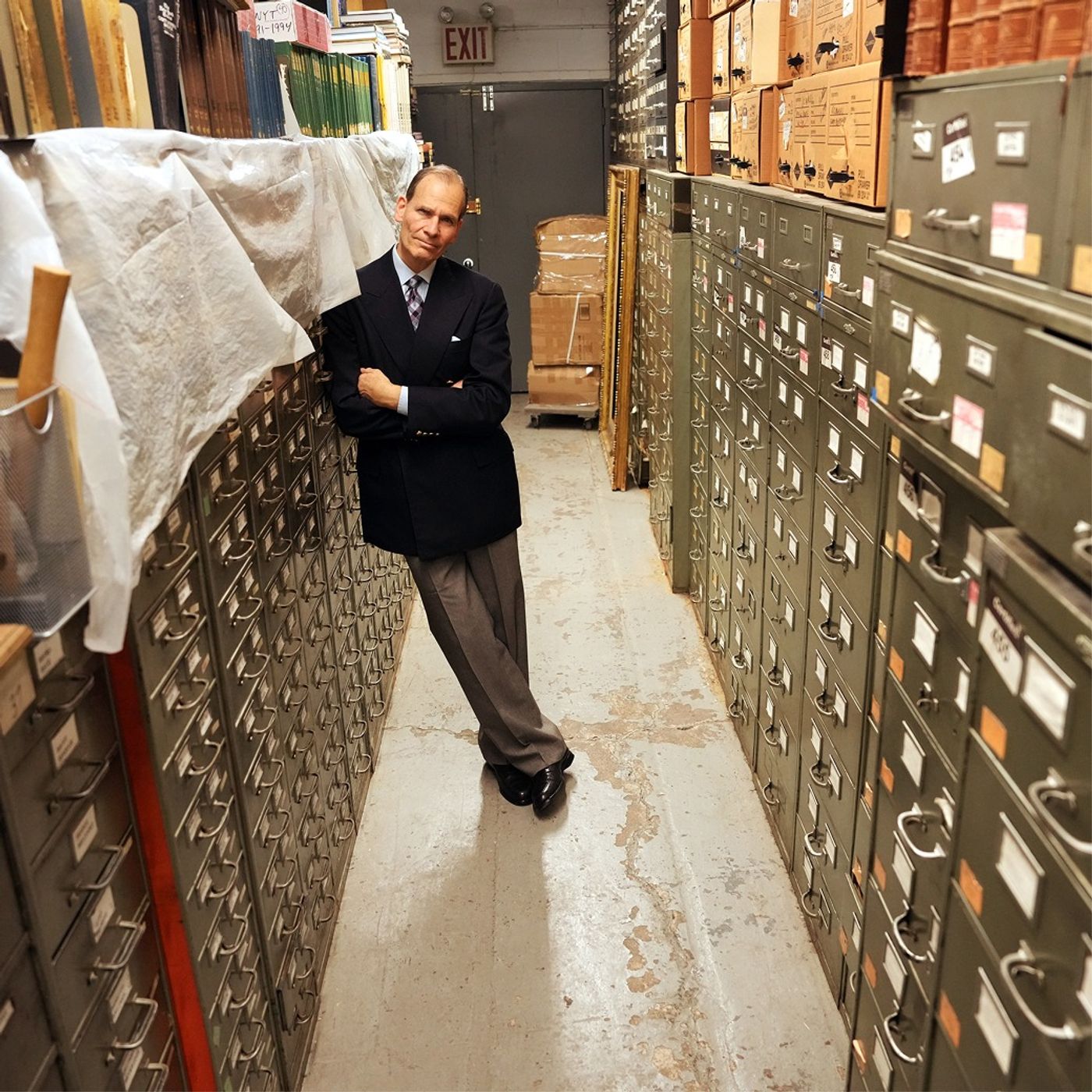
The Daily
Inside 'The Morgue' at The New York Times
00:25:23
In this subscriber-only episode, the host Rachel Abrams ventures deep into the basement of The New York Times in Manhattan to visit a place affectionately known by staff members as “the morgue.” There, she meets Jeff Roth, the sole guardian of the vast and eclectic archive that houses the paper’s historical news clippings and photographic prints, along with its large book and periodicals library dating back to the 19th century.
Loading summary
Transcript176 lines
- [00:00]
A
Brought to you by the Capital One Savor Card. With Savor, you earn unlimited 3% cash back on dining, entertainment, and at grocery stores. That's unlimited cash back on ordering takeout from home or unlimited cash back on tickets to concerts and games. So grab a bite, grab a seat, and earn unlimited 3% cash back with the saver card, Capital One what's in your wallet? Terms apply. See capitalone.com for details.
- [00:29]
B
All right, Rachel, where are we going today?
- [00:31]
C
We're going to the New York Times morgue, which I've never been to, and I've worked here 12 years.
- [00:35]
B
What is a morgue? For those of us who don't know?
- [00:38]
C
Okay, well, I think it is the place where they keep all kinds of clippings from old New York Times stories as well as books that reporters have relied on for literally decades.
- [00:47]
B
Okay. And I see today that you are holding a book yourself. You want to tell us about it?
- [00:51]
C
Yes. Okay, so maybe. Maybe close to 12 years ago, I myself was a retail reporter who needed to learn about Ralph Lauren, and I borrowed a book. And Jeff, who we're gonna go meet, who runs the morgue, told me explicitly, like, you have to return this, and I never did. So we're gonna go return this book and see how mad he is.
- [01:09]
B
Did you read it?
- [01:11]
D
No.
- [01:13]
B
Very nice. All right. Does he know you have it?
- [01:16]
C
He doesn't know. So he can capture his real reaction. He won't even recognize us.
- [01:19]
D
I don't think.
- [01:23]
C
So. We're gonn. We'll head over soon. Hey, it's Rachel. I'm back with another episode for subscribers. Hi, Jeff.
- [01:32]
D
Hello.
- [01:34]
C
Nice to see you. It's been a little while. I'm Rachel. I don't know. This week, I am taking you somewhere pretty interesting.
- [01:40]
D
Want to head that way?
- [01:41]
C
Yes. Jeff, I brought something for you.
- [01:44]
D
Oh, okay.
- [01:45]
C
Okay. I don't know if you remember this, but, like, maybe 10 years ago or so, I can't remember exactly when. I borrowed a book from the morgue about Ralph Lauren, and I never returned it.
- [01:55]
D
Oh, I know that book.
- [01:57]
C
Do you recognize this? Have you been, like, where has this been?
- [02:00]
D
No.
- [02:00]
B
Oh.
- [02:02]
C
Do I owe you, like, a late fee or something?
- [02:04]
D
Yeah, right.
- [02:06]
C
I thought you'd be so happy to have it back. It's deep underneath midtown Manhattan where there's an archive owned by the New York Times. Okay, good. It's filled with millions and millions of newspaper clippings and books about pretty much any subject you can think about going back to the 1800s, and it's kind of a Secret.
- [02:23]
B
So we're walking into the building right now where the morgue is. It's a building right next to the New York Times building. And Jeff is signing us in.
- [02:36]
C
I knew about this place, but I'd never been myself. It's run by a man named Jeff Roth, the only person who really understands how it works and where everything is. I just want to note, by the way, that we're going downstairs. The Borg is located in the basement.
- [02:52]
D
We're deep enough that I can hear the new subway.
- [02:55]
C
Oh, wow.
- [02:55]
D
Yeah, so that's pretty deep. Yeah.
- [02:57]
C
Recently, Jeff and I met up along with Daily producer Rochelle Bonga, so he could show us around and I could return that book.
- [03:05]
D
This is three levels down, and this is actually the old Herald Tribune's building, as in the New York Herald Tribune and the International Herald.
- [03:13]
C
Today, on the subscriber only episode of the Daily a tour of what we call the morgue.
- [03:19]
D
Well, yeah, you can see here. Come, come, come this way. For these are all of those.
- [03:28]
C
All of these bankers boxes, or what you got.
- [03:31]
D
There are about 1300 of them that are coming.
- [03:33]
C
Oh, my gosh. And I can see how many are here. There's like all these brown stacks and stacks, like eight boxes.
- [03:39]
D
So I'm breaking down the pallets. 54 boxes on each. So these are coming from the University of Texas in Austin. So they had them there, and I boxed them up and sent them down there, I think 27 years ago. And then recently, they asked if we wanted to use them again, and so we said yes. But I only had room for. Well, originally I thought I only had room for 900 boxes. So I was going to get rid of the rest. But since the stuff was so great, I decided to bring 1300. So it's subjects and states and countries. So it's kind of anything and everything.
- [04:22]
C
Can I just pull out a random thing to see what it is? Okay, so, all right, I'm gonna pull out this packet. I'm unwinding some twine that's attaching these clips together. I'm gonna read you a few headlines from some of these kind of worn pieces of paper that have been cut out from newspaper. So this first one. Let's see here.
- [04:39]
D
And so here are what we call the rag edition, which is made out of. Literally made out of cloth.
- [04:47]
C
Wait, the articles are made out of cloth?
- [04:48]
D
Well, it's like they call it linen. And so you would have. So here, feel it. It's like it was made yesterday.
- [04:55]
C
It does not feel like a rag.
- [04:56]
D
This definitely feels no it's paper, but it's fine paper. And so we used to print. It's called the Rag Edition of the Times.
- [05:05]
C
It says June 1st, 1950. The headline of what I'm holding says, at and T. Veil Awards for Courage Go to Four. God, I have no idea what that is.
- [05:13]
D
Yeah, I have no idea what that is. And so here's August 1950.
- [05:18]
C
It's literally what we're looking at is one inch of text. The headline is Saved by telephone, printed on sort of a yellow piece of paper that is pasted onto what looks like a white note card. Almost. August 1, 1950. Pauline Meinskau, 22 years old. A telephone operator saved the life of a woman who was knocked unconscious when a china closet fell on her.
- [05:40]
D
In.
- [05:41]
C
In her fall, Mrs. Hiram K. Moses, 44, swept a telephone off a table. Ms. Minesko heard a groan over the wire and notified the police.
- [05:50]
B
She will never be forgotten.
- [05:51]
C
She will never be forgotten.
- [05:52]
D
Well, and so here's the thing, is that. So if you looked for this, let's say the family looked for it on the Internet, they wouldn't find it because it was killed after the first edition. And so they wouldn't find it.
- [06:04]
C
Can you imagine?
- [06:04]
D
But it was here.
- [06:05]
C
Listen to this. The subscriber only episode about the morgue. Should we go into the actual morgue?
- [06:09]
A
Yeah, yeah.
- [06:13]
C
I don't think I've been to this morgue. Jeff. This does not look familiar to me. How long have you been down here?
- [06:19]
D
Since 2007.
- [06:20]
C
And just to describe what this room looks like. So not only is it just full of boxes and filing cabinets and books.
- [06:28]
D
Everywhere, but the filing cabinets, this room weighs about £700,000.
- [06:36]
C
I've never heard somebody say that a room weighs.
- [06:39]
D
Well, when we moved from 43rd street, movers get paid on how much stuff weighs. And so we had to weigh each cabinet. And there's hundreds of cabinets in here, and each cabinet weighed between 4 and 600 pounds. So there's a lot of cabinets here.
- [06:53]
C
How many cabinets?
- [06:56]
D
I think 600. And then probably thousands of boxes. And then I'm adding another 1300 boxes to this. And so it weighed 600,000 pounds. But I think I've added about 100,000 to it since we moved in in 2007.
- [07:11]
C
And the walls are also decorated with all kinds of New York Times memorabilia. Like, I see a poster that says where the New York Times is made. And this is. This is. Oh, and here's something from a.m. rosenthal. That was Abe Rosenthal, I presume, one of the former executive editors of the New York Times. Wait. Actually, this is really moving. Can I just want to read the whole thing, just so we have it?
- [07:30]
D
Yeah.
- [07:31]
C
So it's a.m. rosenthal on the morgue. The joy of it was that you would find what you did not know you were looking for. You would get an assignment, then go to the morgue to find out what you were going to report about. Who the people were, what they had done, said and thought that had been printed in the paper. After reporting, but before sitting down to write, you would go back to the morgue and look at the clips again, relating them to what you had learned yourself. You would spread the clips out on your desk, and almost always before and after the reporting, you would find a clue, a piece of information that you did not know had existed. The pleasure of serendipity. No morgue, no paper. I did not know a reporter who did not understand that the morgue provided the memory and the history not only of the subject, but of the paper itself. And how could any paper live without its memory and its history? That's really lovely.
- [08:19]
D
Exactly. And, yeah, I think the. The thing here is that there's the serendipity of finding something that you just didn't know about, didn't know existed and moving on from there and trying to figure out how it fits into, let's say, a story that a reporter's doing. And that would happen all the time.
- [08:40]
C
So can you explain, what is this place? What is it for?
- [08:44]
D
So the Times morgue is where we store all the old stories and all the old pictures and various other things, parts of the book collection. So the morgue itself dates pretty much from the late 1800s. Starts being collected in uniform and codified. About 1905, our great former executive editor, Car Van Anda, asks two boys, John Beacon and Thomas Bracken, to start. And when I say boys, because back then, the Times hired young boys who were, let's say, 14 or 15 years old, and they started creating this collection. It was a different type of coding system. They did things alphabetically, corresponding to numbers than other newspapers. We were kind of specific that way. So you have people and you have subjects.
- [09:44]
C
So George Washington or the Emmys, for instance.
- [09:47]
D
Exactly. And so George Washington, you would look under W, George, and he'd have his folder. Fanciful characters have their folders. Famous racehorses have their folders. And so you have collections for biographical, as in people, and you have collections for subjects. And the subjects can range from countries and states to diseases, drugs.
- [10:15]
C
And why is it called the morgue?
- [10:18]
D
Why is it called the morgue. It's not exactly 100%, but supposedly. So if you wrote a story, we'd call it. Okay, so the story is. It's a dead story. Now put it in the dead drawer. So once there were a number of drawers, it became a morgue, like the drawers in a morgue. So that's how the origin of the word supposedly. And that's a word that was being used probably from the late 1800s on.
- [10:52]
C
Should we put my book back?
- [10:55]
D
Yeah, yeah, let's put that back. Okay, so Rachel's book goes where I have all the fashion books. So if I crank the. This shelf.
- [11:09]
C
Wait, so there's an actual crank attached to.
- [11:11]
D
Yeah, so there's an actual crank attached. And truthfully, what's being moved is probably about, I'd say £20,000 or maybe at least over £10,000.
- [11:23]
C
I saw you as you cranked it, the entire wall of filing cabinets moved. Yes, to create a new walkway for us.
- [11:30]
D
Exactly. And here, I'll take the book. And so this is book on Ralph Lauren. So I have some of the culture sections, fashion books.
- [11:43]
C
Okay, well, we're walking through this newly walkway. So on my left are filing cabinets. My writer filing cabinets.
- [11:50]
D
And it goes up there. But I need my ladder. But I don't have my ladder right now. So I'll just put it over here for now.
- [11:57]
C
But how will it ever find its way back?
- [11:59]
D
Oh, no, I have my ladder and I bring it. You know, I have the moving ladder and I bring it and I put.
- [12:04]
B
It on the A filing system for knowing that Rachel returned her book after 12 years.
- [12:09]
C
No, that's why you never tried to get it back from me. So, okay, so just to describe this. So this is. We're looking at a. I'm 5 foot 6 and these filing cabinets are about my height. And then above them is probably another 5ft or so more than that, more than 5ft of books just piled high. And so you're telling me that my book goes on the very top here, where we cannot reach. So you put it on top of another stack of books.
- [12:34]
D
Exactly.
- [12:35]
C
And you will know that this is here.
- [12:37]
D
Yeah. And so what this is is. This is outside of the times library books. This is kind of my so to speak collection in the morgue of fashion books and books that deal with New York City and books that deal with architecture.
- [12:57]
C
Old New York and early photographs. Can I see this?
- [12:59]
D
Yeah, yeah. So that's Dover Publications book. The.
- [13:03]
C
Yeah, this is like Jenga. If I pull one of these out, it's all going to fall in my head. Okay, here we go.
- [13:07]
D
And so those are.
- [13:08]
C
These are black and white photos.
- [13:10]
D
And so that's from the collection of New York Historical Society.
- [13:14]
C
This is so cool. How long has the New York Times had a morgue? And how long have you worked at the morgue?
- [13:23]
D
New York Times has had a Morgue since the 1800s. I'd say the earliest clip files that I have are the late 1870s. My earliest advance obituary I just found was from 1899.
- [13:39]
C
An advance obituary meaning an obituary written ahead of the person dying?
- [13:43]
D
Yeah. So we have maybe three or 4,000 written. I think it's three or 4,000 written. Probably another three or 4,000 that have to be written. And so this was written in 1899. It was a Civil War general from the Union army, and he was also speaker of the House. And so we wrote it in 1899. And he lived into the 1930s. So he was pretty old. He was almost 100, I was gonna say.
- [14:06]
C
Presumably that obit has been used by now.
- [14:09]
D
Yes. And so as far as the morgue and how long it's been. Yes, 1800s, definitely. The. Maybe making it uniform and cataloging dates to about 1905.
- [14:26]
C
And how long have you worked at the morgue?
- [14:28]
D
I don't know. It's over 30 years now. But, I mean, I got hired to do this. So what did you see me doing today? Moving a bunch of boxes. That's what I got hired to do. Move a bunch of boxes. So I'm still doing the same thing.
- [14:42]
C
But I am curious, though, how the Internet changed the way that reporters rely on and use the morgue and the clips here.
- [14:51]
D
Oh, you know, it's pretty much. They don't use it much anymore. Unless I will see that they're talking about something. And I'll say, well, you know, we got a bunch of the clips on such and such. And they'll take a look and they'll be kind of amazed that we have this stuff. It's used, but it's definitely not used like it was. But that's just the way it is.
- [15:18]
C
How do you find anything in here? Like, if I want to find every clip about Angola, how do you know which box?
- [15:25]
D
There's a box that has the Angola folders.
- [15:27]
C
But how do you know where that box is?
- [15:28]
D
Oh, well, I know where it is. I mean, it's up there.
- [15:32]
C
But what happens if you go on vacation and somebody needs a box with Angola in it?
- [15:36]
D
I don't get it. It's not like the paper Closes down or something.
- [15:39]
C
I guess I just want to understand, like, is there any kind of map in here?
- [15:42]
D
Yes, it's pretty alphabetical to a certain extent, but it's kind of all over the place. And yes, the problem there is that I'm kind of the one who knows where that is.
- [15:52]
C
Like, you are. If I was doing an article about chimney sweepers, I think I do have.
- [15:58]
D
I think I pulled that folder. Yeah. Let me take a look. Let's. Well, I gotta move my. I gotta take my. This. Yeah, so I'm gonna take. I'll take the ladder here. Of course.
- [16:23]
C
Okay, so you're walking up to 1, 2, 3, 4, bus. Sure. Eighth row, boxes and filing cabinets.
- [16:30]
D
Hold on a second.
- [16:31]
C
Jeff, if you pull that, is it. Is the whole thing going to come tumbling down?
- [16:34]
D
Of course not.
- [16:36]
B
All right, just have.
- [16:39]
D
So they have names. So, like, let's say here, this is the first box of churches. Baptists. So chimneys.
- [16:49]
C
I'm gonna read some of the labels on some of these boxes while you're looking. Colleges, Columbia Clubs. Atrocities to chronologies. Etiquette to feuds. So this is. These are obviously not subjects that have to do with one another. These are just alphabetized.
- [17:04]
D
Well, these were. I pulled a bunch of stuff that I thought was great to have. So if someone's doing stories on etiquette and doing stories on feuds, well, here's all the stories. So if you're doing a story on excommunications, well, here. June 1949 to 1958.
- [17:22]
C
Okay, I gotta read some of these others. Fiddlers to free enterprise. Free enterprise to gypsies. Habeas corpus to inflation. We're looking for. On a mission for chimney sweepers.
- [17:32]
D
Chimney sweepers, yeah. So let me see. So it's over here.
- [17:42]
C
Can I read what this is? Okay, this one. This is a filing cabinet. Says Chinese New Year. Churches, Episcopal, Trinity.
- [17:49]
D
Yeah. So there's like. So there's, you know, here's the morbid folders, like cadavers, May 1963. Cannibalism, 1940-51.
- [18:00]
C
I'm gonna look through this chimneys folder and see if there's anything on chimney sweepers. Yep, here we go. So I see the first article. What does it say? Yep, the first thing. Oh, well, actually, no, you know what it says? Chimney. Chimney sweep. Demand is reaching a peak. Okay.
- [18:17]
B
So presumably.
- [18:18]
C
Oh, there's a picture of a chimney sweeper on this. The very first article I pulled out is about chimney sweeping.
- [18:23]
D
From.
- [18:24]
C
From. From. Wait, it's a. November 3rd, 1985. Can you describe, Jeff, what this was like when you first started, and maybe even take us back to your first day if you remember it.
- [18:40]
D
Yes. So what was it like when I first started? It was in the old building, the third floor.
- [18:46]
C
The old building was.
- [18:47]
D
Was on 229 West 43rd Street. And so we. The Times was in that building around the corner from Times Square. From. It was called the Times Annex. And we were there from 1913 to 2007. So on my first day, there was a counter, meaning reporters and picture editors would. There was a room, large room with a mezzanine, two levels that had all of the cabinets on there, along with. There were other parts of that building that had hundreds of cabinets and other rooms. At the height, I think there were maybe 1200 or 2000. It was a crazy number of cabinets.
- [19:33]
B
What date was your first day?
- [19:36]
D
Somewhere around 93 or something like that. Yeah. And so first day you come in, there's a counter. And my job when I was hired was, as I said, to move boxes. But I was also hired for. Yes, to be on the counter and to. A reporter comes and asks, like you asks for the chimneys folder because I'm doing some human interest story on what's doing with chimney sweeps. And so I'd come and I'd pull the chimneys folder. And so that's what you do. So that was pretty much the first day. Yeah, and we had three shifts a day till 3am the good night was pretty late. And so when I started, there were 20 people. Pretty much at the height. There were 30 people who worked in the morgue. Yeah, yeah, the morgue and the picture library. The picture library and the clippings morgue were combined for labor purposes in about 1968.
- [20:38]
C
How old were you, if I may ask, when you were hired?
- [20:41]
D
I was like 33, 34, something like that.
- [20:47]
C
So this wasn't your first job?
- [20:49]
D
No, I was doing. Truthfully, I was doing like narcotics interdiction before.
- [20:54]
C
What was that?
- [20:55]
D
Narcotics interdiction.
- [20:56]
C
What does that mean?
- [20:57]
D
You know, like law enforcement stuff.
- [21:00]
C
So you went from working in law enforcement to working in the morgue of the New York Times?
- [21:05]
D
Yeah, I had a friend who was working here and I was getting out of that, and so I was here like one day a week. It was part time. But I know I did a bunch of stuff before. Like, you know, my wife and I used to transport cars and trucks around the country, so we did a whole bunch of stuff. So this was not my first, you know, thing I was doing. I had no intention of coming Here. It's not like I was, like, interested in working at the New York Times.
- [21:31]
C
So what made you stay for this long?
- [21:34]
D
Well, what made me stay this long is because obviously there's a lot of files to move.
- [21:39]
C
No, but I mean, presumably you have some attachment to the morgue.
- [21:45]
D
Yeah, I mean, I love what I do, but again, it's also I love the fact that it's, you know, there's some kind of brain power that's part of this, but it's mostly just moving a bunch of boxes.
- [22:00]
C
You're not just moving boxes around, if I may say so, either. You are the keeper of a lot of knowledge at the New York Times and knowing how to find it. And so, Jeff, I'm so curious. How do you go from being somebody that doesn't particularly feel an affinity necessarily for the New York Times? You did all these other jobs, you moved cars and trucks around. As you said, you worked in law enforcement. You ended up coming here part time. Didn't expect to stay so long. How do you go from that to caring as much as you clearly do about the journalism? Like, what was the. What about the work made you feel that kind of pride?
- [22:33]
D
What about the work made me feel that kind of pride? Obviously, when you know, number one, when you look at the reporters and what they're doing, I think the key thing here is understanding that this is this organization, you know, whatever you want to call it, it's a team of people, a group of people, and there's that esprit de corps of you wanting to help them. And so how do you help them by doing things like that.
- [23:06]
C
If you had to guess how many physical clippings are in this morgue ballpark, what would you guess?
- [23:15]
D
I'd say upwards of 10 million or more. Absolutely. Yeah. No question.
- [23:22]
C
And I forgot to ask, I was really curious. How do people know what to clip?
- [23:27]
D
Like, oh, so they would clip. There was what was called a thesaurus of descriptors, and there was a list. So, okay, so if this story deals with false arrests and imprisonments, but those words aren't mentioned. And here's where there was an editorial decision. You read the story and you said, oh, this is about some kind of false arrest. Let's put it in the false arrest folder. And so you had a list along with all the time. There'd be new categories because there'd be new words coming up and new things.
- [24:02]
C
That happen, like a computer or fax machine.
- [24:05]
D
So we're still a very anachronistic system where computers are under US Industry, business, comma, office machines, comma calculators, comma, computers.
- [24:21]
C
That's how it's still filed. The computer file is filed that way.
- [24:25]
D
Yeah. Wow. Yeah, because computers were calculators and they were business machines. Because, like. Yeah. Because television is under radio, comma, television. Wow. So you got to see. And like, space is under rockets, comma, space. Because that's all before.
- [24:44]
C
So what is TikTok under?
- [24:47]
D
There's no.
- [24:48]
C
There's no TikTok file. You gotta make a TikTok file, I think. Coming up.
- [24:53]
B
Yeah, that's great.
- [24:54]
D
Yeah, they're matters.
- [24:59]
C
Jeff, thank you so much for showing us around today.
- [25:02]
D
You're welcome. It's a very unique place, and we use it all the time.
- [25:10]
C
So nice to see you again, and I'm glad I got this book back for you.
- [25:13]
D
Absolutely. And I'll file it in a little bit up there. I just got.
- [25:17]
B
Thank you so much.
- [25:18]
D
So it was so. So what's the story? So.
- [25:26]
C
Today's episode was produced by Rachelle Bonga and edited by Brendan Klinkenberg and was engineered by Alyssa Moxley. That's it for the Daily. I'm Rachel Abrams. See you on.
- [25:43]
D
Foreign.
- [25:48]
A
This podcast is supported by On Investing, an original podcast from Charles Schwab. Each week, hosts Liz Ann Saunders, Schwab's chief investment strategist, and Kathy Jones, Schwab's chief fixed income strategist, along with their guests, analyze economic developments and bring context to conversations around stocks, fixed income, the economy, and more. Download the latest episode and subscribe@schwab.com oninvesting or wherever you get your podcasts.