Loading summary
Transcript169 lines
- [00:00]
David Fahrenthold
This podcast is supported by TNT Sports.
- [00:04]
Podcast Announcer
Tennis season is heating up and TNT has you covered for every point of Roland Garros. Tune in as the second major of the year serves up all the high flying, heart pumping action from those iconic clay courts in the middle of Paris. Keep up with the biggest stars of the tennis world, including Janik Sinner, Novak Djokovic, reigning champion Coco Gauff and so much more as they battle for the ultimate glory. Watch coverage of Roland Garros now through June 7th on TNT and streamed on HBO Max Huts.
- [00:37]
Podcast Host
Do you have a minute? We make a podcast called the Daily Sure. We're in town looking at all of the renovations and construction work that the President's undertaken, the reflecting pool, Lafayette park and the arch that's going to be built behind us. And we're just trying to figure out what people are thinking about it.
- [00:55]
David Fahrenthold
I think it's a mess. I'm really disappointed because we're here for my granddaughter's 16th birthday. She wanted to come to D.C. see
- [01:04]
Listener/Caller
all the stuff and I really thought
- [01:06]
David Fahrenthold
that pool would be finished.
- [01:08]
Podcast Host
I'm very sad that this year, our trip, they're renovating the pool because all the other years before they saw very nice views from the pool and we
- [01:17]
Advertisement Voice
should have been allowed to see.
- [01:19]
Michael Barbaro
From the New York Times, I'm Michael Barbaro.
- [01:22]
Podcast Host
What do you think about the reflecting pool?
- [01:26]
Michael Barbaro
This is the daily in the lead up to America's 250th birthday this summer, President Trump is spending hundred of millions of dollars on a massive renovation of the nation's capital.
- [01:40]
Podcast Host
I think it's good. I mean they're fixing it up, making it look pretty. I mean this is Washington D.C. everyone's gonna come here.
- [01:46]
Michael Barbaro
And depending on where you sit, these projects are either boldly slicing through bureaucratic red tape to bring Washington back to its glory.
- [01:57]
Podcast Host
Love him. I 100% behind him. He's making this wonderful DC look greatly beautiful again. All right, tell us about your the arch.
- [02:05]
David Fahrenthold
The arch 100% behind the arch as well.
- [02:08]
Podcast Host
Or I think when things are done, why change them and then change them again? It was made that way for a reason, wasn't it?
- [02:17]
Michael Barbaro
They are blowing through every single rule and regulation designed to protect taxpayer dollars and safeguard the historical integrity of the city.
- [02:28]
Podcast Host
I personally don't like any of it.
- [02:30]
Michael Barbaro
I believe it's all about his ego
- [02:31]
Podcast Host
and not about our country. And so for me that it doesn't work.
- [02:35]
Michael Barbaro
So today we're taking a walking tour of the sites that Trump is remaking with our colleague David Fold. Who has been investigating exactly how these projects have come together and what they will mean for the country's most iconic public spaces. It's Monday, June 1st.
- [03:02]
David Fahrenthold
Hey.
- [03:03]
Podcast Host
Hello, David.
- [03:04]
David Fahrenthold
What's going on, man?
- [03:05]
Podcast Host
Pleasure. You, too. Our tour guide has arrived. How are you? Welcome to D.C. thank you so much. Thank you for being our tour guide today. So our plan, if you sign on to it.
- [03:15]
David Fahrenthold
Yes.
- [03:16]
Podcast Host
Is for you to take us to the biggest construction sites across the Mall. We're going to start where we're standing in front of Lafayette park in downtown Washington, D.C. literally a stone's throw from the White House. Then we're going to go to the Reflecting pool and we're going to end with the arch. But your reporting, as best I can tell on all this, starts right here in Lafayette Park.
- [03:46]
David Fahrenthold
That's right.
- [03:46]
Podcast Host
So just tell us that story.
- [03:49]
David Fahrenthold
So I cover government contracts. I write about how the government spends its money and the way that it chooses the people it pays. President Trump in his second term, has been obsessed and very ambitious about changing Washington, renovating, repairing, improving the physical surroundings of downtown Washington, the place where he works. And those projects are happening all over. And I was really interested in seeing how those projects came together. What were those contracts like, who was getting paid, how were they getting paid, and how did they get selected? And my curiosity led me to this one, particularly the renovation of Lafayette park, particularly because of what I found in government contracting records, or more precisely, what I didn't find. The contract to fix this park is secret. It doesn't exist in any of the public databases of government spending.
- [04:37]
Podcast Host
That's unusual.
- [04:37]
David Fahrenthold
Yes, very unusual for something like this. We're not building a missile launch site. This is not a bunker. There seemed to be no reason why it would be secret. And then when we did get a copy of that contract, the story we pieced together was even more interesting. Now, what needs to happen in Lafayette park is fairly simple. There's a couple of fountains built in the 1960s that don't work. And after talking to many, many people about Washington fountains, I've come to the personal belief that fountains are just a demonstration of man's hubris, the belief that we can harness and conquer nature. And we were always proven wrong. Fountains always break.
- [05:08]
Podcast Host
And just to say, like, it's a
- [05:10]
David Fahrenthold
big fountain, it's a big fountain right
- [05:11]
Podcast Host
in front of us. It looks like, I don't know, maybe 300, 400 square feet across.
- [05:14]
David Fahrenthold
It's not the Bellagio, but it is a pretty big fountain. There's two fountains, each of them has sort of two spray rings, as they call them, and they don't work. They haven't worked for a few years. So the job was to just repair those so the water could start flowing again. It's not top secret. It's not particularly hard. It's something that happens in the government all the time. But what we found was that the contract was given out on a no bid basis. So the government selected a contractor without going through the legally required process of comparing offers and figuring out who could do the best job for the least money.
- [05:45]
Podcast Host
Right. Which is what most people think of as just best practice. Whether you're having a tree taken down in your yard or a deck built on your house, you ask two, three, if you're really ambitious, four companies to tell you what they're going to charge you.
- [06:00]
David Fahrenthold
Right. When it's your money, that seems obvious. Right. And the reason these laws exist is because the government is not spending its own money, they have to spending ours. Yeah. They have to make sure that the government follows these procedures so that they're getting the same good deal for us, the taxpayers, that we would try to get for ourselves if it was our air conditioner that broke or our plumbing or our fountain or whatever.
- [06:17]
Michael Barbaro
Right.
- [06:17]
Podcast Host
And what's the administration's rationale for giving this contract out with zero bidding process?
- [06:23]
David Fahrenthold
Well, they've cited an exemption that does exist in the law for urgent situations. These are times when there's no time to seek other bids because there's some sort of emergency going on. Often in natural disasters or wartime They've cited that as a reason not to seek other bids and just go with this bid here. And the urgency in this case is not a war, obviously, or a natural disaster, but just that the president wants this done by July 4th for the 250th.
- [06:45]
Podcast Host
Right.
- [06:46]
David Fahrenthold
But remember, the 250th anniversary of the country has been on the calendar for 250 years. And also the Trump administration started talking about this and caring about this last spring. So it's not like this deadline, July 4, 2026, appeared for the first time out of nowhere in the beginning of this year. It's something that had been on their calendar from the beginning.
- [07:04]
Podcast Host
And David, once you figure out what's inside of his contract, what do you come to understand about how much this one bidding company is charging we, the taxpayers for these fountains?
- [07:15]
David Fahrenthold
Right now? This contract is worth $17 million. And what we were able to tell by looking inside the government's contracting records was that the original estimate the government had gotten from this job. It had reached out in the Biden era to an independent estimator to get a sense of how much it ought to cost was about 53, $4 million. And you could tell by looking in the records that the Trump administration had gone into that and pumped that figure up in a couple of ways that contracting officials told us was odd.
- [07:40]
Podcast Host
Such as?
- [07:41]
David Fahrenthold
Well, they counted inflation twice. They increase it for inflation and then increased it again for inflation.
- [07:45]
Podcast Host
I want to count inflation twice.
- [07:46]
David Fahrenthold
Right, Exactly. I'm selling a home. I'm definitely going to do that.
- [07:49]
Podcast Host
And $17 million in the grand scheme of federal funding is not a ton of money. Just to be clear. Right. It's like half of a wing of a fighter plane. How are we to really think about why that number is a big deal?
- [08:04]
David Fahrenthold
It's not a lot of money in the context of the federal government, but it's really emblematic of something that we have seen all over Washington and in some places all over the federal government, which is that the Trump administration is bypassing the competitive process that is set up in the law to make sure taxpayers get the best deal and handing out contracts without competition or often to companies that have some sort of connection to the president or his administration.
- [08:26]
Podcast Host
Okay, well, since you raised it, what should we know about the company that got this no bid contract on the fountains?
- [08:33]
David Fahrenthold
The company that got these contracts is called Clark Construction. It's a really large company based in Maryland. It's done government contracts for 100 years.
- [08:40]
Podcast Host
Yeah, I've seen their flags flying over buildings in New York City.
- [08:43]
David Fahrenthold
Right. This is a big company, but they are in a special relationship with Trump because they are the ones building his White House ballroom. And the White House ballroom is not like other federal projects. We don't know how much it's going to cost. Trump has said foreign, 400 million, but we don't really know.
- [08:56]
Podcast Host
He's also said he may need an additional 1 billion for security underneath that he would like the taxpayers to fund.
- [09:02]
David Fahrenthold
Exactly right. He said he's going to come from all private donations, but then he's also asked for a billion dollars from Congress, and we don't really know how much Clark is going to make off of this. Right. Trump has actually said publicly that Clark is not going to be paid at all. He said that Clark has offered to do this ballroom project for free. We don't think that's true, but it's clear that they have taken on this special relationship on a big project with it seems like uncertain dimensions and also uncertain Funding sources all putting themselves in the good graces of Trump for now.
- [09:30]
Podcast Host
So perhaps a cynic would wonder, is the Fountain project, with its potentially inflated costs, a thing you give a company doing you a favor?
- [09:42]
David Fahrenthold
Right. There certainly are people that see it that way. Clark told us they did everything above board. There's nothing sort of wrong about the way they handled this project, but certainly they are getting paid a lot more than the government originally thought they should get paid for this project. And the details of those payments, if we hadn't reported them, would be totally secret.
- [10:00]
Podcast Host
You can kind of see the logic if you're the president. Clark's already working on my ballroom on the White House property. I have something else for them to do across the street. Just take care of that.
- [10:11]
David Fahrenthold
You're right. There is logic. And that was one of the things they cited, was that Clark was already staging its equipment nearby, and so it would be easier for them to. There's also a concern about security clearance. Clark has security clearance to work inside the White House grounds. And sometimes Lafayette park is closed off for diplomatic events and effectively becomes part of the White House security perimeter. And it's important to know that, like, the White House does have sort of special rules for building within the White House grounds, but we are here in the real world, right outside the White House fence, where all the normal laws are supposed to apply. So what we're seeing is that the approach President Trump has taken to the ballroom, which is like, let's keep everything secret. You know, let's pick people that the president hand picks, is now sort of like bleeding outside the White House grounds into the real world. And this is the first example of it.
- [10:53]
Podcast Host
In other words, what the president's doing with the ballroom, that's in its own category. It's the White House, it's the President. A lot of it is, we're told, private funds. But once we get into Lafayette park, we're in a whole other world. Tax dollars, public space, and a legal process that's supposed to apply, that's being disregarded and treated as if this is all just an extension of the White House.
- [11:17]
David Fahrenthold
That's right.
- [11:18]
Podcast Host
So with all that backstory, how's the work actually going? Is it going fast? Is it going to be ready?
- [11:24]
David Fahrenthold
It does seem to be going fast. The work has expanded to a few other things in the park, including some benches and landscaping. But the heart of it is still the fountains. And the fountains, we are told they have tested them, they flow. They are on track to be ready, the government says, for July 4th and as we look at them right now, there's still some sort of blue painter's tape around the outside. It seems like the work is still going on.
- [11:44]
Podcast Host
Right. But when it is ready, I think it's fair to say it's going to be beautiful. This is a very prime location directly in front of the White House. And to have two highly functioning rings of water will probably make this a lovely destination for tourists, for nearby office workers. The New York Times bureau down there, I could see. See myself coming here and having a sandwich.
- [12:07]
David Fahrenthold
It certainly will be beautiful. And it's important to know that there are broken fountains or there were broken fountains and Park Service properties all over D.C. and President Trump has made those things a priority in a way that no previous presidents had. He's used Park Service funding that was meant to serve the whole country to renovate those fountains. So there are fountains all over Washington, including some that probably the President will never see in neighborhoods that are used by Washingtonians that are flowing now for the first time in a long time because of what President Trump did, which
- [12:34]
Podcast Host
is, I think, inarguably a good thing. Fountains that actually fountain.
- [12:40]
David Fahrenthold
Yes.
- [12:41]
Podcast Host
And as we know, this is really the starting point. This is, so to speak, where the President is getting his feet wet. And I think that brings us to our next location, which is the Reflecting Pool.
- [12:55]
David Fahrenthold
Right. A much bigger project and a much bigger pool.
- [12:58]
Podcast Host
So let's take the very long walk from here to the Reflecting Ball.
- [13:02]
David Fahrenthold
Let's go. We gotta get over this way, and then it's a little bit west of here. So let's go over to seven.
- [13:17]
Podcast Host
So we're just being paused in front of a security gate outside the White House, where black SUV is going in.
- [13:26]
David Fahrenthold
I think this is the preparations for the UFC fight.
- [13:30]
Podcast Host
What's that?
- [13:31]
David Fahrenthold
I think this is the preparations for the UFC fight.
- [13:35]
Podcast Host
As we get a little bit closer to the Reflecting Pool, I just wanted to observe some of the sight lines that we can see because they feel so central to how this place works. The Washington monuments in front of us, behind it, the Capitol dome. And if you turn around, you can look directly into the Lincoln Memorial. And these things exist clearly in a line that's super intentional.
- [13:57]
David Fahrenthold
That's right. So much of the city is engineered, even the heights of the buildings, the widths of the avenues, making sure that when you're at one landmark, you can see another, and that you sort of get that message that these, you know, the branches of government, the parts of our history are linked together.
- [14:10]
Podcast Host
Right.
- [14:11]
David Fahrenthold
In a country that changes this much and is so focused on progress. Washington is frozen and changes so slowly to provide that kind of reminder, right? We're reminded both of the origins of our government, but also like of the history that created that country. And we're not, you know, we don't change that even small details of that without really, really thinking about it.
- [14:30]
Podcast Host
All right. With that, let's walk through the World War II memorial to the reflective we'll be right back.
- [14:49]
Advertisement Voice
Summer it's when we share more time, more memories and More photos and at ATT the iPhone 17 Pro is your summer essential. Its center stage front camera auto adjusts the frame to fit everyone into group selfies. You don't even have to turn your phone and ATT makes sharing those pics with everyone easy. Right now at at&t ask how you can get iPhone 17 Pro on them with eligible iPhone trade in any condition requires trade in of iPhone 15 or higher excluding iPhone 16 and 17e requires eligible plan Terms and restrictions apply. Subject to change. Visit att.com iPhone or visit an AT&T store for details. Brought to you by the Capital One Savor card. With Savor, you earn unlimited 3% cash back on dining, entertainment and at grocery stores. That's unlimited cash back on ordering takeout from home or unlimited cash back on tickets to concerts and games. So grab a bite, grab a seat and earn unlimited 3% cash back with the Saver Card. Capital One what's in your wallet? Terms apply seecapital1.com for details.
- [15:49]
Leon Nayfak
This podcast is supported by OnlyFantasy on Audible. From the earliest days of the Internet, people have shared content online. But then came a platform that promised to put creators in charge of their own destiny. While you've heard of OnlyFans and its creators, OnlyFantasy is here to challenge what you think you know about the platform. In this new investigative podcast, journalist Leon Nayfak teams up with comedian and OnlyFans creator Gracie Kanan for a one of a kind exploration into the current state of human connection. Listen to Only Fantasy wherever you get your podcasts or binge all episodes ad free right now only on Audible. Start your Audible subscription in the Audible app or on Apple Podcasts.
- [16:29]
Podcast Host
Okay, so now that we are at the reflecting pool and before we talk about this construction, which you can literally hear, there's a metal gate being locked in front of us, just remind us about the place of this reflecting pool on the mall and its place in the larger Washington D.C. mythology.
- [16:50]
David Fahrenthold
So the reflecting pool was built in the 20s along with the Lincoln Memorial and the point of it is to amplify both the Lincoln Memorial at one end and the Washington Monument at the other. So you stand at one, you look across, and you see a mirror image of the other great monument. You see sort of them double. And it was designed to be invisible in that way. You don't look at the pool to see the pool. You look at it to see a reflection of both the monuments around it and also the sort of history making events that have happened along the sides of it.
- [17:18]
Podcast Host
Right. Which are many.
- [17:19]
David Fahrenthold
Which are many people may know a fictionalized one, which is the scene in Forrest Gump where Jenny jumps into the
- [17:25]
Podcast Host
pool and yells, forest.
- [17:27]
David Fahrenthold
But there also have been many famous real events going back to the 1960s. The I have a Dream speech by Martin Luther King.
- [17:32]
Podcast Host
King.
- [17:33]
David Fahrenthold
Some huge protests against the Million Man March. Million Man March in the 1990s. Gatherings of the left and the right. President Trump counted as the scene of one of his great events after his election in 2016. So just think about how many Americans, we're seeing them around us today, have come here, stood at this place, looked out at this reflecting pool and thought, you know, I'm standing in the place where history happened.
- [17:53]
Podcast Host
But of course, the reflecting pool of film and American lore is not what we are looking at right now.
- [18:00]
David Fahrenthold
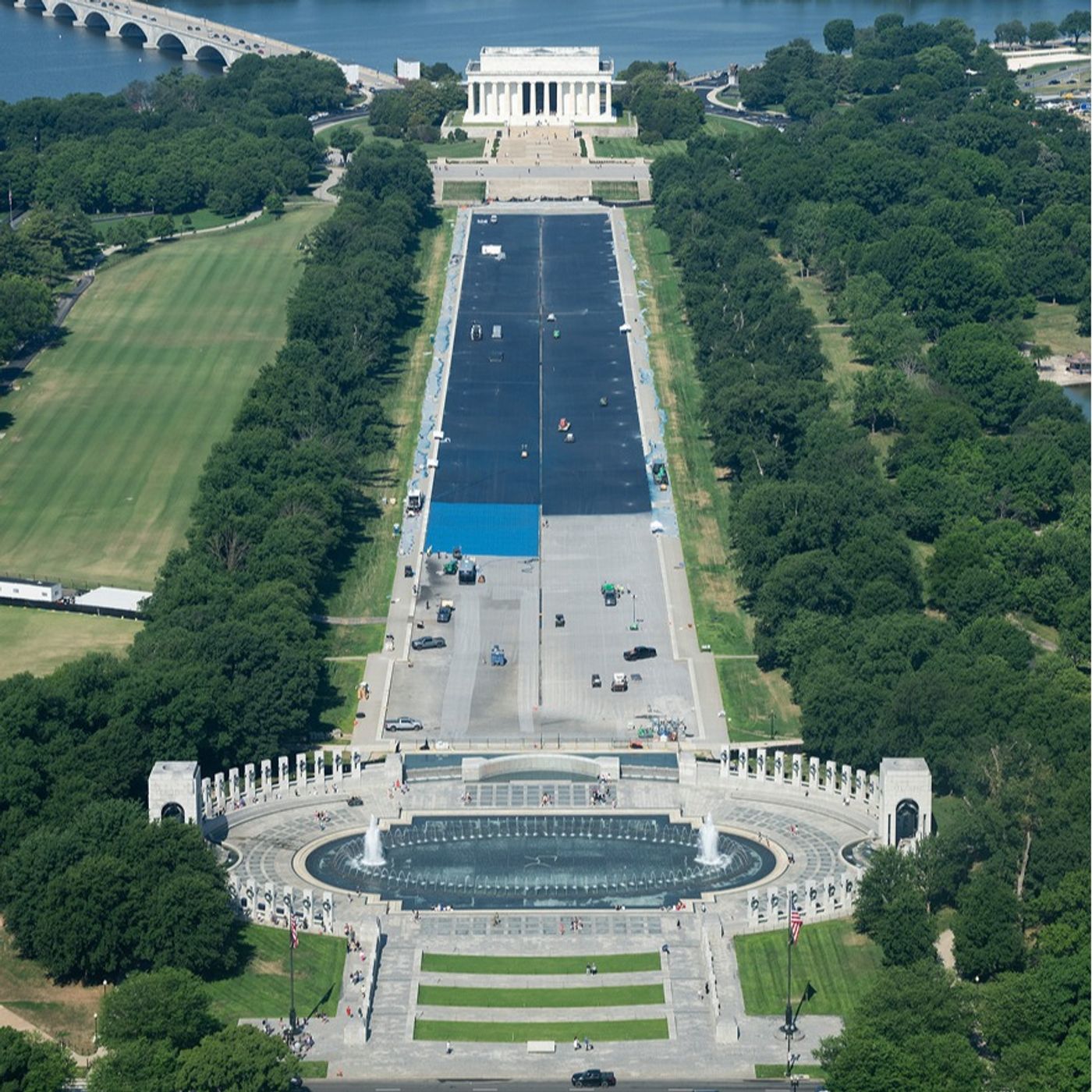
No, we're standing in front of a construction site. The reflecting pool is empty of water. Instead, it has a semi truck, lots of trailers, generators, a lot of construction equipment. There's sandbags, Porta potties. Porta potty. Barrels of supplies. We're looking at a very large construction site here.
- [18:17]
Podcast Host
So talk us through the construction that's happening here and how it fits into the larger reporting project you've been up to.
- [18:24]
David Fahrenthold
Well, the project we're seeing in front of us is another example of the Trump administration bypassing the usual computer competitive bidding process and just handing an important contract directly to one company.
- [18:33]
Podcast Host
Okay, and what is that company?
- [18:36]
David Fahrenthold
Company's called Atlantic Industrial Coatings. It's a small company based in a place called New Canton, Virginia. Oddly, President Trump told the story several times of how this company was hired. He said, I realized that it was actually just a giant swimming pool. I talked to the swimming pool guys from my golf clubs. I picked the guy who'd done a great job at my golf club in Northern Virginia. And I called him, I said, can you take care of it? He said, great, you know, I can handle it. A pool's a pool, a pool's a pool, and we'll do it like a pool. And that was what President Trump said several times in public. It turns out that's not true. As far as I can tell, this company advertises no experience doing swimming pools. There are experiences in things like coating highway culverts, fuel tanks, waterproofing things, but not swimming pools. And I also don't think they've ever worked for the Trump Organization. And now Trump himself has said as much. He said, I don't know this company and they never worked for me. Raising again the question of how they got this job. It's odd that this company, which doesn't have any advertised experience doing even small swimming pools, would be entrusted by the government without any sort of competitive bidding process. But that is what happened.
- [19:40]
Podcast Host
And this is this company's first time doing work for the federal government.
- [19:43]
David Fahrenthold
This is their first ever federal contract. Wow.
- [19:45]
Podcast Host
It's a pretty big stage to make a debut on.
- [19:47]
David Fahrenthold
It is, that's right.
- [19:48]
Podcast Host
And what is the scope of work that this company is undertaking here to get this thing fully functioning by the 250th anniversary?
- [19:57]
David Fahrenthold
Well, we could see that work in front of us. So one of the things they're doing is spreading a waterproofing compound on the 8 inch thick concrete slabs. They're also filling in the gaps or trying to fill in the gaps between the concrete slabs.
- [20:07]
Podcast Host
So that's supposed to address the leaks?
- [20:08]
David Fahrenthold
The leaks.
- [20:09]
Podcast Host
Okay.
- [20:10]
David Fahrenthold
To understand, though, why that was such a risk, I think you need to know a little bit more about why the pool has been troublesome and why it needs repair. Okay.
- [20:17]
Representative Don Beyer
The pool.
- [20:18]
David Fahrenthold
Pool has three main problems. The water leaks out between the concrete slabs. There are pipes that connect the pool to its filtration system, which is behind us here, a few hundred yards away. Those pipes often break and leak, which means they have to shut everything down or else the water just leaks out into the ground. And then at the filtration site, there's also a need for a better filter because algae blooms, makes the water green and matted and ugly and actually makes it impossible to reflect in some cases. So lots of administrations have tried over the years to fix those problems. So President Trump in his first term started thinking about, how do I fix the problems of the reflecting pool? And what we're seeing now is that in his second term, he's actually trying to make those repairs happen. Well, here's what's odd about what the Trump administration is doing. They are doing two of the three things that needed to be done before. They're trying to fix the leaky joints between the concrete slabs. Another Contract not done by this company is putting a new filtration system in, but they're not doing one key piece, which is they're not fixing the pipes that connect the pool with that filtration system. And if those don't get fixed and they continue to leak, then the algae problem could recur because you're not getting the water to the place where it's cleaned.
- [21:25]
Podcast Host
And why wouldn't you just fix this root to stem, fix the pipes, permanently restore this pool?
- [21:33]
David Fahrenthold
It's a great question. That was the plan starting in the first Trump administration through Biden. The plan was to do all three of those things. Seal the pool, fix the pipes, fix the filtration. Somewhere. This year, the fix the pipes thing got put on the shelf. They say now they might do it in the fall, but it's not happening now. And until that gets done, what people we've talked to said it's not a permanent fix. And we see in Park Service documents that the Park Service says, you know, our own people didn't come up with this plan to fix the pool. The person who came up with it is a guy named David S. An administration advisor. Who is David S. If you look in other documents related to this contract, you see that a guy named David Schutzenhofer, who's the general manager of Trump's golf course in Bedminster, New Jersey, was advising the Park Service on this job, was helping connect them with other vendors. We don't know for sure that he is the same David S. But you see that the origins of this, this whole idea, the whole plan for fixing this pool, have come from outside the Park Service, and it was an idea they hadn't even considered before. So that gives you a sense of how kind of out of the box this solution is.
- [22:42]
Podcast Host
What is the price tag that this company is charging all of us to do this work?
- [22:47]
David Fahrenthold
It's charging right now $13.1 million. That is notable because it's also different than President Trump first described. He originally said this contract would cost $1.8 million. It's now, obviously, seven times that.
- [22:59]
Podcast Host
Okay, and do we know why this
- [23:01]
David Fahrenthold
contract is as large as it is? In part because the company is charging 20% for overhead and then 20% more for profit. Now, we've seen Park Service documents that show that even within the Park Service, people believe that those two percentages, 20% and 20%, were excessive and inflated. The Park Service is paying them anyway, in part because they're on a very quick timeline. The government wanted this work done. So badly that it actually told them to stop start work before they'd agreed on a price tag. And so that means that later on, when they came to haggle over the final price, the pool was already partly underway. So the government has very little leverage to come back then and say, hey, listen, we're not going to pay the full price. Would they really threaten to kick them off with the work partly done?
- [23:41]
Podcast Host
Right. And with everyone understanding that the President wants to get this thing ready for 250th, which means we really only have a couple months left.
- [23:48]
David Fahrenthold
That's right. The original due date for this project was May 22nd. Now President Trump is saying the real deadline is July 4th.
- [23:55]
Podcast Host
Right. Which I think brings me to the final issue with the reflecting pool, which is the President's selection of a very specific shade of blue, which I am looking at. And I just want to ask you about.
- [24:08]
David Fahrenthold
Well, a lot of the pool's bottom is painted a dark shade of blue. President Trump said that he had originally wanted to be turquoise like the Bahamas, but that the contractor that he had hired for this told him that it should be American flag blue. And so American flag blue is what they've settled on.
- [24:23]
Podcast Host
Kind of a deep navy blue.
- [24:24]
David Fahrenthold
Yeah, it's a dark kind of blue. Dark blue jean blue. That is the color now of most of the pool. It will be the final color of the entire pool. And the question is, what will it look like when it is filled? People that I've talked to, landscape architecture experts, say that it probably will not affect the reflectivity. What makes it reflective is that it's shallow when it's dark, and it will still have both of those elements.
- [24:44]
Podcast Host
So in the end, when it comes to the reflecting pool, we have a project that's not going to solve what may be all the big underlying problems. And because the administration granted this to a single company and didn't put it out for any competitive bidding process, we don't know if somebody might have come along and said, actually, I can do it for less than 13 million. We'll never know that because of the way that this contract was awarded.
- [25:09]
David Fahrenthold
That's right. This case really embodies the risks of no bid contracts. Right. Without knowing what other people would charge, without knowing how other people would have attacked these same problems, it's really hard to know if what they have here is the right solution, the best solution, the cheapest solution. It's impossible to evaluate what else could have been done. We only know what they have.
- [25:30]
Podcast Host
All right, Dave, we have one last stop. On this tour. And that is the Arch.
- [25:35]
David Fahrenthold
That's right. We're now going to walk west to the Lincoln Memorial to look across the Potomac river at the future site of
- [25:40]
Podcast Host
the Triumphal Arch, the United States triumphal archetype. The Lincoln Memorial right over there. This is by far my favorite. I think it's everyone's favorite.
- [26:05]
David Fahrenthold
Yeah, mine as well.
- [26:06]
Podcast Host
Monument on the Mall. Because it's something spectacular about going into his little home.
- [26:12]
David Fahrenthold
Right. It is grand and also intimate when you get inside there. Should we just go to this little, like patch of green here or do you want to go across the bridge? I'm happy to do either one.
- [26:27]
Podcast Host
Can we stand up on this?
- [26:28]
David Fahrenthold
I don't think so. I don't think there's any problem. Parkour.
- [26:39]
Podcast Host
So, David, we just scaled the wall and now we're sitting on a patch of grass behind the Lincoln Memorial. And we've picked an incredible moment to have a conversation about the Arch. Let me explain why. There is currently a protest, a group of people marching against the arch. They have handwritten signs saying no arch.
- [26:57]
David Fahrenthold
They have a tuba. There's a band in there.
- [27:00]
Podcast Host
There are people beeping. And that volume is on top of all the traffic and the planes going overhead. So just explain to us as we're looking down at the Arlington Memorial Bridge, how the arch is going to fit into the view that we're taking in right now and what you've learned about the process behind the arch so far.
- [27:22]
David Fahrenthold
Well, what we're looking at now, across the other end of the bridge is a green hillside in Virginia that belongs to Arlington National Cemetery. Instead, with the arches completed, you will see a very large 250 foot tall, that's 25 story tall triumphal arch, which is a little bit like the Arc de Triomphe in Paris, but bigger. And it will have golden statues. I believe there'll be angels and eagles. It'll be a really good large arch dominating this view.
- [27:47]
Podcast Host
Got to be the biggest new construction in this kind of official stretch of Washington in decades.
- [27:54]
David Fahrenthold
That's right. It will be something on the scale of or bigger than the Lincoln Memorial. We haven't built anything that large as a monument on the Mall in, as you said, decades.
- [28:04]
Podcast Host
And how has the president gotten the arch to this point? And how emblematic is it of what we just saw at Lafayette and with the reflecting core?
- [28:12]
David Fahrenthold
Well, there hasn't been any contracts to sign yet, so we don't know if there's going to be no bid contracts or not. But it is of a similar vein in that he is trying as much as he can to avoid or bypass outside oversight. So even to Congress. So there's been a. He's made the point to Congress that normally they would have to approve something this large in Washington's monumental core. But he said they don't need to because 100 years ago, another Congress approved a sort of similar sounding project that was never built, and so it already has congressional approval. That's extremely creative. Yes, it is similar to the other projects in that they are going as fast as they can to build something as big as they can.
- [28:45]
Podcast Host
And what kind of opposition has or hasn't it aroused, besides the honking horns here on the road?
- [28:51]
David Fahrenthold
There are a lot of people in Washington unhappy about it. There have been some lawsuits filed. There are people who would like to stop this in its tracks. A group of veterans have sued, saying that this disrupts the view of Arlington Cemetery, but none of them succeeded so far. There have been some incremental changes as a result of some of the review boards that have considered it. It's gotten slightly shorter. I believe some of the lions have come off, but the fundamental shape of it is still, for now, the same. The noise we're hearing from the planes is a reminder of one of the big hurdles laying in front of it, which is actually that this is on the flight path, the approach to Washington National Airport. And there is a concern that the FAA might block it because it will be turned much of a constriction on air traffic. So there are some hurdles in front of it. But I. If I had to bet, I would bet that it's going to be built.
- [29:36]
Podcast Host
Well, we talked before about sight lines, and I do think it's worth just spending a second on what this arch would change, because there are some really specific structures on the hill behind the Arlington Memorial Bridge that relate to the Civil War. Right. Relate back to. To the Lincoln Memorial and all these kind of reciprocal relationships between the historical monuments of Washington.
- [30:05]
David Fahrenthold
Okay, so if you'll indulge me as a transplanted Washingtonian, I think this is one of the most remarkable places in Washington. So we're standing here by the Lincoln Memorial, a symbol of the rebinding of north and South. So what's beyond us on the other side of the bridge is Arlington House, which belonged to Robert E. Lee. It was Robert E. Lee's home before he left. Left to become the leader, the top general of the Confederacy.
- [30:25]
Podcast Host
A bridge between the home of the man who tried to tear the Union asunder and the president who, through grit and Determination made sure that the country stayed whole.
- [30:34]
David Fahrenthold
Right. And the graves of the folks who died to win that war. And so if you're going to block that, right, if you're going to put something in between these two symbols of the greatest crisis in American history and the reconciliation that followed, you better have a really good reason. Right. It better really mean something that you're putting that there and blocking the view of this incredible piece of American history that's just right across the river from Washington.
- [30:55]
Podcast Host
And what is the reason why the President wants to put this arch here at this moment? And as best I can tell, and Time's 3D renderings does show this, it substantially does change the view, especially from Arlington House, from Arlington Cemetery, back towards the Lincoln Memorial.
- [31:14]
David Fahrenthold
My reading of it is that he wants an arch. He's talked about how all great cities have arches. London, Paris, Rome. And so Washington needs one. And this is the easiest place to put an arch because it's a big empty lawn around which traffic flows. What President Trump says this arch is meant to celebrate is all of us, the 250 years of American history. But it seems in some ways to be more a monument to President Trump and his importance in American history. To the degree that there's any singular person or cause associated with this arch, it's him.
- [31:45]
Podcast Host
Right. You know, it strikes me that any change to the official Washington infrastructure makes people crazy. And I'm remembering the battle that preceded the construction of the World War II memorial, which we walked through on our way to the reflecting pool. It was the late 1990s. I was in high school. There was a huge fight about whether that memorial, Memorial was going to muck up the National Mall.
- [32:09]
David Fahrenthold
Right.
- [32:09]
Podcast Host
And it got built.
- [32:11]
David Fahrenthold
Yep.
- [32:11]
Podcast Host
Despite that huge battle. And it was really, really pitched, really angry. And now no one thinks twice about it. You walk through it, it's just not that big a deal. And you kind of can't imagine that there was ever a big battle over it at all. And I wonder if that's ultimately going to be the case with the arch. Yes, it's going to deprive someone standing at the Arlington House of a very specific view back to the Lincoln Memorial. But is that really such a big deal? And will people ultimately walk under it, drive under it, and ultimately not think that much about, or be grateful for the fact that there's this bold, beautiful arch at the end of the Mall?
- [32:50]
David Fahrenthold
I think you are right that if it is built within a few years, everybody will think of it as part of the scenery in Washington. Nobody will walk by and say, you know, it doesn't belong. It is the same architectural style as the rest of Washington. So it will stand out for its size, but not for its architecture. The one thing that I think is different from the other monuments that have caused consternation in Washington over the years, and I think of not just the World War II memorial, but the very modernist Vietnam War memorial before that, is that those other monuments were monuments to a group of people, people who had sacrificed something. What's slightly different about this is that there's not like one set of people this is designed to honor or one set of people who will come here and feel like, yes, I have my place in Washington that I didn't have before. It's either totally abstract or it's about Trump.
- [33:33]
Podcast Host
Okay, but. And this is a really big but. If we look all around us, left, right, front, back, there are monuments to American presidents all around us. We've talked about Lincoln, we've talked about Washington. Over there to my left is Jefferson. So in that context, why shouldn't President Trump get what we kind of understand to be a memorial to himself, given how monumentally he has changed American politics, American policy, how the world thinks about America?
- [34:08]
David Fahrenthold
Well, traditionally, we have not let presidents build their own memorials. Traditionally, you have to leave office. There has to be some sort of intervening period in which Americans and American history can judge your time in office and decide whether you are worthy of monumental tribute.
- [34:23]
Podcast Host
Right. And how that monument relates to the way we think of you.
- [34:25]
David Fahrenthold
Right. We don't give every president. There's not a Grover Cleveland monument around here. Right. We give presidents that we decide are worthy of emulation and adoration. We give them a place here in Washington. And Trump has decided to give himself that place effectively. And that is very emblematic of who he's been. All the ways he's discarded the so called rules of politics, but also the real rules of Washington and succeeded and put his stamp on the country and the world. So in that way, having Trump build his own memorial is very fitting. That said, you can't seal your place in history and trust that it will stay that way. American history will still render some judgment on Trump. You can't just build a monument and forestall that. But he is certainly trying to make sure that he can't be forgotten.
- [35:13]
Podcast Host
Oh, David, thank you very much.
- [35:15]
David Fahrenthold
Thank you.
- [35:24]
Michael Barbaro
After we spoke with David, Congressional Democrats introduced legislation seeking to block construction of the arch. Their bill claims that the arch relies on illegal use of public funds without permission from Congress. The bill, which is considered a long shot is co sponsored by Representative Don Byers of Northern Virginia, whose district includes Arlington National Cemetery and whose grandparents, parents and sister are buried there.
- [36:00]
Representative Don Beyer
This is one of our country's most hallowed spaces.
- [36:02]
Michael Barbaro
In a video recorded in front of the cemetery, buyers described the arch as an act of desecration.
- [36:11]
Representative Don Beyer
Unfortunately, those of us who treasure it are reckoning with a threat to the peace of this sacred place and to the honor and trust it represents, a towering 250 foot vanity project that would overshadow the resting place of our heroes and hide it from the view of visitors to the National Mall and Lincoln Park Memorial.
- [36:33]
Michael Barbaro
We'll be right back.
- [36:37]
Advertisement Voice
Brought to you by the Capital One Savor card. With Savor, you earn unlimited 3% cash back on dining, entertainment and at grocery stores. That's unlimited cash back on ordering takeout from home or unlimited cash back on tickets to concerts and games. So grab a bite, grab a seat and earn unlimited 3% cash back with the saver card. Capital One what's in your wallet? Terms apply. See capitalone.com for details.
- [37:02]
Listener/Caller
This podcast is supported by Vanguard. To all the financial advisors listening, let's talk bonds for a minute. Capturing value in fixed income is not easy. Bond markets are massive, murky and, let's be real. Lots of firms throw a couple of flashy funds your way and call it a day. But not Vanguard. Vanguard bonds are institutional quality. Institutional quality isn't a tagline, it's a commitment to your clients. It means top grade products across the board. The Lineup includes over 80 bond funds. They're actively managed by a 200 person global squad of sector specialists, analysts and traders. The bond market is complex, and it's not something one person or a small team can realistically keep up with. Vanguard's been in the game a long time, and their scale gives them a serious edge. They're able to invest across all kinds of sectors, maturities and geographies. So if you're looking to give your clients consistent results year in and year out, go see the record for yourself@vanguard.com audio that's vanguard.com audio all investing is subject to risk. Vanguard Marketing Corporation Distributor
- [38:04]
Michael Barbaro
here's what else you need to know today. The future of President Trump's controversial $1.8 billion fund to compensate victims of government weaponization is in growing doubt after decisions on Friday from two federal judges. One judge temporarily barred the fund from being set up, while another reopened a legal case involving Trump and the irs, whose dismissal appeared to lead to the fund's creation at the same time, aides to the president are increasingly urging him to get rid of the fund amid intense blowback from both courts and from Congress. And a cornerstone of the president's plan to celebrate America's 250th anniversary, a series of musical concerts on the National Mall starting later this month, is collapsing. Over the weekend, Trump called for the music series to be canceled after at least five of the nine performers dropped out. Several of the singers said they had originally believed the event would be nonpartisan, only to learn later on that it was being planned and overseen by the president himself. Today's episode was produced by Lexi Diao, Mooj Zaidy, Diana Nguyen and Jack Desadoro. It was edited by Rob Zypko with help from Liz O? Balin and contains music by Mary Adrian Lozano, Rowani Misto, Dan Powell, Brad Fischer and Leah Shaw Dameron. Our theme music is by Wonderlane. This episode was engineered by Afim Shapiro and Alyssa Moxley. That's it for the Daily I'm Michael Balbaro. See you tomorrow.
- [40:10]
Advertisement Voice
Brought to you by the Capital One Savor card. With Savor, you earn unlimited 3% cash back on dining, entertainment and at grocery stores. That's unlimited cash back on ordering takeout from home or unlimited cash back on tickets to concerts and games. So grab a bite, grab a seat and earn unlimited 3% cash back with the Savor Card. Capital One what's in your wallet? Terms apply. See capitalone.com for details.