← The Daily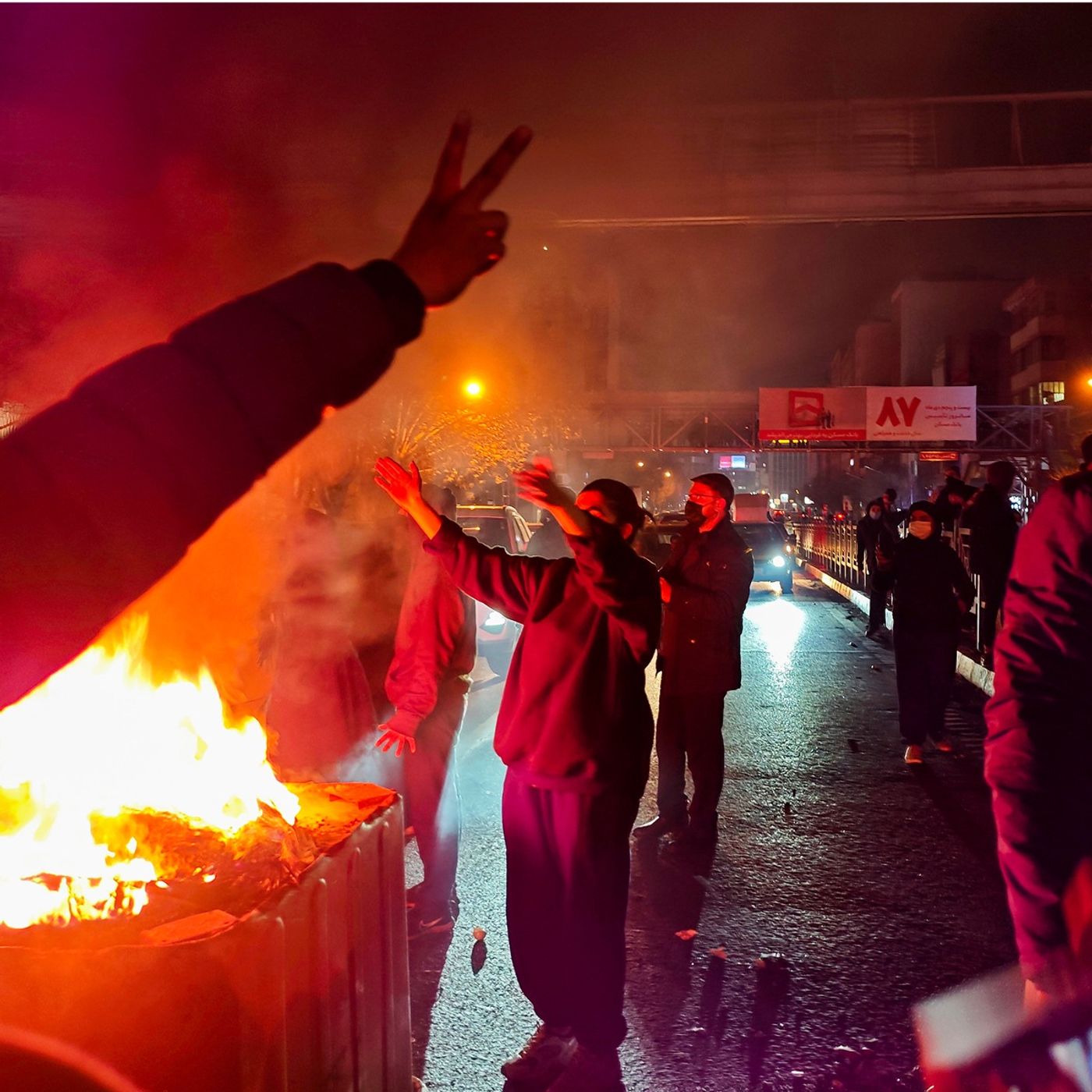
The Daily
Iran on the Brink
00:28:46
Iran is experiencing expansive protests after economic grievances snowballed over the past two weeks into a broader challenge to the country’s authoritarian clerical rulers. In recent days, a full picture of the government’s crackdown on demonstrators has emerged, garnering global condemnation and threats of action from President Trump. Farnaz Fassihi, who has been covering the story, explains what is driving the protesters and why the regime may be facing one of its gravest challenges in decades.
Loading summary
Transcript38 lines
- [00:01]
A
Hi, I'm Solana Pine. I'm the director of video at the New York Times. For years, my team has made videos that bring you closer to big news moments, videos by Times journalists that have the expertise to help you understand what's going on. Now we're bringing those videos to you in the Watch tab in the New York Times app. It's a dedicated video feed where you know you can trust what you're seeing. All the videos there are free for anyone to watch. You don't have to be a subscriber. Download the New York Times app to start watching. Over the past week, massive protests have erupted across Iran. Calling for economic reform and an end to the regime. In recent days, a full picture of the government's crackdown on the protesters has emerged, garnering worldwide condemnation.
- [01:03]
B
We don't want to see what's happening in Iran happen.
- [01:06]
A
And threats of action from President Trump.
- [01:08]
B
When they start killing thousands of people. And now you're telling me about hanging. We'll see how that works out for them. It's not going to work out good.
- [01:18]
A
Today, my colleague Farnaz Fasihi on what's driving the protesters to and why the Iranian regime has never been closer to collapse. It's Wednesday, January 14th. Farnaz, thank you so much for joining us.
- [01:39]
B
Thank you for having me.
- [01:40]
A
Farnaz, you have been covering Iran for decades. And we at the Daily turn to you during these huge moments of disruptions, eruptions, which is what it feels like we are in right right now in Iran. We're talking to you Tuesday afternoon at about 1:30pm and I'd like for you to start off by characterizing what we are seeing on the ground right now.
- [02:03]
B
For the past week, we've seen nationwide protests in cities big and small, across different demographics erupt all across Iran with a singular demand for the end of the Islamic Republic's rule. And this is coupled with an external threat from the United States and Israel that there might be a military strike on Iran and an economy that's in tailspin, which is creating a very unique and difficult challenge for the government because it's facing a kind of a perfect storm. But we're also seeing the government brutally responding to these protests and violent crackdown unfolding with thousands of people killed and injured and bodies are piling up at the morgue and at the cemetery as reports of the killings trickle out.
- [02:59]
A
So as you said, it is a perfect storm of things that the regime is dealing with in terms of threats. So I want to start with the protests themselves and what's going on inside the country? Can you just talk a little bit about what's driving people to the streets?
- [03:14]
B
People are just fed up racial. They feel like they've got nothing to lose, that this government is either unwilling or incapable of bringing the kind of change that people want to see in their lives, ranging from social freedom to political freedom. And of course, the economy which is fueling these protests. Now, we have to remember that Iran's economy has been in shambles for years. President Trump reimposed sanctions on Iran China, targeting its oil revenues and international banking structures in 2018, when he exited the nuclear deal between Iran and world powers. In the fall, the United Nations Security Council reimposed UN Sanctions on Iran through a mechanism known as snapback, related to Iran's standoff with Europeans in the United States over the nuclear program. And from then, the currency started falling even further than it had before. But In December, on December 28, the rial plunged to an all time low against the US Dollar. And it sort of unleashed this wave of anger because when the currency free falls, it has a direct impact on inflation and on the prices of everyday goods, including food items. Inflation is now around 60%. Prices of everyday goods such as cooking oil, rice, eggs, like staples of an Iranian grocery basket, suddenly tripled overnight. So this wave of protests that we're seeing now started in Tehran's bazaar, which is really the pulse of Iran's economy. The bazaar is the equivalent of the stock market here, right? So when the bazaaris go on strike, it really can paralyze the economy. And the reason the bazaaris went on strike was because the rial was plunging against the dollar. The prices were fluctuating, and they were facing too much instability. You know, from hour to hour they had to adjust the prices of what they had to buy and what they had to procure and what they had to sell because they didn't know within a few hours what the price of US dollar against the real was going to be. And there was this sense that we want to put pressure on the government and the central bank to try to stabilize the currency because we just can't operate this. And then it spread. It first spread to working class areas, to small towns that are underdeveloped, that are economically on a lower level. And it sort of percolated that way for about a week.
- [06:15]
A
And how did the government respond to all of this growing unrest?
- [06:20]
B
The government initially responded with a more conciliatory tone with the President, Masoud Pezeshkian, saying, you're all my Children, the protesters have a legitimate reason to protest. We understand, and we feel bad. And then he moved very quickly to take measures that he thought would contain an appease, particularly the bazaar. He sacked the governor of the central bank. He also announced a new currency policy. And then the government announced that it was giving every Iranian a monthly stipend of $7, which, because of the inflation, it could only buy you a bottle of cooking oil. But the measures that he was taking not only did little to appease people, but they also had an opposite effect. So it sort of reinforced this feeling that the people who are in charge don't really know what they're doing and things are not going to get better. And that fueled more anger, that sparked more outrage, and, you know, momentum was sort of building for people to come out in larger numbers and say enough is enough.
- [07:38]
A
So we're talking about a crisis that is largely sparked, it sounds like, from this spiraling economy. But I think that a lot of people who are listening to this are going to remember another protest just a few years ago that started over women's rights. And there was a question then too about whether these protests, whether this unrest would actually topple the regime. Obviously that did not happen. But can you talk a little bit more about why, more broadly, Iranians are unhappy with the government? That goes beyond the economic reasons you've just laid out.
- [08:10]
B
The Iranian society is very different from the government and clerics that rule it. The majority of people are a lot less religious than what the state wants and what the state has, has enforced. They are not ideological. Sort of the ideology of the Islamic Republic of the 1970s, where we're anti American, we're anti imperialist, that has faded in generation after generation. And the younger generation, as we've seen in videos coming out in protests of the women led uprising that you mentioned, want a different kind of a life. They're super plugged in on social media. They see how the rest of the world is living, how their counterparts in other countries, not just in Europe and the U.S. but in Turkey, in Dubai, in, you know, other Muslim countries, they have social freedom, they have economic prosperity. And they're saying, why not us? Iran's a very resource rich country. It has oil resources, energy resources. And what I hear from many Irans is that this is not a government and a system that we deserve. We have to remember that over the past two decades there have been waves of pro democracy protests happening in Iran, starting with the student activist movement in 1999, the green movement in 2008, the women led protests and uprising in 2022, all of them grassroots and mobilized and organized by activists and leading opposition figures inside the country, such as Iran's most prominent human rights activist, Nargis Mohammadi, who's a Nobel Peace Prize laureate who's currently in jail. And many people look up to her as a leader of this pro democracy movement. So we see all of these forces at play on the streets across Iran in videos that we're seeing coming from the protests that have gone viral. We hear crowds chanting, death to the dictator. Death to the oppressor. Whether be it king or the supreme leader. Clerics, get lost. We're also hearing crowds chant Long live the Shah, a reference to the last monarch of Iran, Muhammad Reza Shah Pahlavi, who was toppled in the 1979 revolution. In what seems to be a nostalgic call for an era that Iranians remember pre the revolution. And we're seeing young men and women crowds forming in in different parts of the capital and Tehran and other cities, fists in the air, chanting, freedom, Freedom. Azadi.
- [11:24]
A
So it sounds like this is really the culmination of a deep disconnects between the Iranian people and its leadership, which at least, as you said, initially seemed sympathetic to the movement and its concerns. But clearly we know that the situation has turned very bloody and very hostile and violent. And I wonder, when did that switch happen and what have we seen in terms of the violence that's gone on on the ground?
- [11:50]
B
The change of rhetoric from the government started when Supreme Leader Ayatollah Khamenei delivered a public speech foreign, Labeling protesters as rioters and saying they were the agents of the United States and Israel. And they were destabilizing the country, working for Iran's enemies. Iran's chief judiciary also said that there would be no mercy for anyone arrested and justified the crackdowns by pointing out to widespread vandalism and burning of public properties and cars, and even attacks on mosques and police stations that they had seen.
- [12:57]
A
Rising now, now, now.
- [12:59]
B
And then on Thursday, when the crowds swelled in the streets and the cries for freedom grew louder, The government unplugged the Internet and plunged the country into total D. They blocked incoming and outgoing international calls, making it really difficult for anyone outside to get visibility about what was really going on. Cell phone reception inside the country has also been disrupted in what seems to be an effort to try to stop people from organizing and mobilizing protests. By Sunday, a picture was emerging that a massacre was unfolding in Iran. I've been able to communicate to protesters to Doctors, nurses, and people who've been on the ground through satellite Internet connection that they may be able to find. Everyone that I spoke to who's been out to protest has seen someone get shot and killed in front of them. Two people told me that they saw snipers in two different parts of the city shooting down at the crowds. A friend who was in central Tehran described a horrific scene of security forces gunning down young people. A young crowd of men and women with machine guns and people falling on top of each other. Nurses and doctors that I've been able to connect with described absolutely horrific scenes unfolding at hospitals. People shot at close range in the head, in the torso, from the back. One video that went viral was of an Iranian wildlife photographer, Sadeq Parvizadeh. His face is bloody, blood dripping from his face, and his addressing the camera, saying. To the security forces, how can you fire your own countrymen? Killing a person is like a game for them. I swear to God. We're also citizens of this country. We have pain. Videos we're seeing from Tehran's morgue show bodies in bags piled in the parking lot and on the ground, and families wailing and screaming as they're going through them, trying to identify their loved ones. This is a level of violence and cruelty that I haven't seen in the 30 years that I've been covering Iran.
- [16:09]
A
What you are describing, Farnaz, is just horrific and inconceivable, I think, to a lot of people. Just these scenes of absolute carnage all over Iran. And I wonder whether the brutality of this response is working for the regime in terms of actually quelling the protests or. Or whether it perhaps is having an opposite effect on people and what they're willing to do in the face of all of this opposition.
- [16:36]
B
The situation is very fluid. The protests have attracted international attention, pressure on the Iranian government, and, of course, the unpredictable variable of whether the United States is going to take military action the against Iran.
- [17:07]
A
We'll be right back.
- [17:12]
C
Hi, I'm Megan Lorum, the director of photography at the New York Times. A photograph can do a lot of different things. It can connect us. It can bring us to places we've never been before. It can capture a story in a universal visual language. But one thing that all these photographs have in common is that, you know, they don't just come out of the ether. We spend a lot of time anticipating news stories, working with the best photographers across the globe. These are photographers who have spent years mastering their technical craft, developing their skills as visual chroniclers of our world. You know, getting certified as a scuba diver and learning how to shoot underwater to document climate change or tremendous cardiovascular training in order to ski on the slopes next to Olympic athletes. This is an effort that takes tons of time and consideration and resources. All of this is possible only because of New York Times subscribers. If you're not a subscriber yet, you can become1@nytimes.com subscribe.
- [18:14]
A
Fernaz at the beginning of this conversation we talked about internal forces on Iran and external forces on Iran. So I want to go external now. Can you talk about what has happened outside of Iran that has led to this moment and had such an impact?
- [18:28]
B
Remember that Iran has had a really tough year. In June, Iran had an intense 12 day war with Israel when Israel launched surprise attacks on Iran's military structure and took out its military command chain and nuclear scientists. Iran was able to strike Israel with a barrage of ballistic missiles. But that war exposed Iran's weakness in terms of being able to defend itself. And the war, of course, culminated with the United States getting involved in bombing and severely damaging Iran's nuclear facilities. Another dynamic at play here is that Iran's regional standing has changed. It's militant allies around the region that it helps arm and fund, like Hezbollah in Lebanon and Hamas in Gaza, have been decimated and weakened by Israel. Iran had counted on these groups, particularly Hezbollah and Syria, the base that it had in Syria, as a way to exert pressure and as sort of a forward defense that it would say, well, if you attack me, I can also fire and create problems across the region. In that sense, Iran has really been weakened.
- [19:44]
A
How should we be accounting for all of that? The embarrassment, the evident vulnerability is that on the minds of these protesters that we're seeing out on the streets now.
- [19:55]
B
Of course, I think that all of this feeds into the momentum where it emboldens people taking to the streets thinking maybe this is the moment.
- [20:05]
A
We've talked about how one big open question right now is how the United States is going to respond. And President Trump has said on multiple occasions he's willing to take action in defense of the protesters. On Tuesday, even he put a post on Truth Social urging people to continue protesting. He said that they will pay a big price, referring to the regime. So what do we know about how the regime is thinking about the president and his threats?
- [20:37]
B
Iran's leadership is taking the threats and rhetoric coming from President Trump very seriously. They of course, have the experience of the US Bombing the nuclear facilities, but also what happened in Venezuela really rattled them because there was this sense that President Trump is not bluffing and he'll actually carry out what he says. From my conversations with a few government officials, we know that Iran's National Security Council conducted an emergency meeting to talk about how they would prepare. I know that Iran's armed forces been put on the highest alert possible, anticipating an attack. And the government has said that if the US Attacks us, we are going to retaliate forcefully against American targets and ships and military bases in the region. And we will also attack Israel. So it seems like they're preparing for war.
- [21:38]
A
There's also some broader context that we should not neglect here about the relationship between President Trump and Iran, which has for years been extremely antagonistic. During the first Trump administration, President Trump killed Iran's top general. That led to an Iranian assassination plot against President Trump. But I've also been having a lot of conversations more recently with colleagues in the newsroom who cover the administration about how, if at all, any of that that I've just described plays into Trump's decision making. And they've told me a range of answers that this could be about regime change right now. It could also be about oil, but it is also about power and how Trump exerts it. So I wonder what you make of all of this, Farnaz, just trying to put together all of this context, history and the latest comments we've seen from the president. What is your assessment about sort of why the United States is considering some of this action?
- [22:35]
B
Well, we don't know for sure what President Trump's motivations are. We don't even know if he's going to go ahead and topple the Iranian regime. He has said previously that the US does not want to engage in nation building and regime change anymore. But it's also possible that President Trump sees some benefits to eliminating the Iranian government's rule because it would end nearly five decades of animosity between Iran and the United States. It would also remove a government that has been hostile to not just the United States, but also to Israel. There's also a slight chance that this could help realign the Middle east in ways that could benefit and secure American interests. And of course, Iran is an oil rich country, so there's also the energy factor there, too. But we also know from history, including recent history, that military interventions in the Middle east carries enormous risks. I was a war correspondent in the Middle East. I covered the Afghanistan war in its aftermath, Iraq, Syria. And we've seen that the US can win the military war because of its military might, but it can't win the long war or the long peace. That stability and a smooth transition have been elusive in other places where the US Intervened, namely Iraq. The United States own history with Iran is also checkered. In 1953, the United States intervened and toppled a democratically elected government of Prime Minister Mossadegh and reinstalled the Shah through a CIA coup. And many Iranians will tell you that that killed the path that the country was on toward becoming a democracy or a republic. And within a few decades, it exploded in an Islamic revol. And, you know, usually regimes and governments are toppled either by defections and coups inside or by military interventions. We haven't seen any major defections among the military ranks of Iran's armed forces. We haven't seen defections among the political class. So right now there's no sign that something's going to happen from within. And for all the reasons that we, we have discussed, a military intervention to topple the government could actually bring about years of instability.
- [25:15]
A
What might that instability look like for Naz?
- [25:17]
B
Well, I think for one thing, the fight for what Iran's future might be. What kind of various opposition groups that are very divided and don't have a unified vision even currently. So how would that play out? There are ethnic minorities in Iran that have aspirations for separatism, for federalism. There are also forces in the region, including the Islamic State terrorists, including militant Islamic forces that might, like they did in Iraq, like they did in Syria, might see a power vacuum in Iran and pour into the country and use that as a power base. And also we have to also remember that the Iranian government does have a support base of about at least like 10%. It does have armed Revolutionary Guards and paramilitary force that are loyal to it. So you could see also a scenario where they would form armed insurgencies and fight whatever is the next government. These are scenarios that are not fantasies. And it's important to keep a clear eye and sober view of what the options are and what the outcomes may be.
- [26:26]
A
Farnaz, you have seen and covered decades worth of uprisings in Iran. And I wonder what you think it would do to the Iranian psyche and to the people who are in the streets right now at such great personal risk if ultimately nothing really changes in Iran and the status quo remains.
- [26:47]
B
The current uprising in Iran has created a sliver of light and hope for Iranians inside and for the diaspora watching what's unfolding in their country. And I think for people to feel they're so close to change and to freedom and for it to be crushed would be devastating, would be heartbreaking, but I don't think it would be the end of the aspirations of the Iranian people. I think no matter how much force the government uses and the level of crackdowns, it can crush protests periodically. But it can't kill the dream as it hasn't been able to in previous protests. The protests have built upon each other over the years and what I hear this time and what I see is that the Iranian people have lost their fear.
- [27:54]
A
Farnaz, thank you so much.
- [27:58]
B
Thank you for having me.
- [28:09]
A
We'll be right back. Here's what else you need to know today. On Tuesday, six federal prosecutors in Minnesota resigned in protest over the Justice Department's push to investigate the widow of Renee Good Good, the protester killed by an ICE agent last week. At least one of the prosecutors, Joseph Thompson, reportedly also objected to the department's refusal to investigate the shooter. Johnson and another prosecutor were leading the sprawling fraud investigation that has roiled the state in recent weeks. And Bill and Hillary Clinton are refusing to to testify in the congressional investigation of Jeffrey Epstein, escalating a months long battle with the Republican Representative James Comer of Kentucky, who chairs the Oversight Committee and who said he would hold the couple in contempt. The strategy to push the Clintons to testify reflects Comer's overall approach. Deflect FOCUS from President Trump by redirecting it to prominent Democrats who also associated with the convicted sex offender and his longtime companion Ghislaine Maxwell. Today's episode was produced by Mooch Sethi, Rachelle Banja and Jessica Chung, with help from Ricky Novetsky. It was edited by Michael Benoit and Patricia Willans, contains music by Diane Wong, Marion Lozano and Pat McCusker and was engineered by Alyssa Moxley. That's it for the Daily I'm Rachel Abrams. See you tomorrow.
- [30:13]
B
This podcast is supported by the American Petroleum Institute. Energy is all around today. America's natural gas and oil keeps the country moving, growing and building, and makes every day a little easier. But energy demand is growing and the infrastructure built today will help secure a more affordable, reliable future with enough energy to go around. When America builds, America wins.