← The Daily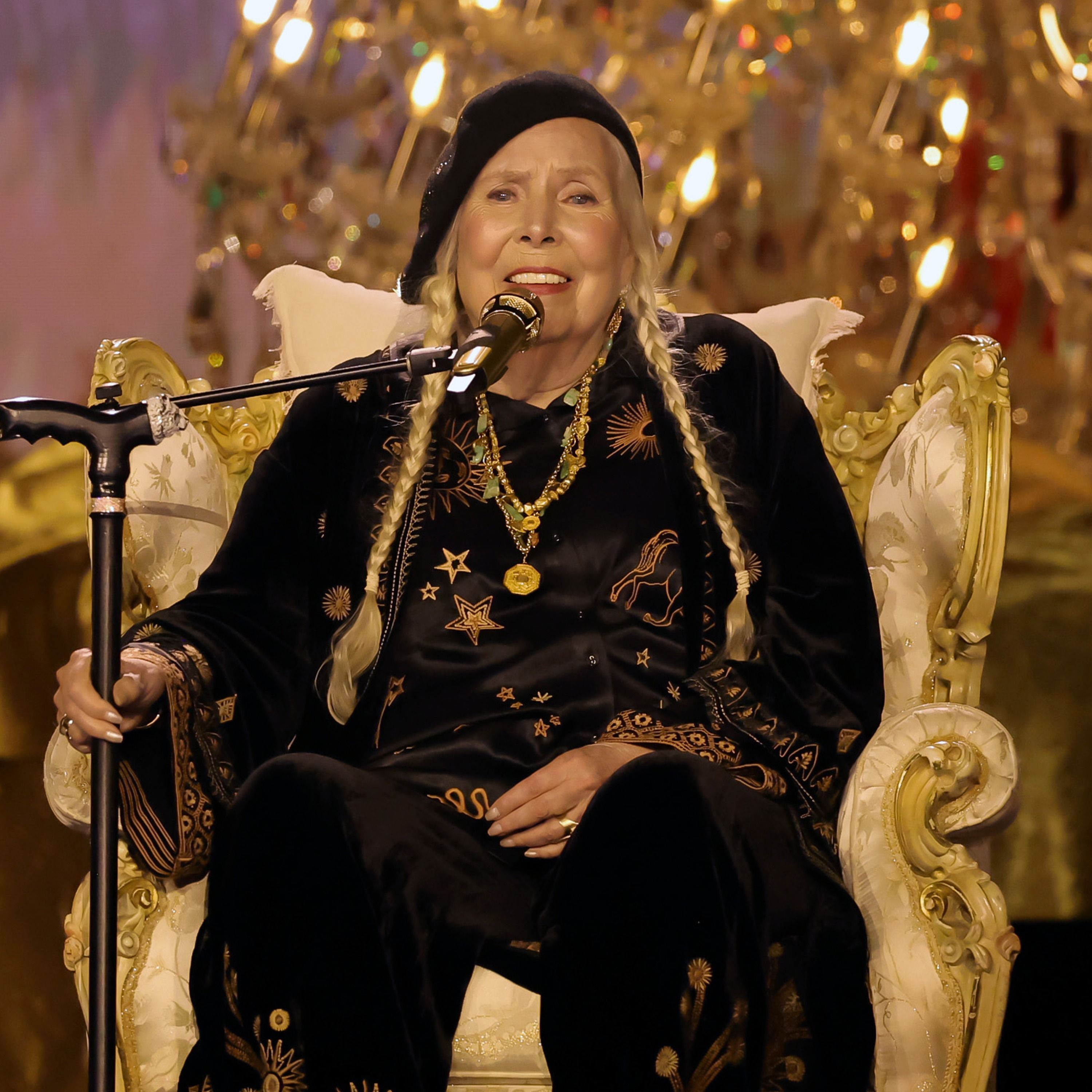
The Daily
Joni Mitchell Never Lies
00:33:15
In 2022, seven years after surviving a brain aneurysm that left her unable to sing or even speak, Joni Mitchell appeared onstage at the Newport Folk Festival. Singing alongside her were her supportive — and emotional — musician friends, including Brandi Carlile, Marcus Mumford and Wynonna Judd. Our critic Wesley Morris had his doubts. What was really happening here? Did Joni Mitchell even want this? Or were her younger adoring musician fans propping her up for their own reasons? When he learned this fall that Joni would be appearing onstage again, at the Hollywood Bowl, he bought a ticket to see for himself. On today’s episode, Wesley talks with his editor Sasha Weiss about the concert, and what it’s like to experience an 80-year-old in full command of her meaning.
Loading summary
Transcript167 lines
- [00:00]
Wesley Morris
This podcast is supported by Google Gemini.
- [00:03]
Michael Barbaro
Google Gemini is an AI assistant you can talk to any time you need.
- [00:06]
Sasha Weiss
Help brainstorming, prepping for something important like.
- [00:08]
Michael Barbaro
An interview or exam, or just learning something new. The best part is you already know how to use it. Just open the app, start talking, and Gemini will do the rest.
- [00:16]
Sasha Weiss
And by the way, this script was.
- [00:18]
Michael Barbaro
Actually read by Gemini.
- [00:19]
Sasha Weiss
You can download the Gemini app for free on iOS or Android.
- [00:23]
Michael Barbaro
Must be 18 to use Gemini Live. Hey, it's Michael. For our last few episodes of 2024, we're bringing you something really special. A Year of Culture in review. We're going to begin with one of our all time favorite guests talking about one of the year's most astonishing performances and the really improbable story of how it even happened today. Critic at large Wesley Morris on the comeback of the singer and songwriter Joni Mitchell. It's Christmas Day Wednesday, December 25th. I'm Wesley Morris. I'm a critic at the New York Times. And back in 2022, this news broke that this amazing event had taken place at the Newport Folk Festival in Rhode Island. Joni Mitchell had come out and played a concert for the first time in a long time. And it was a big deal because Joni Mitchell, the singer, the songwriter, influencer of generations of musicians, that person had virtually disappeared from public life. She'd sworn off touring, and then in 2015, a brain aneurysm almost killed her. She survived, but her ability to sing or even speak was gone. So you can imagine the shock when she appeared on stage at Newport surrounded by a bunch of musicians led by Brandi Carlisle and including folks like Winona Judd and Marcus Mumford. Some of these same musicians had been convening at her house in la and somebody started calling those gatherings Joanie Jams. And now here they all were, taking her living room sessions public. The Joni Mitchell fans went crazy. She was back, and I might add, back in that signature beret. But honestly, I had my doubts. Like, what was really happening here? Did Joni Mitchell even want this? Or were these adoring young musician fans making her do something for their own reasons? Was it elder care? I wasn't there. I don't know. And then earlier this year, I'm watching the Grammys at home in my living room, and in the middle of the show, the stage went dark and a familiar voice filled the room.
- [02:54]
Joni Mitchell
Frozen flows of angel hair.
- [02:59]
Michael Barbaro
It was low and it was deliberate.
- [03:01]
Joni Mitchell
And ice cream castles in the air.
- [03:06]
Michael Barbaro
And slowly part of the stage spun around to reveal feather Canyons everywhere. Joni Mitchell seated in an armchair, one hand stirring a walking cane, the other moving to the cadences of her own lyricism. And she was indeed surrounded by other musicians.
- [03:23]
Joni Mitchell
I looked at love from both sides.
- [03:27]
Wesley Morris
Now.
- [03:31]
Michael Barbaro
And I was like, okay, nevermind. I take it all back. Because so much about this performance was so moving. First of all, just the way the people on stage, these musicians, these great musicians were regarding Joni Mitchell, like they were having the same experience that I was at home, except they were there and they were in awe of the beauty of this moment. Like they were at the feet of. Of a musical mother. And then there were the cutaways to musicians in the audience. One shot looked over Dua Lipa's shoulder at Beyonce, who was just swaying in thought. And then another shot caught Taylor Swift mid standing ovation. And I just got the sense that a lot of people in that room were thinking about what 50 years from now looks like for them. How's Anti Hero gonna sound when Taylor Swift's 80 years old? What's that song gonna be about then? But mostly I was struck by how good Joni Mitchell sounded. She's lost an octave over the years, but there's still tremendous power in her lower register. She can still control, she can still wield it. So when more of these Joanie jams got scheduled at the Hollywood Bowl, I knew I had to get myself on a plane to hear her with my own ears and see her with my own eyes. I also knew my friend Sasha Weiss was going. Sasha's a writer and my editor at the Times Magazine, and we talk a lot. And I wanted to ask her what it felt like to be there at one of these shows. We went on different nights. She went on Saturday, I went on Sunday. And I wanted to talk about who Joni Mitchell is to her and how it feels to experience an 80 year old in full command of her meaning. Hi, Sasha.
- [05:27]
Wesley Morris
Hi, Wesley.
- [05:29]
Michael Barbaro
How are you?
- [05:30]
Wesley Morris
I'm good.
- [05:31]
Michael Barbaro
I want to talk about the concert, obviously, but before we do that, I just. I gotta ask you what your relationship to Joni Mitchell is like. What's your first Joni Mitchell moment?
- [05:40]
Wesley Morris
My parents introduced me to Joni Mitchell, and it was at a pretty young age. I mean, I. I can't really remember a time when her voice wasn't in my head. I woke to Joanie. I slept to Joni. You know, I think from the ages of like seven on, I mean, very young.
- [05:54]
Michael Barbaro
Wow.
- [05:55]
Wesley Morris
And they'd play it a lot on car rides.
- [05:57]
Michael Barbaro
So I think Joni, that seems apt.
- [05:59]
Wesley Morris
It's so apt.
- [06:00]
Michael Barbaro
That seems apt for a person who's.
- [06:01]
Wesley Morris
She's a traveler, she's a travel, She's a restless wanderer. And I think that also implanted something in me that, you know, I grew up in. I would say, in some ways, in a kind of cozy, somewhat cloistered environment. I mean, I grew up in New York City, but, you know, in a kind of strong Jewish community. I mean, there was a sense of, like, shtetlikeness in my upbringing, I would say. And I think Joni did implant a seed of wondering and wandering because so many of her songs are about. I mean, on Blue alone, she's in California and she's in Spain, and she's in France.
- [06:33]
Michael Barbaro
I have been on, like, All I Want is. You know, the first line is, I'm.
- [06:38]
Wesley Morris
On a lonely road and I'm traveling.
- [06:40]
Michael Barbaro
Yeah, traveling, traveling, traveling, traveling, traveling.
- [06:43]
Joni Mitchell
Looking for something worthwhile.
- [06:46]
Wesley Morris
I mean, I loved to sing. I still love to sing. And I really studied her singing and learned to sing from Blue. And I think just the leaping in the range, you know, the way that Joni can adventurously, boldly, almost insolently, like, she can go from really low to just leaping up.
- [07:07]
Michael Barbaro
It's sort of doing a parallel bar routine where, like, it goes from the low bar to the high bar, flips around a little bit, goes back down, comes up, and then sticks the landing every time.
- [07:23]
Wesley Morris
Oh, I wish I had a river. I feel like there's a desire there. There's a hunger, there's a command. I wanted that vocally, and I think I wanted it, like, interpersonally or something.
- [07:35]
Michael Barbaro
Like, what does that look like?
- [07:37]
Wesley Morris
I don't know. I think the ability to explore, the ability to, like, take command, the ability to be daring. I mean, I don't know if I've achieved these things, but I think this was, like, my fantasy, especially Blue. But Cordon Spark, too, shaped my ideas about what love was. I always felt like love was a complex, laden thing, not a simple thing. Because of Joanie, what it was to be a writer. I think. You know, her songs are so writerly, so many of them are short stories in miniature. And you get a whole life in those songs. So I think that her words. I listened to them thousands of times. I mean, Blue is just stamped on my consciousness. So I think I wanted to see what kind of woman I'd become by encountering Joanie.
- [08:27]
Michael Barbaro
Oh, my God. We just started talking, and my eyes are already welling up. Okay. I first heard Joni Mitchell in the 90s cause I was listening to this radio station when I was a kid that was really singer, songwriter, heavy. So.
- [08:42]
Wesley Morris
So Night Ride Home.
- [08:43]
Michael Barbaro
Night Ride Home was my first Joni Mitchell album.
- [08:46]
Joni Mitchell
Once in a while in a big blue moon There comes a night light.
- [08:52]
Michael Barbaro
I bought a cassette, and the voice on it was unlike any of the other people they were playing on this radio station. The voice was deeper than the leaping that you're talking about. All of that beauty, which I would describe in some ways as young womanish. By 1991. Had really solidified into something that moved less, but weighed more. There's a song on that album called Passion Play. When all the Slaves Are Free. And it's essentially the sort of song that she had begun to really luxuriate in. Which is a kind of moral judgment on the condition of this. Well, I'm gonna say the United States. She's Canadian, lives in Los Angeles, according to her, is her workplace. And her home in western Canada is her home. But she has a real sense of the way the world is operating. And the way the world is different in 1991 from how it was in 1974 or 69. Even in this particular case. It's just about the possession of land. And this idea that men are not stewards of the land, they're proprietors. And what's it gonna look like when the people that you have laboring for you have a revolution? There's just something about the way that she says, who you're gonna get to do your dirty work?
- [10:34]
Joni Mitchell
Who you gonna get to do the dirty work?
- [10:36]
Michael Barbaro
When all the slaves are free Slaves are free. And she's doubling herself. And that doubling. It just sounds different when your voice is that low. We're gonna get. And I just was so drawn to whatever that sound was. Because there was wisdom in it. Especially with this later music, which I.
- [10:59]
Wesley Morris
Would say, which I don't know as well. So I love.
- [11:01]
Michael Barbaro
Most people don't.
- [11:02]
Wesley Morris
Yeah.
- [11:03]
Michael Barbaro
Most people don't.
- [11:03]
Wesley Morris
Yeah.
- [11:04]
Michael Barbaro
All right, let's talk about the Hollywood bowl show we went to this fall.
- [11:07]
Wesley Morris
I've been waiting. It's been hard. I mean, I watched the newport performance.
- [11:13]
Michael Barbaro
The one in 2022 for big comeback.
- [11:16]
Wesley Morris
And I was so moved hearing her sing again. I think in those performances, her voice was still in the process of returning. There were moments when her voice broke, Moments when the songs felt like they were being explored again. So I felt both moved, amazed, sometimes anxious, watching her. And I really wanted to see her a couple years later and to see what had happened to her voice. And her performance, now that she'd really decided to take it on the road, what was different? I felt it was really her show.
- [11:51]
Michael Barbaro
Yeah, yeah.
- [11:52]
Wesley Morris
That she was the band leader. And it's so interesting because she was seated the whole time, right? She sits.
- [11:56]
Michael Barbaro
Oh, my God, the chair.
- [11:58]
Wesley Morris
Like, chair. And we gotta talk about the furniture, which is incredible. But her presence just has this gravitas and physicality, even though, you know, she's not standing. But she really draws the 17,000 seat, beautiful outdoor amphitheater into her. There's something energetically, incredibly potent. And maybe that was true at Newport too. But I just felt that she kind of returned to some kind of energetic center. I could feel it the minute I saw her come on the stage.
- [12:28]
Michael Barbaro
I felt the same thing. I mean, there's something about the chair, right. I mean, it really is a throne, like, set piece. And it really gives everybody a raid around her, a kind of not subservient role. But they're all there to facilitate the needs of this monarch.
- [12:52]
Wesley Morris
But at the same time, she's so playful. I mean, there's the chair and there's the scepter, like cane, which looked to me to be gilded. You know, like, the chair's a bit gilded.
- [13:01]
Michael Barbaro
There's a coyote. I think it might be a coyote on the actual handle of the cane.
- [13:08]
Wesley Morris
I didn't observe that. I just saw something of tell and glinting and, you know, it's like she's wielding it. But she's so playful. And as you were talking about earlier, you know, her rhythms. Her rhythms are so unusual. And she's tapping them and tracing this kind of rhythmic, idiosyncratic signature throughout the songs. And it's just incredible. So she's at once grand and there's just something droll and fun and playful about her in her posture. It's both. It's both end. And also, I would say that the way the stage looks, it's a recreation, as I understand it, of the Joni jams that took place in her living room over the course of many years, which, you know, led up to this moment of coming back to the stage, you know, where she'd gather with musician friends. And I think Brandi really facilitated it. And all these different people would come, right?
- [14:03]
Michael Barbaro
Many different people came to play for her over several years. Herbie Hancock, Dolly Parton, Chaka Khan, Harry Styles. But not all of those people were on stage that night at the Hollywood Bowl. Definitely none of the people I just.
- [14:15]
Wesley Morris
Named, but it seemed like there was a core group, that those were the People who were on stage who clearly had a long running experience singing with her, like an ability to improvise. That seemed to me to be drawing from the experience of having done a lot of work together. But the stage, I mean, it felt very intimate. And from where I was sitting, like, everyone sort of seemed in a pile. So it was like, you know, it was both really like an ensemble. And, yes, Joanie was this commanding presence.
- [14:44]
Michael Barbaro
I can't imagine what it would be like to go to this concert if you're someone who has flown halfway, like, completely across the country to hear what you think is gonna be a night of her doing Blue.
- [15:00]
Wesley Morris
Yes.
- [15:01]
Michael Barbaro
There are 10 songs on that album and people only heard three. California, California, Carrie, which the audience sung.
- [15:11]
Joni Mitchell
Carry it out your cane.
- [15:14]
Michael Barbaro
It was explicitly stated, this song is for you. You and the audience can sing it. I think that was it. I might be missing something, but I don't think I am.
- [15:25]
Wesley Morris
She did a case of you my.
- [15:26]
Michael Barbaro
Night oh she did do a case of you I could drink a case of you oh, darling but most of the songs were from these later albums. From Hejira in 76 up to shine, which is 2007.
- [15:46]
Wesley Morris
Part of the feeling that I got of her being in command was the set list, which. Oh, yeah, I felt like she was preaching. She was not bringing nostalgia and comfort.
- [15:56]
Michael Barbaro
I got the sense that this is a person who does not think that they've gotten their due as an artist past a certain point. Right. I think in the popular imagination, Blue has kind of eaten her entire body of work, which is interesting to me, because, you know, the song she sang at the Grammys that night was Both Sides Now, Not On Blue was on Clouds. And the songs that have all of the kind of world weariness come after that. Right. It's the experience of being extremely popular and extremely famous for those two albums they kind of put her off of. I mean, what's the great line from Freeman in Paris? I'm out here stoking the star, making machinery behind the popular songs.
- [16:54]
Joni Mitchell
Stoking the star maker machinery behind the popular song.
- [17:01]
Michael Barbaro
Right. I can't be free I cannot be a free man in Paris. If I'm out here trying to sell records. The two things are incompatible. There's making my art and then there's toiling for money.
- [17:14]
Wesley Morris
So she gave us mostly her art songs.
- [17:17]
Michael Barbaro
Yes, 100%, 27 songs, most of which are songs she wrote after 1976.
- [17:24]
Wesley Morris
I did feel like I was being schooled in a really good way. I mean, there's a Quality of attention that you have to bring to her new register. And there's.
- [17:34]
Michael Barbaro
Yes, I agree.
- [17:35]
Wesley Morris
Such a depth and a richness. I mean, I kept thinking of wood grain. Like, it just felt Sasha rich and, you know, so much to hear and think about in movement. But, I mean, maybe it's also about the reverence. Like, you could hear the crickets. Maybe you always count in the Hollywood Bowl. But I felt it was about a sense. Again, it's this kind of energetic gravitas. And I did feel she was demanding a kind of listening, partly in the choice of song. She wanted a hush. And choosing those later songs, like, it didn't create the excitation. Right. Like, it created something else that was unusual.
- [18:12]
Michael Barbaro
I just was so in tune with her voice, and I was really hearing these songs in a new way. I just closed my eyes and just got transported to wherever it was she was trying to take us.
- [18:26]
Wesley Morris
I also think there is a really special kind of listening going on on the stage. Mm.
- [18:34]
Michael Barbaro
Say more about that.
- [18:35]
Wesley Morris
Well, I think this gets back to the way that these concerts came about. I mean, you know, this is what I understand from reading and listening around, you know, that she had these regular.
- [18:45]
Michael Barbaro
Gatherings, the Joanie jams in her living room.
- [18:48]
Wesley Morris
And at first she wasn't singing much because she couldn't, and she was still recovering. And I think over time, she started to chime in, you know, and sometimes it was just with a line or two. Sometimes, you know, I think as her voice strengthened, it was more and more. And eventually she started to pick up the guitar. And I felt very much the attunement of the other musicians to her, which I guess with any great band, you feel that. But it felt really potent because I felt like they really understood when she was taking over the song. Yes, to me, it was, like, really utopian. It modeled something really beautiful, like they were partners and they could recede. And I really liked watching them do that. So I think, you know, they're doing really intense listening, and you can kind of feel that atmosphere, and it kind of invites you to listen in a different way. I mean, there's some kind of intimate, communal, collaborative act of attunement that was going on in this concert. But whatever's happening and however they're following along, there is a shagginess and an imperfection, you know? And, I mean, on the one hand, Joanie is such a virtuosic. Like, she does have a kind of, like, consummate Apollonian artistry to her. Like, everything she does is excellent. But I did feel that there was a, you know, sometimes, like the starts of songs were a little. A little off. And I loved that. And I love that she let us hear that and see that.
- [20:19]
Michael Barbaro
I kept track of when I felt she was most present. Like when she did Night Ride Home, I mean, she was back in this song. She's back. Whatever this song is about, whatever memory she's having of this dance, wherever the song came from, she was back there. And like a romance, right? Like no interruptions, no distractions, no phones till Friday.
- [20:50]
Joni Mitchell
No phones till Friday.
- [20:58]
Michael Barbaro
I was struck by just how present she was in this music. And like, when she sounded to me like this arrangement has found a great place for her singing. And it happened, you know, out of 27 songs, it happened more than half the time.
- [21:17]
Wesley Morris
Yeah.
- [21:18]
Michael Barbaro
Okay, let's take a break. And when we come back, I had one complaint about this show. I only had one. Oh, wait, did you have any, by the way? 00G. I think I can give you one and I'll tell you after the break.
- [21:31]
Wesley Morris
Foreign this podcast is supported by Google.
- [21:39]
Sasha Weiss
Gemini for anyone new to Gemini. It's an AI assistant you can have real conversations with. Whether you want to brainstorm something, prep for a presentation or interview, or just learn something new, Gemini can help you do it smarter and faster. And by the way, this script was actually read by Gemini. You can download the Gemini app for free on iOS or Android. Must be 18 + to use Gemini Live.
- [22:00]
Wesley Morris
Brought to you by the Capital One Venture X card. Earn unlimited 2x miles on everything you buy and turn everyday purchases into extraordinary trips. Plus receive premium travel benefits like access to over 1,300 airport lounges and a $300 annual credit for bookings through Capital One Travel. Unlock a whole new world of travel with the Capital One Venture X card. What's in your wallet? Terms apply. Lounge access is subject to change. See capitalone.com for details.
- [22:26]
Michael Barbaro
After the movie Free Willy became a hit, word got out that the star of the film, a killer whale named Keiko, was sick and still living in a tiny pool in a Mexican amusement park. Fans were outraged. Kids demanded his release. I'm Daniel Alarcon from Serial Productions and the New York Times comes the Good Whale, a story about the wildly ambitious science experiment to return Keiko to the ocean. Listen to new episodes on Thursdays. Want early access to the whole show? Subscribe to the times@nytimes.com podcast to listen on Apple Podcasts and Spotify. Okay, I do have one complaint about this show, and I don't know how you felt about this?
- [23:10]
Wesley Morris
Okay.
- [23:11]
Michael Barbaro
Brandi Carlisle kept calling the music deep cuts. Deep cuts. Like she's singing with Cher. This is the person who has one top 10 songs, one top 10 song in 60 years of music, which is.
- [23:24]
Wesley Morris
Yous Turn Me On On Radio.
- [23:26]
Michael Barbaro
Well, that's a top 40 song. Yes. Help me, Help me. Help me hit number seven, by the way. Come on. Perfect song.
- [23:34]
Wesley Morris
I'm really taking all I have to not burst into song.
- [23:37]
Michael Barbaro
You can do it. You can do it. I will not harmonize with you because it will not sound good at all.
- [23:44]
Wesley Morris
Help me. I think I'm falling in love again When I get that crazy feeling I know I'm in trouble again I'm in trouble. Cause you're a rambler and a gambler and a sweet talking ladies man and you love your loving but not like you love your freedom.
- [24:18]
Michael Barbaro
I will never sing on this show again. That was beautiful. That was beautiful. As a person who cannot sing but loves when you sing, I do enjoy trying. That's one of my.
- [24:30]
Wesley Morris
I love it.
- [24:31]
Michael Barbaro
But that's her only top 10 song. Like, she really was following her heart and not her pocketbook.
- [24:39]
Wesley Morris
She wasn't down with that. She thought it was funny when they were like, give us a hit.
- [24:44]
Michael Barbaro
Oh, wait, can we listen to that part of Miles of Isles where she's about to do the circle game? Miles of Isles, of course, being like her first live album, which came out 50 years ago this year. And there's this moment on stage that I just think is so indicative of who Joni Mitchell is as a person. And she's standing there, I guess, tinkering with her guitar. And she's just finished Blue and there's like 30 seconds of people just shouting at her. They're just shouting out song titles. Play this, play that, play what you want.
- [25:28]
Joni Mitchell
Alright.
- [25:28]
Michael Barbaro
This is what she says in response to that.
- [25:30]
Joni Mitchell
It's one thing that's always like, this.
- [25:32]
Michael Barbaro
Is her in 1974.
- [25:34]
Joni Mitchell
Been a major difference between like, the performing arts to me and being a painter. You know, like a painter does a painting and he does a painting. That's it. You know, he's had the joy of creating it and hangs it on some wall. Somebody buys it, somebody buys it again. Or maybe nobody buys it and it sits up in a loft somewhere till he dies. But he's never. They. Nobody ever says to him, you know, nobody ever said to Van Gogh, paint a Starry night again, man. You know, he painted it. That was it.
- [26:01]
Michael Barbaro
She's just like, I don't want people Screaming song titles at me.
- [26:05]
Wesley Morris
And the concert felt like a culmination of that or like some bracket to that. Right. Like, she was like, I'm playing what I want to play and you're going to listen really carefully. You know, it's also worth saying, like, her Persona on stage, I think it's very different than it was. I mean, in the, you know, YouTubes I've seen of her youthful performance where she was a little more. I mean, she always was like a cool cat, but, you know, a little more soft. I mean, she's got a droll, unbothered Persona, which is really interesting next to these adoring musicians. And it's not like she undercuts them because I think she's really receiving, which is also something we should talk about, the receiving of the love and the adulation. But there is just the kind of knowingness, unbotheredness and drollery that I found extremely charming and funny. And, you know, she's not ingratiating. She just isn't.
- [27:04]
Michael Barbaro
No, not at all. I mean, she's not a person out here trying to do what they call fan service. I mean, this is also a person who said she'd never perform again.
- [27:12]
Wesley Morris
Yeah.
- [27:13]
Michael Barbaro
I mean, I swear to God, in 2015, we found out that she'd had this aneurysm. We thought she wasn't gonna make it. And I think for people who do come out the other side of that situation, you know, if you're even close to being at death's door, the idea that you're gonna live for nine more years and that for at least three of those years, you're gonna be thriving in public, you're gonna go to the Grammys, and I don't know, I can't imagine what that's like.
- [27:41]
Wesley Morris
It may be worth saying that this is the second time in her life where she came back from a severe illness. When she was a young girl, she had polio and she was stricken for months and couldn't walk and apparently really sort of dreamed herself back into walking. She was lying in a bed and she was determined to walk. And there's some real force of will there, obviously, you know, some capacity for self creation that she had even as a young girl. And I don't know, to me, there's something really amazing and I mean, very upsetting about the fact that she had another experience of being bedridden again. But there's some.
- [28:25]
Michael Barbaro
Something was just like, nope, not like this.
- [28:28]
Wesley Morris
Not like this.
- [28:28]
Michael Barbaro
Y'all gonna have to find another way to end this? Yeah, it's not gonna end here.
- [28:32]
Wesley Morris
Yes.
- [28:32]
Michael Barbaro
I wanna go back to that Grammys moment. Actually, the thing that really struck me and completely embarrassed my skepticism about was this. Her choice. She got bills to pay. What, what is going on here with this return but the Grammys performance, I mean, from my own two eyes it just said, Wesley, shut up.
- [28:55]
Wesley Morris
Why were you suspicious?
- [28:56]
Michael Barbaro
I just.
- [28:57]
Wesley Morris
You see, she's not gonna do what she doesn't wanna do. That's what we've been talking about the whole time.
- [29:01]
Michael Barbaro
I understand that.
- [29:02]
Wesley Morris
Yeah.
- [29:02]
Michael Barbaro
But you know, the entertainment business is full of stories where people have been weekends at Bernie. Like lots of people have been propped up, made to keep working when they shouldn't have been and we don't find out till it's too late.
- [29:15]
Wesley Morris
Yeah.
- [29:15]
Michael Barbaro
So I just wanted. I just wanted to know. But this performance to me was just so life affirming and it was beautiful because I just can't imagine writing something when you're what, 25, 26 years old.
- [29:37]
Wesley Morris
She was even younger when she wrote that song.
- [29:39]
Michael Barbaro
Probably even younger when she wrote it. And to reinhabit that song as an 80 year old like, and have it mean even more tears and fears.
- [29:55]
Joni Mitchell
And feeling proud to say I love you.
- [30:03]
Wesley Morris
Right out loud, it was an incredible thing to witness. I mean, there's a beautiful line in that song. Something's lost and something's gained. And the way she phrased it in the performance I saw she really elongated the word gained.
- [30:22]
Joni Mitchell
But something's gained in the living. Every day.
- [30:33]
Wesley Morris
I felt like she was taking in the riches of experience right there on the stage in front of all of us. And it was incredibly transcendently moving.
- [30:43]
Joni Mitchell
I really don't know life. I really don't know life at all.
- [30:57]
Michael Barbaro
I mean, it's just so rich. I was going to ask you if there was a moment that really messed you up. Was this a moment?
- [31:08]
Wesley Morris
Yes.
- [31:12]
Michael Barbaro
Why are you so sheepish about it?
- [31:14]
Wesley Morris
No, I just. I'm just like reinhabiting it. Yeah. I mean, it just felt like the profundity of life right there in the.
- [31:26]
Michael Barbaro
Hollywood bowl, you know, throwing a tissue at you.
- [31:30]
Wesley Morris
I can't believe we're lucky enough to experience living on earth with Joni Mitchell, who is still able to interpret her own music 60 years later.
- [31:44]
Michael Barbaro
Yeah.
- [31:45]
Wesley Morris
In a time of doubt and turbulence.
- [31:48]
Michael Barbaro
In the world that got absorbed into that night too.
- [31:51]
Wesley Morris
The personal and the kind of national and political meaning in all of that in that song. Like, I just feel like she's a distiller and processor of our collective experience. In a way that kind of like none other. And it's all there in the timbre of the voice. It's all there. I just couldn't believe my good fortune.
- [32:14]
Michael Barbaro
We'll be right back.
- [32:19]
Wesley Morris
This podcast is supported by Google Gemini.
- [32:22]
Sasha Weiss
Using Gemini is as easy as having a conversation. You can interrupt it, add details, ask follow up questions, and Gemini will adapt to you in real time. But the best way to learn about Gemini is to try it. And by the way, this script was actually read by Gemini. Download the Gemini app for iOS and Android today. Must be 18 + to use Gemini live. From gift swaps with friends to office holiday parties to big family dinners, tis the season to spend with loved ones. Walgreens knows the holidays are busy, so they make getting vaccinated quick and easy. Walk in or schedule ahead to get both your flu and COVID 19 vaccines for free, all in one trip. Help keep your family protected at your neighborhood. Walgreens vaccines available at no cost to you with most insurance. Check with your insurance plan for eligibility. Vaccines subject to availability, stage age and health related restrictions may apply.
- [33:15]
Michael Barbaro
This podcast is supported by the International Rescue Committee. When conflict and disaster strike, the IRC is ready to help families immediately after an emergency occurs and long term with health care supplies, clean water and other critical aid. As crises continue in Gaza, Ukraine, Sudan.
- [33:31]
Joni Mitchell
And around the world.
- [33:33]
Michael Barbaro
The IRC is committed to ensuring families can survive, recover and rebuild their lives. For a limited time, all donations are doubled to help the IRC meet this moment of unprecedented need. Make your matched gift@rescue.org rebuild.
- [33:50]
Wesley Morris
Can we talk about the laughter?
- [33:52]
Michael Barbaro
She laughed through that whole show.
- [33:55]
Wesley Morris
She laughed after every applause. She has a great laugh and she laughs sometimes on her recorded songs. She has this kind of musical, slightly antic laugh.
- [34:03]
Michael Barbaro
Yep.
- [34:04]
Wesley Morris
To me it evokes. This is very, very Jewish. It evokes the biblical laughter of Sarah.
- [34:10]
Michael Barbaro
Whoa, whoa.
- [34:11]
Wesley Morris
When she was told in her 90s that she was going to be a mother to Isaac. Laughs and Isaac is the name for laughter in Hebrew. And this deep story of Renaissance, of creation, of surprise, of fertility in old age. And I felt like the laughter was an ancient laughter of generativeness that came from someplace really deep. I heard that in the laughter.
- [34:42]
Michael Barbaro
I think that's it.
- [34:47]
Wesley Morris
She sang a song about Job, so she appreciates that.
- [34:50]
Michael Barbaro
Sasha, I mean, you've been in my life for such a long time. It's wild to have a conversation with you about on a microphone anyway, about a thing we'd be talking about at our desks.
- [35:01]
Wesley Morris
I know. So fun.
- [35:02]
Michael Barbaro
So thank you for doing that. I really appreciate it.
- [35:05]
Wesley Morris
Me too. Thank you, Wesley.
- [35:11]
Michael Barbaro
Thanks for listening, everybody. Before you go, I just want to tell you that what you just heard is gonna happen every week starting next year. It's gonna be me talking to other people, people who I love talking to about everything. Art and movies and books and sports and all kinds of things that are happening in the culture. So to be the first to know when we launch Sign up for our Audio there's an audio newsletter I didn't know, so I'm gonna sign up with you to find out what's happening with my show in the audio newsletter. You can find it@nytimes.com audio newsletter which is what I'm gonna do right now. All right. This episode was produced by Elissa Dudley, edited by Wendy Dore and Paula Schumann, and engineered by Pat McCusker with production assistance from Cait LoPresti. Special thanks, by the way, to Matty Masiello and Nick Pittman, and thanks to you for listening. Talk to you soon. That's it for the Daily I'm Michael Balbaro. Happy holidays and see you tomorrow.
- [36:29]
Wesley Morris
This podcast is supported by Google Gemini.
- [36:32]
Sasha Weiss
With the Gemini app, you can talk live and have a real time conversation with an AI assistant. It's great for all kinds of things, like if you want to practice for an upcoming interview, ask for advice on things to do in a new city, or brainstorm creative ideas. And by the way, this script was actually read by Gemini. Download the Gemini app for iOS and Android today. Must be 18 to use Gemini Live.