← The Daily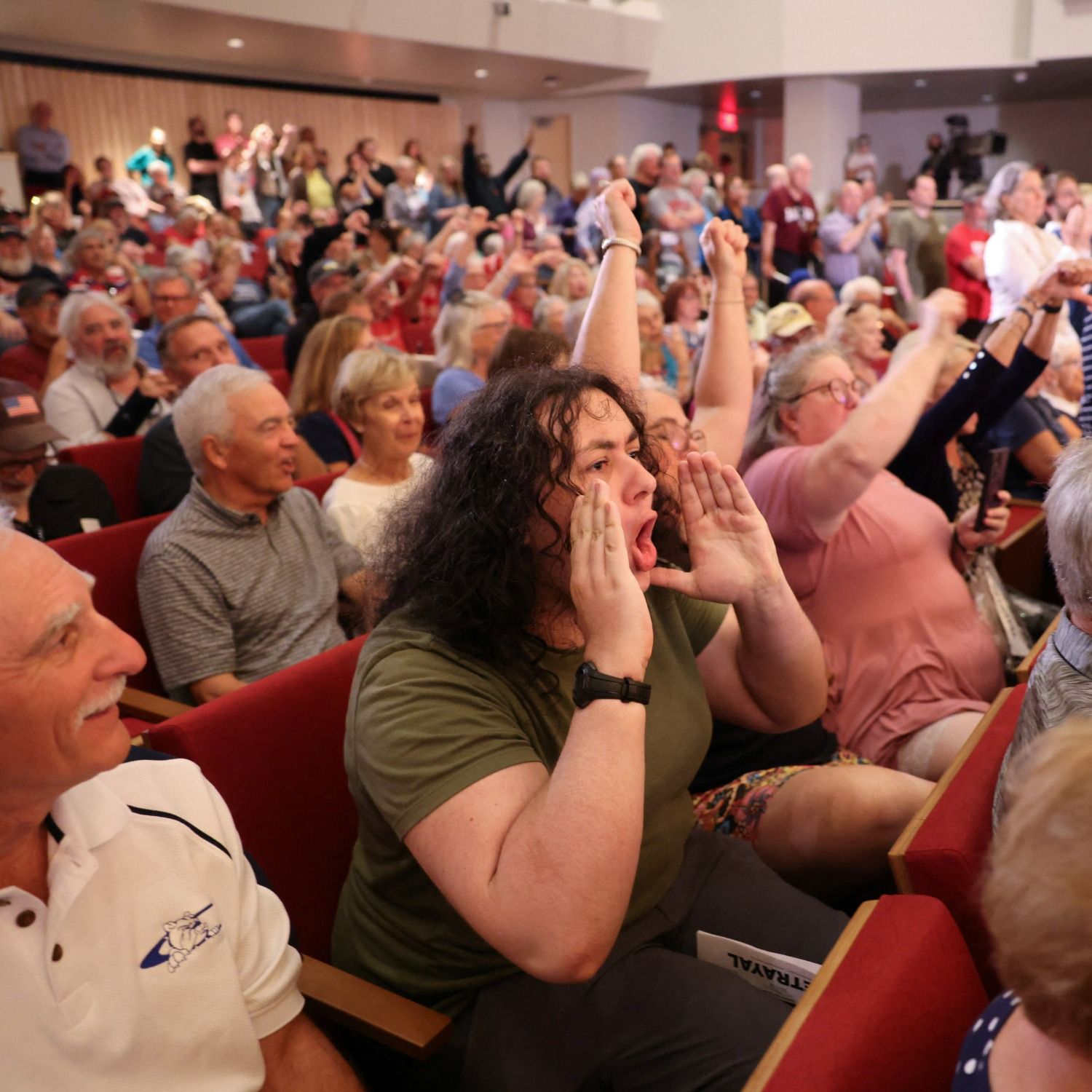
The Daily
Republican Town Halls Turned Ugly. One Congressman Kept Doing Them Anyway.
00:39:42
From Iowa to New York, Republican members of Congress have struggled to answer constituents’ tough questions about their party’s agenda, with several town hall meetings turning angry and going viral. Republican leaders have told lawmakers to stop holding them all together. Representative Mike Flood of Nebraska has ignored that advice. The congressman speaks about the disappearance of an American political tradition and why he thinks it is worth preserving.
Loading summary
Transcript208 lines
- [00:00]
Narrator
The Twisted Tale of Amanda Knox is coming to Hulu and hulu on Disney August 20th. In 2007, Amanda Knox was halfway around the world studying abroad in Italy. She had no idea her dream would turn into a nightmare inspired by the actual events of her wrongful conviction and 15 year fight for freedom. Watch the Hulu original series the Twisted Tale of Amanda Knox on August 20, streaming on Hulu and Hulu on Disney for bundle subscribers. Terms apply.
- [00:31]
Michael Barbaro
From the New York Times, I'm Michael Balbaro. This is the daily.
- [00:36]
Congressman Mike Flood
What people of.
- [00:38]
Congressman Mike Flood (Town Hall Speaker)
America see with people of eastern Washington.
- [00:39]
Veteran Constituent
See is President Trump delivering on his promises?
- [00:42]
Michael Barbaro
And so from Iowa to New York, Republican members of Congress have struggled to answer tough questions about their party's agenda in open town hall meetings that have turned angry.
- [00:55]
Congressman Mike Flood (Town Hall Speaker)
But what I view is the moral hazard created by the Biden administration by allowing the U.S. mexico party.
- [01:03]
Michael Barbaro
And gone viral.
- [01:04]
Congressman Mike Flood (Town Hall Speaker)
So people are not dying. Well, we all are going to die.
- [01:11]
Michael Barbaro
So much so that Republican leaders have told lawmakers to stop holding the town halls altogether. But at least one Republican has ignored that advice.
- [01:26]
Congressman Mike Flood (Town Hall Speaker)
I will be visible. I will be accessible.
- [01:29]
Michael Barbaro
Today, Congressman Mike Flood of Nebraska on the disappearance of an American political tradition and why for him, it's still worth preserving.
- [01:41]
Congressman Mike Flood (Town Hall Speaker)
It is an honor to serve you and a privilege to serve you at the United States Congress. Thank you very much.
- [01:47]
Michael Barbaro
It's Monday, August 18th.
- [01:56]
Interviewer / Journalist
Good morning, Congressman.
- [01:58]
Congressman Mike Flood
How are you?
- [01:58]
Interviewer / Journalist
I'm well. How about you?
- [02:00]
Congressman Mike Flood
Good. Sorry I was run a few minutes late. There's so much road construction between where I live and my district office. It took me a little longer today.
- [02:06]
Interviewer / Journalist
That seems like something you should be able to solve.
- [02:10]
Congressman Mike Flood
I need to go to the state government to solve some of those problems.
- [02:13]
Interviewer / Journalist
Right.
- [02:14]
Congressman Mike Flood
Cone placement. Cone placement.
- [02:17]
Interviewer / Journalist
There's only so much a member of Congress can do.
- [02:21]
Congressman Mike Flood
Isn't that true?
- [02:22]
Interviewer / Journalist
Congressman, thank you for, for making time for us. I appreciate it.
- [02:26]
Congressman Mike Flood
Yeah.
- [02:27]
Interviewer / Journalist
Let, let me just start by explaining my own interest in the subject we're going to be talking about, which is town halls. I spent most of my career here at the Times as a political correspondent and I think I've probably attended hundreds of town halls and I've always seen them as a pretty special part of our political system, a unique chance for elected officials to come face to face with voters, actually answer questions. In my experience, it really levels the playing field and there's this built in accountability system because everyone in the room is watching the elected official answer those questions and it's evaluating them for authenticity and for candor. And I've watched Elected officials master the form of the town hall. I think a lot about Chris Christie, who would bring this tough love approach to a town hall. And he charmed people across New Jersey, and he became a national political star in the process. But now your party is questioning whether this tradition still makes sense in today's political environment and has basically concluded that they don't. And yet you have kept doing them against the advice of leaders in your party. So I really want to understand why town halls are so important to you. And I think that means going back to the beginning and understanding, if that's in any way personal for you. What is your first memory of attending a town hall, if you have one?
- [03:59]
Congressman Mike Flood
Well, let me give you a little background, if I may, just on how I'm built, and then I will give you an example about the town hall I remember the most.
- [04:08]
Interviewer / Journalist
Sure.
- [04:09]
Congressman Mike Flood
So I grew up in a home with two very active Democrats. My mom was on the state central Committee. My dad was elected county attorney in a very Republican area of Nebraska. I remember he was driving me to the polls in 1980 with him. I wasn't going to vote, but I asked him, what's the difference between Republicans and Democrats? And he said, well, Democrats are poor and Republicans are rich. And right there I was like, well, I'm going to be a Republican.
- [04:35]
Interviewer / Journalist
How old were you at the time, if you recall?
- [04:38]
Congressman Mike Flood
I would have been five. And then in 1986, when I was 11, we had a very unique gubernatorial contest in Nebraska. We had two women running against each other for the first time in American history. And my dad had Helen Bousalis sign in the yard, and I had Kors sign in the yard. Kay is the Republican, Helen was the Democrat. And I told my dad, I want to go to Kors fundraiser at Omaha, two hours away, because I had gotten an invitation and he laughed about it.
- [05:08]
Interviewer / Journalist
You had finagled as a child an invitation to this?
- [05:11]
Congressman Mike Flood
Well, I got on some list. I'm sure they didn't know I was 11, but I got on some list because I had done some call center work. My dad drove me down there, but he wouldn't park in front of the House because he didn't want to be seen. So he dropped me off three blocks away, and I walked in by myself. And I just loved it. I loved everything about it. And so growing up, I was interested in the interaction between elected officials and their constituents. But when I think about town halls and I think about the first real experience I saw this would have been in 2003, a state senator from Lincoln, Ron Raikes was proposing to eliminate all of the one room schoolhouses across Nebraska, the rural schools. And I went to Wahoo, Nebraska, and the place was packed with angry rural Nebraskans.
- [06:05]
Interviewer / Journalist
Right. Who did not want to see their schools close.
- [06:08]
Congressman Mike Flood
Did not want to see their small schools closed. Yeah. So Ron Rake sat up there at the head of a table with the other members of the Nebraska Legislature Education Committee, and he let everybody speak. And I saw tears, I saw screaming. I saw people that were just despondent. I mean, this was a way of life for them. Their children were getting this great education, education, and he was changing it. And I was definitely against what he was doing, but he sat there and respectfully listened to everybody, and everybody got their say, you know, and this went on for like three and a half hours. And when I saw that, I said, this is everything I wanted it to be. This is the job I want to be in.
- [06:57]
Interviewer / Journalist
As painful as it probably was, yes.
- [06:59]
Congressman Mike Flood
It was very powerful for me to witness the people, you know, exercising their right to protest and the power that it had.
- [07:14]
Interviewer / Journalist
Well, given the importance that you so clearly place on. On town halls, what did you think when the National Republican Congressional Committee advised. Republicans advised, basically lawmakers like you earlier this year to basically stop having them. Because in. In their minds, it was starting to create just too many negative headlines and it was becoming too rich a target for Democratic activists, many of whom end up in the audience when Republicans have these town halls. That felt like a really unusual thing. I think we can all remember when town halls have gotten out of hand in modern political history. I'm thinking about the Tea Party era, when folks are furious at President Obama over his health care plans. But I can't recall a moment when one of the two parties said, that's it for town halls. No more of these. So what was your first thought at that directive? What was your reaction?
- [08:17]
Congressman Mike Flood
I was like, oh, my gosh, I have one scheduled for next week. That was my first thought.
- [08:22]
Interviewer / Journalist
Too late to cancel?
- [08:24]
Congressman Mike Flood
Yeah, too late to cancel.
- [08:26]
Interviewer / Journalist
I mean, did you for a minute consider canceling?
- [08:29]
Congressman Mike Flood
Well, for a brief second, I was like, I don't want to run afoul of the House leadership. You know, like, I'm a team player. I pride myself on wanting to do the right thing and to build the respect of my colleagues. And so, of course I'm going to think about it. But the guy that I replaced in Congress was Jeff Fortenberry, and he had town halls every year for 17 years. So when I was running and somebody asked me I said, yes, I will do three town halls a year.
- [08:58]
Interviewer / Journalist
So that's the commitment you made as a candidate.
- [09:00]
Congressman Mike Flood
Yeah, yeah. And it's something that Nebraskans expect in a lot of ways. And so by the time I got back to my office, my message to my chief of staff was, you better let leadership know that we're having these town halls, and the first one is next week, and we're not canceling it.
- [09:21]
Congressman Mike Flood (Town Hall Speaker)
I want to start by saying that I believe the town halls are an.
- [09:23]
Congressman Mike Flood
Important part of the process.
- [09:25]
Congressman Mike Flood (Town Hall Speaker)
It's democracy. It's how we communicate with each other. Tonight is an opportunity for me to listen to, to you, to learn from you, to answer your questions. But I want you to know I'm guided by this. This really matters to me, and I think it matters to all of us. Kim, why don't you start with our first question?
- [09:49]
Interviewer / Journalist
Let's talk about your town halls this year and what they felt like, what they've sounded like since you decided to keep holding them when you opened up. Your first town hall this year was late March. Trump is suddenly back in office. He's got a slew of executive orders against law firms. He's starting to go after universities. He's claiming the right to end birthright citizenship, even though it's guaranteed in the 14th Amendment. Doge has started. It's firing thousands of federal workers. There's a lot going on. So with that in mind, do you have any idea just how raucous these town halls are going to get going.
- [10:30]
Congressman Mike Flood
Into that first one? No.
- [10:36]
Congressman Mike Flood (Town Hall Speaker)
Here's the deal. That $36, $36 trillion number is not going away. It is not going away unless we deal with Medicare and Medicaid. Let's remain calm.
- [10:49]
Congressman Mike Flood
It was in Columbus town my wife was born in, raised in a town 45 minutes south of me.
- [10:55]
Congressman Mike Flood (Town Hall Speaker)
And this is something we have to do as a country.
- [10:58]
Congressman Mike Flood
I couldn't have predicted that it would have gone like that.
- [11:02]
Congressman Mike Flood (Town Hall Speaker)
A balanced budget where we. How can you be against a balanced budget? How can you be against a balanced budget? All right. Elon Musk gets $40 billion a year.
- [11:22]
Interviewer / Journalist
In funding from the federal government.
- [11:24]
Congressman Mike Flood (Town Hall Speaker)
Do you think he would cut that before he would cut our Medicare or our Social Security or our jobs? I support Elon Musk and the Department of Government Efficiency.
- [11:39]
Congressman Mike Flood
And I think when it was over, I was stunned and a little numb. That's my honest. That's honestly how I felt.
- [11:51]
Congressman Mike Flood (Town Hall Speaker)
I don't think your high school civics teacher would endorse that behavior.
- [12:00]
Congressman Mike Flood
And on the drive back to Norfork, which is 45 minutes. I was just replaying in my head everything that I saw and I heard. What are you doing to be real with people about how Trump is breaking the law? And I got home and when are.
- [12:17]
Interviewer / Journalist
You and Congress going to take back your responsibility?
- [12:19]
Congressman Mike Flood
I just had to kind of just process everything.
- [12:22]
Interviewer / Journalist
You have done nothing.
- [12:23]
Congressman Mike Flood
Who's lying?
- [12:24]
Interviewer / Journalist
Them or you?
- [12:26]
Podcast Host / Wesley Morris
Why are you doing this to your constituents?
- [12:28]
Interviewer / Journalist
When are you going to do something?
- [12:30]
Congressman Mike Flood (Town Hall Speaker)
This is where we're at.
- [12:31]
Interviewer / Journalist
You have an oath.
- [12:32]
Congressman Mike Flood
We need actual action.
- [12:34]
Congressman Mike Flood (Town Hall Speaker)
What are you going to stand up for?
- [12:37]
Constituent Questioner
Foreign.
- [12:40]
Interviewer / Journalist
It'S interesting because it felt like the subtext of a lot of the questions you were getting in these town halls, especially early on, is where is Congress right now? Where in particular are Congressional Republicans as a check on a president who is exercising a greater level of power than any president in modern history. And, and there's one inquiry that stood out to me.
- [13:04]
Congressman Mike Flood (Town Hall Speaker)
Yeah. My question is regarding your oath of office. So you have up until now abdicated all of your rights as Congress to the executive branch. And if you don't act as a check and a balance.
- [13:14]
Interviewer / Journalist
The question ended with this voter saying.
- [13:17]
Congressman Mike Flood (Town Hall Speaker)
What exactly is the purpose of Congress?
- [13:20]
Interviewer / Journalist
Why do you even exist?
- [13:23]
Congressman Mike Flood (Town Hall Speaker)
I have not abdicated any responsibility I have under the Constitution.
- [13:28]
Congressman Mike Flood
Well, I think some of that is overblown. And let me tell you why. There's this idea that if you are providing oversight or the checks and balances, that it has to be done on CNN at 9:00 clock Eastern or Fox News at 9:00 clock Eastern. If I'm going to draw a red line, I'm not going to draw it on tv. I'm going to draw it with the people that are actually in charge of their part of the government.
- [13:57]
Interviewer / Journalist
You're saying it's unseen?
- [13:58]
Congressman Mike Flood
Well, it's unseen by the people that are dealing with the issue. It's just not done for public purposes.
- [14:04]
Congressman Mike Flood (Town Hall Speaker)
When I see things that I do not think are right, I work on them, I speak out against them and I stand up. I also, and I'm going to say this loud and clear, I voted for Donald Trump and I support Donald Trump as president. He's done more to address the root issues of this country in the last four months than we saw from our prior president. And I believe that. And I want to say that out loud so that I'm on record doing that.
- [14:30]
Interviewer / Journalist
Well, you did say that in your answer to this constituent that you do speak out when you don't like something. But let's get specific. Have you Spoken out against anything Trump has done in the second term, specifically.
- [14:44]
Congressman Mike Flood
National Weather Service cuts. National Weather Service is a vital federal agency for Nebraska because we are in tornado Alley. You know, I'm visiting these offices, and they're down 40%.
- [14:57]
Interviewer / Journalist
Right.
- [14:58]
Congressman Mike Flood
And this was a hill to die on for me. Like, this was public safety. And so, you know, I was successfully able to get this going. And since they've hired back people. So that would be one example.
- [15:09]
Interviewer / Journalist
Why did. Why did you not say that at the town hall? When you're speaking to voters? Did it occur to you to say that, look, I push back. I got these jobs restored at the National Weather Service.
- [15:21]
Congressman Mike Flood
Yeah, I did at one of them. But, you know, like, who wants to work with a grandstander? You know what I mean? Like, the goal is to fix the problem, and I'm happy as hell that it got fixed.
- [15:38]
Interviewer / Journalist
Well, grandstanding is an interesting word for what speaking out against something you don't like is. And I think you may know where I'm headed here. In the second Trump presidency, it feels like lawmakers, especially within the Republican Party, are fearful of publicly getting crosswise with the president. And when you were asked about abdicating your role, when you were asked about specific policies, you, in these town halls, tend to specifically go out of your way to emphasize how much regard you have for the president. And you say, I want to make that loud and clear. I voted for him. I mean, am I right to intuit a certain level of, I don't want to step in it in this town hall, and I don't want to become the subject of the president's ire. Does that constrain you in this environment? It sounds like it does.
- [16:32]
Congressman Mike Flood
I am supportive of the president. I mean, when I got to Congress in 2022, 65% of my time was dealing with agency rules and regulations that were punishing all sorts of folks in Nebraska, whether it be farmers, ranchers, banks, you name it. And the relief that came on January 20th is what I voted for. Like, that's what I wanted. I want innovation. I want all of these new ideas. Do President Trump and I have the same demeanor? Probably not. I think it's fair to say that we don't. But I thought it was very important that I say, listen, I support President Trump and I support Elon Musk in doing what they're doing, because the federal debt is a big issue for me, and the spending is a big issue for me. And although the way it was approached at all times wouldn't be my preference, I think that the overall arc of what we're doing in terms of spending is important.
- [17:31]
Interviewer / Journalist
What I heard were some people in that room saying, where are you pushing back at all? And I think essentially what they're asking, and I'd ask it on their behalf, is, is there anything besides the National Weather Service, for example, that the president has done that has concerned you?
- [17:49]
Congressman Mike Flood
Well, tariffs concern me because it introduces uncertainty into our economy. But you look at the first time he ran, he made it work, so we're counting on that. I mean, so there's something just.
- [18:04]
Interviewer / Journalist
Just to put it really plainly, do you feel like you can be truly candid in any disapproval that you have of President Trump's actions? Especially in a public room where cameras may be rolling, people are searching for viral moments?
- [18:16]
Congressman Mike Flood
I understand that if you pop over the hedge and say, nope, I don't agree with that. Right. For me to do that, I have to be convicted in what I'm doing. I want to know where my conference is at. You don't come over the hill with no one. And sometimes he just says things, right, like seizing the Panama Canal, turning Alcatraz into a prison again, you know, like, don't take the bait. Like, look at what you're trying to accomplish. Like, I'm trying to get housing reform going. I go to work every single day, and I work on that bill, and I'm talking to people about that bill, and it's bipartisan, and so I know that it would make some people on the left love every minute of seeing their member up over the hedge every single day. But you don't get to have a new red line every day just because a subset of your constituents are livid about X. He is the leader of the party that I'm in, and there's a balance.
- [19:22]
Congressman Mike Flood (Town Hall Speaker)
I will continue to do town halls. I will continue to show up in person, and I want to thank all of you for coming. Good night.
- [19:31]
Event Staff / Moderator
Okay, when you exit, please go out the exit right here on your left. So don't go back out the way you came in.
- [19:44]
Michael Barbaro
We'll be right back.
- [19:50]
Carlos Prieto
My name is Carlos Prieto, and I'm one of the people that help make the Daily. As part of our reporting on immigration, we heard from this woman crossing one of the most dangerous stretches of land on the whole planet to get to the United States. I knew that she was from Venezuela, which is where I'm also from, but what I found out is that not only was she from the same city that I grew up in, but she was also from the same neighborhood. She was describing parks and plazas and streets where I spent a lot of my childhood. She was a woman that I might have encountered at some point in my life. It made me feel an extra responsibility to find a way for our listeners to feel like they understood her and her story. What makes the Daily Special is that we try to understand every story with that level of closeness so that our listeners can really connect with the humans in the middle of a news event. If this is the kind of journalism that you like and that you care about, the best way to support it is by subscribing to the New York Times.
- [20:53]
Congressman Mike Flood (Town Hall Speaker)
Here's what I ask of you tonight.
- [20:55]
Congressman Mike Flood
I know some of you are angry. I know some of you are upset.
- [21:01]
Congressman Mike Flood (Town Hall Speaker)
Let's make this a model for the.
- [21:03]
Congressman Mike Flood
Nation and how we can have a discussion about the future of America and.
- [21:08]
Congressman Mike Flood (Town Hall Speaker)
We can talk as much about ideas and solutions as we do identifying the problems.
- [21:14]
Congressman Mike Flood
Because ultimately, it's my job to do the best job I can, representing all of you with that, I want to.
- [21:20]
Congressman Mike Flood (Town Hall Speaker)
Cut my remarks short. I want to get right into questions and answers.
- [21:24]
Interviewer / Journalist
Let me get back to this idea of Congress's responsibility, your responsibility.
- [21:29]
Constituent Questioner
Hello, Congressman Flood. I share your concern for our national debt, but the ends do not justify the means. Can you please.
- [21:36]
Interviewer / Journalist
You had an exchange with someone at a town hall who asked you about a provision of the president's giant domestic policy bill, one big, beautiful bill, as he refers to it, that would have seriously curtailed the power of the federal courts.
- [21:52]
Constituent Questioner
Can you please tell us why you voted to approve a budget bill that includes section 700, 302, which effectively prohibits federal courts from enforcing contempt orders.
- [22:06]
Interviewer / Journalist
And contempt orders allow federal judges to hold the executive branch accountable when they defy the courts. It's really their only tool, which would.
- [22:13]
Constituent Questioner
Then allow current and future administrations to. To ignore those contempt orders by removing the enforcement capabilities.
- [22:22]
Congressman Mike Flood (Town Hall Speaker)
I do not agree with that section.
- [22:25]
Congressman Mike Flood
That was added to that bill.
- [22:31]
Congressman Mike Flood (Town Hall Speaker)
This provision was unknown to me when I voted for the bill.
- [22:38]
Event Staff / Moderator
Okay, next question. Next question.
- [22:40]
Congressman Mike Flood (Town Hall Speaker)
I am not going to hide the truth. This provision was unknown to me when I voted for that bill. And when I.
- [22:47]
Interviewer / Journalist
And what you told this voter, Congressman, is that you didn't know that provision was in the bill, presumably because you didn't read the entire bill before you voted for it. So how did it feel having to kind of admit that, which you did, that you voted for something you didn't quite understand?
- [23:06]
Congressman Mike Flood
Two things here. I did read the bill. I voted for that one big, beautiful bill. I voted until like 7 in the morning, I got on a plane, I went back home to Nebraska. Now it's 9:30 at night. Someone in the legal community in Nebraska calls me and like, did you know this is in the bill? I was like, what are you talking about? Well, this section. So I pull it up. I went to law school. I practiced as a general practitioner for 20 years. You can read those seven lines 15 times. And if you aren't a practitioner in a federal district court on issues like constitutional issues, like, I've never been to federal district court. And the way that provision was written, I had to go to an article written by a Notre Dame law professor to really understand its import. And after I did those things, I felt terrible. I didn't want that in there. I didn't have any interest in defanging the federal district courts. And that was a red line for me. And honestly, I appreciated the question. The only way through that was to be honest and to tell him how much that meant I wasn't going to hide it. I couldn't defend it. There was no way around it.
- [24:29]
Congressman Mike Flood (Town Hall Speaker)
Hey, why are you guys booing me? I'm just telling you I didn't do the bare minimum of my job.
- [24:36]
Interviewer / Journalist
Right. That moment went basically viral. Not necessarily in a good way is.
- [24:40]
Congressman Mike Flood
Never a good sign when your defense.
- [24:43]
Congressman Mike Flood (Town Hall Speaker)
To that in front of your own.
- [24:44]
Constituent Questioner
Constituents was, I didn't read that version.
- [24:48]
Interviewer / Journalist
Listen, I don't know what would be worse, honestly, if he was really this negligent or if he voted for it because he thinks Trump should be a king like Hinson does.
- [24:56]
Congressman Mike Flood
Apparently.
- [24:57]
Congressman Mike Flood (Town Hall Speaker)
It's not like a 23andMe terms of service agreement where you can just blindly sign it. And now there's a clone of you who's a sex slave for an Uzbek oligarch. Unlike that, these bills are important.
- [25:12]
Congressman Mike Flood
You know, my oldest son, Brennan, said, dad, you didn't read the bill. I said, I missed it. Brennan, wow. I missed it.
- [25:20]
Interviewer / Journalist
He must have seen this moment as well somewhere on the Internet.
- [25:23]
Congressman Mike Flood
Oh, yeah. And you know, he got ridiculed for that, I'm sure.
- [25:28]
Interviewer / Journalist
Hmm.
- [25:30]
Congressman Mike Flood
So to say it bothered me. It really bothered me. The next day after I figured that out, I called my staff. We got a hell to the Senate Judiciary Committee. We flagged it for them. And the reason we have three rounds in our unicameral is that things get in bills that you end up figuring out what their real import is. You take them out. This is part of the process of lawmaking. What I voted for was not a law. I voted for A bill that went to the Senate and that was stripped out and I was able to vote for it. So it worked. The process worked.
- [26:00]
Interviewer / Journalist
But I guess I'm just. Does a moment like this help explain to you why some of the people in these town halls were so upset? Could you understand where they were coming from?
- [26:11]
Congressman Mike Flood
Yes. We've got people to come to these town halls that are upset to start with. I mean, they are receiving all of their news and information, oftentimes from a television network that has a slant, just like Republicans are receiving their news and information from a network that has a slant. And there's not a lot of nonpartisan information that comes. So they come angry to start with.
- [26:35]
Interviewer / Journalist
Well. And then they hear their congressman, as earnest as you are, saying, I didn't know that I was voting for a bill that was going to neuter the courts at a moment where the president is already defying them.
- [26:46]
Congressman Mike Flood
Yeah, I get it. I get it. The only way through that, though, is to tell them the truth. And you know what? I slept better that night than I had in a long time because I didn't blink. And as mad as people are and as much as people can get upset about that, isn't that kind of what they also want? They want you to stand up. They want you to be there. One thing I'd add here.
- [27:15]
Interviewer / Journalist
Yeah.
- [27:16]
Congressman Mike Flood
That exchange right there is the reason why politicians on both sides of the aisle don't want to do town halls. Because these things are real, they're raw, and they are as accountable as anything else in America.
- [27:39]
Congressman Mike Flood (Town Hall Speaker)
Well, good evening, Lincoln. Thank you very much for being here tonight. I know that many of you stood in line for a long time. I know that many of you have made this a point to be here. And here's the deal.
- [27:51]
Interviewer / Journalist
So, Congressman, in your final town hall this year, which you held after this bill, the one big, beautiful bill, as it was known, officially passes.
- [28:00]
Congressman Mike Flood (Town Hall Speaker)
I want to go right into this bill because I know this is something a lot of people have questions about. Okay, let's start here. Let's start here.
- [28:11]
Interviewer / Journalist
That's when voter anger seems to reach a fever pitch. Yes.
- [28:14]
Constituent Questioner
First of all, I'd ask you please not to refer to that monstrosity as the big beautiful bill.
- [28:22]
Congressman Mike Flood (Town Hall Speaker)
It's the name of the bill, though.
- [28:25]
Event Staff / Moderator
So how can you justify taking health care away from 78,000 Nebraskans?
- [28:33]
Congressman Mike Flood (Town Hall Speaker)
As I explained before, this bill protects Medicaid for the future.
- [28:39]
Interviewer / Journalist
People are asking you about cuts to Medicaid.
- [28:41]
Event Staff / Moderator
Why did you cut SNAP and health care research?
- [28:48]
Congressman Mike Flood (Town Hall Speaker)
We do not have unlimited Money in.
- [28:50]
Congressman Mike Flood
The United States.
- [28:52]
Interviewer / Journalist
To food stamps. Snap.
- [28:54]
Congressman Mike Flood (Town Hall Speaker)
And I see this new bill that transfers trillions of dollars of wealth from working class Americans, people that are sitting in this room, to billionaires that don't even look live in this state. And so my question is, I know who I work for, but who do you work for?
- [29:07]
Congressman Mike Flood
So my question is, did you read the bill?
- [29:11]
Congressman Mike Flood (Town Hall Speaker)
I read the bill. I read the bills.
- [29:17]
Interviewer / Journalist
And you worked really hard to make the case that this legislation is good for your district.
- [29:22]
Congressman Mike Flood (Town Hall Speaker)
If we didn't pass the big beautiful bill, it would have been a sixth $1,500 tax increase to every Nebraska family. That is a true middle class tax cut. Next slide, please.
- [29:43]
Interviewer / Journalist
You look like a college professor on that stage talking about what's in this bill.
- [29:48]
Congressman Mike Flood (Town Hall Speaker)
People in here are upset with me that I voted a couple cut, $2 trillion in spending from the budget. But still, the Republican Party now more than ever represents the heart and soul of the working class.
- [30:05]
Interviewer / Journalist
You're booed.
- [30:06]
Congressman Mike Flood
How much does it cost for fascism? How much do the taxpayers have to.
- [30:11]
Interviewer / Journalist
Pay for a fascist country? You're jeered.
- [30:15]
Congressman Mike Flood (Town Hall Speaker)
Fascists don't hold town halls with open question and answer series.
- [30:26]
Interviewer / Journalist
So I'm curious, as someone who sees so much value in this format, what was the value in that? Was there any.
- [30:37]
Congressman Mike Flood
Yeah, there's value because I think it's cathartic for the people that are so upset. And I get something out of it. You know, people don't realize when you're standing on stage and everybody's looking at you. I see people that maybe are upset about the one big beautiful bill, but they are with me on Ukraine. And I see that in the nonverbal. I see people that are worried about the future of democracy and they are smiling when I say fascists don't hold town halls. There's a communication back and forth that only the elected official gets to see when you're talking to a crowd of people that are upset. Had I not done a town hall in Lincoln, it would have been a slap in the face to my biggest city in my district. And before each town hall, I go out and shake the people's hands coming in. You know, Chris Christie says it's hard to hate up close, right? So I go up and I shake everybody's hands and, you know, I get a lot of feedback. But one of the things I heard a couple times when I was shaking people's hands was, thanks for realizing that we're in Nebraska too. And at first I was like, what are they talking about? And it's easy to go to these rural communities where there's more, you know, Republicans. And as somebody who grew up in a small town, I felt that way before. Like, am I really part of Nebraska? Isn't all this just about Oman, Lincoln? And so to have people from Lincoln say thanks for coming here and doing it here.
- [32:13]
Interviewer / Journalist
Right.
- [32:14]
Congressman Mike Flood
We're in Nebraska too.
- [32:15]
Interviewer / Journalist
This is your most democratic corner of your district.
- [32:18]
Congressman Mike Flood
Yeah, I thought that's a compliment. You know, like I'm here and we're doing this.
- [32:24]
Interviewer / Journalist
Can I say that they were thanking you, but the hate to quote cause Christie was up close. It was not hard to hate up close in that, in that room, it seems.
- [32:34]
Congressman Mike Flood
No, that's true. But that was maybe 100 people of the 700 that were that, that upset. And at no time did I ever lose my cool or my, my mode of operation. We just kind of went through it. And I did say going in, I said, hey, let people say their peace when I do not want people drug out of here. That is not what this is about. If this way they want to do it, that's the way they want to do it. But if I'm not willing to go stand in the middle of my biggest city, how does anything ever get better?
- [33:04]
Event Staff / Moderator
Okay, next question.
- [33:06]
Veteran Constituent
Can you hear me?
- [33:07]
Congressman Mike Flood
Yes.
- [33:08]
Veteran Constituent
I'm a, I'm a lifetime member of the Veterans of Foreign Wars.
- [33:11]
Congressman Mike Flood
You know, I had somebody come up to me in Seward and say, you know, he's a 57 year old postal worker.
- [33:17]
Veteran Constituent
You voted for a budget bill that cuts the Social Security supplement, which is a large portion of our benefits. And these are benefits that we've earned. We work for these benefits.
- [33:27]
Congressman Mike Flood (Town Hall Speaker)
Okay.
- [33:28]
Congressman Mike Flood
We had made one change that he was fine with in his retirement system, but there was something else in the bill that wasn't good.
- [33:34]
Congressman Mike Flood (Town Hall Speaker)
What I need to understand in your situation is the exact program that you're on and the exact impact that the, the bill in its current form is having.
- [33:43]
Veteran Constituent
We're eligible to retire when we're 57, so we're not eligible for, for Social Security till we're 62. So what, what the bill that you voted for does erases the 57 to 62 supplement that gets us to it, which is a large portion at that age of our retirement.
- [34:00]
Congressman Mike Flood (Town Hall Speaker)
I'm happy to sit down with you.
- [34:01]
Congressman Mike Flood
I'm happy to look at it.
- [34:02]
Congressman Mike Flood (Town Hall Speaker)
I will get the information, and then I will do my best to act on your behalf. That is my pledge to you.
- [34:07]
Congressman Mike Flood
We went back, we called him, we made sure we understood it, and we Were able to tell him, hey, that has been resolved. People don't see the casework that comes out of these things. But you know, I would have never known about that issue with a postal worker that's 57 years old. There's no way I would ever have dreamt that. But he came to a town hall and he put it on everybody's radar.
- [34:25]
Interviewer / Journalist
But I guess I'm still wondering what it means for constituents, for voters when these town halls go away. If most of your party is avoiding this format, does something important get lost?
- [34:42]
Congressman Mike Flood
Well, first I will say the reason you see less of these is that you have constituents that attend on both sides of the aisle that say they're frustrated at their inability to have to glean information from a respectful back and forth dialogue because they're actually there to try and get answers to the questions that they have. So a lot of the people that are doing the booing are the ones that are creating the challenge for others. But you know, like, everybody does their job differently in Congress and this fits my way that I do it. Others are way more productive in different ways, communicating with their constituents. And some of my colleagues have legitimate safety issues that I don't feel like I have. That is legit, right?
- [35:28]
Interviewer / Journalist
I mean, I mean back to that moment when you hesitated about whether to cancel your own town hall. What do you think would have been lost if you had canceled all three of them this year? Right. I mean, how would that 57 year old postal worker have gotten his concern across?
- [35:47]
Congressman Mike Flood
Obviously there's value. You know, like I think a lot of people see it, they don't think it has any value and nobody's talking about the value that's there. You know, it's good for America that we have Republicans and Democrats that can spend an hour and a half in a room together. And yeah, there's some shouting and yelling, but I got the chance to say what I wanted to say. I got the chance to explain my vote votes. I got the chance to essentially debate with a few of my constituents and they got the chance in their eyes to hold me accountable and to tell me how they felt. We all got something out of it. So right or wrong, maybe there's a better way to do this. I've been going to these things for a long time and I hope that as Americans, they continue for a long, long time.
- [36:28]
Interviewer / Journalist
It sounds like you're going to keep holding town halls next year as you have this year. And I'm thinking back to the town halls you talked about when you were A young lawmaker, and clearly there was emotion in them. But I don't think it looked like this. I mean, yes, when people were having their school shut down, they were emotional and they were upset. Were they calling the lawmakers fascists? I don't. I mean, I'm seeing you nod no. And what I'm really asking is you said in one of your town halls, you urge voters to make the town hall that you were about to embark on a model of discussion for the rest of the nation. So what do you think it says that your town halls went the way that they did about the nature of our democracy, the nature of our ability to have conversations right now. What does it say to you?
- [37:20]
Congressman Mike Flood
It's certainly strained, but it's also not representative of where I think most of the people are. I mean, the media grabs on to that person that's screaming fascist, and it delights one half of America and it repulses the other half of America. But I have more in common with those screaming protesters than I do the rest of America that thinks that politics is a hobby, doesn't affect them, and they don't pay any attention to it.
- [37:53]
Interviewer / Journalist
Hmm.
- [37:57]
Congressman Mike Flood
Like, this is America. This is. Every decision I make affects somebody.
- [38:02]
Interviewer / Journalist
So you have kind of come to a grudging admiration for the passion that leads someone to come to a town hall like that and scream, you're a fascist.
- [38:10]
Congressman Mike Flood
Of course. Because they care. Right?
- [38:13]
Interviewer / Journalist
Yeah.
- [38:14]
Congressman Mike Flood
There are people that can live in America and take care of their family and not give one ounce of thought to anything that's happening in the world other than the bubble that they live in. And the lady that's calling me a fascist is not living in that bubble. She is very invested in her beliefs and where she thinks the country's going. She showed up and she's spicy. Like, that's the town square. That's politics. That's what we do. That's like, if I think that my votes are the right votes, I should have no problem standing in the town square and defending them. And I did that.
- [39:05]
Interviewer / Journalist
Well, Congressman, thank you very much. We appreciate it.
- [39:08]
Congressman Mike Flood
My pleasure.
- [39:21]
Interviewer / Journalist
We'll be right back.
- [39:30]
Podcast Host / Wesley Morris
Your home is an active investment, not a passive one. And with Rocket Mortgage, you can put your home equity to work right away. When you unlock your home equity, you unlock new doors for your family. Renovations, extensions, even buying your next property. Get started today with smarter tools and guidance from real mortgage experts. Find out how@rocketmortgage.com Rocket Mortgage LLC. Licensed in 50 states. Nmlsconsumeraccess.org 3030 I'm Wesley Morris.
- [40:01]
Congressman Mike Flood (Town Hall Speaker)
I'm a critic for the New York.
- [40:02]
Interviewer / Journalist
Times, and I'm the host of a brand new podcast called Cannonball. We're going to talk about that song you can't get out of your head.
- [40:10]
Congressman Mike Flood (Town Hall Speaker)
That TV show you watched and can't.
- [40:12]
Interviewer / Journalist
Stop thinking about and the movie that you saw when you were a kid that made you who you are whether you like it or not.
- [40:19]
Congressman Mike Flood (Town Hall Speaker)
I was so embarrassed the whole time because it's a bad film and I still love it.
- [40:24]
Interviewer / Journalist
You can find Cannonball on YouTube and wherever you get your podcasts.
- [40:32]
Michael Barbaro
Here's what else you need to know today. By Sunday, there was growing consensus that President Trump had broken from the principles of his European European allies and sided with Russia during his summit on Friday with Vladimir Putin. During the summit, Trump adopted Putin's view that to end the war between Russia and Ukraine, Ukraine must give up territory in a direct peace deal, including land unoccupied by Russia, rather than first trying for a ceasefire. That has alarmed Europeans officials who believe that the plan prioritizes Russia's goals over Ukraine's. On Sunday, leaders from Germany, France, Britain, Italy and Finland said that they would travel to Washington today to join Ukrainian leader Volodymyr Zelensky for a meeting with Trump. Their goal, they said, is to present a unified front against Russia and to try to persuade Trump Trump to back away from Putin's views. Today's episode was produced by Asta Chaturvedi and Rob Zivko, with help from Michael Simon Johnson and Alex Stern. It was edited by Lindsay Garrison and Maria Byrne, fact checked by Will Peichl, and was engineered by Chris Wood. That's it for the Daily I'm Michael Balbaro. See you tomorrow.
- [42:12]
Podcast Host / Wesley Morris
Brought to you by the Capital One Venture X card. If you love to travel, Capital One has a rewards credit card that's perfect for you. With Venture X, earn unlimited double miles on everything you buy and turn all of your purchases into extra extraordinary travel, and you get premium benefits at a collection of luxury hotels when you book through Capital One Travel. Plus, you'll get access to over 1,000 airport lounges worldwide. Capital One what's in your wallet? Terms apply. See capitalone.com for details.