← The Daily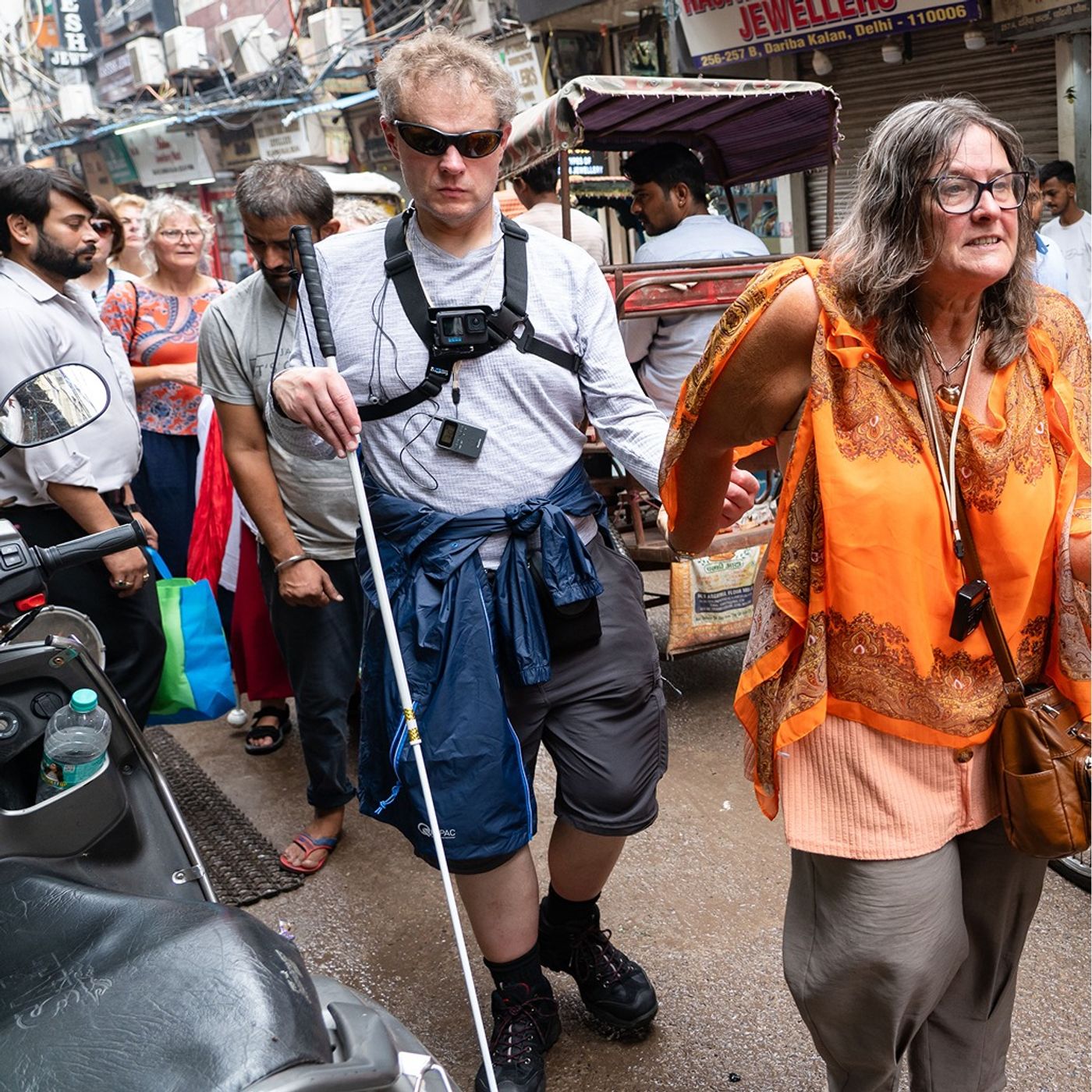
The Daily
Sites Unseen: What’s Revealed by Traveling With the Blind
00:27:10
Andy Isaacson is a writer and photographer. His work for The Times has taken him to every corner of the world, and he has transmitted what he’s experienced through his images. But recently, Isaacson took a trip unlike any he’d taken before. Not because of where he traveled, but because of how he traveled. Paired with a set of unlikely travel companions, he put down his camera and experienced the word through touch, smell and sound. On today’s episode of “The Sunday Daily,” Isaacson talks with Host Michael Barbaro about a trip that forever changed the way he travels.
Loading summary
Transcript147 lines
- [00:00]
Commercial Narrator
This message is brought to you by Apple Card. For a limited time, when you get a new Apple card and purchase AirPods Pro 3 at Apple, you can earn back the cost up to 250 daily cash. New AirPods Pro and up to $250 daily cash back. Now that's music to my ears. Subject to credit approval, limitations and spend requirements apply. Apple Card is issued by Goldman Sachs bank usa, Salt Lake City Branch Terms and more at Apple Co AirPods
- [00:28]
Michael Barbaro
from the new York Times, I'm Michael Balbaro. This is the Daily on Sunday. Travel is an inescapably visual experience. The entire vocabulary we attach to travel confirms that. We go sightseeing, we ask for rooms with a view. We we memorialize our trip or we brag about it by posting photographs on social media. But my colleague Andy Isaacson, an accomplished photographer and writer, recently took a trip with a group of blind travelers that directly challenged the idea that we best understand the world through our eyes. Today, Andy talks to us about that trip and and about the deeper layers of experience that are revealed by travelers who cannot see. It's Sunday, May 24th. Andy Isaacson, welcome to the Daily.
- [01:39]
Andy Isaacson
Thanks so much.
- [01:40]
Michael Barbaro
You have traveled all over the world for your work. You've reported for the Times for From every continent on Earth.
- [01:49]
Andy Isaacson
Yeah.
- [01:50]
Michael Barbaro
And I have to say that sounds like the most romantic job in the universe. Do you hear that all the time?
- [01:56]
Andy Isaacson
I hear dream job. It certainly was my dream job.
- [01:59]
Michael Barbaro
Was it?
- [02:00]
Andy Isaacson
Yeah. I was the kid that collected National Geographic magazines and books about wildlife and world history. And I think once I got into journalism, a lot of my career was driven by a desire to see the world, to lay eyes on these places.
- [02:17]
Michael Barbaro
Can you give us a brief rundown of some of the places you've been in that fully realized dream job career?
- [02:24]
Andy Isaacson
I've been to the South Pole. I've been a few clicks shy of the North Pole. I've been across Tajikistan. I've spent a month on the world's most remote inhabited island, which is in the South Atlantic.
- [02:37]
Michael Barbaro
What's that called?
- [02:38]
Andy Isaacson
Tristan da Cunha.
- [02:39]
Michael Barbaro
You've been around.
- [02:40]
Andy Isaacson
Yeah. And I think I just always wanted to create in my mind's eye a visual map of the world. I wanted to go to these places. I wanted to see them with my eyes and be able to visualize anywhere
- [02:54]
Michael Barbaro
on Earth to like be able to look at a map and put your finger somewhere and see it because you had seen it.
- [03:00]
Andy Isaacson
And that's what I think drove a lot of my traveling life, was to be able to fill in the dark spots on the map with pictures. For years, I would return from a trip abroad, and a friend of mine would ask me, what did it smell like? And I always fumbled for a meaningful answer. And it made me wonder what kind of deeper layers of experience I was missing. To what degree was I. Was my sight so dominating my experience that it was leaving out richer, deeper layers of. Or a fuller sense of place?
- [03:45]
Michael Barbaro
Mm. And how did you try to answer that question?
- [03:56]
Andy Isaacson
Well, I've tried it in different ways. Seventeen years ago, I was in Zurich, and I went to the world's first permanent dark restaurant staffed by blind and visually impaired people. You have to put away all your equipment in a locker, and then the staff member comes out who's blind. You put your hands on his or her shoulder, they lead you into the restaurant. And I still remember, 17 years later, the sound of the room. I remember the taste of the tomato sauce. I remember how it felt when I stabbed my face with the ravioli. I think that just shows what happens when we dim certain dominant senses and what that can open up and how that can enrich an experience. And so I think that goes to show just how much richer travel can be when you activate other senses to
- [05:00]
Daniel
have the charcoal smells, the animal smells,
- [05:05]
Luke
the door is moving, you can hear
- [05:10]
Additional Narrator/Participant
a lot going on. There's a lot of chaos, a lot of different things happening in all different directions.
- [05:19]
Andy Isaacson
So that idea was kicking around in my head for a while. And some years later, I learned about this company called traveleyes, which takes this to another level. Explain that it pairs visually impaired travelers with sighted travelers as equal companions. And its whole premise is that blind travelers can bring a perspective that deepens the experience. Then sighted people can also provide details, descriptions, and help with navigation. And together, they could have a deeper, richer travel experience.
- [05:55]
Narrator/Storyteller
Right.
- [05:55]
Amar Latif
Sighted folk just think about the site, and all the other things are just afterthought.
- [06:03]
Andy Isaacson
The company was founded by a man named Amar Latif. He was raised in Glasgow and lost his sight at 18 due to retinitis pigmentosa.
- [06:12]
Amar Latif
I woke up, and I basically couldn't see. And I realized that this was it, that I was now blind. And people all around me kept saying that I couldn't do this and I couldn't do that. And at the beginning, I was believing it, and it was getting me really down, so I was a prisoner in my own head.
- [06:31]
Andy Isaacson
He didn't want to live with those limits, so he pushed himself to travel. He went to Canada for school, and that's where the travel Bug bit him.
- [06:41]
Amar Latif
That was the most amazing year of my life. And I learned so much about the world. And I learned that if you dare to push your limits, you know, your world becomes bigger.
- [06:53]
Andy Isaacson
Then he became a young professional. He finally had disposable income to do travel.
- [06:58]
Amar Latif
I had money to spend. I wanted to go and see the world. But when I approached mainstream tour operators, all of them wouldn't let me book on their group holidays.
- [07:11]
Andy Isaacson
Mainstream travel companies rejected him. They didn't want him to be on their trips without a caregiver, and they excluded him from more adventurous activities like hiking and skiing.
- [07:24]
Amar Latif
I wanted to have that independent experience when I didn't have to rely on my friends and family.
- [07:31]
Andy Isaacson
And so we decided to create something new.
- [07:33]
Amar Latif
So I came up with the concept of, well, we'll just, you know, have sighted travelers come along. There'll be customers as well. They're not going to be.
- [07:41]
Andy Isaacson
Traveleyes was a company that would allow blind travelers and sighted travelers to travel together as equal companions, not as clients and helpers, but as co travelers, so that both could experience the world more fully.
- [07:58]
Michael Barbaro
So the idea is that this makes for a better travel experience for both of these groups. It wouldn't be a charity. It would be a kind of cross pollination of travel experiences.
- [08:10]
Amar Latif
Yeah.
- [08:11]
Andy Isaacson
In providing a multi sensory travel experience, which could benefit obviously the visually impaired travelers, it would also engage all five senses of the sighted travelers and in turn provide a deeper, richer travel experience for them.
- [08:26]
Amar Latif
And then it makes them think about their own life as well. And it gives them a different perspective, gives them inspiration.
- [08:38]
Andy Isaacson
I'd reached a point in my traveling life in, in which I was less interested in traveling to a new place, but traveling to a place differently. And travel eyes offered the promise of that. It offered the promise of a new, different, more immersive way of experiencing a travel destination. So I flipped the catalog and I saw that they had a trip to India. And I thought, what better place to experience this form of travel than the most multi sensory place on earth. In front of us is a peacock with one of those, like really long
- [09:20]
Guide/Interpreter
tails running across the road.
- [09:27]
Michael Barbaro
And we're going to hear all about this trip that you took to India right after the break.
- [09:41]
Commercial Narrator
These days it seems like AI agents are just about everywhere you turn, every field and every function. But without identity, you can't trust they'll serve your business instead of jeopardizing it. Fortunately, Okta helps you get identity right by securing your AI agents identities, giving you a single layer of control, a single standard of trust. So whether an AI agent supports a single user or your entire enterprise, with Okta you'll turn risk into opportunity. Secure every agent. Secure any agent.
- [10:11]
Okta secures AI this podcast is supported by E Trade from Morgan Stanley. Now that etrade is part of Morgan Stanley, there's even more to love. Get the freedom to invest on your own with $0 commissions on stocks, options, ETFs and mutual funds, plus account types for every investor. And when you're ready, spend speak with a pro to help guide you on your financial journey. Discover more ways to make the most of your money and get up to $1,000 when you open a brokerage account with a qualifying deposit today. Learn more@etrade.com offer terms and other fees apply. Investing involves risks. Morgan Stanley Smith Barney LLC Member SIPC E Trade is a business of Morgan Stanley.
- [10:48]
Spend less time searching and more time actually interviewing candidates who check all your boxes. Less stress, less time, more results when you need the right person to cut through the chaos. This is a job for Indeed. Sponsored Jobs and listeners of this show will get a $75 sponsored job credit to help get your job the premium status it deserves@ Indeed.com podcast just go to Indeed.com podcast right now and support our show by saying you heard about Indeed on this podcast. Indeed.com podcast terms and conditions apply. Hiring do it the Right Way with Indeed.
- [11:37]
Michael Barbaro
Andy what are we listening to here?
- [11:40]
Andy Isaacson
This is the cacophony of Old Delhi. We're moving through Old Delhi. We're navigating uneven pavement. We're dodging rickshaws, people coming in to try to sell us things, cows walking along the sidewalk, horns. And I'm moving through this environment with a visually impaired man named Daniel gently holding my elbow. My role is to guide him safely around the streets of Delhi and describe to him the visual details I see to give him a picture of what we're passing through. It's at the end of a long kind of sort of plaza with a reflective pool. Daniel, meanwhile, is interpreting India through his own sensory experience.
- [12:50]
Additional Narrator/Participant
Yeah, I mean for us, for really impaired people, you'd be walking through that and you'd perceive. You'd sort of walk through an entrance. You'd come into some sort of anti chamber or room and then you come for another one. And then again, you're in a big open space.
- [13:02]
Andy Isaacson
Yeah, you're in a big open space. What I noticed as I was describing these visual details is I was focusing on those sort of prosaic elements that quietly define a place, those unremarkable things that you might ordinarily pass over. The black and white painted curbs, the way that roadside vendors displayed their potato chip bags over the front of their stands like colored beads, the neat lane lines that were universally ignored. It was sharpening my noticing. And as I was describing these visual details, I was gaining a more vivid impression of India myself.
- [14:06]
Michael Barbaro
After Delhi, where did you all go next?
- [14:11]
Andy Isaacson
From Delhi, we went to the Taj Mahal in Agra.
- [14:14]
Guide/Interpreter
Okay, so now we're in this, the inner sanctum of this entry monument.
- [14:23]
Andy Isaacson
On that day, I was paired with a new visually impaired traveler, or VI as Traveleyes calls them. And his name was Luke.
- [14:30]
Luke
The floor is undulated. His texture is smoothish, but not.
- [14:41]
Andy Isaacson
We make our way through security and we line up with all the other tourists angling for photographs.
- [14:48]
Luke
See what you can do.
- [14:49]
Andy Isaacson
And I attempt to describe for Luke one of the most iconic visual pictures in the world. Sunrise at the Taj Mahal, maybe a thousand meters.
- [15:02]
Guide/Interpreter
The reflective pool is in front of us. It is a gorgeous white marble monument set against a ever whitening sky.
- [15:14]
Andy Isaacson
From the sunrise, Luke asked me to take photos of him with his GoPro camera. And then he held my arm gently, my elbow with one hand and his cane in the other. And we walk the grounds.
- [15:35]
Guide/Interpreter
Let's walk a little forward here. And we're going to take a step down right here.
- [15:44]
Luke
The ground is quite level.
- [15:46]
Guide/Interpreter
This is all pure marble.
- [15:48]
Luke
I can tell. Certainly I've lost some tactile sort of feedback with these foot coverings on. It's really weird. There's birds, I think there are, I believe, trees.
- [16:03]
Guide/Interpreter
I'm looking at a sign that says don't go near monkeys. Don't make direct eye contact with monkeys. Don't tease or irritate monkeys.
- [16:12]
Andy Isaacson
I was trying to take the assignment very seriously. I really felt as though Luke's impression of the Taj Mahal rested with how well I could describe this place right
- [16:25]
Michael Barbaro
entirely in your hands.
- [16:27]
Andy Isaacson
So I tried to rise to the occasion.
- [16:30]
Guide/Interpreter
Luke, if you look, tilt your head up, we are looking straight up at the facade of Taj Mahal. So I'm going to put your hand on the facade of the building. These are the inlaid precious stones that he was talking about.
- [16:52]
Luke
There's some differences. For example, this bit here is quite glossy. I assume that's probably one of the
- [17:00]
Guide/Interpreter
inlaid stones and it's green.
- [17:02]
Luke
Yeah.
- [17:06]
Guide/Interpreter
We are now in the inner. Approaching the sort of inner chamber of the tower.
- [17:13]
Commercial Narrator
Yeah.
- [17:13]
Luke
This is very. This is. You get a lot of echo reverb from people's Voices. Is that like a vaulted ceiling?
- [17:23]
Guide/Interpreter
Yes. Above us is a vaulted ceiling in this antechamber. Up and over a threshold here, Luke.
- [17:30]
Candy
Ah.
- [17:31]
Luke
The sound is increased. This is really. It's like a chorus.
- [17:37]
Andy Isaacson
That's a corneliff.
- [17:39]
Guide/Interpreter
We're now in the innermost chamber of the Taj Mahal.
- [17:43]
Luke
Yeah. The echoing is doubled and tripled. Yeah, you get. You get. It's almost like you're inside. Speaker. Yeah, I heard somebody singing over to. The. Sort of over to the right in front of us.
- [18:00]
Guide/Interpreter
So now we're going to. Now we're going through a narrow threshold from where we came. This is a wooden surface that's kind of a boardwalk that they've built over the marble flooring.
- [18:17]
Andy Isaacson
And I think I was benefiting from moving slowly through the environment. The experience of guiding a blind traveler allowed me to slow down and to notice more. It allowed me to savor it in a way.
- [18:35]
Guide/Interpreter
Can you feel the sun on your face as we pass by?
- [18:38]
Luke
Yeah.
- [18:39]
Guide/Interpreter
These are the kind of latticed marble.
- [18:43]
Luke
What's this we're looking at here?
- [18:45]
Guide/Interpreter
What we're looking at is the Yamuna river, which is this beautiful,
- [18:54]
Andy Isaacson
placid river
- [18:55]
Guide/Interpreter
that runs along the backside of the Taj.
- [19:04]
Andy Isaacson
What do you sense in front of us?
- [19:07]
Luke
It was wide open space, so I was running around.
- [19:12]
Guide/Interpreter
It's a child wearing bangles on her feet, on her.
- [19:20]
Andy Isaacson
Around her ankles.
- [19:21]
Guide/Interpreter
Just turning it back around and. And now just bathed in sun is the whiteness of the Taj Mahal set up against a blue sky.
- [19:36]
Andy Isaacson
So the next day, I was paired with someone named Candy.
- [19:39]
Guide/Interpreter
What is the specific nature of your visual impairment?
- [19:43]
Candy
For me, at this point, I don't have any vision. I have prosthetic eyes.
- [19:50]
Andy Isaacson
And Candy told me when I asked her what she wants descriptions of, she said the whole sights thing doesn't really interest me. I'm more interested in hearing about the reality of India, depending on what it is.
- [20:02]
Candy
I like descriptions of the people, like what they're doing, even if it's not the most. Even if they're laying on a bench or something. That part, I find, you know, has, like, more of an impact, I guess. Then, you know, there's a tree over here with yellow leaves.
- [20:24]
Andy Isaacson
And so I peered out the window, and I pointed out the grittier aspects of India. The laundry fluttering outside of apartment buildings, and the men on the side of the road threading Marigold Garlings for temples. And Candy told me one of the most vivid impressions of India that she had had.
- [20:57]
Candy
Kind of interesting. This one kid, little kid came up and like patted my leg and I reached out to see what it was and I felt, I don't know if it was a boy or a girl, but their hand, it was just really rough. Like the skin was rough. And sometimes you would think, you know, children tend to have softer skin and softer hands. And this was, I just thought about, you know, a child like having rough, such rough hands. And I thought, how have they lived and what's made their hands so rough? Like, what have they been through?
- [21:45]
Andy Isaacson
I was really struck by that. It felt very profound to me that this portal, this doorway into India for her was crossed by this moment of touch. In that moment, she was totally transported into the humanity of this place.
- [22:08]
Candy
Like people are just real. Like they're real, they have real feelings and emotions and, you know, lives and just the whole.
- [22:37]
Michael Barbaro
Now that you're home from India, I really want to understand how you process this entire experience. But first we're going to take a very quick break.
- [22:57]
Commercial Narrator
From game day crowds to memorable meals. Genius by Global Payments keeps your kitchen and floor perfectly in sync. Real time menus, seamless updates, big league reliability. For any business, that's genius.
- [23:12]
Matching outfits, extravagant birthdays, many nicknames, a few classic moves of a dog obsessed parent. Ollie is obsessed with how obsessed you are with your pup. So they strive to give your dog the best. From fresh human grade dog food to in app health. Check ins to track your dog's well being. You could say Ollie feeds the obsession. Visit ollie.com daily and use code daily to get 70% off your welcome kit. Ollie feed the obsession.
- [23:44]
IBM Commercial Narrator
So there's a lot of noise about AI, but time's too tight for more promises. So let's talk about results. At IBM, we work with our employees to integrate technology right into the systems they need. Now a global workforce of 300,000 can use AI to fill their HR questions. Resolving 94% of common questions, not noise. Proof of how we can help companies get smarter by putting AI where it actually pays off. Deep in the work that moves the business. Let's create smarter business. IBM.
- [24:15]
Michael Barbaro
So Andy, when this trip to India was over and as a journalist, inevitably you sat down to make sense of it all and write about it,
- [24:27]
Amar Latif
what
- [24:27]
Michael Barbaro
did you come to understand?
- [24:31]
Andy Isaacson
That no single viewpoint, no single impression of a place captures the full picture. And it made me think of this well known Hindu parable that one day as we're crossing the Rajasthani desert, our tour director told us about six blind men who encounter an elephant for the first time.
- [24:50]
Narrator/Storyteller
The first blind man kept his hand on the side of the creature. An elephant is smooth and solid, like a wall, he said.
- [24:58]
Andy Isaacson
And they each touch a different body part. One touches its trunk and imagines a snake. One touches the floppy ear and describes an elephant as like a flying carpet.
- [25:11]
Narrator/Storyteller
The third blind man touched the elephant's pointed tusk. I was right, he decided. An elephant is sharp as a spear.
- [25:19]
Andy Isaacson
And they all argue, each convinced that his perception is right.
- [25:24]
Narrator/Storyteller
Each of you touched only one part. Perhaps you all will put the parts together. You will see the truth. Now let me take.
- [25:34]
Andy Isaacson
And the idea is that everyone experiences the world differently, and no single viewpoint can capture the whole picture right. And understanding others perspectives is part of seeing the fuller truth. Experiencing India alongside of the visually impaired travelers and having them describe their perceptions gave me a fuller picture of India.
- [26:01]
Michael Barbaro
Just like the parable says.
- [26:03]
Andy Isaacson
Just like the parable says. There was a moment in which I remember one of the VI travelers at the Taj Mahal described this Om that he heard in the mausoleum.
- [26:15]
Daniel
The hum, the generic hum in the Taj Mahal, it has like an Om note pitch, an Omn pitch, just from people talking to each other about the various, various things.
- [26:27]
Andy Isaacson
And he said most sighted tourists would probably never have experienced that aspect of the Taj Mahal. They would have never really heard the resonance of that chamber because they're too busy taking photographs.
- [26:50]
Michael Barbaro
I wonder how you think this will change how you travel in the future.
- [26:55]
Andy Isaacson
As a sighted person and so visually dominant, I don't imagine that I'll be able to dim that sense. But I think it certainly gave me a new and deeper appreciation for turning on my other senses. Moments in which I could feel what is the texture of the air. It reminds me of something that Amar Latif once told me about the difference between how blind and sighted people experience travel.
- [27:25]
Michael Barbaro
This is the guy who founded Travel Eyes.
- [27:27]
Amar Latif
Yeah, it's a bit like. I would say that as a blind person, traveling is like almost like the
- [27:36]
Andy Isaacson
book version for blind travelers. He told me it's like reading a
- [27:40]
Amar Latif
book, you know, because you're imagining things in your own head. So you get these descriptions and then you're imagining them.
- [27:47]
Andy Isaacson
For sighted travelers, it's like, you know, the film version, it's more like watching
- [27:53]
Amar Latif
a film, watching the film and, you know, maybe the book version. Sometimes better
- [28:01]
Andy Isaacson
sighted people tend to rely on immediate visual cues. Architecture, color, landscape, it's all rendered for them like a movie on a screen. For blind travelers, they experience a place in a more interpretive way. It's a more interpretive process in which descriptions feed imagination. The world reveals itself more slowly through these layers of sound and touch and scent. Spatial awareness. And that's what builds the impression of a place.
- [28:41]
Michael Barbaro
Fascinating.
- [28:42]
Andy Isaacson
I'll always have more of that film version of a place, right?
- [28:47]
Michael Barbaro
How could you not?
- [28:47]
Andy Isaacson
But I think this experience gave me the tools to unlock more of that book version.
- [28:53]
Daniel
The incense that people might be burning or just what they're having for dinner. You can smell their version of Dao compared to our version.
- [29:01]
Luke
The preparations would suggest the arch is perhaps 20ft up.
- [29:08]
Daniel
30.
- [29:09]
Additional Narrator/Participant
All the sensors together build a cohesive image comprising more elements than just sight.
- [29:17]
Candy
Because I do like riding in that on the street. I mean, you saw every bump and every.
- [29:23]
Daniel
It's almost like a race car because. Because of the engineer.
- [29:28]
Luke
Something scraping over there.
- [29:29]
Guide/Interpreter
As if somebody's brushing or cleaning something. Yeah, it's a guy removing the bird poop.
- [29:39]
Michael Barbaro
Andy, thank you very much. We appreciate it.
- [29:42]
Andy Isaacson
Thank you, Michael.
- [29:47]
Michael Barbaro
Today's episode was produced by Alex Baron with help from Luke Van der Pluke. It was edited by Wendy Dore. Our production manager is Franny Carr Toth. And production assistance came from Dalia Haddad. This episode was engineered by Daniel Ramirez and features original music by Dan Powell and Marion Lozano. Special thanks to Alicia Ba Itube, Diane Wong and Alisha Hari Dasani Gupta. That's it for the Daily on Sunday. I'm Michael Balbaro. See you tomorrow.
- [30:31]
Commercial Narrator
Know the feeling when AI turns from tool to teammate? If you're Rovo, you know, with Rovo, you can streamline your workflow and power up your team's productivity. Find what you need in a snap with Rovo Search. Connect Rovo to your favorite SaaS apps to get the personalized context you need. And Rovo is already built into Jira and Confluence. Discover Rovo by Atlassian and streamline your workflow with AI powered search, chat and agents. Get started with Rovo, your new AI teammate@rovo.com.