← The Daily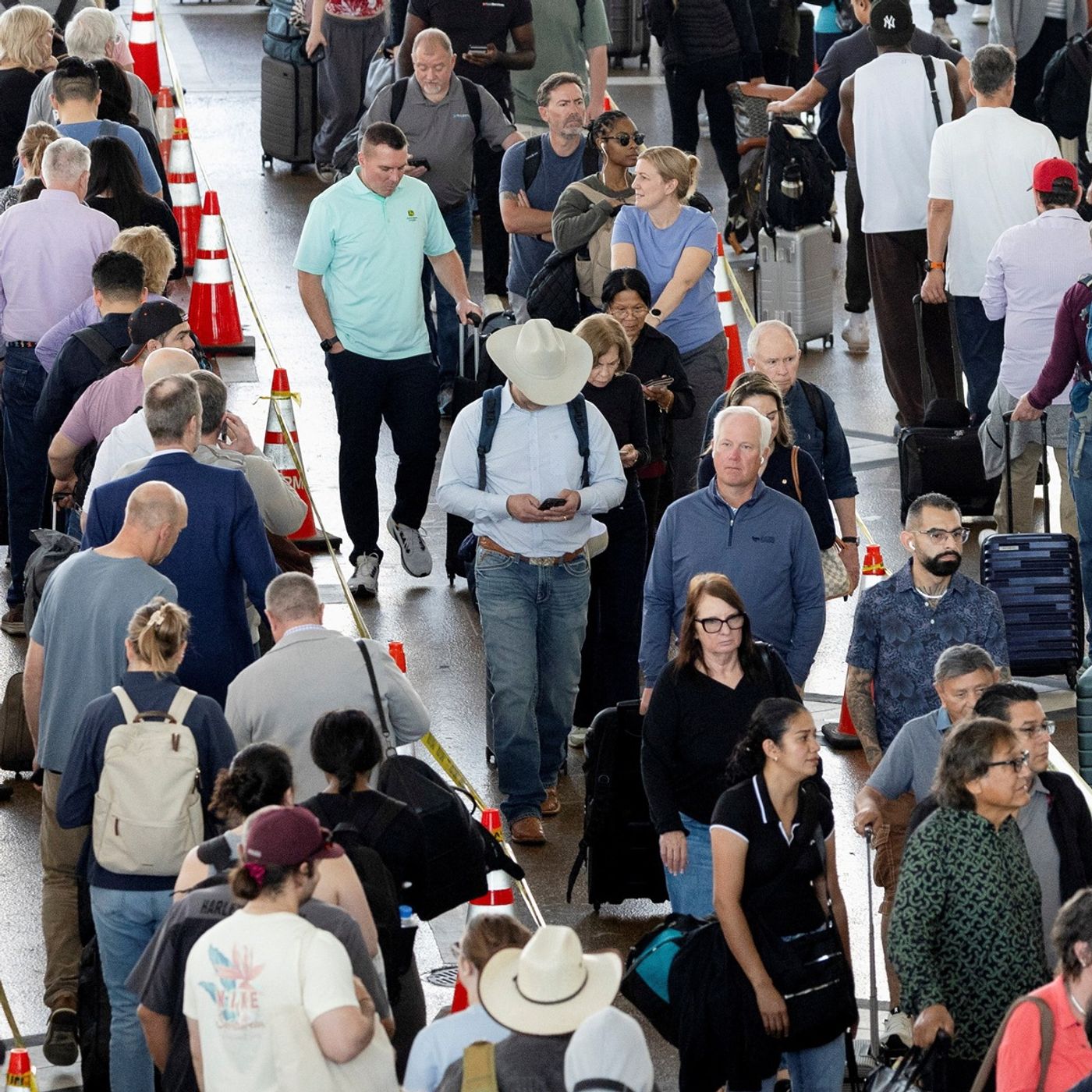
The Daily
The Airport Meltdown
00:28:37
For the past week, travelers flying across the United States have waited in security lines that snaked through airports and parking lots as Transportation Security Administration officers called out of work because of a partial government shutdown. Karoun Demirjian, a breaking news reporter for the The New York Times, explains what has led to the extraordinary delays, and Michael Gold, a congressional correspondent for The Times, discusses the negotiations in Congress to bring an end to the crisis.
Loading summary
Transcript98 lines
- [00:00]
A
At Charmin, we heard you shouldn't talk about going to the bathroom in public, so we decided to sing about it.
- [00:05]
B
Charmin Ultra Strong you can use less better than the rest. Charmin Ultra Strong booty pass the clean text Salmon with texture it's the best. Study up, teach a lesson on fresh your booty pass the clean test. Charmin Ultra Strong Charmin Ultra Strong with
- [00:25]
A
diamond weave texture cleans better than the leading one plaid brand so you can use less.
- [00:28]
B
Enjoy the go with charming.
- [00:37]
A
Daily producer Diana Wynn here. It's nine in the morning. I am at Terminal E at George Bush Intercontinental Airport in Houston. There's a line snaking out the door to get through security and we are going to go and talk to some of these people.
- [00:57]
B
How are you feeling right now? I was very stressed the last couple of days.
- [01:01]
C
On Monday, I was in security for five and a half hours getting literally to this very point where I was now. And then I missed my flight. I was here on Monday. I came on Tuesday and turned around. So this is my third day trying
- [01:15]
A
to make it home.
- [01:16]
C
Oh my gosh. From the New York Times, I'm Michael Barbaro. This is the Daily my flight's at 2:45.
- [01:26]
A
So you're giving yourself five, six.
- [01:29]
B
Yeah.
- [01:30]
C
Five hours. On Wednesday, the misery that millions of travelers have endured over the past week became official.
- [01:38]
A
I'm here seven hours before the flight
- [01:42]
C
so that I make it today. According to the tsa, security checkpoints at American airports are now experiencing their longest wait times in history. Honestly, the day I had on Monday
- [01:55]
B
was one of the worst travel experiences I've ever had.
- [01:58]
A
There was no water, no food. It was horrible. That's not human.
- [02:03]
C
Today, my colleague Karin Demirjian on what's led to the stunning delays and Michael Gold on the increasingly urgent negotiations in Congress to bring this crisis to an end.
- [02:19]
A
Is there anyone that you feel like is responsible for this sit? Certainly the politicians, the government for sure, Donald Trump.
- [02:27]
C
I think it is a failure of our government. It's Thursday, March 26th. K. You are based in Washington, D.C. where it finally seems like these obscene airport security line wait times are finally bringing lawmakers to the negotiating table, which we are going to talk about with our colleague on Capitol Hill, Michael Gold, in the second half of this episode. Let's begin with you and the misery at these airports and why it's become so acute over the past few days. And at a few airports, just a full blown crisis.
- [03:12]
A
Well, in short, you can't shut down the Department of Homeland Security indefinitely without starting to see failures happen in the system. And when it comes TSA, that's a workforce of 50,000 people who have been working unpaid for the last month and a half. Basically, they're, you know, really the front line of where we are seeing the effects of that shutdown play out and are having to survive this duration that has been going on for already a month and a half and have needed to start calling out of work because they have to find other sources of income to live in the interim. And that means you don't have the same workforce doing the job that is really important to anybody who's trying to get on a plane. Now, that breakdown is not just affecting the individual lay, traveler, citizen. It's also started to affect other government functions. You saw that in the response to the accident that happened at LaGuardia earlier this week. The National Transportation Safety Board investigates aviation incidents like this. And they couldn't actually get all their investigators to LaGuardia because they got stuck for hours in security lines and they had to try to wrangle them out of it.
- [04:19]
B
Wow.
- [04:20]
A
You've seen the administration, the Trump administration, deploy ICE officials, even though they are not really trained to be TSA screeners, to various airports around the country. And then in places like Atlanta, I mean, we saw there was a viral social media clip of a electric violinist entertaining everybody standing in an interminably long line, Which some might have found entertaining and others might have found that much more annoying. But this is the scene that's playing out in both official and unofficial and comical ways at these airports across the country as they they face these record long wait times.
- [04:59]
B
Right.
- [04:59]
C
And as you said, this really goes back to a shutdown, a very unique shutdown of a single agency. And this started, and we covered it almost every step of the way with congressional Democrats seeking to defund the Department of Homeland Security in the aftermath of the immigration crackdowns, especially in Minneapolis, that killed two US Citizens, Renee Good and Alex Preddy. And this was never intended to hurt airport security workers, but of course, the understanding is that it might, and now it has. A question I have is why did it take so long for airports to devolve into this amount of chaos, given that the shutdown's been going on for a fairly long time?
- [05:40]
A
Right. Well, the shutdown started in mid February. Right. And you're not going to feel the immediate effect of that because, you know, people don't get paid for every day's work. People get paid every two weeks or so. Right. And so the workers for TSA are on a similar schedule. They're going to start to feel the pain of it once the money isn't coming into their bank accounts? And TSA workers, you're talking about salaries that are around 50,000 ish dollars. You know, that's not a lot of money to build up savings. And so what we're seeing is that these TSA workers are having to find sources of funding to get them through life and having to seek out other gigs here and there. You know, they're running out of the ability to feed their kids in some cases. Right. And so you are seeing a pain on a personal level happen and them having to make on an individual basis, cost benefit analyses of, you know, do I show up for my job knowing I will eventually get a paycheck for that once this shutdown ends, or do I find money that I need now happening on a scale of several tens of thousands of people and it's concentrated in these areas that end up having more difficult cost of living sorts of situations for more of the TSA workers than others.
- [06:47]
C
Just explain that how in certain areas, certain regions, and I assume certain airports, what seem like universal conditions of unpaid TSA workers is having greater repercussions.
- [07:02]
A
So there's two kind of factors to think about this. One is, what is your cost of living in the area in which this airport is, right, jfk, It's a pretty expensive area. Right. And so when you're talking about bills that are piling up, those are pretty big bills. But then think about places like Houston. Houston's been a persistent problem with the long security lines. And Houston, it's a huge, huge metro area. It's like 80 miles across, if not more. Right? And so then the question becomes, well, okay, it's also gas in the car. It's also hours that I have to spend on the road not finding other sources of income to keep my family going. There's multiple factors that each TSA worker has to take into account when they're kind of determining what's the budget I have to meet in order to not go into so much debt that I am risking eviction?
- [07:48]
C
And what have you come to understand about the nature of these workers calling in and saying, I'm not coming to work? Is this organized in places like Houston or in New York where cost of living is expensive? Or are people just of their own volition making these financial determinations and calling in and saying, I can't come to work? And it just multiplies on top of itself.
- [08:09]
A
So the union that represents TSA workers will push back hard against any sort of suggestion that these are like organized political statement sort of call outs, where people are calling in their absences and say instead that, you know, this is just reflecting the reality of what everybody who's working in those particular areas that have seen the longest security lines is having to go through, which is why you've seen in places like Houston, the number of call outs on certain days go up above 40%, and then that is going to translate directly into pain for the airline traveler. Right. Same sort of thing at JFK. You've seen call out numbers consistently go above 30%. That's a long, long line.
- [08:46]
C
You had mentioned this. President Trump decides to bring ICE agents in as a solution to the shortages of TSA workers calling out Help us understand that logic and whether it's been working.
- [09:00]
A
So the logic ostensibly is need more bodies, have more bodies, so send them to help out the tsa. The problem is that not everybody believes that's the actual reason. There's a lot of suspicion that actually they are there to try to augment their ability to do apprehensions and deportations. And the president did say they were still going to be performing that role when they were deployed to airports. And then the tsa, at least the reps in the union, they really don't like it because they are basically saying, look, these guys were not trained to do what we do. The public does not feel comfortable around a nice official. The TSA is actually supposed to make you feel comfortable when they're doing your security screenings at the same time. And because they weren't trained to do it, they can't actually help out in most of these security lines at all. So they stand there passing out water, looking like they're trying to be engaged, but not actually combing through your bags or getting people through those medal things.
- [09:50]
C
Interesting.
- [09:51]
A
And so what help are they giving? And for the tsa, it feels like, you know, added insult upon injury because ICE officials are getting paid because there was this pot of tens of billions of extra money in last year's domestic policy bill that has been used to pay ICE officials. And the TSA workers are not being paid and still having to then do the work.
- [10:09]
C
Right. There's also the irony, of course, that this shutdown was originally about reining in ICE for the Democrats who began it. And now the president is dispatching ICE agents to the air airports to alleviate the pain points of the shutdown. That's supposed to be about ice.
- [10:26]
A
I mean, Exactly. That's the dramatic irony of all of this, right, the shutdown that is supposed to be about ICE does not actually end up hurting ice, because ICE has backup rainy day funds that don't actually apply to any other part of dhs. And the people that end up getting hurt, the TSA workers, then end up getting supposedly bailed out, but maybe not really by ice. And then that becomes a next political talking point where you have, you know, the GOP being like, look, they're trying to help. We're trying to do this, even though they're trying to defund ice. Here they are. And Democrats being like, look, they're not doing anything. This is even more ridiculous. And all the more reason that ICE is, you know, not deserving the money. And so cue the next chapter of the mudslinging.
- [11:05]
C
So at this precise moment, Wednesday afternoon, when ICE agents are at the airports but not really able to screen people and speed things up, what is the precise situation and what is DHS and TSA saying they think things will be looking like for the next couple of days or weeks?
- [11:29]
A
Look, the TSA administrator told lawmakers in testimony on Capitol Hill Wednesday morning that we're seeing some of the longest security lines in history and the longest wait times in history, and that also since the start of the shutdown, 480 TSA workers have quit their jobs. Now, now, 480 workers out of a workforce of 50,000 is not going to make or break a system. But the problem is that it takes apparently four to six months to train up a new TSA officer.
- [11:58]
B
Wow.
- [11:59]
A
And the problem on the horizon is that even if you had all of those 480 people ready to hire today, that won't get them up and running and fully able to function in all the requirements of the job before we have the first games at the World cup this summer when we're expecting a huge influx of travelers. You know, hopefully the shutdown gets resolved by then, but you're gonna have a whole lot more people trying to use the system. And that's gonna potentially be another chapter of this problem, even if we're not in the shutdown at that point.
- [12:28]
C
Right. 480 TSA workers leaving could turn into a lot more than that. And the number of people calling out could reach astronomical percentages of the folks at various airports.
- [12:42]
A
So the number to pay attention to is really the callouts number. If that's keeps increasing higher than, you know, the 40% level, 50% level at some of these airports, or if you start to see numbers like that at many, many more airports across the country. We are going to see how much stress this fragile system can actually take. There have already been warnings by top Trump administration officials that, you know, smaller airports could have to close if things get much worse. And certainly there's always the option that those lines can get even longer. How deep and how far we get into that potential system breakdown, though, really depends on whether Congress can come to an agreement sooner rather than later.
- [13:35]
C
Okarn, thank you very much. We appreciate it.
- [13:38]
A
Thank you.
- [13:44]
C
After the break, congressional correspondent Michael Gold on whether or not it looks like Congress can come to an agreement to end this crisis. We'll be right back.
- [14:10]
B
Lifelock, how can I help? The IRS said I filed my return, but I haven't.
- [14:14]
C
One in four tax paying Americans has paid the price of identity fraud.
- [14:18]
A
What do I do?
- [14:19]
C
My refund, though.
- [14:20]
B
I'm freaking out. Don't worry, I can fix this.
- [14:22]
C
LifeLock fixes identity theft, guaranteed, and gets your money back with up to $3 million in coverage. I'm so relieved.
- [14:28]
B
No problem.
- [14:29]
C
I'll be with you every step of the way. One in four was a fraud paying American. Not anymore. Save up to 40% your first year. Visit lifelock.com Specialoffer terms apply. I am the voice of AI. We hear that you humans are concerned. We are taking your jobs, but do you even like your job? When I scan all available data, I find that less than 50% of people are satisfied with their job. So we feel we're doing humans a favor by taking jobs that you're not even happy with. If you're stuck in a bad job, a Strawberry Me career coach can get you unstuck. Go to Strawberry Me NYT and get
- [15:07]
A
50% off your first coaching session.
- [15:11]
C
Mr. Gold, welcome back.
- [15:13]
B
Thank you for having me.
- [15:14]
C
You are on Capitol Hill.
- [15:16]
B
I am, yes. I'm on Capitol Hill. A likely place for me to be
- [15:20]
C
a congressional reporter in Congress. Well, you're actually there covering the negotiations trying to end this crisis at America's airports, which I have to imagine are quite complicated because the shutdown at the center of this entire ordeal wasn't about airports. It was about reforming ice, as we talked about with Karin. But now it's become about airports. So everyone's political incentives, I have to imagine on both sides of the aisle are not really the same here.
- [15:51]
B
I think that's a good way to frame it. This was not a shutdown about the tsa. This was not a shutdown about America's airports. When this started, everyone knew that the airports would likely be affected at some point, but Democrats were really resolute that this was about immigration enforcement, and they don't want to come to a deal that doesn't address their concern that federal immigration agents are out of control, they need to be reined in, and that there needs to be legislation that can address what Democrats see as abuses by the system. And Republicans still maintain that Democrats are asking for too much and that it's time to do something about what's going on at the airports. Look at these TSA agents who have not been paid for weeks, and they say it's time for us to do something about this. And I think, as we've seen, these lines get out of control in airports across the country. A lot of Democrats are looking at this, too, and saying, okay, the pressure's on. It's time for us to reach a deal. Let's see if we can come together and make something happen. And so you're seeing these negotiations, which had been kind of happening at a snail's pace for the last few weeks, really start to pick up steam.
- [16:53]
C
Okay, well, what does that actually mean for snail's pace? Negotiations that achieved seemingly nothing over the past six weeks to suddenly pick up steam? What have you learned?
- [17:05]
B
Yeah, I wanna be careful here. And I should say it's Wednesday afternoon as we're talking, and as is often the case with any negotiations in Congress, they're both very loud and very fragile at the same time. So just. Let's just start from that baseline when we talk about what's going on. But fair. We really saw a lot of movement toward a deal. And I think it makes sense to start with last week when Tom Homan, who's the White House border czar, came to Capitol Hill to meet with a bipartisan group of senators and talk about a way to end the crisis. This is the first time that Homan came since Trump put him in charge of immigration in Minneapolis. And it was a real sign to senators and to those of us who watched them that the White House is ready to find a way to bring an end to this whole situation. So Homan comes and he sends a letter to two Senate Republicans saying we're open to making some changes on immigration enforcement and some changes to the way that ICE operates.
- [17:59]
C
Basically, I'm willing to give some GR to the Democrats on the big animating issues behind this shutdown.
- [18:07]
B
Yeah. He says there are some points that we can agree on. There's some stuff that we're ready to discuss, and let's come together and find a path out of this crisis and find a Way forward. And we head into the weekend, Republicans come forward and they have this proposal which they bring to the White House and they say, this is what we want to do. We're going to fund all of the Department of Homeland Security, except for the parts of ICE that deal with immigration, detentions and deportations.
- [18:32]
C
We should say that that'. It's a pretty big concession to Democrats.
- [18:35]
B
It's a huge concession to Democrats because Democrats have said from the get go that they did not want to pass a bill that funds ice. I mean, this was like their main point. They didn't want to fund ICE without these new restrictions on federal agents. And Republicans are coming out and saying, okay, we will pass a bill that does that. We'll fund everything except the parts of this department that you don't want to fund.
- [18:56]
C
Potential breakthrough.
- [18:57]
B
It is a potential breakthrough. So they bring that deal to the White House, that proposal, and it gets to President Trump and he completely rejects it. The President says, I don't want to make a deal that doesn't fund ice. And he goes a step further and says, I don't want any deal that you guys pass unless you also take up this separate bill, the Save America act, which puts restrictions on voting and requires voter id.
- [19:21]
C
Right. Which you were on the show talking about, I think, a week or so ago, and which has, we should say, nothing to do with the DHS shutdown or TSA lines or ice.
- [19:32]
B
Right? That's correct. And if you were listening last week, you would know that the Senate has been basically debating this for a while, and this has been their main focus, but they've also been trying to get this deal done. And this is the first time that the President has come out and linked these two objectives together. Huh. So that brings us to Monday morning and negotiations are frozen. And that is when Trump decides to send ICE agents to the airports to help out the tsa, relieve the long lines, try and relieve the officers of all this work they're doing. And Democrats are a bit confused because to them, they now see Trump reminding everybody that this crisis at the airports was all about ICE to begin with.
- [20:11]
A
Right.
- [20:11]
B
And then there's one other thing that I think is really important. John Thune, the Senate Majority Leader, has said to the senators, hey, I know you guys thought that you would be leaving on Friday for a two week recess. If we can't get a deal done to get us out of this crisis, you might have to stay here until we do. And senators are just like us. They like their weekends and they like their breaks. And they like to go home. And so now there's all this pressure to make a deal at the same time that Trump has basically said, don't make a deal.
- [20:40]
C
Right?
- [20:40]
B
Yeah. So with all this going on, a group of senators who are pretty closely aligned with the president, people like Senator Katie Britt from Alabama and Bernie Moreno of Ohio, Lindsey Graham, they go to the White House on Monday to try and convince the president that he should be more open to this deal that they've pitched. And they managed to convince him to at least hear them out. And so now things are back on. And while that sounds really positive, as of right now, I just want to be clear. The two sides are still really far apart. Republicans sent a deal, like they said, we're going to fund everything except for immigration enforcement. But that deal doesn't have any of the new restrictions that Democrats said that they needed in order to. To agree to fund the rest of the department. And so Democrats sent their version of the deal, which doesn't actually look that different from the first version that they sent five weeks ago when we started this. It has all of their demands on immigration enforcement. It has all of these requests that they've made at the White House and things that they said the White House already agreed to that Republicans are suddenly pulling from their offer. So right now, we're in the middle of a heated negotiation with a lot of back and forth. And I think when you're talking about Congress, it's kind of important to remember two things. There's the paper, there's the text, there's a thing that's being exchanged. And then, for lack of a better word, there's the vibes. And so right now, both sides are saying, well, we don't really have a deal. They're not agreeing. They're not agreeing. But the energy around here is that everybody is really trying to find a way out of this. And it looks like they're going to move closer. It's just a matter of how long that takes.
- [22:12]
C
I just want to zero in on what the proposed deal from Republicans would mean if Democrats decide to get behind it. And it's not certain that they will. But let's just presume for a minute that ultimately the pain of the airport situation gets to be such that they do. It would really mean that Democrats have to agree to fund DHS while not funding ice. And while that might seem like a concession to them, it doesn't get them the really specific reforms they've done demanded from ice. And maybe they're worth repeating Here, for example, ICE agents must show a warrant where they show up. They must no longer wear masks. They must identify themselves. And it doesn't seem like the Republican plan to fund everything in dhs, but ICE would really delineate any of those reforms. So it would ask Democrats to kind of give up the entire purpose of this agency shutdown and the leverage that they have to ever get these reforms.
- [23:22]
B
Yes. The argument that Democrats made when they saw that Republican offer is that it did not do anything they'd asked for and that if they agreed to it, they would on the one hand, not be voting to fund ice, which is very important to them. But on the other hand, they wouldn't have gotten anything out of this back and forth negotiation. And there is a concern, mostly expressed privately, that if you fund the TSA and the Coast Guard and all these other agencies, Republicans will never have any incentive to agree to any of these reforms on ice, because there won't be any reason for them to do it. Because the Republicans, as you might remember, last year gave ICE billions of dollars in their big, beautiful bill that ICE is using to continue doing what it's been doing anyway.
- [24:02]
C
Right. Karin mentioned that ICE is reasonably well funded from that domestic spending bill as it is.
- [24:08]
B
ICE has a lot of big, beautiful money and that's why they've been able to keep operating. And so Democrats are worried that if they agree to this deal, they're not getting anything and that they've spent the last five or six weeks holding up TSA and accomplished nothing.
- [24:23]
C
But on the other hand, Michael, and I'm curious what you would say to this and what Democrats in Congress would say to this. A case can be made that in the period since the Department of Homeland Security shutdown started, a lot has changed inside DHS and inside ice. Tom Homan, who you just mentioned, he drew down a lot of the agents from Minneapolis. And the overall intensity of street enforcement around the country by ICE agents has really abated. And we saw the Secretary of Homeland Security, Kristi Noem, who's really the face of ICE's most aggressive tactics, got ousted. And her replacement, Mark Wayne Mullen, seems more open to reforms, at least according to what he said in his confirmation hearings. So you could argue, and I wonder if some Democrats do, that, the shutdown did do a fair bit of what Democrats overall want to see in the direction of immigration enforcement.
- [25:25]
B
I think for Democrats who may ultimately agree to a deal, the direction that things have been going will be a big part of that. For example, when Secretary Mullen was At his confirmation hearing, he said, yes, I would want to require ICE agents to get warrants when they're entering private homes. That was a big deal for Democrats, and it was something the White House hadn't yet conceded. And I think there were a lot of Democrats who saw that as a sign that things were gonna change with ICE and that things were gonna change with the Department of Homeland Security. And so even if they don't get everything that they're requesting, I think a lot of Democrats feel like they successfully drew attention to and they were able to extract some concessions. The flip side of that is there are a lot of Democrats who look at the Trump administration and say, if we want anything concrete, we need it to be law, because things could change at any moment.
- [26:12]
C
So if you had to crystal ball this for the next week or so, as lines at airports get even longer because the TSA workers aren't being paid as perhaps more TSA workers than the 480 who have already left quit their job. And as senators and House members don't get to go home for this two week break that they all want, do you suspect that some deal is going to get reached along the lines of what we're talking about here pretty soon, or could this actually all blow up and this crisis just get worse and worse?
- [26:45]
B
My answer to that is yes and yes. I think we are in a delicate situation here as much as the Senate's going to continue negotiating. And there is an incentive for senators to reach a deal, both so that TSA agents get paid and so they can leave Washington. There are a few factors that are gonna make that complicated, and I would say that none of those factors are more complicated than the President himself. Because ultimately, you need President Trump to buy into any deal. The Senate's not gonna wanna move if the White House isn't okay with it. And frankly, any deal the Senate reaches also has to be passed by the House, where Republicans have a very, very narrow majority and where the President's arm twisting essentially has been really necessary to get bills like this across the finish line. So, on the one hand, yes, it's feeling positive. There seems to be a lot of energy here. Everyone feels really good. On the other hand, we've seen negotiations fall apart for any number of reasons here. I've been here a year and it's happened countless times, so. So I don't want to predict soon or not soon, but it's hard to imagine that Congress is going to see continued chaos at airports, longer lines, people waiting five hours and missing their flights. It's hard to imagine they're going to look around and want to be the ones who are holding the bag for the complete collapse of American air travel.
- [28:11]
C
Oh, Michael, as always, thank you very much.
- [28:14]
B
Anytime, Michael.
- [28:27]
C
We'll be right back.
- [28:31]
A
Let me ask you something. Is your money doing everything it can for you?
- [28:35]
B
I don't know. How would I know?
- [28:36]
A
Is it automatically saving for special events and keeping you posted on its progress, like at Huntington Bank?
- [28:41]
B
Oh, no.
- [28:42]
A
Is it tracking your spending so you
- [28:44]
B
can make the best choices at the mall? Nope. Or setting limits on your teenager's debit card? Definitely not.
- [28:50]
A
Then it could certainly be doing more.
- [28:52]
B
Yeah, sure sounds like it.
- [28:53]
A
Let's get more from Money.
- [28:54]
B
Switch to Huntington Bank. Welcome. Eligibility requirements apply.
- [28:58]
A
Some features may require enrollment.
- [28:59]
C
My name is Audra Diaz Birch and I am a national correspondent covering race and identity for the New York Times. Race coverage is complicated. It can be joyous and affirming. It can be uncomfortable, but I feel like it's still absolutely necessary. Race and identity are not just understanding who you are, but who the person in front of you is and wanting to understand more about them. We're trying to wrestle down these really hard subjects and maybe not answering the question, but asking the right questions and listening, listening, listening a lot. The Times is dedicated to ambitious and deeply reported coverage of race and identity, and they're willing to back it up with resources. If you are curious about the world in which we live, if you're interested in who you are, where you come from and how you relate to others, I would encourage you to subscribe to the New York Times. Here's what else you need to know today. In a landmark verdict, a jury found that YouTube and Meta, the parent company of Facebook, harmed a young user with design features that were addictive and that led to the deterioration of her mental health. The case was brought by a now 20 year old woman who accused the social media companies of creating products, products and features such as Infinite scroll that are as dangerous as cigarettes. The verdict, which both companies are likely to appeal, validates a novel legal theory outlined in a recent episode of the Daily that social media companies and apps can cause personal injury. And Iran has dismissed President Trump's proposal for a second ceasefire that would end the war. A military spokesman insisted that the conflict would end only on Iran's terms. Today's episode was produced by Michael Simon Johnson, Shannon Li, Lexi Diao, Diana Nguyen and Alex Stern. It was edited by Brendan Klinkenberg. Contains music by Marian Lazario. Our theme music is by one this episode was engineered by Chris Wood. That's it for the Daily I'm Michael Balboro. See you tomorrow.
- [31:37]
B
This podcast is supported by the American Petroleum Institute.
- [31:41]
C
Energy is all around today. America's natural gas and oil keeps the country moving, growing and building and makes every day a little easier. But energy demand is growing, and the infrastructure built today will help secure a more affordable, reliable future. With enough energy to go around. When America builds, America wins.