Loading summary
Transcript167 lines
- [00:00]
A
This podcast is supported by nrdc, the Natural Resources Defense Council. The Trump administration just carried out the largest environmental rollback in American history. They eliminated the endangerment, finding a core scientific and legal foundation for tackling climate pollution. This is illegal and NRDC is suing to stop them. For a short time, listeners of the Daily will have their gift matched to support their legal challenge. Go to nrdc.org daily
- [00:32]
B
from the new York Times, I'm Natalie Kitroweff. This is the Daily.
- [00:44]
C
In the middle of a crisis for American education. With reading and math scores down across
- [00:49]
B
much of the country, one place has managed a stunning turnaround.
- [00:54]
C
Mississippi, one of the poorest states in America today. My colleague Sarah Mirvash on how Mississippi may have pulled off an educational miracle and what a deep red state could teach us about how to educate our kids.
- [01:17]
B
It's Friday, april 10th. Sarah, you've been spending time looking into what is being called the Mississippi miracle, this unthinkable improvement in the state's schooling. I want to start by asking you first to just lay out what that improvement has actually looked like. The scale and the scope of this turnaround.
- [01:45]
D
Yeah, I mean, it's significant. I'll start with just a few stats. As recently as 2013, Mississippi ranked 49th in the country for education, particularly for young kids learning how to read.
- [01:56]
B
49th.
- [01:57]
D
49th. No one wants to be 49.
- [02:00]
B
Nope.
- [02:00]
D
And so that's a result that in some ways seemed predictable and even inevitable because Mississippi is a pretty poor state. It doesn't spend a lot on education. But slowly but surely, they started turning things around. By 2019, they were about in line with the national average, and now they are a top 10 state for. For fourth graders learning how to read.
- [02:20]
B
Wow.
- [02:21]
D
Yeah. And I think something even more impressive is if you adjust for poverty and other demographics like race, Mississippi is the number one place in the country for fourth graders learning reading and math and the number one state for eighth grade math.
- [02:35]
B
Okay, just explain that for me. When you say when you adjust for poverty, it's number one for these metrics, what do you mean exactly by that?
- [02:45]
D
Some of the best states that traditionally are seen as having the best education are the richest states, places like Massachusetts or New Jersey, because rich kids just score higher. Right. But if you adjust for the student population that they're serving. So how does a state serve its poor kids? Or if it has a lot of kids who are learning English? So when you look at the students that it has, how does the state do? Mississippi does really well. Poor kids in Mississippi are scoring better on national tests in fourth grade than poor kids in almost any other state. So basically what that's telling me is that Mississippi is one of the best places in the country for a poor child to get an education.
- [03:24]
B
Okay. So that's pretty remarkable. And all that is happening, of course, in a context where America's schools are not doing well. Right. On the whole, like, the trends are bad, test scores generally are down across the board.
- [03:40]
D
Yeah. And I think this is something that would maybe surprise people who've heard, oh, it's pandemic losses. Actually, this decline started going back to 2015. Things started to take a bit of a turn. And this decline was basically driven by the lowest performing students. So our bottom 25% of students have just been dropping off for about a decade or more. And in Reading in particular, the declines have continued since COVID So things are just continuing to trend downward. And one of the things that got me really interested in Mississippi was that Mississippi is one of the only states that's defying that trend, either helping its lowest performing students hold steady or even helping them improve during this time frame.
- [04:18]
B
Okay. So I have to imagine that much of the country is looking at what happened in Mississippi and trying to figure out how they did it, which is exactly what you set out to do in your reporting, Sarah. So what did you learn? Like, how did they do it?
- [04:33]
D
Well, there wasn't a magic bullet, unfortunately. Everyone wants there to be one simple thing. Right. And what I found is that it was several different factors. And at a high level, what that looked like was the state taking a much more aggressive hands on role to education and sort of telling districts what to do. And part of that was about how they taught young children how to read, but it also was about accountability and support. So I think that was a really crucial aspect of what Mississippi did, is they were, they were actually holding schools accountable, but they were also like getting in there and offering support. And that support was also telling schools what to do.
- [05:07]
B
And when did this start? When did this turnaround? When did these interventions begin?
- [05:11]
D
So a lot of this dates back to 2013. People in Mississippi have been trying to make progress on education for a while and making some changes, but when you're 49th in the country, it's sort of like even, you know, from a business standpoint, when you look at the future outlook of your state, you've got like Republican led legislature and business leaders and people all agreeing, thinking, we've gotta do something.
- [05:32]
B
This is a crisis.
- [05:33]
D
Yes. And so what they decide to do is they pass a big, sweeping piece of legislation that focuses on changing how young kids learn how to read. I'm Sarah Mirvash. I'm the reporter at the New York Times.
- [05:45]
E
Nice to meet you.
- [05:47]
D
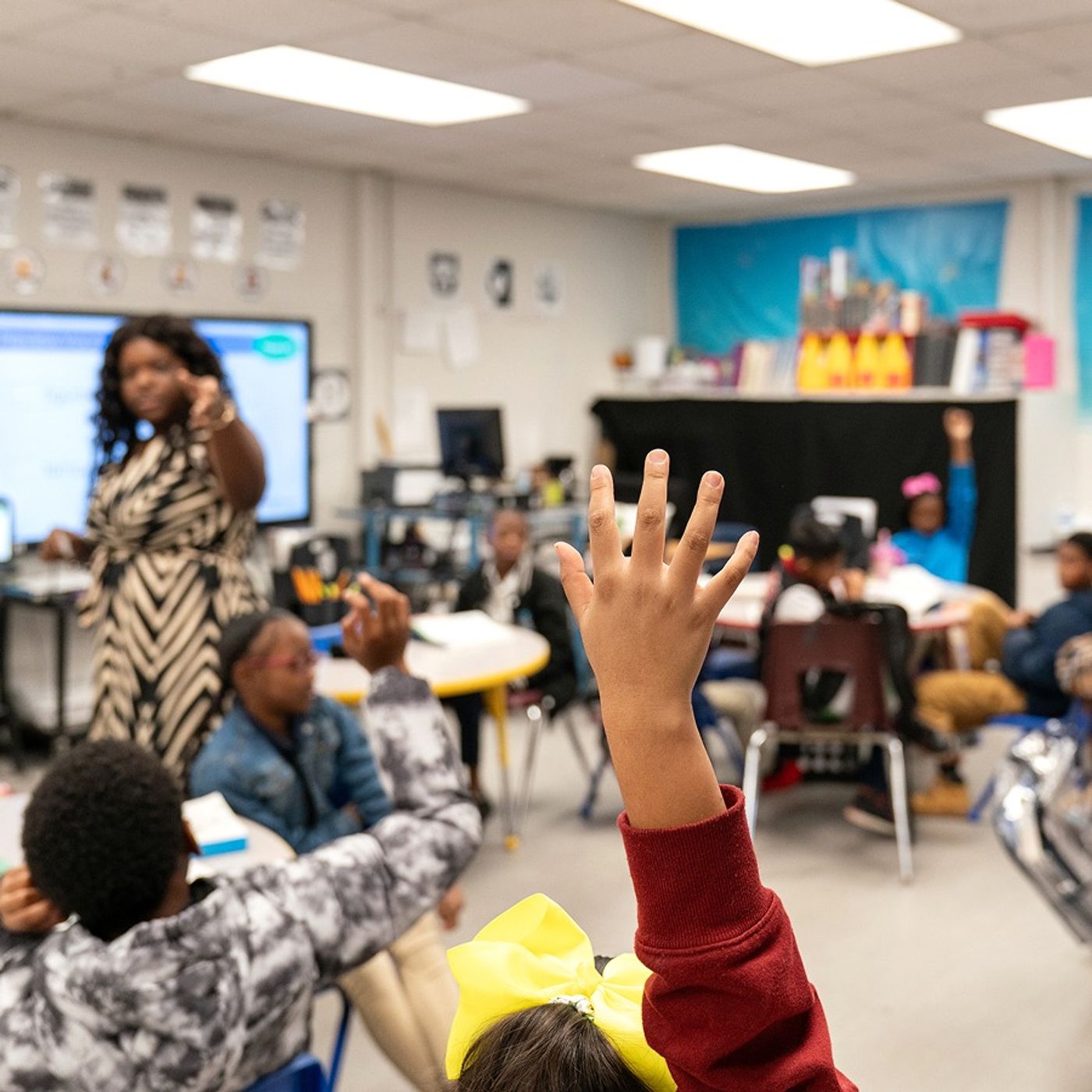
So to really see this in person and get a sense of it myself, I went to a school called Hazlehurst elementary, and it's in a rural community south of Jackson, which is the state capital. Yeah. And back in 2015, just 12% of students at the school were reading on grade level.
- [06:05]
B
Wow.
- [06:06]
D
And today, they have clawed and fought to get that figure to 35%.
- [06:10]
B
Impressive.
- [06:11]
D
Yeah. It's really, really hard to dramatically improve test scores, particularly for poor students who have a lot going on in their home lives. But I don't think any, including the principal, would argue that it's, you know, it's okay to have just 35% of students reading on grade level, but it's real, real progress. So how did they do it?
- [06:29]
E
Okay, boys and girls, I need your attention. I need your eyes on me.
- [06:33]
D
One, two. So this big piece of legislation really changed the way that children were taught to read. And if you go into a school like Hazlehurst, you're not gonna see kids off in the corner on their own, sort of nestled up with a book, just sort of absorbed in a picture book. Really, what you're gonna see is, like, what I saw, which is.
- [06:53]
E
So my word would be what?
- [06:57]
D
Second graders sounding out words together. Blamelessness.
- [07:03]
E
Blamelessness. Blamelessness. Good job.
- [07:06]
D
And so they explicitly teach kids how to sound outwards. That's called phonics. But they also teach things like vocabulary, like, explicitly. It's not just assume that you're gonna know what that word is in that passage you're reading. So I went into. I think it was a second or third grade classroom, and I remember they were reading a passage, and they were discussing what is the meaning of complain.
- [07:29]
E
The next word is complain. He said complain. Complain.
- [07:33]
D
And that was one of the words, the vocabulary words that day.
- [07:36]
B
Very important.
- [07:37]
D
The kids were. They had many complaints. They were very animated and very into it.
- [07:42]
E
Anybody else complain about something? Tyler, will My dog making too much
- [07:45]
D
noise in the house.
- [07:46]
E
Oh, Lord. I don't even like animals.
- [07:48]
D
Thank.
- [07:48]
E
Go.
- [07:50]
D
So that's actually a significant change from just sort of reading for the love of reading and developing a love of reading and maybe adding in some phonics as it comes up. But it's explicit teaching, and it's direct. It's not just implied.
- [08:05]
B
And how did the law make this happen? Like, how do you if you're a state government mandate, an approach to teaching reading, how do you control what teachers do in their classrooms?
- [08:17]
D
Well, Mississippi was basically at the forefront of this. Lots of states have since done this. But what Mississippi did is it put a huge focus on how to train teachers how to teach reading. They were not just letting teachers teach willy nilly, however they learned in school or whatever their teacher down the hall taught them. The state was saying this is the best practice. But then they also, if you're in the bottom 25% of schools, they send a literacy coach into your school.
- [08:43]
B
What is a literacy coach?
- [08:44]
D
It is not a coach for the students. It is a coach for the teachers. And so it's basically like an amplifier and sending the best practices out into the system to say, this is how you teach reading.
- [08:55]
E
All right, so in my story,
- [08:58]
D
the
- [08:58]
E
story that we're on, right.
- [09:00]
D
And when I was there, I observed the coach in action. And there's a lot that goes into it. Some of it is the coach actually leading a lesson in the classroom and the teacher watching the coach do it. But it can also be in real time, small corrections. The coach, when I was there, corrected one of the teachers who was mispronouncing a word. She was mispronouncing the word tortoise.
- [09:21]
E
I had the tortoise, which was my turtle, and I had my hare.
- [09:25]
D
The literacy coach just walked right up to her and just whispered in her ear and corrected her in the moment.
- [09:30]
E
My tortoises. My tortoises. Okay.
- [09:33]
D
You know, it's like a real time coach for how to do your job.
- [09:37]
B
And what do teachers think about this?
- [09:40]
D
Well, I was surprised. I thought they might be a little prickly. But at the school that I went to, they loved it. Like, they loved it. And I talked to some of the teachers and they were just thirsty for the knowledge and for the help. And I think if you could just have a mentor basically to help you every time you get frustrated or confused and that person was not there in a punitive way. And that's very important in Mississippi. They are state employees, but they're not there to punish. They're really there to mentor and coach and spread best practices. Like, hallelujah. Like, I would love if someone could just help me every time I was struggling with a story.
- [10:11]
B
Sounds awesome.
- [10:13]
D
Yeah.
- [10:13]
B
Honestly.
- [10:14]
D
Yeah. And another thing that they did is the state took a stronger role in taking a top down approach to curriculum, which is not always popular. And so what they did is basically say, like, here are the five or six curriculums that we think are high quality and approved for use in Mississippi for teaching reading, for example. And so this was actually very eye opening to me because at this school that I visited, they had previously been using a different kind of curriculum that was an intervention. So if a child is behind and they're giving a special curriculum, like all kids were getting, that because a lot of kids at the school were behind. And that is a problem because that means that kids are not getting access to the grade level content at sort of the highest level that they would be expected to perform at the end of the year. And so the state coaches and others helped recognize that and said, hey, we actually need to adjust this. And so we're going to switch to one of the state vetted curriculums.
- [11:08]
B
And Sarah, when you said earlier that Mississippi was also holding schools accountable, what
- [11:13]
C
did you mean by that?
- [11:14]
D
Well, around the same time that they passed this big 2013 legislation, they also changed their accountability system for schools. So they did two things. One, they raised the standards for what it means to be proficient in reading or math. So they basically raised the bar for what kids need to know. And then they also changed the way that schools were graded and held accountable. And all of this talk about accountability might bring back memories of something called no Child Left Behind.
- [11:44]
F
You know, a huge percentage of children in poverty can't read at grade level. That's. That's not right in America. We're going to win the war overseas, and we need to win the war against illiteracy here at home as well.
- [11:57]
D
And so this bill, no Child Left behind, of course, is the George W. Bush era policy that went into effect in 2002. And if you were growing up in the United States in that time, like I was same you were, you were taking tests. That was no Child Left Behind. Like, what was the proficiency of your school?
- [12:15]
F
So this bill focuses on reading. It sets a grand goal for the country. Our children will be reading by the third grade. That's not an impossible goal. It's a goal we must meet if we want every child to succeed.
- [12:33]
D
And so what that law did is it literally set the goal that every child in America would be proficient in reading and math.
- [12:41]
F
Because the only way to determine whether a child is reading at grade level is to have accountability in our school systems. And that's the basic strategy of no Child Left Behind. It says, here's some money. We expect you to teach. We want to measure to determine if you are teaching. We look forward to patting you on the back. But if you're not Teaching a child the basics, then we expect you to change before it is too late.
- [13:09]
B
And if I remember correctly, this law was incredibly unpopular.
- [13:14]
D
Yeah, I mean, it was very contentious. Teachers and parents alike grew frustrated at certain points with it. And there was a pushback that there was just too much testing. Teachers were teaching to the test, that they were taking time away from other important subjects like art or music or social studies. So eventually, it just becomes so unpopular and there's so much pushback that in 2015, no Child Left behind is replaced, repealed, and replaced with a different law, the Every Student Succeeds act under President Obama. And so in 2015, and even a little bit before that, states start to sort of move away from accountability as the mantra in education.
- [13:51]
B
But Mississippi embraces accountability. What's their logic, why they do?
- [13:57]
D
It's sort of like no Child Left behind, but with a twist. So Mississippi leaders felt like it was really important to have some way to see how schools are doing and help parents to decide what was a good school, what's not. And so what that looks like in Mississippi now is that schools get an A through F letter rating. And what goes into that is not just, you know, how much do students know at the end of the year, are they on grade level, but they also take into account growth. How much are the students improving throughout the year, where do they start, where do they end up? And really importantly, they double count the improvement of students in the bottom 25%. So schools are motivated not just to help their top students or their middle students who are on the verge proficiency, but they're motivated to help all students because they get credit for helping all students, and they get double credit for helping their lowest performing students.
- [14:50]
B
Fascinating. So what's happening here is Mississippi is deciding how well each school is doing, not just by looking at the absolute scores that these kids are getting, but by looking at the change in those scores. They're measuring progress.
- [15:05]
D
Exactly. Yes.
- [15:07]
B
So we know teachers hated being graded on test scores during no Child Left Behind. How did teachers and students that you talk to in Hazlehurst feel about this focus on test scores? This no Child Left behind with a twist, as you put it?
- [15:24]
D
Yeah. I mean, some of the criticisms of no Child Left behind can still apply to Mississippi. There is a big testing culture. At the school that I visited, students were taking tests every two weeks, like the. Even more than the state recommended.
- [15:36]
B
Yikes.
- [15:36]
D
But they, you know, the school felt like they couldn't afford to wait any longer to see, you know, how kids were doing. And even health class was Sort of like more reading instruction and vocabulary. So some of those same criticisms still exist. The teachers, I think, in some ways did feel some measure of pressure to deliver on the results. But I also observed, you know, in the interactions that I saw with the kids, just how much joy and satisfaction and dignity they felt in the learning itself that I don't think we can take for granted. I saw one little girl in second grade who was, you know, coaching another kid on how to pronounce a word. And so they're teaching each other. And I did some interviews with fifth graders. And how old are you, Johnny?
- [16:15]
E
10.
- [16:16]
D
10. Okay, so it's fifth grade. Everyone's here is in fifth grade.
- [16:19]
E
Yes.
- [16:19]
D
Okay. Who, you know, talked about, you know, how they felt about the testing, and some of them felt some pressure. But then this 10 year old named Johnny described what I thought was so profound. He told me, this will stick with me for a long time. He talked about tracking his own testing data. You're growing. And you do you have that information as students about how you're doing in class?
- [16:39]
G
Yes.
- [16:39]
E
Like, I like how, like, if I make a low grade on the other grades, if I make it higher, it's
- [16:46]
G
like staircases that go up. Yeah.
- [16:50]
E
It's just like building a lot.
- [16:52]
D
You like it because it's like a staircase. Because if you start out, you know, but down here, when you're going up, that feels good.
- [16:57]
E
Like the bar grail.
- [16:59]
B
Wow. These are like the cutest interviews ever, by the way. Fifth graders. I'm very jealous.
- [17:04]
D
Setting aside, reading aside, what is the favorite part? What's your favorite part of the school day? Could be anything.
- [17:09]
G
Eat it.
- [17:10]
D
Yeah.
- [17:17]
B
So Mississippi is directing its teachers on how to teach. It's grading schools based on the improvement that they're making in the kids test scores. Are those the main ingredients to this Mississippi approach?
- [17:31]
D
Well, there's one other thing, and that is Mississippi is also holding kids accountable. And that's one of the most controversial and most debated things that they have done.
- [17:45]
B
We'll be right back.
- [17:54]
H
Self directed investing, trading, full service wealth management, Automated investing, financial planning, thematic investing, retirement planning.
- [18:01]
D
Whew.
- [18:02]
H
And to think that's just a small taste of what Schwab offers. Because Schwab knows, when it comes to your finances, choice matters. No matter your goals, investing style, life, stage, or experience, Schwab has everything you need all in one place so you can invest your way. Visit schwab.com to learn more. With no fees or minimums on checking accounts, it's no wonder the Capital One bank guy is so passionate about banking with Capital One. If he were here, he wouldn't just tell you about no fees or minimums. He'd also talk about how most Capital One cafes are open seven days a week to assist with your banking needs.
- [18:38]
D
Yup.
- [18:39]
H
Even on weekends, it's pretty much all he talks about. In a good way. What's in your wallet? Terms apply. See capitalone.com bank capital1na member FDIC taxes
- [18:51]
I
can feel confusing when you're trying to manage everything by yourself. But with Intuit, TurboTax help is closer than you think. Stop by one of their new state of the art store locations. There you can ask a tax expert to sync your accounts via the TurboTax app and automatically import your documents. With TurboTax Full Service, your expert looks for every possible deduction while keeping you updated every step of the way. In the app, eliminate the guesswork and file your taxes. With a TurboTax expert today. Visit TurboTax.com
- [19:22]
B
okay, Sarah, before we get to the controversy surrounding this element of the approach, explain to me how exactly does the state hold kids accountable?
- [19:32]
D
Well, that 2013 big piece of legislation, a big part of it said that if kids don't know how to read by the end of third grade, they're holding kids back. And so every year about 6 to 9% of Mississippi third graders are held back. And there are certain exceptions, but more or less, if you can't learn to read by the end of the year, you can't move on.
- [19:53]
B
And why is that controversial? Explain that part.
- [19:56]
D
Oh, all sorts of reasons. I mean, the emotional impact on kids. There's a lot of worry about what that's going to do to them long term and to see their peers move on. It also is just a lot of pressure. I mean, one of the kids that I talked to almost like shuddered and winced thinking back to his third grade year and the amount of pressure that was for him about whether he was gonna get to move on with his friends. So there's that, and then there's also just the question of whether it even helps them in the long term. There's some mixed evidence as to whether it really helps them by the time they get to later, middle school or high school, for example. And then there's of course, just the realities of like, who is going to get held back from a law like this. It's often not gonna be tons and tons of kids from the affluent white district.
- [20:37]
B
Right.
- [20:38]
D
There's gonna be racial elements and class elements to held back. And so that's something that has come up. And then, you know, there's been a very interesting and rigorous debate in the education world about whether this retention policy is actually what's driving Mississippi's success.
- [20:53]
B
Hmm. How do you mean?
- [20:55]
D
Because some have argued that if you hold back kids in third grade, that their scores are going to be higher in fourth grade, which is when this national test that sort of compares states, measures kids academic achievement. And so some have said that basically it's artificially inflating the scores because basically
- [21:15]
B
you're introducing potential selection bias. Right.
- [21:18]
D
You're taking out the lowest kids and giving them an extra year to learn. And I spend a lot of time looking at this because look, if you're going to look at a story about Mississippi is that, you know, are they really doing well? And what I came to conclude is that, yes, the lowest performing third graders are held back each year and they do get an extra year of learning and then they take the test the next year. And part of the story here, I think, is about the extra help that they get. They're not just retained without any help. Like in Hazlehurst, for example, third graders get extra after school help. Kids can go to summer school. So they're sort of infused with extra support. Like, retention without support isn't good. You can't just retain kids and be like, extra year. Now you're gonna be older and your friends are gonna move on. You have to, to help them get there.
- [22:06]
B
Can I ask, how is Mississippi giving all of that support? I mean, this is one of the poorest states in the country. How are they affording all of this?
- [22:15]
D
Yeah, I mean, they're on a budget, let's put it that way. Mississippi does have one of the lowest per student spending in the country. They spend about $13,500 per student. And that's compared to the national average, which is almost 18,000 per student. And in states like New York, it's 29,000 per student. So they're basically at or near the bottom in student spending.
- [22:37]
B
Yeah.
- [22:37]
D
And so this is a big question. How are they doing this? And so what I found when I went there is, look, I mean, the school that I went to is cash strapped. They recognize it and they're making academics their core. Like that is what they're doing. And what the state does is they're spending a little more money, but what they're doing is they're targeting it to specific things. So remember the literacy coaches I talked about? That was an investment that the state made. They also spent money to invest in preschool, expanding preschool so that more kids could be better prepared when they get to kindergarten. So they are making some investments. And when I did sort of back of the envelope math, none of those things were like dramatically changing the picture of how much Mississippi was spending per student. But it was targeted and it allowed the state department of education to make specific investments versus allowing districts to spend it however they want.
- [23:26]
B
It does seem to show that it's possible to make meaningful improvements in education without spending vast amounts of money. And we've been talking about fourth grade test scores. Sarah, what are we seeing in the later years? Do these improvements last in Mississippi?
- [23:42]
D
Yeah. So this is one of the criticisms of what's happening in Mississippi. When you get to eighth grade, the results start to look a little bit less impressive. They still do quite well, adjusted for the poverty and the students that they serve. But kids in Massachusetts are still way outperforming 8th graders in Mississippi. And so the state is actually trying to take some of the things that they're doing in the early years and turn trying to apply it to older kids. So they're trying to get more money for adolescent literacy coaches. Like the same thing they do in the early grades. They're trying to do that so that the bottom performing schools in late elementary school and middle school could also get literacy coaches, things like that.
- [24:21]
B
So basically part of it is Mississippi is not applying these interventions consistently every single year. This is an early education strategy that they're applying and they're saying we would need to, to do this on the long haul to actually see the results carry over.
- [24:41]
D
Exactly. Now I should mention that just last year on the state tests, for the first time outside of the pandemic, Mississippi started to see a little bit of a dip in its scores. And so we don't know what that's going to look like on the national tests that allow you to compare across states. But it is a little bit of a. Something a little inclination of. Is Mississippi starting to stagnate or is it just dealing with the same issues that everyone else is around the country when it comes to students missing school post pandemic, Some of the things with technology and screens and is that affecting students learning? So it's like, look at what it's taken so far. And also can this be sustained when you look at the tides that are facing education nationally?
- [25:22]
B
Okay, so there are some caveats here. This Mississippi miracle is not 100% durable. It does seem though that Mississippi has figured something out that other states haven't about educating kids about specifically Educating poor kids. In this case, this is a deep red state, following through on a goal that I think blue states would say they value a lot, being the best at lifting up the most disadvantaged children. And so I wonder, are there other states that are looking at this and wondering if they should mimic it, if they should try this?
- [26:03]
D
Well, there are some states that are showing some similar signs of progress, but there are generally a few handful of other red states in the South. So Louisiana and Alabama have also shown some promising signs over the last few years, using some of the same strategies as Mississippi. Maryland is another state that comes to mind. They've actually hired Mississippi's former state superintendent who helped lead this turnaround. So she's now in Maryland trying to help Maryland, which was once number two in the country for reading and fell way to the bottom. Do Mississippi 2.0 up there help them pull a Mississippi? Yes, exactly. But by and large, blue states I agree with you should sort of be looking at, wow, what is Mississippi doing? What is Louisiana and Alabama doing? What should we be doing? And we haven't quite seen the same embrace of some of these policies.
- [26:52]
B
Why not?
- [26:53]
D
Well, one reason is that lots of blue states are contending with powerful political forces like the teachers unions. In states like, you know, California, New York, Massachusetts, teachers unions have historically opposed some of the strong test based accountability measures like we see in Mississippi, and they have a lot of reasons for that. But I think the reality is it's just harder to make sweeping, top down radical change when you're dealing with negotiations and political forces that it just makes things a lot more complicated. Sure. And then, you know, another reason is that blue states have gone in a different direction than over the past few years. In some cases, between the pandemic and other things, they've lowered proficiency standards, they've gotten rid of graduate requirements, they've been much more focused on what a source of mind likes to call the inputs of education. Like we're gonna add counselors and social workers and we're gonna increase spending. And those are things that schools need and they want and kids need. But it's more of a conversation about the inputs than the outputs, such as, you know, how are kids doing on the test, Are they prepared? And in Mississippi, I think there's much more agreement that academics is core and that is what a school is for.
- [28:03]
B
You know, one of the ironies in all of this is this red state Mississippi is taking an approach that feels in many ways like it could be considered a big government type of strategy. The state government Kind of taking away local control from the schools and forcing its priorities on individual teachers and on families, like taking a heavy hand in things.
- [28:30]
D
Yeah, it's sort of the opposite of what you would think. And then you have states like Oregon who's, you know, deep blue state, a lot of liberal values, and it has taken the opposite approach in many ways. It is much more hands off when it comes to their education department and telling districts what to do. It takes a much softer approach to accountability. There's a lot of distrust of testing in the state of standardized testing. And at the same time, they're getting a much poorer return on investment, on the money that they spend. When you adjust for their demographics and who they serve, Oregon is at the bottom. And so it is a really interesting question. It's very much the inverse of what you would expect.
- [29:07]
B
Just to step back here, Sarah, from all your reporting on Mississippi, on its success on these measures, what is the lesson of this little red state that could. What should we take from this?
- [29:19]
D
Well, I think one of the clear lessons is that it is possible to make progress and poverty cannot be an excuse. Like number one, this is possible.
- [29:28]
B
Right.
- [29:28]
D
So then the question is, how do you do it? You know, one of the things is just that there is no magic bullet and that you have to do this and this and this and you have to keep after it. Like it's not something where you can just pick the easiest thing that's most politically palatable. And when I look around the country and I look at discussions about education, it strikes me that it's not going to be politically popular to promise results and change in education because it just takes a really long time to see real progress, even when you are doing everything that you can and all of the strategies. Think about that. You got a two term governor, that's eight years. I mean, you might start to see some progress in that time, but maybe not. And so what you really have to have is the political will and the will across business and across the culture of a place to say like this is something that we as a state are going to commit to. We're going to be pretty aggressive. We're going to be a little bossy in telling you what to do. But then we're also going to flood you with support and we're going to see it through to the end.
- [30:30]
B
Well, Sarah, thanks so much for coming on the show.
- [30:33]
D
Thanks for having me. We'll be right back.
- [30:41]
H
With no fees or minimums on checking accounts, it's no wonder the Capital One bank guy is so passionate about banking with Capital One. If he were here, he wouldn't just tell you about no fees or minimums. He'd also talk about how most Capital One cafes are open seven days a week to assist with your banking needs. Yup. Even on weekends, it's pretty much all he talks about. In a good way. What's in your Wallet? Terms apply. SeeCapitalOne.com Bank Capital One, NA Member, FDIC.
- [31:12]
J
In theory. I knew that. This kind of thing can happen in any family. Anyone's first cousin could be plotting murder.
- [31:19]
D
This is UCE 4735 and today is.
- [31:23]
J
Upstanding citizens are always turning out to be secret criminals. And I wouldn't even call my cousin Alan an upstanding citizen.
- [31:31]
D
You know, my clients are cartel level guys. They're all badasses.
- [31:34]
J
But it's one thing to know there
- [31:36]
D
is a more permanent way to do it. Is there?
- [31:38]
F
Yeah.
- [31:38]
D
More and more definite permanent.
- [31:41]
J
And another thing to understand Alan.
- [31:44]
D
Murder me.
- [31:46]
J
It ended up being so much worse than I thought I knew.
- [31:49]
F
The price is eminently reasonable. For what it's worth.
- [31:52]
J
What the hell was Alan thinking?
- [31:54]
F
Let's just say that I'm a little pissed off.
- [31:56]
D
Yeah, yeah.
- [31:56]
F
No, I get it.
- [31:57]
D
Yeah.
- [31:59]
J
From Serial Productions and the New York Times. I'm M. Gessen, and this is the Idiot. Listen, wherever you get your podcasts,
- [32:12]
B
Here's
- [32:12]
C
what else you need to know today. On Thursday, Israeli Prime Minister Benjamin Netanyahu promised to keep striking Lebanon, further challenging the fragile truce between the US And Iran. That announcement came hours after Netanyahu had said he was ordering the Israeli government to begin diplomatic talks with Lebanon about disarming Hezbollah militants. President Trump told NBC News that after he called Netanyahu, the Israeli leader had agreed to scale back his strikes on Lebanon.
- [32:46]
G
And good afternoon. The lies linking me with the disgraceful Jeffrey Epstein need to end. Today.
- [32:56]
C
Melania Trump delivered a rare public address from the White House criticizing what she called false claims about her relationship to Jeffrey Epstein.
- [33:06]
G
I am not Epstein's victim. Epstein did not introduce me to Donald Trump.
- [33:13]
C
It was unclear why the first lady decided to speak out at this particular moment or what reports she was specifically referring to. She addressed a cordial email that she'd sent to Ghislaine Maxwell and run ins that she'd had with Epstein, but hit back hard at any insinuation that she was connected to Epstein or Maxwell's crimes.
- [33:34]
G
I was not a participant, was never on Epstein's plane and never visited his private island.
- [33:43]
C
The first lady called on Congress to keep investigating Epstein. Today's episode was produced by Eric Krupke, Jack Desadoro, and Ricky Novetsky, with help from Alex Stern. It was edited by Lisa Chow and contains music by Marian Lozano. Our theme music is by Wonderly.
- [34:06]
B
This episode was engineered by Alyssa Moxley.
- [34:21]
C
That's it for the daily I'm natalie kitroweff.
- [34:24]
B
See you on Sunday.
- [34:30]
H
With no fees or minimums on checking accounts, it's no wonder the Capital One bank guy is so passionate about banking with Capital One. If he were here, he wouldn't just tell you about no fees or minimums. He'd also talk about how most Capital One cafes are open seven days a week to assist with your banking needs.
- [34:47]
D
Yup.
- [34:47]
H
Even on weekends, it's pretty much all he talks about in a good way. What's in your wallet? Wallet terms apply. See capitalone. Com, bank, capital1na member, FDIC.