← The Daily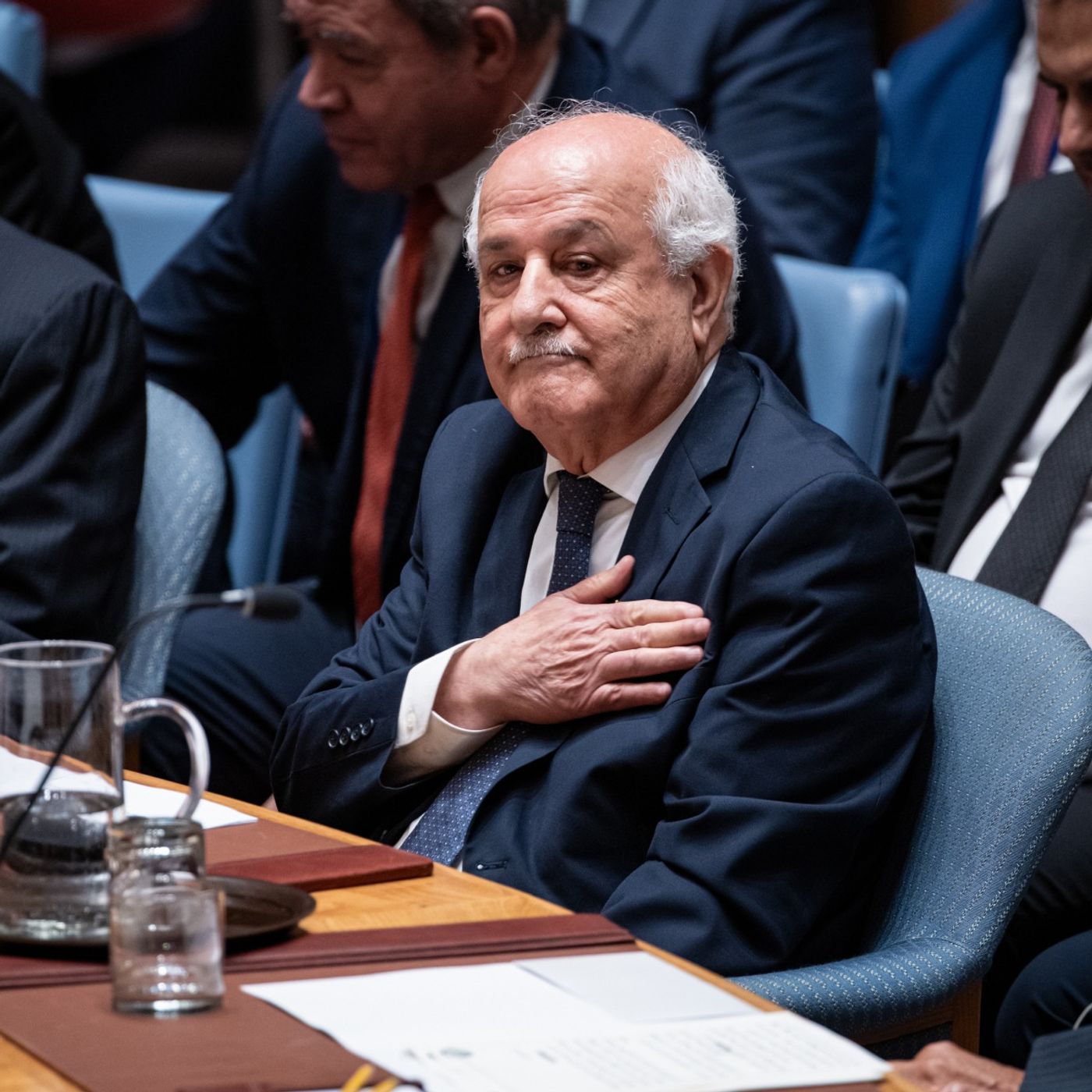
The Daily
The Question of Palestinian Statehood
00:29:09
The suffering in the Gaza Strip has fueled international pressure on Israel to end the war and pushed western powers to recognize a Palestinian state. The isolation was on display last week at the United Nations. Jessica Cheung, a producer for “The Daily,” speaks to Riyad Mansour, the Palestinian ambassador to the U.N., about what Palestinian statehood means to him. Then, Mark Landler, the London bureau chief of The New York Times, discusses what the recognition means without the support of the United States and Israel, which was underscored in their new peace plan.
Loading summary
Transcript134 lines
- [00:00]
Capital One Advertiser
Brought to you by the Capital One Savor card. With Savor, you earn unlimited 3% cash back on dining, entertainment and at grocery stores. That's unlimited cash back on ordering takeout from home or unlimited cash back on tickets to concerts and games. So grab a bite, grab a seat and earn unlimited 3% cash back with the saver card. Capital One what's in your wallet? Terms apply. See capitalone.com for details.
- [00:26]
Rachel Abrams
From the New York Times, I'm Rachel Abrams, and this is the Daily it's been nearly two years since Hamas carried out its deadly attacks on Israel on October 7th and Israel began its bombardment of Gaza. Since then, the humanitarian crisis in Gaza has only worsened and Hamas is still holding hostages. But the images of Palestinian suffering have lately fueled international pressure on Israel to end the war with and pushed Western powers to recognize a Palestinian state. This culminated last week at the United nations, where a group of world leaders formally recognized Palestinian statehood, which deepened Israel's isolation. But just a week later, a new peace plan unveiled by President Trump and Israeli Prime Minister Benjamin Netanyahu underscored the reality that Palestinian statehood is a long way off. Today, the optimism and the fury of this moment and what this recognition actually means. It's Friday, October 3rd. Jess Chung, you are one of the producers on our show, and last week you spent time on the ground at the UN to document this historic moment in which the question of Palestinian statehood was really front and center. So talk to us a little bit about what you were there to capture.
- [01:51]
Jess Chung
Well, over the past two years, the international community has grown increasingly frustrated with Israel's tactics in the war. And what we've seen recently is a push by a number of Western countries like the U.K. france, Australia, and Canada to formally recognize the Palestinian state as a way to put pressure on Israel to end the war. Now, up until this point over over 140 countries had already done this. But what's interesting about this new group of countries is that they're traditionally Israeli allies. That infuriates Israel and the US who say what this is going to do is reward Hamas for its terrorism on October 7. But regardless, 10 countries were planning to come to the UN General assembly last week to stand up and say for the first time we recognize the Palestinian state. So it was going to be a huge moment and I wanted to capture that, particularly through the eyes of this one guy, Riyadh Mansour. You can stand. Well, it's a pleasure to meet you.
- [02:53]
Riyadh Mansour
Pleasure to meet you.
- [02:53]
Jess Chung
Ambassador Mansoor is the Palestinian ambassador to the UN and he's worked toward this moment for pretty much his entire life.
- [03:00]
Riyadh Mansour
We are in the Rose Garden here at the United Nations.
- [03:04]
Jess Chung
Yes.
- [03:04]
Riyadh Mansour
I have beautiful memories.
- [03:06]
Jess Chung
I meet him in the gardens of the UN in midtown Manhattan. This was all before the big meeting was set to take place. He's dressed in a suit. He's got a small Palestinian flag pinned on his lapel. And how long have you been serving in this role?
- [03:21]
Riyadh Mansour
September. 20 years straight.
- [03:23]
Jess Chung
20 years straight?
- [03:23]
Riyadh Mansour
Yes.
- [03:24]
Jess Chung
Mansour is in his late 70s and he's been representing Palestinians here for decades.
- [03:29]
Riyadh Mansour
For me, I was working for these things from long time ago.
- [03:34]
Jess Chung
How does it feel to have these countries now on board?
- [03:38]
Riyadh Mansour
It feels very great. We hope from the few days to come that the international community is making a turn. A turn where now having the state of Palestine a reality. So we are marching in the direction of peace and justice.
- [04:01]
Jess Chung
Thank you so much. And I hope to follow you throughout the week.
- [04:03]
Riyadh Mansour
Okay, very good.
- [04:04]
Jess Chung
Thank you. Thank you so much. Thank you so much. We'll touch base. Because he's been here for so long, Mansoor seems to be a kind of fixture in this place. He scurries around these halls doing a seemingly endless amount of press gaggles, shaking a seemingly endless amount of hands.
- [04:23]
Riyadh Mansour
Was she there?
- [04:24]
Jess Chung
No, she's overhead meeting a seemingly endless amount of diplomats. But sitting down with him, I realized that the UN has long been a fixture in his life, too.
- [04:35]
Riyadh Mansour
I was born in Palestine, a child of a Palestinian refugee family, Mansoor spent.
- [04:41]
Jess Chung
His childhood in Ramallah in the west bank.
- [04:44]
Riyadh Mansour
And we lived in caves and in the valleys before UNRWA came to the picture.
- [04:49]
Jess Chung
His family was among the hundreds of thousands of Palestinians who were expelled or fled from their homes amid the wars surrounding the creat of the State of Israel in 1948, a period known to Palestinians as the Nakba started giving us tents. And the UN provided food, schools and medical care to those displaced Palestinian families, including Mansoors. Do you have an early memory about how you understood that Palestinians didn't have a state of your own?
- [05:18]
Riyadh Mansour
I don't know exactly what on those days the idea of statehood was. What was in our mind is we want to return to our towns, to our villages, to our homes. Like the key for our house in Palestine from the town where we were expelled from was hanging inside the house. So that's a symbol of returning to.
- [05:48]
Jess Chung
In the 1950s, Mansour's father immigrated to the U.S. he took a job as a steel worker in Youngstown, Ohio. Mansoor was around 17 years old when he followed his father Here he went on to study at Youngstown State, and.
- [06:02]
Riyadh Mansour
I was influenced by the thoughts of the moment.
- [06:06]
Jess Chung
Throughout college, he was politically active, marching for civil rights against the war in Vietnam and seeing those movements create real change around him. He started speaking out against Israel's occupation in the west bank, in Gaza, trying to raise awareness of Palestinian rights.
- [06:23]
Riyadh Mansour
It wasn't easy. It was not popular. But I was young.
- [06:27]
Jess Chung
And then, in 1974, Palestinian leader Yasser Arafat was invited to speak at the UN for the first time, where he made an appeal to the international community for a Palestinian state.
- [06:38]
Riyadh Mansour
I was a student, so I brought three.
- [06:41]
Jess Chung
Mansoor organized three buses of people, two to drive from Ohio to New York for the event.
- [06:55]
Riyadh Mansour
And I was among the lucky ones to go to the United nations to shake hand with Chairman Arafat after he gave his famous speech. So that was the first time that I entered the un.
- [07:07]
Jess Chung
Palestinians were talking about state statehood and what it would mean.
- [07:11]
Riyadh Mansour
Is this what we want? Is it one state, two state?
- [07:15]
Jess Chung
And a decade later, Mansoor would take a job at the UN and keep pushing for the same goal.
- [07:20]
Riyadh Mansour
And that journey took a long time. The 80s, the 90s, then the Oslo agreement.
- [07:27]
Jess Chung
For years, Mansoor worked through cycles of Palestinian intifadas and militancy, Israeli retaliation and expanding settlements, new wars, new ceasefires, new peace agreements like the Oslo Accords, which were seen as the closest the international community came to resolving the conflict. But in the end, they didn't achieve what they set out to.
- [07:49]
Riyadh Mansour
You see, we went through cycles, hopes. Then they go down. The same thing after October 7, when.
- [07:58]
Jess Chung
Hamas, in a surprise attack, killed 1,200 people and kidnapped about 250 others. Pictures emerge of the destroyed kibbutzim, videos of hostages being carried away on the backs of motorcycles and trucks driven by militants. Stories of people shot in their homes and trapped in burning buildings. All of it shocked the world.
- [08:20]
Riyadh Mansour
There were sympathies in the first few days with the families of the victims as a result of October 7th.
- [08:31]
Jess Chung
But after Israel launched the war against Hamas in Gaza, as that war entered its second year, with more than 60,000 Palestinians dead and the humanitarian situation worsening, people around the world also saw those pictures and heard those stories, including Mansoor, who described what he was seeing in Gaza to the United Nations Security Council this spring.
- [08:54]
Riyadh Mansour
The images of mothers embracing their motionless bodies, caressing their hair, talking to them, apologizing to them.
- [09:13]
Benjamin Netanyahu
Unbearable. How could anyone tolerate this world?
- [09:26]
Mark Landler
Excuse me, Mr. President.
- [09:29]
Jess Chung
It was around that time that Mansour said he felt things begin to shift. And I asked him about that.
- [09:36]
Riyadh Mansour
It created a tremendous amount of support and empathy and solidarity with the Palestinian people. Now the international community, enough is enough. We're not going to continue going through cycles. We're going to up and down, up and down this time. We're going to stop this war and allow the two state solution to become a realty. This is the moment.
- [10:13]
UN Representative
I stand before you to today beneath the emblem of the United nations to confirm the historic decision of the British government to recognize the state of Palestine.
- [10:30]
Riyadh Mansour
Portugal formally recognized the state of Palestine.
- [10:35]
Various Diplomats
A two state solution.
- [10:36]
Riyadh Mansour
Australia recognized the state of Palestine.
- [10:39]
Mark Landler
Canada recognizes the state of Palestine.
- [10:42]
Various Diplomats
Belgium announces the recognition of of the state of Palestine. And that is why Ireland last year with Spain, Norway and Slovenia recognized the state of Palestine. The systematic decimation of Gaza. The use of food as a weapon of war.
- [10:59]
UN Representative
Children dying of starvation while food rots at the border.
- [11:05]
Various Diplomats
The killing of tens of thousands of.
- [11:07]
Riyadh Mansour
Tens of thousands of civilians.
- [11:08]
Various Diplomats
More than 65,000 people killed in Gaza, most of them women and children. Horrifically, more than 20,000 of them children. And hundreds of our own humanitarians. Aid workers.
- [11:20]
Riyadh Mansour
Aid workers killed.
- [11:21]
Various Diplomats
Journalists.
- [11:22]
Riyadh Mansour
Journalists killed.
- [11:23]
Various Diplomats
Doctors targeted and killed. We have reached a point where what has been credibly described as a genocide is being carried out in front of the eyes of the world.
- [11:34]
UN Representative
Statehood is the inalienable right of the Palestinian people and that two states is the only path to security and lasting peace for Israelis and Palestinians alike.
- [11:54]
Jess Chung
Israel denies many of these allegations and strongly refutes the accusation of genocide. The Israeli delegation didn't come to the meeting. Their seats stayed empty.
- [12:07]
Riyadh Mansour
Today felt so great, I think that my tears were coming down on my face.
- [12:13]
Jess Chung
But Mansoor was moved to cheers.
- [12:15]
Riyadh Mansour
It's a historic day. We are climbing a very tall mountain and we are approaching the top of the mountain.
- [12:26]
Jess Chung
Throughout the week, while I was following Mansour, I kept asking him why this moment felt so important. After all, over 140 countries had already recognized Palestine. So isn't this week largely a symbolic gesture? He kept holding up this analogy, apartheid in South Africa. He said much of the world also condemned apartheid for decades. But it was Western countries putting pressure on South Africa that helped end apartheid. So Mansour says he sees this moment as a turning point for statehood. But this moment has also been controversial. What do you say to those who see this recognition as rewarding Hamas for its terrorism? I asked Mansour what he thought about the fact that some people view all this formal recognition as a reward to Hamas for the atrocities. On October 7, Mansoor told me he thinks that's the wrong way to look at it.
- [13:25]
Riyadh Mansour
Not only us, but almost all the countries do not agree with that assessment. Nobody would believe that France, uk, Canada, Australia are rewarding Hamas. That doesn't make sense. All of them, they were doing it as an investment in peace and harmony.
- [13:53]
Jess Chung
Mansoor said Palestinian statehood is not a prize for attacking Israel. In his view, Palestinian statehood is protection for Israel to make sure it won't happen again. But that's not how Israel sees it and that was made clear as the following days unfolded.
- [14:14]
Rachel Abrams
After the break, my colleague Mark Landler on what this recognition means without the support of Israel and the United States.
- [14:32]
Jess Chung
Hi New York Times, I would be very interested in having separate logins for a shared subscription. I'm 35 years old. I still share my parents New York Times subscription.
- [14:44]
Mark Landler
I think if my teenagers were to have their own logins we could share articles. It doesn't let us play the same games as each other.
- [14:50]
Jess Chung
I play the stoku, I do the crossword, I do the spelling bee.
- [14:54]
Mark Landler
I do the word all. Please help.
- [14:57]
Rachel Abrams
Having our own accounts would be amazing. My mom could save her own recipes.
- [15:01]
Jess Chung
My friends could save their recipes.
- [15:03]
Rachel Abrams
I want to get the weekly newsletter but they seem to always go to my husband and then he doesn't forward them to me.
- [15:08]
Jess Chung
We both love cooking. I'm a 30 minute and under dinner girly.
- [15:12]
Rachel Abrams
My boyfriend is very elaborate. I think him having his own profile would be great.
- [15:16]
Jess Chung
We love the New York Times and.
- [15:18]
Rachel Abrams
We would love to love it individually.
- [15:21]
Mark Landler
Listeners, we heard you introducing the New York Times Family Subscription one subscription, up to four separate logins for anyone in your life. Find out more@nytimes.com family.
- [15:35]
Jess Chung
Mark, you have.
- [15:35]
Rachel Abrams
Covered this story for decades, the Israel Palestinian conflict and the fight for Palestinian statehood.
- [15:41]
Mark Landler
Yes I have.
- [15:42]
Rachel Abrams
Which is why we're turning to you to help us understand what happened not just last week at the UN but but also earlier this week when Israeli Prime Minister Benjamin Netanyahu visited the White House where he stood next to President Trump as President Trump presented this new plan to end the war. I want to start with the UN where the overwhelming support for Palestinian statehood infuriated Netanyahu. Can you walk us through what happened that day?
- [16:09]
Benjamin Netanyahu
The assembly will hear an address by His Excellency Benjamin Netanyahu, Prime Minister of.
- [16:17]
Various Diplomats
The State of Israel.
- [16:20]
Mark Landler
Well, after these countries stood up and recognized Palestinian statehood, Prime Minister Benjamin Netanyahu gave his response. Ladies and gentlemen, he took the dais and railed against these moves towards recognition.
- [16:35]
Benjamin Netanyahu
This week, the leaders of France, Britain, Australia, Canada and Other countries unconditionally recognized a Palestinian state. They did so after the horrors committed by Hamas on October 7.
- [16:51]
Mark Landler
Netanyahu's argument, in short, is that recognizing Palestinian statehood is a reward for Hamas.
- [16:58]
Benjamin Netanyahu
You know what message the leaders who recognize a Palestinian state this week sent to the Palestinians? It's a very clear message. Murdering Jews pays off.
- [17:12]
Mark Landler
What the west is basically saying to Hamas is you can inflict terror on Israeli citizens, and in our desire for peace, we're going to be willing to give you this very symbolic concession.
- [17:26]
Benjamin Netanyahu
The Palestinians, they don't believe in this solution. They never have. They don't want a state next to Israel. They want a Palestinian state instead of Israel.
- [17:38]
Mark Landler
And Netanyahu's argument is what we should really be doing is supporting Israel in its effort to crush Hamas, to remove Hamas from the equation altogether and to back Israel to the hilt, fighting for the return of the hostages and supporting its military campaign in Gaza, rather than heading down with what he views as this cul de sac of recognizing a Palestinian state.
- [18:05]
Rachel Abrams
I watched Netanyahu speech, and I was really struck by how many representatives from other countries literally walked out of the hall as he took the stage. And yet, despite that, he still had this defiant tone as he talked, which I think really underscored the fact that Israel, even as it's become more and more isolated on the world stage, Netanyahu has continued to dig his heels in, and that that was very evident during his speech at the U.N. yes, I think that's right.
- [18:36]
Mark Landler
And I think he did it for one critical reason. For all those countries that oppose Israel and are critical of Israel, he knows he has one country that is steadfastly behind Israel, and that's the United States and particularly President Donald Trump, he came out against recognition of a Palestinian state. He echoed Netanyahu's argument that this would be a reward for terrorism, a reward for Hamas. And he did so even as there is some polling that suggests that the American public is far more divided on this issue. After two years of harrowing images of war from Gaza, more Americans are beginning to question unstinting support for the state of Israel, but not the president himself. But as long as Trump continues to support Netanyahu, continues to stand behind him in his military campaign in Gaza, I think Netanyahu feels that he has the latitude and the license to be as aggressive as he needs to be.
- [19:37]
Rachel Abrams
Obviously, the US Is Israel's strongest ally. But on the question of Palestinian statehood, which, of course, is what Netanyahu is so angry about, why does the US's position matter so much?
- [19:50]
Mark Landler
Well, the US is so important because it still holds a veto in the United Nations Security Council. So as long as the US Is totally behind Israel, there is a limit to what Palestinians can accomplish. I think it's also widely understood that without US Buy in, the whole notion of a two state solution really falls apart. The US has always been viewed as the central player in the question of a peace settlement between the Israelis and the Palestinians. That hasn't changed in the last few years even as these countries have moved toward recognizing Palestine. So while it's a very positive step for the Palestinians without the US Joining in, it's still has its limits.
- [20:35]
Donald Trump
This is a big, big day, a beautiful day, Potentially one of the great days ever in civilization.
- [20:45]
Mark Landler
And so you saw that critical American role on display just this past Monday when President Trump welcomed Prime Minister Netanyahu back to the White House.
- [20:55]
Donald Trump
So today is a historic day for peace. And Prime Minister Netanyahu and I have just concluded an important meeting on many vital issues, including they came out and.
- [21:05]
Mark Landler
Faced the TV cameras and presented a plan for Gaza, a Trump plan to end the war in Gaza.
- [21:12]
Donald Trump
This proposal calls for the release of all remaining hostages immediately, but in no case more than 72 hours.
- [21:22]
Mark Landler
It called on Hamas to give up their weapons, return the hostages immediately. They would have no future role in the governance of Gaza. Israel would remain a very strong military presence around the enclave. So really very much a pro Israel.
- [21:40]
Rachel Abrams
Plan for Gaza with terms that we should note. Hamas has consistently said it would never accept absolutely.
- [21:46]
Mark Landler
That Hamas has ruled out unilaterally. I should say, though, that our reporting shows many Gazans want Hamas to accept this deal, although a lot of people think it's a real long shot that Hamas ever would.
- [21:59]
Rachel Abrams
And did this plan say anything explicitly about statehood?
- [22:02]
Mark Landler
Well, it acknowledged that statehood was an aspiration of the Palestinian people, and it suggested that one could envision the creation of a Palestinian state subject to a number of conditions, including a reform of the Palestinian Authority.
- [22:20]
Donald Trump
I think while we're waiting for signatures and waiting for approvals from a lot of different countries that are involved in this, we probably shouldn't take questions, but.
- [22:29]
Mark Landler
It left the timeline and the roadmap for all of this completely unclear.
- [22:35]
Donald Trump
Thank you very much. Thank you.
- [22:41]
Mark Landler
And interestingly, the plan got, in the immediate aftermath, some pretty widespread support among Arab countries, but also among European countries, the very countries who a week earlier had formally recognized a Palestinian state.
- [22:56]
Rachel Abrams
What do we make of that? The fact that all these European countries had come out in support of a Palestinian state and now are supporting a plan that seems to heavily favor Israel.
- [23:08]
Mark Landler
I think really what this shows you is the desire among European countries and Arab countries for the US to remain engaged in the process. I think the mere fact that they saw President Trump stepping forward with a plan with his name on it, willing to be heavily engaged and visibly engaged for them, was a huge positive. I think they feel that they can work out the details, many of which they may not particularly like, as the process unfolds. But what's vital is for Trump to be involved. So the image of him standing next to Netanyahu saying he wants to play this role, that was worthy of their support. And that's why I think he got the kind of show of support that he did. And then immediately after his meeting with President Trump, Prime Minister Netanyahu, speaking to a domestic audience, said in Hebrew, don't worry, this is never going to happen.
- [24:12]
Rachel Abrams
It sort of feels like Netanyahu is kind of talking out of both sides of his mouth, right? Because on the one hand, he gets up at this press conference and he unveils this plan that gives a cursory nod to the possibility of statehood if, like 15 unlikely things happen first. And then in Hebrew, he's basically saying, over my dead body. And whatever he wants to do. Thus far, he's basically had the backing of the United States, even as there's been this growing list of countries that say they support Palestinian statehood. And so I wonder, where does all of this leave the prospect of a Palestinian state in your mind?
- [24:50]
Mark Landler
Well, you're right to say that Netanyahu was talking out of both sides of his mouth. And one could could say, in fact, he's been doing that for many years. On this topic, if you go back in time, there was a moment when Netanyahu claimed he supported a two state solution, as did a lot of mainstream Israeli leaders. Though it must be said that if you look at Netanyahu's actions over the years, he's really consistently undermined the prospect for a Palestinian state, whether it is expanding Jewish settlements in the bank or colluding with Hamas in the governance of Gaza, which had the effect of splitting the Palestinian movement in two. His actions have never been geared toward allowing or encouraging the creation of a Palestinian state. Now, in some senses, he's being clearer. He's saying quite publicly that at the moment he thinks a Palestinian state is a dire threat to Israel's security. But he's not willing to, to completely defy an American president, especially Donald Trump, when he includes this Kind of fairly wishy washy language in his plan for Gaza. So I think from Netanyahu's point of view, he sees this as something he's simply going to have to live with. And perhaps he's also confident that Hamas will never accept it anyway, so he won't be forced to live with anything that's in this plan anyway.
- [26:22]
Rachel Abrams
Mark, our colleague Jess earlier spoke to Riyadh Mansour, the Palestinian ambassador to the UN and he sounded so optimistic about the real possibility of a Palestinian state. And I wonder, just listening to everything that you've outlined, do you think that that optimism is misplaced?
- [26:43]
Mark Landler
Well, Riyadh Mansour is looking at this from his particular vantage point as a diplomat who has spent years, if not decades, lobbying countries to recognize a Palestinian state. And in that, he and they have been remarkably successful. You now have 150 some countries that recognize a Palestinian state, and they include some of the most important and powerful countries in the world. So from that point of view, the Palestinians have been remarkably successful. But in the nuts and bolts sense of building a state, I think it's a much different story. You have in Gaza a state of war and an enclave that's largely in ruins where Gaza health officials put the death toll at more than 65,000. In the west bank, you have a territory that's been carved up by the Israelis into an ever expanding set of Jewish settlements. You have a Palestinian Authority whose control and credibility is in question. So from the point of view of a viable and functioning state, I think the Palestinians are further away from that than they've been for a very long time.
- [28:03]
Rachel Abrams
Mark, thank you so much.
- [28:05]
Mark Landler
Thanks, Rachel.
- [28:14]
Rachel Abrams
We'll be right back.
- [28:21]
Mark Landler
I'm Wesley Morris. I'm a critic for the New York Times, and I'm the host of a podcast called Cannonball. We're gonna talk about that song you can't get out of your head. That TV show you watched and can't stop thinking about and the movie that you saw when you were a kid that made you who you are, whether you like it or not. I was so embarrassed the whole time because it's a bad film and I still love it. You can find Cannonball on YouTube and wherever you get your podcasts.
- [28:53]
Rachel Abrams
Here's what else you need to know.
- [28:54]
Jess Chung
Today.
- [28:56]
Rachel Abrams
A man rammed a car into a crowd and stabbed people outside of a synagogue in Manchester, England, on Thursday. Two people were killed and three others were seriously injured in what police called an act of terrorism. It happened on Yom Kippur, the holiest day in the Jewish calendar. Police said officers shot and killed the suspect only minutes after he began his assault.
- [29:18]
Various Diplomats
It is a serious incident, I have.
- [29:20]
Rachel Abrams
To say, the mayor of Greater Manchester, Andy Burnham, told people to avoid the area where the attack had happened.
- [29:27]
Various Diplomats
But at the same time I can gives some reassurance immediately to people that the immediate danger appears to be over, and Greater Manchester police have dealt with it very quickly.
- [29:38]
Rachel Abrams
The attacker was identified by Britain's counterterrorism police as a British citizen of Syrian descent. Police said investigators were still working to understand the motive behind the attack, and the Food and Drug Administration approved a generic version of the above abortion pill, mifepristone, making it more easily available at a time when abortion opponents are pressuring the Trump administration to restrict access to abortion pills. The approval, issued earlier this week, means that three American companies can now produce mifepristone to terminate a pregnancy. Today's episode was produced by Jessica Chung, Lindsay Garrison Mooch Sethi, Diana Wynne and Claire tennisgetter. It was edited by Maria Byrne with help from Paige Cowett. Fact Checked by Susan Lee. Music by Pat McCusker and Dan Powell engineered by Chris Wood. Special thanks to Yara Bayoumi, David Helpfinger, David Sanger and Aaron Boxerman. That's it for the Daily I'm Rachel Abrams. See you on Monday.
- [30:59]
Lifelock Advertiser
Sometimes an identity threat is a ring of professional hackers. And sometimes it's an overworked accountant who forgot to encrypt their connection while sending bank details.
- [31:08]
Jess Chung
I need a coffee.
- [31:09]
Lifelock Advertiser
And you need Lifelock. Because your info is in endless places. It only takes one mistake to expose you to identity theft. Lifelock monitors hundreds of millions of data points a second. If your identity is stolen, we'll fix it, guaranteed, or your money back. Save up to 40% your first year@lifelock.com specialoffer terms apply.