Loading summary
Transcript160 lines
- [00:00]
Apple Card Advertiser
Brought to you by Apple Card. Hey, you could be earning 2% daily cash back on that purchase. And that one and even that one. That's because Apple card users earn 2% daily cash back on every purchase, including everyday items they buy online or in store when using their Apple Card. With Apple Pay, not an Apple Card customer, you can apply in the Wallet app on iPhone. Subject to credit approval. Apple Card issued by Goldman Sachs bank usa. Sign Salt Lake City branch terms and more at Apple Co benefits.
- [00:31]
Conversation Starter
Okay, we have got to talk about
- [00:33]
Mark Benelli
this Michael Jackson movie
- [00:37]
Michael Barbaro
From the New York Times. I'm Michael Barbaro. This is the Daily.
- [00:41]
Michael Jackson Fan
Oh my God, that was like the greatest movie I have ever seen. Oh my God.
- [00:46]
Mark Benelli
Like I love this man.
- [00:47]
Michael Jackson Fan
The obsession I have right now with Michael Jackson is just so unreal.
- [00:52]
Michael Barbaro
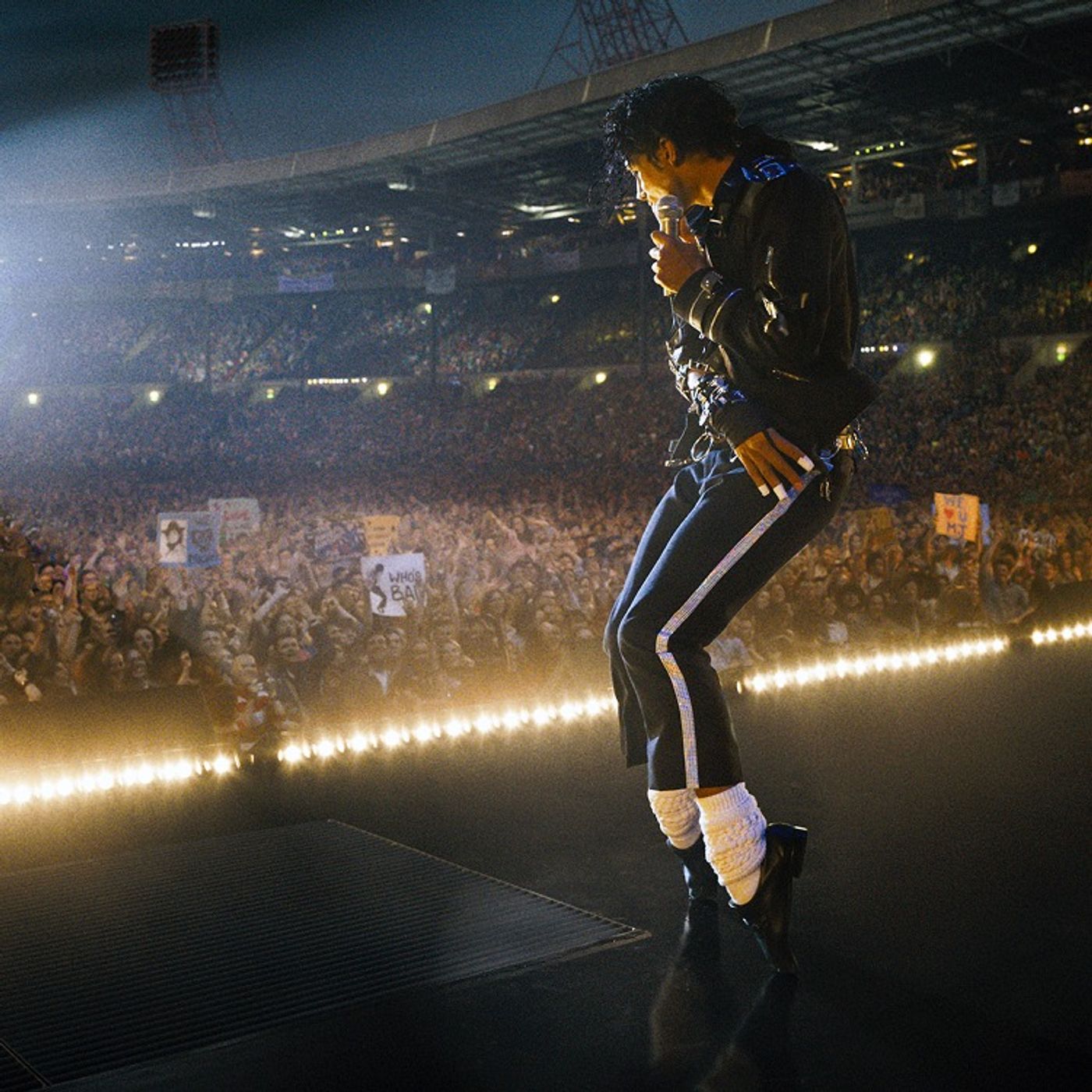
The record shattering box office success of Michael, the new biopic about Michael Jackson.
- [00:59]
Michael Jackson Fan
I have not stopped thinking about it. Like every time I talk to my friends, I'm like, dang, I can't wait to get off the phone with y' all so I can listen to some Michael Jackson.
- [01:06]
Couple Discussing NYT
He was so majestic and just like
- [01:09]
Michael Barbaro
a beautiful human being.
- [01:10]
Mark Benelli
I'm genuinely appreciating Michael Jackson as a
- [01:13]
Michael Jackson Fan
whole more than I thought I ever would.
- [01:16]
Michael Barbaro
And the outpouring of love for the late musician that the movie has unleashed was no accident. Instead, it was the culmination of a painstaking years long effort to resurrect the reputation and profitability of the King of Pop, despite the multiple accusations of sexual abuse that have surrounded him for decades. Today, Times magazine writer Mark Benelli takes us inside the new playbook for rewriting the past.
- [01:50]
Couple Discussing NYT
This world is just not the same without him.
- [01:55]
Narrator/Host
It's Friday, May 8th.
- [01:58]
Mark Benelli
Oh, I miss him so much.
- [02:02]
Interviewer
Mark, welcome to the Daily.
- [02:05]
Mark Benelli
Thanks for having me.
- [02:06]
Interviewer
You are not a movie critic.
- [02:08]
Mark Benelli
No.
- [02:09]
Interviewer
And we're not really here to talk about the artistic merits of this movie about Michael Jackson. Although, just to say, critics have been pretty unkind to the movie overall, which has done nothing to dampen the ticket sales. Your reporting has been focused on how the movie came to be and how it fits into a much larger project of Michael Jackson image repair. Is that the way to think about it?
- [02:37]
Mark Benelli
Definitely. Yeah. It's really a fairly remarkable business story. And it was orchestrated by the people now running his estate. And their project, as you said, has been to rehabilitate Michael Jackson, who'd become a fairly toxic asset and restore his life and music as exploitable intellectual property. And this biopic, Michael is the culmination of that years Long effort and it's been an undeniable success, I would say.
- [03:07]
Interviewer
And where in your mind does the story, the project of image rehabilitation, this business success story begin?
- [03:16]
Mark Benelli
So it really begins right after his death.
- [03:18]
Conversation Starter
Tonight came the word from la. Michael Jackson, the King of Pop, as
- [03:22]
Mark Benelli
he was called, has died in 2009.
- [03:26]
Conversation Starter
A child star at first, who as an adult was a deeply troubled man with mental.
- [03:31]
Mark Benelli
And to understand just how massive a project the state was facing at that point, you have to remember that Michael Jackson's reputation when he died really could not have been worse.
- [03:41]
News Reporter
Life was tarnished by allegations of child abuse by addictions to prescription drugs and plastic surgery.
- [03:48]
Mark Benelli
He had been accused multiple times over many years of child sexual abuse.
- [03:54]
News Reporter
Michael Jackson, the biggest superstar in the world, allegations that he sexually molested young boys.
- [04:02]
Mark Benelli
Those accusations were very public.
- [04:04]
Conversation Starter
Allegations of child abuse have prompted a Los Angeles police investigation of pop star Michael Jackson. The Los Angeles Police Department initiated a criminal investigation.
- [04:14]
Mark Benelli
The first instance was a child named Jordi Chandler. This was in 1993.
- [04:19]
Michael Jackson Quote
The resolution of this case is in
- [04:22]
Mark Benelli
no way an admission of guilt by Michael Jackson. That case ended with a multimillion dollar settlement with Chandler and his family.
- [04:32]
Michael Jackson
I am not guilty of these allegations, but if I am guilty of anything, it is of giving all that I have, all that I have to give to help children all over the world.
- [04:44]
Mark Benelli
He very much denied any wrongdoing, always did. Then in 2005, Michael Jackson came face to face with his accuser for the first time in court. On Wednesday, a second accuser, a boy named Gavin Arvizo Blake Chandler, accused him of sexual abuse. That case went to trial.
- [05:05]
News Reporter
If convicted on all 10 counts, which range from child molesting to giving alcohol to a minor, he would face more than 20 years behind bars and Jackson was fully acquitted.
- [05:16]
Mark Benelli
And he's always denied those allegations. But he had a habit of making everything worse for himself.
- [05:27]
Narrator/Host
Is it really appropriate for a 44
- [05:29]
Mark Benelli
year old man, Most infamously, he sat down with Martin Bashir, a British journalist,
- [05:34]
Narrator/Host
to share a bedroom with a child who is not related to him at all.
- [05:39]
Michael Jackson
That's a beautiful thing.
- [05:41]
Mark Benelli
Where he openly acknowledged sharing bedrooms with children.
- [05:46]
Narrator/Host
That's not a worrying thing.
- [05:48]
Michael Jackson
Why should he be worrying? Who's the criminal? Who's Jack the Ripper in the room? This is a guy trying to help
- [05:54]
Mark Benelli
heal a child and defended himself.
- [05:57]
Michael Jackson
Why can't you share your bed? The most loving thing to do is to share your bed with someone.
- [06:08]
Mark Benelli
At the same time, Jackson is in a huge financial hole. He's deeply in debt for decades. He continued to spend as if he were the reigning pop star on the planet, even when his reputation got worse and worse and he was no longer touring. And when he dies, he's close to $500 million in debt. Wow. And I was able to get a very close look at how this happened in the state of his affairs by a ruling in a tax trial that took place after he died between the estate and the irs, the government arguing that the estate owed hundreds of millions of dollars in taxes based on the value of his name and likeness at the time of his death. And the estate found itself in this sort of perverse position of arguing that, no, his name and likeness and future earning potential were close to nil because his reputation was so irredeemably degraded.
- [07:03]
Interviewer
Literally nil.
- [07:04]
Mark Benelli
Nothing, Pretty much. I mean, you have to remember that the estate is arguing in this case specifically to get the tax burden as low as possible. So they're making a very extreme argument. And if you read through the judge's ruling, it's really a fascinating document. I mean, the first six months of 2009. He died that summer. The judge found Jackson had only made $24. Wow. That's two, four off of his name and likeness. At the time he was preparing to return to live performance. He'd booked a series of dates in London at the O2 Arena, 50 dates, which had sold out nearly instantly. They couldn't find a sponsor, a corporate sponsor for the shows. The merch company that they contracted with to make T shirts and the products. They refused to make any of the products until the shows actually started because they were worried that Jackson wouldn't go through with it. A Q score is a measurement of a brand or a celebrity's consumer appeal, basically.
- [08:05]
Michael Jackson Fan
Right.
- [08:05]
Interviewer
Their kind of reputational value to the market.
- [08:07]
Mark Benelli
Yeah. By the end of his life, Jackson's had dropped to zero. So that tells you something.
- [08:15]
Michael Barbaro
It's genuinely hard to fathom that there
- [08:17]
Interviewer
could ever be a moment when Michael Jackson, looming as large as he does, could have a brand that was essentially worthless.
- [08:27]
Mark Benelli
Yeah. When we're talking about his personal reputation, the songs are something else. You know, there was always going to be a potential value there because they're just such a huge part of our culture. And so the ultimate project moving beyond the songs would be to rehabilitate the man in some way and stop that reputational bleeding into the rest of his ip, for lack of a better word. So legal documents describe this really remarkable scene in the hospital where Jackson is pronounced dead and his family is Surrounding his bed, mourning him. And meanwhile, a group of advisors have commandeered a room nearby and they've turned it into a war room. Essentially their immediate task at hand is to figure out how to deal with this massive amount of debt and basically stave off bankruptcy. And so the guy who ends up leading this process is a man named John Branca. He was Jackson's lawyer throughout most of the 80s, through sort of peak Jackson era. And he just come back onto the scene literally eight days before Jackson died. And it turned out that Jackson's will had named Branka and a longtime family friend named John McClane as co executors. So now suddenly, Branka was running the estate, essentially.
- [09:49]
Interviewer
And what ends up being Ranka's plan? What is his idea for how to take this reputation that's in tatters and this debt that is mounting and somehow turn it around?
- [10:03]
Mark Benelli
Well, the first order of business is to start generating any income. The London shows obviously had been part of that plan before he died. That's off the table with Jackson gone. But there was rehearsal footage of him preparing for the shows, and so they decided to cut it together into a concert film. The film was called this Is, premiered in theaters just a few months after his death. This is the moment.
- [10:36]
Michael Jackson
This is it.
- [10:37]
Mark Benelli
And the movie was a huge hit, grossing somewhere in the neighborhood of $260 million, making it, you know, one of the, if not the most successful concert films ever.
- [10:47]
Michael Jackson Fan
Wow.
- [10:49]
Mark Benelli
A smooth grimace, call for applause, Fade out. And as Billboard magazine pointed out, shortly after that, it became pretty clear that Jackson was worth more dead than alive.
- [11:00]
Interviewer
Hmm, explain that.
- [11:02]
Mark Benelli
Well, you know, the living Michael Jackson had this habit of doing things that reminded people of everything that made them feel somewhat queasy about him. So with him gone, it's a morbid thing to say, but there was no one around anymore to give problematic interviews or to dangle babies over balconies or do anything that could get in the way of people just loving the songs in a simple and uncomplicated way.
- [11:31]
Interviewer
Right. In death, Michael Jackson kind of severs himself and all the baggage around him from that beloved music.
- [11:39]
Mark Benelli
Exactly. So now with the success of this concert film, the estate realizes they can control the story. And so, you know, they do a number of the normal things you would do after an artist dies. They mine the vaults for unreleased material, they reissue old records with bonus tracks, things like that. But then they start doing other things. One of the first big successes after the concert film is they make a deal with Cirque du Soleil. They build a whole show around his music. And as you would imagine, it's a Cirque du Soleil show. So it's, you know, it's about acrobats, it's about visuals, it's about music. It's not about allegations of sexual abuse or anything controversial. And similar to the concert film, it really overperforms. It's a draw for audiences, actually. It's still running today. And from there, the estate goes on to develop a Broadway show, MJ the
- [12:34]
Interviewer
Musical, and describe that show.
- [12:36]
Mark Benelli
So that's essentially a jukebox musical that very cannily takes place during the rehearsals for the dangerous tour in 1992. So this is a year before that first accuser, Jordan Chandler, comes forward. So the audience is placed in this moment in time when completely uncomplicated Michael Jackson fandom is still possible. And they really pulled out all the stops for the show. Lynn Nottage, a Pulitzer Prize winning playwright, wrote the book and very coyly hints at certain dark secrets Jackson might have. The show is built around this reporter from MTV who's there to interview him at the rehearsals. And this reporter character senses that he has a dark secret. And its secret is eventually revealed to be an addiction to pills, which is a completely acceptable rockstar vice.
- [13:27]
Michael Jackson Fan
Right.
- [13:27]
Interviewer
Rather than the deep, dark secret that we all know to be the dominant story at his death, which is his relationship with young boys.
- [13:34]
Mark Benelli
Yes. And it works. It goes on to be a big hit.
- [13:39]
Interviewer
So there's now a very clear playbook that the estate is using in this rehabilitation project. And it's telling the story about Michael Jackson and death that was not being told at the end of his life that celebrates the music and to a large degree, in the form of that musical, Even the man. In an uncomplicated and pretty sanitized way.
- [14:06]
Mark Benelli
Yes. And everything is basically going according to plan until a documentary premieres at Sundance in 2019 that threatens the entire project.
- [14:27]
Michael Barbaro
We'll be right back.
- [14:34]
Apple Card Advertiser
Summer it's when we share more time, more memories and more photos. And at, at and t, the iPhone 17 Pro is your summer essential. Its center stage front camera auto adjusts the frame to fit everyone into group selfies. You don't even have to turn your phone. And AT&T makes sharing those pics with everyone easy. Right now, at, at and t, ask how you can get iPhone 17 Pro on them with eligible iPhone traded any condition requires trade in of iPhone 15 or higher, excluding iPhones 16 and 17. E requires eligible plan. Terms and restrictions apply. Subject to change. Visit att.comiphone or visit an AT and T store for details.
- [15:10]
Ivan Penn
Hi, I'm Ivan Penn. I'm an energy reporter for the New York Times. I think a lot of people take electricity for granted, but it's an essential piece of some of the biggest stories right now. The rise of artificial intelligence, the threat of climate change, and the real challenges that everyday people are facing with increasing electric bills. I spend my days talking to experts, sometimes traveling to really remote places and investigating the role that energy plays in these huge issues. I'm just one of hundreds and hundreds of journalists at the Times, experts in what they cover, who carry the same level of commitment to their reporting. And that's the beauty of the New York Times. We're all working together to help you better understand and make sense of the world today. So if that sounds like something that connects with you and you're not a subscriber yet, you can go to nytimes.com subscribe.
- [16:07]
Interviewer
So, Mark, I think we've reached the Leaving Neverland moment in this story. That's the name of the documentary about Michael Jackson that comes out in 2019. And I remember it really well because we did a daily episode about it and it was kind of a cultural phenomenon. But just remind us why that documentary was so important and why it imperils this project.
- [16:29]
Mark Benelli
Right. Well, this documentary came out really when MeToo was in full swing.
- [16:36]
Leaving Neverland Accuser
He was one of the kindest, most gentle, loving, caring people I knew and
- [16:46]
Mark Benelli
gets picked up by hbo. And so an enormous number of people see it.
- [16:50]
Leaving Neverland Accuser
And he also sexually abused me for seven years.
- [16:54]
Mark Benelli
And it was an incredibly powerful film.
- [16:57]
Leaving Neverland Accuser
I grew up in a little town called Simi Valley. I was pretty happy and pretty outgoing, kind of a performer, I guess. My father worked at a rubbish company, so we had a family. Rubbish.
- [17:13]
Mark Benelli
It's the story of two men, James Safechuck and Wade Rapson, who both claim Jackson sexually abused them as boys.
- [17:22]
Leaving Neverland Accuser
So taking showers together and, you know, fondling and kissing. So him kissing me. I mean, like full open mouth, tongue in mouth kissing, basically in the film,
- [17:36]
Mark Benelli
just walk the audience through this horrific grooming process that they claim took place in stomach churning detail.
- [17:44]
Leaving Neverland Accuser
Him talking to me. You and I, we were meant to be together, you know, and this is us showing each other that we love each other.
- [17:54]
Mark Benelli
And it's quite powerful and compelling.
- [17:56]
Leaving Neverland Accuser
Yeah. Then we get up in the morning like nothing had ever happened and go have another day filled with childhood magical games and adventures.
- [18:09]
Mark Benelli
And the estate, I think justifiably criticized the filmmaker for not including them in Any way, including any sort of rebuttal.
- [18:17]
Oprah Winfrey
But regardless, after I saw Leaving Netherland for the first time, people like Oprah,
- [18:25]
Mark Benelli
an abuse survivor herself, endorsed the film.
- [18:28]
Oprah Winfrey
I tried and tried and tried to get the message across to people that sexual abuse was not just abuse. It was also sexual seduction.
- [18:36]
Mark Benelli
Hosted a special with the two accusers.
- [18:38]
Oprah Winfrey
And I know people all over the world are gonna be in an uproar and debating whether or not Michael Jackson did these things or not, whether these two men are lying or not lying. But for me, this moment transcends Michael Jackson.
- [18:52]
Mark Benelli
It was a moment, and it felt like it could be a moment for some sort of reckoning.
- [18:56]
Michael Jackson Fan
Right.
- [18:56]
Interviewer
And in the face of these projects that the estate had blessed and promoted from the concert and to Cirque du Soleil and so on, it felt like a genuine cultural rebuttal to all of that that was breaking through.
- [19:10]
Mark Benelli
Exactly. The Financial Times reported that his music essentially stopped appearing in ads almost entirely after the documentary came out.
- [19:19]
Interviewer
Hmm.
- [19:20]
Mark Benelli
And the film, it was kind of a sensation. It was all over social media, and it had basically reset the conversation around Jackson in a way that was completely opposite everything the estate had been working to do, which was to keep the focus on the music and not the man, and the controversies surrounding the man. Now, that's all that everybody could think about.
- [19:48]
Interviewer
Right. And in a way that seemed kind of impossible perhaps, to go back from.
- [19:55]
Mark Benelli
It would seem so. But the estate essentially had a two pronged strategy. First, they went hard after the film itself, Leaving Neverland. And they did it in a pretty unusual way. They went back and found a contract that Michael Jackson had signed with HBO in 1992 when they aired a concert film Live from Bucharest. And in the contract, there was some fairly standard language, non disparagement language. And the lawyers for the estate argued that airing leaving Neverland 30 years later was a violation of that non disparagement clause. A pretty unusual argument to be making. But eventually neither side will talk about what happened, except to say that it was amicably settled. But they did reach a settlement. And you can't find leaving Neverland on HBO's platforms anymore.
- [20:58]
Interviewer
Wow. So the estate gets this documentary that has gripped the nation that Oprah is talking about on her show, taken off of HBO and basically removed from circulation.
- [21:12]
Mark Benelli
Yeah. There's no way to watch the film in the US Legally.
- [21:20]
Interviewer
Okay, well, what's the second prong of the strategy?
- [21:23]
Mark Benelli
They also thought about making their own documentary, and instead they decided to make a biopic, which could be the ultimate Brand reset. So they start putting together this a list team of talent. They get Antoine Fuqua, the director of Training Day and the Equalizer franchise. Jafar Jackson, his nephew plays Michael. They have Graham King producing. He made the Queen biopic Bohemian Rhapsody a few years earlier, which had been a huge massive hit, grossed nearly a billion dollars worldwide. And music biopics, if they work properly, they bind the music to a feel good story, a triumphant story where the audience can enjoy these songs they love at sort of maximum volume with fantastic visuals, but they can also feel connected to the artist as a person, as a sort of character in a movie. Think of every recent biopic you can think of, from Ray to a complete unknown, the Dylan biopic to Elvis to Bohemian Rhapsody. And when those work, they really work.
- [22:29]
Michael Barbaro
And so what is the estate's plan?
- [22:30]
Interviewer
To make this biopic do the work that you just described and be the ultimate reset of the Michael Jackson brand.
- [22:40]
Mark Benelli
The wild thing about this strategy, I got hold of copy of the original script for the biopic. And it wasn't just Jackson denying the accusations. It went much, much further than that into, you know, what I found to be morally questionable territory. It presented the accuser's father as an extortionist and a grifter. It fully exonerated Jackson by presenting very contested evidence as if it was fact. And you can see some of the script, the past script in the current film, which goes out of its way to present Jackson as this very innocent man child with no friends. And his love of children is completely innocent. And a beautiful thing in the telling of this version of the movie, he's visiting them in hospitals and things like that. In that script, I saw the Brank, a character seeing all these kids visiting Neverland says something like, you know, I'm not worried about them, I'm worried about the parents. There are lots of greedy people out there.
- [23:37]
Apple Card Advertiser
Hmm.
- [23:39]
Interviewer
So this original script very much portrays Michael Jackson as the victim of greedy, opportunistic parents.
- [23:47]
Mark Benelli
Very much so. And specifically naming the Chandler family, the family of this 1993 accuser.
- [23:55]
Interviewer
But that was not the movie that ultimately lands in.
- [24:00]
Michael Barbaro
No.
- [24:01]
Mark Benelli
Because in a fairly unprecedented event, they completed principal photography, the movie was done, and only at that point, somehow did they realize the settlement with Chandler and his family, signed way back in 1993, had a clause prohibiting either side from ever depicting or discussing anything about the settlement or their relationship. Somehow this had been completely overlooked, and they didn't realize this existed until after the film was completed.
- [24:36]
Interviewer
Wow. Old legal clauses. Big theme of this conversation.
- [24:40]
Mark Benelli
Yes. Yes. So they had to reconvene, bring the cast and everyone back together and shoot new material and completely cut out the final act of the film, which covered the accusation and Michael's. In the telling of the film, exoneration. That's all gone now.
- [25:00]
Interviewer
So what does the final version of this biopic have to say about these accusations and about this enormous chapter of Michael Jackson's life?
- [25:11]
Mark Benelli
It says nothing about it very much like the musical, it stops well before any of those accusations took place. In the case of the movie, they stop at the very beginning of the bad tour in 1988. So there's plenty of distance between then and the first inklings of something more sinister. It's very much a hero's journey. It's Michael rising up and triumphing over, you know, his father is really the villain of the film. Joseph Jackson.
- [25:41]
Interviewer
Have you seen the movie, Mark?
- [25:43]
Mark Benelli
I have seen it. I had not seen it. My story came out before the movie was released. I wasn't invited to a screening, but I saw it yesterday. I mean, when your producer told me I needed to see the movie before taping this, I was. I'll admit, I was feeling a bit resentful. I did not want to see this movie. And I was very surprised to say that I didn't hate it. And I left the theater, you know, humming his songs. The reviews have been negative across the board. Critics really hate this film. I'm not defending it. I don't. I didn't love it. I understand why people enjoy this movie.
- [26:23]
Interviewer
What did you like about it, and what did you feel when you watched it?
- [26:29]
Mark Benelli
You know, I think I share some of the hardwired nostalgia for Jackson before the fall. I still have a vinyl copy of Thriller that I won as a kid and a radio call in. So I'm the exact right age to have grown up loving his music. And it's hard to resist those songs and to resist that version of Michael Jackson that was so predominant before everything else happened. I benefited from seeing the movie after having read this early version of the script, which I thought was terrible, and after having read all of these reviews, which, you know, lowered my expectation considerably. So I was coming into this movie expecting to really, really hate it.
- [27:19]
Michael Barbaro
Right.
- [27:19]
Mark Benelli
And I liked it more than that.
- [27:21]
Interviewer
But to state the obvious, Mark, and I say this with no malice, you reported on the rehabilitation project of Michael
- [27:29]
Michael Barbaro
Jackson, and you understand it better than anyone.
- [27:32]
Mark Benelli
And then it still kind of worked on me. Yeah.
- [27:35]
Interviewer
You became its happy customer in the theater.
- [27:37]
Mark Benelli
Yeah. No, to my complete surprise, I Mean, it's. It's powerful stuff, and again, it's a piece of propaganda. I understand what the film is doing, and I'm not arguing that it's a good film, but it works in its way. The average person who's going to see this movie, who has made this movie such a massive hit, probably isn't carrying that baggage, probably isn't even aware of the reshoots or these other versions of the film that existed or could have been made. And if you just watch it for what it is, it's a sort of celebration of this specific period of his life. And just to say, you know, the movie made $200 million its opening weekend, which has made it the most successful opening for a music biopic ever, and it could make a billion dollars worldwide.
- [28:31]
Interviewer
Mark, I want to talk about how we should think about this movie's success, because at the end of the day, I'm not breaking any news here. It is about as sanitized a version of the Michael Jackson story as one could possibly fathom, and audiences are eating it up. And that makes me think back to a conversation I had back in 2019 with our colleague Wesley Morris when Leaving Neverland came out. And that movie asked all of us to reckon with the artist and the art and the scandal. And something that Wesley said back then is still ringing in my ears right now. He concluded that it was on all of us to live with the messiness of what Michael Jackson represents. And he said, literally, the work is on us, and it's really hard work. We don't want to do that work. And is that the not so huge revelation of this movie that when presented with the opportunity to not do that work and celebrate this man, to think about the allegations and the people who suffered and the lives that were derailed, the youth that will never be reclaimable,
- [29:58]
Mark Benelli
we choose not to do it. I think that's exactly right. And I think the fiasco of having to remake the movie, all of that bad press they got in the lead up, I think that ended up being the best thing that could have happened to the filmmakers in the estate, because had that original version of the film come out, I think it would have situated the audience right in the middle of that messiness that you're describing. Even though they were doing their best to proclaim his innocence, I don't know how that would have sat with audiences. Who knows, Maybe people would have just bought it, but I think that would have been a much more uncomfortable position to put audiences in. It would have made it Much more difficult to just enjoy the music. The version of the movie that they ended up having to make completely elides that. And I think it's been to their benefit. And it's certainly what a lot of audience members want to see.
- [30:52]
Interviewer
Right. And perhaps somewhere out there there are people who want to do this hard work of reckoning with the fullness of Michael Jackson. But for the moment, there's a clear playbook that the estate has established for reaching that much larger audience that does not want to do that work.
- [31:11]
Mark Benelli
Yeah. And I think that largely rests on, you know, the sui generis nature of Michael Jackson himself and his music. And I mean, I think you have to give credit to John Branca and the estate. He's a very shrewd operator and they've made a number of incredibly savvy moves since Jackson died. But ultimately without Jackson's music, without songs like Billie Jean Pyt, you rock my world, Thriller, man in the Mirror, will you be there? Without his singularity as one of the most important artists of his era, you don't get people coming out to this movie in these numbers. You don't get this kind of worldwide show of love. It all comes back to what he did as a musician.
- [32:06]
Narrator/Host
Right.
- [32:07]
Interviewer
Without him, there's no brand to reinvent.
- [32:08]
Mark Benelli
Yeah.
- [32:10]
Interviewer
Well, Mark, thank you very much.
- [32:13]
Michael Barbaro
We really appreciate it.
- [32:14]
Mark Benelli
Thank you for having me.
- [32:21]
Narrator/Host
We'll be right back.
- [32:25]
Mark Benelli
I gave my brother a New York Times subscription.
- [32:28]
Couple Discussing NYT
We exchange articles and so having read the same article, we can discuss it.
- [32:33]
Ivan Penn
She sent me a year long subscription so I have access to all the games.
- [32:36]
Couple Discussing NYT
The New York Times contributes to our quality time together. It enriches our relationship.
- [32:42]
Mark Benelli
It was such a cool and thoughtful gift.
- [32:44]
Couple Discussing NYT
We're reading the same stuff, we're making the same food, we're on the same page.
- [32:50]
Michael Barbaro
Learn more about giving a New York
- [32:51]
Apple Card Advertiser
Times subscription as a gift@nytimes.com gift
- [32:58]
Narrator/Host
here's what else you need to know today. The United States and Iran traded a tax on Thursday even as both countries negotiated a long term peace deal that could end the standoff in the Strait of Hormuz. The United States said that Iran had tried but failed to attack three US Military ships. In response, the US struck a variety of Iranian military sites responsible for those attacks. Speaking to reporters, President Trump said that despite the attacks, a weeks old ceasefire remained in place.
- [33:38]
Donald Trump
They trifled with us today. We blew them away. They trifled. I call that a trifle. I'll let you know when there's no seizure. You won't have to know.
- [33:48]
Michael Barbaro
And the Times reports that the United States has reached a bleak milestone. The size of its debt, $31.3 trillion, now surpasses the nation's total economic output.
- [34:03]
Interviewer
The source of the problem is well known.
- [34:06]
Michael Barbaro
The United States is spending far more money than it's earning through taxes. Over time, that mismatch could trigger a fiscal crisis in which America can no longer afford to pay the interest on its own debt.
- [34:26]
Narrator/Host
Today's episode was produced by Olivia Nad, Mouj Zaidy and Eric Krupke. It was edited by Brendan Klinkenberg with help from Michael Benoit. Contains music by Dan Powell, Rowan Misto and Diane Wong, and sound design by Alisha Ba? Itube. Our theme music is by Wonderly. This episode was engineered by Alyssa Moxley. That's it for the Daily I'm Michael Bavarro. See you on Sunday.
- [35:04]
Michael Jackson Quote
Spend less time searching and more time actually interviewing candidates who check all your boxes. Less stress, less time, more results. When you need the right person to cut through the chaos. This is a job for Indeed. Sponsored Jobs and listeners of this show will get a $75 sponsored job credit to help get your job the premium status it deserves@ Indeed.com podcast, just go to Indeed.com podcast right now and support our show by saying you heard about Indeed on this podcast. Indeed.com podcast terms and conditions apply. Hiring do it the Right Way with Indeed.