← The Daily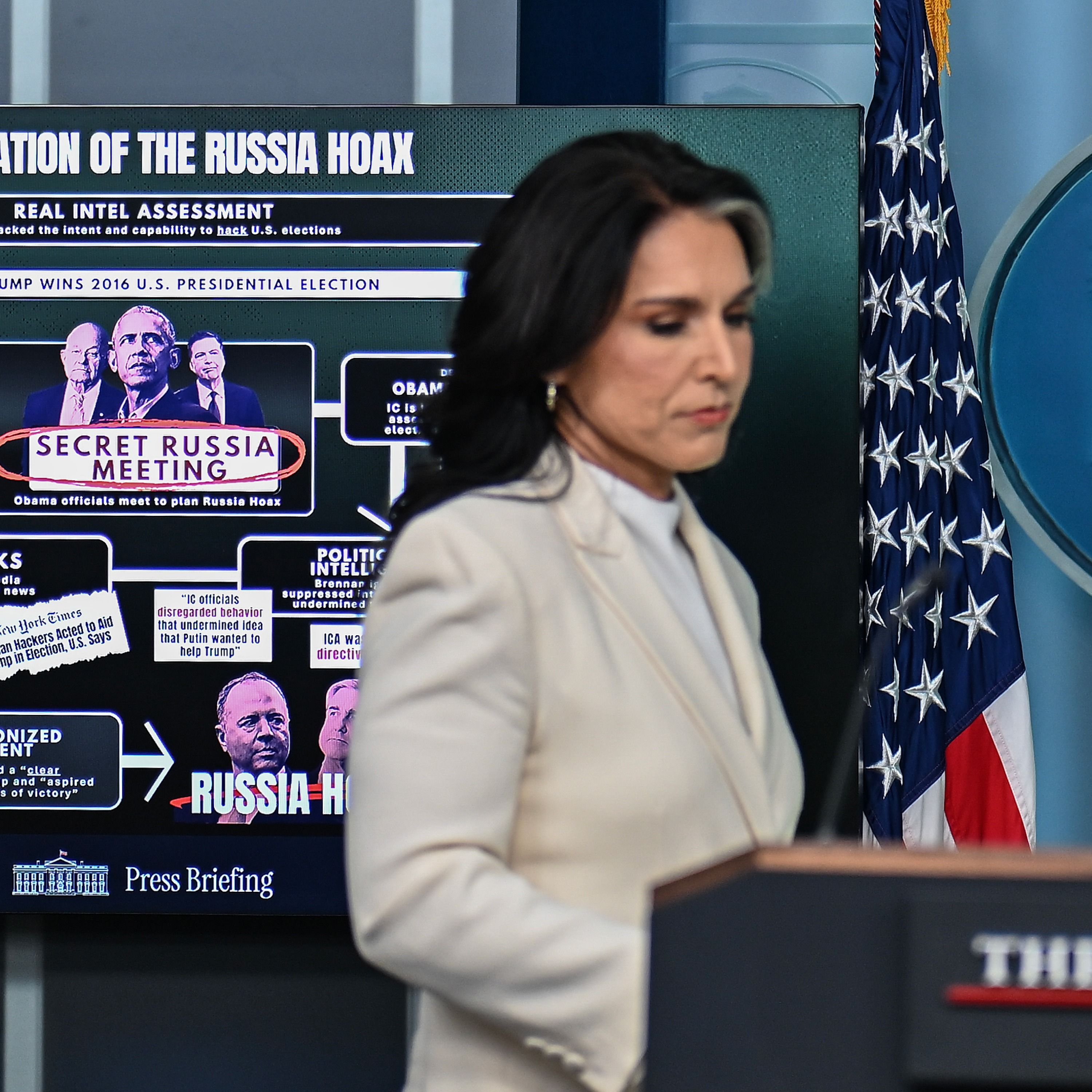
The Daily
The Sprawling Government Effort to Prosecute Barack Obama
00:27:32
Over the past few weeks, the most senior intelligence officials in the federal government have released a series of new documents which they claim shows that, starting in 2016, President Barack Obama and his deputies carried out a criminal conspiracy against President Trump. Michael S. Schmidt, an investigative reporter for The Times, explains what’s behind the sudden re-emergence on the Trump-Russia saga, and what happens when heads of the C.I.A., F.B.I. and Justice Department all turn their attention to the president’s domestic enemies.
Loading summary
Transcript117 lines
- [00:00]
Capital One Advertiser
Brought to you by the Capital One Venture X card. If you love to travel, Capital One has a rewards credit card that's perfect for you. With Venture X, earn unlimited double miles on everything you buy and turn all of your purchases into extraordinary travel. And you get premium benefits at a collection of luxury hotels when you book through Capital One Travel. Plus, you'll get access to over 1,000 airport lounges worldwide. Capital One what's in your wallet? Terms apply seecapitalone.com for details from the.
- [00:31]
Michael Barbaro
New York Times, I'm Michael Balbaro. This is the Daily over the past few weeks, the most senior intelligence officials in the federal government have released a series of new documents that they claim shows that President Obama and his deputies carried out a criminal conspiracy against President Trump starting in 2016. Today, Mike Schmidt on what's behind the sudden re emergence of the Trump Russia saga and what happens when the heads of the CIA, FBI and DOJ all turn their attention to the President's domestic enemies. It's Wednesday, August 13. Mike, I think for a lot of us this all started a couple of weeks ago inside the White House press briefing room. Hello, good afternoon everybody. And I wonder if you can take us back to that moment. Let me begin with a few scheduling items.
- [01:51]
Mike Schmidt
It starts with the White House press secretary holding her regular daily press briefing.
- [01:58]
Capital One Advertiser
We have a special guest with us today who will speak momentarily.
- [02:01]
Mike Schmidt
But for this briefing she brings out a special guest.
- [02:06]
Michael Barbaro
Thank you very much. Good afternoon.
- [02:08]
Mike Schmidt
President Trump's direction and with she hands over the podium the biggest bully pulpit that the White House has to Tulsi Gabbard, the Director of National Intelligence.
- [02:23]
Michael Barbaro
The stunning revelations that we are releasing today should be of concern to every American.
- [02:28]
Mike Schmidt
This is not about who oversees all of the intelligence community agencies.
- [02:33]
Michael Barbaro
The implications of this are far reaching and have to do with the integrity of our Democratic Republic.
- [02:40]
Mike Schmidt
And she proceeds to claim that she has uncovered a massive conspiracy involving President Obama, his intelligence agencies, Russia and Trump.
- [02:53]
Michael Barbaro
There is irrefutable evidence that details how President Obama and his national security team directed the creation of an intelligence community assessment that they knew was false.
- [03:06]
Mike Schmidt
She goes so far to say the.
- [03:09]
Michael Barbaro
Expressed intent and what followed afterward can only be described as a years long coup and a treasonous conspiracy that what.
- [03:17]
Mike Schmidt
Obama and his intelligence agencies did was treason.
- [03:23]
Capital One Advertiser
Director Gabbard, we thank you for your time today.
- [03:26]
Michael Barbaro
This is a truly extraordinary claim from the senior most intelligence official in the United States. And Mike will eventually talk through the specific allegations that Gabbard is making. We'll fact check it, but just explain at the highest possible level. What's really going on here? What it is that Gabbard is doing?
- [03:46]
Mike Schmidt
Gabbard's press conference was the start of this weeks long effort by several different members of the Trump administration to do two things. The first is to make the case that they now have new evidence to support their long standing claim that the Trump Russia investigation was a conspiracy manufactured by President Obama and his intelligence officials to try to essentially destroy Trump and undermine his legitimacy as a president. The second thing they're trying to do is apparently create a distraction because Trump finds himself in this highly unusual situation in the past several weeks in which he is almost crosswise with his base over the Jeffrey Epstein scandal. And the Trump administration is going back to an old play of using Russia in the idea that Trump is a victim of a larger conspiracy there to distract from all of the Epstein questions that they don't seem to have any good answers for.
- [05:14]
Michael Barbaro
Right. Talking about Russia better than talking about Epstein.
- [05:18]
Mike Schmidt
Correct. And in a larger sense, what the administration is trying to do is to not just say, hey, these guys were criminals, but to bring criminal charges against them for engaging in this conspiracy, which.
- [05:38]
Michael Barbaro
Would be a major escalation in a very long running set of complaints about the Russia investigation.
- [05:48]
Mike Schmidt
They want to follow this thing all the way through and put Barack Obama and officials like his CIA director, John Brennan in prison.
- [06:02]
Michael Barbaro
Mike, since for the Trump administration, this is all about the original government investigation into Trump and Russia dating back to the 2016 campaign, I think we need to go back to that investigation, which I know you covered very closely. Just remind us of the very basics of that investigation and its conclusions and why the Trump administration remains so fixated on it.
- [06:26]
Mike Schmidt
In the aftermath of Trump winning the 2016 election, it was widely understood that Russia had meddled in the campaign. Obama, faced with that reality, ordered his intelligence community to conduct an assessment, essentially a determination to understand what Russia had done and why it had done it. The intelligence community comes to a series of conclusions which they lay out in a document that was released in the final days of the Obama administration, just before Trump was about to take over. And they find that Putin tried to hurt Hillary Clinton and help Donald Trump while undermining America's democracy. But for Trump, this document, this assessment, was the original sin, because what it did was cast doubt on his victory. Did he win the election fair and square or did the Russians help him do that?
- [07:37]
Michael Barbaro
And from what you're saying, folks like Tulsi Gabbard are now coming out in the last two weeks and saying we have firm evidence that that intelligence community assessment was wrong and that the people involved in producing it, especially Obama, knew that it was wrong. So let's get back to what Gabbard is alleging.
- [08:05]
Mike Schmidt
What Gabbard is starting to do is declassified documents that she claims irrefutably prove that not only is the assessment a bunch of nonsense, but it's at the heart of a criminal conspiracy. So she releases a classified report that was written by House Republicans in Trump's first term that claims that Putin was not trying to help Trump and hurt Hillary Clinton.
- [08:41]
Michael Barbaro
So a report that takes real issue with this pretty central finding of the Obama intelligence conclusion that Putin wants Trump to win.
- [08:53]
Mike Schmidt
Correct. But it's really important to note that this report was written by a bunch of hardened Trump partisans in the House, and it stands alone. No other serious entity that has looked at this question, including a massive bipartisan investigation in the Senate, comes to the claim that these House Republicans did.
- [09:25]
Michael Barbaro
How does a report like that justify the incredibly strong language that Gabbard is using, that there is treasonous conspiracy afoot in the Obama administration against Trump?
- [09:38]
Mike Schmidt
Well, it doesn't. There is a massive gap between what she is claiming and what she is releasing. The report offers essentially a different opinion from what the Obama administration came to essentially says, you guys said Putin wanted to do one thing. We believe Putin didn't want to do that. But there's nothing in that report like an email from Obama to his intelligence community saying, I don't care what the evidence shows. We need to get Donald Trump that proves or shows or raises even questions about a larger treasonous conspiracy.
- [10:28]
Michael Barbaro
Right. There's no evidence, it sounds like, of any kind, to suggest a conspiracy, but that is not at all how Tulsi Gabbard is talking about this from the White House podium.
- [10:39]
Mike Schmidt
No, she is making this out like the smoking gun that Trump and his allies have been searching for for all these years. Nothing that she has released backs up her claim of a treasonous conspiracy. But despite that, she sends a criminal referral to the Justice Department, essentially a letter saying, hey, guys, you really need to conduct a criminal investigation into this. And Gabbard is not the only Trump administration official who, over the past few weeks, has been declassifying information and releasing documents to claim that they have their own evidence that Obama and his officials engaged in criminality.
- [11:31]
Michael Barbaro
And we will talk about those right after the break. We'll be right back.
- [11:51]
Mike Schmidt
Want to live better. Join Chris Hemsworth in National Geographic's new Disney original series, Limitless. Live Better now. Chris will put his mind and body to the test in three unique challenges over three episodes. Confronting risk by climbing a 500 foot dam wall in Switzerland, embracing pain while working with the South Korean military and retraining the brain by learning to play the drums with one of the world's biggest pop stars. Live Better now is streaming August 15th on Disney and Hul.
- [12:20]
Michael Barbaro
The New York Times app has all.
- [12:22]
Mike Schmidt
This stuff that you may not have seen.
- [12:23]
Michael Barbaro
I can immediately navigate to something that matches what I'm feeling.
- [12:27]
Capital One Advertiser
The way the tabs are at the top with all of the different sections.
- [12:30]
Michael Barbaro
It'S just easier to navigate that way. There is something for everyone.
- [12:34]
Capital One Advertiser
Those personalized page, the utep that one's my favorite.
- [12:37]
Michael Barbaro
I can also save my articles easily in this area right under the byline.
- [12:42]
Mike Schmidt
It says click here.
- [12:43]
Michael Barbaro
If you like to listen to this article.
- [12:44]
Mike Schmidt
I like that the cooking tab on.
- [12:46]
Capital One Advertiser
Top is really easily accessible.
- [12:48]
Mike Schmidt
So if I'm on my way home and I'm just thinking, oh, what am.
- [12:50]
Capital One Advertiser
I going to make for dinner?
- [12:51]
Michael Barbaro
I'll just quickly go on to cooking.
- [12:53]
Capital One Advertiser
And say, oh, I've got this in my pantry.
- [12:56]
Mike Schmidt
I'm going to try out some of these recipes I see in here.
- [12:58]
Michael Barbaro
I go to games, always doing the mini, doing the wordle.
- [13:01]
Mike Schmidt
I loved how much content it exposed me to.
- [13:03]
Michael Barbaro
Things that I never would have thought.
- [13:05]
Mike Schmidt
To turn to a news app for. This app is essential.
- [13:09]
Michael Barbaro
The New York Times app, all of the times all in one place.
- [13:13]
Capital One Advertiser
Download it now@nytimes.com Apple.
- [13:22]
Michael Barbaro
So Mike, walk us through what these other Trump administration intelligence officials have been releasing in their effort, like Gabbard, to try to prove that the Obama Russia assessment was a criminal conspiracy.
- [13:37]
Mike Schmidt
The head of the CIA, John Ratcliffe, puts out a report that also cast doubt on the 2016 intelligence assessment.
- [13:47]
Michael Barbaro
How so?
- [13:48]
Mike Schmidt
The report doesn't dispute the central finding of the 2016 assessment, but it takes issue with the tradecraft for how the report was produced. It says that the process was rushed. It says that top officials were far too involved in it. And it says that there was pressure on analysts to reach a conclusion. But then the report kind of undercuts itself because it says that there's no evidence that the analysts actually felt that pressure.
- [14:26]
Michael Barbaro
H so a pretty complicated and contradictory set of claims there.
- [14:31]
Mike Schmidt
Correct. And there's even another, I hate to say it, confusing claim, and that's about a footnote and an annex onto the original assessment. Just hold my hand. Let me try and explain this to you.
- [14:47]
Michael Barbaro
Okay?
- [14:48]
Mike Schmidt
As part of the assessment, the CIA had the dossier Remember that compilation of unsubstantiated allegations dug up by a British spy about Trump's ties to Russia, attached as an annex to the assessment? The assessment was not based on the dossier. It didn't play a role in the conclusions. But what the report is essentially saying is that this unsubstantiated document, called the dossier, it should never have been attached in the first place. And because it was attached, it casts some doubt on the entire claim. So, based on this and not much more, Radcliffe comes out swinging.
- [15:38]
Michael Barbaro
Trey, there is no question this was the greatest political scandal of our lifetime.
- [15:44]
Mike Schmidt
He says all the world can now see the truth.
- [15:47]
Michael Barbaro
It derailed our country. It derailed President Trump's presidency, his first four years.
- [15:53]
Mike Schmidt
Brennan, Clapper and Comey manipulated intelligence and silenced career professionals.
- [15:59]
Michael Barbaro
And it really is a stain country. That should never happen again. And. And Donald Trump is committed to making.
- [16:04]
Mike Schmidt
Sure that it doesn't all to get.
- [16:06]
Michael Barbaro
Trump, despite the fact that there's nothing in his own agency's assessment of the assessment that proves that.
- [16:16]
Mike Schmidt
Correct.
- [16:17]
Michael Barbaro
So, as with the case of Tulsi Gabber, the Director of National Intelligence, when it comes to the CIA director, John Ratcliffe, we're dealing with a very big gap between the evidence that he's putting forward and the claims he's making. Very loudly and very publicly. He's claiming, like Gabbard, there's a criminal conspiracy here. But this CIA report he puts out in no way supports that.
- [16:45]
Mike Schmidt
But Radcliffe, too, sends his own criminal referrals to the Justice Department, asking them to investigate.
- [16:53]
Michael Barbaro
So we now have two intelligence officials telling the Department of Justice that they should criminally investigate Obama administration officials over the Russia investigation.
- [17:05]
Mike Schmidt
And while all this is going on, the FBI chimes in. This was incredible.
- [17:11]
Michael Barbaro
Sources telling Fox News Digital that Director.
- [17:13]
Mike Schmidt
Kash Patel found a tranche of documents.
- [17:16]
Michael Barbaro
Related to the Trump Russia probe inside multiple burn bags.
- [17:21]
Mike Schmidt
The FBI director, Cash Patel, declassifies a piece of intelligence that he claims shows that this conspiracy, it actually originated with Hillary Clinton. That's how vindictive and vicious the former leadership structure here was. They withheld and hid documentation and put it in rooms where people weren't supposed to look. And it's a good thing we're here now to clean it up. And you're about to see a wave of transparency. But are you saying.
- [17:51]
Michael Barbaro
And what evidence does Patel offer to support that claim?
- [17:55]
Mike Schmidt
An email between Clinton allies in which they claim that Clinton personally approved a plan to tie Trump to Russia. But what Patel doesn't say is that a previous special Counsel that was appointed by Trump's Justice Department to look into the Russia hoax determined that the email was likely a fake.
- [18:26]
Michael Barbaro
Wow.
- [18:27]
Mike Schmidt
That Russian intelligence officials had taken a range of hacked emails and made them into a composite that depicted Clinton as the originator of the conspiracy.
- [18:39]
Michael Barbaro
And presumably the FBI director, Cash Patel, would have known that and yet still released it and treated it as a smoking gun.
- [18:47]
Mike Schmidt
Correct.
- [18:49]
Michael Barbaro
So a very noticeable pattern is clearly emerging here. A senior Trump administration intelligence official claims very publicly to have unveiled a new piece of evidence proving a criminal conspiracy when it comes to the Russia investigation. And yet, when we actually look at the allegedly supporting evidence, the document, the report, the email, it doesn't hold up. It does not support the claim that the official is making. Yet nevertheless, it's amounting to a series of pretty serious criminal referrals to the Justice Department.
- [19:28]
Mike Schmidt
And what it does is it tees up the Justice Department and Attorney General Pam Bondi to go out and do a criminal investigation. So within days of these criminal referrals coming in.
- [19:43]
Michael Barbaro
Breaking tonight, a major development in the Russiagate investigation.
- [19:47]
Mike Schmidt
The reports start to emerge in conservative.
- [19:50]
Michael Barbaro
Media, and the Justice Department is taking its case to a grand jury that.
- [19:55]
Mike Schmidt
There is a grand jury investigation being conducted into these allegations. Attorney General Bondi is taking the referrals from Director of National Intelligence Tulsi Gabbard, quote, very seriously. Here's what President Trump said on Truth Social. The truth always wins out. This is great news.
- [20:14]
Michael Barbaro
God bless America and a White House. And just put that into context for us, the significance of a grand jury possibly looking into this.
- [20:23]
Mike Schmidt
It means that the Justice Department is prepared to go out and use its criminal powers to the power of subpoena, the power to compel witnesses to testify, the ability to go to a judge and try and get a search warrant. It means that the Justice Department is now willing to use the federal government's most powerful tools to try to get to the bottom of this.
- [20:45]
Michael Barbaro
I mean, let's end with a reality check about whether or not these criminal investigations could ever result in. In successful prosecutions and convictions of senior Obama administration officials. Because let's just take the example of former President Obama. It's our understanding now, it's been widely covered that the Supreme Court's ruling that gives President Trump immunity for a lot of things that he has done in office would likely apply to previous presidents, including Obama. So it seems like it'd be pretty hard to successfully prosecute President Obama for something he did in office, Right?
- [21:27]
Mike Schmidt
Correct. And prosecuting the other intelligence officials would be very difficult. Too. You would need to have a judge look at the evidence that the government is presenting and essentially say, yeah, there's enough here to move forward with putting this person on trial and trying to get a conviction.
- [21:49]
Michael Barbaro
Right. And as we've demonstrated, there isn't all that much evidence there.
- [21:52]
Mike Schmidt
The chances that they would be prosecuted are not nearly as high as the expectations. But I think we kind of need to take a step back from that and look at the larger issue of what's going on with retribution during Trump's second term. Right after Trump came into the White House, he and his aides went after law firms and universities, and particularly with the universities like Harvard. They used a whole of government approach to pressure the school in ways that certainly I had never considered.
- [22:35]
Michael Barbaro
Right. When you say whole of government, you simply mean almost the entirety of the government. Multiple agencies.
- [22:41]
Mike Schmidt
We use this term like whole of government approach, a term that's usually used about out how to use the federal government to solve a problem like cancer. And what we're now seeing is that whole of government approach where the intelligence community is using the fruits of what it has in its coffers to get the Justice Department to go out and criminally investigate Trump's enemies. And there's a level of sophistication to that that is just different than what we saw in Trump's first term when he had many more guardrails around him and his best efforts at getting his enemies investigated were screaming about it on Twitter or trying behind closed doors to twist the arms of Justice Department officials.
- [23:43]
Michael Barbaro
Right. This time, he is activating the leaders of the most important agencies in the federal government who seem extremely eager to cooperate with this goal of his, of going after these people. I mean, the Director of National Intelligence, the Director of the CIA, the Director of the FBI.
- [24:05]
Mike Schmidt
And I don't even think Trump needs to say anything. These people all have the same view of Trump's enemies and what should be done to them. So I'm not sure it's as much about whether Trump directed or not, but that he has surrounded himself with, yes, people who know exactly what he wants and are using their powers to try to get him there.
- [24:38]
Michael Barbaro
But is there any risk to the Trump administration doing everything that's done here, starting these criminal investigations and as you've said, potentially not getting very far, not being able to really prosecute anyone, probably not being able to get anyone in jail. Doesn't that end up potentially backfiring in kind of the same way that over promising on the Jeffrey Epstein story has backfired?
- [25:02]
Mike Schmidt
I think the Epstein story is different because in the Epstein story, Trump and his allies who are now in his administration promised that they would release information that was going to show Trump's base how powerful wealthy Democrats were pedophiles. And now, in reaction to the administration not releasing that material, it's raised questions among the base about, hey, are you trying to still cover something up in the Russia story? It's always been very clear to the base who the good guys and the bad guys are to them.
- [25:45]
Michael Barbaro
Right.
- [25:46]
Mike Schmidt
And it's been clear that Trump has tried as hard as he can to go after them. And at the end of the day, I'm not sure that Trump's supporters are going to hold him accountable if promises of criminal prosecutions don't turn out the way that they want. Right.
- [26:11]
Michael Barbaro
Because he will always be on the right side of this battle when it.
- [26:15]
Mike Schmidt
Comes to Russia, Trump will always be the victim and he will always be the hero.
- [26:22]
Michael Barbaro
Well, Mike, thank you very much.
- [26:24]
Mike Schmidt
Thanks for having me.
- [26:32]
Michael Barbaro
In response to the drumbeat of new documents and criminal referrals from the Trump White House, a spokesperson for President Obama recently issued a statement. It said, quote, out of respect for the office of the presidency, our office does not normally dignify the constant nonsense and misinformation flowing out of this White House with a response, but these claims are outrageous enough to merit one. These bizarre allegations are ridiculous and a weak attempt at distraction. We'll be right back.
- [27:23]
Mike Schmidt
Hi, I'm Josh Haner and I'm a staff photographer at the New York Times covering climate change. For years, we've sort of imagined this picture of a polar bear floating on a piece of ice. Those have been the images associated with climate change. My challenge is to find stories that show you how climate change is affecting our world right now. If you want to support the kind of journalism that we're working on here on the Climate and Environment desk at the New York Times, please subscribe on our website or our app.
- [27:53]
Capital One Advertiser
Your home is an active investment, not a passive one. And with Rocket Mortgage, you can put your home equity to work right away. When you unlock your home equity, you unlock new doors for your family. Renovations, extensions, even buying your next property. Get started today with smarter tools and guidance from real mortgage experts. Find out how@rocketmortgage.com Rocket Mortgage, LLC. Licensed in 50 states. Nmlsconsumeraccess.org 3030.
- [28:24]
Michael Barbaro
Here'S what else you need to know today. On Tuesday, the mayor and police chief of Washington, D.C. met with the Trump administration to discuss the president's takeover of the city's police force and the imminent arrival of federal troops on the city's streets to fight crime. We're here to work together with our federal parties and that's what we're going to do. City officials appeared to take a conciliatory approach to what is widely seen as an unusual encroachment on their authority. During a news conference, the police chief and the mayor emphasized their desire to make the most of the federal support.
- [29:04]
Mike Schmidt
How we got here or what the what we think about the circumstances right now.
- [29:10]
Michael Barbaro
We have more police and we want to make sure we use them. And Russian troops are making swift battlefield advances inside Eastern Ukraine just days before their leader, Vladimir Putin, is scheduled to hold high stakes peace talks with President Trump. The Russian troops have advanced several miles into Ukrainian held territory, potentially giving Putin a stronger hand in his negotiations with Trump. Russia now occupies about 20% of Ukraine and has repeatedly said that it wants to win permanent control of Eastern Ukraine in any peace deal. Today's episode was produced by Anna Foley and Nina Feldman. It was edited by Rachel Quester, contains original music by Diane Waugh, Marion Lozano and Dan Powell, and was engineered by Alyssa Moxley. Our theme music is by Jim Brunberg and Ben Landsberg of Wonderly. Special thanks to Devlin Barron. That's it for the Daily I'm Michael Barbara. See you tomorrow.
- [30:30]
Capital One Advertiser
Ollie knows the back to school chaos all too well. Schedules, carpools, relearning algebra 2. It's a lot for you and your crew. Ollie makes wellness an easy and delightful part of your routine. Neat Immune Support Kids will enjoy Try Kids Multiplus Probiotic. Is bedtime a struggle? Go with kids Sleep for gentle support Moms Support your immune system, nutrition and more with Women's Multi. Grab these products@ollie.com or retailers nationwide. These statements have not been evaluated by the Food and Drug Administration. This product is not intended to diagnose, treat, cure or prevent any disease.