← The Daily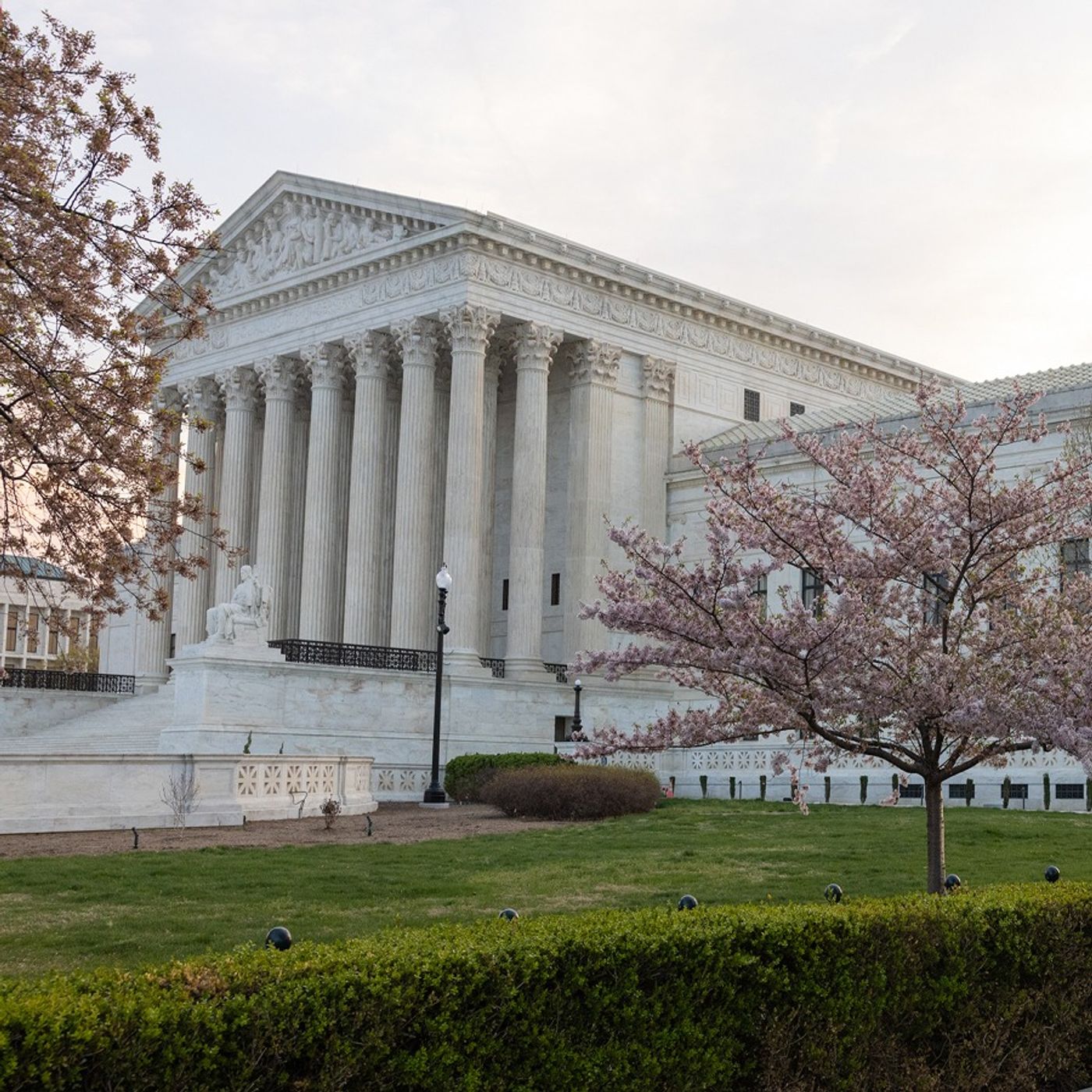
The Daily
The Supreme Court Takes On Birthright Citizenship
00:30:07
The Supreme Court heard arguments on Wednesday morning over President Trump’s efforts to limit birthright citizenship. In a historic first, the president himself showed up to the hearing. Ann E. Marimow, who covers the Supreme Court, took us inside the room.
Loading summary
Transcript170 lines
- [00:00]
Comcast Business Announcer
Introducing the total solutions advantage only from Comcast Business. It's the largest, fastest fiber powered network for small business gig speeds with equipment and security included and a five year price lock. That's reliability, security and savings in one switch. Today get started with a great offer as low as $60 a month. No one does business like comcast business
- [00:22]
Comcast Business Offer Details
offer N6126 new customers only requires 300Mbps Internet and security edge one year agreement. Eco bill and auto pay required equipment, taxes and fees extra.
- [00:34]
Ann Marimow
Can I ask you a couple questions? Did you sleep here last night? Yes, we did. We did. We got here at about 11:30pm and got some sleep until maybe 6:00am yeah, yeah. How early did you get here? 6:30.
- [00:47]
Michael Barbaro
I got here a little bit after 4. So we are waiting in the line from last Sunday.
- [00:56]
Ann Marimow
Sorry, you've been waiting in line since last Sunday?
- [00:59]
Cecilia Wong
Yeah, yeah, yeah.
- [01:00]
Ann Marimow
Last Sunday.
- [01:02]
Michael Balbaro
From the New York Times, I'm Michael Balbaro. This is the Daily On Wednesday morning in Washington, the scene outside of the Supreme Court captured the enormous stakes of the case that was about to be argued before its nine justices.
- [01:20]
Ann Marimow
This is pivotal. This will define the immigration experience for decades.
- [01:26]
Michael Barbaro
Birthright citizenship is just been a big
- [01:29]
Ann Marimow
part of what it means to be American for a very long time, like
- [01:33]
Michael Barbaro
almost as long as the country. The crux of this is illegals or those here temporarily shouldn't receive the benefit
- [01:40]
Justice Neil Gorsuch
of American citizenship, which is to be cherished.
- [01:44]
Michael Balbaro
A case about President Trump's efforts to end birthright citizenship that literally asks who gets to be an American.
- [01:53]
Sandra E. Garcia
So this case was very important for me because I'm an immigrant, too. We all came for a reason, because US is a shining city on the Hill. And now to change the whole thing, I'm like, did I make a right decision of wanting to come here?
- [02:10]
Michael Balbaro
And a case so historic that President Trump himself showed up in the courtroom to hear the arguments today. My colleague Ann Marimo takes us inside the room. It's Thursday, April 2nd.
- [02:35]
Michael Barbaro
Anne, you had a pretty coveted seat inside the Supreme Court on Wednesday morning. And I suspect your eyes quickly fix themselves on the presence of President Trump.
- [02:48]
Ann Marimow
Yes, it was a historic day. The first sitting president to be in the Supreme Court courtroom for an oral argument and to be sitting there as the justices were Deb birthright citizenship.
- [03:01]
Michael Barbaro
And what did it look like for him to enter that August room?
- [03:05]
Ann Marimow
So a hush came over the courtroom as the president was escorted to his seat. The courtroom is always quiet, but this was even more quiet than usual as he walked in at that moment, wearing a red tie and a dark suit and took his seat. And it's really interesting where he was seated. Instead of being close to the Justices in the special seats reserved for their families and visiting dignitaries, he was seated in the front row for the public.
- [03:32]
Michael Barbaro
Why?
- [03:33]
Ann Marimow
I think it's because he is one of the parties in the cases and he's not a lawyer or member of the Supreme Court bar. So there he was in the front row of the public gallery, just far
- [03:42]
Michael Barbaro
enough away, perhaps for some of the Justice's liking. It feels difficult to overstate the symbolic potency of the head of the executive branch being in this room, in the heart of the judicial branch. And as you know, well, this is a President known for very keenly understanding power and how you flex it. And it felt to me anyway like the President, by showing up for these oral arguments on this case, was basically saying, you all want to sit in judgment of my executive order on birthright citizenship, and therefore I'm going to sit in judgment of you as you do that.
- [04:20]
Ann Marimow
There's absolutely a lot of symbolism having him there. He had mused about showing up previously when the Court took up his tariffs plan. That was also very important to the President. He ended up not coming and saying he didn't want to be a distraction. But you're right. There's been this effort, as you've seen when the Court has ruled against him, the President has tried to intimidate the Justices and criticize them in really harsh personal terms. So to have him actually there in person, face to face with the Justices, sent a real signal.
- [04:51]
Michael Barbaro
And above all, that signal was this case is really important to the President and to his second term agenda, especially immigration. Just briefly remind us how this case found its way into this room.
- [05:04]
Ann Marimow
So you'll remember the President, on his first day back in office, issued this executive order to really limit the guarantee of birthright citizenship and say it does not include the children of illegal immigrants or the children of many temporary foreign visitors. That was seen as an open challenge to the long held understanding of the 14th Amendment. And there were lawsuits filed immediately by Democratic state attorney generals and expectant parents.
- [05:31]
John Sauer
Right.
- [05:31]
Michael Barbaro
Basically saying the 14th Amendment guarantees that anyone born, with very few exceptions, on American soil is an American citizen.
- [05:39]
Ann Marimow
Yes. And not just in the 14th Amendment, but in subsequent court rulings, in actions by past presidents. This has been the common subtle law understanding.
- [05:49]
Michael Barbaro
Right. And so we always understood that the administration's legal arguments in defense of this executive order were, we're going to be potentially tough sledding before the entire judiciary. So take us into these oral arguments and how they unfold, and let's start with the administration's lawyer.
- [06:12]
Chief Justice John Roberts
We will hear argument this morning in case 25365, Trump versus Barbara. General Sauer.
- [06:19]
John Sauer
Mr. Chief justice, and may it please the court.
- [06:21]
Ann Marimow
President Trump's Solicitor General, John Sauer, who represents the administration at the Supreme Court, is asking the Justices to reinterpret or restore what he says is the original meaning of the 14th Amendment.
- [06:34]
John Sauer
The citizenship clause was adopted just after the Civil War to grant citizenship to the newly freed slaves and their children.
- [06:40]
Ann Marimow
So a key point to the administration's argument centered on the language of the 14th Amendment and the meaning of a phrase subject to the jurisdiction of the language of the 14th Amendment says that all persons born or naturalized in the United States and subject to the jurisdiction thereof are citizens of the United States.
- [07:01]
John Sauer
In 1984, this court recognized that subject to the jurisdiction means owing direct and immediate allegiance. The clause thus does not extend citizenship to the children of temporary visa holders or illegal aliens.
- [07:13]
Ann Marimow
John Sauer is trying to get the Justices to focus on again the meaning of subject to the jurisdiction of in his view, the babies of illegal immigrants are not subject to the jurisdiction of the United States and are therefore not citizens.
- [07:28]
John Sauer
Unrestricted birthright citizenship contradicts the practice of the overwhelming majority of modern nations. It demeans the priceless and profound gift of American citizenship.
- [07:39]
Michael Barbaro
And why, according to sour the President's Solicitor General, is that the case that children born to illegal immigrants are not subject to the jurisdiction thereof of the United States government and therefore not eligible to be American citizens when they're born on American soil?
- [07:57]
Ann Marimow
So the administration's argument really rests on one of the court's rulings in 1898, and this is the case of Wong Kim Ark. There the Court ruled that a man born in San Francisco but to Chinese immigrants was a citizen. And John Sauer says, we've been thinking about that case all wrong. It's been read too broadly to apply to a larger group of people. And really, he says, the key in that decision is the word domicile and the fact that Mr. Wong's parents were legally present in the United States even though they were not citizens, they had a commitment to living in the US and that for that reason, when their son was born in San Francisco, he was a citizen.
- [08:43]
John Sauer
The Court says at the very beginning of his opinion, here are the accepted facts. These are lawfully domiciled here. When it states the question presented, it talks about domicile when it recites the legal principle. At page 693, it says domicile three times. And at page 705, at the end of the opinion, it says, here's the single question we've decided. We've decided that Chinese immigrants with a permanent domicile in residence here are fall within the rule of birthright citizenship.
- [09:06]
Ann Marimow
And so throughout the argument, John Sauer asked the Justices to focus on that word and saying that that's key to someone being able to become a birthright
- [09:16]
Michael Barbaro
citizen and just define that word domicile, because having watched these oral arguments myself, not in the room, but at home, it comes up a lot.
- [09:24]
Ann Marimow
It did come up a lot. And the Solicitor General told the justices, domicile to him and in the law means somebody's residence, but also their intention to stay and make a home and having the ability legally to be able to be domiciled somewhere.
- [09:41]
Michael Barbaro
And in his telling, undocumented immigrants by definition, cannot be legally domiciled in the United States because they are here illegally,
- [09:52]
Ann Marimow
because they've come into the country illegally. But also he brings in another term, and that is allegiance, because they sort of have a political allegiance to a foreign nation.
- [10:03]
John Sauer
It did not grant citizenship to the children of temporary visitors or illegal aliens who have no such allegiance. This conclusion reflects the original public meaning of the clause when Congress.
- [10:14]
Michael Barbaro
So basically, Sauer is arguing that if you look really closely, especially at that ARC case issued by the Supreme Court many, many, many decades ago, people have been misunderstanding this birthright citizenship precedent for a very long time, and they've allowed it to be applied too broadly to people who should not be birthright citizens, illegal immigrants, especially.
- [10:40]
Ann Marimow
That's right.
- [10:41]
Michael Barbaro
Okay, so how do the Justices respond to this?
- [10:46]
Ann Marimow
So John Sauer got a lot of pushback pretty quickly, including from some of the key conservative Justices who are often in the majority, most notably from Chief Justice Roberts, you obviously put a lot
- [10:58]
Chief Justice John Roberts
of weight on subject to the jurisdiction thereof, but the examples you give to support that strike me as very quirky.
- [11:06]
Ann Marimow
To refer to the government's theory as
- [11:09]
Michael Barbaro
quirky, never a great sign.
- [11:12]
Ann Marimow
Exactly. So the Chief justice pointed out that the 14th Amendment includes very specific exceptions to groups of people who are not subject to the jurisdiction of the United States and therefore not citizens.
- [11:25]
Chief Justice John Roberts
You know, children of ambassadors, children of enemies during a hostile invasion, children on warships.
- [11:32]
Ann Marimow
These are children of foreign diplomats, children of invading armies, and the children of Native American tribes. Until Congress changed the law, and then
- [11:41]
Chief Justice John Roberts
you expand it to a whole class of illegal aliens are here in the country. I'm not quite sure. How you can get to that big group from such tiny and sort of idiosyncratic examples.
- [11:55]
Ann Marimow
And he's asking John Sauer, you're asking us to create this huge new exception and to expand that understanding.
- [12:03]
Michael Barbaro
Right. Robert seems to be saying, you want us to get from the concept that invading pillagers of the US Their kids should not be American citizens to suddenly saying that all the children of undocumented immigrants shouldn't be given birthright citizenship. And he just doesn't quite see the line between the two.
- [12:22]
Ann Marimow
Yes. And Sauer's response is to go back to the debates around the drafting of the 14th Amendment and even to a statute that existed before the amendment, and to pull out various statements from senators at the time.
- [12:34]
John Sauer
And one of the strongest statements of this is Senator Trumbull's statement that I quoted at the beginning where he says he's asked, what does that mean subject the jurisdiction there is? And he says it means not owing allegiance to anybody else. That is what it means.
- [12:46]
Ann Marimow
And to try to reinforce this idea that in order to be a birthright citizen, your parents had to have complete allegiance to what he called the political jurisdiction of the United States.
- [12:57]
Michael Barbaro
And it felt like the Solicitor General knew his audience, that this conservative majority on this court likes originalism, likes to go back to original sources, and that he was appealing to that.
- [13:10]
Ann Marimow
Sure. That's going to be key to this decision. What was the original meaning? What were the drafters thinking of the time? And there was a lot of discussion about how do you apply that history and the text to this modern day issue of illegal immigration that the drafters were not necessarily thinking about in these terms at that time.
- [13:28]
Justice Samuel Alito
And what we're dealing with here is something that was basically unknown at the time when the 14th Amendment was adopted, which is illegal immigration. So how do we deal with that situation when we have a general rule?
- [13:40]
Michael Barbaro
Right. Justice Alito pipes up at this point, and he's curious how the government's argument confronts that right.
- [13:47]
Ann Marimow
And he asks about the idea of applying a broad principle to a new problem. And the Solicitor General says, that's right. This broad principle does apply here. And that's what we often do when we're interpreting the Constitution. And he has all of these historical examples that he cites to sort of back up this claim in the way that he thinks the principle has been applied over time.
- [14:09]
John Sauer
Now, the problem of temporary visitors did exist. And it's very interesting that as you look at pages 26 and 28 of our brief Commentators going from, you know, 1881 until 1922 are uniformly saying, the children of temporary visitors are not included.
- [14:24]
Ann Marimow
And then Justice Kagan intervenes and says, wait a minute, where does this principle come from?
- [14:30]
Justice Elena Kagan
Allegiance, domicile allegiance. I think you point to a Lincoln funeral speech as your primary example of where this principle comes from.
- [14:41]
Ann Marimow
It's certainly these are really obscure, esoteric references you're making to history and kind of pulling them out of thin air.
- [14:48]
Justice Elena Kagan
But as far as I can tell at the time of the 14, you're using some pretty obscure sources to get to this concept.
- [14:56]
Ann Marimow
And she really casts doubt on those as strong evidence.
- [15:00]
Michael Barbaro
Right. She's saying, I'm listening to all your historical references and they feel like you're really stretching and reaching because you don't have texts within the 14th Amendment on your side. In fact, the texts of the 14th Amendment, in her telling, undermines your case.
- [15:18]
Ann Marimow
So what's interesting is that the skepticism about the administration's use of history extends from the liberal justices to some of the key conservative votes like Justice Barrett and Justice Gorset.
- [15:29]
Justice Neil Gorsuch
And just to circle back to Justice Kagan's point, it's striking that in none of the debates do we have parents discussed. We have the. The child's citizenship and the focus of clauses on the child, not on the parents. And you don't see domicile mentioned in the debates. That's the absence is striking.
- [15:49]
Ann Marimow
And Gorsuch asks questions about this word domicile and says, if that's so critical to your argument, where is that in the debates surrounding the drafting of the 14th Amendment? Where is that in the history? What was the understanding of that word
- [16:02]
Michael Barbaro
at the time and what is Sauer's response?
- [16:05]
Ann Marimow
Well, he says that there are 19th century sources that talk about domicile, but really returns to Wong Kim Ark and the language in that opinion.
- [16:13]
John Sauer
I would first cite Wong Kim Ark on that point because Wong Kim Ark says you're.
- [16:18]
Justice Neil Gorsuch
Well, I'm not sure how much you want to rely on Wong Kim Ark,
- [16:20]
John Sauer
but there is a statement in there that says so long as they are permitted to be here.
- [16:24]
Ann Marimow
And Gorsuch goes so far as to suggest the Solicitor General not rely on the decision in Wong Kim Ark that was taken as a broad affirmation of birthright citizenship.
- [16:36]
Michael Barbaro
This exchange really does seem to capture the tricky spot that the Trump administration is in here, because one of the biggest arguments it's presenting to these justices is is this idea that a decades old Supreme Court ruling that, as you said, broadly affirms birthright citizenship as a universal principle that somehow underpins the administration's case that birthright citizenship shouldn't apply to illegal immigrants. And Gorsuch, a Trump appointee to the Supreme Court, is saying, be careful here because you're kind of turning yourself into a legal pretzel, right?
- [17:14]
Ann Marimow
By the time John Sauer was finished with his argument, you had Chief Justice Roberts asking him about his quirky idiosyncratic theory. You had Justice Amy Coney Barrett asking, how is this going to work on a practical level with the parents of newborn babies and asking them about their immigration status. And you had Justice Gorsuch saying, this precedent you're relying on is probably not your best case. So it was not looking good for the administration.
- [17:47]
Michael Balbaro
We'll be right back.
- [18:04]
Comcast Business Announcer
Introducing the Total Solutions advantage only from Comcast Business. It's the largest, fastest fiber powered network for small business gig speeds with equipment and security included and a five year price lock. That's reliability, security and savings in one switch. Today get started with a great offer as low as $60 a month. No one does business like comcast business.
- [18:26]
Comcast Business Offer Details
Offer N6126 new customers only requires 300Mbps Internet and security edge one year agreement. Eco Bill and autopay required equipment, taxes and fees extra.
- [18:36]
Em Gessen
In theory, I knew that this kind of thing can happen in any family. Anyone's first cousin could be plotting murder.
- [18:43]
Michael Barbaro
This is UCE 4735.
- [18:45]
Em Gessen
And today is upstanding citizens are always turning out to be secret criminals. And I wouldn't even call my cousin Alan an upstanding citizen.
- [18:55]
John Sauer
You know, my clients are cartel level guys. They're all badasses.
- [18:58]
Em Gessen
But it's one thing to know there's
- [19:00]
John Sauer
a more permanent way to do it. Is there?
- [19:02]
Justice Neil Gorsuch
Yeah, more and more different permanent.
- [19:05]
Em Gessen
And another thing to understand, Alan murder me. It ended up being so much worse than I thought I knew.
- [19:13]
Michael Barbaro
The price is eminently reasonable.
- [19:15]
Ann Marimow
Okay, for what it's worth, what the
- [19:17]
Em Gessen
hell was Alan thinking?
- [19:18]
Michael Barbaro
Let's just say that I'm a little pissed off. You know what I mean? Yeah, yeah, no, I get it. Yeah.
- [19:23]
Em Gessen
From Serial Productions and the New York Times. I'm Em Gessen and this is the idiot. Listen, wherever you get your podcasts.
- [19:36]
Michael Barbaro
So, Ann, walk us through the argument put forth by the other side of this case. The lawyer challenging President Trump's executive order on birthright citizenship.
- [19:45]
Chief Justice John Roberts
Ms. Wong.
- [19:46]
Cecilia Wong
Mr. Chief justice, and may it please the court.
- [19:48]
Ann Marimow
So this is Cecilia Wong, who is legal director of the American Civil Liberties Union and she's representing the group of Expectant Parents who've sued the Trump administration on behalf of their future babies.
- [20:03]
Cecilia Wong
Ask any American what our citizenship rule is, and they'll tell you everyone born here is a citizen alike. That rule was enshrined in the 14th Amendment to put it out of the reach of any government official to destroy.
- [20:17]
Ann Marimow
And Wong makes the case that it's a simple reading of the 14th amendment.
- [20:21]
Cecilia Wong
When the government tried to strip Mr. Wong Kim Ark's citizenship on largely the same grounds they raise today, this court
- [20:28]
Ann Marimow
said no, that it's been interpreted broadly for generations and understood in court rulings throughout the years and executive actions by past presidents. And she says very strongly that the interpretation of the 14th Amendment should not be changed now.
- [20:46]
Cecilia Wong
My friend has now clearly said that the government is not asking you to overrule Won Kim Ark. That is a fatal concession because Wong Kim Ark's controlling rule of decision precludes their parental domicile requirement.
- [21:02]
Ann Marimow
And Wong says that the government's case is particularly weak because it's asking the court not to overrule Wong Kim Ark, which again, she says stands for this broad principle of birthright citizenship.
- [21:14]
Cecilia Wong
And the majority tells us six times in the opinion that domicile is irrelevant under common law.
- [21:21]
Ann Marimow
She says the government's emphasis on the word domicile was not the point of that opinion. So if they continue to say that it should not be overruled, then the ACLU should win.
- [21:31]
Michael Barbaro
Right. She basically seems to be saying where the Trump administration finds some legal solace in this case, which is that old ARC case, means that actually they have no case at all. Because that domicile argument and her telling is just kind of bunk.
- [21:46]
Ann Marimow
Right. But then she faces some major pushback from the justices.
- [21:50]
Chief Justice John Roberts
We've heard a lot of talk about Wong Kim Ark, and you dismiss the use of the word domicile in it. It appears in the opinion 20 different times.
- [22:01]
Ann Marimow
So first she hears from Chief Justice Roberts, who makes the point that the administration has made over time to point out that the opinion in Juan K. Mark does include the word domicile 20 times.
- [22:14]
Chief Justice John Roberts
Isn't it at least something to be concerned about, to say that discussed 20 different times and has that significant role in the opinion that you can just dismiss it as irrelevant?
- [22:26]
Ann Marimow
Well, and he asked sort of how this can be dismissed as irrelevant if the court from that era chose to include that in the opinion on that.
- [22:36]
Justice Neil Gorsuch
What do we do with the fact that after Wong Kim Arc, at least some authority took the view that the non domiciliary question wasn't decided, remained open and even continued to press the view that domicile is required.
- [22:54]
Ann Marimow
You hear similar questions from Justice Gorsuch about the history. And then perhaps more surprising, Justice Elena Kagan, a liberal, also starts asking questions about the appearance of the word domicile throughout the opinion.
- [23:08]
Justice Elena Kagan
Well, Ms. Wong, I mean, everything you say strikes me as, yeah, that's the way I read it too. But then what are those 20 domicile words doing there?
- [23:16]
Cecilia Wong
Well, I think again, that was. Those were the stipulated facts in the case. And it's clear we have textual evidence in the majority opinion.
- [23:25]
Ann Marimow
And in response, similar to the Solicitor General, she started pulling on different aspects of history.
- [23:32]
Cecilia Wong
We have an 1896 State Department regulation,
- [23:36]
Ann Marimow
all to make this case about the long standing, broad principle of birthright citizenship.
- [23:41]
Cecilia Wong
Again, after setting out the English common
- [23:43]
Comcast Business Offer Details
law rule and the exception, she went
- [23:44]
Ann Marimow
back to English common law and other areas of history, citing even the example of Japanese nationals who were interned during World War II.
- [23:53]
Cecilia Wong
When the United States was detaining Japanese
- [23:57]
Ann Marimow
nationals whose children, babies who were born
- [24:00]
Cecilia Wong
were US Citizens, everyone agreed that those babies were US Citizens. And Professor Mueller goes on to explain that, you know, there are many cases of those US Citizens going on to a lifetime of government service to the United States. Everyone agrees those babies.
- [24:14]
Michael Barbaro
Right. And seemingly to make the point that even in what seemed like rather extreme moments where we might question the allegiance of a foreign national and whether they were domiciled, our system determined that their children were American citizens.
- [24:33]
Ann Marimow
Yes, exactly. Even in wartime. She's saying this principle was affirmed over and over again throughout history. And many of the Justices seem satisfied with her answers to questions about the word domicile. But one of the most skeptical Justices seemed to be Justice Samuel Alito.
- [24:50]
Justice Samuel Alito
So let me give you these examples
- [24:53]
Ann Marimow
who posed a hypothetical about a boy born to an Iranian father.
- [24:58]
Justice Samuel Alito
That boy is automatically an Iranian national at birth, and he has a duty to provide military service to the Iranian government. Is he not subject to any foreign power?
- [25:12]
Ann Marimow
And he asked, wouldn't the child be subject to military service and doesn't that child still have allegiance to that country? It's no surprise that he brought up this example since we are at war with Iran.
- [25:24]
Michael Barbaro
Right.
- [25:25]
Cecilia Wong
But again, Justice Alito, that would have meant that the children of Irish, Italian and other immigrants, which Wong Kim Mark refers to and the debate the framers refer to, would not have been citizens either.
- [25:41]
Ann Marimow
And in response, Hwang tried to broaden the scope to say, you know, if that's the case, what about children of Irish immigrants? What about children of Italian immigrants? Likely referring to Justice Alito's own immigration history.
- [25:54]
Michael Barbaro
Right. Because Alito is of Italian descent. And what she seems to be saying is if you take the hypothetical argument that Alito was making about an Iranian father and son and would he have to serve in the army, perhaps because he has dual citizenship, that that was true of every person from every country who came to the US and had a kid. They owed some theoretical allegiance back to their home country.
- [26:19]
Ann Marimow
Right. And she's saying that this issue of birthright citizenship has never been about the parents. It's always about the children born here and their citizenship opportunities.
- [26:30]
Chief Justice John Roberts
Thank you, Counsel General. The case is submitted.
- [26:34]
Michael Barbaro
And as these arguments wrapped up on Wednesday afternoon, and just to say they were long and they were very substantive, was it right to think of this as a case that is quite likely to cut against the president and his executive order seeking to end birthright citizenship? Was that the way the wind was blowing?
- [26:53]
Ann Marimow
Yeah. I heard skepticism from at least a majority of justices, including some key conservative justices. But I was also struck by how seriously they took the arguments from the Trump administration. Those were once seen as sort of fringe, obscure theories. It was clear that they were trying to process those and make sense of those. But at the end of the day, I do think that the citizenship order will be struck down.
- [27:20]
Michael Barbaro
And I want you to return to President Trump, who, as best I can tell, is in that courtroom during a lot of the argument we're talking about. What do you glean from his body language, from anything about what he made of these arguments?
- [27:35]
Ann Marimow
Well, he ended up leaving about halfway through. He stayed to hear from his solicitor general arguing in favor of the administration's position. He listened to the introduction from the ACLU lawyer, and then he popped up and just slowly walked out of the courtroom and quickly went back to the White House. And there he got onto social media and started criticizing the whole idea of guaranteed birthright citizenship, saying that the United States is the only country in the world stupid enough, as he said, to allow birthright citizenship, which we know is not true, but just showing how much the this is on his mind and how important it is to him.
- [28:12]
Michael Barbaro
Right. And something about that phrase stupid enough makes me think that Trump might have left the Supreme Court. Not certain of victory, in fact, maybe nervous of defeat. And perhaps if he had hoped that being there might change the dynamics of this difficult case, perhaps recognizing that maybe it didn't.
- [28:36]
Ann Marimow
I think that he's been counseled all along that this was a difficult case, asking the court to reinterpret a long held understanding of the 14th Amendment. But certainly the atmosphere, the dynamics, the pushback to the administration could not have felt great leaving the courtroom.
- [29:06]
Michael Barbaro
Well, Anne, thank you very much. Appreciate it.
- [29:09]
Ann Marimow
Thank you.
- [29:20]
Michael Balbaro
We'll be right back.
- [29:25]
Comcast Business Announcer
Introducing the total solutions advantage only from Comcast Business. It's the largest, fastest fiber powered network for small business gig speeds with equipment and security included and a five year price lock. That's reliability, security and savings in one switch. Today get started with a great offer as low as $60 a month. No one does business like comcast business
- [29:47]
Comcast Business Offer Details
offer N6126 new customers only requires 300Mbps Internet and security edge one year agreement. Eco bill and auto pay required equipment, taxes and fees extra.
- [29:55]
Sandra E. Garcia
Hi, my name is Sandra E. Garcia and I'm a reporter at the New York Times. I write for the Styles desk where we try to understand our complicated world by keeping with culture. We want to take you to the forefront of cultural shifts and let you know why things are trending. Our subscribers make this kind of coverage possible so the New York Times can continue to highlight the stories that go beyond breaking news. Help us keep a pulse on culture by subscribing@nytimes.com subscribe.
- [30:27]
Michael Balbaro
Here's what else you need to know
- [30:29]
Sandra E. Garcia
today as we speak this evening. It's been just one month since the United States military began Operation Epic Fury, targeting the world's number one state sponsor of terror, Iran.
- [30:44]
Michael Balbaro
In a televised speech to the nation on Wednesday night, President Trump declared that the United States and Israeli war against Iran has been a major military success.
- [30:54]
Sandra E. Garcia
In these past four weeks, our armed forces have delivered swift, decisive, overwhelming and victories on the battlefield.
- [31:02]
Michael Balbaro
But Trump offered no clear timeline for when or how the war might end, downplayed its economic costs and claimed without evidence that the Strait of Hormuz would spontaneously open back up at the conclusion of the conflict.
- [31:20]
Sandra E. Garcia
When this conflict is over, the strait will open up naturally. It'll just open up naturally.
- [31:25]
Michael Barbaro
They got
- [31:28]
Michael Balbaro
in.
- [31:30]
Michael Barbaro
10, 9, 8, 7. RS 25 engines lift. 4, 3, 2, 1. Booster ignition and lift off.
- [31:43]
Michael Balbaro
Artemis 2, a 10 day mission around the moon began on Wednesday evening when a spacecraft carrying four astronauts astronauts blasted off from the Kennedy Space center in Florida.
- [31:56]
Michael Barbaro
The crew of Artemis 2 now bound for the moon. Humanity's next great voyage begins.
- [32:04]
Michael Balbaro
The mission is one of several that are expected to culminate in the next few years with the return of humans to the moon for the first time in decades. Today's episode was produced by Eric Krupke, Shannon Lynn, Lexi Diao and Jack Decidoro, with help from Claire Tennisketter. It was edited by Rob Zipko and MJ Davis Lynn, with help from Lindsay Garrison. Contains music by Marion Lozano, Chelsea Daniel and Pat McCusker. Our theme music is by Wonderland. This episode was engineered by Alyssa Moxley. That's it for the Daily. I'm Michael Balmora. See you tomorrow. We've got one final piece of big news for today. Introducing the Total Solutions advantage only from Comcast Business. It's reliability, security and savings all IN1.
- [33:16]
Michael Barbaro
Visit comcastbusiness.com to learn more.