← The Daily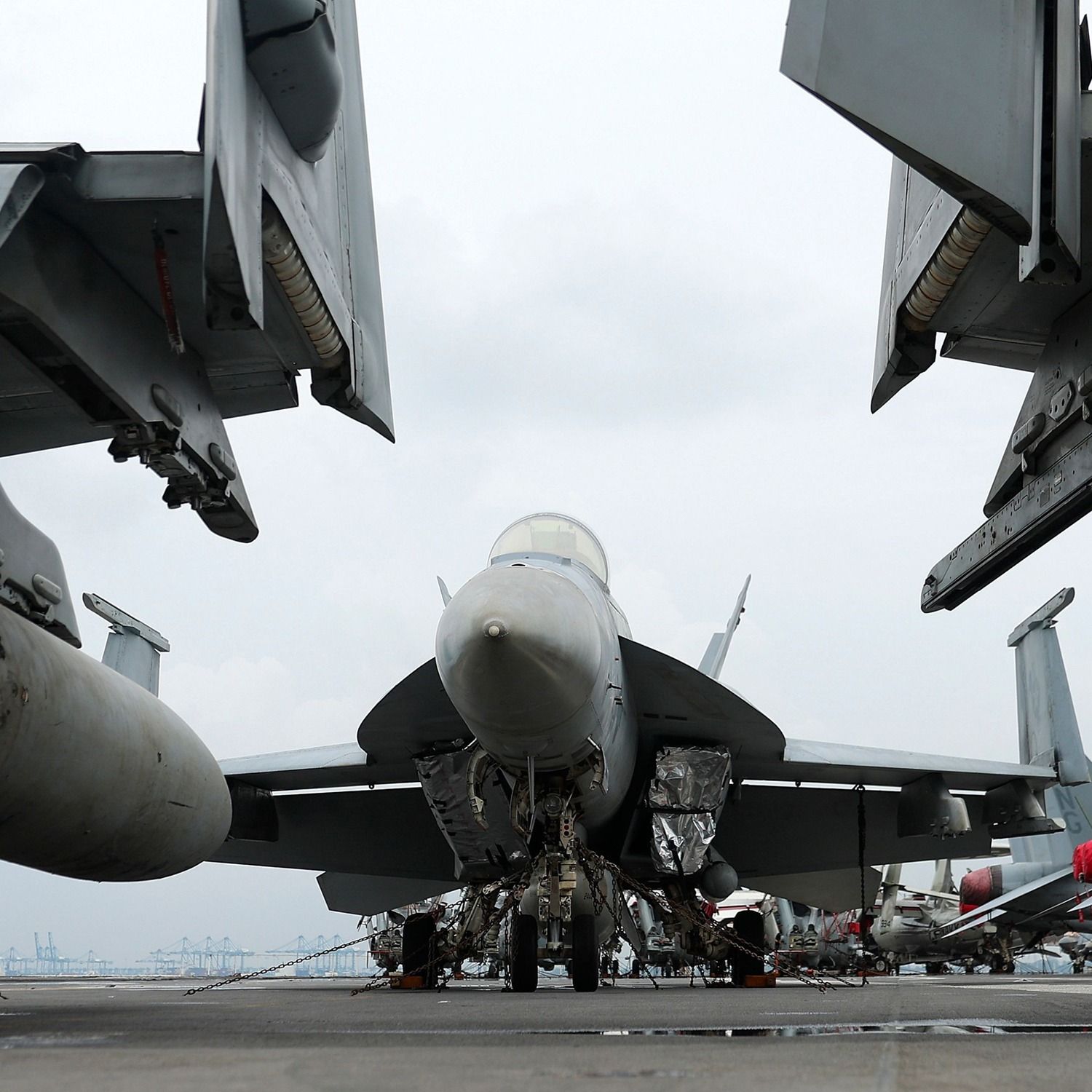
The Daily
Trump Weighs War With Iran
00:23:13
The United States has been building up a military presence around Iran for weeks, even as negotiators from both countries plan to meet later this week in hopes of finding a diplomatic solution to the escalating tensions. David E. Sanger, a national security correspondent for The New York Times, explains what President Trump hopes to achieve through potential military action, and why he has chosen this moment.
Loading summary
Transcript50 lines
- [00:00]
David Sanger
This podcast is supported by Hulu's Paradise.
- [00:03]
Sterling K. Brown
Hey, it's Sterling K. Brown from the Hulu original series Paradise. The next chapter begins as Xavier's search for his wife takes him above ground and what he finds will change everything. It was never just about the bunker. Tune in and discover the truth lies outside Paradise. The official podcast is now streaming and stream paradise on Hulu and Hulu on Disney plus.
- [00:26]
Rachel Abrams
From the New York Times, I'm Rachel Abrams and this is the Daily. For weeks, the United States has been building up an enormous military presence around Iran, even as negotiators from both countries plan to meet later this week in the hopes of finding a diplomatic off ramp to the escalating tensions. Now, as President Trump signals a potential attack, our colleague David Sanger explains what the president hopes to achieve through military action and why he's chosen this moment. It's Tuesday, february 24th. David Sanger, welcome back to the Daily
- [01:23]
David Sanger
Rachel, Great to be with you.
- [01:25]
Rachel Abrams
The last time we talked about Iran on the show, we were in the middle of this brutal crackdown on anti government protesters who were protesting the regime. And at the time, there was a huge question about whether the United States would take some kind of military action. That obviously did not happen. But in the weeks since, we have seen this massive military buildup in the region. So, David, can you just start by describing what that buildup looks like and what we understand about what exactly is going on in this moment?
- [01:54]
David Sanger
Well, Rachel, the buildup is the largest we've seen in the Middle east since the run up to the war in Iraq in 2003. Wow. There are two aircraft carriers in the region, the Abraham Lincoln and the Gerald R. Ford, which has come back from Venezuela. There are fighter jets, refueling capability, bombers. They are all taking up positions from Jordan, all through our bases in the region. And meanwhile, there's the last gasp of a diplomatic track underway on Thursday. We expect that the Iranians will be meeting with the two main American negotiators, Steve Witkoff and Jared Kushner, to present a package that might satisfy President Trump's demands. But the president has made clear that he is thinking of everything from a limited strike on Iran to what could be a much larger military action that could take days or weeks.
- [03:01]
Rachel Abrams
You mentioned that the president has made demands. What are those demands exactly? Like, what does the United States want right now and what are they trying to achieve either through these talks or through any kind of potential military action?
- [03:14]
David Sanger
You know, there's a bit of a murkiness on this issue. Usually when presidents get to a situation like this, they're pretty clear about what it is they are seeking. But in this case, the President has not been clear. The president's offered a dizzying array of rationales for the military action that we may see.
- [03:38]
Deloitte Representative
Donald Trump is urging Iranians to keep
- [03:40]
Rachel Abrams
protesting, saying if Iran shoots and violently
- [03:44]
David Sanger
kills peaceful protesters, which is their custom, the United States of America will come to their rescue. He's talked about supporting the protesters, of course.
- [03:54]
Unnamed Political Analyst
We talked about Hamas and we talked about disarmament.
- [03:57]
David Sanger
He's talked about cutting off support for the proxies like Hezbollah and Hamas.
- [04:02]
Unnamed Political Analyst
There's nothing that would do more good for this part of the world than for Iran's leaders to renounce terrorists, stop threatening their neighbors, quit funding their militant proxies.
- [04:13]
David Sanger
And he's talked about taking out Iran's missile capability. The missiles that can reach Israel. These are all conventional weapons, but they pose a big threat to a major American ally. And then, of course, there's the one big reason he keeps returning to.
- [04:31]
Unnamed Political Analyst
You can't have peace in the Middle east if they have a nuclear weapon, and they can't have a nuclear weapon,
- [04:37]
David Sanger
and that is going after the remnants of Iran's nuclear portfolio.
- [04:42]
Unnamed Political Analyst
I hope they're not trying to build up again, because if they are, we're going to have no choice but very quickly to eradicate that buildup.
- [04:53]
Rachel Abrams
The nuclear portfolio, we should mention, which the President had previously claimed that the US had wiped out back in the summer.
- [04:59]
David Sanger
That's right, Rachel. And you know, just to wind back the clock for a moment, you may remember that in June there was a 12 day war that the Israelis initiated against Iran.
- [05:11]
Rachel Abrams
Right.
- [05:12]
David Sanger
And that it ended with a US Attack on the three major nuclear enrichment sites that Iran has built up over the decades. And these were three sites that only the US Air Force had the capability with bunker busters to get down deep enough to try to destroy. And in the course of doing that, they ended up burying under the rubble Iran's stockpile of enriched uranium that was enriched to a purity just shy of what you would need to make a nuclear weapon.
- [05:48]
Rachel Abrams
And just to be clear, after the US Conducted that whole campaign, what would be left now to hit through some kind of military action?
- [05:57]
David Sanger
Well, there are still targets. There are places where the Iranians have made nuclear centrifuges, the machines that spin at supersonic speeds and produce uranium. You could wipe out some of those targets.
- [06:12]
Rachel Abrams
David, the last time that the United States took a military action against Iran, it was in close coordination with Israel, which is obviously our biggest ally in the region. They have grave concerns about Iran's nuclear and missile programs. What do we know about Israel's involvement this time around?
- [06:29]
David Sanger
Well, we know that Prime Minister Benjamin Netanyahu has been talking frequently to President Trump. He came for a visit about two weeks ago, and what little leaked out from that session indicated that the Israeli government was quite concerned that the US Wasn't paying enough attention to the missiles. And it's the missiles that can reach Israel that actually pierced the missile defenses last time and struck some civilian targets and killed some Israelis. And, you know, at the same time, the president has got some people in his ear and including Iran hardliners in Congress saying you will never have an opportunity like you've got right now, that Iran and Ayatollah Khamenei have never been weaker. They're economically on the ropes. There are protests in the streets. People are sick of their government and the repression surrounding it, and that after the war in June, they have never fully recovered militarily. Just take the moment to push them over the cliff. So the president may have in the back of his mind, a great desire to seize the moment, but at the same time, this is risky business. This is a country of 90 million people. They have considerable ability not only to strike back with missiles, but but with a terror network that runs throughout Europe and to some degree has shown some capability to operate inside the United States. They've got significant cyber capabilities as well. So it's hardly guaranteed that this is going to be a like, one night attack like you saw in June when they went after the nuclear sites. It's very possible that the Iranians could respond. The US Then escalates, the Iranians then escalate, and you're into a bigger conflict than anyone wants to see happen in the Middle East.
- [08:37]
Rachel Abrams
Okay, so it sounds like there are a lot of people in the president's ear right now. There's Netanyahu, there are the Iran hawks in Congress. But one thing that I think has been very top of mind at least since the protests in January is regime change. And how a lot of these goals that you mentioned that the administration could be considering right now could lead to that, depending on what kind of military action they take. Is that part of the calculation here?
- [09:02]
David Sanger
We have to assume that it's one of the biggest parts of the calculation. But the fact of the matter is the president has stopped just short of that. And when the topic came up with Secretary of State Marco Rubio in some Senate testimony last month, he said, well, this would be Big and complicated. And we'd have to give a lot of thought to what that would look like. Well, a little late to come to the conclusion. We have to think that through. The fact of the matter is the government of the United States has been thinking about regime change in Iran for decades.
- [09:35]
Okta Representative
Right.
- [09:36]
David Sanger
So there are a couple of big questions here, Rachel. The first is, can you bring about regime change with an air campaign? It's not clear at all that that's necessarily going to work. Second, if it does work, what's the assurance that the government that would come in would be any friendlier to the United States? It could just be another repressive regime. And the other risk, of course, is that this could just escalate into a much larger regional conflict, which would be entirely understandable if the Iranians decided that the regime was at risk and they were going to throw everything into the retaliation foreign.
- [10:27]
Rachel Abrams
We'll be right back.
- [10:33]
Deloitte Representative
A biotech firm scaled AI responsibly. A retailer reclaimed hours lost to manual work. An automaker now spots safety issues faster. While these organizations are vastly different, what they have in common sets them apart. They all worked with Deloitte to help them integrate AI and drive impact for their businesses. Because Deloitte focuses on building what works, not just implementing what's new. The right teams, the right services and solutions. That is how Deloitte's clients stand out. Deloitte together makes progress.
- [11:10]
Rachel Abrams
David. When we think about a potential military strike in Iran and what that might mean for regime change, I am of course reminded about the recent action that the US Took in Venezuela when it removed the president, Nicolas Maduro. My sense is at least that that really caused other countries to sit up a little straighter in the face of U.S. pressure. And so I wonder whether that is coming into play here at all with how the US Is interacting with Iran in this moment.
- [11:37]
David Sanger
Oh, Rachel, I think it's definitely part of the calculation. I mean, first of all, there is a just overall similarity to the gunboat diplomacy here, right? You mass a naval fleet off the coast, you issue a set of demands, and if the demands are not met, you then use that military force to compel the country to change the way you want it to change. But there's also a real difference here as well, because in Venezuela, it was a very targeted operation. They were aiming for one guy, Maduro, and when they pulled him out of there and sent him off to the Brooklyn Detention center, they left the rest of his government fully in place. In Iran, however, it seems very unlikely that that model would work. First of all, it's a much larger country. It's 90 million people. Second, it's a lot more complex. It's a lot better armed. It's got air defenses that Maduro never had. It's got a population that may go along with the removal of the government, but also has bitter Memories of CIA efforts to bring about coups in Iran in the 1950s. And finally, if the US was successful, it's not clear that you could leave the existing government in place the way they have in Venezuela. You'd have to take out that entire structure run by the Islamic Revolutionary Guard Corps. You'd have to eliminate almost all of those loyalists to Ayatollah Khamenei. So it's not clear that you would have someone in place to go run the country and to respond to those American demands.
- [13:29]
Rachel Abrams
Okay, so given the fact that a military action would be extremely complicated in Iran, what would a more quote, unquote, limited strike look like that the United States is actually considering?
- [13:44]
David Sanger
It's a good question. Because there are all kinds of targets. They could go after the besiege, which is the local militia groups that have been used to put down the protesters. That way, at least the president could say he's making good on his commitment. They could go after the Islamic Revolutionary Guard Corps. And you may remember that back in 2020, in his first term, President Trump ordered a drone strike on the head of the Quds Force, the most elite part of the Iranian military, and managed to kill him. So you could imagine more attacks on the leadership of the irgc. You could imagine attacks that were just limited to those missiles and missile sites and the launchers that Israel's most worried about. But all of those would gain mostly a tactical advantage if the government didn't change. The military leaders will get replaced eventually. Iran will build more missiles or buy them. So the real question is, are you just mowing the lawn or are you bringing about real change?
- [15:01]
Rachel Abrams
How concerned is Iran about all of this or any of this?
- [15:06]
David Sanger
Well, Rachel, the Iranians have made it pretty clear they're deeply concerned. I mean, first of all, we've seen them burying and reinforcing some nuclear related sites or suspected nuclear related sites that hadn't been hit back in June. Second, they've moved a good number of their missiles and other arms to the borders where they could more easily reach American bases or Israel to make the point that they're going to get some shots off if they get attacked. Thirdly, there's the strange action by Ayatollah Khamenei, who is 86 years old and presumably has some succession plans anyway, but as we've reported in the Times, he's deepened those in recent times. So the Supreme Leader is clearly aware that the US May be going for regime change and he wants an insurance policy against that. These are all the kind of preparations we've not really seen the Iranians take at this level before.
- [16:10]
Rachel Abrams
At the same time, though, of course, there are these diplomatic talks. What kind of off ramp, if any, is being considered right now so that we do not see this kind of escalation?
- [16:22]
David Sanger
Well, the talks have been stymied a bit by the problem that the US Is demanding that there is no uranium enrichment. In other words, that Iran get completely out of the business of making any nuclear fuel. And there's an interesting idea that's been floated, which is to allow the Iranians to have a very limited enrichment capability purely for medical and medical research related purposes. It's got a nice humanitarian tone to it. It would be basically allowing the Iranians to produce fuel for a small research reactor that's been in Tehran since 1967, when Iran, in one of those great ironies of history, the United States gave the reactor to the Shah of Iran. And it's used mostly for production of pharmaceuticals. It's useful for cancer treatments and so forth. And this would allow the Iranians to say, we're still enriching, and allow the United States to say we've stopped all their nuclear weapons activity. But it's not clear the Iranians will give up that much capability. And it's not clear that President Trump would accept any continued enrichment of any kind for any purpose?
- [17:41]
Rachel Abrams
Given all of that, David, is it possible that the military buildup that we've seen is not necessarily an alternative to diplomacy, but actually something that the president is using to sort of strengthen his hand diplomatically? Like, could he be using this threat of the military action as leverage to push for a diplomatic solution at the talks later this week?
- [18:04]
David Sanger
It's very possible. That's the diplomacy part of gunboat diplomacy. Of course, the flip side of that, Rachel, is if you have spent hundreds of millions, if not billions of dollars assembling a huge force off a country's coast, the temptation to go use that is extraordinarily high. And if his real goal here is regime change, then he may not really be that interested in a diplomatic solution, because a diplomatic solution would, if anything, bolster the existing regime. It would remain in place.
- [18:42]
Rachel Abrams
Just to take a step back here, the United States has viewed Iran as a threat for many, many years. So on the one hand, it makes sense that it would continue to be a priority. But on the other hand, during the second Trump administration, the United States has really kind of laid out this worldview of spheres of influence which we've talked about a lot on the show. The idea that the great powers can carve up the world and consider sections of it to be under their own purview, we've seen from the US Side that that has meant the Western Hemisphere. So I wonder where you feel like the Middle east fits into that worldview.
- [19:25]
David Sanger
Rachel, you're exactly right. This does not fit comfortably into the President's national security strategy that came out in November. On the one hand, as you suggest, American presidents have been pushing back on Iran and the Iranian nuclear program for decades. Ever since the Iran hostage crisis. Right. Which came right after the Iranian Revolution in 1979, the United States has sabotaged the Iranian nuclear program over the years. It's mounted some of the most sophisticated cyber attacks in history against Iran's nuclear infrastructure. So there's always been a consistent effort to push back the day when Iran could get a nuclear weapon. And if you view it that way, then President Trump in what he's doing today, is escalating and expanding what has been a long running American policy across Democratic and Republican administrations. But if you view it in the context of his national security strategy, well, Iran isn't exactly in the Western Hemisphere. Right. And so he may just be seeing a moment to deal with a longtime adversary that is going through a period of remarkable military, economic and political weakness. And I think that's really what's happening here. It's not as if the Iranians are in a position right now to attack us. Right. Their nuclear program has been buried. Their economy is at a point of near collapse. They are not about to go out of their way to pick a conflict with the U.S. instead, the president might be engaging in what legal and diplomatic historians call a preventive war, a war where we are strong, our adversary is weak. And so we're going to hit them now because we've got a good chance. That is in international just war theory, considered to be an illegal use of force. That may not stop the President. The President may believe that he'll go down in history as the one who solved America's long running conflict with Iran that goes back to 1979. But if the President decides to take military action in the next few days or weeks, I suspect that historians will look back at this moment as a war of choice, not a war of necessity.
- [22:19]
Rachel Abrams
David Sanger, thank you so much as always.
- [22:23]
David Sanger
Thanks, Rachel. Great to be with you.
- [22:32]
Rachel Abrams
We'll be right back.
- [22:37]
Okta Representative
These days it seems like AI agents are just about everywhere you turn every field and every function. But without identity, you can't trust they'll serve your business instead of jeopardizing it. Fortunately, Okta helps you get identity right by securing your AI agents identities, giving you a single layer of control, a single standard of trust. So whether an AI agent supports a single user or your entire enterprise, with Okta you'll turn risk into opportunity. Secure every agent. Secure any agent. Okta secures AI.
- [23:11]
Rachel Abrams
Here's what else you need to know. Today, Mexican authorities appear to have restored order in multiple cities after the killing of a major cartel leader set off a wave of violence that left at least 62 people dead. Mexico's most powerful criminal organization, the Jalisco New Generation Cartel, unleashed the chaos after its leader, Nemesio Oseguera Cervantes, or El Mencho, died in a military raid on Sunday in western Jalisco. State and British police arrested the former ambassador to the United States States, Peter Mandelson, following accusations that he had passed on confidential information to the sex offender Jeffrey Epstein. The move comes just days after the arrest of Andrew Mountbatten Windsor, formerly Prince Andrew, on suspicion of the same offense and months after Mandelson was fired once the extent of his friendship with Epstein was revealed. Today's episode was produced by Carl Carlos Brieto, Nina Feldman and Claire tennisgetter. It was edited by Maria Byrne and Mark George. Contains music by Marian Lozano, Alicia Beitup and Rowan Ni Misto and was engineered by Chris Wood. Special thanks to Eric Schmidt and Mark Mazzetti. That's it for the Daily I'm Rachel Abrams. See you tomorrow.
- [24:46]
Deloitte Representative
Most all in one HR systems are a patchwork of disconnected and manual tools. Rippling is totally automated. If you promote an employee, Rippling can automatically handle necessary updates from payroll taxes and provisioning new app permissions to assigning required manager training. That's why Rippling is the number one rated human capital management suite on G2. TrustRadius is and Gartner. If you're ready to run the backbone of your business on one unified platform, head to rippling.com thedaily and sign up today. That's R I P P L-I N G.com thedaily to sign up.