← The Daily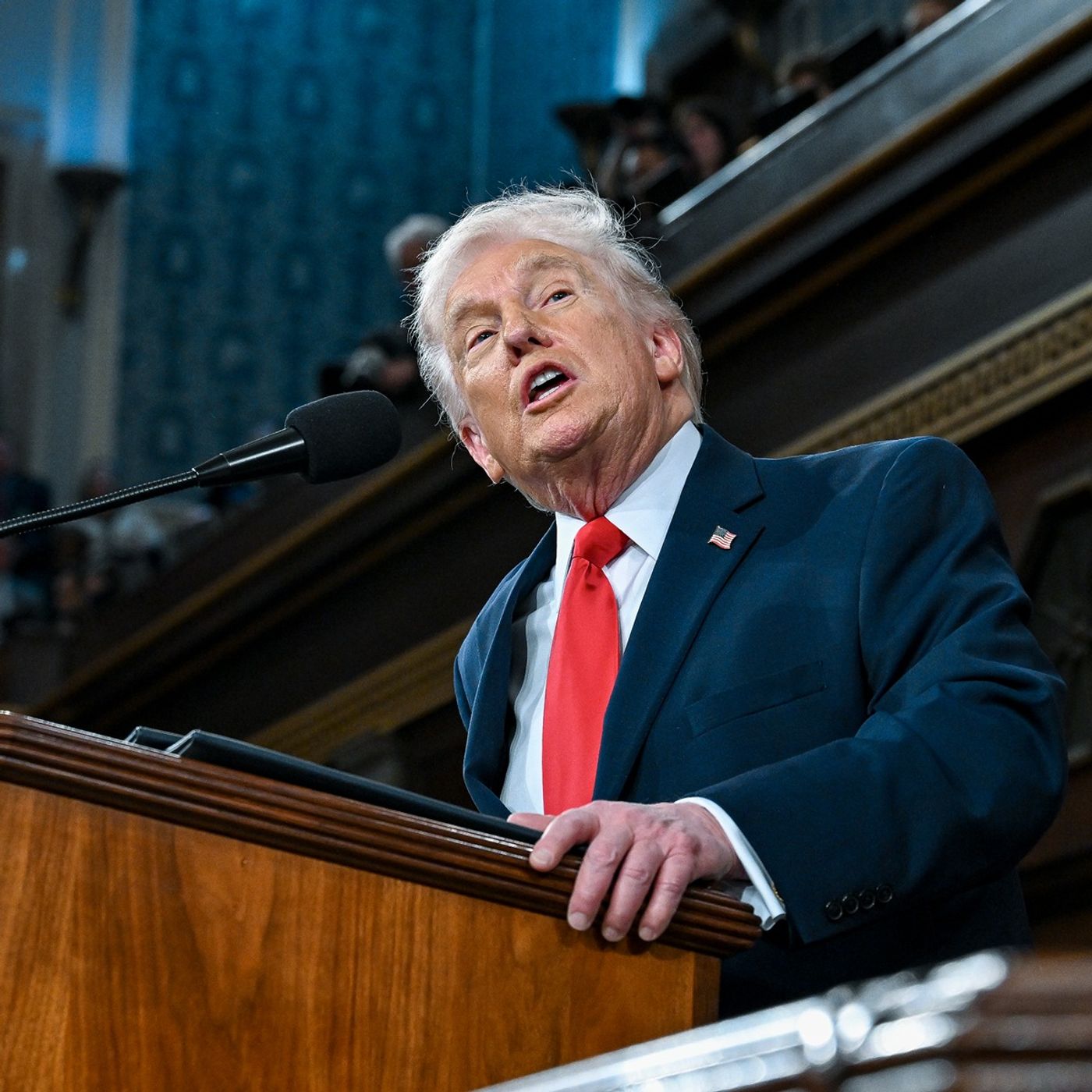
The Daily
Rosy Predictions, Angry Attacks: Trump’s State of the Union
00:37:21
In his first State of the Union address of his second term, President Trump offered a rosy portrait of a United States that has lost confidence in his leadership. He also relentlessly baited Democrats, who want to win back control of Congress in the midterms this fall. David E. Sanger, a White House correspondent for The New York Times, takes us inside the room.
Loading summary
Transcript185 lines
- [00:00]
A
This podcast is supported by Hulu's Paradise. Hey, it's Sterling K. Brown from the
- [00:04]
B
Hulu original series Paradise.
- [00:07]
C
The next chapter begins as Xavier's search
- [00:09]
A
for his wife takes him above ground. And what he finds will change everything.
- [00:13]
C
It was never just about the bunker. Tune in and discover the truth lies outside Paradise. The official podcast is now streaming and stream paradise on Hulu and Hulu on Disney plus.
- [00:26]
A
From the New York Times, I'm Michael Balbaro. This is the Daily Today, in President Trump's first State of the Union of his second term, he offered a rosy portrait of a country that has lost confidence in his leadership and relentlessly baited Democrats as they try to win back control of Congress this fall. My colleague, chief Washington Washington correspondent David Sanger, takes us inside the room. It's Wednesday, February 25th. David, good evening.
- [01:17]
B
Hey, Michael, we're back again.
- [01:20]
A
We're back again. This is your second episode, I think, in two days. It's about 11:30pm on Tuesday night, and the president just wrapped his State of the Union address. And it was a very long State of the Union address.
- [01:36]
B
Oh, yeah, it was an hour and 47 minutes. You know, for years we thought that Bill Clinton set the record at 99 minutes.
- [01:46]
A
Right.
- [01:47]
B
And people couldn't believe how verbose he was. But Donald Trump has shown consistently he
- [01:54]
A
can go longer, and he did go longer. This was the longest, by New York Times calculations, State of the Union in history.
- [02:03]
B
Yep.
- [02:05]
A
Well, David, as you know, well, every State of the Union, no matter its length, feels deeply grounded in the moment in which it is delivered. And I want to start there with you with the stakes of this speech for President Trump. As we went into this speech on
- [02:20]
B
Tuesday night, well, he had a lot to get done because a year ago he was coming in fresh from a big electoral victory. People were kind of tired of the Biden years. Now, he came into this one with polls showing that voters have turned on President Trump pretty severely, that more than 60% are saying that his priorities are not their priorities. They're concerned about affordability and inflation. They're worried about tariffs. And we're a little bit relieved when the Supreme Court seemed to step in and say the president overstepped his authority. They're concerned that we've put a good percentage of our Navy and Air Force off the coast of Iran for what may be an invasion that people are still pretty apprehensive about. And there's a midterm election looming and a lot of very nervous Republicans who have backed President Trump sitting in that audience worried about what it is that they'll be stuck with come November. So he had a lot of hurdles to go cross tonight.
- [03:37]
A
Right. I would say that an economy Americans are extremely anxious about, a tinderbox potential war in the Middle East, a tariff ruling that went against him all in, in an election year makes for about as high stakes a State of the Union as you can really imagine. So take us into the room as this speech gets underway.
- [03:59]
C
Mr. Speaker, the President of the United States.
- [04:05]
B
So the President walked in with the usual introductions, each one of which leads to a burst of applause. Applause. There are protests among some of the Democrats, but, you know, he immediately diffused the big issue, which was how would he deal with the Supreme Court that he had denounced as unpatriotic just days before?
- [04:28]
A
Right.
- [04:31]
B
He went up and shook the hands of a couple of the justices, the ones who he said a few days ago, their families would be ashamed of them.
- [04:40]
C
Well, thank you very much, everybody. It's really an honor.
- [04:44]
A
And then after that brief moment of surprise diplomacy, he takes to the podium.
- [04:50]
C
Less than five months from now, our country will celebrate an epic milestone in American history, the 250th anniversary of our glorious American independence.
- [05:02]
B
He does, and, you know, he opens up with an immediate reference to the 250th anniversary of the United States.
- [05:09]
C
This July 4th, we will mark two and a half centuries of liberty and triumph, progress and freedom in the most incredible and exceptional nation ever to exist on the face of the earth. And you've seen nothing yet. We're going to do better and better and better. This is the golden age of America.
- [05:28]
B
And I thought for a minute there, well, he's going to really go do a unifying speech here built around that theory. Theme, the theme of a country that was in the throes of revolution, has had divisions before and came together.
- [05:43]
C
When I last spoke in this chamber 12 months ago, I had just inherited a nation in crisis with a stagnant economy, inflation at record levels, a wide open border.
- [05:57]
B
It's not quite what we got.
- [05:59]
C
Rampant crime at home and. And wars and chaos all over the world.
- [06:04]
B
And then he launched into what turned out to be a play in three parts. Right. The first part was a familiar recitation of what he thinks his accomplishments were. The middle was a highly partisan attack on Democrats. And the end was sort of a return to these unifying themes. The 250th anniversary war heroes, an America that can do anything it wants to do.
- [06:31]
A
Okay, well, let's start with the first of those Trump's accomplishments in his telling.
- [06:37]
B
Well, in his telling, America has come back from being basically dead on arrival in the emergency room.
- [06:45]
C
But tonight, after just one year, I can say with dignity and pride that we have achieved a transformation like no one has ever seen before. And a turnaround for the ages. It is indeed a turnaround for the ages.
- [07:02]
B
And not surprisingly, Michael, he ran through a number of inflated claims that are pretty familiar to anybody who listens to Donald Trump at rallies or at press conferences.
- [07:15]
C
The roaring economy is roaring like never before.
- [07:19]
B
He talked about economic growth, and 100%
- [07:23]
C
of all jobs created under my administration have been in the private sector.
- [07:30]
B
He talked about how many jobs were created in the private sector without mentioning the fact that Doge cut many in the public sector. Overall job growth is pretty low. He talked about winning, particularly winning new investment in the United states.
- [07:46]
C
And in 12 months, I secured commitments for more than $18 trillion pouring in from all over the globe.
- [07:54]
B
Well, nothing close to that has come in in the past year. It looks like he is adding together and maybe inflating commitments that came from different chief executives talking about their investment over the next decade or two. And most importantly, my administration has driven
- [08:13]
C
core inflation down to the lowest level in more than five years. And in the last three months of 2025, it was down to 1.7%.
- [08:26]
B
He made his case that inflation was finally under control, and that was the closest he got to the affordability argument that we know he hates making because he thinks it's a nonsense argument, but that every one of his aides tells him he's got to address. It's the one thing that the polls show anger Americans of all stripes.
- [08:51]
C
A short time ago, we were a dead country. Now we are the hottest country anywhere in the world. The hottest.
- [09:00]
B
What was really striking about this was if you compare his claims to the way people feel, what they tell pollsters, there was an element of unreality to this.
- [09:12]
C
One of the primary reasons for our country's stunning economic turnaround, the biggest in history, where the Dow Jones broke 50,000 four years ahead of schedule, and the S and P hit 7,000, where it wasn't supposed to do it for many years, were tariffs.
- [09:31]
A
And it's around this point, David, that Trump formally turns to a subject we knew he would need to address, the tariff ruling by the Supreme Court justices. Like you said, he had shaken their hands as he walked in, but then it seemed like he kind of unshook their hands in this actual speech.
- [09:49]
C
And then just four days ago, an unfortunate ruling from The United States Supreme Court, it just came down. It came down. Very unfortunate ruling.
- [09:58]
B
Well, I actually thought, Michael, that compared to what he said last week when he was making specific accusations against the individual justices who had ruled against him, he was pretty moderate.
- [10:13]
C
So despite the disappointing ruling, these powerful countries saving. It's saving our country the kind of money we're taking in.
- [10:22]
B
But this didn't last long.
- [10:24]
C
Congressional action will not be necessary. It's already time tested and approved.
- [10:29]
B
And he basically made the argument, I'm going to reimpose all of those tariffs under different authorities. And he moved on moving forward.
- [10:39]
C
Factories, jobs, investment, and trillions and trillions.
- [10:42]
B
Right.
- [10:43]
A
I did think it was notable that the President, when he said he was going to reimpose the tariffs, said he didn't feel like he needed congressional action to do that, because the context, of course, is that he's in a room filled with members of Congress who in theory, should covet the ability to influence this decision. The Supreme Court said it's their job, not the president's. And instead, the president looks at all these members of Congress and basically says, I don't need you. I'm gonna do this anyway.
- [11:12]
B
You know, that's a theme throughout his presidency. This is not a president who wakes up in the morning and thinks about bills he's going to go push through Congress. This is a president who wakes up in the morning and thinks about what authorities he has or can claim to have so that he can do things by executive order.
- [11:33]
C
Because we finally have a president who puts America first, put America first. I love America.
- [11:39]
A
And then the president turns to what, David, you have termed the second act of this speech, the partisan act.
- [11:48]
C
For decades before I came along, we
- [11:51]
A
had the exact opposite, especially as he turns to the topic of immigration.
- [11:57]
B
Well, you know, Michael, if you think that the first part was sort of delivered by the good Donald Trump, the one who seems sort of jovial, the tone changed as soon as he got into this middle section under Biden and
- [12:12]
C
his corrupt partners in Congress and beyond. It reached a breaking point with a Green New scam. Open borders for everyone. They poured in by the millions and millions from prisons, from mental institutions. They were murdered.
- [12:27]
B
He immediately goes into setting up this kind of rhetorical motif in which he attacks Democrats, Democratic cities, and he begins to run through his now familiar list of ills he thinks Democrats have brought back to the United States.
- [12:47]
C
But when it comes to the corruption, that is plundering, really, it's plundering America. There's been no more stunning example than
- [12:57]
B
Minnesota So he blamed the Somalis in Minnesota for fraud.
- [13:03]
C
This is the kind of corruption that shreds the fabric of a nation, and we are working on it like you wouldn't believe.
- [13:10]
B
He went after sanctuary cities. He defined his immigration effort as an effort to get the worst of the worst out.
- [13:18]
C
And we're getting them the hell out of here fast.
- [13:21]
B
We don't want them skimming over right away. Others with no criminal record who have been deported, and, of course, the shootings of two American citizens in Minneapolis.
- [13:35]
C
The only thing standing between Americans and a wide open border right now is President Donald J. Trump and our great Republican patriots in Congress. Thank you.
- [13:46]
A
Right. It kind of felt like he was trying to reclaim the topic of immigration, which has gone from being a strength into being a vulnerability for him. But in the process, he did not represent what's actually unfolded under his leadership.
- [13:59]
B
But he had a deeper goal here, which was to set up the Democrats, who, of course, were sitting on their hands while the Republicans were applauding each one of these.
- [14:11]
C
One of the great things about the State of the Union is how it gives Americans the chance to see clearly what their representatives really believe.
- [14:20]
B
And then at one point, after, he has built up to this crescendo.
- [14:25]
C
So tonight, I'm inviting every legislature to join with my administration in reaffirming a fundamental principle. If you agree with this statement, then stand up and show your support. The first duty of the American government is to protect American citizens, not illegal aliens.
- [14:45]
B
He asks everyone to stand if they agree with him, knowing that he would get the image of Republicans who are standing and Democrats who remain sitting.
- [14:57]
C
Isn't that ashamed? You should be ashamed of yourself. Not standing up. You should be ashamed of yourself.
- [15:05]
B
So if you ever wanted a moment where you could sort of capture the division between the Trump Republicans and the Democrats, President Trump was creating it right there for the cameras. And then eventually, the Democrats take the
- [15:23]
C
bait to end deadly sanctuary cities that protect the criminals and enact serious penalties for public officials who blocked the removal of criminal aliens, in many cases drug lords.
- [15:37]
B
And not surprisingly, Representative Ilhan Omar, who he has attacked repeatedly, begins yelling at him. And he has a few exchanges with her.
- [15:49]
A
Right. At one point, she says, you killed American citizens. She wants to distinguish between what he's arguing, which is there's a problem with illegal immigration. And. And what she says is the problem, which is, you guys are so overzealous that you're hurting American citizens.
- [16:06]
B
Right. This was exactly the contrast that I think President Trump wanted to bring up. This was the moment he wanted for the cameras. Because what he was building toward once the yelling laid down was this one line that may remain as the one that people remember from this speech.
- [16:29]
C
These people are crazy, I'm telling you, they're crazy.
- [16:38]
B
These people are crazy, I'm telling you. And of course, he's thinking of that as the theme for the midterm elections.
- [16:46]
A
Right. Instead of trying to justify all of his administration's conduct in places like Minneapolis, for example, where ICE enforcement has become a real liability for him, he is attempting to turn this around and make it a liability for Democrats. It's deeply unclear whether that will work, but he's saying they remain out of the mainstream. This is not about me. This is about them in an election year.
- [17:15]
B
That's right, Michael. But it's also where the disconnect shows up again, because polls will show that Americans are largely sympathetic with the idea of throwing out illegal immigrants who are violent, who have criminal records and so forth. It tapers off pretty fast when you have people who've been in the United States for a long time, no criminal record, built their own businesses or students or something like that. And it completely falls off when you ask about the ICE enforcement activity that we've seen take place, including the killings of American citizens. And the way he dealt with the last was simply not to mention it.
- [18:02]
A
Okay, David, we're gonna take a quick break. When we come back, we're gonna talk about how the president eventually gets to that third act of this speech by way of a journey through foreign affairs. So we'll be right back.
- [18:30]
D
This podcast is supported by the International Rescue Committee. Co founded with help from Albert Einstein. The IRC has been providing humanitarian aid for more than 90 years. The IRC helps refugees whose lives are disrupted by conflict and disaster, supporting recovery efforts in places like Gaza and Ukraine, and responding within 72 hours of crisis. Donate today by visiting Rescue.orgRebuild
- [19:00]
C
we're proudly restoring safety for Americans at home and we are also restoring security for Americans abroad.
- [19:09]
A
So, David, about an hour into this speech, President Trump turns to international affairs and his role in bringing about the end to a whole lot of conflicts, as he puts it.
- [19:24]
B
Well, yes, that's right, Michael, because our
- [19:26]
C
country has never been stronger. My first 10 months, I ended eight
- [19:30]
B
wars, including, of course, he repeats the somewhat dubious claim that he has single handedly ended eight wars. There are a couple he can take credit for. But what's important here is the Democrats kind of laughed at him.
- [19:48]
C
Sick people.
- [19:50]
B
And the Republicans all applauded him on it. He Then turned to what was clearly his biggest success.
- [19:58]
C
Under the ceasefire I negotiated, every single hostage, both living and dead, has been returned home. Can you believe that?
- [20:08]
B
He talked about the agreement that brought all the hostages, living and dead, out of the hands of Hamas. That was a truly remarkable accomplishment.
- [20:19]
C
Nobody thought it was possible.
- [20:22]
B
And then overstated the ceasefire that has followed, which has been pretty rocky. Then he just glided by what four years ago was the dominant subject of the State of the Union.
- [20:35]
C
And we're working very hard to end the ninth war, the killing and slaughter between Russia and Ukraine, where 25,000 soldiers are dying each and every month.
- [20:46]
B
The Russian invasion of Ukraine, which happened four years to the day before this speech.
- [20:52]
C
A war which would have never happened if I were president, would have never happened.
- [20:58]
B
And while President Biden was out there four years ago getting bipartisan applause for his promise to stick with Ukraine, thick and thin in this case, the president simply said he's working on it, that there have been awful casualties and he just wants to bring the war to an end.
- [21:17]
A
Right. He steadfastly refused to offer any real support to.
- [21:22]
B
To Ukraine, which was the one thing the Ukrainians were looking for today on the fourth anniversary. Just the message that we're with you. And they didn't get it.
- [21:35]
C
As president, I will make peace wherever I can, but I will never hesitate to confront threats to America wherever we must.
- [21:44]
A
And then the President pivots to the international subject that all of us were wondering whether he would get to and if he got to it, how thoroughly he would broach it, which is Iran.
- [21:59]
C
For decades, it had been the policy of the United States never to allow Iran to obtain a nuclear weapon. Many decades.
- [22:07]
B
That's right. And I'd say this was, in some ways, the lost opportunity of the speech. Hmm.
- [22:13]
A
Just explain that.
- [22:15]
B
Well, he brushed by the topic of Iran so quickly that if you were a casual listener, you would never have known that we've got something like a third of the U.S. navy and a good deal of the American air power that's available around the globe, parked off the Middle east, and that within a few days, we could well be in a situation where we're in an enduring conflict with Iran.
- [22:41]
C
They were warned to make no future attempts to rebuild their weapons program, and in particular, nuclear weapons. Yet they continue starting it all over. We wiped it out, and they want to start all over again.
- [22:56]
B
So he ran through Iran's offenses over the many years. He raised the possibility that they were trying to reconstitute their nuclear program, which was pretty remarkable because Eight months ago, he was saying he obliterated the nuclear program and they wouldn't be able to restart it for years. Right.
- [23:15]
A
In a previous attack.
- [23:16]
B
Yeah, that's right. That was in the June attack on the three major enrichment sites.
- [23:22]
C
They've already developed missiles that can threaten Europe and our bases overseas, and they're working to build missiles that will soon reach the United States of America.
- [23:33]
B
He talked about their missile developments. He talked about 32,000 Iranian protesters who had been killed during the uprisings last month.
- [23:43]
C
We stopped them from hanging a lot of them with the threat of serious violence.
- [23:50]
B
But what was strange about this, Michael, was he never used the moment to explain what he was trying to accomplish with all. All of that military firepower sitting off of Iran. Was he trying to stop the nuclear program or overthrow the regime or protect the protesters? He simply did not say. And that's the one thing that everybody was listening for the most. He said the Iranians had not given him the one thing he wanted to hear.
- [24:23]
C
They want to make a deal. But we haven't heard those secret words. We will never have a nuclear weapon.
- [24:31]
B
We will never have a nuclear weapon. Well, of course, the Iranians have said that many times. In fact, their foreign minister tweeted it out a few hours before the speech. But the problem isn't what the Iranians say. It's what they've been caught doing at various points over the past few years.
- [24:49]
A
I have to say, David, I had a slightly different reaction to hearing this section of the speech, and I almost never differ with you. But I heard what felt like a all the above rationale from the President in stating his disgust with Iran. And taken together, it did feel like the beginning of a rationale for military action against Iran.
- [25:15]
B
He came up with a casus belli, or actually four or five. But he never told us how the application of military power, how bombing the Iranians would change this. And as we've talked about before, you know, you might be able to destroy some facilities, but it's not clear how you protect protesters. For example, by dropping bombs in Tehran.
- [25:37]
C
We're also restoring American security and dominance in the Western Hemisphere, acting to secure our national interests.
- [25:44]
A
It's interesting, at least it was to me, that the President chose to juxtapose his implicit threats against Iran with his already very explicit actions against Venezuela.
- [26:00]
B
That's right.
- [26:02]
C
And America's armed forces overwhelmed all defenses and utterly defeated an enemy.
- [26:09]
B
He talked about that operation, and this
- [26:11]
C
was an absolutely colossal victory for the security of the United States. States. And it also opens up a bright new beginning for the people of Venezuela.
- [26:21]
B
He then brings into the hall Chief
- [26:24]
C
Warrant Officer 5 Eric Slover, the helicopter
- [26:29]
B
pilot who was part of the Maduro raid.
- [26:33]
C
While preparing to land, enemy machine guns fired from every angle. And Eric was hit very badly in the leg and hip. One bullet after another he absorbed and
- [26:45]
B
who took incredible amounts of fire. His leg was shattered.
- [26:49]
C
Then, even as he was gushing blood, which was flowing back down the aisle. Helicopter lands at a steep angle.
- [26:56]
B
He lands the helicopter despite the fact that he's bleeding. And the President describes this in somewhat gory detail.
- [27:03]
C
So we have a surprise for Eric and Amy in recognition of Eric's actions above and beyond the call of duty.
- [27:12]
B
And then, of course, they give the pilot the Medal of Honor right there in front of all of Congress and everybody who's watching with our nation's highest
- [27:23]
C
military award, the Congressional Medal of Honor.
- [27:31]
B
So that was a little bit of a brilliant turn, because how could the Democrats not stand for the awarding of a medal to somebody that courageous? And how could they not stand when he did similar awards for elderly veterans some 100 years old?
- [27:52]
C
Navy fighter pilot Royce Williams served in World War II, Korea, Vietnam, flying more than 220 missions who had fought in
- [28:02]
B
World War II and Korea and Vietnam.
- [28:05]
C
But tonight, at 100 years old, this brave Navy captain is finally getting the recognition he deserves. He was a legendary.
- [28:15]
B
So at that moment, he sort of matched his martial tendencies with a celebration of great heroism.
- [28:26]
A
I'm curious, David, as a veteran of State of the Unions and also as someone who's covered military affairs in your day, how you thought about all of the military awards that the President bestowed during this speech? I tend to think of those as awards typically given in solemn, much more intimate ceremonies. This is the most public possible venue, a President's State of the Union, and thus has a bit of a partisan tinge. A Purple Heart was given out, Congressional Medals of Honor were given out. Was that celebrating American heroism? Was that in some ways exploiting it?
- [29:06]
B
I think there was an element of showmanship and an element of exploitation to it as well. Because what he was doing was combining the experiences of these people in just wars, World War II, you know, and so forth. Korea, where we were fighting for a nascent democracy and managing to try to merge that with what many would argue were less clear uses of American power
- [29:35]
A
and potentially even illegal.
- [29:37]
B
And potentially illegal. And we're headed to that debate about Iran for sure, if he went ahead. So this is sort of taking the Ronald Reagan idea of putting prominent Guests and heroes in the State of the Union audience and moving it to the next level by awarding them these medals in front of the entire Congress.
- [30:03]
A
So, David, take us to the end of this speech, the third act, when President Trump takes a stab at unity.
- [30:13]
B
Michael, the third act.
- [30:15]
C
250 years is a long time in the life of a nation, but in another sense, it's really a mere moment in the eye of history, picked up
- [30:25]
B
on the 250th anniversary of America.
- [30:28]
C
Everything our nation has done, everything we have achieved, has been the work of those few great lifetimes.
- [30:35]
B
So he talked about America as a young nation.
- [30:37]
C
Americans lifted humanity into the skies on the wings of aluminum and steel.
- [30:43]
B
Then he talked about America as an innovative nation.
- [30:46]
C
All of this and so much more is the enduring legacy, unmatched glory of the hardworking patriots who built and defended this country and who still carry the hopes and freedoms on all of humanity's backs.
- [31:03]
B
Then he talked about Americans as people who could never be defeated, whose ideas and spirit sort of carried through and could do anything in the world.
- [31:14]
C
There is no challenge Americans cannot overcome, no frontier too vast for us to conquer, no dream too bold for us to chase, no horizon too distant for us to claim. For our destiny is written by the hand of Providence. And these first 250 years were just the beginning.
- [31:38]
B
Who did that sound like? Joe Biden, who used to say at every speech, there's nothing Americans can't accomplish. And in some ways, it was not like Donald Trump. But he delivered it with some passion, and it made you realize that he has within him the ability to talk in unifying terms. He just can't help himself.
- [32:05]
C
And our future will be bigger, better, brighter, bolder, and more glorious than ever before. Thank you. God bless you, and God bless America.
- [32:25]
A
So in the end, thinking back to the stakes of this all, at this moment in the economy, at this moment in the immigration battles in the country, and potentially at the start of a new war, did he meet the moment?
- [32:41]
B
You know, I don't think, Michael, that he moved the needle. He had to go convince Americans in this speech that the evidence indicated that they didn't need to feel this economically insecure. I don't think he met that. He had to go lay out a rationale for why we may be at war in the next couple of days. He certainly didn't do that. He had to go make the case that the Republican Party had a full policy agenda that was ready to go between now and the midterm elections. And there was very little policy in this speech. So my overall sense is President Trump talked about how he believes the country should view him rather than how it does view him. And that raised the question of whether or not he is yet in tune with the rest of the nation.
- [33:51]
A
Well, David, it is now almost 1am it's time for you to go to bed.
- [33:57]
B
It certainly is.
- [33:58]
A
Thank you very much. We appreciate it.
- [34:00]
B
Thanks much, Michael.
- [34:09]
A
Shortly after President Trump's speech, the newly elected governor of Virginia, Abigail Spanberger, delivered the Democratic Party's rebuttal.
- [34:18]
D
You have to ask who benefits from his rhetoric, his policies, his actions, the short list of laws he's pushed through this Republican Congress?
- [34:28]
A
Spanberger portrayed the president as a self dealing egomaniac.
- [34:34]
D
Somebody must be benefiting. He's enriching himself, his family, his friends. The scale of the corruption is unprecedented. Cozying up to foreign princes for airplanes and billionaires for ballrooms. Putting his name and face on buildings all over our nation's capital. This is not what our founders envisioned, not by a long shot.
- [35:00]
A
And said that at the end of the day, both the president and his agenda are deeply out of touch with regular Americans.
- [35:09]
D
Is the president working for you? We all know the answer is no.
- [35:18]
A
We'll be right back.
- [35:25]
D
These days, it seems like AI agents are just about everywhere you turn, every field and every function. But without identity, you can't trust they'll serve your business instead of jeopardizing it. Fortunately, Okta helps you get identity right by securing your AI agents identities, giving you a single layer of control, a single standard of trust. So whether an AI agent supports a single user or your entire enterprise, with Okta you'll turn risk into opportunity. Secure every agent. Secure any agent. Okta secures AI.
- [35:59]
A
Here's what else you need to know today. On Tuesday, House Republicans voted down a bill that federal regulators said could prevent deadly mid air collisions like the one last year in Washington, D.C. that killed 67 people. The bill, which would have required planes to carry advanced location tracking technology, was originally endorsed by the Defense Department and adopted by the Senate in December. But the Defense Department has since withdrawn its support, citing concerns over national security and costs. That prompted just enough House Republicans to vote against the bill to block its passage.
- [36:42]
D
And coming on to say it is day 24 since our mom was taken in the dark of night from her bed. And every hour and minute and second and every long night has been agony.
- [37:01]
A
In her latest plea with the public, Savannah Guthrie, the Today show co host, said that her family was offering up to $1 million for information that leads police to find her mother. Nancy.
- [37:16]
D
Someone out there knows something that can bring her home. Somebody knows. We are begging you to please come forward now.
- [37:25]
A
Despite a massive more than three week long investigation, police appear to have few leads about who abducted Nancy Guthrie on February 1st in Arizona or where she is. In the video, Savannah Guthrie acknowledged that her mother may already be dead.
- [37:46]
D
We also know that she may be lost. She may already be gone, but we need to know where she is. We need her to come home.
- [38:05]
A
Today's episode was produced by Ricky Novetsky, Olivia Knapp, Mary Wilson and Asta Chaturbati. It was edited by Rachel Quester and Liz o'.
- [38:15]
B
Ballin.
- [38:16]
A
Contains music by Diane Wong and Dan Powell and was engineered by Chris Wood. Special thanks to Afim Shapiro. That's it for the Daily I'm Michael Balbaro. See you tomorrow.
- [38:51]
D
What does slow travel sound like? The sound of Italy. Brought to you by Belmond. Learn more@nytimes.com Belmond LifeInItaly.