Loading summary
Transcript57 lines
- [00:00]
Deloitte Narrator
The right technology can strengthen human judgment. That's why Deloitte brings together AI and data analytics with multidisciplinary teams who can help you connect the dots across your enterprise, from risk to operations to customer needs. So opportunities don't slip by and surprises don't spread. Because the smarter your systems, the sharper your instincts. That's how technology makes people better at what they do best. Deloitte together makes progress. Learn more@deloitte.com TogetherMakesProgress from the new York
- [00:34]
Rachel Abrams
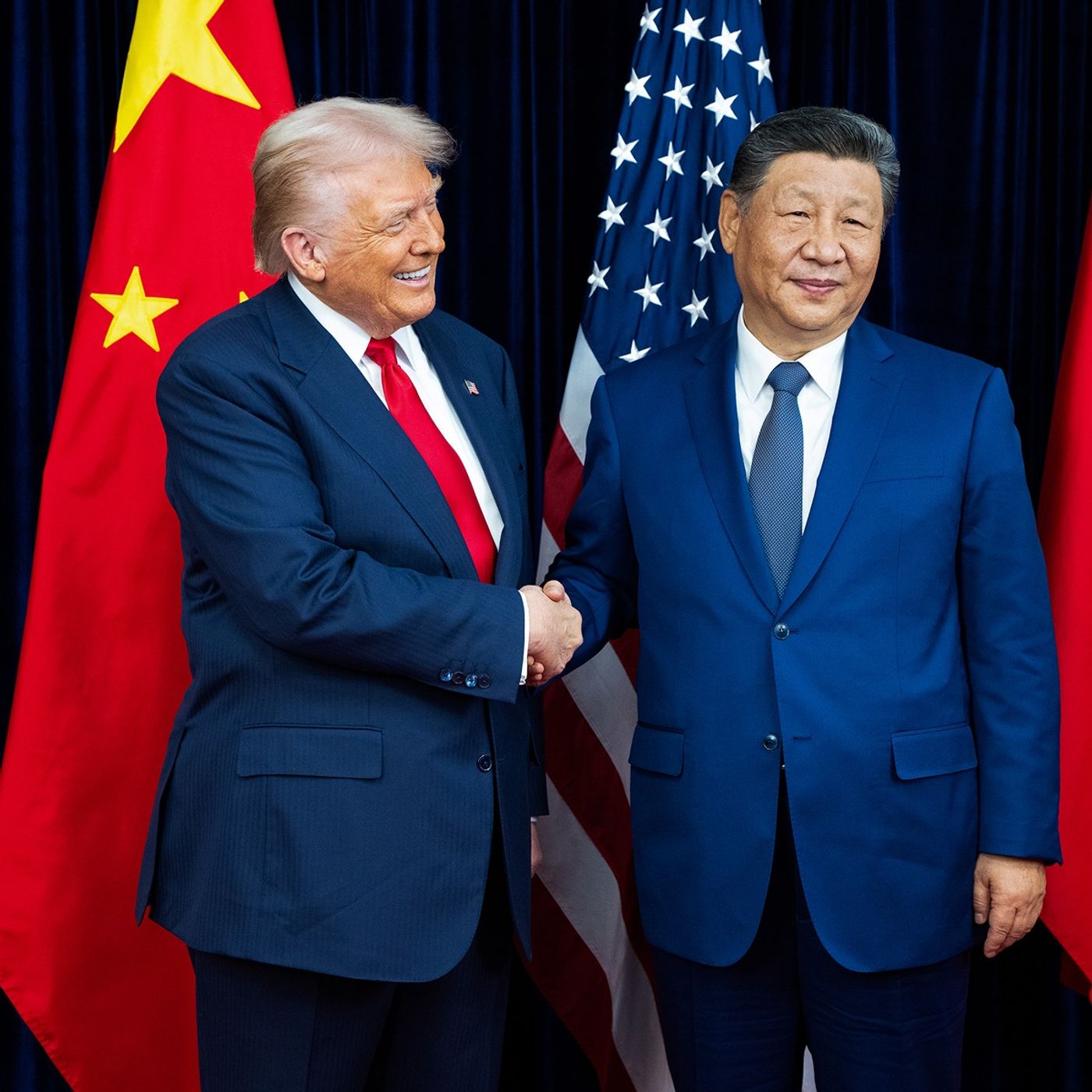
Times, I'm Rachel Abrams, and this is the Daily. For the first time in nearly a decade, President Trump will meet with China's President Xi Jinping in Beijing. The meeting comes as Trump struggles to extract himself from the war with Iran and must now face off against China, the biggest threat to the US's dominance on everything from technology to trade. Today, my colleague David Sanger explains what's likely to come of this meeting, and more pressingly, what will not. It's Wednesday, may 13th.
- [01:27]
David Sanger
Hey, guys, can you hear me?
- [01:29]
Rachel Abrams
David, we can hear you. Where are you right now?
- [01:32]
David Sanger
Good, good, good. I'm in my hotel in Beijing. I just arrived with several of my Washington bureau colleagues, and we are all preparing for the President arriving for his first trip to China in the second term. He'll get in on Wednesday night and meet Xi Jinping the next morning and part of Friday before he just turns around and goes right back home.
- [02:01]
Rachel Abrams
Okay, so now that you're in Beijing, can you set the scene for us a little bit, David, like, what is the significance of this meeting between President Trump and Xi Jinping?
- [02:09]
David Sanger
Well, as initially conceived, Rachel, this was going to be the first of a series of meetings this year in an effort by the President to have something of a rapprochement with the Chinese after many, many years of tension. Last time the President was here was 2017, and it was a very different situation. The President was treated with all the pageantry that the Chinese do very well. President Xi, I want to thank you
- [02:46]
Julian Barnes
for that incredible welcoming ceremony.
- [02:49]
David Sanger
He had just been elected president to the surprise of China and the world and perhaps themselves. Today I discussed with President Xi the chronic imbalance in our relationship as it pertains to trade. He was just beginning to think about how China correlated with his economic policies and his defense policies. The United States is committed to protecting the intellectual property of our companies and
- [03:20]
Julian Barnes
providing a level playing field.
- [03:22]
David Sanger
It was going to focus on China's rise as a major power in the
- [03:26]
Julian Barnes
coming months and years.
- [03:28]
David Sanger
I look forward to building an even stronger relationship between our two countries, China and the United States of America. But this time he arrives under the cloud of the Iran conflict. You'll remember he was supposed to come here in April and put it off. And did so, I think fairly convinced that by mid May, Iran would have already capitulated. And now instead, he shows up with Iran resisting, with other world leaders like Chancellor Mertz of Germany contending that Iran has humiliated the United States, and with the Chinese themselves a bit mystified about why the US Was having such a hard time opening up a body of water such as the Strait of Hormuz, or defeating a kind of second or third rate power in their mind like Iran. And of course, all summits are about optics. And while I'm sure there will be all the pomp and ceremony that goes with these, the fact of the matter is he comes into this summit looking a bit weakened.
- [04:44]
Rachel Abrams
Okay, so I understand that Donald Trump is walking into these meetings much weaker than in 2017. But as for the meeting itself, what do we know, if anything, about what they're actually going to be discussing?
- [04:56]
David Sanger
Well, we don't know a huge amount right now. But the obvious in any summit that involves President Trump is that you begin with the trade and economic relationships. And there, there's almost always a series of big purchases by China to be announced and potential business deals and memorandums of understanding, some of which will come to fruition and some of which will not. But these are all sort of the low hanging fruit of the relationship. I mean, this is what Donald Trump would do in any big summit meeting. And in some ways, those may be the easier of the issues to resolve. Which isn't to say that any of them are easy.
- [05:40]
Rachel Abrams
Well, can we dive into that a little bit more? Like when you say low hanging fruit trade business, what are we talking about exactly?
- [05:47]
David Sanger
Well, Rachel, this is Donald Trump and his idea of a summit is to emerge with a bunch of business deals, even if they don't fundamentally change the nature of the relationship. And he set this one up just that way. And so you'll hear a lot about the three Bs, beef, beans and Boeing.
- [06:07]
Rachel Abrams
Why beans, beef and Boeing?
- [06:09]
David Sanger
Well, these are three big, distinctly American exports. The Chinese have always bought American soybeans, although they think they're overpriced. They've long been dependent on Boeing, although now they're building some very good aircraft of their own. And beef, well, they're trying to start up their own beef industry as well, but they're still buying some specialty American beef. These are Always the low hanging fruit of these summits because China needs to buy some of this anyway. And the President wants to be able to go out and describe something that is an immediate deliverable to the American people.
- [06:47]
Rachel Abrams
Right. The President doesn't need to fly halfway across the world to negotiate something that China was just going to buy anyway.
- [06:53]
David Sanger
I'm sure that you'll hear many announcements and the President will declare that these were the biggest purchases ever. But they are fundamentally commodities, and that's where the two countries do business most easily.
- [07:07]
Rachel Abrams
But you know, one thing that I did not hear you discuss in your discussion of the three Bs, David, was a pretty big T that we've been talking about on the show a lot, and that is tariffs. Where does that fit into all of this?
- [07:19]
David Sanger
Well, obviously, tariffs are a huge issue for the Chinese. China's been a big target of Trump's tariff regime, and I'm sure that it will dominate a lot of the discussion. But the fact of the matter is the Chinese were able to get President Trump to back down some last year when in retaliation, they cut off rare earths and magnets and so forth to the US to demonstrate that they too, have a bit of leverage here. And then came the Supreme Court decision which forced the US to pay back some of the tariffs that have already been collected. And now a trade court decision is going after President Trump's ability to to impose a 10% tariff on every country. So I think that Xi Jinping probably feels like he's already won half his argument before he starts. Now, there are some tariffs on specific Chinese products that certainly are a big concern to them. And here the biggest example is Chinese cars. The Chinese during the President's first term exported about a million cars a year. This past year, they've exported around the world, 7 million, except to the United States, where they were barred chiefly by Joe Biden, who put 100% tariff on Chinese cars. And that's a big source of complaint on the part of the Chinese.
- [08:52]
Rachel Abrams
Okay, so China is going to want to push to get these cars into the U.S. do we expect a deal?
- [08:59]
David Sanger
No, we do not. Because I think everybody recognizes that China's car production capacity is posing a considerable threat to the American carmakers, just as Japan did decades ago. But I think what's worth remembering here, Rachel, is these are the immediate trade tensions that take place between countries all the time, with our adversaries, with our allies. But what's frustrating sometimes around these summit meetings is that we all know there are much more fundamental divides between the two countries divides that go to the heart of the question of who will be the dominant economic power, the dominant military power, the. The dominant technological power for the next number of decades. And it's not clear whether any of those core issues in the relationship will come up, at least in direct form.
- [10:14]
Rachel Abrams
We'll be right back.
- [10:19]
Deloitte Narrator
With no fees or minimums on checking accounts, it's no wonder the Capital One bank guy is so passionate about banking with Capital One. If he were here, he wouldn't just tell you about no fees or minimums. He'd also talk about how Capital One cafes are open seven days a week to assist with your banking needs. Yep. Even on weekends. It's pretty much all he talks about. In a good way. What's in your wallet? Terms apply. See capital1.com BankGuy Capital One NA Member FDIC.
- [10:48]
Julian Barnes
I'm Julian Barnes. I'm an intelligence reporter at the New York Times. I try to find out what the US Government is keeping secret. Governments keep secrets for all kinds of reasons. They might be embarrassed by the information. They might think the public can't understand it. But we at the New York Times think that democracy works best when the public is informed. It takes a lot of time to find people willing to talk about those secrets. Many people with information have a certain agenda or have a certain angle, and that's why it requires talking to a lot of people to make sure that we're not misled and that we give a complete story to our readers. If the New York Times was not reporting these stories, some of them might never come to light. If you want to support this kind of work, you can do that by subscribing to the New York Times.
- [11:44]
Rachel Abrams
So, David, talk to us about those fundamental divides that are both at the heart of the battle for dominance between these two countries and also potentially unlikely to come up in the meeting this week or.
- [11:55]
David Sanger
Rachel, it's no secret that for the past 10 years, the US and China have been engaged in what sometimes looks like a bit of a debt struggle. Right. Xi Jinping has made no secret of the fact that by 2049, he wants China to be the number one military, economic, political, and perhaps even cultural power in the world. And the question of how the United States is going to deal with the rise of essentially a peer competitor, the only country that can deal with us across the board in those areas is the fundamental question. And you're seeing in summits like this that this plays out in arguments about all kinds of specific issues. But the overall question is, how do you deal with a country that's trying to displace you as the world's number one power.
- [12:59]
Rachel Abrams
What are some of those issues, David? Walk us through those.
- [13:02]
David Sanger
Well, start with nuclear weapons. China had under Mao and for many decades after a minimum nuclear deterrent. It kept 100, 200 nuclear weapons, just enough to deter others from striking it. But when Xi came in, he almost immediately began a huge buildup that the United States didn't really become fully aware of until years later. And today it has about 600 nuclear weapons. But the Pentagon estimates that China will have about 1,000 nuclear weapons by 2030 and will match the US and Russia by about 2035. And why is this critical? Because just a few months ago, as we've discussed on the Daily before, the last remaining arms control treaty between Russia and the United States expired. And President Trump, I think, rightly said it doesn't make sense to negotiate a new one unless China's part of that agreement. And the Chinese so far have said outright they have no interest in arms control or even discussing it until they have an arsenal the size of ours that they wouldn't put themselves in that kind of disadvantageous negotiating position. So President Trump said to us in January in our lengthy interview with him that he plans to bring up nuclear arms control issues with President Xi. I don't think it's going to get very far. The Chinese just aren't ready to discuss it. What they are ready to discuss is Taiwan and Taiwan's right to exist.
- [14:49]
Rachel Abrams
And what specifically about Taiwan do you anticipate coming up in this meeting?
- [14:54]
David Sanger
Well, Xi Jinping would like to do anything he can to show that the United States is becoming more open to the thought that China over time would take over Taiwan. He doesn't expect an invitation for them to do so. What he's looking for are some small wording changes that might make the Taiwanese more doubtful that the US Would come to their aid.
- [15:23]
Rachel Abrams
Wording changes like.
- [15:24]
David Sanger
Well, the simplest one that is described most often is that American officials usually say that they would not support Taiwan declaring its own independence. But what the Chinese want to do is move that word to oppose. Sounds like a small change. In fact, it's got big diplomatic significance to it because opposes means that we would take a specific view that the only real China is the People's Republic and that we would oppose any effort to go challenge that.
- [16:05]
Rachel Abrams
Right. The words themselves might seem like not that big of a deal, but in effect, they are a huge deal diplomatically.
- [16:12]
David Sanger
Right. And we just don't know how this is going to turn out. One of his aides told reporters in a briefing over the weekend that he expected no change in the American position. But that's only true if the President doesn't freelance. And of course, we know he is bound to freelance, which I can imagine
- [16:36]
Rachel Abrams
is exactly what China's hoping for.
- [16:38]
David Sanger
Yes, but what's really interesting is that Taiwan is one of the few topics that when you raise it with President Trump, he refuses to get fully engaged.
- [16:51]
Rachel Abrams
It seems like there are a couple reasons why you might think that Taiwan would be higher up on the President's priority list, so to speak. Like, one thing we haven't mentioned yet, of course, is the technology, the chips that are related to AI that Taiwan is a big producer of. For that alone, you'd think that perhaps the President would be very keen to discuss Taiwan originals.
- [17:13]
David Sanger
He recognizes that the United States needs the output of Taiwan Semiconductor Corporation, the world's most advanced semiconductor maker. Its facilities are overwhelmingly in Taiwan. And, of course, the AI chips that are at the core of the artificial intelligence revolution. Now, this could play both ways. You could imagine Xi Jinping saying, you know, I know how to deal with Donald Trump. I just guarantee him that he's getting his chips if he just doesn't care about the rest of the island.
- [17:50]
Rachel Abrams
I think for myself, and probably for a lot of other people, AI, perhaps more than many of these other issues on the table, feels really front of mind. This technology, it feels like it is racing out in front of our security, maybe even our understanding of it. And so are we imagining that we will see any kind of real action on this front from these two leaders at the meeting this week?
- [18:14]
David Sanger
Well, usually we found that these discussions between world leaders are pretty limited and pretty superficial. During the Biden administration, it took months to negotiate a simple line or two between the US and and China, in which the two countries agreed never to allow their nuclear weapons to be directed by artificial intelligence programs. So seemed like a pretty basic thing, let's keep human beings running our nukes. But the idea was to build on that and try to get some common understandings about not letting artificial intelligence make life and death decisions when it comes to autonomous weapons. And so there's sort of an understanding that we need a new form of arms control, but that everything that we did in the nuclear age doesn't apply very well in the AI age, because it's not as if these are specific weapons that you can easily inspect or count or keep control of. So these would largely be codes of conduct and very hard to enforce. And. And it'll be interesting to see if the two leaders even touch on this topic or are even willing to send their aides off to discuss it.
- [19:37]
Rachel Abrams
Obviously, both the US And China are in this race to win the AI battle, and maybe because of that, they don't want to do anything that would restrict their growth. But, David, doesn't it feel like they each have at least some kind of vested interest in putting some kind of guardrails around the other one?
- [19:53]
David Sanger
You would think that it would be pretty obvious to both countries that they do need guardrails. But you'll remember that the Trump administration came into power saying one country is going to win this race, and it's going to be whichever country allows industry to do its thing unfettered. We're not going to bog down the industry with a lot of rules early on. That attitude has changed just in recent weeks, and what's changed it has been the arrival of Mythos, this anthropic version of its main artificial intelligence products, which it declined to release to the public because it is so effective at conducting offensive cyber attacks. It can search out and find almost instantly vulnerabilities in the code of utility grids or other infrastructure and then order up an attack that can also be useful for defending that infrastructure. The Chinese are worried about Mythos themselves, but presumably they are working on very similar kinds of large language models, and it's probably only six months, eight months, maybe a year away before they have a Mythos of their own. That should deeply worry the administration. And I think one of the concerns that many American China experts have right now is that the top officials of the Trump administration have been so distracted by what's happened in the Middle east that they're coming into this a bit ill prepared.
- [21:36]
Rachel Abrams
Well, let's talk about that. How does the war in Iran fit into all of this?
- [21:41]
David Sanger
This is not the conditions for the summit that President Trump envisioned when he put off this meeting by about six weeks. He assumed that by that time, the war would be over, the Iranians would have capitulated, and the Strait of Hormuz would be open. None of those three things are the case.
- [22:00]
Rachel Abrams
So are you saying that you think the war is likely to maybe take up more oxygen than some of the other super pressing topics that you've described to us, like nuclear weapons, AI et cetera?
- [22:12]
David Sanger
I think we're going to see or maybe hear about secondhand a lot of conversations surrounding the reopening of the Strait and the ending of this conflict. The Chinese clearly want to get the strait opened without having to go intervene themselves. And they probably don't have the power to intervene very much. They get about 30% or more of their oil and gas moving through the Strait of Hormuz. So the Chinese have a huge economic interest in getting this resolved, especially because their own economy wasn't doing so wonderfully before the war in Iran. And this increase in energy prices is killing a lot of Chinese enterprises. But for the Chinese, it's a little more complicated than just that. President Trump will undoubtedly ask them to stop supplying targeting data and technology to the Iranians, technology the Iranians need for their missiles, for their interceptors, and for generally pursuing the war. The United States also wants China to use its influence with Iran, since it is such a big purchaser of Iranian goods, to get the Iranians to open up the strait. And it'll be really interesting to see whether President Xi, who is very cautious but has a strong interest in seeing the war end, might actually quietly intervene on the US's behalf with Iran.
- [23:58]
Rachel Abrams
You know, David, you said at the beginning of this conversation that these summits are often about a demonstration of strength back home, and that at this summit in particular, it does not seem like there's going to be much headway made on some of the thorniest and most urgent issues of our time. So I wonder what you think will feel like a win to both of these men at the end of the day.
- [24:19]
David Sanger
Well, I guess the question is what feels like a win, and what they can sell is a win for President Trump, I think it's pretty clear he always wants to emerge from these with a bunch of business deals and announce that that was indeed his goal out here as dealmaker in chief. But as we've discussed, that doesn't get at some of the fundamental questions, including whether the Chinese, after Iran, view the United States as not quite as invincible as perhaps some leaders thought they may be. For President Xi, it's something of a longer game. He isn't particularly interested in the individual deals that come out. If they help grease the wheels of diplomacy, that's fine. But President Xi may want to demonstrate that he in fact, is running the more stable power right now, that it is not invading other countries or following the law of the jungle, as he said the other day in that veiled swipe at President Trump, and that over time, the world will depend on Chinese power, Chinese capital, to rebuild and to establish new trading relationships around the world. I think that's his long term plan. And I think he may doubt whether the United States has a long term plan of its own.
- [25:58]
Rachel Abrams
David, thank you so much for making the time and hope you have an easy trip.
- [26:01]
David Sanger
Thank you, Rachel. It'll be interesting.
- [26:11]
Rachel Abrams
We'll be right back.
- [26:15]
David Sanger
David.
- [26:16]
Rachel Abrams
I'm David Marchese. And I'm Lulu Garcia Navarro and we're the hosts of the Interview from the New York Times. David and I have spent our careers interviewing some of the most interesting and influential people in the world, which means we know when to ask tough questions and when to just sit back and listen. And now we've teamed up to have these conversations every week. We'll try to reveal something about the people shaping our world and we'll get some great stories from them, too. It's the Interview from the New York Times. Listen wherever you get your podcasts. Here's what else you need to know today. Dr. Marty Makary, the commissioner of the Food and Drug Administration, resigned on Tuesday after weeks of pressure and rumors that President Trump was planning to fire him. Dr. Makary ultimately left over concerns about the administration's decision to authorize fruit flavored e cigarettes, which he opposed, according to people familiar with the matter. And cash. Patel, the FBI director, sparred with Senator Chris Van Holland of Maryland at a budget hearing over his conduct, including whether he ordered polygraphs of FBI employees to find leakers and a report that claimed that he drank excessively in a way that affected his work. Patel, who has denied the report about excessive drinking and sued the publication, accused Van Holland of drinking with Kilmar Abrego Garcia, an immigrant who the Trump administration mistakenly sent to a prison in El Salvador. Today's episode was produced by Jessica Chung, Shannon Lynn, Adrienne Hurst and Anna Foley. It was edited by Devin Taylor with help from Paige Cowan. It and contains music by Chelsea Daniel and Marian Lozano. Our theme music is by Wonderly. This episode was engineered by Alyssa Moxley. That's it for the Daily. I'm Rachel Abrams. See you tomorrow.