← The Daily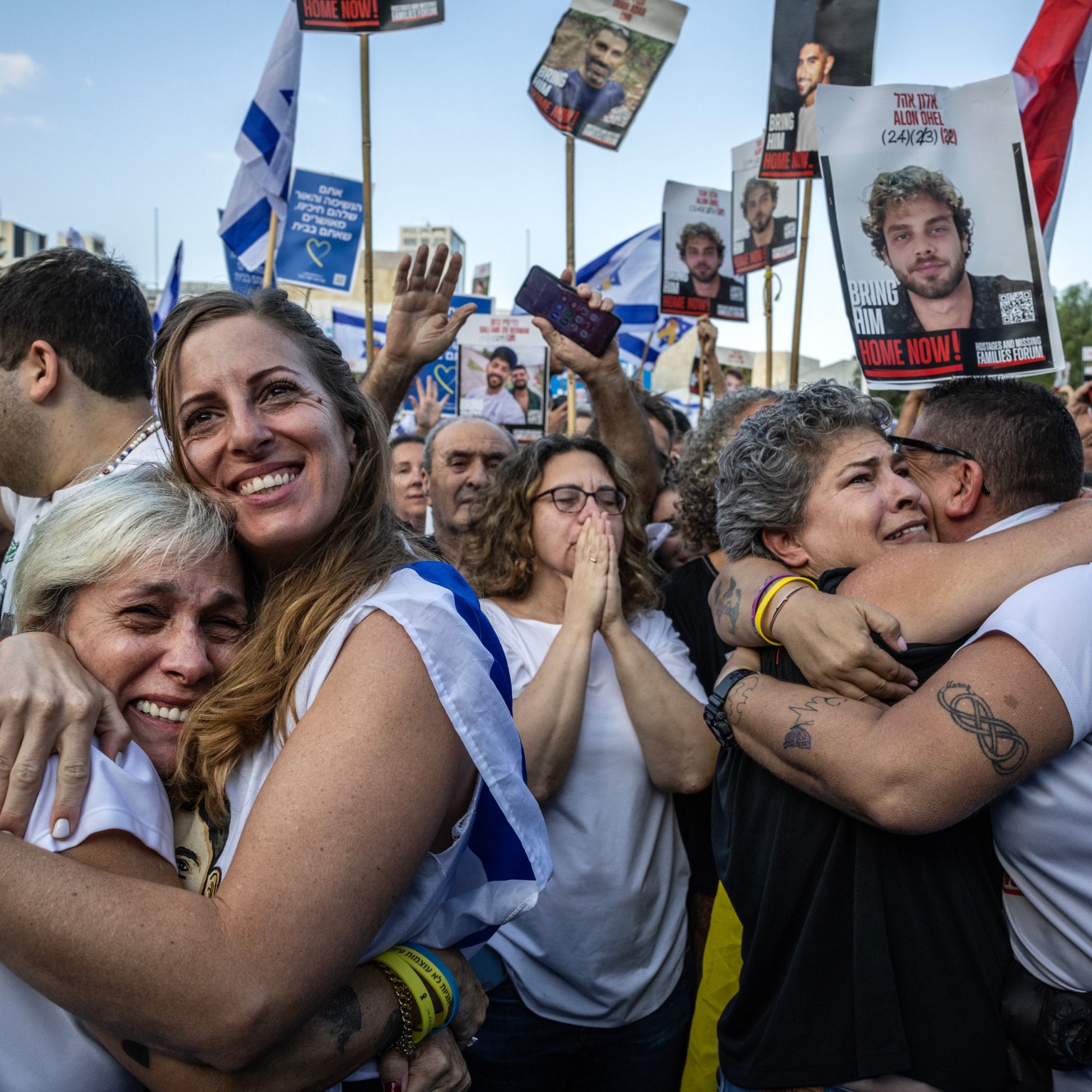
The Daily
Two Years Later, Israel’s Last Hostages Return
00:30:43
The Israeli military said on Monday that it had received the 20 remaining living hostages released by Hamas under the terms of the cease-fire deal. Rachel Abrams speaks to families of those hostages, and to other Israelis, about the long-anticipated moment, and Isabel Kershner, a Times reporter who covers Israel and Palestine, discusses why the hostages have been such a crucial factor in efforts to end the war.
Loading summary
Transcript85 lines
- [00:00]
Podcast Advertiser
This message comes from Capital One Commercial Bank. Your business requires commercial banking solutions that prioritize your long term success with Capital One. Get a full suite of financial products and services tailored to meet your needs today and goals for tomorrow. Learn more@capitalone.com Commercial Member FDIC.
- [00:24]
Rachel Abrams
From the New York Times, I'm Rachel Abrams and this is the Daily Hamas is expected to release the remaining hostages by Monday.
- [00:33]
Isabel Kershner
Israel will also free hundreds of Palestinian prisoners and detainees.
- [00:44]
Rachel Abrams
Over the past few days, the world has seen dramatic scenes unfold from Israel and Gaza. In Gaza, thousands of Palestinians are returning to their homes and their neighborhoods and they're seeing firsthand the devastation that two years of war has brought. As international journalists continue to wait for access to the Strip. We've also been watching Israel as the country prepares for the return of the remaining hostages taken in the October 7th attack. Today I talk with families of hostages and other Israelis in what's become known as Hostage Square in Tel Aviv about this long anticipated moment. And also with my colleague Isabel Kershner about why the hostages have been so pivotal in the efforts to end the war. It's Monday, October 13th. Ladies and gentlemen, we welcome you to Ben Guria International Airport here in Tel Aviv. And our arrival time is approximately 9. As the ceasefire took effect in Gaza, I flew to Israel with Daily producer Claire Tenisketter to ask people how they're feeling and what they're thinking. So we just got off the plane. We haven't even been walking maybe five minutes. And all along this very brightly lit hallway are pictures of the hostages. And within minutes of arriving, we started seeing reminder after reminder of the remaining hostages in Gaza. It lists the ages of the hostages on some of these posters and some of them are crossed out with new ages as they've, I guess, gotten older. This guy, 34 crossed out, 35 crossed out. Now it says 36. So as soon as we dropped off our luggage, we went straight to what's become the epicenter of the push to return the hostages to Israel, a place known as Hostage Square. It's a concrete public plaza between an art museum and a public library. And it's across the street from the Israeli military's headquarters. And in the weeks and months following October 7th, this place developed into a sort of living interactive memorial to the hostages that were taken on that day.
- [03:28]
Kormit Palti Katsir
What's going on over in this? So this is actually like a little synagogue itself.
- [03:31]
Rachel Abrams
There are big white canvas tents. Some of them are for shade, some of them are sort of information booths.
- [03:37]
Kormit Palti Katsir
The tent of prayer and Good deeds.
- [03:40]
Rachel Abrams
T shirts, hats, flags. And there are little pop up stores selling T shirts and books and pins, the yellow ribbons. But the whole space has become a kind of remembrance area. Can you tell us what you're doing?
- [03:53]
Isabel Kershner
I write a message for the. For the hostages.
- [03:59]
Rachel Abrams
Every square inch of this place seems like it has a photo of a hostage or a message for them or some kind of memento. And there are other things that feel very specific to this place and to this war. There's a piano that anybody can come up and play because one hostage loved to play the piano. Can you describe what we're looking at? It's the remaking of the tunnel. And there's even kind of an interactive, artistic replica of a Hamas tunnel where the hostages are believed to be held. I remember the tunnel from the last time I was in Israel over the summer when it felt so different. There was no hostage deal in sight. The mood was somber and despondent, angry. But now coming back, we're very, very, very happy.
- [04:49]
Moshe Lavi
This war is coming to an end.
- [04:50]
Rachel Abrams
And the mood was optimistic and people were excited.
- [04:54]
Moshe Lavi
We're so happy.
- [04:56]
Ruby Chen
So we celebrate.
- [04:57]
Rachel Abrams
So we are offering a free cake for everyone. Free cake?
- [05:00]
Podcast Advertiser
Yeah.
- [05:02]
Rachel Abrams
The other remarkable difference we really have to thank America for the deal, especially Donald Trump, was that there were outpourings of gratitude for President Trump and his role in brokering the hostage deal. Can you tell me what your sign says?
- [05:14]
Isabel Kershner
Thank you, President Trump, because we want him to know that we are thanking him from the bottom of our hearts.
- [05:21]
Rachel Abrams
Thank you. The square is where the families of the hostages have come since the beginning of the war, demanding that the military and the government bring their loved ones home. And it's also where thousands of supporters, protesters, have come to weekly rallies to show solidarity and support for those families. And so after we spent some time taking in the scene, we asked a few family members to talk to us about how they were feeling just hours before the final hostages were supposed to come home. Tell us who you are and why you're here today.
- [05:53]
Moshe Lavi
I'm the brother in law of Henri Mirand, held hostage for two years now.
- [05:59]
Rachel Abrams
We met Moshe Lavi in the lobby of the library along the square where families of hostages sometimes go to get away from the crowds. Moshe was wearing a T shirt with a picture of his brother in law, Omri, holding up one of his two young daughters in the air.
- [06:13]
Moshe Lavi
Omri has two young daughters. They were held captive themselves on that day with my sister, luckily rescued and hoping that this will end. I just arrived yesterday with my sister, Lishai from D.C. that's where we got the good news and we rushed back here. I'm very excited to finally conclude this chapter.
- [06:37]
Rachel Abrams
When you think of Omri, do you have an image that comes to mind?
- [06:41]
Moshe Lavi
Omri, for me, is always going to be the smiling man who made my sister happy after difficult years. It's the love of her life. That's what I have in my mind. The smiling face, the bashful eyes. And the heart is this big heart that entered our family.
- [07:02]
Rachel Abrams
If you had to guess, what do you think Omri's. The first thing Omri will want to do is when he gets home.
- [07:08]
Moshe Lavi
No, I don't want to suppose what he wants to do. He didn't have a choice for two years. And ever since we received the news, our focus is now on preparations from small things like preparing a bag to a bag for Muy. Because when he arrives, he would want to see. Wants to wear something that is not what terrorists forced him to wear.
- [07:41]
Rachel Abrams
Have you thought about the first thing you want to say to him?
- [07:46]
Moshe Lavi
Just a hug.
- [07:51]
Kormit Palti Katsir
Yeah.
- [07:54]
Moshe Lavi
And. And primarily I just want to see my sister and nieces. Hagem I'm. I'm not important for that. I hope they'll have that moment, and I hope it will be the most beautiful moment in their life.
- [08:16]
Rachel Abrams
Family members like Moshe are in so many different situations. Some of them are waiting for hostages they know are alive. For others they don't know. They're uncertain. And it's unclear how much hope they should have. But still they hope to be on the cusp of some kind of ending. Thank you so much for what you've done for us. Difficult day Another person we met at Hostage Square who had a family member go missing during the war was Ruby Chen.
- [08:47]
Ruby Chen
I'm a New Yorker, grew up in Flatbush, and I met my wife in Israel, and we decided to have a home here.
- [08:56]
Rachel Abrams
Ruby and his wife raised their three kids in Israel, but would frequently travel.
- [09:00]
Ruby Chen
To the U.S. my eldest inherited my love for the New York Knicks, and it'sai as being the middle son, the more rebellious one. He decided to be a Celtics fan, for the love of God. I don't know how that happened, but I feel that I failed as a father.
- [09:17]
Rachel Abrams
And when the war broke out, one of his sons, Itay, the one with the rebellious streak, was performing his mandatory military service.
- [09:24]
Ruby Chen
And he, unlike his elder sibling that went to a technology unit, he of course, decided to do something totally different. And he wanted to go into combat. And he joined the tanks division. And he, on that fatal October 7th was on the board of Gaza at a base called Nahal Oz, which is kind of in the middle of the Gaza strip. And they were ambushed. They got hit by a few anti tank missiles and the tank was neutralized. And we were totally in the dark. Monday we went to the missing people command center that was put together by the police and they said, well, he's missing in action, meaning no one is able to identify him physically standing next to him. He wasn't in one of the hospitals. And a few days after we got notified that he is indeed a hostage in Gaza. And we're sitting there and okay, do you have anything else to tell us? Where is he now? Oh, we don't know. Okay, then we'll do.
- [10:36]
Rachel Abrams
So they waited, hoping for a positive sign, desperate for information on how their son was doing.
- [10:42]
Ruby Chen
In March 24, we got another knock on the door.
- [10:47]
Rachel Abrams
Then a few months later, Ruby got.
- [10:49]
Ruby Chen
A very different message when the IDF concluded based on intelligence that he most likely did not survive on October 7th. And we asked, okay, where's the physical evidence? He says, oh, we don't have that. So we understand. We looked at the, I looked at the intelligence, I understand that most likely thay is not one of the 20, but he is no less of a hostage. You know, there's the missing holidays, you know, Thanksgiving to Hanukkah to, you know, Easter. And just, you know, think of a family dinner, holiday dinner with a chair that is empty. Going back to the Celtics, you know, now is the beginning of basketball season. We will be sitting on the couch, you know, thinking about and jabbing one another. Who has a better chance of winning the division title? And we will play NBA 2K and you will play with the Celtics and play with the Knicks. He would of course beat me because he's much better at 2k than I am and he's missing. It is just as important to us to get itai back and then we'll deal with the two options that we have. Either being able to hug him or it means that one chapter ended and we need to start another chapter of our family, but we need to have that ending of this chapter.
- [12:21]
Rachel Abrams
Thank you so much. Some of the family members of the square have the answers that people like Ruby are dreading. They know that their relatives are dead, but they come here for different reasons. They come to support other people. They come out of a sense of solidarity. They come because they understand what it means to wait for these kinds of answers and to finally get them. Can you tell me to start just who you are and why you're here tonight.
- [12:57]
Kormit Palti Katsir
Okay? So my name is Kormit Palti Katsir. I'm the daughter of Rami Katsir who was murdered on October 7th in Kibbutz Niroz. My mother, Chana Katzir, was abducted from Kibbutz Niroz and my brother El Ad was also kidnapped from Kibbutz Niroz. My mom returned after 49 days in captivity in Gaza, and my brother Elad was murdered in captivity and his body was retrieved to Israel in April 2024. When my mother came back, I remember when she was brought on a gurney and she looked up and she saw me and she saw my sister. And then I could see that she's looking about the missing faces. She couldn't see my father and she couldn't see my brother. And she asked me, where are they? And I have to tell her, like on the first five minutes she's with us, that my father, her husband, was shot to death and that my brother. For me, it was good news. I told her mom, but, you know, the good news is that he's kidnapped and he's alive. And it's crazy that even considered to be a good news, but for us, it was a good news. I remember when they told us that he's dead. So my mom, she was in the hospital at the time, and she told the officer that she wants her son, my brother, to be brought to her so she can kiss him goodbye. And then the officer was shocked and he told her, like, we can't bring him over. You can't kiss him goodbye because his body wasn't in a state that she could have done that. And it's awful because the sense of closure, it's not full because we don't get to have these normal phases of grief and. And goodbye.
- [14:56]
Rachel Abrams
Meanwhile, Carmeet's mom was struggling more and more with her health. Suffering from ailments related to her captivity, she steadily declined and passed away last year.
- [15:06]
Kormit Palti Katsir
It's a huge difference between what I've been through with my father or my brother or with her, because with her, we have the opportunity and the privilege to say goodbye, to say how much we love her, to hold her hands, for her, not to feel alone for a second. And we didn't have that with my brother, and we didn't have that with my father. And this make this feeling of closure very different.
- [15:33]
Rachel Abrams
The people here, the families. There are so many families who are anticipating having their loved ones returned. What does that feel like as somebody that also was in that position.
- [15:46]
Kormit Palti Katsir
I'm struggling all the time. For 736 days. Today, I'm fighting for the release of all hostages. This is my main goal in life. And of course I'm so thrilled that it's finally happening. But of course, emotionally it's so complicated because tomorrow people are going to hug their loved ones and I'm not going to have this hug forever.
- [16:13]
Rachel Abrams
How do you think the country has changed and how much of that change is permanent and how much will go away when the war is over?
- [16:21]
Kormit Palti Katsir
I feel that this war has been too much and too long and too devastating both for Israelis and for Palestinians, for Gazan people. I feel like the loss and the ruins both in Israel and in Gaza, it will take years and decades to rebuild something new. I'm not talking about the, you know, the house or the homes or the neighborhoods. I'm talking about the possibility of living one next to each other. And I feel like there is a crisis of trust or of confidence between the Israeli people and its leadership. So I feel that in the end of the war, none of us is feeling more safe. And it's sad to say.
- [17:30]
Rachel Abrams
Coming up next, I speak with my colleague Isabel Kirschner on what the return of the hostages means more broadly for Israeli society and for the end of the war. We'll be right back.
- [17:43]
Podcast Advertiser
This episode is supported by Choiceology, an original podcast from Charles Schwab hosted by Katie Milkman, an award winning behavioral scientist and author of the best selling book how to Change. Choiceology is a show about the psychology and economics behind our decisions. Hear true stories from Nobel laureates, historians, authors, athletes and everyday people about why we do the things we do. Listen to choiceology@schwab.com podcast or wherever you listen.
- [18:11]
Chevron Advertiser
This is an advertisement for Chevron. Chevron's strategy is to leverage its strengths, including human ingenuity, to safely deliver affordable, reliable and ever cleaner energy to a growing world. Meet Scott, an engineer from California who's applying his problem solving solving skills to technologies that can reduce greenhouse gas emissions.
- [18:29]
Ruby Chen
I'm proud that my kids may someday.
- [18:32]
Rachel Abrams
Drive a car powered by hydrogen.
- [18:34]
Ruby Chen
I'm helping build one of the first facilities designed to produce hydrogen using solar power.
- [18:39]
Chevron Advertiser
To learn how human ingenuity is helping power the world, visit chevron.com over the.
- [18:45]
Podcast Advertiser
Last two decades, the world has witnessed incredible progress. From dial up modems to 5G connectivity, from massive PC towers to AI enabled microchips. Innovators are rethinking possibilities every day. Through it all, Invesco QQQ ETF has provided investors access to the world of innovation with a single investment. Invesco QQQ let's rethink possibility. There are risks when investing in ETFs, including possible loss of money. ETFs risks are similar to those of stocks. Investments in the tech sector are subject to greater risk and more volatility than more diversified investments. Before investing, carefully reading, consider fund investment objectives, risks, charges, expenses, and more in perspectives@invesco.com Invesco Distributors Incorporated Isabel, thanks so.
- [19:20]
Rachel Abrams
Much for talking to us. We are speaking at this moment when there are enormous scenes unfolding, not just where you and I are in Israel, but also in Gaza, where hundreds of thousands of people are going back to their homes and their neighborhoods, which have been largely destroyed, to try to figure out how to start rebuilding their lives. And international journalists are still waiting for access to Gaza. We're not allowed in there and in the meantime I wanted to come to Israel where there was this seismic event happening, which is the return of the hostages. So just to start, can you remind us who are the hostages as a whole?
- [20:04]
Isabel Kershner
Sure, Rachel. So the hostages were taken captive during the Hamas led attack on Israel on October 7, 2023, and at the time, about 250 people were taken captive and taken back to Gaza. They included many civilians, women, children, grandparents, and some soldiers. In the intervening two years of war, we've had in the past two brief temporary ceasefires where some hostages were exchanged for some Palestinian prisoners from Israeli jails and the women and children, for the most part were returned. Some of the younger men who were considered to be in the most vulnerable states physically were returned. And what we're expecting is early Monday morning for the 20 live hostages to all be returned more or less at the same time. They're mainly men, mostly young men, mostly civilians, and some a small number of soldiers. And then the remains of 26 more people who were either killed or died in captivity. Some are supposed to also be returned later in the day on Monday, but the authorities have been saying that it will be much harder to locate all the remains. Some might be buried in places that very few people know where they are. And so it could take much longer to return all of them.
- [21:52]
Rachel Abrams
Can you remind us, Isabelle, how these hostage returns have worked in the past, just mechanically? And what is different about this time?
- [22:03]
Isabel Kershner
Of course. So in the past, what we've seen largely are these ceremonies where Hamas militants would kind of in a show of force, build a stage and bring out some of the hostages in small groups, surrounded by masked gunmen, sometimes be made to wave to the crowd or to give little speeches. This time around, we understand that Hamas is supposed to not be holding these ceremonies, so we might not see very much at the beginning, but the idea is they will be handed over to representatives of the Red Cross in Gaza. They will then be transported and handed over to Israeli military and will be brought over the border into an Israeli military base called Reim, which is in southern Israel. And that's where they usually get their initial checks to see what their condition is and are reunited with close family members. And, you know, you ask what's different this time? So much is different this time. I mean, for one thing, these hostages have been in captivity for two years, so nobody really knows what their condition is. We've seen some hostage videos released by Hamas over the months where some have appeared extremely emaciated and skeletal and very, very distressed. And it's very unclear what the condition will be of those coming out alive. And for the Palestinians too, the Israelis are releasing more than 200 Palestinian prisoners who were convicted of life terms for serious deadly attacks against Israelis, plus almost 2000, about 1700 plus detainees from Gaza who were detained by Israeli forces during the war and brought to Israel. So it's a very large landmark occasion on all sides.
- [24:17]
Rachel Abrams
One of our producers, Clare Tennisketter and I spent last night, Saturday night at Hostage Square, where there have been weekly rallies in support of bringing the hostages home since the beginning of the war. And last night was one of, if not the biggest crowd that has ever been there, according to a bunch of different reports. And can you talk about the significance of the hostages to the war and to Israeli society and how that's changed since the start of all of this?
- [24:48]
Isabel Kershner
Well, there's an ethos in Israel that's largely been nurtured through the Israeli military, which is a conscription army. So, you know, most people in Israel, their children or their siblings, somebody they know, their neighbors, will be serving or will have been serving in the military. And the ethos, because it's a so called people's army particularly, has been that you never leave soldiers behind in the field. And there's been a feeling that's grown over the two years as these captives have languished longer and longer, that the Israeli government had essentially abandoned these people and left them in the field. So the square has become a kind of fulcrum of anger and frustration as successive rounds of hostage talks collapsed and ceasefires collapsed. And this war seemed to be turning into a forever war. And now, of course, you experienced a complete Flip and switch in the atmosphere to actually seeing some light at the end of this and seeing the hostages about to come back and seeing this war end, which a majority of Israelis has been calling for. I mean, in every single opinion poll for months and months and months, you've had a majority cutting across political lines saying that they favored prioritizing a hostage deal and a return of the hostages over continuing the war.
- [26:29]
Rachel Abrams
I was really struck by how many people were carrying signs saying, thank you, Mr. President, with pictures of President Trump on them. There was one guy actually dressed as President Trump holding a sign that said Nobel Peace Prize, like, indicating he should get it, which obviously a lot of people have talked about how he wants to get the Nobel Peace Prize. And in the speeches that we heard, particularly in Steve Witkoff speech, that's the Middle east envoy for the Trump administration. Every time Witkoff mentioned Trump, the crowd would go nuts and cheer and clap. And every time Witkoff mentioned Prime Minister Benjamin Netanyahu, people would boo. And I wonder what you make of that.
- [27:09]
Isabel Kershner
Yeah, that was quite stunning to see, actually, Rachel. I mean, the cheer that went up as Witkoff and Jared Kushner and Ivanka Trump walked through the crowd and took the podium and the electrifying atmosphere and, yes, this massive gratitude and appreciation of the Trump administration's role and President Trump personally in getting this done. And then, as you mentioned, this extended, prolonged booing that accompanied every time Wyckoff mentioned Netanyahu's name. There's a lot of anger still against the government for Netanyahu's refusal to take responsibility personally for, you know, the failures, the intelligence failures, the policy failures that occurred on his watch. And, you know, I think that's what you were seeing last night in the square. And there was immediately afterwards a lot of discussion on the panel shows on TV about, you know, whether it was appropriate or not. But it was just a very genuine, authentic, spontaneous response. And nobody had planned it or rehearsed it. And I think it was just, you know, very reflective of how people have felt here.
- [28:32]
Rachel Abrams
What are we watching for now? What are people expecting to happen next?
- [28:37]
Isabel Kershner
Yeah, that's the golden question. Nobody really knows this deal. It was very vague other than the first phase of it, which is the hostage for Palestinian prisoner exchange and an increase in aid going into the Gaza Strip, as well as an Israeli pullback. There's already been an initial pullback of forces to defense line within the Gaza Strip. Beyond that, there are a lot of open questions which do raise concerns about the fragility of such a deal. And I think that's why we're also seeing on Monday, after President Trump makes this sort of lightning four hour visit to Israel. He's then going on to Sharm El Sheikh in Egypt for what he's calling a peace summit led by himself and the President of Egypt, where they've invited world leaders and the Arab partners to sort of buttress and support this deal. And I think the idea is just to create as strong a coalition as possible and as broad as possible of countries who are just going to try and make sure that this holds.
- [30:01]
Rachel Abrams
I mean, whatever happens next, clearly people in Israel at least are celebrating the end of the war. It feels to them like we have reached the end of the war with this first phase. Does that seem fair to you?
- [30:13]
Isabel Kershner
Yes. I think Israelis, for the large part, are relieved. After two years, there's little appetite in Israel to continue fighting. It's a very Sisyphean task, really. You're in an insurgency situation and it just seemed to be a kind of stalemate. But does it mean peace? Does it mean the Israeli Palestinian conflict has been resolved? Absolutely not. I mean, the fundamental issues remain, but it certainly brings this two year chapter to some kind of close, however unclear the future looks.
- [31:01]
Rachel Abrams
Isabel, thank you so much.
- [31:03]
Isabel Kershner
Thank you.
- [31:15]
Rachel Abrams
Early Friday morning, thousands of people had already gathered in Hostage Square.
- [31:20]
Isabel Kershner
So happy right now. I stayed awake all night just to see it. Everything. It's amazing. Not everybody's coming back.
- [31:28]
Rachel Abrams
And news broke that the first group of hostages had returned to Israel, starting an exchange for Palestinian prisoners and detainees that was expected to begin later in the day.
- [31:37]
Kormit Palti Katsir
It's a great feeling, great feeling. We waited so long for this. It's wonderful. And thanks to Trump, the crowd packed.
- [31:47]
Rachel Abrams
The square waiting for updates on the remaining hostages who were expected to return home to a changed country.
- [31:54]
Moshe Lavi
My emotions are very mixed. We're happy, but we are also concerned, sad. We have now to start to work on other things and the story is not over.
- [32:13]
Rachel Abrams
We'll be right back.
- [32:15]
Podcast Advertiser
This episode is supported by Choiceology, an original podcast from Charles Schwab, hosted by Katie Milkman, an award winning behavioral scientist and author of the best selling book how to Change. Choiceology is a show about the psychology and economics behind our decisions. Hear true stories from Nobel laureates, historians, authors, athletes and everyday people about why we do the things we do. Listen to choiceology@schwab.com podcast or wherever you listen.
- [32:42]
Chevron Advertiser
This is an advertisement for Chevron. Chevron's leveraging its strengths, including human ingenuity, to safely deliver affordable, reliable and ever cleaner energy to a growing world. Meet Zoe, a computational geophysicist working to reduce transportation emissions intensity.
- [32:57]
Rachel Abrams
I wanted to use my skills to.
- [33:00]
Isabel Kershner
Solve real world problems.
- [33:02]
Chevron Advertiser
Zoe uses data to map out where Chevron's compressed natural gas stations incorporating renewable fuel should go because data driven decisions can help scale the use of lower carbon intensity fuels. To learn how human ingenuity is helping power the world, visit chevron.com over the.
- [33:17]
Podcast Advertiser
Last two decades, the world has witnessed incredible progress from dial up modems to 5G connectivity, from massive PC towers to AI enabled microchips, innovators are rethinking possibilities every day. Through it all, Invesco QQQ ETF has provided investors access to the world of innovation with a single investment. Invesco QQQ let's rethink possibility. There are risks when investing in ETFs, including possible loss of money. ETFs risks are similar to those of stocks. Investments in the tech sector are subject to greater risk and more volatility than more diversified investments. Before investing, carefully reading, consider fund investment objectives, risks, charges, expenses and more in perspective@invesco.com Invesco Distributors, Inc.
- [33:53]
Rachel Abrams
Here's what else you need to know today. Over the weekend, President Trump said that he would pay members of the military during the government shutdown, tapping into about $8 billion of Pentagon funds. It would cover the next pay period for more than a million active duty service members, but it's not clear how long the administration could pay troops if Congress and the White House can't reach a spending deal. Meanwhile, the Smithsonian Institution said on Sunday that the shutdown has forced it to close its 21 museums and the National Zoo. Today's episode was produced by Claire Tennisgetter, Rob Zipko and Michael Simon Johnson. It was edited by Patricia Willins and Ben Calhoun and was engineered by Alyssa Moxley. That's it for the Daily I'm Rachel Abrams. See you tomorrow.
- [35:09]
Podcast Advertiser
This episode is supported by Choiceology, an original podcast from Charles Schwab, hosted by Katie Milkman, an award winning behavioral scientist and author of the best selling book how to Change. Choiceology is a show about the psychology and economics behind our decisions. Hear true stories from Nobel laureates, historians, authors, athletes and everyday people about why we do the things we do. Listen to Choiceology at schwab. Com podcast or wherever you listen.