← The Daily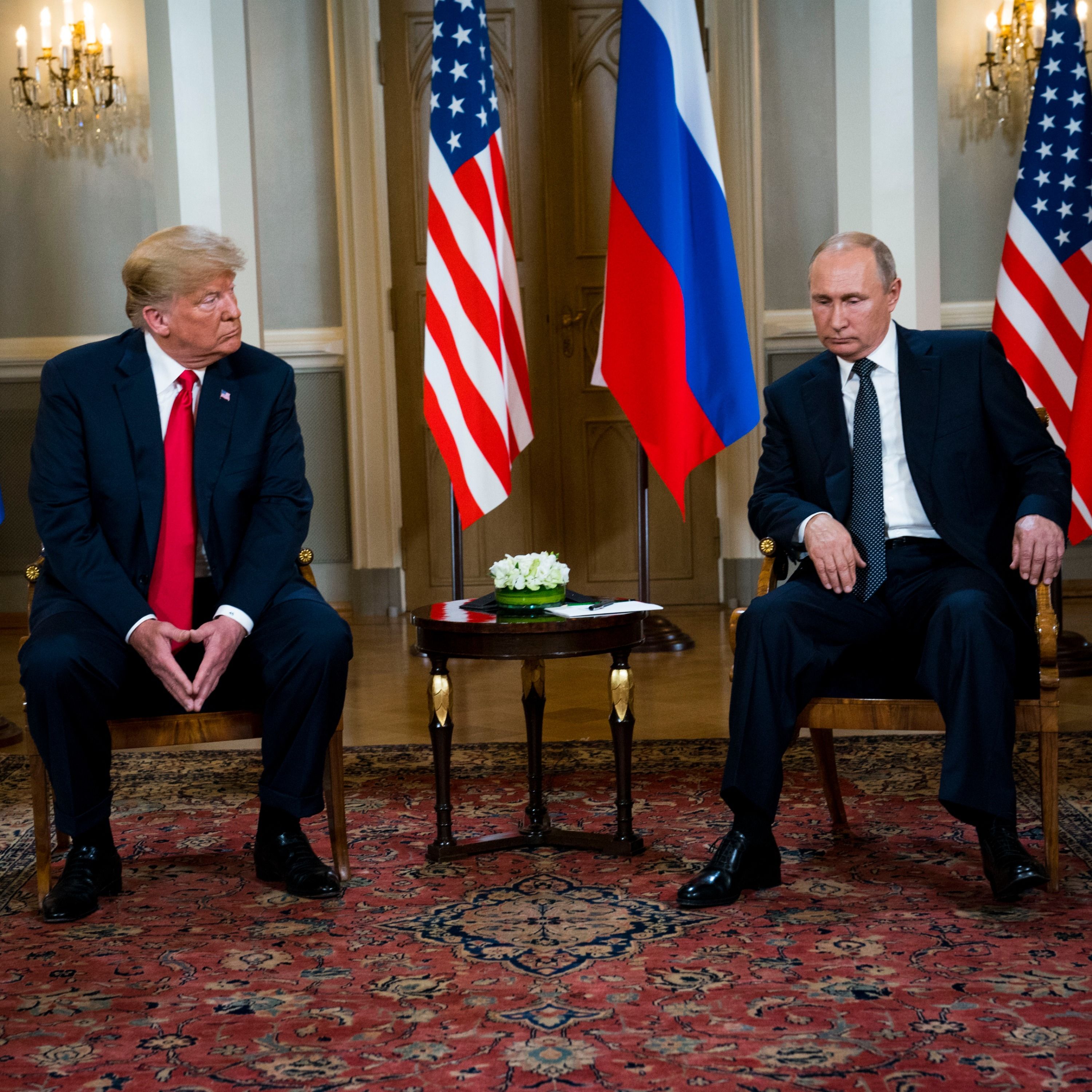
The Daily
What Hangs in the Balance of Trump's Meeting With Putin
00:27:03
Today, President Trump and the Russian president, Vladimir V. Putin, are meeting on U.S. soil for the first time, to discuss an end to the war in Ukraine. David E. Sanger, the White House and national security correspondent for The New York Times, discusses the wide range of possible outcomes and why, no matter what happens, the meeting is a win for Mr. Putin.
Loading summary
Transcript84 lines
- [00:00]
Advertiser
Brought to you by the Capital One Venture X card. If you love to travel, Capital One has a rewards credit card that's perfect for you. With Venture X, earn unlimited double miles on everything you buy and turn all of your purchases into extraordinary travel. And you get premium benefits at a collection of luxury hotels when you book through Capital One Travel. Plus, you'll get access to over 1,000 airport lounges worldwide. Capital One what's in your wallet? Terms apply seecapitalone.com for details from the.
- [00:31]
Rachel Abrams
New York Times, I'm Rachel Abrams, and this is the Daily Today, President Trump and Russian President Vladimir Putin are meeting on US Soil for the first time in Anchorage, Alaska. They'll be discussing an end to the war in Ukraine. And I spoke to my colleague David Sanger about the wide range of possible outcomes and why, no matter what happens, the meeting is a win for Putin. It's Friday, August 15th. David, thank you for joining us from Alaska. Are you gonna get any fishing done while you're there?
- [01:26]
David Sanger
Oh, I'd love to, Rachel, but I have to confess that at breakfast this morning at our hotel here, I was sitting next to this guy who, you know, looked like Mr. Alaska, and he had all his gear, and we were talking about the returning salmon that are moving up the rivers. And at the end of it, he said, so where are you fishing the next few days? And I had to admit I was here to cover the Trump Putin summit meeting, and he looked at me like I was the world's greatest loser.
- [01:55]
Rachel Abrams
So basically, what you're saying is no fishing while you're in Alaska.
- [01:57]
David Sanger
No fishing. Yeah, yeah, yeah.
- [01:59]
Rachel Abrams
Besides being filled with bearded fishermen, what is the atmosphere like right now in Alaska ahead of this meeting?
- [02:08]
David Sanger
Anchorage in August is always jammed, right? No hotels in the best of times. And in the midst of this, they drop the first summit in four years between a president of the United States and the president of Russia, and they couldn't even find a resort to hold it at. So it's going to be held at the Elmendorf Air Base, which is where Air Force One and other government planes all get refueled on their way to and from Asia.
- [02:40]
Rachel Abrams
What exactly is on the table here? What are the stakes of this meeting?
- [02:44]
David Sanger
This is the first time that an American president and a Russian president have sat down face to face to talk about how one might end the war in Ukraine. And you have to give some credit to President Trump for trying to get a negotiation going that would end this horror. That said, no one really knows how this is going to turn out when the two sit down, it could end up being basically nothing that the president is here to, as he put it the other day, hear Putin out and understand what his grievances are. Or this could be Yalta, the 1945 conference after World War II where Churchill and Stalin and FDR divided up Europe. Many people regard Yalta now as the symbol of the great powers ignoring the interests and needs of the people in smaller states and basically carving up the world. And if they start discussing how to slice up Ukraine and pressure Europe, and particularly Ukraine, to take that deal, this could be a huge turning point.
- [04:02]
Rachel Abrams
Before we get into all the details of this, what's likely to happen after this meeting? Specifically, I want to address something that feels like kind of a glaring eye oddity, which is that this is obviously a meeting about ending a war between two countries, Russia and Ukraine, and nobody from Ukraine is actually in this negotiating room.
- [04:21]
David Sanger
It is a huge oddity. Now, President Trump has calculated, maybe correctly, that if you just put Zelensky and Putin in a room together, even with the president there, and you don't have a structure for the conversation and you don't have some outlines of what the deal is going to look like, it's going to des into a shouting match or worse.
- [04:44]
Rachel Abrams
David, how did this meeting actually come about? And can you remind us a little bit about the relationship between these two men?
- [04:51]
David Sanger
Well, Rachel, remember that this was the war that President Trump promised as a candidate to end in 24 hours.
- [04:59]
Rachel Abrams
That's right.
- [05:00]
David Sanger
On the basis of his relationship, what he viewed as his long and respectful relationship with Putin. And the essence of that argument was he. He'll listen to me in a way that he would never listen to Joe Biden or to Kamala Harris. But once he got into office, the first thing that he did was make a series of unilateral concessions to Putin that I think were intended to sort of indicate he was willing to give him a good deal.
- [05:32]
Rachel Abrams
He started out playing nice. Basically.
- [05:35]
David Sanger
He did. Well, good afternoon, friends. This is my first Ukraine defense contact group, and I appreciate the opportunity to share President Trump's approach to the war in Ukraine. First, he sent his Secretary of Defense, Pete Hegseth, out to Europe in February. The United States does not believe that NATO membership for Ukraine is a realistic outcome of a negotiated settlement. And he declared that Ukraine would never become part of NATO in, you know, for years to come, something the US had long promised. Rose Garden. Let's get reaction to the president's tariff plan.
- [06:17]
Scott Bessen
Treasury Secretary Scott Bessen joins us now.
- [06:19]
David Sanger
Thank you. For being here. Good to see you.
- [06:21]
Scott Bessen
It was a big day, the President calls it.
- [06:22]
David Sanger
And then he put very low tariffs on Russian goods, lower than he put on almost all American allies. Look, there are policy decisions here, but also there's a calculus here. And he did not go to Congress looking for more arms.
- [06:38]
Scott Bessen
We are going to be sending them weapons and they're going to be paying for them. We, the United States, will not be having any payment made.
- [06:47]
David Sanger
And in fact, his whole strategy has been only arm Ukraine with arms that Europe buys on Ukraine's behalf.
- [06:54]
Advertiser
Right.
- [06:55]
David Sanger
So he has gone out of his way. And what he got in response to that, Rachel, was almost nothing. And that's what led him to declare with significant anger about a month ago, that he had these nice conversations with Putin. And he got, he said only bullshit in return. That was his phrase. But after turning against Putin, he suddenly announced that there would be this face to face meeting. But we don't know whether or not the two men actually regard this as a moment to negotiate or a moment to feel out what are the bottom lines for each side.
- [07:39]
Rachel Abrams
It feels like these two men have done enough talking and have known each other for so long that part of me thinks like, sure, the war has progressed, but don't they kind of know where each other stands by now? Like, what is their history exactly?
- [07:53]
David Sanger
Well, their history is pretty complicated, but it's always been a fraught relationship. And that goes back in some ways to their first meeting in 2017 in Hamburg on the edges of a larger summit meeting. They met and talked three times. And after that summit ended, the President got on Air Force One and he called me on his cell phone before they took off. Wow. And he said to me, you know, David, President Putin just said the most interesting thing to me. He said that the Russians couldn't have interfered in the 2016 election because they're so good at cyber that they never would have been caught. Don't you agree with that?
- [08:38]
Rachel Abrams
What did you say in response to that?
- [08:40]
David Sanger
What I said in response was, well, you'll have to decide, Mr. President, whether you believe President Putin or whether you believe the intelligence chiefs who came and briefed you about the Russian activity. And of course, what the President said to me over the phone was completely consistent with what he said a few months later in public at that press conference in Helsinki.
- [09:03]
Scott Bessen
I have President Putin. He just said, it's not Russia. I will say this. I don't see any reason why it would be.
- [09:11]
David Sanger
But I really where he basically adopted Vladimir Putin's view of the Russia scandal.
- [09:17]
Scott Bessen
So I have great confidence in my intelligence people. But I will tell you that President Putin was extremely strong and powerful in his denial today. And what he did is.
- [09:30]
David Sanger
And that sort of shocked everybody because it looked like he was buying Putin's line.
- [09:35]
Rachel Abrams
Basically. It sounds like, David, from what you're telling us, that based on the way these two men have interacted in the past and their relationship and the things that Trump has said that seem to mirror Putin's talking points, Trump does not see Putin as an adversary. That much seems obvious. And the fear here from people who have a stake in this war and are not, of course, on Russia's side is that Trump could be susceptible to Putin's propaganda about the war.
- [10:02]
David Sanger
That's exactly what people are worried about, particularly the Europeans and the Ukrainians in this coming session. And that's why so many of them have been warning him, you don't want to emerge from this appearing to be duped by Putin.
- [10:18]
Rachel Abrams
Okay, so obviously, Trump wants a deal. He doesn't want to look like a fool. But what does he want the actual deal to look like? Do we know any details of that?
- [10:27]
David Sanger
He hasn't said very much about that. The only thing he has uttered is the phrase land swaps. And that suggests that what he's interested in is discussing with Putin whether Russia would get land that it has not yet taken militarily, presumably in return for something Ukraine really wants. But the fact of the matter is, we really don't know what he wants, other than the ability to step out and say that he's gotten a great deal or he's on the way to a great deal.
- [11:01]
Rachel Abrams
So, obviously, Putin very much wants land, and I imagine that dangling that in front of Putin as a carrot is an enticing way to get him to the table. So can you talk a little bit more about what else Putin wants out of this meeting?
- [11:16]
David Sanger
Sure. Putin has been pretty clear over the past three years what he wants. He wants to make sure that Ukraine never is invited to join NATO. He wants to make sure that Ukraine's military is constricted in size and the kind of arms they have. Putin also has talked at various moments about trying to push NATO back to the lines it was at in the 1990s before the big expansion of NATO states, that, to Putin's mind, has encircled and encroached on traditional Russian territory.
- [11:55]
Rachel Abrams
It's worth noting, I think, that everything you mentioned, everything that Putin wants, he's wanted since the beginning, like his position on this war and what he wants out of it has been consistent the entire time. Right.
- [12:06]
David Sanger
He has been incredibly consistent about his war objectives. It's the United States, I think, that has been probably the most inconsistent.
- [12:18]
Advertiser
Right.
- [12:19]
Rachel Abrams
I mean, to your point, David, the way you've described it, Trump tried the carrot, then he tried the stick, then he tried the carrot again, which is where we are now, it seems. And so I wonder why Trump thinks a deal is more likely now.
- [12:32]
David Sanger
It's a bit of a mystery, Rachel, because the only thing that's really changed is that Putin's beginning to make some significant progress on the battlefield, and thus he's got less of an incentive to bring about a ceasefire or sign a deal right now. But the President is under considerable pressure here. First he said he would get this solved in 24 hours, then he said he'd get it solved in 100 days. Now we're past 200 days. So President Trump is coming to a sort of put up or shut up point. And it's very possible that Putin is detecting this, wants to diffuse the President's recent anger at Russia and specifically at him, but also wants to play for time.
- [13:21]
Rachel Abrams
So it sounds like there's really no indication that Putin is more willing to give anything up at all. And even if they reach some kind of agreement, it sounds like the question here is whether or not Ukraine will actually accept it. Right. Because they're not in the room when they're being negotiated over. So can you just explain, David, what Ukraine's position is at the current moment as we are heading into the summit?
- [13:46]
David Sanger
So President Zelensky has been very clear that while he is thankful to President Trump for getting this process going, he can't trust President Trump with Ukraine's interests. So what does Ukraine want? Well, first of all, we think the Ukrainians understand they're going to lose some territory in the course of this. But it's important how they lose the territory. In other words, that they feel like they are getting something that Zelensky can sell at home.
- [14:15]
Rachel Abrams
They're exhausted, they're tired. They need some kind of a win brought back to them.
- [14:19]
David Sanger
That's right. And what it really means is Ukraine's future security. The Ukrainian nightmare here is that Putin gets a permanent foothold on what was Ukrainian territory and then at some point, go out and take the rest of the country. So he wants to make sure that Ukraine doesn't give away territory. That essentially sets Russia up to be able to do that. And he wants guarantees that the west will keep arming Ukraine and will keep its promises of helping to defend Ukraine.
- [14:57]
Rachel Abrams
It doesn't sound like Ukraine's position has changed much either based on that description.
- [15:01]
David Sanger
That's exactly right, Rachel. The Russians, the Ukrainians, they're essentially taking the same positions they've taken for these past three years. And that does make you wonder what can really come out of this discussion in Anchorage.
- [15:32]
Advertiser
We'll be right back.
- [15:49]
Chris Hemsworth
Want to LIVE better? Join Chris Hemsworth in National Geographic's new Disney original series, Limitless Live Better. Now. Chris will put his mind and body to the test in three unique challenges over three episodes. Confronting risk by climbing a 500 foot dam wall in Switzerland. Embracing pain while working with the South Korean military and retraining the brain by learning to play the drums with one of the world's biggest pop stars. Limitless Live Better is now streaming on Disney and Hulu.
- [16:17]
Advertiser
Your home is an active investment, not a passive one. And with Rocket Mortgage, you can put your home equity to work right away. When you unlock your home equity, you unlock new doors for your family, renovations, extensions, even buying your next property. Get started today with smarter tools and guidance from real mortgage experts. Find out how@rocketmortgage.com Rocket Mortgage, LLC, licensed in 50 states. Nmlsconsumeraccess.org 3030.
- [16:48]
Rachel Abrams
So, David, this meeting is going to take place soon at this Air Force base, as you mentioned. Can you just describe what's actually going to happen?
- [16:56]
David Sanger
Well, the president's going to land in Air Force One at the base. About a half an hour later, President Putin's supposed to arrive and the president's supposed to go greet him. So there'll be this sort of red carpet moment and then the two are going to sit down. They're going to meet for some number of hours. A little bit unclear. At some point they are supposed to have a joint press conference. Now after the meeting is over, President Trump has told President Zelensky he will call him and give him a summary of what was discussed and then do the same with the European leaders.
- [17:29]
Rachel Abrams
What are the possible deals that could come out of this meeting?
- [17:32]
David Sanger
Well, Rachel, in any negotiation like this, failure is always an option. So it's possible we'd get nothing. I doubt that's gonna happen because it's in President Trump's interest to show that he's gotten a conversation going and it's in President Putin's interest to buy some time. So they're gonna come out with something. The most important first thing to look for would be whether there is any discussion or commitment to a ceasefire. And the Ukrainians and The Europeans have insisted that there must be a ceasefire first before any real negotiation about land or anything else can take place. Want to negotiate while the war is going on, while civilians are being killed and while the lines are changing. But there are various kinds of ceasefires. There's a full ceasefire in which all guns are silent. There has been discussion of an air war ceasefire that would stop the use of drones back and forth, but would continue the ground war. There are ceasefires of various time limits to create time pressure for a negotiated solution. And of course, those negotiations then would have to happen in later sessions, presumably one that would start with President Putin, President Zelensky and President Trump all meeting together. And that's been hinted for coming weeks, but we don't know if that would happen.
- [19:00]
Rachel Abrams
Okay, so basically what you're saying is that if something came out of this meeting, it would be some form of a ceasefire? Most likely. Right. And then only after that is when the real negotiations start over the specific details, the central issues in this war, which are land and security.
- [19:18]
David Sanger
That's right. That's the best you could hope for. And, of course, at this moment, it may not be in Putin's interest to actually have a ceasefire because he's winning.
- [19:27]
Rachel Abrams
I assume, though, that Ukraine cares about what type of ceasefire is agreed to.
- [19:32]
David Sanger
Oh, they care deeply. In a full ceasefire would stop the killing and enable a real negotiation to go on. A ceasefire that only ended the air war would continue the awful trench warfare that's happening inch by inch in the Donbas and that has been so costly on both sides. It would also limit Ukraine's ability to strike deep inside of Russia. What is it that the Ukrainians have done that has most shaken the Russians? It's the ability to send those drones right around the Kremlin into Moscow.
- [20:07]
Rachel Abrams
I remember that.
- [20:08]
David Sanger
It's the ability to strike deep into Russian territory and take out their oil facilities or take out their airfields. And so I think that the kind of ceasefire that might be declared here, if one can be reached, matters greatly to the Ukrainians.
- [20:26]
Rachel Abrams
David, do you think that Putin will agree to a strong ceasefire?
- [20:31]
David Sanger
I think he may agree to a ceasefire, but it may be for the future. And, of course, he's going to try to distract the President from the narrow issues of Ukraine by offering a bigger and broader future for the US Russia relationship.
- [20:49]
Rachel Abrams
What does that look like to him?
- [20:51]
David Sanger
Well, you see it already in the agenda. President Putin is bringing with him a business delegation, which suggests that he's probably going to dangle rare earths or critical minerals or US Investments in Russia, or maybe even Russia investments in the US as the surest way to Donald Trump's heart. But he also hinted on Thursday, before he left Russia, at one other thing, which was a broader nuclear agreement. Remember, we are only seven months away from the expiration of the last big bilateral arms control agreement between the US And Russia. So it is possible that the two presidents could work out an executive agreement to freeze or even lower the number of weapons that they are pointing at each other. And this combination, business deals and some kind of a nuclear accord, are two things that we know Donald Trump is. Is very sensitive to.
- [21:54]
Rachel Abrams
It sounds like Putin is basically playing to Trump's long desire to strengthen the relationship between Russia and the United States. So, basically, like, if Trump thinks he can get something very enticing out of these discussions, he might just give up on Ukraine, is Putin's thinking.
- [22:12]
David Sanger
Or if not give up on Ukraine, then at least soften his position on Ukraine.
- [22:16]
Rachel Abrams
Mm. The idea that the United States and Russia, at least in this meeting, are acting like they are potentially the most important players on the global stage that get to decide the fate of all these other people and places. That reminds me of what you said at the beginning of this conversation, which is that this summit could be sort of similar to Yalta. Is that why you made the comparison?
- [22:39]
David Sanger
It is. And I'm. I'm certain that in Putin's mind and in President Trump's, there's probably a bit of that going on. In this case, the analogy begins to fail because Russia really has been an adversary to the United States, and there's another major superpower out there that really is deciding the fate of nations, along with Russia, the US and others, and that's China, and they're nowhere to be seen here.
- [23:09]
Rachel Abrams
I wonder if you think that this summit will reveal the extent to which Trump actually feels like Russia is an adversary.
- [23:16]
David Sanger
Rachel, we're all going to be looking for that at this press conference, assuming it happens, and we're going to be looking for it in President Trump's future comments about Russia. He's been all over the map in the first six months, and now he's talking about inserting himself into the middle of a negotiation where it's not clear that either side is ready to give.
- [23:42]
Rachel Abrams
From everything you've told us, it doesn't seem like an end to the war is imminent and that in all likelihood, it's going to actually keep grinding on and on and on, which probably only benefits Putin.
- [23:57]
David Sanger
Well, it's certainly true that Donald Trump needs a ceasefire to come out of this conversation. Whereas Putin wins just by showing up, right? I mean, he's been isolated by the international community and Western leaders would not meet with him. And so the very fact that he is showing up on American territory, meeting the President of the United States one on one, doing so in Alaska, a place that used to belong to Russia and therefore is a symbol of the fact that international borders move, those are all wins for Putin, even if there is no agreement.
- [24:38]
Rachel Abrams
Let's just say that Trump comes out of this and he decides, you know what? I'm done with this war. I'm tired of it. I'm throwing up my hands, I'm walking away. Europe would likely step in, presumably, and provide some kind of support to Ukraine. The war would continue going on even if the US Stepped back. So if a deal between the US And Russia is not going to happen, let's just say, how does the war actually end?
- [25:04]
David Sanger
Well, let's think about your scenario for a moment, Rachel, because if the United States stepped back, then Vladimir Putin has won his biggest victory, right? What does he most want to do? Split NATO. And if he could separate NATO's central, most powerful member, the United States of America, from the other 31 members of the alliance, that would be a huge victory for him. And thus, in the view of many, the one thing that Donald Trump's got to most avoid, the other big question is how does the United States view its role as a superpower? Are we here to support nascent, if corrupt and imperfect democracies like Ukraine to protect them from having their countries overrun? At some point, President Trump may well have to make a choice. And that choice is, does he restore America's role for most of the past three years as a steadfast ally of Ukraine? Or does he do what many in his administration argue for, which is essentially try to make peace, but if that doesn't work, wash your hands of it and essentially walk away. And so this is not just a negotiation about the war. It's actually going to be revelatory about how America views itself.
- [26:47]
Rachel Abrams
David, thank you so much.
- [26:49]
David Sanger
Thank you, Rachel.
- [27:00]
Advertiser
We'll be right back.
- [27:05]
Chris Hemsworth
Want to live better? Join Chris Hemsworth in National Geographic's new Disney original series, Limitless. Live better now. Chris will put his mind and body to the test in three unique challenges over three episodes. Confronting risk by climbing a 500 foot dam wal in Switzerland, embracing pain while working with the South Korean military, and retraining the brain by learning to play the drums with one of the world's biggest pop stars Limitless Live Better now is now streaming on Disney and Hulu.
- [27:33]
Advertiser
Your home is an active investment, not a passive one, and with Rocket Mortgage, you can put your home equity to work right away. When you unlock your home equity, you unlock new doors for your family, renovations, extensions, even buying your next property. Get started today with smarter tools and guidance from real mortgage experts. Find out how@rocketmortgage.com Rocket Mortgage LLC, licensed in 50 states nmlsconsumeraccess.org 3030.
- [28:05]
Rachel Abrams
Here'S what else you need to know today. City officials and advocates spent much of Thursday trying to clear homeless encampments, and in Washington, D.C. they urged people to go to shelters ahead of expected federal raids after President Trump ordered a federal takeover of the city's police department and sent hundreds of National Guard troops into the Capitol. And PBS is cutting its budget by more than 20% after Congress's recent decision to eliminate roughly $500 million in federal funding from public radio and TV. The decision, announced in an email to PBS member stations on Wednesday, is one of the biggest consequences to date of the congressional vote which eliminated federal funding and doomed the Corporation for Public Broadcasting. Today's episode was produced by Carlos Prieto, Claire Tenisketter and Mary Wilson. It was edited by Lexi Dio and Paige Cowett, contains original music by Pat McCusker and was engineered by Chris Wood. Our theme music is by Jim Runberg and Ben Landsberg of Wonderly. That's it for the Daily I'm Rachel Abrams. See you on Monday.
- [29:28]
Advertiser
Your home is an active investment, not a passive one, and with Rocket Mortgage, you can put your home equity to work right away. When you unlock your home equity, you unlock new doors for your family, renovations, extensions, even buying your next property. Get started today with smarter tools and guidance from real mortgage experts. Find out how@rocketmortgage.com Rocket Mortgage LLC, licensed in 50 states nmlsconsumeraccess.org 3030.