← The Daily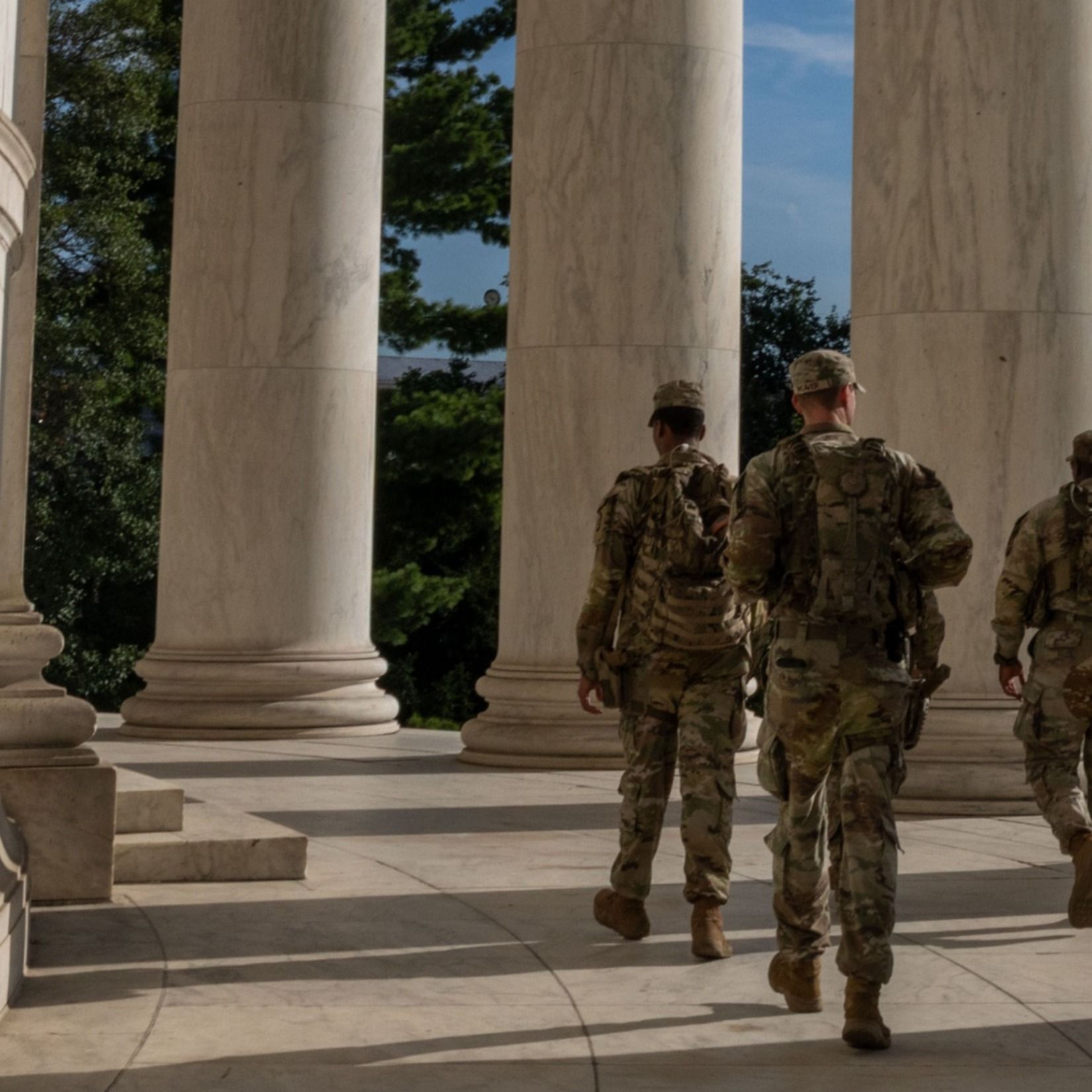
The Daily
When the National Guard Comes to Town
00:36:48
One month after sending the National Guard into Washington, D.C. saying they would fight crime there, President Trump is so pleased with the results that he is discussing how to put federal troops onto the streets of cities across the country — from Chicago to New Orleans. It’s a potentially dramatic expansion of what has already become an unprecedented military deployment on domestic soil. Today, we hear from residents of Washington about what life is like with the National Guard in town.
Loading summary
Transcript197 lines
- [00:00]
Michael Barbaro
This podcast is supported by the International Rescue Committee. When conflict and disaster strike, the IRC is ready to help families immediately after an emergency occurs and long term with health care supplies, clean water and other critical aid. As crises continue in Gaza, Ukraine, Sudan and around the world, the IRC is committed to ensuring families can survive, recover and rebuild their lives. For a limited time, all donations are doubled to help the IRC meet this moment of unprecedented need. The make your matched gift@rescue.org rebuild from the new York Times, I'm Michael Babaro. This is the Daily One month after sending the National Guard into Washington to fight crime there, President Trump is so pleased with the results that that he's now discussing how to put federal troops onto the streets of cities across the country, from Chicago to New Orleans. It's a potentially dramatic expansion of what has already become an unprecedented military deployment on domestic soil. Today, my colleague Jessica Chung speaks with residents of Washington about what it's really like to when the National Guard comes to town. It's Monday, September 8th.
- [01:41]
Resident 1
I'm announcing a historic action to rescue.
- [01:45]
Resident 2
Our nation's capital from crime, bloodshed, bedlam and squalor.
- [01:50]
Jessica Chung
And worse.
- [01:53]
Resident 2
Our capital city has been overtaken by violent gangs and bloodthirsty criminals, roving mobs of wild youth, drugged out maniacs and homeless people.
- [02:03]
Jessica Chung
And we're not going to let it happen anymore.
- [02:05]
Resident 1
We're not going to take it.
- [02:08]
Resident 2
This is Liberation Day in D.C. and.
- [02:11]
Jessica Chung
We'Re going to take our capital back.
- [02:13]
Resident 2
We're taking it back.
- [02:18]
Jessica Chung
A day after President Donald Trump announced he was deploying National Guard troops into Washington, D.C. the first humvees started rolling in. They lined up between the African American History Museum and the Holocaust Museum along the National Mall. About 800 troops eventually came. And they weren't alone. President Trump also called on the dea, Homeland Security and the FBI. My message to residents is this. We know that access to our Democracy is tenuous. D.C. mayor Emil Bowser complied with all of this, saying there wasn't much he could do which makes sense. The city is a federal district where the president controls the National Guard. And while this action today is unsettlingly and unprecedented, I can't say that given.
- [03:08]
Michael Barbaro
Some of the rhetoric of the past.
- [03:10]
Jessica Chung
That were totally surprised, violent crime in Washington is actually falling dramatically. Some people found all this strange crime in D.C. has actually dropped to a 30 year low.
- [03:24]
Michael Barbaro
Let's look at some of this data. In 2023, D.C. had its most murders.
- [03:28]
Resident 2
In more than two decades, 274.
- [03:30]
Michael Barbaro
But it then plunged to 187 murders last year, and it's been falling again so far this year. So there is no crime emergency. So it's hard to say exactly what the purpose is.
- [03:42]
Jessica Chung
You think it's really about crime?
- [03:45]
Michael Barbaro
This is not about crime. This is about control.
- [03:49]
Jessica Chung
So people were resistant.
- [03:51]
Michael Barbaro
This is not about public safety. This is about power.
- [03:56]
Jessica Chung
A Washington Post poll found that eight out of 10 residents were against the federal takeover of law enforcement.
- [04:02]
Michael Barbaro
Whose city?
- [04:03]
Jessica Chung
Our city.
- [04:04]
Michael Barbaro
Whose city?
- [04:05]
Levon Williams
Our city.
- [04:05]
Resident 1
Who city?
- [04:06]
Levon Williams
Our city.
- [04:07]
Michael Barbaro
Whose city?
- [04:08]
Jessica Chung
To Americans who don't live in D.C. you think of the landmarks, the White House, the Monument, the Capitol. But to locals, they think of their city in terms of four. Northeast, Northwest, Southwest, and lastly Southeast, where crime is the highest. So we wanted to talk to people living there to know what they thought about this, how life has changed since the feds came to town. And they told me the streets were quieter, which is quite a change compared to what's normally like, especially in one of the most dangerous neighborhoods in southeast Congress Heights.
- [04:46]
Levon Williams
When you walk into Congress park, the tension is high. Every day, all day, you can feel the tension.
- [04:55]
Resident 1
Shootings all the time. I hear gunshots all day long.
- [04:57]
Levon Williams
There are young guys killing each other.
- [05:00]
Resident 1
Child got killed. She got shot riding a scooter. It's terrible.
- [05:04]
Jessica Chung
We talked to two residents who work in neighborhood safety.
- [05:08]
Resident 1
I'll drive to the doctor's office. And it's a shame that when you get in your car, you can't sit there like you used to because somebody will carjack you. So you just get in your car, lock the door, and pull off.
- [05:20]
Levon Williams
It's a loving community. It's just trauma felt. So in split second, it could go from loving to violence, you know what I mean? In a heartbeat.
- [05:31]
Resident 1
And just taking our lives away from us. It's almost like we're in prison.
- [05:40]
Jessica Chung
Sondra Segers was one of the people we talked to. She grew up in D.C. and lives in Congress Heights.
- [05:46]
Resident 1
Grew up in zip code 20024, which is Ward 6, Southwest.
- [05:50]
Jessica Chung
Sandra is 74 years old. She lives in a small brick house with manicured rose bushes and hydrangeas.
- [05:56]
Resident 1
Look at my block. We keep the grass cut.
- [05:59]
Jessica Chung
She's a community activist. Seven years ago, she founded a local group called Crave Concerned Residents Against Violence. They lobby the city to spend more money on safety and reward. When she hears that crime is at a low point in the city, even in her neighborhood, it doesn't feel that way to her. How do you react to people who say actually crime is down and that people did try to stop the crime, and it was successful.
- [06:25]
Resident 1
I would say they're fools because they don't live where I live. Almost every other night, I can look down the street and see.
- [06:30]
Jessica Chung
She says the crime problem in Congress Heights goes back decades. Her own brother was shot and killed in the 70s. But she says back then, crime was targeted toward people who were involved in it. And for the most part, bystanders were left alone.
- [06:44]
Resident 1
And as time went on, things changed. There was more crime. The stores shut down.
- [06:49]
Jessica Chung
But now, especially since the pandemic, she says, it feels like the violence is more random.
- [06:54]
Resident 1
The criminal's getting younger and younger.
- [06:57]
Jessica Chung
And for Sondra, that means more innocent people and even businesses are caught up in it.
- [07:02]
Resident 1
First there was chicken place.
- [07:04]
Jessica Chung
She points to a nearby storefront that can't seem to stay open to the subway.
- [07:09]
Resident 1
At one point, it was maybe a Mexican cuisine. One of the businesses moved so quickly, the wires were still hanging out the walls. It's like they didn't take time to push the wires in the wall. They just got out.
- [07:19]
Jessica Chung
She says after the murder of George Floyd, the police were too lenient on crime. She was also frustrated with a D.C. law that prevented kids from being charged with adult crimes. She was so fed up that she actually wrote a letter to the mayor and City Council asking for the National Guard to be sent in. And she wasn't alone. The Wards council member, Trayon White did, too, but the response was no.
- [07:44]
Resident 1
The City council couldn't stop it. The police couldn't stop it. The mayor couldn't stop it.
- [07:48]
Jessica Chung
So Sandra, too afraid to go outside, hasn't been to a grocery store in two years.
- [07:55]
Resident 1
I'm announcing a historic action to rescue.
- [07:58]
Resident 2
Our nation's capital from crime, bloodshed, bedlam.
- [08:01]
Jessica Chung
She was listening to the local radio station one late afternoon when she heard the president describe the city as one beset by crime and lawlessness.
- [08:10]
Michael Barbaro
But you want to have safety in the streets.
- [08:11]
Resident 2
You want to be able to leave your apartment.
- [08:14]
Jessica Chung
It resonated with her.
- [08:17]
Resident 1
I did not vote for Donald Trump, did not. And I don't agree with a lot of things he's doing. But when he decided to bring in the National Guard and the federal agencies, I was happy. The first day it was announced that same night. I didn't hear gunshots, no shootings and no stabbing. I saw one car come by and one person walking, and that was it. People calmed down.
- [08:48]
Jessica Chung
She has yet to see federal agents in her neighborhood, but she says that her neighbors have. One of them sent her a video from his porch surveillance camera. It shows a trail of 12 unmarked cars going down an alleyway. And she said that many of her neighbors feel the same as her.
- [09:05]
Resident 1
They afford because we realize that no one else is trying to stop the criminals, and we all suffer. So with him, he's serious about it, and he's not going to play with them, which is good.
- [09:18]
Jessica Chung
As for the people in D.C. who don't agree with her, who want them out, Sandra says they're protesting the wrong thing.
- [09:25]
Resident 1
Where were all these protesters? Where were they when these children, babies, and toddlers were getting murdered? Where were they then? They didn't protest anything, but now they protest, and here's somebody trying to make it safer for us. They protest them. Delusional.
- [09:44]
Jessica Chung
Sondra says she still doesn't venture too far from home, but she now feels like she doesn't have to worry as much.
- [09:51]
Resident 1
I don't be watching my back like I used to. I just go out. I be pulling the weeds from my flowers. I feel safe. I do.
- [10:05]
Levon Williams
Nah, what they're doing is putting a temporary fix on a bigger issue.
- [10:11]
Jessica Chung
Not everyone in Congress Heights feels this way.
- [10:14]
Levon Williams
I believe It's a show three blocks over.
- [10:17]
Jessica Chung
Levon Williams, a D.C. native, works in a nearby neighborhood complex as a violence interrupter for a local nonprofit. His target area is Congress Park.
- [10:27]
Levon Williams
Say two neighborhoods are beefing, getting into and shooting at each other. I go to one neighborhood first, speak to who I'm. You know, the lead is in that neighborhood. Then I go to the other neighborhood, do the same thing, bring the two neighborhoods together, and I mediate the conflict. I've been trained in cbt, cognitive behavior therapy. I've been trained.
- [10:52]
Jessica Chung
Levon is trained in this line of.
- [10:54]
Levon Williams
Work, mental health and behavior training.
- [10:56]
Jessica Chung
But he also says that he can do this because he has established credibility within the neighborhood.
- [11:01]
Levon Williams
I had my run ins with the system.
- [11:03]
Jessica Chung
On the streets, he's known as Big Sykes, like psycho, a nickname he was given from his days as a troubled kid. He dealt drugs, ran with the wrong crowd, and ended up in juvie and then again in prison for a homicide that was ultimately overturned. And now he uses his reputation on the streets to try to prevent crime. He says that since the feds came to town, prevention seems to be taking a backseat to arrests, and it has left Levon feeling obsolete.
- [11:32]
Levon Williams
One of the things that I was tasked with doing was, was just trying to show them who we are, what we do in the community. And, you know, to my surprise, we've been ignored or discredited.
- [11:44]
Jessica Chung
You know, a few days after the feds arrived, Levon Got a call from a mom in Congress park saying that the DEA had her son in handcuffs.
- [11:53]
Levon Williams
So when I got around there, say, how you doing, sir? My name is Levon Wynn. You know, I'm a violence interrupted community. You have one of my participants. You know, I was just wondering what, you know, what is he being held for? And they ignore me.
- [12:08]
Jessica Chung
You know, he said the agents had smelled marijuana in the air. They searched the kid for drugs and any sign of narcotics, but didn't find any. Eventually they let him go. Is your understanding that with MPD in charge, it wouldn't have happened like this?
- [12:25]
Levon Williams
Right, Because MPD understand DC policy and procedures. The officer understands what he's trying to say. He knows how to deal with community members. Right. You know, whether it's his friends, older people, whoever. Right. What happens now is federal officers, they only understand federal codes and federal laws. So it's been a lot of misunderstandings in the communities.
- [12:53]
Jessica Chung
My colleagues at the Times have found that 1,000 arrests were made in the first two weeks since the federal takeover, many for low level offenses. So far they say that the deployment looks more like a sprawling dragnet than a precise crime fighting operation. And crime has fallen. The deterrence seems to be working. But to leave on this all feels excessive and the long term effect damaging. When you have agents policing people they don't know.
- [13:22]
Levon Williams
See, these are things that the U.S. marshals and police officers don't do. They don't hold groups with people that they feel are criminals. Right. They don't take them to do community building. They don't do outreach. They don't do healing circles with young guys that are full of trauma, that are now trying to kill each other. They are more.
- [13:42]
Jessica Chung
He says however the deterrence is working, it's not going to work for long. He thinks many of these guys are just waiting for the feds to leave. And in the meantime, their presence is just driving crime underground.
- [13:55]
Levon Williams
These guys are still going to find a way to make their money. They're going to find some building or somewhere to go into and still do everything that they planned on doing out on the streets. It's just on the inside.
- [14:11]
Jessica Chung
Now, is this what you're hearing from people, that they are actually just doing this inside, away from the gaze of National Guard troops?
- [14:23]
Levon Williams
Yeah, there are men in this city that have three, four children. Right. They're the breadwinner of the home. And yeah, they're out here trying to find employment. But until they do, they have to figure out a way to feed their children. So now because of the presence of these officers, these guys unable to sell the drugs to feed their children, now they're picking up the gun to find somebody to rob. You see? So you just went from a basic drug dealer that was standing on the corner selling drugs to someone that if the person makes the wrong moves now you just created a murderer. So did you fix the problem?
- [15:05]
Jessica Chung
He also says that the Feds aren't focused on the more serious crimes they say they are here to solve. He points to something that happened on Martin Luther King Jr. Avenue on the first day of school four days ago.
- [15:17]
Levon Williams
After the National Guard was deployed in D.C. there was a shooting. A 15 year old little boy got shot in his stomach. While we were there responding to that shooting, we. We knew that they were on their way. We just knew. Because this is a shooting of a child. This is why they say they're here. You know, this is the job that they're here to do, right? Later we got another notification that two more young men were shot right around the corner from this shoot. Within an hour, these people are coming outside to see what's going on. Mothers and fathers that's sitting out there hoping and praying that this is not one of their children laying on the ground. Like one of these agencies could have just been curious, right? As to what's going on, right? Not one agency outside of NPD came to be curious and the whole community was out to see it. Here it is, right? Your opportunity to show the community why you're here and you don't come.
- [16:39]
Jessica Chung
I mean, could it be possible that because MPD showed up that the other agencies didn't feel like they had to?
- [16:47]
Levon Williams
Well, if that's the case, then why don't you let MPD police the rest of your street? You're here being the big brother, mpd. If you feel as though that you don't need to come because MPD has it under control, why are you here? But they are downtown catching Uber drivers at lights, asking them do they have their paperwork? Like you have the time to do this, right? You have the time to stereotype and harass people that are just trying to make an honest living. But when it comes to actual violence, you're nowhere to be found.
- [17:44]
Michael Barbaro
We'll be right back. Building a portfolio with Fidelity Basket Portfolios is kind of like making a sandwich. It's as simple as picking your stocks and ETFs, sort of like your meats and other toppings and managing it as one big juicy investment. Now that's pretty good. Learn more@fidelity.com baskets. Investing involves risk, including risk of loss. Fidelity Brokerage Services, LLC Member NYSE SIPC this podcast is supported by My Mochi Ice Cream September's here. The backpacks are packed, the inbox is full, and we're back to the rhythm of real life. When you crave a moment that still feels like summer, Reach for My Mochi Ice Cream. My Mochi is scoops of rich premium ice cream wrapped in a sweet dough. It's cool and creamy on the inside and soft and chewy on the outside. It comes in amazing fruit flavors like mango and strawberry in classic favorites like cookies and cream. Gluten free and only around 70 calories per piece, My Mochi is the perfect snack for mid meeting breaks or after school treats or anytime the calendar fills up and you need a break from the rush. You'll feel joyfully chill with every single bite. No spoons, no bowls. My Mochi Ice Cream is just a sweet, simple reminder that summer doesn't have to disappear all at once. Look for the purple box of My Mochi at Walmart or go to mymochi.com to find a store near you.
- [19:17]
Jessica Chung
This message comes from Capital One Commercial Bank. Your business requires commercial banking solutions that prioritize your long term success with Capital One. Get a full suite of financial products and services tailored to meet your needs today and goals for tomorrow. Learn more@capitalone.com Commercial Member FDIC days into the National Guard deployment and some of the places where they were most visible. They were often kind of milling around. They were walking the halls of Union Station in the northeast of D.C. smiling with tourists and doing selfies. We're out here supporting the National Park.
- [19:56]
Resident 2
Service and trying to keep federal areas clean.
- [19:58]
Jessica Chung
They were seen picking up trash, even doing some landscaping, put down mulch beds.
- [20:03]
Resident 2
Around the Tidal Basin as well as.
- [20:05]
Michael Barbaro
Flower placements in the city.
- [20:07]
Jessica Chung
A kind of beautification project.
- [20:12]
Resident 2
And yet hundreds of National Guard troops are flowing into the nation's capital.
- [20:16]
Jessica Chung
Two weeks after the initial deployment, more troops had arrived. A thousand of them.
- [20:21]
Resident 2
West Virginia, Mississippi, Ohio.
- [20:23]
Jessica Chung
Sent from seven states. These Republican governors answered Trump's requests for more support. Scoop trucks were seen clearing the personal belongings of homeless people, beds, tables and appliances at encampments in the city's northwest quadrant.
- [20:40]
Resident 2
Stand back.
- [20:41]
Jessica Chung
Do you have any idea? Checkpoints started popping up all over the city, including in the city's northwest quadrant, where there's a higher concentration of Latino residents. Food delivery times were getting slower. Moped drivers were getting stopped and detained.
- [20:59]
Resident 1
You all right dude?
- [21:00]
Jessica Chung
ICE eventually joined the police. Police patrols and People started sharing images and videos of residents getting stopped on the streets, sometimes on foot, sometimes at traffic stops while driving in their cars. He was just driving.
- [21:13]
Michael Barbaro
You're arresting him because it's a brown man.
- [21:17]
Jessica Chung
We talked to several people living in these neighborhoods, along with producer Carlos Prieto, gathering small snapshots of a changed city. Many of the people we spoke to wanted to remain anonymous out of fear for their own safety, including a woman who was a cook at a restaurant. She was preparing chicken when she looked out a window and saw officers set up a checkpoint right outside. One of her co workers had already been arrested in the week before her boss locked the doors. She and her colleagues continued working in the back kitchen in fear. We heard from other people who were changing their routines, like going to the grocery store. Families who would send one person out to the store instead of going together. Parents and kids were now navigating the new school year, carpooling so their kids didn't have to take the bus or the metro where a lot of troops had been stationed. Undocumented moms and dads who were handing off their kids to other parents to take them the rest of the way to school. Some families would take different routes altogether. We have taken a different route.
- [22:40]
Resident 2
Not the main streets.
- [22:41]
Jessica Chung
You talk to a ninth grader, an American citizen whose Salvadoran roots make him scared.
- [22:47]
Michael Barbaro
I've never felt this unsafe ever.
- [22:50]
Jessica Chung
So he's changing things about himself.
- [22:52]
Resident 2
I haven't talked Spanish out loud whenever I'm in the street.
- [22:56]
Jessica Chung
Like how he speaks and where he goes.
- [22:58]
Resident 2
Me, I like to go play soccer.
- [23:00]
Jessica Chung
He no longer goes to the soccer field where he plays goalkeeper.
- [23:03]
Resident 2
Play with other people.
- [23:04]
Jessica Chung
But he's not going to lose his hair.
- [23:06]
Resident 2
My curly hair. Like not cutting my hair too short, at least. If I have to let go of one part of me, I guess I want to keep one part true to myself. I want to just be me.
- [23:23]
Michael Barbaro
I wouldn't want to be related to.
- [23:25]
Resident 2
A mice, but I feel like mice. How they're always hiding. They going around silently.
- [23:31]
Jessica Chung
Quickly.
- [23:33]
Resident 2
Yeah, my head has been on a swivel 24 7.
- [23:42]
Jessica Chung
If you're in DC, don't come down New York Avenue to get on the Belway because they have a big ass checkpoint.
- [23:49]
Resident 2
Hey, man, they got a police checkpoint on a street.
- [23:52]
Michael Barbaro
14Th street is crawling with ice.
- [23:55]
Jessica Chung
Some people have developed warning systems alerting people to what streets to avoid on neighborhood forums and social media. So on New York Avenue, ice is there.
- [24:07]
Michael Barbaro
Please be careful. Watch what you're doing out here, everybody.
- [24:13]
Jessica Chung
But sometimes there is no Warning.
- [24:18]
Resident 2
It was six in the morning, and my brother, my mom, and I, we all wake up to screaming.
- [24:26]
Jessica Chung
Christopher is 18 years old. He grew up in Mount Pleasant in northwest DC. On the morning of August 21st, while it was still dark, he heard his dad yelling outside their apartment building.
- [24:38]
Resident 2
And we look out the window, and then we see three SUVs and people that were, like, trying to grab my dad out of his work truck.
- [24:46]
Jessica Chung
As soon as they see that, his mom rushes down five flights of stairs to the scene.
- [24:51]
Resident 2
I see my mom crying and, like, what happened? What happened? And she immediately, like, yells at me. She was like, they took your dad. They took your dad. I'm like, what?
- [24:59]
Jessica Chung
She said. The men sprang out of unmarked SUVs, dressed in plain clothes, no uniforms, and they grabbed his dad just as he was about to get into his work truck.
- [25:09]
Resident 2
And she heard, like, a big oomph. What I'm guessing is that they knocked the wind out of him because apparently there was, like, four people on top of him. And then just threw him in one of the SUV's and they drove off. And then I rushed to his truck because his truck is, like, in the middle of the street. It's turned on.
- [25:26]
Jessica Chung
His father works in construction just outside the city. He's a scaffolder. Christopher opens the truck door to try to look for clues as to what happened.
- [25:34]
Resident 2
It was still running. And I look inside. It's empty.
- [25:38]
Jessica Chung
His dad's uniform and some bottles of water were there, along with his phone. The keys were left dangling in the ignition. So Christopher parked the car.
- [25:48]
Resident 2
I was kind of, like, panicking a little bit. I could definitely hear my heart beating. I start thinking, like, okay, who could these people possibly be? Because they had nothing. They had no vest. Their vehicles were unmarked. Nothing. I thought he was being kidnapped.
- [26:04]
Jessica Chung
About a half hour later, MPD arrives. A neighbor who had heard the screams had called 91 1.
- [26:10]
Resident 2
And then the police officer came up. He was like, yeah, I think I have an idea what happened. Because immigration enforcement is going around doing their patrols. They were usually going around in the mornings, like, early mornings. A bunch of people, at least from my community, they wake up early to go to their jobs. So I think that that's who took your dad.
- [26:30]
Jessica Chung
Christopher explained to the police that his dad had temporary protected status. He had been living here for the past 20 years after arriving from El Salvador. So if it had been ice, there had to be some kind of mistake.
- [26:43]
Resident 2
They told me that they couldn't do anything because they're a separate agency that the police Department couldn't really do much about it. They just said that if you have any, like, questions, like, visit the Immigration Enforcement website to put in his A number in case he's a case already on his file.
- [27:01]
Jessica Chung
An A number is an alien number. Anyone who's a non citizen is assigned one by dhs.
- [27:07]
Resident 2
Then he said, sorry, I couldn't help, and then he just left.
- [27:15]
Jessica Chung
In all likelihood, it seemed to Christopher his dad was taken by ice, but even the police couldn't say for sure. So you still didn't know where he was?
- [27:26]
Resident 2
No. Then I get a call from a random number from my dad's phone, see? And I hear my dad's voice. He's like. He's like, son, I'm like, dad, where are you? What happened?
- [27:48]
Jose (Christopher's Dad)
And I scared. I don't know that guy. I don't know.
- [27:51]
Resident 2
It's the police. Ice.
- [27:53]
Jessica Chung
As he's riding in the back of the car, Christopher's dad was also trying to figure out who had taken him.
- [27:59]
Jose (Christopher's Dad)
And I cried and I say, you know, help me, help me. Because they don't have no badge number. Or they say, it's police. Maybe these people gonna kill me. Something like that. Because I don't know, are they. They just tell me, you know, you're illegal. You're being arrested because you're illegal. And I say, I'm not illegal. I got paper. They don't listen. They don't listen to me.
- [28:23]
Jessica Chung
It's only then that he starts to understand. And that's what he tells Christopher.
- [28:28]
Resident 2
He was like, everything's okay. They're just detaining me. And as soon as I heard the word detainment, I just thought to myself, like, oh, my goodness, I just detained.
- [28:36]
Jose (Christopher's Dad)
Him and be crying because you never think they're gonna happen. You maybe later, my family be the same way.
- [28:46]
Jessica Chung
In that moment, whatever was happening to you, you worried they were gonna come back for your family?
- [28:51]
Jose (Christopher's Dad)
Yeah, because, you know, they look Spanish, too. Like me, you know.
- [29:01]
Jessica Chung
When Christopher's dad, Jose, arrives at the Icefield office in Chantilly, Virginia, and they take his wallet.
- [29:08]
Jose (Christopher's Dad)
Where his papers are, I say, I'm legal, I'm good. I got paper.
- [29:12]
Jessica Chung
They say, no, but he says, they don't listen. He's processed into a holding room with what he described as 65 other people just like him. All say they've been swept up from D.C. some with papers, some without. He told me there were so many people on the floor, no one could lie down fully to sleep. So people just stood like an animal.
- [29:33]
Jose (Christopher's Dad)
You know, because you can Sleep.
- [29:35]
Jessica Chung
We've talked to a lawyer and other families whose loved ones had been detained. They paint a similar picture to the one Christopher's dad did. Crowded. Some were given a foil blanket and a single burrito for the day. Do you talk to anyone inside?
- [29:50]
Jose (Christopher's Dad)
Yes, like normal people, you know, they go to work. Like me.
- [29:54]
Jessica Chung
They were on their way to work.
- [29:56]
Jose (Christopher's Dad)
Yes, like me.
- [29:57]
Jessica Chung
Christopher's dad was there for hours. He began to worry that this was the start of a wrongful deportation. At the first chance he could, he called his son.
- [30:08]
Resident 2
My dad's phone, it rings. It's from a detention center. When I pick up, I hear my dad.
- [30:14]
Jose (Christopher's Dad)
What I do is call my son, you know, and say where I am.
- [30:18]
Resident 2
And he's like, mijo, son. I'm like, hey, dad, where you at?
- [30:21]
Jose (Christopher's Dad)
I've been right now in Chantilles. I tell my son, look for lawyer.
- [30:26]
Resident 2
And he was just telling me, please find a lawyer quick, because they might move him.
- [30:31]
Jose (Christopher's Dad)
Want to make sure they not report me to Salvador.
- [30:34]
Resident 2
And then once he hung up, we were like, okay, we got to go find people. My cousin and I, we were driving throughout the entire D.C. area trying to find lawyers. So the first stop, the second stop, I think it was around northeast, northwest, southwest, like, between the border of southwest and northwest. We asked for the lawyer. They were like, I don't know if we can because we're booked up. Hey, yeah, we're booked up. We're doing it as fast as we can. We're looking everywhere. We can't really help you. The schedule's filled up. We're opening doors left and right to see who's available because everyone's filled up that she was in surgery at the time. They gave us, like, a list of recommended lawyers, and we called them. All. The lawyers around the area are like, same process. Like, hey, they're full. We're booked up. We can't. It's a bunch of people who are being detained by eyes you until we find this one lawyer.
- [31:24]
Jessica Chung
And this is after how many lawyers you've hit up?
- [31:27]
Resident 2
She's the eighth one. And then she was like, yeah, we could set up a meeting, like, around next week.
- [31:37]
Jessica Chung
The next morning, the lawyer called to say that there was a cancellation. So he immediately took the open spot.
- [31:42]
Resident 2
We were going through my dad's papers. 20 minutes after the meeting started, I get a call from dhs. Like, the name was called DHS ice.
- [31:52]
Jessica Chung
He got news that his dad had been moved elsewhere in Virginia to Richmond.
- [31:56]
Jose (Christopher's Dad)
When they taking me to Rhys Mall, the first thing I see the One, the big guy supervising. And the supervisor asked, where's Christopher, Daddy? And I said, I am. He said, I don't understand why you'd be arrested. They don't supposed to take you because you got paper, you're good. And he said, I'm sorry. Very sorry for that. When they tell me that, I cry because you think never gonna see people like him talking nice and say, you good. You in legal here. You said, sorry, I'm sorry. You know, I feel good. At that moment, the guy, the supervisor. Hey, man, I'm crying, man. You. Everything going to be okay? He said, you asked somebody to pick up you? I said, yeah, my son.
- [33:13]
Resident 2
And then we started rushing out to go into the car to go pick him up. I just hear my mom crying. She's like, thank the Lord. Thank God that it happened.
- [33:21]
Jose (Christopher's Dad)
And my son cried, too. You know, my wife. Everybody cried that moment, and I cried, too.
- [33:37]
Jessica Chung
When we asked the Department of Homeland Security about what Christopher and his dad told us, they refuted their account. They said ICE agents clearly identify themselves as law enforcement, including by wearing the proper identifying clothing. They also said that their agents are trained to ask a series of questions to determine a person's status and, if arrest is needed, to use the minimum possible force. And lastly, they denied the conditions in Chantilly, saying that detainees have access to phones, legal representation, and three meals a day. Their goal, they said, is to support, quote, the re, establishment of law and order and public safety so Americans can feel safe in our nation's capital. Even though Christopher got his dad back, things feel different now. His mom stopped going to work. His dad sends Christopher out for errands, and he tells his son to have his passport on him at all times, because they're not ruling out that this could all happen again.
- [34:41]
Resident 2
I mean, I'm not sure if it's even in the system that he was even detained, because he looked again, and there were still zero cases with his. A number. Very worried that it could happen again.
- [34:51]
Jose (Christopher's Dad)
When I go to work or go to a house, I look around like, you scared everybody. You know what I mean? I scared for everything.
- [35:01]
Jessica Chung
Yeah, you're scared every day, people looking for you.
- [35:10]
Jose (Christopher's Dad)
Sometime when I. When I go to work, I feel the guy is behind me, but not. Not bad, but I feel something like that. Sometime when I go to work, I feel. I feel the same. I feel that day all the time. That thing is in my head. Mm. They're still right there in my head.
- [35:40]
Jessica Chung
The future of federal troops and agents in D.C. remain uncertain. Over the past week, the city's leaders sent conflicting signals. Mayor Bowser issued an order requiring local police to continue working with most federal agencies, excluding ICE indefinitely. But a few days later, the city's attorney general sued the Trump administration over the deployment of the National Guard, calling it an illegal military occupation. Over the weekend, Trump signaled that the next target for his strategy would be Chicago. In a social media post on Saturday, he published a Photoshopped image of the Chicago skyline filled with military helicopters and billowing flames. Invoking the new name he's given to the Department of Defense, Trump wrote, quote, chicago about to find out why it's called the Department of War.
- [36:39]
Resident 2
Hey, Chicago, stand your ground.
- [36:44]
Resident 1
They will never break us down.
- [36:47]
Jessica Chung
They will never break us down. That prompted thousands of residents in Chicago to take to the city's streets a few hours later to protest Trump's threat to do to Chicago what they've already seen him do to Washington, D.C.
- [37:14]
Michael Barbaro
We'Ll be right back.
- [37:18]
Jessica Chung
Support for this podcast comes from GoodRx prescriptions keep getting pricier and more of a hassle to fill it's like the Wild west getting prescription medication these days. Good thing GoodRx wrangles it for you. From telehealth to wellness tips to easy discounts of up to 80%, GoodRx is riding with you at every step. GoodRx is not insurance, but if you have Insurance or Medicare, GoodRx may beat your copay. Save time and money on prescriptions@goodrx.com thedaily.
- [37:49]
Michael Barbaro
This episode is supported by FX's the Lowdown, starring Ethan Hawke. Allow us to introduce you to Lee Raybon, a quirky journalist, rare bookstore owner, unofficial truth seeker who who is always on the tail of his latest conspiracy. This time, his most recent expose puts him head to head with a powerful family that rules Tulsa. Meaning only one thing. He must be onto something big. FX's the Lowdown premieres September 23rd on FX stream on Hulu.
- [38:18]
Jessica Chung
Your home is an active investment, not a passive one. And with Rocket Mortgage, you can put your home equity to work right away. When you unlock your home equity, you unlock new doors for your family. Renovations, extensions, even buying your next property. Get started today with smarter tools and guidance from real mortgage experts. Find out how@rocketmortgage.com Rocket Mortgage LLC, licensed in 50 states. Nmlsconsumeraccess.org 3030.
- [38:51]
Michael Barbaro
Here'S what else you need to know today. On Sunday, the US And South Korea reached a deal to release hundreds of Korean citizens who were detained in one of the largest immigration raids of Trump's second term on a Hyundai Motor plant in Georgia. The surprise raid resulted in the detention of around 300 South Korean citizens who U.S. officials allege had overstayed their visas or had entered the country through a visa program that had barred them from working. The raid has shocked South Korea, a close US Ally and trading partner, as well as Hyundai, which has promised to expand its manufacturing in the US and it demonstrated just how wide ranging Trump's immigration crackdown has now become. Today's episode was reported and produced by Jessica Chung with help from Carlos Prieto and Mary Wilson. It was edited by Lindsay Garrison, Lexi Dial and Michael Benoit, fact checked by Sharmila Venkatasubin with help from Susan Lee and was engineered by Alyssa Moxley. That's it for the Daily I'm Michael Balbaro. See you tomorrow.
- [40:38]
Jessica Chung
In today's fast changing digital world, proving your company is trustworthy isn't just important for growth, it's essential. That's why Vanta is here. Vanta helps companies of all sizes get compliant fast and stay that way with industry leading AI, automation and continuous monitoring. So whether you're a startup tackling your first SoC2 or ISO2,701 or an enterprise managing vendor risk, Vanta's trust management platform makes it quicker, easier and more scalable. Visit vanta.com daily to sign up for a free demo today. That's V A n T a dot com daily.