Loading summary
Transcript94 lines
- [00:00]
Sponsor/Announcer
This message is brought to you by Apple Card Spring always feels like a reset, clearing things out, simplifying what you don't need. Apple Card is built with that same idea in mind. No annual fee, no late fees, and no foreign transaction fees. No fees, period. Get started and apply in the Wallet app on your iPhone today. Subject to credit approval. Variable APRs for Apple Card range from 17.49% to 27.74% based on creditworthiness rates as of January 1, 2026. Existing customers can view their Variable APR in the Wallet app or@car.apple.com Apple Card issue by Goldman Sachs Bank USA Salt Lake City branch terms and more@applecar.com from
- [00:37]
Natalie Kitroeff
the new York Times, I'm Natalie Kitroweff. This is the Daily. It was a chaotic weekend of news out of Washington. There was a shooting at an event where President Trump and top cabinet officials were gathered, which were following and we'll update on later in the show. And also, Trump abruptly and dramatically called off the latest round of peace talks with Iran at the very last minute, leaving the fate of the ceasefire in limbo. One of the main reasons Trump gave was that he doesn't think Iran is sending credible negotiators to the table and says he has no idea who's actually in charge of the country. Today my colleague Farnaz Fasihi takes us inside the world of Iran's leadership and explains what her reporting reveals about what they really want. It's Monday, april 27th. Farnaz, it's wonderful to have you back on the show.
- [01:44]
Farnaz Fasihi
Thank you for having me, Natalie.
- [01:47]
Natalie Kitroeff
So what do we know about what just happened where we saw Trump suddenly back away from face to face negotiations with Iran? It almost seemed like over the weekend he kind of turned the team of American negotiators around as they were basically on their way to the airport.
- [02:03]
Farnaz Fasihi
We started this weekend thinking that Iranians and Americans were going to meet in Islamabad for a second round of negotiations. Iran's foreign minister went to Islamabad and the US Special envoy, Steve Witkoff and President Trump's son in law Jared Kushner were scheduled to also fly to Pakistan on Saturday. And everyone anticipated another round of talks. And and then we started getting mixed messages. The Iranians said, oh well, we're not meeting directly with the Americans and the foreign minister left Pakistan and President Trump abruptly announced on social media that he was canceling the talks and not sending his envoys to meet with the Iranians. And now we're in a state of limbo. There's no talks. There's a unilateral ceasefire declared by President Trump without a set deadline, and the Iranians are under a sea blockade. So the situation, I think, is very fragile.
- [02:59]
Natalie Kitroeff
And what about the president's claim, which he made on social media over the weekend and he's made before, that the Iranian regime is in complete disarray and that he doesn't even know who's making the decisions in the country?
- [03:11]
Farnaz Fasihi
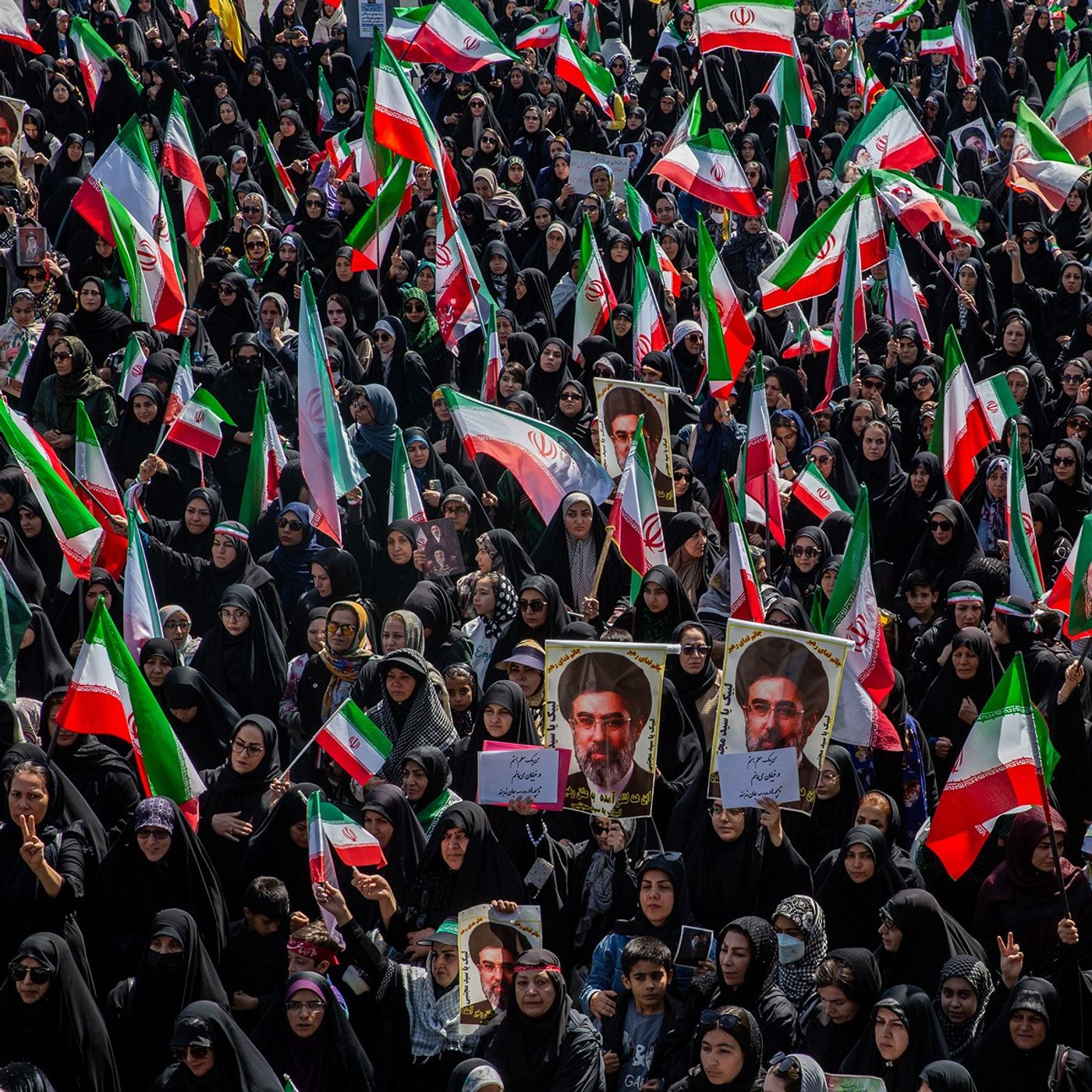
Well, since the start of this war, some of the big questions have been, who's running Iran? Who's making the decisions? Where is the new Supreme Leader, Moshe Abhamenei, and are there divisions at the top? I spent the past month reporting these questions, talking to sources inside Iran. I interviewed 22 to people inside Iran. Some of them were senior officials. Some were members of the Revolutionary Guards, Some of them know Mushta Bahomeini or his father. And all of them understand the framework of how decisions are being made in Iran and how the country is being run. And that has helped me answer this
- [03:49]
Natalie Kitroeff
puzzle through just extraordinarily deep reporting. So what have you learned?
- [03:56]
Farnaz Fasihi
Well, I'll tell you, in my interviews over the past month, every time I would ask that question from sources, I would say, who is making the decisions? Who's running the country? And I would hear, means the Revolutionary Guards. No one said the ayatollah. No one said, it's the supreme leader. And that was just such a difference to how things were done before the war, where the senior Ayatollah Khamenei, the supreme leader of Iran for 37 years, always had the last word on all decisions that were critical to the state. And before the war, whenever I would ask, who's making the decision, it would say, we're waiting for Mr. Khamenei to decide. We're waiting for him to say yes or no. And now it's the generals. Since the war started, a cohort of senior Revolutionary Guards generals have sort of taken over running and managing the war and running the country.
- [04:54]
Natalie Kitroeff
Okay, you're saying something that's actually pretty stark, which is worth just lingering on for a moment, which is that the Supreme Leader is not the one calling the shots here. And so I have to ask, when we say the Revolutionary Guards are, who are they? Who are we talking about?
- [05:12]
Farnaz Fasihi
The Revolutionary Guards are the most elite military force in Iran. They were created in the aftermath of the 1979 Islamic Revolution as sort of a line of defense for the regime. But over the past nearly half a century that the Islamic Republic's been in power The Revolutionary Guards have expanded their reach and expanded their power. When we here think about a military force, we think of people in uniform who are in military bases and making military decisions.
- [05:43]
Natalie Kitroeff
Right.
- [05:44]
Farnaz Fasihi
But the Revolutionary Guards are all over the place in Iran. They hold key positions in the government. Many lawmakers, ministers, presidents, have been former Revolutionary Guards. The current speaker of parliament, who's leading the negotiations with the US As a commander of the Revolutionary Guards. The head of the National Security Council is a Revolutionary Guards commander. And they also have a big footprint in Iran's economy. Right. They have a huge conglomerate in every economic sector, from energy to transportation to even tourism that you can think of. So they really are the parallel power in Iran. And now, as a result of the war, they've become the dominant power.
- [06:28]
Natalie Kitroeff
That's fascinating.
- [06:29]
Farnaz Fasihi
You know, it's part of a pattern of the country becoming more and more militarized and the influence of the clerics fading.
- [06:38]
Natalie Kitroeff
So this ubiquity of the Guards, that's something that's been developing over time. Their presence everywhere. This isn't new, per se, right?
- [06:46]
Farnaz Fasihi
It's not new, but it's never been this dominant. The Revolutionary Guards have been rising for years. The former Supreme Leader really relied on them for securing Iran's borders, for navigating and cultivating relationships with proxy militant groups in the region that were aligned with Iran ideologically, such as Hezbollah in Lebanon or Hamas in Gaza and the Shia militia in Iraq. And also, whenever there was an uprising inside the country and protests against the government, it was the Guards that took over security and crush those protests. And in exchange, the Guards were sort of given more of a free hand to enter politics and to enter the economy. And that empowered them in ways that was far beyond their military role in Iran. But they could only rise so far under the leadership of Ayatollah Khamenei, the father, because he was the person with the final authority over everything. But this war created an opening for them. And the Guards saw the killing of Ayatollah Khamenei by the United States and Israel on the first day of the war as an opportunity. As an opportunity to put in place a new supreme Leader who had close ties to them and through whom they could rule Iran.
- [08:13]
Natalie Kitroeff
Right. You told us last time on the show that the Guards were absolutely critical in putting the younger Khamenei in place as supreme leader. They basically got him there.
- [08:23]
Farnaz Fasihi
Exactly. They totally got him there. I mean, I think last time we spoke, we talked about the succession war and Game of Thrones that was going on to replace the senior ayatollah, and that the Revolutionary Guards really pushed to have the son succeed him.
- [08:39]
Natalie Kitroeff
And so the reason you're saying that the new Supreme Leader has less sway over the Guards is in part because he's indebted to them, is that right?
- [08:49]
Farnaz Fasihi
I think there are a number of factors, Natalie. One is that he's indebted to them for his position as the new Supreme Leader. He's also indebted to them for the survival of the regime. Right. I mean, the Revolutionary Guards basically managed to contain the threat that this war brought to the regime. When the Israeli and Americans airstrikes happened, two military superpowers attacking Iran, the regime thought that this was an existential threat. Right. But now they seem confident that they've contained the threat, and there's no signs of them cracking or defecting or the Islamic Republic toppling. There are other reasons for why he's deferring to the Guards as well. Part of it is his injuries. Mushta Bar Khamenei was gravely injured in the airstrikes that targeted his father's compound.
- [09:43]
Natalie Kitroeff
Right. That's been a big question mark is exactly how injured.
- [09:48]
Farnaz Fasihi
Very injured. I've heard that one of his legs may be amputated. He's had three operations and is waiting for a prosthetic leg. He's had operations on one of his arms and hands, and his face and lips have been burned severely, and the burns are so extensive that he can't even speak properly, which is one of the reasons why we haven't heard his voice or seen his face.
- [10:13]
Natalie Kitroeff
Yeah, I was gonna ask if that's one of the reasons why he hasn't made a public appearance. I mean, I'd imagine that also limits his clout. But it sounds like he just can't right now.
- [10:22]
Farnaz Fasihi
No, he can't right now. Sources that I talked to who know him said that he doesn't want to appear weak and vulnerable in the first public address that he gives to the people, whether it's audio or visual. The extent that the public has heard from him has been several written statements that the state media has read or it's been published social media. And another reason is also the logistics of his security situation.
- [10:50]
Natalie Kitroeff
Hmm. Talk to me about that.
- [10:52]
Farnaz Fasihi
Well, from the first day of the war, the Israeli said that whoever succeeds Mr. Khamenei will be a target and specifically said that Moshaba is on their assassination target list. So he's been moved to a very high, secure, secret place. Access to him is almost impossible for government officials or Military commanders. There's no electronics around him. He can't speak on the phone or engage electronically in any way. And communicating with him is sort of, you know, the old ways of writing longhand letters, sealing it in an envelope, and having a human chain of couriers carry the letters to his secure place and then back. And logistically that takes time. So you can't imagine that it's hard for him to be making decisions in real time. And he would have to delegate some authority to the generals that he trusts.
- [11:49]
Natalie Kitroeff
Okay, so you've described this situation in which there's this empowered group of generals within the Revolutionary Guards who technically answer to the Supreme Leader, but that Supreme Leader is in hiding, he's badly injured, he's really hard to get to. So how do they actually make decisions in that scenario? Like, how does that work?
- [12:12]
Farnaz Fasihi
Well, you know, in Iran, particularly in this new era, decisions are being made more collectively and collaboratively. The General is definitely are leading the charge and calling the shots. But there's a debate going on. In fact, people who I spoke to in Iran were telling me that the decision making is now kind of like a board of directors, that the Ayatollah is sort of the director of the board and the generals are the members of the board. And that, yeah, it's not a one man show anymore.
- [12:40]
Natalie Kitroeff
And when those decisions are eventually brought to the Supreme Leader through couriers to his hideout, and is he essentially being asked to rubber stamp them? What's his role in this?
- [12:54]
Farnaz Fasihi
His role is to give them feedback and to approve them. Because one way that the generals can tell the public that the decisions that they're making is legitimate, particularly when it comes to giving any concessions to the United States, is to say, look, what we're deciding is endorsed by the Supreme Leader. So everyone should go along. As to whether it's a rubber stamp. Well, to the best of our knowledge, he hasn't objected to any of their decisions yet, and he's gone along. Part of that reason is because of the relationship that he has with the generals and the trust that he has.
- [13:29]
Natalie Kitroeff
Okay, talk to me about that. That relationship and that trust. How should we understand it?
- [13:35]
Farnaz Fasihi
So we always knew that he had close ties to the Guards, but my reporting shows that these ties go much deeper and they go back decades. One way to understand it is that the Supreme Leader now has some of his best friends, people he has known since he was a teenager and grew up with in charge. And that story goes back to when he was 17 years old in the 1980s. He volunteered to go fight in the Iran Iraq war. And he was placed in a Revolutionary Guards battalion called the Habib Brigade. And in the Happy Brigade, there were other young soldiers who had volunteered. And I interviewed one of his close friends who was deployed with him to that brigade, and he told me that, look, this experience really shaped us. And those bonds we made with the battle buddies really carried us and became lifelong. As this group aged, they climbed the ranks of power. Some of his friends from this particular brigade became key influential politicians and military commanders and intelligence officials. And we're kind of seeing that play out right now. It's a relationship of friends who are on first name basis and of peers.
- [14:55]
Natalie Kitroeff
So you're saying part of this trust is really that Khamenei has deep ties with these people that go back years. I mean, he trusts them because he's known them for a very long time and has worked directly with them.
- [15:08]
Farnaz Fasihi
Exactly. And that's become a central dynamic of this relationship right now between the Supreme Leader and the Guards.
- [15:20]
Natalie Kitroeff
So when you add this whole picture together, what you're describing is a pretty fundamental shift in the way that the entire country and its government works. Before the Supreme Leader empowered the Guards. Yes. But also directed them. And now it kind of seems like the tail is wagging the dog.
- [15:38]
Farnaz Fasihi
Yes. You know, I think when most people, Natalie, think of Iran, they think of an Islamic theocracy run by clerics. We've always referred to Iran as a clerical rule. Right. And we're seeing that change in real time now. It's shifting away and transforming from a clerical theocracy to. To a military dictatorship with a cleric as its leader. So I think this change could have surprising implications for Iran and also for negotiations with the United States. Foreign.
- [16:35]
Natalie Kitroeff
We'll be right back.
- [16:42]
Sponsor/Announcer
This podcast is supported by Starbucks.
- [16:47]
Starbucks Representative
Starbucks baristas know their communities. That's why every year, Starbucks baristas can nominate local nonprofits to receive grants, with more than 16,000 grants awarded to local organizations. So how Starbucks supports communities is led by people in those communities. Because at Starbucks, making an impact together is just the start. Learn more@starbucks.com partners
- [17:15]
Thomas Gibbons-Neff
My name is Thomas Gibbonsnev. I'm a journalist at the New York Times. I served in the Marine Corps as an infantryman. When it comes to reporting on the front line, a lot of the same basics are at play. You're looking at the map of where you're going. If you're on a paved road, field roads, is there a hospital nearby? Is your body armor affixed with a first aid kit? Does Everyone know where that first aid kit is? We arrive into a military position. I get out of the car, I look at my watch. You know, I set a timer. No more than an hour. I'm listening for drones, jets. Check in with the team. Is everyone comfortable? And if they are, then we proceed. Frontline reporting is dangerous, but I think nothing is more important than talking to the people involved, you know, hearing their stories, and being able to connect that with people thousands of miles away. Anything that can make something like this more personal, I think is well worth the risk. New York Times subscribers make it possible for us to keep doing this vital coverage. If you'd like to subscribe, you can do that@nytimes.com Subscribe.
- [18:17]
Natalie Kitroeff
Farnaz, Just explain why it matters that the power structure in Iran, as you just told us, is shifting to one where the military, the guards, really hold all the cards and the clerics are secondary.
- [18:30]
Farnaz Fasihi
Well, for Iranians, it could be worse. Politically, it could be more repression, if that's at all possible. Because we've seen the guards over the years whenever there's a protest or uprising, take control of crackdowns and killings and crushing the protests. So it's very likely that dissent will be less tolerated, that there'll even be more crackdowns. But in terms of negotiations with the United States or the way that Iran might deal with the west, the guards could be more pragmatic than the clerics and their religious ideology.
- [19:12]
Natalie Kitroeff
Hold on. What? The military hardliners could be more pragmatic how?
- [19:18]
Farnaz Fasihi
Well, because these generals are not as motivated and driven by the cleric ideology that defined Iran in the past 47 years. Sort of the death to America, the religious theocracy. What motivates these generals is power and money. And for both of those things to happen, the regime needs to survive and it needs to thrive economically.
- [19:47]
Natalie Kitroeff
So when you say these generals are not ideological, it sounds like what you're saying is they're not really driven as much by a cause. They're driven essentially by self preservation. It is worth noting that this is definitely not how we've been talking about them up until this point. We've been talking about them as hardliners.
- [20:07]
Farnaz Fasihi
Right. The view of the Islamic Republic from the outside is an ideological theocracy driven by anti American and anti Israeli and religious Islamic ideology. And that's sort of how they've organized themselves for much of the time that they've ruled. There's definitely a faction still within the system that is very hardline, that is driven exactly by those ideologies. But they've been kind of sidelined from decision making. And the generals who are now in charge have a real interest in making a deal with the United States because they view this as survival. And that's a real shift because, remember, just up until a few months ago, the former Ayatollah Khamenei, the Supreme Leader, had banned Iranians from directly engaging with Americans. But five weeks after the US Killed their supreme Leader and waging a vicious war against Iran, suddenly the commanders of the Revolutionary Guards are sitting across the table from Vice President J.D. vance. I mean, I would not believe it if someone had told me that five weeks ago.
- [21:15]
Natalie Kitroeff
But can I just raise a question about this? On their pragmatism, we have seen these generals in charge really willing to use hardline tactics, like they've been willing to hold up the strait. They've been willing to bomb their neighbors to sow chaos in the region. And does that bear on their pragmatism? Like, how do you make sense of that?
- [21:37]
Farnaz Fasihi
We've seen the generals deploy tactics that they thought would preserve the Islamic Republic system and regime by escalating the war and making it very costly for not just us And Israel, but also for all the Arab countries by blowing up the region thinking that this would create deterrence. Right. But we've also seen that they've discovered the Strait of Hormuz as a new card, as something that they could upend the global economy with and have impact on the energy supplies of the world. At fertilizer supplies and all commercial ships, oil tankers. They're using these tactics because they want to gain leverage at the negotiating table, leverage that they can come sit across this table from the United States and say, in exchange for opening the strait, we want you to lift the sanctions against us, or we want you to unfreeze billions of dollars of our assets that are frozen. So that's the key thing to remember, is that there's a strategy behind the Iranian Revolutionary Guards moves.
- [22:45]
Natalie Kitroeff
Okay, you're starting to get into this, but let's talk about the actual terms of any deal. You said these generals are open to a real give and take with the American side. So what are they willing to offer and what do they want?
- [23:00]
Farnaz Fasihi
The most important incentive for Iran, for its leaders and the Revolutionary Guards, is to reach some sort of an end to hostilities and to get sanctions relief. Iran's economy was in shambles even before the war. Its currency was plunging and inflation was skyrocketing. And the war has just made everything worse. And there's also on top of that, an estimate of from 300 billion to $1 trillion of economic losses as a result of the war. In order for Iran to rebuild and reconstruct, it needs to lift sanctions and it needs to get access to its funds and sort of the global financial markets.
- [23:45]
Natalie Kitroeff
From Iran's perspective, basically the idea is, look, the United States and Israel have really destroyed a lot of our country. We need money to rebuild it.
- [23:54]
Farnaz Fasihi
Exactly. We need money to rebuild it. We need money to improve the economy. Because one of the big sources of dissent and protests has been economically driven. And, you know, one of the things that they've done is they've proposed a very detailed list of ways in which American companies can come to Iran and invest in Iran. For the first time in 47 years. The generals have gone to the Americans and said, said, if there's a deal, your oil and shipping companies can come and invest in Iran. You can help us reconstruct and rebuild. And that's something that's never been done before. The senior Ayatollah Khamenei had specifically banned all American companies from coming to Iran after the 2015 nuclear deal. And now the generals are doing away with that order.
- [24:44]
Natalie Kitroeff
They're actually, you're saying, talking about inviting the Americans in as investors, as collaborators, you're saying, working with them to rebuild the country. Really?
- [24:54]
Farnaz Fasihi
Yes, exactly. These generals are basically appealing to President Trump's business side and deal making side. They're trying to create financial incentives for the Trump administration to engage with Iran, similar to what a lot of other countries have done.
- [25:11]
Natalie Kitroeff
Just fascinating. What about the other sticking points of any deal, for example, the big one, restricting the enrichment of uranium that the Iranians could use to build a bomb. Where do they stand on that?
- [25:24]
Farnaz Fasihi
These are sticking points, Natalie, to what level? Iran is willing to stop enriching uranium, whether it's going to be a suspension or shutting down its nuclear programs, and what it's going to do with the stockpile of highly enriched uranium that it has. These are issues that have not been resolved. But I think the most important thing for Iran is to save face. They don't want to look as if they've surrendered. President Trump really likes to keep saying that I have achieved something that no American president has achieved. I've destroyed Iran's military and nuclear capabilities. And he wants to say that the war forced Iran to capitulate. And Iran is absolutely adamant. Whatever deal it reaches, it's also able to save face. And a lot of, I think the tension is now around this idea that how do we reach a deal where we don't look like we gave something that we weren't willing to give before the war as a result of the war?
- [26:24]
Natalie Kitroeff
Right. And part of the tension there is that President Trump also needs to be able to save face and message to the American public that he actually got something out of this war and that what he got was better than the deal that had already been achieved under Obama to restrict and cap uranium enrichment in Iran. So both sides are dealing with that face saving impulse.
- [26:47]
Farnaz Fasihi
Exactly. Both sides are dealing with that. President Trump also needs to be able to say that I achieved something from this very unpopular war as well.
- [26:58]
Natalie Kitroeff
Okay, let's talk about the Strait of Hormuz. The million dollar question on everybody's mind, Will things go back to normal in this strait, or does Iran and its leaders now see this as theirs to control as they see fit?
- [27:14]
Farnaz Fasihi
Iran and its leaders view the Strait of Hormuz as their territory. They've now discovered that they can control it, that they can even threaten ships by suggesting there are mines at the bottom of the seas. And of course, insurance companies are not going to risk it, and that alone will upend the global shipping and energy economy. So they now have a tool in their disposal and they're trying to figure out how to monetize it, because they've calculated that if they toll the ships that are through the Strait of Hormuz, they can make a lot more money than they do from their oil revenues.
- [27:51]
Natalie Kitroeff
Oh, wow. So even here you see their pragmatism at work, looking for money making opportunities, calculating the best way to do that. Farnaz, what about Israel? Because Israel's been this other major factor that's been affecting the negotiations. A potential Israeli attack is part of what's keeping the Ayatollah in hiding and really affecting the way the leadership works are the guards. Assuming that Trump can keep Israel from waging the kinds of attacks that we've seen destabilize these negotiations, how do they view Israel in this?
- [28:28]
Farnaz Fasihi
They view Israel as a major threat that could still be a threat even after conventional war is over. Iran and Israel were engaged in a shadow war for many, many years that I've written about with my colleague in Israel, Ronan Bergman. Israel had assassinated multiple Iranian nuclear scientists and military commanders and done covert operations and attacks on military sites and nuclear sites. The threat of Israel will be there and also the threat that they might covertly try to assassinate the supreme leader or any other official. So I think that they believe that the United States has a lot of influence and power over Israel, and that once there's a ceasefire, it also extends to Israel. But I don't think there's a guarantee that Israel's going to not continue the covert operations.
- [29:20]
Natalie Kitroeff
Got it. So, essentially, Israel remains this big wildcard, and the negotiations are now stalled on the other sticking points. But can I ask, what is the ideal realistic outcome of these negotiations for the people leading Iran right now?
- [29:39]
Farnaz Fasihi
That's a really good question, and the answer might surprise you. I think the generals leading the negotiations are looking at a kind of a deal that ends this limbo status they've been in with the United States for 47 years, where Iran is not really at war with the US but there's this threat hanging over it. They keep saying, we want a grand deal, we want to reach a big deal. That will be the end of hostilities, and it could sort of stabilize Iran. If that happens now, it's not clear whether that's going to happen or not. This is sort of the ideal situation for them, that they have lasting peace, sanctions are removed, American companies come in, investments come in, and Iran can stabilize economically as well as politically.
- [30:29]
Natalie Kitroeff
It's interesting we did not get in Iran the kind of regime change that President Trump and his allies forecast and maybe imagined would come of this war. But just in terms of these negotiations, these peace talks, is the president right in some sense when he says that there are now more reasonable people in charge in Iran, just in terms of reaching a deal?
- [30:58]
Farnaz Fasihi
I think in some ways, yes. The president has said the war brought regime change in Iran. There's clearly not been a regime change. The Islamic Republic is still very entrenched, and we still don't know how. How this new era of leadership is going to evolve when things stabilize. When Moshe Khamenei comes out of hiding, is he going to retain power, what that dynamic will be if the Revolutionary Guards get the money, how they're going to spend it, are they going to rearm their proxies and what the political repression in Iran is going to look like? The situation is very fluid. Right. And of course, there's a risk that they're going to overplay their hands using all the levers that they think they have in negotiations. But on this very narrow question of whether the people sitting across the table from the American negotiating team are more motivated to reach a deal, I think, yes, they are.
- [32:02]
Natalie Kitroeff
Well, for not. Thank you so much. We really appreciate it.
- [32:06]
Farnaz Fasihi
Thank you so much for having me, Natalie.
- [32:26]
Natalie Kitroeff
We'll be right back.
- [32:31]
Sponsor/Announcer
This podcast is supported by Starbucks,
- [32:36]
Starbucks Representative
Starbucks, Baristas know their communities. That's why every year, Starbucks baristas can nominate local nonprofits to receive grants, with more than 16,000 grants awarded to local organizations. So how Starbucks supports communities is led by people in those communities. Because it's Starbucks, making an impact together is just the start. Learn more@starbucks.com partners.
- [33:06]
Farnaz Fasihi
The Opinions Podcast from New York Times Opinion, bringing you a mix of conversations and new ideas featuring the voices of
- [33:14]
Sponsor/Announcer
our writers and columnists.
- [33:17]
Sean McCreesh
To me, the single most underestimated force in international relations is actually stupidity, including
- [33:23]
Natalie Kitroeff
Jamil Bouie, Trustee McMillan Cottom, Michelle Goldberg,
- [33:26]
Farnaz Fasihi
Thomas Friedman, and many more. Find the opinions wherever you get your podcasts.
- [33:36]
Natalie Kitroeff
Here's what else you need to know today.
- [33:37]
Unnamed White House Correspondent
Get out.
- [33:38]
Farnaz Fasihi
Let's go, let's go.
- [33:40]
Natalie Kitroeff
New information continued to emerge about Saturday's shooting at the White House correspondents dinner in D.C. The incident started when a gunman attempted to storm the annual event where President Trump and senior Cabinet officials were in attendance. The attacker ran through a security checkpoint and exchanged fire with the authorities before being subdued and taken into custody. He was armed with knives, a shotgun and a handgun. Our colleague Sean McCreesh was there as part of a pool of reporters covering the president, and he witnessed the chaotic scene as it unfolded.
- [34:22]
Sean McCreesh
We were sort of milling about looking for seats, trying to connect to the wi fi. I asked a young Secret Service agent to take me to the bathroom. A moment later we were both in there washing our hands, making chit chat, and suddenly we heard all this yelling, all this commotion, and he looked at me, his eyes grew wide, and we both darted out of the bathroom, turned the corner, and there were probably five or six agents with guns drawn pointed right at our chest like this. And in about two seconds they sort of assessed that we weren't a threat and then began yelling at us to get down and to cross the hall. And we had no idea what we were walking into.
- [35:06]
Natalie Kitroeff
Inside the main ballroom, journalists and other attendees hit the floor to take cover while Secret Service officers whisked away Top Trump officials and their spouses.
- [35:15]
Sean McCreesh
One of the things that made it such a crazy scene was that the people who were running around the hallways with basically machine guns were also wearing tuxedos and suits because so many of the agents were dressed up like party guests. And so you really had no idea what was going on because every which way you looked, you didn't know, you know, who had a gun, what was going on. Cabinet members were running across the hall. It just felt like total chaos.
- [35:50]
Natalie Kitroeff
About an hour later, back at the White House Trump addressed reporters, many of whom were attendees at the gala.
- [35:57]
Unnamed White House Correspondent
Nobody told me this was such a dangerous position profession. If Marco would have told me, maybe I wouldn't have run. Maybe I would have said, I'll take a pass. No, it's a dangerous profession.
- [36:09]
Natalie Kitroeff
He said he'd planned to deliver a scathing speech at the event, but now he wanted to emphasize the need for national unity and bipartisan healing.
- [36:18]
Unnamed White House Correspondent
I was all set to really rip it and I said to my people, this would be the most inappropriate speech ever made. If I said so I have to save it. I don't know if I could ever be as rough as I was going to be tonight. I think I'm going to be probably very nice. I'll be very boring the next time.
- [36:34]
Natalie Kitroeff
But he also said that the shooting was another reason to build out a larger ballroom in the east wing of the White House, which would have stronger security measures built in.
- [36:43]
Unnamed White House Correspondent
I didn't want to say this, but this is why we have to have all of the attributes of what we're planning at the White House House. It's actually a larger room and it's much more secure. It's got, it's drone proof, it's bulletproof glass. We need the ballroom. That's why Secret Service, that's why the military are demanding it.
- [37:05]
Natalie Kitroeff
The authorities have identified the suspect in the attack as Cole Thomas Allen, a 31 year old from California. In a note that law enforcement attributed to the suspect, he said he was targeting administration officials and he conveyed deep anger at the president without mentioning him by name. He's set to be arraigned in federal court on Monday. Today's episode was produced by Mary Wilson, Nina Feldman, Stella Tan and Michael Simon Johnson. It was edited by Michael Benoit and Patricia Willen and contains music by Marian Lozano, Pat McCusker and Dan Powell. Our theme music is by Wonderly. This episode was engineered by Chris Wood. That's it for the Daily I'm Natalie Kitroweff. See you tomorrow.
- [38:09]
Farnaz Fasihi
Foreign.
- [38:16]
Sponsor/Announcer
This podcast is supported by Starbucks.
- [38:18]
Starbucks Representative
Starbucks baristas can nominate local nonprofits to receive grants, with more than 16,000 grants awarded to local organizations so far. Because at Starbucks, making an impact together is just the start. Learn more@Starbucks.com partners.