Loading summary
Transcript204 lines
- [00:00]
A
Introducing the Problem Solvers, a new series from Anthropic about the startup founders who are getting things done with Claude, like Max Unistrand, co founder and CEO at Legora, an AI workspace for legal teams.
- [00:12]
B
The very cool thing for us is
- [00:14]
C
that with each new model, new capabilities are unlocked.
- [00:17]
B
This is profoundly changing the legal industry
- [00:20]
A
because no technology before has ever been able to work with language and reasoning like large language models. Watch the series@cloud.com problem solvers that's claude.com problem solvers. Problem solvers.
- [00:35]
B
Messi running inside.
- [00:38]
C
Back out it goes. Lionel Messi. Lionel Messi,
- [00:46]
B
First career World cup hat trick ties the all time goal scoring record.
- [00:53]
D
From the New York Times, I'm Natalie Kitroeff. This is the Daily.
- [00:58]
C
And there it is. Erling Harlem meets the World Cup. The World cup meet Sterling, Holland.
- [01:06]
D
Two weeks into the World cup, the most watched sports event on the planet has already broken records.
- [01:12]
E
Brilliant.
- [01:13]
B
From Mbappe. Brilliant. France lead magical.
- [01:18]
D
Hitting its highest attendance ever and generating the most goals scored in history. But one of the biggest stories of the tournament is happening off the field.
- [01:28]
B
I feel like I've been lied to my entire life about America. Like, I'm in Florida. This beach is insane. Like, just as good as Australian beaches.
- [01:39]
D
As a wave of international visitors encounter an America they'd never seen up close.
- [01:47]
B
Texas is good. Everything is big. Ranch. I love ranch. I taste it here.
- [01:53]
C
It's delicious.
- [01:55]
B
And I take two bottles with home.
- [01:57]
D
And Americans encounter them and open their arms to the world's soccer fans.
- [02:03]
C
It's hard to sit there and think
- [02:05]
B
Americans are bad because every single person I've met that's American has been unbelievable.
- [02:12]
D
Today, my colleague Tarek Panja explains the magic and the complexity of this moment. And Daily producer Anna foley talks to two fans in the middle of it. It's Monday, June 29th. Tarek, welcome back to the Daily. It's lovely to have you.
- [02:30]
C
Lovely to be back with you.
- [02:32]
D
So I have been watching the World Cup. It has been incredible. The competition itself, but also the amazing scenes that we have seen from fans from all over the world colliding with each other. And this is the thing that you told us would happen when you were last on the show. There is always this anticipation and anxiety that leads up to the World cup and then the games begin and it becomes this human experiment of what happens when you bring the entire world together around a sport.
- [03:07]
C
It does. And tournament after tournament, it gives us this brief moment of uplift, of joy, of people coming together. And we're seeing it in places big and small here in the United States. And I'm so pleased that people in this part of the world are able to experience this.
- [03:28]
D
And we should say this wasn't perhaps expected because there was a lot of angst around some of the geopolitical tension that was hanging over this. I mean, one of the host countries, in this case the United States, is literally in the middle of a war right now. And the US has even had beef with the co hosts, Mexico and Canada. One of them Trump has threatened to bomb and the other he's threatened to turn into the 51st state. So this wasn't straightforward.
- [03:56]
C
You're right, this wasn't straightforward at all. America's posture to the world has been one which is kind of antithetical to a tournament that is supposed to bring the world together and bring the world to it. This was a country that was talking about building walls, reducing immigration, sending people out. And for fans who were trying to come here, getting visas was proving very difficult. Then there was the question of ice enforcement at the tournament, the possibility of that. And even, even on the cusp of the tournament, we had the situation with the referee from Somalia, a FIFA referee, someone on the list to work at this tournament sent back to Turkey, where he flew from. And that does give you a sense of dread if you are not someone who is sure they're going to be able to get into this country. But tournament starts and we've seen wonderful images, we've heard wonderful songs, we've all heard anecdotes of things that only the World cup can bring. It is what happens when the world comes together.
- [05:06]
D
And so Tarik, despite the baggage, the good feelings began almost immediately. So tell us how that happened. Like what actually shifted?
- [05:18]
C
What shifted the people. It starts with these teams, 48 teams in the biggest World cup ever. And they have to choose base camps where the team will be staying between the matches in these enormous stadiums in these cities. And where they tend to go are certainly not big cities. And I'll give you some examples. Spain going to Chattanooga, right? And there is a phenomenon there called Lamin watching. So Lamine Yamal is one of the most famous athletes in the world. He is going to be the next massive superstar after Messi and Ronaldo. And here we are seeing him go to a Walmart. Then we have Erling Haaland, who also has a claim to be one of the most famous people in the world.
- [06:20]
D
I've been eating healthy since I came
- [06:22]
E
to the US and now I enjoy some American food.
- [06:25]
C
He's with Norway in Greensboro.
- [06:27]
B
How cool is it to have Norway in Greensboro, North Carolina?
- [06:31]
D
It's awesome. It's epic.
- [06:34]
C
But the best example of the one that is almost acutest is what happened when the Algerian team arrived in Lawrence, Kansas. They prepared by getting the marching band of the University of Kansas to learn the national anthem of Algeria.
- [07:00]
B
I want to say thank you to
- [07:02]
A
team Algeria for choosing our hometown, Lawrence,
- [07:06]
B
Kansas, to come here and so welcome.
- [07:11]
C
This, I believe it's a college town, would never have had anything approaching this in terms of a global event.
- [07:19]
B
So far, everybody here has been very friendly and very welcoming, and I'm really glad Algeria is going to be here. And 1, 2, 3. Viva Algier.
- [07:29]
C
You see local people dressed in the Algeria jerseys. They are all rooting for this Algerian team.
- [07:36]
B
So I'd love to support them, you know, especially since they're in Lawrence, you know, like, I'll support them.
- [07:50]
A
Right.
- [07:50]
D
Okay. So you start to have this mutual excitement bubbling up on both sides, the teams and the Americans that are receiving them. And then there's a next wave that comes right when the fans of these teams begin to arrive. Talk to me about that now.
- [08:08]
C
This is my favorite part. This is where fans from every corner of our world arrive full of hope, full of cheer, and just ready to have fun, meeting each other and showing their colors, the showing their songs. And we've seen that. We've seen images of the famous, or now famous, Norwegian Viking Road taking over New York and New Jersey, including an escalator where you have Norwegian fans sitting down and rowing as it takes them into the subway system.
- [08:48]
D
Yeah.
- [08:51]
C
There are buses that have been organized by the city of Dallas to take fans to various points of interest in Norway.
- [09:01]
B
We have nothing like this. This is too much. I love it.
- [09:06]
C
But the one that's proved more popular than most has been the trip to BUC EE's. Never gonna believe this, guys. This is a gas station. This goes on for miles and miles and miles.
- [09:18]
D
Gotta get to BUC EE's. I agree with that strategy.
- [09:22]
C
And the guys behind the counter, like,
- [09:24]
E
they do a sing song.
- [09:25]
C
What is this place? I can stay in here forever. We've also had all of these stories of fans, whether they're French, Japanese, or from anywhere else, trying American food and actually liking it.
- [09:39]
B
Hot french fries in a chocolate milkshake. That shouldn't work, but that's actually really good.
- [09:45]
C
Texas barbecue seems to be a big hit at the moment.
- [09:49]
B
Amazing. Hey, that's a shark. I love it.
- [09:53]
D
The Philly cheesesteak, a national Delicacy.
- [09:56]
C
Yeah, a national delicacy. I love.
- [09:58]
D
I love.
- [09:59]
C
I love beef, I love cheese. You know, it's perfect combination. And then foreign. Scotland. What can we say about the Tartan army? The name the Scottish fans are best known by.
- [10:17]
B
What's been the most Bostonian thing you've seen or witnessed?
- [10:20]
C
It's gotta be Samuel Adams, the br.
- [10:22]
B
A couple of guys don't like it,
- [10:24]
C
but I think it's quite nice. They hadn't been to the World cup since 1998.
- [10:29]
D
Right.
- [10:29]
C
And they really have made up for lost time, haven't they?
- [10:32]
A
The Bostonians are something special.
- [10:35]
E
Honestly.
- [10:36]
C
The people of Boston will never forget the days the Tartan army invaded their city and obviously drank the city dry. But all in good cheer.
- [10:52]
B
We went from regular Boston to all of a sudden, party Boston.
- [10:55]
C
24 7, gentlemen, you only gotta know two words. Yankees suck. The Scots making up for lost time is going to be one of the stories of the World Cup.
- [11:10]
D
Scotland did, unfortunately just officially get kicked out of the World cup this past weekend, but they clearly left an impression. I mean, it was so pronounced, this love story between these Scottish fans and the Bostonians that received them, that I think the Boston Globe literally dedicated a full page in the newspaper just thanking them for visiting.
- [11:32]
C
They did indeed. And now the Scots have a tradition for this. The way the fan culture works is be loud, be fun, drink all of the beer, but leave the people happy. You were there. This was a culture that was created almost as an opposition to the hooliganism that was around English football and English fans in the 80s and 90s that
- [11:54]
D
I had no idea. That's so interesting.
- [11:56]
C
And it's not just the Scots. You can't manufacture some of these meetings. They are chance meetings. And we are seeing this in a way that perhaps we were not expecting because of the sensation or the feeling around the U.S. right?
- [12:14]
D
And so these international fans, they're being exposed to parts of America that they may never have seen otherwise.
- [12:21]
B
And.
- [12:22]
D
And for Americans, you do see people trying to show their most open selves.
- [12:28]
C
I think there's also the inquisitiveness. People want to know about each other, and there's a pride as well, say, look, this is our town, this is who we are, and we want to show our best face.
- [12:43]
D
It also feels significant that this is happening at the same time that the United states celebrates its 250th anniversary, and some of those official celebrations have begun, become very tied to President Trump, and they've become contentious in some cases for that reason. And then at the same time, you have this other celebration that's happening all across the country that also feels like it's saying something important about the United States and its identity.
- [13:13]
C
Yeah. It tells us that this country is a patchwork of people, and it was built on everybody. This is an immigrant nation. The World cup has shown it to be. So not only are the fans coming from overseas to support their teams, the entire diaspora of these teams is also behind them. I met a guy who was Jordanian. And what's your name, sir?
- [13:39]
B
My name is Farouk or Fred.
- [13:41]
C
This man called Farouk, I moved to
- [13:43]
B
the state 46 years ago.
- [13:45]
C
46 years ago, yes.
- [13:48]
B
It's a split love. I love America more than anything.
- [13:51]
C
And he just could not tell me how much he loved America.
- [13:55]
B
It's the one that gave me the opportunity. It gave me everything. My kids. I have three boys and a girl. They're all successful.
- [14:02]
C
He was beaming about what America gave to him.
- [14:05]
B
But Jordan, it's my love.
- [14:07]
C
But he also said, I love Jordan. How do you feel?
- [14:11]
B
Oh, my God. This is the proudest moment of my life, really. For a small nation of ours, you cannot believe how proud we are.
- [14:19]
C
I am so proud that my country has made the World Cup.
- [14:24]
B
I came to the first game, and I'm in second game. Then I'm gonna go watch.
- [14:28]
C
He was off to Dallas next to see them against Lionel Messi every day of the week.
- [14:32]
B
God bless America. God bless everything about this place, and God bless my nation, Jordan.
- [14:37]
C
Thank you, Farouk. So you can have that duality. It's also what it's shown. You can be two things. You don't have to lash yourself to one flag or to the mast of one idea.
- [14:49]
D
Right. And in many ways, this is kind of the diaspora World cup off the
- [14:54]
C
field and on the field. The word diaspora has been said over and over about this World Cup. But with that comes a degree of complexity. It is not a seamless thing. This can sometimes be difficult.
- [15:12]
D
Just talk about that side of things. What exactly you mean by that?
- [15:16]
C
The most obvious case has to be that of Iran. This is a team I've been following now for months. Since the start of the war, this team has faced hardships unlike any other. This is the first time a team participating at the World cup has been in conflict, military conflict, with a host nation. Right.
- [15:40]
D
That has struck us here, too. I mean, the complications around the Iran team has been this major story of the World cup for many reasons. Right?
- [15:48]
C
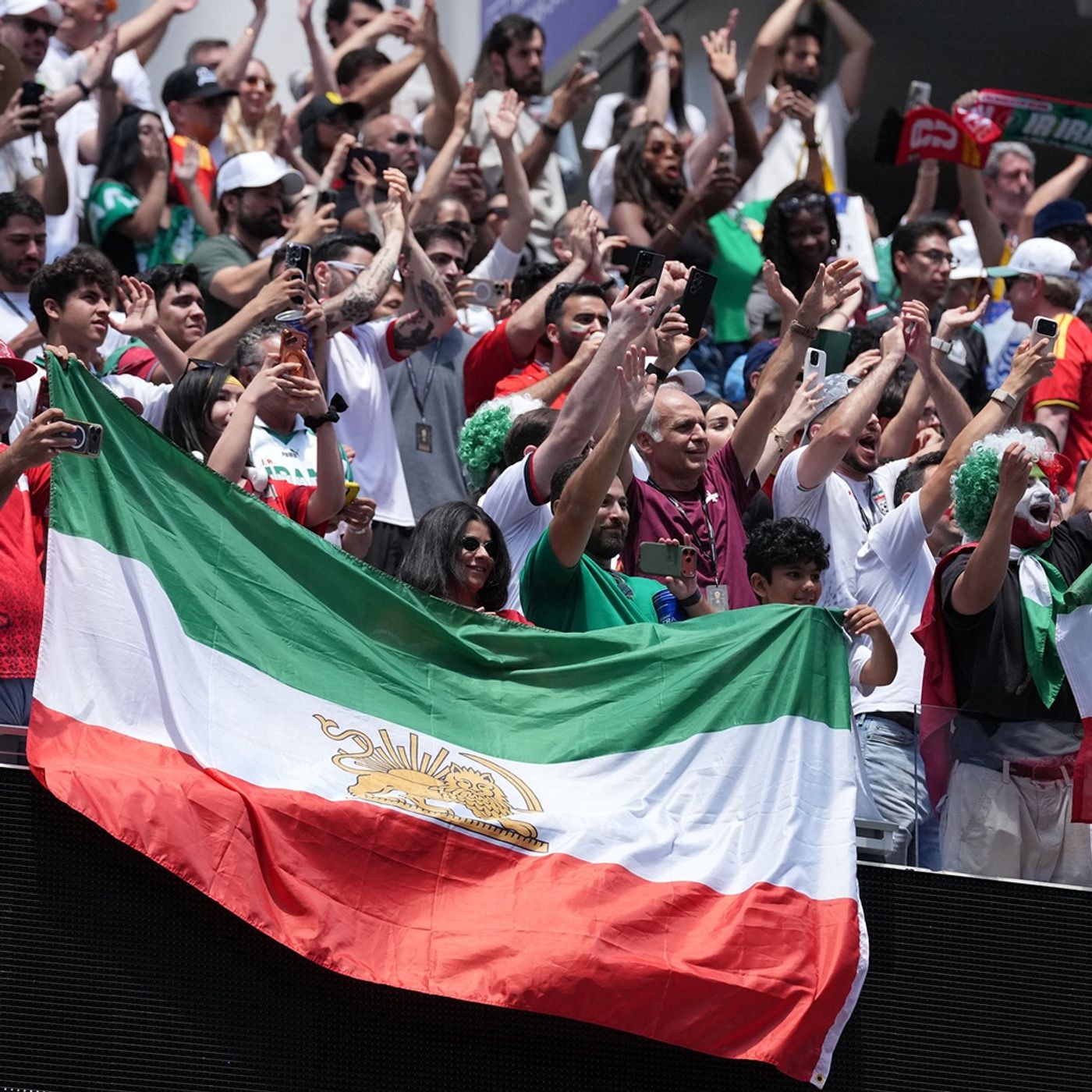
Yeah. And the fans have had their own kind of hardships because of the feeling towards the government in Iran, the love of country in that context, and the love of team. Do we support this team? Who does this team represent? And it has split the Iranian community somewhat. I think most Iranians remain firmly supportive of the team on the field. But I've spoken to so many people who are trying to find ways to support the team, but also in a way, protest or find a way of opposing the government back home.
- [16:32]
D
You're saying this really big Iranian community in the United States is itself in conflict over how to relate to their own team. Right. Because they have such a conflicted relationship to their government. And the idea of how to support them is presenting all of these conundrums for these people.
- [16:52]
C
It does. On the most extreme edge of this are people who simply will not support the team and say, this is a propaganda tool of the government in Tehran. This is not the Iranian team, but it's the majority in the middle. They're the ones, I think, that are finding it the hardest because they do love this team. They do love their country as well. So how do you support them? So we're almost seeing kind of the internal divisions of the Iranian opposition, Iranian politics writ large around the outskirts of a World cup stadium in Los Angeles. Right?
- [17:36]
D
You're seeing this internal struggle of this diaspora play out live in front of us in the stadiums outside them, this internal debate inside of a community over how to relate to their team. It's all there in public.
- [17:55]
C
It's all there in public, and it's all in the face of those players. So when the Iranian national anthem plays, you hear widespread booing, jeering across the stadium. But when the team then takes to the field, it's like a home game. What we are seeing in real time is a mashup of nationalism, of identity, of patriotism, of a sense of people trying to work out who they are, what they want, and what their future holds all around this international soccer tournament.
- [18:41]
D
Well, Tarek, thank you so much for being here.
- [18:44]
C
Nice to be with you again.
- [18:53]
D
We'll be right back.
- [18:58]
A
Anthropics Claude is the AI for problem solvers like Scott Wu, co founder and CEO of Cognition. With the help of Claude, Scott and his team built the first autonomous AI software engineer at Cognition.
- [19:10]
B
What we've always focused on is trying to solve for the messiness of software engineering, of the real world. By getting to work with Anthropic, we've been able to help bring folks to a new era of software engineering.
- [19:20]
A
To hear more, go to claude.com problemsolvers that's claude.com problemsolvers
- [19:28]
B
I'm Jonathan Knight and I'm the general manager of New York Times Games. If you play our games, you probably know there's something a bit different about them. Just like there are writers behind the articles you read in the Times, there are creators behind our daily puzzles. Tracy Bennett curates the day's wordle solution to keep it lively and varied. Winna Lou creates each connections board, including all those categories that try to stump you. Sam Ozerski combs through every last letter word and pangram in Spelling Bee so that loyal players of all skill levels enjoy it. Our puzzles are human made every day with the standards you'd expect from the New York Times. And this matters because when you choose to spend time with our games and it should be time well spent solving puzzles that are challenging, surprising and joyful puzzles handcrafted for you, we think that's something worth investing in and something worth paying for.
- [20:21]
A
Subscribe now for a special offer on all of our games@nytimes.com joingames
- [20:30]
D
as we said before the break, the team in arguably the most complicated place in this World cup is Iran. The team is playing in a host country that's in open conflict with theirs. And now the whole world's watching as this fragile ceasefire gets tested again and again. One of our show's producers, Anna Foley, spent time with a couple of lifelong fans of the Iranian team just hours before Iran played their first game. They talked about what all this is like this year and the complex business of sorting out national pride and fandom in the middle of war.
- [21:09]
A
Is there anything you miss from Iran? Of course this is. Farhad. Tell me something.
- [21:16]
E
Okay, People. The smell of land. People very hospitable, kind, caring, full of love. I've been a third of my life over there and two third here. Believe it or not, I remember the first 1/3 to me here, time flies extremely fast.
- [21:49]
A
Farhad came to the US from Iran 47 years ago. Back then, he'd been trying to get a visa for years.
- [21:56]
E
For five years I tried. Nothing happened.
- [21:59]
A
But nothing seemed to work. This was right before the Iranian revolution. A lot of other people were trying to get visas around the same time. One day he showed up at the embassy.
- [22:09]
E
The whole street completely filled with people.
- [22:13]
A
There were thousands of people there. Chances seemed slim he was going to be able to get his paperwork. But then he heard a man call
- [22:19]
E
his name and I was sort of surprised. No microphone, no speaker, nothing. He just yelled it and I happened to be right there. So he Handed me my passport, and I didn't even know what that meant. I said, can you tell me what this is? With broken English, of course. And he said, you got visa? I said, so I can go to United States? He said, yes, of course. So I was really, really shocked. Really, really shocked.
- [22:47]
A
Very lucky. Yeah.
- [22:49]
E
No. How this thing happened, I took it as a. Honestly, as an act of God. I could not logically reason it, how this thing worked out.
- [23:02]
A
Farhad says he's replayed that moment every day. He's lived in America, which it's been a while. He got here in 1979, settled down in Ohio, got married, had kids.
- [23:15]
B
I'm a lifelong soccer fan, World cup
- [23:18]
A
fan, one of whom is Kevin.
- [23:22]
B
So we had this videotape. It was like the 50 greatest World Cup Goals.
- [23:26]
A
And Kevin's lifelong obsession with soccer started at home with his dad and an old VHS tape of World cup goals.
- [23:33]
B
That's how I discovered World cup and Goals and Nations.
- [23:36]
A
Kevin couldn't get enough. One VHS tape turned into boxes of taped games in the living room. Soon Kevin was playing soccer in a neighborhood league, and Farhad was taking him to meet American players.
- [23:48]
B
Obrad Friedel, Brian McBride, Thomas Dooley.
- [23:51]
A
Kevin became a real student of the
- [23:52]
B
game in the second half. Like the U.S. i think, hit the post, like, four times in that game.
- [23:58]
A
Even now, he can recite what happened in one of his favorite games from when he was 11.
- [24:02]
B
I'm obsessed with these. I've rewatched all the old US games.
- [24:05]
E
Kevin has tremendous amount of knowledge. I can. It's like an encyclopedia of soccer, Honestly.
- [24:12]
A
Why did you love soccer so much? What drew you in, do you think?
- [24:16]
B
I think a big part of it is the connection with my family, the fact that my dad loved it. It's one of the major ways that I have been able to connect with my past and my heritage. My Iranian side in particular.
- [24:33]
A
This is all, of course, a classic. Father and son watch a sport, feel closer. It's how they show they love one another. They live in the same apartment complex. These days, Kevin told me a typical night for them is he'll go over to his dad's, they'll cook some Persian food and turn on a game. And Iranian soccer has always been a part of their Bond. Back in 1998, when Kevin was 11, the Iranian national team was good. It looked like they stood a chance to qualify for the World Cup. So Kevin and Farhad started following the team, cutting out articles in the paper about their games.
- [25:05]
B
And so then I think, me, my mom and my sister came home from somewhere and my dad said, I have the biggest soccer news for you. And I think it took me two guesses, but I realized it was that Iran had qualified for the World Cup. So that's a moment that I'll always remember.
- [25:20]
A
And then Iran actually played the US in that World cup the first time ever. And for Kevin, it was the first time his two identities were pitted against each other in the sport he loved.
- [25:30]
B
We went to, you know, this restaurant, there was a lot of US fans. And then it's like our little table with the Iranian section and then the rest is like usa. But I also am cheering for both teams. So yeah, those are always sort of interesting situations when like you have two teams that you, you really like and they're coming up against each other.
- [25:50]
A
Iran won that game 2 to 1. What did Iran's victory back then feel like for you? Like, was it complicated to watch Iran win over the us?
- [26:00]
E
No, it was at least for my self satisfaction that Iran came positive. Not that I wanted us to lose or anything, but I was happy. After so many negative things in media regarding Iran and so forth, at least it shows. Yes, they can make effort, they can move up, they can be proud of themselves in the international level. I never can turn my back to where I was raised and so forth. That is part of my nature.
- [26:43]
A
The US and Iran wouldn't meet again on the World cup pitch for more than 20 years. In 2022 in Qatar. that point, Kevin and Farhad had moved to Southern California, the other side of the planet. But the opportunity to see their two favorite teams square off, it was just too good to pass up.
- [27:01]
B
So I got some US tickets for myself, but I was like, I can't not go to the USA Iran game without my dad, you know.
- [27:09]
A
What started as Kevin's plans to take his dad to one game ballooned into an epic father son, Middle east trip. Farhad was in charge of logistics.
- [27:18]
E
So this is our flight pattern and this is all the games that we had.
- [27:23]
A
He showed me the maps of all the stadiums.
- [27:24]
E
I made two copies just in case we lose one train.
- [27:27]
A
Time it took to get there.
- [27:28]
E
Yeah.
- [27:29]
B
My dad is legendary with his notes and his charts.
- [27:32]
A
He ran the itinerary with precision and rigor. But Kevin was the one who had the idea to start off their trip with his dad's lifelong dream to go to Mecca.
- [27:41]
E
When Kevin said it, it just touched my heart. To me, that has the highest value. Nothing can beat that. We basically started our FIFA tournament in a spiritual way.
- [27:54]
A
Yeah, yeah, yeah. So, yeah, I was going to say it's like a nice symmetry. You know, you have a religious pilgrimage and a sports pilgrimage.
- [28:01]
E
Yeah, exactly.
- [28:04]
A
And when it came to the US versus Iran game, here they were again. Two teams that they could cheer for, one game. How to choose?
- [28:14]
B
There was definitely, like, a little bit of a tension about it.
- [28:17]
A
It was nothing like Kevin's experience in 1998 in that little Ohio restaurant.
- [28:22]
B
And you hear the Iranian fans, like, jeering and stuff and whistling at maybe if the US did something or whatever.
- [28:29]
A
This game was louder and full of people who were born and raised in Iran who never even had to question which team to cheer for or how to cheer for. Both.
- [28:38]
B
I've always been Iranian American, even though it's not every day that they come up and play each other in soccer. But there's been, like, sporting rivalries or political things between the two countries. It's always been that way my whole life. Like, I can't even imagine not having that.
- [28:57]
A
Of course, this year, this World cup with the Iranian team playing in the US it is a different kind of complicated. There's an actual war. There's fallout around the world. There's nationalistic rhetoric and threats. And amid all of that, the Iranian team was scheduled to play World cup games in Los Angeles, basically in Farhad and Kevin's backyard.
- [29:21]
B
There's two, like, kind of conflicts in me, which one is like, obviously, the. The war is going on, but then it's like, I really want Iran to be in the World Cup. Are they going to be able to travel? Are they going to be allowed to come into the U.S. you know, especially because, you know, Trump had made comments which were kind of conflicting each other of just like, yeah, they can come, but I can't guarantee their safety or something like that. Like, that was troublesome to hear, that sort of thing.
- [29:47]
A
Kevin doesn't want the games Iran plays to become political. But he's also not naive. When he sees the players on the pitch, he knows that he's seeing them right off a plane. The US Restricted visas for the Iranian players, which forces them to stay in Tijuana. At the start of the tournament, they were only allowed to be in the US For a day at a time. The war is imposing itself whether Kevin likes it or not.
- [30:12]
B
I love both Iran and the U.S. i mean, the government people, Yogi. I love the people of Iran, and I love the people of the United States, and that's what the countries are about. I'm not really crazy about the governments right now. Either of them. I try to block out politics from when I want to feel something good about these countries. I think about the people. I think of the teams playing soccer on the World cup stage and how these people are being represented in that way, as opposed to by whatever the governments are doing.
- [30:46]
A
It's interesting because I think the World cup, it is often that, like, politics and geopolitics seeps into it, you know, like, does it feel that way to you as we're getting ready to go to this first game?
- [30:57]
B
Yeah, absolutely. I mean, sports are always politicized, especially the World cup. You know, 1998, from the Iran perspective, that was highly politicized because after Iran won, it became the government's evidence or something. Like we were in the right or something like that. Like, we beat the US at this or whatever.
- [31:18]
A
It became like a political message.
- [31:20]
B
Right.
- [31:21]
A
How will it feel to cheer for Iran today?
- [31:24]
B
I mean, for me, I'm going to be really happy about it because I'd love cheering for my background in general, but there's an added joy of the fact that Iran was able to send a team even though the situation is going on.
- [31:41]
A
Yeah, Well, I guess I'm curious. I think for some people cheering for Iran today, the Iranian team could be cheering for the regime. I guess I'm kind of curious how that hits you and how you differentiate what you're doing when you cheer for Iran.
- [31:56]
B
Yeah, I could definitely see that. It could be seen that way by some people. For me, personally, it's more about the. The players and the Iranians as a people. So that's kind of the perspective I'm. I'm going from. You know, I'm going from. From a perspective of an Iranian American, specifically. So I'm able to kind of separate it in my mind a little bit. But if we didn't have the context of what's going on right now, and it was just, Iran is in the World Cup, I get to see Iran play in person. That would have me very excited already to begin with, because it's, you know, it's. It's something that kind of taps into my. My heritage. Like, these are some people who are like me, and I don't get to relate to them every day because, you know, especially growing up, there weren't a lot of Iranians around. But now this is a completely different situation because of the war and everything going on. There's kind of like this feeling like you're standing over a ledge or something. It's like there's this huge thing that's happening, but there's a kind of element of unease and danger, and you don't really know how things are gonna be resolved.
- [33:06]
A
Yeah. It feels like you both have such a lovely relationship just to each other, but also to this game and to soccer. And then there's this bigger geopolitical context, this war that's kind of like hanging all above it.
- [33:19]
E
More spicier.
- [33:20]
A
It's spicier. It just makes everything a little bit spicier. Is that how you're feeling? It turns. It turns up the heat is what you're saying? Yeah, yeah, yeah, I guess. How does it feel to sit in that spice?
- [33:32]
E
I guess, as I said, it's more challenging. We'll pass through it, hopefully. Sometimes, you know, you look at the curve in mat, you know, always goes down before it can. Has to meet a minimum point before it starts going up. So you're with.
- [33:54]
A
There has to be a low point
- [33:55]
E
before it becomes a high point. Exactly, exactly.
- [33:57]
A
So what point in the curve are we at right now?
- [33:59]
E
I think, and I'm hoping this is as the lowest it can go, not further than that. And as far as whether this came now versus politic was not involved. It is more challenging, more spicier or whatever you want to call it, but hopefully it will pass through all these things.
- [34:23]
A
Kevin and Farhad left for the first Iran game with five hours to spare. They were worried about traffic and parking, and they didn't want to miss a second of the game. Farhad's a planner, after all. They had nice scenes seats near one of the corners of the field where before the game started, a huge Iranian flag was unfurled.
- [34:46]
B
Please rise in, faithful for the national anthem of the Islamic Republic of Iran
- [34:51]
A
and the country's national anthem played. There were boos all throughout the stadium. Some people turned around so their backs faced the flag while the anthem played. Others waved pre revolution flags in protest. Farhad and Kevin just stood there taking it all in. You know, so much of what we talked about earlier today was, you know, like feeling torn. Have any of those feelings come up for you now that you're sitting here?
- [35:21]
B
There's a little bit just of the way the crowd is going and the way that they were booing like the anthem. But then when the players come in and play, they were cheering the players. So there's a little bit of that.
- [35:32]
A
Are you saying that you resonate with both the boos and the cheers? Is that what you're saying?
- [35:36]
B
I mean, a little bit, because I understand what everything's representing. You know, because I think for a lot of people, especially who are here right now in this stadium, it's the people who. Iran means something different to them because Iran means their childhood and where they grew up before the revolution. So I think a lot of people from are looking at it from that perspective. So they're cheering for Iranians and for the Iranian players and all that, but when the anthem comes on, then that represents a different part of Iran, you know, so it's like you're kind of
- [36:09]
A
watching people like draw lines in the sand in real time.
- [36:12]
B
Yeah, exactly.
- [36:13]
C
Yeah.
- [36:18]
A
Iran tied that game. They actually tied all of their games in the World cup. And over the weekend they were officially eliminated from the tournament. I talked to Farhad and Kevin on Sunday and I asked them how they were feeling. Kevin was excited. His other team, the US was doing well and he was eager to watch them play in the next round. Farhad was disappointed. He felt like politics and the repercussions of the real world had seeped into the game and it all made it impossible for Iran to succeed. Before the Iranian team left Los Angeles, they wrote this note on a whiteboard in the dressing room of the stadium. It said, from the ancient Persia of thousands of years ago to the civilized Iran of today, the spirit of Iran remains alive and steadfast. We came to Los Angeles with pride, competed with honor, and leave with dignity. Thank you Los Angeles for your hospitality and thank you to every Iranian who gave their heart, voice and soul for Iran throughout these 180 minutes. May peace, respect and friendship prevail among all nations. I read it to Farhad and asked what he thought. He said, they wrote what I feel. We'll be right back. If you can dream it, Anthropics, Claude can help you make it. Claude is the AI for problem solvers like kju, CTO and co founder at genspark, an all in one workspace. We are a very small startup, so
- [38:07]
B
Anthropomodel naturally changed everything about how we've worked together as a team. What will James Bot be in two years? My answer is I don't know.
- [38:16]
A
A lot of new things will happen and it will even seem like magic. Watch the problem solvers, a new series@cloud.com problem solvers.
- [38:27]
B
I'm Paul Tanorio. I cover soccer for the Athletic. And I'm Amy Lawrence. I cover football for the Athletic. Whatever you call it. The biggest competition in the sport is happening right now and the athletics World cup coverage has everything you need to follow the tournament. We've got more than 770 obsessive reporters on the ground. If you're eager to know more about
- [38:47]
E
the teams, the matches, all the stories on and off the pitch, we've got
- [38:50]
B
you sorted throughout the tournament. You have free access to all the coverage in our app. Download the Athletic app and see you there.
- [39:00]
D
Here's what else you need to know today. The US And Iran have agreed to stop attacks in the Strait of Hormuz and allow ships to move freely through it, according to a US Official. Iran had yet to confirm that agreement as of Sunday night. Pausing the hostilities would bring calm after a series of attacks in recent days. After accusing Iran of striking an oil tanker in the strait on Saturday, the US Military carried out attacks on Iranian air defense sites and other military infrastructure. Iranian forces retaliated on Sunday, saying they'd targeted a US Naval base in Bahrain and an air base in Kuwait with drones and missiles. No casualties were reported and More than three days after two earthquakes devastated Venezuela, the death toll rose to more than 1400 people, with thousands more injured as the desperate efforts to rescue survivors were stymied by chaos and and delays. The government's response has been complicated by a rush of civilian vehicles carrying relief supplies in La Guaira, the most affected state in the country, leaving aid workers stranded in traffic. There have been more than 430 aftershocks since the earthquakes on Wednesday, prompting many in La Guayda to sleep outside for fear that more buildings could fall. Today's episode was produced by Anna Foley, Rachelle Banja, Eric Krupke and Diana Wynne. It was edited by Brendan Klinkenberg and Ben Calhoun. Fact Checked by Susan Lee and contains music by Elisheba Itupe, Sophia Landman, Marion Lozano, Pat McCusker and Diane Wong. Our theme music is by Wonderly. This episode was engineered by Chris Wood. That's it for the Daily I'm Natalie Kitroweff. See you tomorrow.
- [41:17]
A
Support for this podcast comes from Anthropic Watch the new series the Problem Solvers at Claude.com Problem Solvers learn how startup founders around the world are getting further with Claude. That's Claude.com problem solvers.