← The Daily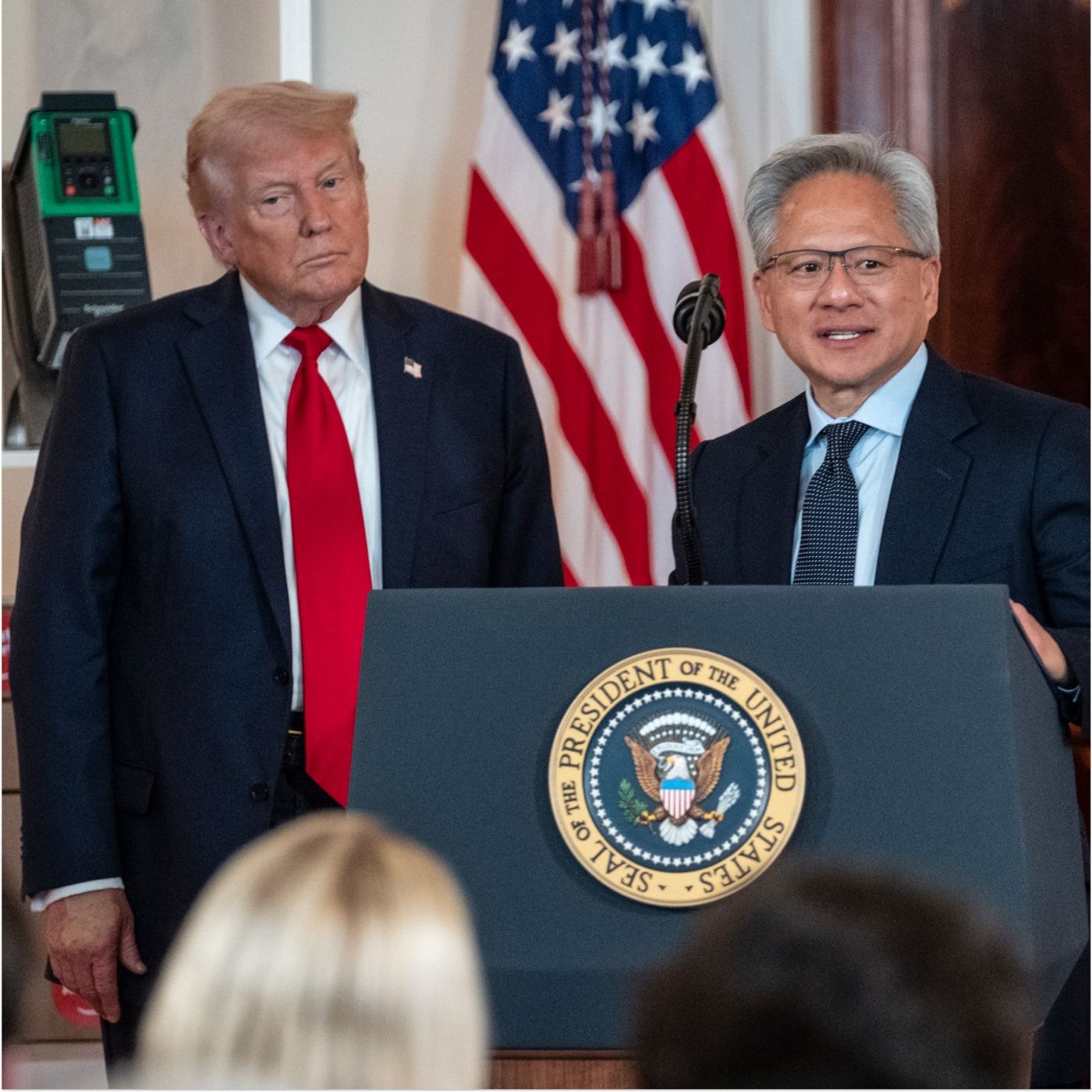
The Daily
Why Trump Just Gave China the Keys to A.I.’s Future
00:31:04
In the global fight to dominate A.I., China is quickly catching up to the United States — which is why President Trump barred the tech giant Nvidia from selling its superpowered computer chips to Chinese companies. Then, a few days ago, Mr. Trump abruptly changed course. Tripp Mickle, who covers Silicon Valley for The New York Times, explains how Nvidia’s C.E.O. persuaded the president that the best way to beat China at A.I. is to help them compete.
Loading summary
Transcript124 lines
- [00:00]
Advertiser
Do you own a business that's ready to thrive? It's time to let Intuit QuickBooks take things like unpaid invoices and tracking expenses off your plate so you can take things to the next level. QuickBooks is an all in one business solution that can help with those day to day tasks like invoicing and expenses. Manage and grow your business all in one place. Intuit QuickBooks your way to money. Get 90% off for 3 months limited time only terms and conditions apply.
- [00:28]
Michael Balbaro
From the New York Times, I'm Michael Balbaro. This is the Daily. In the global fight to dominate AI, China is quickly catching up to the United States, which is why President Trump barred the tech giant Nvidia from selling its super powered computer chips to Chinese companies until, that is, a few days ago, when Trump abruptly reversed course. Today, my colleague Trip Mickle on how Nvidia's CEO persuaded Trump that the best way to beat China at AI is to help China to compete. It's Tuesday, July 22nd.
- [01:32]
Trip Mickle
Well, Tripp, thank you for being here in person. It's very exciting when you tech folks from the coast make your way here to New York.
- [01:40]
Unnamed Analyst
Yeah, we come here to sweat. We leave the cool air of San Francisco to sweat in New York for the summertime.
- [01:46]
Trip Mickle
Yeah, well, I apologize for the weather here, but nothing else. So as you know, we cover a lot of AI here on the daily because its impact on everything grows day after day. And here in the United States, the idea is that to be number one at AI, we need to stay ahead of China, our number one adversary when it comes to AI. And that means restricting what American companies who hold the keys to AI's future can do in China. And that really means restricting what a single company can do. Nvidia, that's a company you cover.
- [02:23]
Unnamed Analyst
Yeah, absolutely. I mean, in the age of AI, Nvidia makes the most powerful chips to develop artificial intelligence. They have a 90% market share in that marketplace for a reason. It's because they began developing this technology more than a decade before anybody else. And conventional wisdom in Washington going back to the first Trump administration when it came to American technology was restrict, restrict, restrict everything that China has access to. And the Trump administration came into office with a mission to shut down Nvidia's shipments to China for the very reasons we just talked about. Let's make sure that the American AI companies stay ahead of the Chinese. And to do so, we'll shut off the lifeblood of developing that technology. And that lifeblood is Nvidia. But last week Donald Trump did what he often does, which is defy Washington convention. He decided, actually what we're going to do is we're going to make these AI chips available to the Chinese because paradoxically, we believe that will actually help American companies in the long run. And the big question is, is that going to prove to be true or not?
- [03:38]
Trip Mickle
Right. Well, we're going to try to unravel that argument in this conversation that giving China Nvidia's AI chips somehow might benefit the US which, as you say, is quite.
- [03:47]
Unnamed Analyst
It's a head scratcher.
- [03:48]
Trip Mickle
Paradoxical in theory. But I just want to talk about why this Trump reversal feels so big. I mean, it not only undermines the Trump restriction approach that you just described so well, it undermines the idea that China is a national security threat to the US that you would want to keep chips away from. And, and finally, it undermines this pretty central tenant of Trumpism when it comes to global trade, which is you don't embrace the view that free trade is the answer. This is not America First.
- [04:23]
Unnamed Analyst
No, this is a globalist approach. This is sell, sell, sell.
- [04:28]
Trip Mickle
So what happened here? How and why is it that the President reversed himself on Nvidia, selling chips to China, and in the process undermining all of these very natural Trump positions?
- [04:41]
Unnamed Analyst
What happened here is that the chief executive of the first company to be a $4 trillion company rolled up his sleeves and did the one thing he least enjoys, which is lobbying.
- [04:52]
Trip Mickle
So tell us about this CEO first and then the story of the sleeve rolling up in the lobbying.
- [04:59]
Jensen Huang
Yeah, in a lot of ways, you know, what I'm experiencing is probably the ultimate American dream.
- [05:05]
Unnamed Analyst
Jensen Huang is an electrical engineer by training. He's an immigrant. His family's from Taiwan Kai to the.
- [05:11]
Jensen Huang
United States when I was 7 years old, I guess 8 years old, and having the opportunity to found a company with good friends.
- [05:19]
Unnamed Analyst
He was raised in Oregon and Kentucky before going to Oregon State. And he teamed up with a couple of engineers at a Denny's, of all places.
- [05:30]
Trip Mickle
Wow.
- [05:31]
Jensen Huang
So we came here, right here to this Denny's, sat right back there, and the three of us decided to start the company. Frankly, I had no idea how to do it, and nor did they. None of us knew how to do anything.
- [05:42]
Unnamed Analyst
And started hashing out a plan for a new company that would make chips for video game developers three decades ago. And they focused exclusively on the video gaming industry for the better part of two decades. And eventually Jensen discovered that the chips that they were making were capable of doing computation simultaneously. And he saw within that computational power, the potential to develop artificial intelligence. And he began to pour billions of dollars into creating software that would control these chips and allow AI engineers to begin to build the artificial intelligence systems that we're now using today. I mean, we would not be here today without Nvidia. There's a reason they have become such a gargantuan company and passed Apple, Microsoft, like all the other tech companies you've known and thought about for decades, Nvidia just flew right past them in the span of two years, all because of this. So when AI has its lightning strike moment, the Biden administration begins to crack down on chip sales. They say to Nvidia, look, we're concerned about the speed and the processing power of these chips going to China because, as we have read a lot about, we're concerned that AI could be used by the Chinese military to coordinate strikes or to develop advanced weaponry.
- [07:16]
Trip Mickle
Right. And basically create a military advantage over the United States. And that's a risk that seems, for many, intolerable. Right.
- [07:23]
Unnamed Analyst
So in 2022, they say, we want you to throttle the performance of the chips you sell to China.
- [07:28]
Trip Mickle
And by throttle, we mean reduce.
- [07:30]
Unnamed Analyst
Reduce the level of capabilities of the chips. So Nvidia does that, and the chip that they came up with eventually for exclusive sale in China is called the H20. And it's just a variation of their chip that is.
- [07:45]
Trip Mickle
Less good.
- [07:46]
Unnamed Analyst
Yeah, less good than what they sell elsewhere. In the midst of all this, Wong is going to Washington for the first time. He's going to the White House for the first time ever. I mean, this is a guy who's been in business for more than two decades at this point, nearly three decades. He just hasn't gone to Washington and had to deal with political issues before. And he really doesn't enjoy it. And he's all of a sudden real. They need to open an office in Washington. They'd never done that. And then come November, President Trump is elected to office, and they realize, oh, wait, we don't even have a Republican lobbyist. So they hire their first Republican lobbyist. And the icing on the cake for Wong is when all the other CEOs in Silicon Valley show up at the inauguration and sit behind Trump and kind of do all that you need to do to get in his good graces. At the start of his presidency, Wong was somewhere else of all places, China.
- [08:41]
Trip Mickle
Oh, wow. Not the most politically adroit decision if you're trying to influence the incoming president. All the other tech CEOs got the memo. It Sounds like, yeah, he did not.
- [08:54]
Unnamed Analyst
He did not get the memo, you know? Meanwhile, at this point in time, Trump has tapped Howard Lutnick to be the head of commerce, which makes the decisions about what is sold abroad, essentially, and sets these restrictions.
- [09:08]
Howard Lutnick
And I take a very jaundiced view of China. I think they only care about themselves and seek to harm us, and so we need to protect ourselves. Right, and we need to stop helping them.
- [09:21]
Unnamed Analyst
He's gone before Congress in his Cabinet hearing and said, Nvidia's chips, which they.
- [09:27]
Howard Lutnick
Bought tons of, and they found their ways around it, drive their deep seat model. It's got to end.
- [09:33]
Unnamed Analyst
I'm going to get companies like Nvidia to stop helping China develop AI if.
- [09:38]
Howard Lutnick
They'Re going to compete with us, let them compete, but stop using our tools to compete with us.
- [09:46]
Trip Mickle
So suddenly, Wong's troubles are growing, and as you've said, he doesn't seem to have a lot of inroads to the Trump administration. He didn't even show up at the inauguration.
- [09:55]
Unnamed Analyst
He'd never even met Donald Trump before. So Nvidia's put on notice that the shutdown was coming, and Howard Lutnick extends an invitation to Wang and says, look, if you want to make one last appeal, you can meet with the president in Mar? A Lago on the sidelines of this $1 million candlelight dinner that President Trump was hosting as a political fundraiser. So Wang shows up, talks to the President, explains that the H20 chip that he's selling in China is not that powerful. But when people in the administration are briefed on this conversation, they feel like he's misled or undersold the capabilities of the chip because it actually has more power than Huang has led on. And so they move to swiftly shut it down. And Nvidia gets a letter a few weeks later saying that they cannot sell H20s in China.
- [10:54]
Trip Mickle
So he has completely misplayed things with the Trump administration.
- [10:58]
Unnamed Analyst
I mean, they were expecting about $15 billion in sales of this chip by the end of the year in China. A lot of money in China.
- [11:04]
Trip Mickle
And suddenly Trump is saying, no, no go. You had mentioned that. This is the story of Wang rolling up his sleeves and somehow overcoming this enormously consequential shutdown decision. So what is the story of how he pulls that off?
- [11:22]
Unnamed Analyst
After this shutdown, Wang's in need of a strategic reset. And so he begins to look for allies within the administration, and. And he finds one in David Sachs, who's the White House AI advisor and czar. The two of them see eye to eye on the idea that restrictions are not the answer. Sachs is a venture capitalist and a libertarian at heart and he begins to circulate and promote this idea that the best way for American companies in the AI world to succeed is to get as much of their technology around the world as fast as possible.
- [12:02]
Trip Mickle
Just explain the, the philosophy there because it's clearly at odds with what the rest of the administration thinks.
- [12:07]
Unnamed Analyst
It's at odds with what the rest of the administration thinks because it's like a very much a Silicon Valley philosophy. It is that the more developers you have and the more people who use your product, the more committed they become to that technology. And so the more they buy it on an each year basis, right? Like why do you buy another iPhone every year? It's because you're used to the way the technology works. It's the exact same philosophy. And so they're anticipating that China is going to challenge Nvidia at some point with a chip maker of its own and say we have to sell as many Nvidia chips abroad in the same way that Apple wants to sell as many iPhones abroad before people decide to buy an Android device.
- [12:51]
Trip Mickle
Dominance leads to American supremacy in AI. Don't restrict it. That's basically the argument, right?
- [12:58]
Unnamed Analyst
We will stay further ahead if we sell more chips than if we restrict chip sales either in China or anywhere else in the world.
- [13:07]
Trip Mickle
Okay, well, how does that argument go with the rest of the administration?
- [13:13]
Unnamed Analyst
With time, they begin to make headway on this in large part because one of the focal points of the administration is this trip that Donald Trump makes to the Middle east in May. And one of the things that Donald Trump wants out of this trip is deals, deals, deals.
- [13:32]
Trip Mickle
Right.
- [13:33]
Unnamed Analyst
And so in the run up to that trip, they began to go to work on a giant chip sale to the United Arab Emirates. And that is a capstone of this trip that Donald Trump makes across the Middle East. President Trump's visit to the Middle east.
- [13:49]
Emily Badger
Unleashing a wave of AI deal making.
- [13:52]
Unnamed Analyst
The Trump administration clearing a path for.
- [13:54]
Emily Badger
Saudi Arabia and the United Arab Emirates.
- [13:56]
Unnamed Analyst
To pursue their artificial intelligence ambitions. As deals with it culminates in the United Arab Emirates where they announce the sale of about 500,000 chips. They're going to build the largest data centers outside of the United States in the Emirates.
- [14:11]
Trip Mickle
And how does Wong and Nvidia fit into this?
- [14:14]
Unnamed Analyst
They're all Nvidia chips. And Sachs is the one who's at the negotiating table who puts this deal together.
- [14:20]
Donald Trump
Thank you very much. It's an Honor to be here. What a great place.
- [14:25]
Unnamed Analyst
And the President is there on his last day of his trip to praise this deal and highlight it before flying home.
- [14:32]
Donald Trump
Nvidia is investing, and I see my friend is here. Jensen. That's very good. Wherever you may be. Thank you very much.
- [14:39]
Trip Mickle
Because he's got it. So Wong gives Trump a major foreign deal. That means a lot to Trump.
- [14:46]
Unnamed Analyst
Wong gives Trump a win. And what does Trump love? He loves winning and he loves winners. And all of a sudden, he recognizes in Wang a US Winner.
- [14:55]
Donald Trump
Where is Jensen, by the way? Where is he? He's standing here. Where is he? I just saw Beth. Thank you very much, Jensen. I mean, Tim Cook isn't here, but you are. What a job you've done.
- [15:08]
Unnamed Analyst
And Wong decides this is a green light to go for the ultimate win, which is getting sales back in China.
- [15:16]
Trip Mickle
Getting the shut down on the sales of these chips to China. Eliminated.
- [15:20]
Unnamed Analyst
Yeah, absolutely. And he knows he needs to grease the wheels and get support from Trump for that. And one of the things that Nvidia does in the midst of all of this is promise to spend $500 billion on manufacturing chips and other AI products in the United States.
- [15:44]
Trip Mickle
Right. Because as we know, most of these chips are made overseas in Taiwan. He's saying, I can bring those here. We can start making them here. American jobs. Music to Trump's ears.
- [15:53]
Unnamed Analyst
Yep. This is exactly what the President likes to hear. And all of this builds up to a meeting at the White House in mid July where Wang goes into the Oval Office and begins to make this argument which is, look, let us sell into China. It will strengthen our business and strengthen American AI to do so. And Trump eventually, at the end of the meeting, agrees. And you have this massive reversal with Long walking out of the Oval Office elated that he's had this huge, colossal win.
- [16:28]
Trip Mickle
Right. Because Trump has quite literally reversed himself on something quite central to his entire political and economic identity.
- [16:37]
Unnamed Analyst
This is the President who started the crackdown on China to begin with, and now he's the one who's loosening the reins for Nvidia and AI chip makers so that they can plow right into China. Which raises this enormous question, what are the repercussions of this going to be?
- [16:58]
Trip Mickle
And that's what we'll talk about after the break. We'll be right back.
- [17:07]
Unnamed Analyst
Foreign.
- [17:15]
Advertiser
Do you own a business that's ready to thrive? It's time to let Intuit QuickBooks take things like unpaid invoices and tracking expenses off your plate so you can take things to the next level, QuickBooks is an all in one business solution that can help with those day to day tasks like invoicing and expenses. Manage and grow your business all in one place. Intuit QuickBooks your way to money. Get 90% off for 3 months limited time. Only terms and conditions apply.
- [17:41]
Emily Badger
I'm Emily Badger. I'm a reporter with the New York Times. Since the pandemic, empty office buildings have become much more common in many cities. Why can't we just turn them into housing? It's actually a really complicated question. To answer this question, you have to find a developer trying to turn an office building into apartments. Ride a rickety elevator to the 30th floor of a construction site to see the interior guts of a building. Finds an expert in incandescent light bulbs who can explain to you how they fundamentally change office buildings. And that's just the beginning of what you have to do. When you subscribe to the New York Times, you are sending reporters like me out into the world to ask questions of dozens of different experts to go and visit places most people don't get to go to. Try to come back with answers and then turn all of that into something that anyone can understand. If you'd like to become a subscriber, head to nytimes.com subscribe. You need to see the animated floor plans in this piece.
- [18:42]
Trip Mickle
So, Chip, let's really talk through the implications of Trump's reversal. And as we've established, it's a reversal on all kinds of Trump's core principles. America first, globalists are bad. China is a big, serious threat. How do you think he ultimately comes to terms with this argument that's been made by Wang and Sachs that selling these chips to China is somehow not a betrayal of all those things and that it's somehow good for the US and not better for China?
- [19:17]
Unnamed Analyst
In large part, the President came around on this because of the boogeyman that Wang and Sachs had created in Huawei.
- [19:24]
Trip Mickle
Giant telecom company in China.
- [19:26]
Unnamed Analyst
Right.
- [19:27]
Trip Mickle
And just remind us why Huawei is a boogeyman.
- [19:29]
Unnamed Analyst
Huawei is a boogeyman. And he's kind of really been a boogeyman for Trump himself going back to the first administration. It is China's crown jewel of technology. It is a company capable of designing smartphones, cars, telecom. And it's a company that when Huang talks about it, his eyes widen because he's petrified that if Huawei is able to begin making gains in the AI chips that it makes and they become as performative as those that Nvidia offers that it will just begin to squeeze Nvidia out of global sales. And there's this philosophy in tech companies, particularly inside chip companies, that the more they sell, the more money they make and the more money they can plow into research and development to make their technology better, faster, higher performance. And so Sachs and Huang's philosophy here is, if we don't sell to China, we're just leaving money on the table, and the Chinese are going to be the ones who are able to make the money and plow that money into research and development, their own future chips. Right. And they're going to leapfrog us. And for the Trump administration, they're sympathetic to this point of view. You have to remember China has the Belt and Road initiative. One of the things that Nvidia has also talked about in the course of this is the possibility that China could create Huawei data centers around the world. And then all of a sudden, instead of having American data centers and running AI on American technology, you have the risk of running it on Chinese technology.
- [21:05]
Trip Mickle
Just to explain what you're saying, One belt, one road. China's infrastructure program, where it deploys its money and sometimes its expertise to help developing economies get where they want to be when it comes to energy or roadways, solar. The idea is that Huawei could help China layer on top of that AI technology around the world, so the entire global AI economy could suddenly be operating on Chinese systems, not American ones. That's the fear.
- [21:36]
Unnamed Analyst
That's the fear. And there's a window right now where Nvidia is ahead of Huawei in terms of the quality of the chips it makes, in terms of its ability to make those chips.
- [21:48]
Trip Mickle
And.
- [21:48]
Unnamed Analyst
And Nvidia has argued we should take advantage of that window. Sachs has argued we should take advantage of that window. You have voices inside the administration, largely because of Sachs, who began to listen to this idea and take it very, very seriously.
- [22:04]
Trip Mickle
Help me better understand the vision that Wang especially has and has successfully sold to the president that giving China Nvidia's chips undermines Huawei without risking the idea that China uses Nvidia's chips to strengthen Huawei and leapfrog the US in AI.
- [22:26]
Unnamed Analyst
The philosophy there is basically that if Nvidia is not present, then Huawei is going to have to make gains in its chip development. It will have to catch up to Nvidia.
- [22:38]
Trip Mickle
That's interesting. In other words, if China has Nvidia's chips, if China has America's chips.
- [22:43]
Unnamed Analyst
Right.
- [22:44]
Trip Mickle
It's less incentivized to get really creative and strive to beat us?
- [22:49]
Unnamed Analyst
Yeah, essentially. And clutter the marketplace. Do you like auto racing at all?
- [22:55]
Michael Balbaro
No.
- [22:56]
Unnamed Analyst
No, but I can.
- [22:57]
Trip Mickle
I want to go wherever this metaphor goes.
- [22:59]
Unnamed Analyst
In a past life, I was a sports writer and I covered NASCAR. And in the world of NASCAR, teams like Hendrick Motorsports, which Dale Earnhardt Jr. Drove for, Jeff Gordon drove for Chase, Elliott drives for, they make engines, Chevrolet engines, and they sell them to other teams, and then they pour the money back into making better engines. And so they equip cars on the track that they compete against with the very same engine that's under the hood of their race cars. Now, this means that they can have more money to make more sophisticated cars than potentially their competitors.
- [23:34]
Trip Mickle
Do they ever get beaten by their competitors using their same engines?
- [23:37]
Unnamed Analyst
And this is the big conundrum, right, because there are so many other dimensions that go into racing. There's the driver behind the wheel, there's aerodynamics and the way the car. There's road conditions, there are wrecks. Right. Like, you just don't know what's going to happen. And so essentially what. What Nvidia has said is, you know, let us sell our engine overseas, China will build on that engine. Right? But we don't know whether or not China will make a leapfrog in its AI development, just like you don't know when you put a Hendrick car on the track, whether or not a competing car that has a Hendrick motor in it will pass it somewhere along the way. The difference is, if you're thinking about this racing analogy, if your car loses, that's not a big deal, right? But if you're thinking about this and you're somebody in the national security orbit in Washington, you're thinking about this and saying, this isn't a car that loses on a track. This is a system that could be used to coordinate military strikes, as we talked about earlier, develop weapons. It can be used for all these other purposes. So you do have the advantage of knowing the tech that is in that system, but you can't predict or control all the other factors that go into.
- [24:53]
Trip Mickle
Right. I mean, it's ultimately a very big bet on the idea that American ingenuity, when unfettered in the market, will remain dominant. And as you've said, the risks are high that it might not work. I want to go back inside the Trump administration for a moment. You said that this argument prevails. I'm curious, given the number of China hawks in the administration, whether, despite the fact that it has prevailed, there's some meaningful dissent within the administration over the fact that Trump is willing to let China have this potential opportunity to leapfrog us, even if the theory is it won't.
- [25:35]
Unnamed Analyst
Many of those voices have been sidelined in the past few months inside the administration, and they have not been able to push back.
- [25:42]
Michael Balbaro
Why?
- [25:43]
Unnamed Analyst
Why? We don't have a real clear answer on this, but the Trump administration has been so focused on trying to negotiate a trade agreement with China that it has begun to negotiate around some of these restrictions as well.
- [26:00]
Trip Mickle
Well, that raises an interesting possibility. Is this part of a larger trade deal with China?
- [26:07]
Unnamed Analyst
Howard Lutnick went on TV after Wang announced that he was open for business in China. Again, I'm looking at Nvidia getting a deal to be allowed to sell certain chips. Is that a change of heart?
- [26:19]
Unnamed Official
Well, it's funny because the Biden administration allowed China to buy these chips last year. So then we held it up and he said, and then in the magnets deal with the Chinese, we told them that we would start to resell them. So remember, these are.
- [26:35]
Unnamed Analyst
This is part of a broader negotiation, in part because China shut off access to rare earth metals that US Companies need to make products. So that was a factor here. Now, the other thing that Howard Lutnick went on and said was exactly what Sachs and Wong had been telling him.
- [26:55]
Unnamed Official
Which is, we don't sell them our best stuff, not our second best stuff, not even our third best. I think fourth best is where we've come out that we're cool.
- [27:04]
Unnamed Analyst
This is the fourth best chip we make, and that's what we're providing the Chinese with, and that's why we will still stay ahead. So, yes, like, it clutters the marketplace in China. It allows Nvidia to generate sales. And by the way, it is not the best we have to offer.
- [27:22]
Unnamed Official
Right. So you want to keep one step ahead of what they can build, so they keep buying our chips. Because, remember, you want the world's developers to use your tech. So Nvidia is driven to make sure all the developers of the world are still using their technology. So you want to.
- [27:39]
Unnamed Analyst
And so there's this giant gamble by the administration that that's good enough to keep American AI companies ahead.
- [27:46]
Trip Mickle
Right. Because we do have the first, second, and third best chips here in the U.S. let me zoom out for just a moment and put what Trump just did with these chips going to China into a larger context of where we are in this moment for AI because this reversal arrives at a pretty interesting moment for AI in the US I have watched with Enormous interest as tech companies here in the States engage in this unprecedented talent arms race. We're seeing job offers with $100 million compensation packages attached to them for a single engineer. And I know that might seem disconnected from what's going on with chips in China, but I suspect it's not.
- [28:36]
Unnamed Analyst
It's not in a way that has slipped under the radar a little bit. Some of these engineers that are getting these giant pay packages are actually Chinese. And one of the reasons that Wang has been so focused on getting back into China is because China accounts for 50% of the AI developers in the world. One country, 50%, right. So in a weird, weird way or an unexpected way, American AI cannot succeed without China. Right. Nvidia needs to sell chips over there, and China has really sophisticated engineers and they are at the forefront of AI development. And so you're going to want some of that talent. Like, look, this is a talent game. I mean, Zuckerberg's spending $100 million because he believes that these guys can really turbocharge what they're developing there. So you can't build a wall between the US And China on this. And the other thing that's at odds or intention here are national security interests and economic interests.
- [29:37]
Trip Mickle
Right, Explain that.
- [29:38]
Unnamed Analyst
National security folks are very, very worried about what China could do to harm the U.S. right. They're taking a very glass half empty view and a risk focused look at China. Silicon Valley is looking at the opportunity to make billions and billions and billions of dollars from this AI transformation. We're talking about a trillion dollar disruption of the entire economy. And so they are racing as fast as they can to grab as big a piece of that as possible. And those two forces are at odds with each other right now. And what we saw in Trump's decision is he decided to side with the economic forces and choose that over the national security concerns. It's really a glass half full promise. Right. And he's really going out on a limb.
- [30:35]
Emily Badger
Right.
- [30:36]
Trip Mickle
And by choosing the economic side of the ledger, Trump is making a bet.
- [30:41]
Michael Balbaro
A historic bet, that the US can.
- [30:44]
Trip Mickle
Keep its advantages over China and stay ahead of the national security threat that Nvidia's relationship with China could present.
- [30:58]
Unnamed Analyst
That's the hope you hope that your car stays faster on the track than anybody else's.
- [31:07]
Trip Mickle
Well, Trip, thank you very much.
- [31:09]
Unnamed Analyst
Thanks for having me.
- [31:24]
Michael Balbaro
We'll be right back.
- [31:31]
Advertiser
Do you own a business that's ready to thrive? It's time to let Intuit QuickBooks take things like unpaid invoices and tracking expenses off your plate so you can take things to the next level. QuickBooks is a powerful AI driven all in one business solution that can help with day to day tasks like invoicing expenses and taxes. QuickBooks can help you unlock the growth in your business so you can get back to enjoying your business. Manage and grow your business all in one place. Intuit QuickBooks your way to money get 90% off for 3 months limited time only terms and conditions apply.
- [32:04]
Unnamed Podcast Host
In 10 minutes or less. The Opinions podcast brings you a fresh way to understand the news with voices from New York Times Opinion.
- [32:13]
Trip Mickle
I've got a break for you. I'm actually going to tell you some good news today.
- [32:17]
Unnamed Podcast Host
One idea, one analysis, one perspective at a time.
- [32:21]
Emily Badger
Featuring David Brooks, Tressi McMillan Cottom, Michelle.
- [32:24]
Unnamed Podcast Host
Goldberg, Thomas Friedman and many more. Find the opinions in your podcast player.
- [32:35]
Michael Balbaro
Here's what else you need to know today. During a closely watched court hearing on Monday, a federal judge in Boston appeared deeply skeptical of the Trump administration's efforts to strip Harvard University of billions of dollars in research funding. Harvard has argued that the White House tactics violated the university's rights under the First Amendment. The White House, on the other hand, has framed them as a righteous response to anti Semitism. The judge will issue a final ruling without a trial as soon as September, and Monday's hearing suggested that Harvard may prevail. Today's episode was produced by Stella Tan, Sydney Harper and Jessica Chung, with help from Alex Stern and Eric Krupke. It was edited by Lexi DL contains original music by Marion Lozano, Dan Powell, Diane Wong and Pat McCusker and was engineered by Chris Wood. Our theme music is by Jim Brunberg and Ben Lanferk of Wonderlane. That's it for the Daily I'm Michael Balboro. See you tomorrow.
- [33:59]
Advertiser
Do you own a business that's ready to thrive? It's time to let Intuit QuickBooks take things like unpaid invoices and tracking expenses off your plate so you can take things to the next level. QuickBooks is a powerful AI driven all in one business solution that can help with day to day tasks like invoicing expenses and taxes. QuickBooks can help you unlock the growth in your business so you can get back to enjoying your business. Manage and grow your business all in one place. Intuit QuickBooks your way to money get 90% off for 3 months limited time Only terms and conditions apply.