← The Daily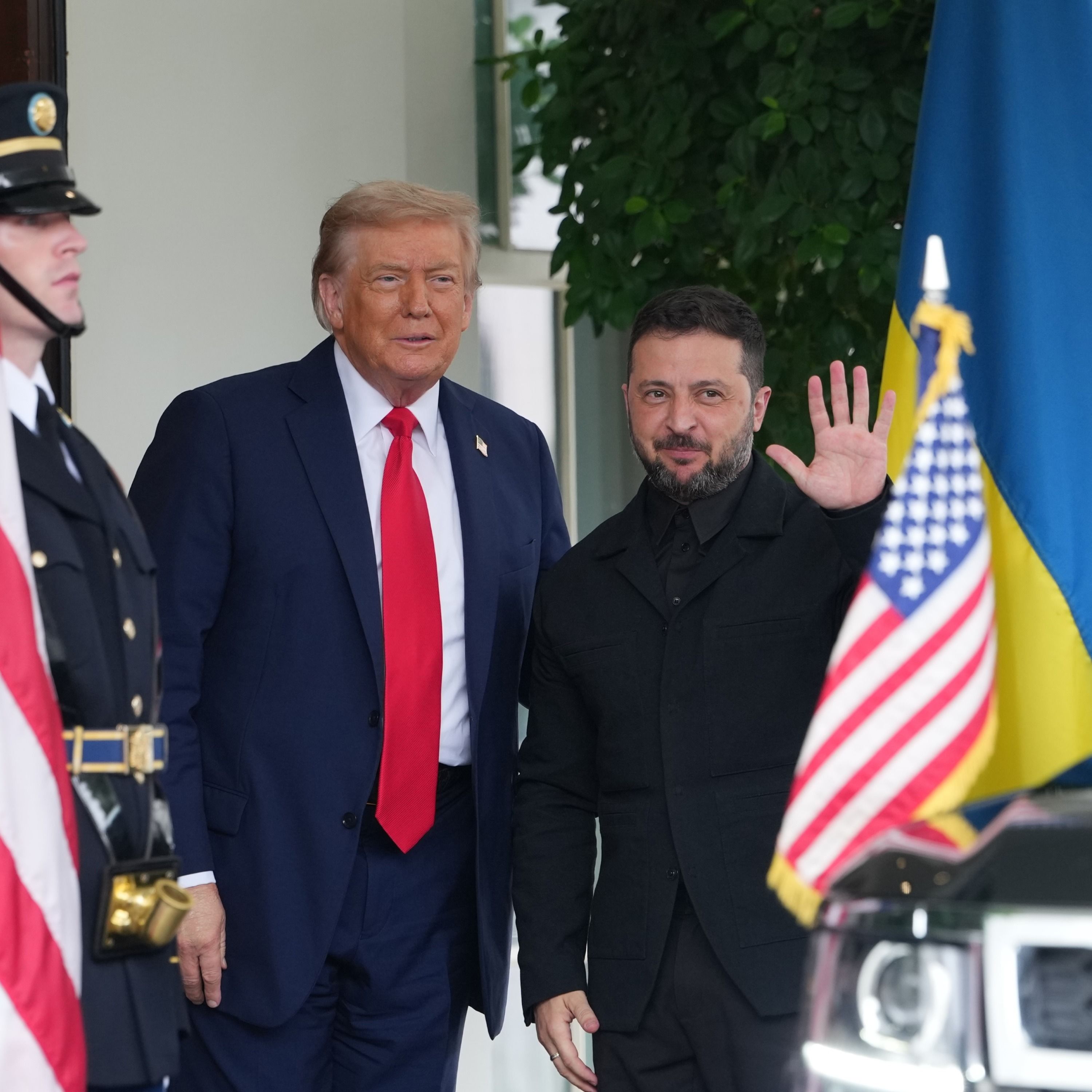
The Daily
Zelensky Survives Second Oval Office Meeting
00:30:24
European leaders raced to Washington to show their support for President Volodymyr Zelensky of Ukraine as he met with President Trump on Monday. It was their first face-to-face meeting at the White House since their disastrous blowup in the Oval Office in February. Michael Schwirtz, who covers global intelligence, explains how and why Mr. Zelensky’s approach has changed.
Loading summary
Transcript107 lines
- [00:00]
Podcast Host/Advertiser
Brought to you by the Capital One Venture X card. If you love to travel, Capital One has a rewards credit card that's perfect for you. With Venture X, earn unlimited double miles on everything you buy and turn all of your purchases into extraordinary travel. And you get premium benefits at a collection of luxury hotels when you book through Capital One Travel. Plus, you'll get access to over 1,000 airport lounges worldwide. Capital One what's in your wallet? Terms apply seecapital1.com for details from the.
- [00:31]
Rachel Abrams
New York Times, I'm Rachel Abrams, and this is the Daily Today, European leaders raced to Washington, D.C. to show their support for Ukrainian President Volodymyr Zelensky as he met with President Trump on Monday. It was the two men's first face to face meeting in the White House since their disastrous blow up in the Oval Office back in February. This time, Mr. Zelensky tried flattery and deference as he continues to press the United States for support in Ukraine's ongoing war with Russia. Today, my colleague Michael Schwirtz explains why Zelenskyy's approach has changed and how this meeting may give him a new advantage in his efforts to end THE It's Tuesday, August 19th. Michael Schwartz, we're talking to you because you have covered the Ukraine war since it was just an idea that we had you on the show to talk about. So we really appreciate you making the time on such a busy news day.
- [01:49]
Michael Schwirtz
Anytime.
- [01:50]
Rachel Abrams
So Michael, there were a lot fewer European leaders in Europe today because so many of them flew to Washington, D.C. for this kind of hastily organized but huge meeting with President Trump and Ukrainian President Volodymyr Zelensky. So to start, explain to us what this meeting was all about.
- [02:09]
Michael Schwirtz
This meeting was a response to a summit that President Trump had with his Russian counterpart, President Vladimir Putin of Russia in Alaska last week. And this is the latest in a series of efforts by the Trump administration to force some kind of settlements to the war in Ukraine, which is coming up on its fourth year. And there have been these on again and off again conversations between the White House, Trump and Ukrainian President Volodymyr Zelensky about trying to come together and forge some kind of peace deal.
- [02:51]
Rachel Abrams
Let's talk about that meeting that you mentioned last week a little bit more. We previewed it on Friday show and it was clear going into that meeting what specifically the Europeans and Ukraine were worried about, that basically Trump would give away the store, so to speak, that he would make too many concessions to Putin. What actually happened during that meeting last week and how did that meeting contribute to the meetings we saw on Monday?
- [03:16]
Michael Schwirtz
I think it's important to state firstly that we don't know exactly what happened in that meeting, despite all the fanfare around it. Trump and Putin went into this meeting, they had a three hour conversation, they made statements, they did not go into any kind of detail. And so what we got about the meeting came out sort of afterwards from both European leaders who were briefed on the call and from Trump himself. And the bottom line was it didn't go well for Zelensky.
- [03:44]
Rachel Abrams
How so?
- [03:45]
Michael Schwirtz
For several months, it seemed that Trump had come around to Zelensky's way of thinking. Trump was angry with Vladimir Putin about strikes on cities in Ukraine that were killing civilians. He had come around to. To Zelensky's position that a ceasefire needed to occur before any negotiation over a possible peace deal. He came out and stated that before traveling to Alaska, he said that Russia would suffer severe consequences if they didn't leave Alaska with a ceasefire deal. Will Russia face any consequences if Vladimir Putin does not agree to stop the war after your meeting on Friday?
- [04:24]
Donald Trump
Yes, they will. Yeah, there will be consequences.
- [04:28]
Michael Schwirtz
Tariffs.
- [04:29]
Donald Trump
There will be. I don't have to say there will be very severe consequences. Yes.
- [04:32]
Michael Schwirtz
And then he turned around and after that meeting came out, and his statement seemed to align more fully with what Vladimir Putin had desired.
- [04:42]
Donald Trump
Right now we're going to stop, really, five, six, seven thousand thousands of people a week from being killed. And President Putin wants to see that as much as I do. So, again, Mr. President, I'd like to thank you very much.
- [04:55]
Michael Schwirtz
And he jettisoned the idea that a ceasefire was a prerequisite for further talks. He said that he was okay with the two sides continuing to fight while the details of a peace deal came together. And he also described what seemed to be a kind of concession from Vladimir Putin, which is that Putin, according to Trump, would agree to halt fighting and freeze the war along the current lines so long as he obtained a large chunk of territory in Eastern Ukraine known as the Donbas. This put Zelensky, it would seem, in a very, very difficult position of having to respond to something that for him is untenable. Giving up territory, one, for the Ukrainians is against the constitution. There's a constitutional rule preventing the president from giving up territory if it's not done through a referendum. And two, this is a strategic area. Strategic. Well, fortified area for Ukraine that would leave them vulnerable should Russia attack again if they were to give that up.
- [05:59]
Rachel Abrams
So, okay, so all of that leads to Zelensky coming to the White House. What do we know about why so many European leaders decided to also join him there?
- [06:09]
Michael Schwirtz
I think we know specifically why they joined him there. But we can surmise the last time that Volodymyr Zelensky went to the Oval Office and met with Trump, it was disastrous, an absolute disaster. Have you said thank you once?
- [06:26]
Volodymyr Zelensky
No.
- [06:26]
Michael Schwirtz
In this entire meeting, have you said thank you? As everyone, I think, remembers, it devolved into a shouting match. In particular, when Vice President J.D. vance accused Zelensky of not being grateful enough. Business like this say thank you, except that they're accepting, except that there are disagreements. This set off a few months of really tense situation between the United States and Ukraine. There was a time when Trump cut off intelligence that Ukraine uses to target enemy troops. There was a time that they cut off supplies of needed weaponry. And this was probably the most dire situation that Ukraine founded in itself since the beginning of the war. And I think the European leaders, together with Zelensky, hatched this plan to basically give Zelensky backup. Zelensky was going to bring a posse with him this time, rather than going alone into the White House.
- [07:24]
Rachel Abrams
Right. And all of that leads to this pretty remarkable scene where you have all of these European leaders basically descending on the White House. Can you just sort of set the scene for us?
- [07:33]
Michael Schwirtz
Yeah. I mean, as Trump would say, it was great television. You had the White House decked out with military honor guard holding flags. You have fleets of SUVs streaming in, dropping off some of the world's most powerful leaders to go into the White House for this really kind of extraordinary gathering of people.
- [07:55]
Rachel Abrams
Can you just run through who was there today from the European side?
- [07:59]
Michael Schwirtz
Yes, it was obviously President Volodymyr Zelensky of Ukraine, the British prime minister, French president, Italian Prime Minister, the German Chancellor, the Finnish president, the European Commission president, and the NATO Secretary General.
- [08:15]
Rachel Abrams
And clearly the last, as you put a disastrous meeting between Trump and Zelensky must have been on everybody's mind. The tone, I watched the press conference, and the tone was remarkably different between these two men. Can you describe their interactions a little bit more?
- [08:31]
Donald Trump
Well, thank you very much. It's an honor to have the President of Ukraine with us. We've had a lot of good discussions, a lot of good talks, and I think progress is being made. Very, very substantial progress in many ways.
- [08:45]
Michael Schwirtz
Despite the topic that they were there to discuss and the continuing ongoing bloody fighting in Ukraine, there were points that were almost jovial.
- [08:55]
Donald Trump
So you say during the war, you can't have elections. So let me Just say three and a half years from now. So you mean if we happen to be in a war with somebody, no more elections. I wonder what the fake.
- [09:11]
Volodymyr Zelensky
You like this idea.
- [09:13]
Michael Schwirtz
It almost felt like there was back slapping going on. Trump went on a small segue to describe how. And this is, of course, coming on the heels of that meeting in February where one of the major points of contention was the way that Zelenskyy was dressed.
- [09:30]
Rachel Abrams
That's right. They criticized him for not wearing a suit, if I remember correctly.
- [09:33]
Michael Schwirtz
Right. And in this meeting, Zelenskyy, in what some are describing as a kind of concession, was in a kind of field suit, this all black outfit with a jacket that he had. He had worn before at the funeral of Pope Francis and on other occasions.
- [09:49]
Donald Trump
President Zelensky, you look fab in that suit. I said the same thing. Yeah, look. You look good. I said the same thing. Yeah, looks good. I said one that attacked you last time. See?
- [09:59]
Michael Schwirtz
And Trump went out of his way to comment on that. And one of the journalists, right wing journalists, who had attacked Zelensky for his lack of a suit in the White House apologized and said he looked great.
- [10:09]
Donald Trump
I apologize to you. Look, you look wonderful.
- [10:12]
Michael Schwirtz
No, my first question for you, President.
- [10:13]
Volodymyr Zelensky
Zelinsky in the same suit. You see, I changed your.
- [10:22]
Michael Schwirtz
But Zelenskyy seemed much more in command. It's also notable that JD Vance said nothing throughout the entire affair. And it was J.D. vance that really led the charge against Zelenskyy the first time. And he sat quietly with Marco Rubio and others while Zelenskyy was pretty much given the floor by Trump to state his peace. He spoke about the toll that the war has had on civilians.
- [10:41]
Volodymyr Zelensky
We live under each day attacks. You know that today have been a lot of attacks and a lot of wounded people. And the child was dead. Small bomb.
- [10:51]
Michael Schwirtz
He noted that in the hours before he arrived at the White House, there was a series of strikes on major cities in Ukraine that killed. At this point, it's about 14 people, I think, including a small child. And Trump really expressed sympathy for this.
- [11:06]
Donald Trump
It's been almost four years now that a lot of people were killed last week. A lot of people last week. I mean, millions of people killed, but a lot of people last week.
- [11:15]
Michael Schwirtz
For whatever reason, Trump has long sort of been frustrated by Russia's targeting of civilian areas in Ukraine. And it was sort of a surprising move by Putin to allow these strikes to go forward. Just as Zelensky was on the verge of talking to Trump, he basically gave Zelensky a wedge with which to use with Trump to bring him around to his position.
- [11:39]
Rachel Abrams
What we saw was basically not just a very different Zelensky, but also a very different Trump. It sounds like a Trump who's really giving Zelensky a platform to make his case to the world.
- [11:49]
Michael Schwirtz
I think that's right. The initial meeting in February between Zelensky and Trump and his team at the White House seemed like a premeditated ambush. This meeting seemed like it was set up to allow Zelensky to state his peace in Alaska. Putin and Trump came out for, I don't know, it must have been less than 15 minutes in total. Following their three hour discussion, delivered a series of platitudes about how great the meeting went and provided no details. Here they really got into some of the substantive issues such as security guarantees.
- [12:24]
Donald Trump
But we will give them very good protection, very good security. That's part of it. And the people that are waiting for us, they are, I think they're very like minded. They want to, they want to help out also.
- [12:35]
Rachel Abrams
Well, can we get into that a little bit? Like, can you just explain to us a bit more about what exactly is on the table, what those terms actually mean? Mean, Right?
- [12:41]
Michael Schwirtz
Yeah. We don't exactly know what's on the table because we don't exactly know what the Russian side wants other than full control over Ukraine or whether even the Russian position has changed at all from the moment that Putin announced his invasion. But from the Ukrainian side, Zelensky came in with his first demand, I would say is a ceasefire.
- [12:59]
Rachel Abrams
Right. But as Zelensky has said over and over again, like, why would I enter negotiations with bombs raining down on me, basically.
- [13:05]
Michael Schwirtz
Exactly. And Putin basically proved his point by shelling these, these cities today. In the meetings today, Trump didn't appear to waver at on the ceasefire, despite Zelenskyy continuing to press him on this as well as other European leaders. The other issue on the table is one of security guarantees. Zelenskyy, for his part, he was asked sort of what sort of security guarantees Ukraine needed from the United States when it comes to the future of its stability.
- [13:33]
Rachel Abrams
What security guarantees do you need from.
- [13:36]
Michael Schwirtz
President Trump to be able to make a deal?
- [13:38]
Podcast Host/Advertiser
Is it American troops, intelligence, equipment, what is it?
- [13:41]
Michael Schwirtz
And Zelensky answered with one word.
- [13:43]
Volodymyr Zelensky
Everything, really. We. It includes two parts. First, strong Ukrainian army.
- [13:52]
Michael Schwirtz
And this is where Trump's position, it seems to be a bit more favorable to the Ukrainians after long resisting, I think promising any kind of security guarantees for the Ukrainians. Trump has wavered recently in saying that yes, he's in favor of, of some kind of security guarantee backed up by the United States. But I think the message that was delivered today in Washington is that this war is bigger than just Russia and Ukraine. The fact that there are so many European leaders there, plus the NATO general secretary, it shows that Europe considers the, the war in Ukraine to be about their security as well. And the question is whether Trump is going to go along with that or whether Trump is going to reorient the United States and align more with Putin and Putin's idea of the world, which is a world divided among great powers, with lesser powers having not much say.
- [15:03]
Rachel Abrams
We'll be right back.
- [15:13]
Podcast Host/Advertiser
This episode is supported by Choiceology, an original podcast from Charles Schwab, hosted by Katie Milkman, an award winning behavioral scientist and author of the best selling book how to Change. Choiceology is a show about the psychology and economics behind our decisions. Hear true stories from Nobel laureates, historians, authors, athletes and everyday people about why we do the things we do. Listen to choiceology@schwab.com podcast or wherever you listen.
- [15:41]
Hannah Dreier
My name's Hannah Dreier. I'm an investigative reporter at the New York Times. So much of my process is challenging my own assumptions and trying to uncover new information that often goes against what I thought I would find. All of my reporting comes from going out, seeing something and realizing, oh, that's actually the story. And that reporting helps readers challenge their own assumptions and come to new conclusions for themselves. This kind of journalism takes resources. It takes a lot of time. It takes a lot of reporting trips. If you believe that that kind of work is important, you can support it by subscribing to the New York.
- [16:23]
Donald Trump
We've had a very successful day thus far. Important discussions as we work to end the killing and stop the war in Ukraine. We're all working for the same goal.
- [16:32]
Rachel Abrams
Okay, so how did the meeting go between Trump, Zelensky and the other European leaders?
- [16:38]
Michael Schwirtz
In the portion of the meeting with European leaders that was orchestrated for the press, the tone was very similar to that with Zelensky.
- [16:47]
Donald Trump
You look great with your tan. Where'd you get that tan? I want to. I want to get a tan like that.
- [16:53]
Michael Schwirtz
Everybody was in a very jovial mood. The point seems to have been, from the European leader's perspective, to flatter Trump. Thank you very much, Mr. President. I think in the past two weeks, we've probably had more progress in ending this war than we have in the past three and a half years. I will be very brief. I really want to thank you President.
- [17:16]
Donald Trump
Of the United States.
- [17:17]
Michael Schwirtz
Dear Donald, for the fact that you, as I said before, broke the deadlock, there was a lot of thank yous, a lot of people praising Trump for just making these negotiations happen.
- [17:29]
Rachel Abrams
So something is changing. Something has changed, thanks to you.
- [17:34]
Michael Schwirtz
So far, nobody, nobody's been able to bring it to this point. So I thank you for that. They're doing this because they know that this is what they need to do to get Donald Trump on board with their plan for the future of Ukraine and the future of European security. The bottom line is that Europe needs the United States. The bottom line is Ukraine needs the United States, and the United States is no longer a guarantee. The support of the United States in Europe, the support of the United States in Ukraine is no longer a guarantee. And that's what this meeting was about.
- [18:04]
Rachel Abrams
And besides saying a lot of thank yous and a lot of praise, what did they actually sort of discuss in terms of the substance of what's on.
- [18:13]
Michael Schwirtz
The table at this point in the meeting? This was the first time we started to see a little bit of pushback, to be honest.
- [18:21]
Friedrich Merz
We all would like to see a ceasefire.
- [18:25]
Michael Schwirtz
Where things became a bit more pointed was over the issue of a ceasefire. And at one point, Friedrich Merz, the Chancellor of Germany, stated flatly his disagreement with President Trump.
- [18:38]
Friedrich Merz
I can't imagine that the next meeting would took place without a ceasefire. So let's work on that and let's try to put pressure on Russia, because the credibility of this efforts, these efforts we are undertaking today are depending on at least a ceasefire.
- [18:56]
Michael Schwirtz
He said that a ceasefire had to happen before any future negotiations, and he urged Trump to focus on a ceasefire first and foremost.
- [19:09]
Rachel Abrams
What was their position on security guarantees at this meeting?
- [19:14]
Michael Schwirtz
The security guarantees have not been fleshed out. The idea, as we understand it, is there would be some kind of foreign contingent of troops presented and placed in Ukraine. And Trump has previously said that he would be supportive of that. When asked about that in one of the many news conferences today, your team has talked about security guarantees. Could that involve U.S. troops? Would you roll that out in the future?
- [19:42]
Donald Trump
We'll let you know that maybe later today.
- [19:45]
Michael Schwirtz
He did not rule out that the US Would send troops. He said this is something that would be negotiated down the line. In the past, he has been very, very clear that he would not send U.S. troops to act as a security guarantee in Ukraine.
- [20:00]
Rachel Abrams
Right. That seems like a huge change of direction for him.
- [20:03]
Michael Schwirtz
It's unclear whether Trump perhaps misspoke a little bit or was being intentionally coy, but, yeah, he did not give an unequivocal no when asked whether he would be willing to send troops into Ukraine.
- [20:15]
Donald Trump
There'll be a lot of, there'll be a lot of help when it comes to security. There's going be to be a lot of help. It's going to be good.
- [20:21]
Michael Schwirtz
But this, this is all theoretical at this point. First of all, this is the red line for Putin. This is the reason Ukraine's kind of increasingly close relationship with the west militarily, that he claims he invaded Ukraine in the first place. A statement released by the Russian Foreign Ministry, timed it seems to come out right when these negotiations were starting, took this idea of any troops aligned with NATO entering Ukraine complet completely off the table. They said that this is a no go area for us. So it's not clear how much wiggle room there is on that point.
- [20:58]
Rachel Abrams
But to that point about the red line and Europe sending troops to the front lines of this Ukraine, Russia conflict, I just want to step back for a minute here and talk about the role that these European countries seem to be playing because it's not like they are itching to send troops to the front lines, right? Like this war has been grinding on forever and it's actually feels like the US and everybody else is sending enough support to Ukraine so that it can keep fighting, but not enough support to frankly allow them to actually win the war. Like, as you mentioned, there are no troops on the ground. And Europe and the United States seem unwilling to do that, at least up until now, because they don't want to be dragged into this wider conflict. And so even though all of these European leaders seem to have been willing to interrupt their summer vacations to fly out to the White House and have Zelensky's back in these meetings with Trump, what are they actually committed to?
- [21:56]
Michael Schwirtz
I think you've laid out perfectly the Ukrainian complaint about Western support from the very beginning of this war. That complaint goes. I'll just reiterate what you said because you said it eloquently that the west wants to give us just enough to survive. They don't want to give us just enough to win. And the question is whether that is changing at this point and at President Trump's prompting. Yes, I think you're right that no country is willing to consider sending troops to Ukraine at this moment. There was a time when Emmanuel Macron, the French president, raised this possibility. But there's no serious discussion of any troops going into Ukraine at the moment from Europe. But things are changing in Europe. Trump has spooked the Europeans into thinking more seriously about their defense. The conventional wisdom after World War II was that there was an exchange made. The United States would provide a security blanket so that Europe could rebuild itself and not have to worry about also protecting itself while it did so. Trump has come to Europe, and I think many Europeans agree and said, you know, we're tired of taking such a strong role in your security. It's time for you to start pulling your weight. And Europe is beginning to rethink some of these questions that seemed in the past to be impossible to imagine. You know, Germany, which spent 80 years trying to break its past culture of militarism after World War II, is once again building up its military. So it's not out of the question that a stronger European role in providing for Ukrainian security could be on the table for discussion sort of in the future, but we're certainly not there yet.
- [23:42]
Rachel Abrams
But it's worth also just noting, just in terms of what Trump has applied pressure to, it's not just Germany that has been building up its military. I mean, basically, Trump has been able to ring concessions out of NATO so that the countries have all committed to spending more on defense. Right. Which they are doing not necessarily in order to defend Ukraine, but certainly these ideas are not divorced from one another.
- [24:04]
Michael Schwirtz
They're maybe not doing it necessarily to defend Ukraine, but I think the idea of a threat from Russia that goes beyond Ukraine is starting to seep into the European psyche. You definitely see this when you go to the Baltics these days. These are the countries that are on Russia's western border. They're preparing for war down to laying tank traps and dragons teeth. And you see all of them having jettisoned a treaty banning anti personnel landmines. These countries are preparing for war. And that mentality has started to go further west. You see this in Britain's recent security statement talking about the threats emanating from Russia. You even see it in Germany, which for so long, even after the invasion of Ukraine in 2022, has been hesitant to see and view Russia as an enemy. You see them building up their military not with theoretical threats in mind, but with the specific threat that Russia poses for the future.
- [25:04]
Rachel Abrams
I know that it's early, but at this point, what do we know about what will actually come out of this series of meetings that we are talking about that happened on Monday? Like, were any of these sticking points that we're talking about, the ceasefire, the land transfer, security guarantees? It doesn't sound like any of them were solved, but did they inch Any closer to resolving them.
- [25:25]
Michael Schwirtz
I think Zelinsky came to Washington today in a significant amount of danger. You had Trump writing as late as Sunday on Truth Social that President Zelensky could end the war with Russia almost immediately if he wanted to. And that was contingent upon him agreeing to this land concession, giving up the totality of the don boss, which is.
- [25:50]
Rachel Abrams
Basically a non starter.
- [25:51]
Michael Schwirtz
Right. But in this meeting, it seems like Zelensky, for the time being, sort of neutralized any of the static that discussion of that question would create. And he did that by doing what people who have negotiated with Trump have learned to do, just to find something to agree with him on. And Trump is keen on what he's describing as a trilateral meeting between Zelensky, Putin and himself that he wants to get done very, very quickly. And so what Zelenskyy did and what Trump seems to have backed him say, look, we'll discuss these territorial issues, but only in the face to face conversation with Vladimir Putin. And it should be pointed out that while Zelensky says he's willing to, to have that face to face conversation, and Trump says that he would really like that face to face conversation to happen, the Kremlin has been largely silent on this. And it's not clear whether Putin would ever at this point sit down and have a meeting with President Zelensky. You know, what I think we've learned from these two summits between Trump and Putin and Trump, Zelensky and these European leaders is that these talks allowed all sides to air their grievances. They allowed all sides to raise the conditions under which they would continue talking. But nobody agreed or even aired any idea of what their concessions might be. And so really what this ends up looking like is just sort of a game of ping pong between Zelensky and Putin and Trump is the ball.
- [27:37]
Rachel Abrams
And Zelensky has basically knocked the ball back into Putin's court.
- [27:40]
Donald Trump
Yeah, I really do believe I've known him for a long time. I've always had a great relationship with him. I think that President Putin wants to find an answer too. And we'll see. And in a certain period of time, not very far from now, a week or two weeks, we're going to know whether or not we're going to solve.
- [27:58]
Michael Schwirtz
This or now it's up for Putin to respond to this idea of a face to face meeting with Zelensky.
- [28:06]
Donald Trump
Thank you all very much. We appreciate it. Thank you very much.
- [28:11]
Rachel Abrams
In all of this, I should say this meeting today, this possible trilateral meeting, everything we've discussed assumes that Vladimir Putin actually wants a deal. But we've said on this show and we've reported in the Times many, many times, over and over again, it does not seem like Putin wants a deal at all. Right. He wants Ukraine. And so I wonder whether all of this that has happened in the last few days, whether it strikes you, I don't know, as a kind of theater almost.
- [28:41]
Michael Schwirtz
I think theater is what President Trump likes and theater is what President Trump understands. I don't know if in private conversations he's more interested in the substance of what is going on, but in his public appearances, it seems that he is more interested in the pomp and the circumstance and in making decrees and having them fulfilled than in getting down into the nitty gritty of negotiating what is at this point, an absolutely intractable conflict. And I think that both Vladimir Putin and Volodymyr Zelensky understand this and have come to learn this about Trump and are trying to use that to get whatever advantage that they can. But what this ultimately means is that there's no end to the war in sight. And what they're really having is a conversation about how to manage Trump, and they're not having conversations about how to end this war.
- [29:59]
Rachel Abrams
Michael Schwartz, thank you so much.
- [30:01]
Michael Schwirtz
I really appreciate it. Thank you very much.
- [30:21]
Podcast Host/Advertiser
We'll be right back. Ollie knows the back to school chaos all too well. Schedules, carpools, relearning algebra 2. It's a lot for you and your crew. Ollie makes wellness an easy and delightful part of your routine. Need immune support? Kids will enjoy. Try kids Multi plus probiotic. Is bedtime a struggle? Go with kids, Sleep for gentle support Moms support your immune system, nutrition and more with women's multi. Grab these products@ollie.com or retailers nationwide. These statements have not been evaluated by the Food and Drug Administration. This product is not intended to diagnose, treat, cure or prevent any disease.
- [31:00]
Michael Schwirtz
The New York Times app has all this stuff that you may not have seen.
- [31:03]
Hannah Dreier
The way the tabs are at the top with all of the different sections.
- [31:07]
Michael Schwirtz
I can immediately navigate to something that matches what I'm feeling.
- [31:10]
Rachel Abrams
I go to games, always doing the.
- [31:12]
Michael Schwirtz
Mini, doing the wordle.
- [31:13]
Hannah Dreier
I loved how much content it exposed me to things that I never would have thought to turn to a news app for.
- [31:19]
Michael Schwirtz
This app is essential.
- [31:21]
Hannah Dreier
The New York Times app, all of the Times all in one place. Download it now@nytimes.com app.
- [31:31]
Rachel Abrams
Here's what else you need to know today. The Trump administration has discussed taking a 10% stake in intel to help shore up the troubled US chip maker and bolster domestic semiconductor manufacturing, according to three people familiar with the talks. One idea being considered is to convert $10.86 billion in recent federal grants into equity and intel, which is worth about $100 billion. The proposal would be one of the largest government bailouts in a US Company since the rescue of the auto industry after the 2008 financial crisis. And the right wing cable channel Newsmax has agreed to pay $67 million to settle a lawsuit against Dominion Voting Systems, which Newsmax had falsely accused of rigging votes in the 2020 presidential election. The settlement did not require Newsmax to issue an apology or a retraction, and the company said in a statement on Monday that it stood by its coverage as, quote, fair, balanced and conducted with an professional standards of journalism. Today's episode was produced by Michael Simon Johnson and Stella Tan. It was edited by Brendan Klinkenberg and Mike Benoit and was engineered by Chris Wood. That's it for the Daily. I'm Rachel Abrams. See you tomorrow.
- [33:07]
Podcast Host/Advertiser
Your home is an active investment, not a passive one. And with Rocket Mortgage, you can put your home equity to work right away. When you unlock your home equity, you unlock new doors for your family, renovations, extensions, even buying your next property. Get started today with smarter tools and guidance from real mortgage experts. Find out how@rocketmortgage.com Rocket Mortgage LLC licensed in 50 states nmlsconsumeraccess.org 3030.