← The Daily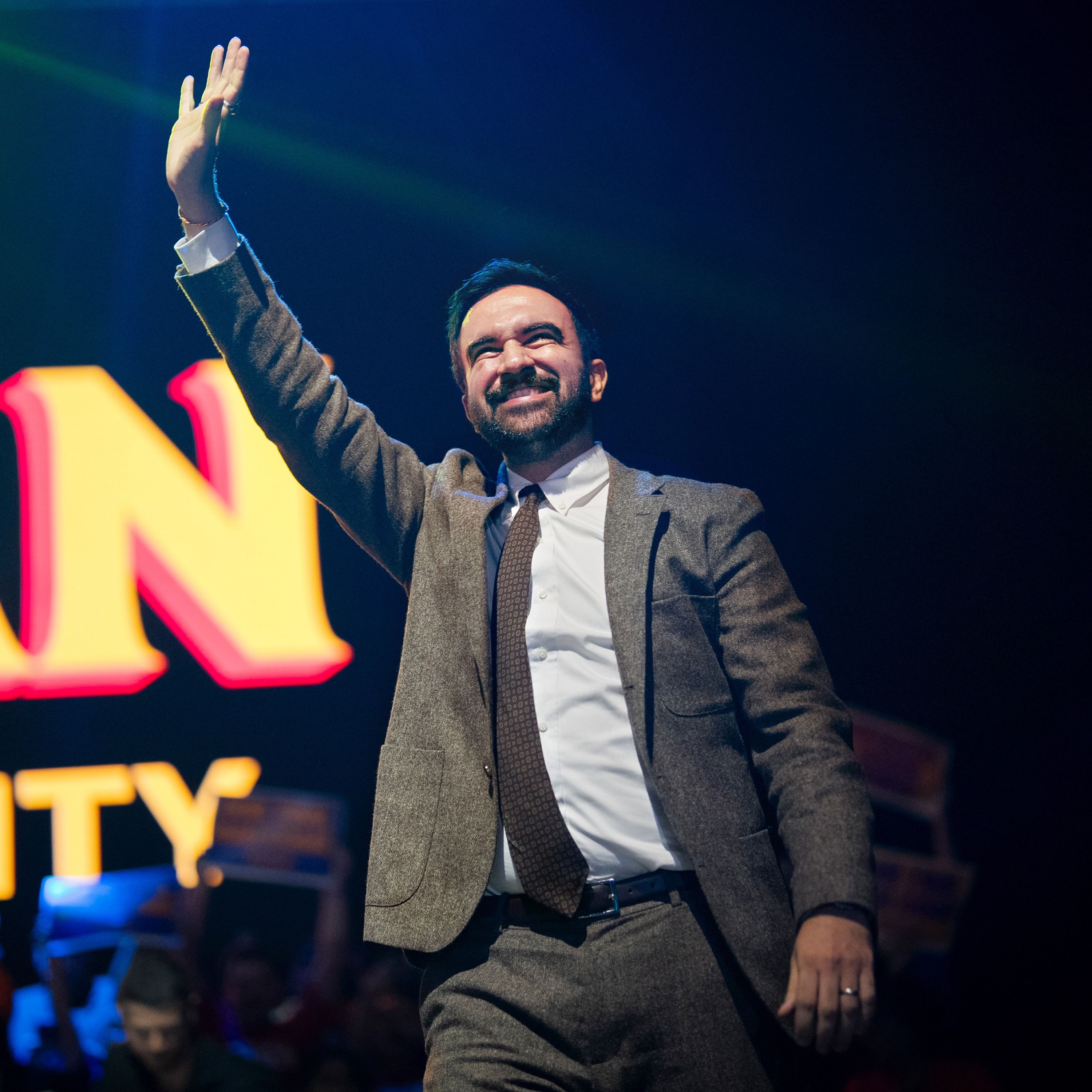
The Daily
Zohran Mamdani Explains His Rise
00:52:39
Assemblyman Zohran Mamdani’s come-from-behind victory in this summer’s Democratic primary for New York City mayor is already the stuff of political legend. But in many ways, the most intriguing phase of his campaign has been the period since then, as he has labored, painstakingly, to win over his skeptics. How, exactly, would a 33-year-old member of the Democratic Socialists of America, with little management experience and a record of polarizing pronouncements, win over enough voters to prevail in the general election? So far, the polls suggest he’s doing just that. And so, a few days ago, “The Daily” sat down Mr. Mamdani for an extended conversation about his campaign, the forces and ideas that have animated it and his plans, if elected on Nov. 4, to deliver on his campaign promises and contend with a Republican president who has promised to treat him as an enemy from his first day in office.
Loading summary
Transcript161 lines
- [00:00]
Podcast Host/Announcer
This podcast is supported by the Capital One Venture X card. Venture X offers the premium benefits you expect, like a $300 annual capital one travel credit for less than you expect. Elevate your earn with unlimited double miles on every purchase, bringing you one step closer to your next dream destination. Plus, enjoy access to over 1,000 airport lounges worldwide. The Capital One Venture X Card. What's in your wallet? Terms apply. Lounge access is subject to change. See capitalone.com for details.
- [00:33]
Zoran Mamdani
Who has already signed up to Canvas?
- [00:38]
Michael Barbaro
So what I am staring at is a line of people waiting to get inside Zoran Mamdani's campaign rally here in Washington Heights. It's now 6pm on Monday night, October 13th. It's hard to explain just how big this line is. It literally spans three and a half blocks and it is dense. And we are going to talk to people in this line and inside this rally about what it is Mamdani means to them.
- [01:07]
Zoran Mamdani
Let's go.
- [01:11]
Michael Barbaro
We're from the show called the Daily. Oh, hello. Hi. And we're just going to ask people in a word, what Mamdani means to you, what he represents. One word. Yeah, one word.
- [01:22]
Zoran Mamdani
Compassion.
- [01:22]
Michael Barbaro
Honest person. He's real.
- [01:24]
Zoran Mamdani
He's brown.
- [01:24]
Campaign Staff/Supporter
And I'm brown.
- [01:25]
Zoran Mamdani
That simple?
- [01:26]
Michael Barbaro
That's simple, yeah.
- [01:26]
Zoran Mamdani
Hope. Hope.
- [01:27]
Michael Barbaro
My first choice would be. And then the future.
- [01:30]
Zoran Mamdani
I think he is a fresh and actual change in the party.
- [01:34]
Michael Barbaro
I'm 16 years old and from what I've heard, cool camp. No, I can't. But I've been volunteering under Zoron. And apparently, according to adults, it's really rare to be like happy or excited about a politician. So, you know, this is kind of a once in a lifetime thing. I'm here because actually my son turned me to Zorhan. I didn't know anything about him. I was talking to him one day, I said, you know, I may just vote for Cuomo, because I thought it was Cuomo.
- [02:00]
Zoran Mamdani
And.
- [02:00]
Michael Barbaro
And Adam.
- [02:01]
Zoran Mamdani
Yeah.
- [02:02]
Michael Barbaro
He's like, you didn't hear about Storehead? And I said no. He sent me a couple of videos and I like what he had to offer. So more so that you're here at his rally and I've been canvassing for him actually the past three weeks. So we're also very excited about his position about Palestine and what's going on. I'm an anti Zionist Jewish girl and I think it's really important that people see that perspective.
- [02:26]
Zoran Mamdani
Right.
- [02:26]
Michael Barbaro
Like finally some movement away from centrist pandering to oligarchic fascists. Not to put too Fine. A point on it. A rather fine point. I feel like it's very necessary for us to have places in this country that are very openly progressive and are not bending to the will of what the president wants and what he represents as a working class person. This is very exciting moment for us. Someone thinking about us. Someone commit to working for us. We're about to raise a family. We don't want to be priced out.
- [03:03]
Campaign Staff/Supporter
I have.
- [03:03]
Michael Barbaro
You're pregnant? Very much so. How many months?
- [03:06]
Zoran Mamdani
Eight.
- [03:07]
Michael Barbaro
I mean, I don't want to be presumptuous, but free child care for all. Yeah, we were just talking about that. It very much is. Yes. Zoran. To help us freeze the rent, faster buses. He's going to get free buses. Put cheaper groceries, grocery cheaper and child.
- [03:24]
Zoran Mamdani
Care and help families.
- [03:26]
Michael Barbaro
All right, thank you for your help. People know this platform like they know the back of their hands, ladies and gentlemen. And now we go to security. They'll check you in. So we're inside this auditorium now, which has a capacity of about 3,500 people. And it very much feels like it's at capacity. I need you to roll for the next mayor of the city of New York, Zoran. After a very long wind up and a bunch of introductory speeches, Mandani is now finally taking the st.
- [04:09]
Zoran Mamdani
Billionaires like Bill Ackman and Ronald Louder have poured millions of dollars into this race because they say that we pose an existential threat. And I am here to admit something. They are right. Fundamental change only comes the courage to turn your back on the old formulas, the courage to invent the future together. That is exactly what we have done. For all those who say our time is coming, my friends, our time is now.
- [05:11]
Michael Barbaro
Okay, so the rally is now over. The crowd is spilling out onto the streets of Washington Heights. And the next stop for us is Mamdani's campaign headquarters in Manhattan where we are going to sit down with him for an interview from the New York Times. I'm Michael Barbaro. This is the Daily Today. Zoran Mandani on the movement he's created in New York City. His critique of the Democratic party, his courtship of those he has alienated with his campaign so far, and his plans to stand up to Donald Trump. It's Thursday, October 16th.
- [06:02]
Campaign Staff/Supporter
Hello.
- [06:03]
Michael Barbaro
Hey, we're here to go to the Mandali campaign headquarters. Oh, they'll come pick us up. Okay, I'll text them. Oh, there's assemblyman.
- [06:13]
Zoran Mamdani
Hello.
- [06:14]
Campaign Staff/Supporter
How are you?
- [06:14]
Zoran Mamdani
Hello, Asta. Nice to meet you. The third floor, which we sometimes stop at, has these Halloween decorations that always take you a little bit aback.
- [06:36]
Michael Barbaro
Is this. Is this your office? Yeah. Okay. Oh, wow. To call it modest would be an injustice to the word modest.
- [06:48]
Zoran Mamdani
Modest is. Yeah. You can sit in that chair, the recliner.
- [06:57]
Michael Barbaro
Okay, we're going. Assemblyman. Do people call you assemblyman?
- [07:03]
Zoran Mamdani
Some people do. You can. You can call me Zoran.
- [07:07]
Michael Barbaro
That's a little familiar. Assemblyman Mondani, thank you for making time for us. And thank you for inviting us to your rally last night.
- [07:14]
Zoran Mamdani
You're very welcome. It's a pleasure to be here.
- [07:16]
Michael Barbaro
So you sit, according to the polls, including our own, at the Times, on the cusp of a historic political victory. Because at the age of. Well, you're now 33, but you'll be 34 just a couple days after this runs. You would be the youngest mayor in a century. You'd be New York City's first Muslim mayor. You'd be its first Democratic Socialist mayor.
- [07:39]
Zoran Mamdani
Well, I. I wouldn't actually be the first Democratic Socialist mayor.
- [07:42]
Michael Barbaro
Who would it be?
- [07:43]
Zoran Mamdani
David Dinkins was also a member of the Democratic Socialist.
- [07:45]
Michael Barbaro
He was a co member of the Democratic Party on the right. Is that it?
- [07:49]
Zoran Mamdani
Well, he was a member of dsa. He identified also as a Democratic Socialist.
- [07:52]
Michael Barbaro
Interesting. Thank you for the. Thank you for the correction, unaware you'd be the second Democratic Socialist mayor after David Dinkins. And I'd like for this conversation to trace the arc of how you got to this moment. The forces, the ideas that made you the candidate that first got into this race, the style of the campaign that transformed you from being, I think it's safe to say, virtually unknown, into the winner of the primary for the Democratic nomination. And the way since that you have tried to broaden your appeal, answer your skeptics in this general election, and finally, of course, what it will look like if you do become mayor. And somehow we're gonna do that in an hour. You grew up the son of a well known filmmaker. Your mother directed Denzel Washington, even Mississippi Masala, Mississippi Masala. Your father was a college professor who studied, among other things, apartheid and genocide. As a young man, you become a college activist. You're focused on progressive politics. And when you graduate from college and start your career in the progressive world, you start to identify not as a Democrat, but as a member of the Democratic Socialists of America. And given your bio, being a Democrat feels like it would have been a pretty natural home. So just let me start by asking about what went into that decision, what you were embracing and what you were rejecting in that identification.
- [09:19]
Zoran Mamdani
So I I wouldn't describe those two identities as mutually exclusive. I think that one can live within the other. Meaning that I am both a democratic socialist and I'm also a Democrat. One is a description of my political ideology. The other is a description of the party that I belong to. DSA being the ideology, democratic socialism being the ideology, DSA being an organization, the Democratic Party being the party. And it was Bernie Sanders run in 2016 that gave me the language of democratic socialism to describe my own politics. It took what I had thought were disparate ideas and cohered them and gave me an understanding of what that politics was and also what a larger movement looked like of people who also were animated by that same focus on dignity, on the unacceptable nature of income inequality across this country. And to me, what democratic socialism means is a belief that it is government's job to ensure that every person is living a life of dignity. And dignity is not the things that you'd like, it's not the things that you'd want, it's the things that you need. And there's a general common sense around many of those things. You know, in New York City, in this country, we'd say that every child deserves public education that's free point of service of K through 12. But we also think that it's okay to be priced out of the education you need prior to that, child care. And for some reason, there's a point at which you should deserve education, then there's a point before that at which it depends on your family's ability to pay.
- [10:57]
Michael Barbaro
Right. And it's somewhat arbitrary.
- [10:59]
Zoran Mamdani
Yes. And the ability to pay is not a nominal amount. We're talking about an average generally of $22,500 a year for a three year old or a four year old or a two year old. And so to me, what Democratic socialism is the. The fulfillment of the ideal that underpins things that already exist within our society but are currently being applied in either a partial manner or not at all.
- [11:22]
Michael Barbaro
So democratic socialism gives you a vocabulary to identify those injustices, those inequities, and say they don't need to be.
- [11:33]
Zoran Mamdani
And it teaches me that the way I feel about housing and the way I feel public transit and the way I feel about childcare. These are not different opinions necessarily. They are in fact rooted in the same understanding of the world we should be living in.
- [11:50]
Michael Barbaro
Democrats talk about many of the things that you just identified have for quite some time, right. Childcare, healthcare, affordability. And I think it's fair to say that and this I think was on display at your rally last night that you have some real objections to the way traditional Democrats have operated. And I want to get to the heart of that, where you think the distinction lies between the problems you're identifying and want to solve, the vision for solving it, and what the existing Democratic Party's view of those things are, because you don't mince words about old ways, old formulas, and a kind of sclerotic Democratic Party that you see your movement as not just changing, but maybe fully replacing.
- [12:43]
Zoran Mamdani
You know, in this race right now, it's easy to view one of my opponents, Andrew Cuomo, through the former governor.
- [12:53]
Michael Barbaro
Yep.
- [12:53]
Zoran Mamdani
Caricature that he is creating of himself. But prior to this moment, he was considered by many to be a leader in the Democratic Party, one of the most prominent Democrats to emerge from this state at a point, someone that people were speaking about as a politician who should run for president of this country.
- [13:16]
Michael Barbaro
I remember.
- [13:17]
Zoran Mamdani
And he is an example of so much of what has disappointed so many about our party, because for all that he is today, there have been examples of this in years past. And these were the very things that we would overlook or we would simply see as parts of what politics had to be.
- [13:39]
Michael Barbaro
Yeah. Get specific about it, if you don't mind, because I think there are plenty of New Yorkers who see an Andrew Cuomo putting aside, which for many is impossible, the allegations of sexual misconduct. A governor who used his platform to remake LaGuardia Airport to build Moynihan Station. We just went through it to pass gay marriage, who used the Democratic Party and its values to create pretty substantial change.
- [14:13]
Zoran Mamdani
And he's the same governor who ensured that there would be Republican power in Albany such that the only progress that would be made was that which he was willing to accept. Many of the same achievements that are accredited to him are the ones that he was initially an obstacle towards before becoming seen as the architect of thinking about this, as the same person who cut funding for a program called Advantage that was providing millions of dollars in. In connecting homeless New Yorkers with apartments that they could live in. And I actually met a woman right here in New York City who had just been approved to that program right before the funding was cut. And the cutting of that funding was one that then pushed her out of the apartment that she was able to rent. This is the same governor who gave Elon Musk $959 million in tax credits in New York. In New York, I say these things because sometimes it's tempting to think that all that is wrong in this moment is from Donald Trump. But it's important that the same people that we have villainized and thought of solely through the prism of Trump existed prior to him and in fact, were some of the very people that were uplifted by these kinds of leaders from the Democratic Party. If you want to understand why so many have come to associate politics with a extended play of diminishing faith and trust, then we also have to understand who the politicians have been that have been leading these very parties, and that many of these issues are not exclusive to the Republican Party. They are, in fact, endemic within our party. And if we want to truly move beyond Donald Trump, we also have to understand the systems that allowed for the flourishing of someone like Donald Trump, and that many of those systems and styles of politics are also within our own party. And Andrew Cuomo being an example of the fusion of these things.
- [16:06]
Michael Barbaro
So just to distill this critique, Democrats like Cuomo make big progressive promises. When the rubber meets the road in your mind, they will cave to the other side, to the elites, to the donor class, to. They ultimately disappoint on questions like affordability. And you're saying you will not. You will not do that, you will not disappoint?
- [16:27]
Zoran Mamdani
Yes, that's the idea, yes.
- [16:30]
Michael Barbaro
Why do you think that they make compromises that you, not yet mayor, not governor, and not having to work with the other side, are so certain you will never make? I've heard about these pauses.
- [16:52]
Zoran Mamdani
It's interesting. Well, you think it's interesting to hear you say the word the other side. Part of my point is that Andrew Cuomo created the other side in Albany. He took what would have otherwise been a Democratic trifecta of Democratic control of the governor's office, the assembly, and the state Senate, and ensured that there was a Republican minority in the Senate that.
- [17:14]
Michael Barbaro
Was talking a little bit inside baseball. But in New York, Andrew Cuomo almost needed, wanted, benefited from a diffusion of power that kept the Democratic and, frankly, the progressives in New York in check.
- [17:28]
Zoran Mamdani
Exactly. And I share this example.
- [17:29]
Michael Barbaro
It's almost like you spent some time.
- [17:30]
Zoran Mamdani
In Albany as inside baseball as it is.
- [17:32]
Michael Barbaro
But I think that's clearly because he feared an unchecked left or a left.
- [17:37]
Zoran Mamdani
That would actually be able to deliver, and, God forbid, an unchecked left that was able to fulfill the aspirations of working people. And I say this because governing will necessitate compromise. There's no question about that. Some of the compromises that have been made, however, are not the ones that are actually innate to these positions. And to this politics. Some of them have actually been created as a means by which to ensure that we could never fulfill the ideals that have brought so many to politics. And the reason I am confident in my ability to deliver on what we have campaigned on is because of the fact, one, that we have campaigned on a very specific set of commitments. I would argue that far more than many other campaigns, New Yorkers know exactly what it is that I'm running on. I'll have people stop me in the street and just shout, fast and free buses or universal childcare or freeze the rent.
- [18:29]
Campaign Staff/Supporter
Yeah.
- [18:30]
Zoran Mamdani
And that means that we're building a movement not around an individual, but rather around these policy commitments. And that is what we will be held to account for. And that is something that I want, because in order to bring people back to politics, in order to bring people's faith back to the idea that government could actually make their lives easier, we have to be honest about what it is we're fighting for, who we're fighting for, and then to deliver on those very things.
- [18:57]
Michael Barbaro
I want to go back for just a moment to a timeline when you're kind of working your way from progressive causes into politics. Clearly, you're inspired at this phase by Senator Bernie Sanders, this movement, this campaign he's created. You run for State Assembly 2020, a really big year in American civil discourse politics. And I wonder if you'd agree with this. It feels to me, looking back at that period, that you're very much straddling the line still between activist political candidate. People who may someday run for mayor of New York City, for instance, tend not to go on social media and right things. And, you know, this tweet, and I know it gets brought up, I think it's fair game. When you wrote in 2020, we don't need an investigation to know that the NYPD is racist, anti queer, a major threat to public safety. You call for defunding the nypd. People who think they may run for mayor tend not to describe themselves ever as anti Zionists. Those things in the past would be seen potentially as disqualifying. That clearly didn't happen in this case with you. But I am curious what prompted you to express those views, especially about the police at that time.
- [20:16]
Zoran Mamdani
I moved to New York City when I was 7 years old. This is where I grew up. And one of the things that I would think about often was the necessity of safety and justice. And growing up meant learning about the moments in which the chasm between those things felt as if it was only continuing to Expand. Learning about the Central Park. 5 Growing up in the city and reading about the wrongly convicted, the exonerated Five growing up and reading about Sean Bell, Eric Garner.
- [20:54]
Michael Barbaro
Yeah, these are victims of police brutality in the city.
- [20:57]
Zoran Mamdani
Reading about Michael Brown. And then in 2020, in the year the tweet is written, the murder of George Floyd. And feeling like this chasm was at the largest I'd seen it in my own life, and struggling with how far apart it felt. And in the time since then, becoming an assembly member, representing about 130,000 people in northwest Queens, Astoria and Long Island City, and learning that to deliver that justice doesn't mean to do so in isolation. It means to still fulfill these twin necessities of safety and justice. And doing so means working with police officers who put their lives on the line every single day, representing Muslim New Yorkers in the District that I represent who were illegally surveilled on the basis of their faith, going so far as even to be watched when they played soccer. And the black and brown New Yorkers who've been victims of police brutality. It means representing all of the eight and a half million people of this city and understanding the necessities of doing so while delivering safety and justice and. And understanding that no one thing can be or should be pursued without the other.
- [22:16]
Michael Barbaro
Let me fast forward a little bit to June, the primary, where you blow everyone away, all your opponents. And it seems like even on the night of that victory, you start to confront those who are skeptical of you and who you want to win over. And since we were just talking about police, let's talk about what you have said since the primary victory. I think it was actually at the times where my colleagues asked you about how you're going to be thinking about the police. And I was struck that you said you were prepared to apologize to the NYPD for some of the things you had said, defund the allegation that the department is racist. Given what you just said about the experiences you recollect, why issue that apology? And what would the apology even be?
- [23:04]
Zoran Mamdani
The issuing of it is to reckon with the fact that it's language that I'm applying to officers, when, in fact, what I'm speaking about are specific practices. And when I've met officers, not only over the course of being an assembly person, but also running for mayor, understanding that behind every caricature, behind every headline, is a New Yorker trying to do their best. And those meetings, those conversations, those are some of the ones I've appreciated the most, where I've shared An apology for the language that I've used and a desire to continue to fulfill those same ideals of safety and of justice and to do so together.
- [23:46]
Michael Barbaro
Are you apologizing for the language or for the thinking behind it? And I'm not trying to be academic about this, but do you still think that the NYPD as an institution is racist?
- [23:58]
Zoran Mamdani
No. And I'm. What I'm apologizing is for the language that I've used and also doing so. As someone who is clear eyed about the necessity of still fulfilling those two.
- [24:13]
Michael Barbaro
Things, let me turn to the rest of your outreach, which has been really striking. I mean, let's turn to developers and to, frankly, the super rich in New York and business leaders. You've been openly skeptical of the role of developers. For example, you have said you don't think billionaires should exist. Last night at your rally, you said that your movement is an existential threat.
- [24:38]
Zoran Mamdani
To billionaires who think that they can buy an election. Full quote.
- [24:44]
Michael Barbaro
You got to feel the. You gotta. You're right.
- [24:46]
Zoran Mamdani
It's a podcast.
- [24:47]
Michael Barbaro
You can't do the ellipses accurately. That's what I wrote down. Maybe I missed the full sense. And you would like to increase taxes on those making over a million dollars a year to pay for things like the three big promises by 2%. And yet you're meeting with many of these people at their offices, at their homes, in some cases. What have you said to those leaders in your meetings with them, and what have they said to you?
- [25:12]
Zoran Mamdani
I've said many of the same things that I'm saying at these rallies out on the street, in these conversations, which is that I continue to believe that two of the most straightforward and productive ways to raise revenue to fund a significant part of our affordability agenda and the need to trump proof the city are by, as you said, trump proof.
- [25:35]
Michael Barbaro
We'll get back to that.
- [25:35]
Zoran Mamdani
Yes. Are by increasing personal income taxes on the top 1% of New Yorkers. New Yorkers make a million dollars a year or more by 2%. And by increasing the state's top corporate tax rate from 7.25% to match that of New Jersey, 11.5%. The socialist utopia.
- [25:53]
Michael Barbaro
The socialist utopia of New Jersey.
- [25:54]
Zoran Mamdani
Yes.
- [25:55]
Michael Barbaro
You were joking about that. Just to be clear.
- [26:00]
Zoran Mamdani
And what I've appreciated about these conversations is that everyone knows exactly where I stand on these fiscal policies. And I'm looking to have a conversation both about why I believe in these fiscal policies, but also that a disagreement on those policies should not preclude us from looking for agreements Elsewhere.
- [26:16]
Michael Barbaro
I mean, it feels like what you're saying to these business leaders is, look, I'm going to be making changes to the system, but I'm not turning New York City, this center of American capitalism, into a socialist utopia, if I'm kind of hearing you correctly. But let me just get specific about a particular policy, and I want to understand your fidelity to it. The idea of what is being called a millionaire's tax, 2% tax on income over a million dollars, which feels very central to your agenda, felt very integral to the campaign and the primary. Since the primary, my sense, please correct me if I'm wrong, is that you've expressed an openness, and I don't know if this flowed from your conversations with business leaders to fund your agenda outside of that kind of attacks. And you know this, and our listeners may not as well. New York and New York City are funky. The governor and the state legislature control all taxes but property tax. And the two taxes you just mentioned therefore require the participation of the governor, who says she does not want to participate in these so far, and the state legislature. So you seem to now be saying it doesn't necessarily matter where the money comes from, but for democratic socialists and for this agenda that you are an avatar of, isn't taxing the rich more as a principle important? Isn't the method here important? Or are you being more pragmatic about it?
- [27:49]
Zoran Mamdani
If you look at the chronology of the campaign, the first thing we speak about is what we are looking to fund. October 23rd, when we launch the campaign, we talk about freezing the rent for rent, stabilized tenants, making buses fast and free, delivering universal childcare. The most important thing is always the policies themselves. And I continue to believe as a principle that it's important to have a fair system of taxation. And I do not think the one that we have is an example of that. And to me, it is always and has always been the case that far more important than the means by which you fund something is the fact that you are, in fact funding it. And so I still think that these two tax proposals are the most straightforward and productive ways to do so. There are other revenue proposals that also exist that have been put forward. There's also the fact that I have sat in Albany year after year and watch and watched, as we've been told, the receipts we estimated they're actually going to be bigger this year than we thought. And if there is a proposal that the $4 billion we would raise from one of these taxes, from the personal income tax increase can be found Elsewhere, I'm not going to fight to bring it back to the original means that I suggested. I'm going to fight to ensure that that $4 billion is then used to fund a significant portion of universal childcare. And I think that always has to be what drives us, that we are funding the affordability agenda, not the question of how. And I do believe these are the two most straightforward ways to do so.
- [29:23]
Michael Barbaro
Right. So the method does matter, but it doesn't have to be this method that gets there. I mean, it does strike me that you're already starting to confront some of the challenges that when you talk about Cuomo you found distasteful, which is, you know, you're dealing with a Democratic governor who isn't on the same page with you. And that's an immediate kind of like old vs DSA Mamdani.
- [29:51]
Zoran Mamdani
I would contrast Governor Local with. With Governor Cuomo in that Cuomo almost made it his mission to go to war with New York City. He would cut so much of what he could find in what the state was funding across these five boroughs. And when Bill de Blasio ran on a promise of universal pre k and the necessity of working with Albany to find the funding for that program, Governor Cuomo was one of the chief obstacles to it.
- [30:21]
Michael Barbaro
Right.
- [30:21]
Zoran Mamdani
And what I found is that though Governor Hochul and I have a disagreement as to the necessity of taxing the wealthiest New Yorkers, the most profitable corporations, we have a clear agreement on the importance of universal child care. And to me, that is the kind of agreement that was missing under the previous leader of the state because so often he was the obstacle to any affirmative vision of what government could be doing for working people.
- [30:50]
Michael Barbaro
Then there's the Jewish community as we. As we kind of tick through the folks that you have been meeting with, and you end up in rooms where people have been challenging you directly, sometimes emotionally, is my sense. I'm thinking about Dr. Albert Borla, CEO of Pfizer. Our colleagues reported on your conversation with him. He's the son of Holocaust survivors, and he pleads with you to stop calling what's been happening in Gaza up until now, there's now a ceasefire, a genocide, which is what you call it. And he pushed for you to condemn this phrase, globalize the intifada, because in his mind, it raises a specter of violence against Jews. My sense is that in these conversations, you've given some ground on things like globalized the intifada, not on genocide. And I wonder what you've come to understand about the perspective of people like Dr. And Jews in general in New York who are in the same way, perhaps that police were grappling with what you were saying about them, grappling with the way you talk about Israel.
- [31:57]
Zoran Mamdani
I would distinguish one piece in that my use of the term genocide is not a personal opinion. Rather, it's a reflection of findings by institutions, even of genocide scholars themselves, institutions like the United Nations. And it is a word that reflects what has been happening in Gaza. And these conversations that I've been having, both since the primary, but also, frankly, prior to the primary, have been illuminating for me in both having an opportunity to meet many New Yorkers, especially Jewish New Yorkers, for whom their only impression of me was through a caricature. Whether it be a caricature.
- [32:49]
Michael Barbaro
What was that caricature, do you think?
- [32:51]
Zoran Mamdani
Well, you know, I had the distinct pleasure of having around $30 million spent against me in the primary. And it was $30 million that was spent in mailers, in TV ads.
- [33:02]
Michael Barbaro
I saw some of those mailers. They were. Some of them were rather vivid.
- [33:06]
Zoran Mamdani
There was a mailer sent by Andrew Cuomo, SuperPAC, that artificially lengthened my beard. And there was another mailer sent by.
- [33:14]
Michael Barbaro
Another candidate so that you were more menacingly something.
- [33:19]
Zoran Mamdani
And it specifically chose to feature a photo of me in a kurta. And there was another mailer sent by another candidate that implied I was going to kill Jewish New Yorkers. Part of the earlier conversation we were having about the Democratic Party. These are mailers that were sent in a Democratic primary. And so if you're a Jewish New Yorker and you're receiving these kinds of mailers, you're opening an article that you're reading and you're reading this kind of a caricature of me. I do not begrudge skepticism. I do not begrudge concern. And what I've appreciated about these conversations is an opportunity to share who I am and the opinions and thoughts and commitments that may be in disagreement with those on the other end of the table, but at the very least can show that these are thoughts that are built on a belief in a universal system of human rights. It's the opportunity to make clear that, you know, I've had a number of Jewish New Yorkers ask me, you said you recognize Israel right to exist, but you won't recognize its right to exist as a Jewish state. Would that be the case for Saudi Arabia? And I've said absolutely it would be, because my belief.
- [34:39]
Michael Barbaro
So your objections remain equal? Yes, for any state, Saudi Arabia, uae.
- [34:44]
Zoran Mamdani
As they do to Israel for any state, I'm not going to recognize its right to be a state with a hierarchy of citizenship on the basis, whether it be of religion or race. And part of that is because, especially as an American thinking of the importance of a state which enshrines equal rights within it. And to make clear that my critiques of Israel are critiques that I would hold for any other state violating any one of these other international laws. And the focus of that I and many other New Yorkers have had on the question specifically of Israel's violations of these international human rights is also in part because of our unique complicity as Americans in those violations.
- [35:30]
Michael Barbaro
You mean because of the American funding.
- [35:31]
Zoran Mamdani
Of the war in Gaza and prior to that and the nature of sending, you know, $4 billion a year every year prior to this.
- [35:39]
Michael Barbaro
One of your critiques of the Democratic Party, and it feels worth mentioning this here is it's pep, progressive, except for Palestinians. And I think, given your last answer, I understand the argument there that Democratic elected officials have, in your estimation, excluded Palestinians from their sense of a kind of global universal justice. You well understand that previous mayors to you have not put the same emphasis on Palestinian rights and have I'm thinking in the case of Mike Bloomberg, personally donated tremendous amounts of money to social services in Israel or in the case of Mayor Adams, visited Israel.
- [36:29]
Zoran Mamdani
Mayor Adams ran in 2021 with a promise that he would retire in the Golan Heights occupied. He not only visited Israel, he met with settlement leaders and came back promising to increase cooperation with them.
- [36:43]
Michael Barbaro
Well, we're at this really interesting moment. There's now a ceasefire, potentially a peace process. And because of that history of the way New York City mayors have treated Israel, because I take the critique of journalists when people say he's running for mayor, not for leader of the free world, not for envoy to the Middle East. But I am curious, since you raised it and since Jewish New Yorkers you, including at Temple of Beth Elohim, I think on Sunday, which version of Israel you can support because of your profound critique of Israel? I am curious if you can be a little specific, because we are now in that moment where potentially a new Middle east may be born, is there a version of Israel that you could be comfortable with and maybe even as almost all mayors have in the past.
- [37:32]
Zoran Mamdani
Visit, I've said, and I continue to believe that one need not visit Israel to stand up for Jewish New Yorkers. And I've also said in the question of visiting countries outside of ours, that my focus is going to be on New York City. And my belief, whether it be for Israel and Palestine or anywhere across the world, is the importance of equal rights as part of any future that we're fighting for. And as you said, I am running to be the mayor of the city. And I also know, to your point that there are millions of New Yorkers, myself included, who care deeply about Israel and Palestine. And my desire is to be a mayor who is both clear in my belief in universal human rights, the necessity of extending those beliefs of freedom and safety and justice and equality to all people, and that that must also include Palestinians.
- [38:32]
Michael Barbaro
And.
- [38:33]
Zoran Mamdani
And that my job in leading the city is to embody that shared sense of humanity.
- [38:38]
Michael Barbaro
I'm hearing you say an injustice anywhere is essentially an injustice to everywhere, to everything.
- [38:45]
Zoran Mamdani
Yes, I would say that that's correct. And I think what's been galling to many in this city has been the ability to be blind to certain injustices. We have a mayor right now.
- [39:00]
Michael Barbaro
Who.
- [39:01]
Zoran Mamdani
Has often been blind to the suffering of many in this city, especially, I would say, Palestinian New Yorkers. I met a Palestinian New Yorker from Bay Ridge about two weeks ago. It's an older man, walked with a cane. We were having chai in Astoria. And he told me how he'd lived in this city for decades. He's from Gaza, and for decades, he worked to save up, to build a house in Gaza. And he built that house, and it was the pride and joy of his life. And the Israeli military destroyed that house in one minute. And in the rubble of that house lay the dreams that he had held for decades, and how his son and his grandkids were in Gaza, continue to be in Gaza today. And he told me about how his son called him the other week and said, listen. Listen to my son. He gave the phone over to this man's grandchild, and the grandchild said, I'm hungry. Can you send me anything? And this man had to grapple with the fact that there was nothing more he could send. There was no way he could reach out. This is a New Yorker.
- [40:09]
Michael Barbaro
I'm just noting the emotion in your.
- [40:12]
Zoran Mamdani
Voice here, because I think there's no other way to respond to this kind of despair and to hold this despair and say that as the mayor of your city, I see what you are struggling through, and the very least you deserve is someone who looks at you with the full humanity you deserve. And that's what I want to bring, is a real belief in a shared sense of humanity for all. Because for far too long, there have been exceptions that have been carved out.
- [40:59]
Michael Barbaro
We'll be right back.
- [41:06]
Campaign Staff/Supporter
This podcast is supported by nrdc, the Natural Resources Defense Council. The Trump administration is gutting environmental protections on a scale never seen before, opening wilderness to drilling and weakening endangered species protections. NRDC is pushing back. They won nearly 90% of resolved cases filed during Trump's first term. That's real hope. Help them protect the planet for future generations. For Daily listeners, donate@nrdc.org daily and your gift will be matched five times.
- [41:38]
Michael Barbaro
This podcast is supported by bank of America Private Bank. Your ambition leaves an impression. What you do next can leave a legacy. At bank of America Private bank, our wealth and business strategies can help take your ambition to the next level. Whatever your passion, unlock more powerful possibilities@private bank.bankofamerica.com what would you like the power to do? Bank of America Official bank of the FIFA World Cup 2026 bank of America, a private bank, is a division of bank of America, NA member FDIC and a wholly owned subsidiary of bank of America Corporation.
- [42:12]
Campaign Staff/Supporter
From 1972 to 1978, 33 young men were kidnapped, murdered and buried under their killer's house and no one was the wiser. The New Peacock Original drama Devil in John Wayne Gacy reveals the conflicting layers of Gacy's life while weaving in heart rending stories of his victims. The series explores the grief, guilt and trauma of the victims loved ones and exposes the systemic failures, missed opportunities and societal prejudices that allowed Gacy's reign of terror Devil in Disguise John Wayne Gacy is streaming now only on Peacock.
- [42:49]
Michael Barbaro
Even if you're able to convince all these constituencies that you are the right candidate to be mayor in this general election, a safe candidate, more than safe, desirable. The argument can be made that there is, because of President Trump, something profoundly unsafe in theory about your election entirely out of your control, which is that if you're elected and Trump said this, he'll target New York, he'll target you. The pretense might be crime, it might be illegal immigration. I think you've used this word. It's an inevitability. If you become elected, can you understand why that might be a complicating factor in people's decision to vote for you? As unfair as it would be to.
- [43:34]
Zoran Mamdani
You, what I've described as inevitability is Donald Trump's desire to send the National Guard to New York City. And what I would say to those who would say this argument, whomever they may be, whatever they may be, whatever.
- [43:50]
Michael Barbaro
Former governor, whatever former governor, whoever, you.
- [43:54]
Zoran Mamdani
Know, Andrew Cuomo, living in Westchester may be, is that Donald Trump is not waiting for me to be the mayor to enact this kind of political retribution. He had arguably the most collaborative mayor he could find in Eric Adams. And even with that Mayor, he pulled $80 million out of a Citibank account. He suspended $50 million in funding because the city refused to give up. Right.
- [44:16]
Michael Barbaro
But kept the National Guard at bay.
- [44:18]
Zoran Mamdani
Yes, while looking to suspend $18 billion in federal infrastructure funding. In no small part, it because of Democrats at the national level refusing to allow him to throw 4 million Americans off of their health care. My point being that retribution is not something that will only appear in this city by virtue of my being mayor. It's already a feature of what it looks like to live in Donald Trump's America. And what we've seen, whether it be in his first administration or now in his second administration, is that Donald Trump, if you want to stand up to him, the first thing you have to do is be able to actually be willing to fight him. And what we have in this moment is not just my campaign, but Andrew Cuomo's, which is one that is so unable to stand up to him, in large part because of the fact that he knows his narrow path to City hall is paved by the very donors who gave us Donald Trump's second term. Which is why there's.
- [45:18]
Michael Barbaro
There's overlap.
- [45:19]
Zoran Mamdani
When he was asked would he condemn Donald Trump for the weaponization of justice in the prosecution of Attorney General Tish James, he said, condemn him for what? He released a statement on the weaponization that refused to name either Donald Trump or Tish James. And so my. My point being, there already exists retribution here in the city, the likes of which that has immense consequences. We have a candidate who is running on the promise of being able to stand up to Trump while he can't even name him. And what I will do is no doubt face these kinds of threats, including those that have been made about deporting me, arresting me, denaturalizing me. I will face them knowing that just by virtue of Donald Trump saying something, it doesn't make it law. What actually makes it law is when we go through the court system. And what we've seen is a approach in California where the Attorney General, the mayor of la, the governor of the state, came together to file a lawsuit that where a federal judge recently found in their favor the deployment of the National Guard was illegal. And also an attorney general who found that for every dollar that they spent on legal fees, they were able to Recover more than 30,000 in federal funds that would have otherwise been stripped of them.
- [46:30]
Michael Barbaro
Ultimately, a major reason why Trump might intervene in New York would be part of an ICE campaign to round up and deport undocumented immigrants. That's been an argument pretense he's made in several places where the National Guard eventually comes. There are an estimated 400,000 undocumented immigrants in New York. And as you found as you ran this primary that was so successful and you met with many Trump supporting New Yorkers who turned around and supported you, is that their viewpoint on these issues is complicated and many of them have serious objections to the level of undocumented immigration in a place like New York City. But I don't hear from your campaign that you're going to be participating in any Trump led effort to detain deport undocumented immigrants. Why not?
- [47:19]
Zoran Mamdani
I'm not looking to assist Donald Trump in his attempt to fulfill his campaign promise to create the single largest deportation force in American history. I'm not looking to do so.
- [47:29]
Michael Barbaro
Because even if you know that some of your, maybe, perhaps many of your supporters do want illegal immigration to be treated differently than it has, what I've.
- [47:39]
Zoran Mamdani
Heard from my supporters and what I've heard from New Yorkers, frankly, is a desire for dignity. And in looking at what ice's presence has been in New York City, what it has meant for our city, seeing at the very least an absence of that and in fact, an attack not only on the question of dignity, but on the very fabric of the city, right, where there are New Yorkers I know of who took down the numbers on every apartment on their floor so that ICE wouldn't know where anyone lived.
- [48:09]
Michael Barbaro
Wow.
- [48:09]
Zoran Mamdani
I spoke to a Dominican barbershop owner in Harlem who told me that all of his barbers have legal status and they are terrified of coming to work. A general sense of the hollowing out of the immigrant hubs of this city. And no, I'm not going to help Donald Trump in doing so. I'm in fact going to fight Donald Trump when he looks to tear families apart. And I'm going to do so because I know what the stakes are when he detains a six year old girl from Queens and deports her. I know that her principal is writing a letter to I saying, please don't do this.
- [48:43]
Michael Barbaro
I mean, here you're saying the method can't be separated from the goal and you're rejecting the method because you're rejecting the goal. I mean, that's, that's right there.
- [48:51]
Zoran Mamdani
I, I think also I reject the goal. It's not just the manner in which this detention is happening. It's the fact that the goal here is cruelty. The goal is to rip these families apart, and the goal is to attack so much of what is the foundation of the city as an immigrant city.
- [49:09]
Michael Barbaro
Would you ever meet with President Trump in the hope that you could defang this person, this president, who may have ill will toward you, but frankly doesn't really know you at all?
- [49:23]
Zoran Mamdani
Absolutely. I will meet with President Trump. I think it's incumbent upon any mayor of this city to meet with the president of the country. What I won't do is work with President Trump at the expense of the city. That's the critique that I've made of Andrew Cuomo and of Eric Adams, is that their conversations with Trump have more to do with themselves than to do with the people of the city. It's not that they're talking political future. It's that who are they talking to him about?
- [49:47]
Michael Barbaro
I want to end this conversation on the movement that you've quite clearly created in New York City. It's a movement we saw on vivid display last night that argues that the democratic politics of the modern era, the old formulas, that word resonated last night when you said it, have failed and that you can replace it with something new. And in your speech at this rally we all went to, you likened it to the great movements of American history, civil rights movement, the movement for labor rights that created the modern weekend where workers can take a break, the New Deal and the birth of the social safety net. That sets expectations pretty high. I'm not sure you can get much higher. And there's. There's nobility in that, and there's real risk in that. And so do you worry that it will be hard to deliver on those expectations? You're pretty new to management on this scale. And if it's impossible or even really difficult to deliver, what does it do to this movement?
- [50:49]
Zoran Mamdani
I'm glad I won't have to answer the hypothetical, because I fully intend to deliver. And we have to. We came to these policies, to these commitments, not because of a poll that we commissioned or a consultant that we sat with.
- [51:04]
Michael Barbaro
In fact, the polls said that you should focus on public safety.
- [51:07]
Zoran Mamdani
Also had me tied with someone else. Literally, literally anybody else. And I beat that guy. But I say this to say that it's New Yorkers who told us it was housing. It's New Yorkers who told us it was childcare. It's New Yorkers who told us it was the slowest buses in America. And the necessity of fulfilling these commitments are also to ensure that those New Yorkers stay New Yorkers. They continue to see themselves in the city, and the only way we can do so is if they see their struggles in our politics. And there are many politicians who will tell you that the best life could ever be is the one that you're living in right now. And those are also the ones who have paved the way for the politics we've seen of Donald Trump. Because you have to be able to reckon with the material needs of working people and the fact that so many of them are going unmet.
- [52:04]
Michael Barbaro
Right. It sounds like you're saying, I know what I believe. I'm not going to compromise on my values and my administration will not compromise on my values. And that will be enough.
- [52:10]
Zoran Mamdani
This is like my translator.
- [52:13]
Michael Barbaro
Perhaps it will be enough. Assemblyman Zoron Host Mr. Mandani, thank you very much for your time.
- [52:21]
Zoran Mamdani
Thank you very much. It's a pleasure.
- [52:22]
Michael Barbaro
Good luck to you.
- [52:22]
Zoran Mamdani
Thank you. Same to you.
- [52:25]
Michael Barbaro
Oh yes, we're doing a quick interview photo.
- [52:28]
Zoran Mamdani
Yes. Should we do one of those politician handshakes or.
- [52:30]
Michael Barbaro
No, no, no, no, no. Later tonight, Zoran Mandani will participate in the first general election debate of the mayor's race where he'll face off against Andrew Cuomo, now running as an independent, and Curtis Sliwa, a Republican. The Debate begins at 7pm we'll be right back.
- [53:03]
Podcast Host/Announcer
This episode is supported by Choiceology, an original podcast from Charles Schwab hosted by Katie Milkman, an award winning behavioral scientist and author of the best selling book how to Change. Choiceology is a show about the psychology and economics behind our decisions. Hear true stories from Nobel laureates, historians, authors, athletes and everyday people about why we do the things we do. Listen to choiceology@schwab.com podcast or wherever you listen. With real world experience across a range of industries, Deloitte helps recognize how a breakthrough in aerospace might ripple into healthcare. How an innovation in agriculture could trickle into retail or biotech or even manufacturing. Is it clairvoyance? Hardly. It's what happens when experienced multidisciplinary teams and innovative tech come together to offer clients bold new approaches to address their unique challenges, helping them confidently navigate what's next. Deloitte together makes progress.
- [54:05]
Campaign Staff/Supporter
You just realized your business needed to hire someone yesterday. How can you find amazing candidates fast? Easy. Just use Indeed join the 3.5 million employers worldwide that use indeed to hire great talent fast. There's no need to wait any longer. Speed up your hiring right now. With Indeed and listeners of this show will get a $75 sponsored job credit. To get your jobs more visibility at Indeed.com NYT. Just go to Indeed.com NYT right now and support our show by saying you heard about Indee on this podcast. Indeed.com NYT terms and conditions apply. Hiring Indeed is all you need.
- [54:43]
Michael Barbaro
Here's what else you need to know today. The Times reports that the Trump administration has secretly authorized the CIA to conduct covert action in Venezuela, a major escalation in its campaign against the country's authoritarian leader, Nicolette Maduro. The US Military has already been destroying boats off Venezuela's coast that it claims are transporting drugs, and in private conversations, US Officials are now making it clear that their end goal is to drive Maduro from power. And in oral arguments on Wednesday, the Supreme Court's conservative majority appeared ready to challenge others, a key provision of the Voting Rights act of 1965 by prohibiting state lawmakers from using race as a factor in drawing election maps. If the Court decides that race may not be used in such maps, it could allow Republican legislatures to eliminate at least a dozen Democratic held House seats across the South. Today's episode was produced by Asla Chaturvedi, Mary Wilson, Jessica Chung and Mooj Zaidy. It was edited by Paige Cowett and Brendan Klinkenberg, contains music by Elisheba Itu, Dan Powell and Marian Lozano and was engineered by Alyssa Moxley. That's it for the Daily I'm Michael Balboro. See you tomorrow.
- [56:30]
Podcast Host/Announcer
This episode is supported by Choiceology, an original podcast from Charles Schwab hosted by Katie Milkman, an award winning behavioral scientist and author of the best selling book how to Change. Choiceology is a show about the psychology and economics behind our decisions. Hear true stories from Nobel laureates, historians, authors, athletes and everyday people about why we do the things we do. Listen to choiceology@schwab.com podcast or wherever you listen to.