Loading summary
Transcript33 lines
- [00:00]
Ryan Holiday
When we open the bookstore, we have
- [00:02]
Stephen Hanselman
Tracy's down the street. One of the things that happens when you have a business is like you
- [00:07]
Ryan Holiday
get all these people that are trying to sell you these different products and services. Oh, this is the right platform.
- [00:13]
Stephen Hanselman
This is the right tool.
- [00:14]
Ryan Holiday
This is what you should use. Most of it's not good. Most of it's a scam. Most of it doesn't help.
- [00:20]
Stephen Hanselman
But the most important choice we made
- [00:22]
Ryan Holiday
with the Painted Porch, other than physically where we were, was using Shopify. We have used Shopify for over a decade, first with Daily Stoic, now with the Painted Porch.
- [00:31]
Stephen Hanselman
It's a choice we've never regretted.
- [00:34]
Ryan Holiday
It's a major part of the business and we wouldn't have succeeded without it. They've grown with us over the years. We've grown with them for almost 10 years now. It's great.
- [00:45]
Narrator/Ad Voice
And we're not the only ones using it. Shopify is the commerce platform behind millions of businesses and brands all over the world. They do 10% of the E commerce in the US from household names to Gymshark and Allbirds to little brands just getting started and little things in between like Daily Sto. Everything is all in one place, making your life easier and your business operations smoother. And if you get stuck, Shopify is always around to share advice with their award winning 24. 7 customer service, which we have used many times at Daily Stoke and with the Painted Porch. It's time to turn those what ifs in to sales with Shopify today. Sign up for your $1 per month trial today at shopify.com stoic go to shopify.com stoic shopify.com sto
- [01:38]
Stephen Hanselman
as a business
- [01:38]
Ryan Holiday
owner, I'm super familiar with how important a strong Internet connection is to keeping everything running smoothly.
- [01:46]
Stephen Hanselman
A slight delay in the Internet connection
- [01:49]
Ryan Holiday
in the store, it could mean missed sales.
- [01:51]
Stephen Hanselman
A lag in a zoom call or
- [01:53]
Ryan Holiday
a podcast recording could mean you lose everything you were doing. When every minute matters, every transaction, every customer, you cannot rely on a subpar Internet connection.
- [02:03]
Stephen Hanselman
You need a provider that's reliable.
- [02:05]
Ryan Holiday
You need Spectrum Business. Spectrum Business keeps businesses of all sizes seamlessly connected with fast, reliable Internet, advanced
- [02:13]
Stephen Hanselman
wi fi, phone, TV and mobile services. They offer 100% US based customer support 24.
- [02:18]
Ryan Holiday
7 to help you stay up and running and are sure to have the
- [02:21]
Stephen Hanselman
right plan for you.
- [02:22]
Ryan Holiday
With tailored connectivity solutions and packages built
- [02:25]
Stephen Hanselman
for every business budget.
- [02:27]
Ryan Holiday
Millions of business owners rely on Spectrum business to keep them connected. Visit spectrum.combusiness to learn more restrictions apply. Services not available in all areas welcome to the daily Stoic podcast, designed to help bring those four key Stoic virtues, courage, discipline, justice, and wisdom, into the real world.
- [02:50]
Stephen Hanselman
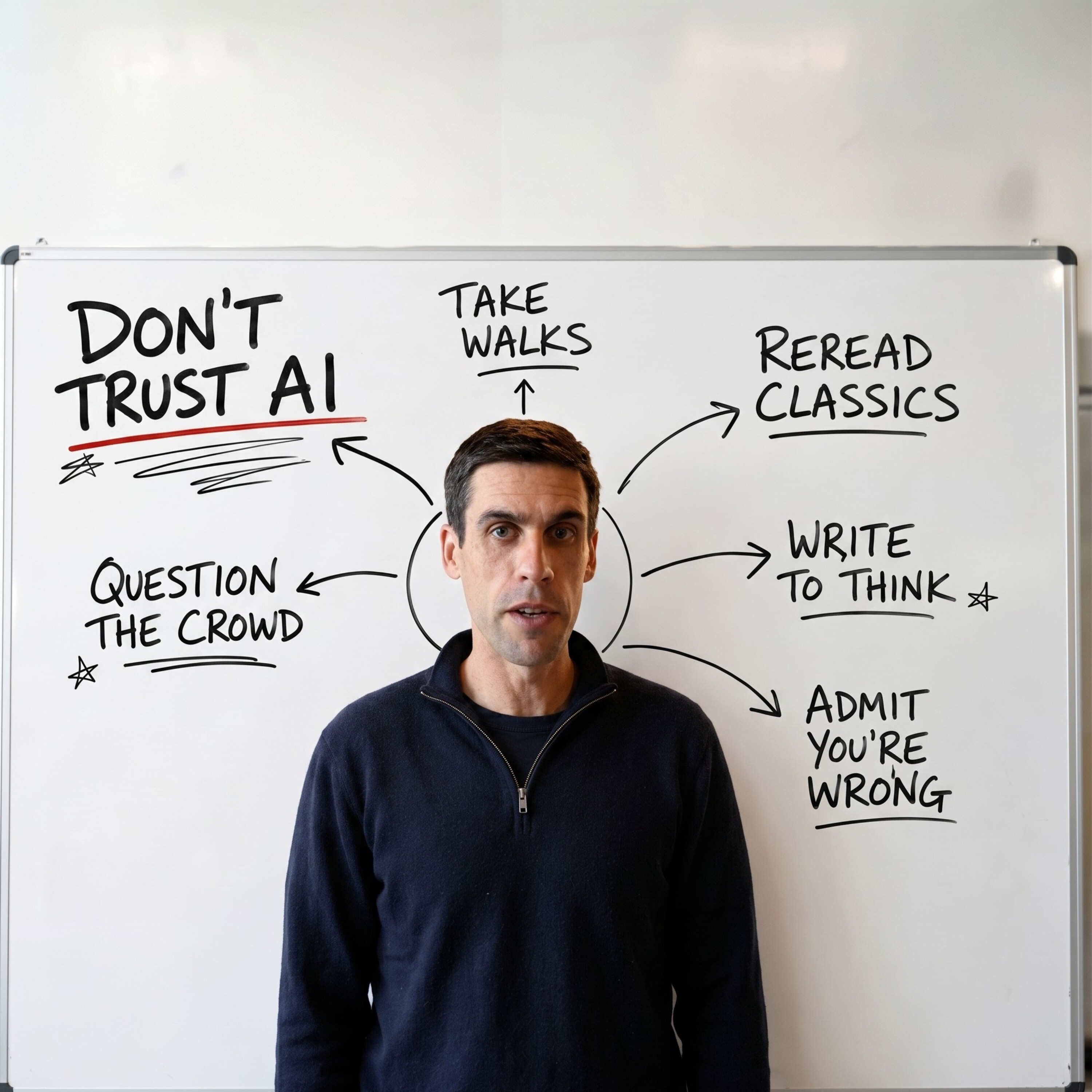
So people are talking about everything that AI is going to replace. And it is true that these technologies are going to make a lot of kinds of expertise obsolete. But I would argue that this incredibly powerful and groundbreaking technology, what it actually does is make thinking even more important. You're going to have to be able to interpret what AI spits back at you. You're going to need to be able to craft insightful, intelligent queries to be able to get what you want out of it. And you're also going to need the wisdom and the experience to be able to spot nonsense and bullshit, to be able to know when it's hallucinating, when it's going in the wrong direction. You could say that the irony of AI, this cutting edge technology, is that it actually makes some really old stuff incredibly relevant again. In short, we're talking about how to be a discerning, critical thinker. And that's what we're going to talk about in today's episode, some timeless lessons from the ancients to make you a better thinker, to help you adapt and make the most out of this watershed technological moment that we are in. What all new technologies, all changes, all new situations demand is that we do something that Aristotle Talked about over 2,000 years ago, which is this idea of going to first principles. Don't just accept where things are, what people are saying, what people are thinking, the way they are being done or have been done. You go to first principles. You don't just blindly accept what gets spit back at you. You don't just listen to a tweet or a headline. You go to the beginning, you break things down, you get to the basis of them, the raw facts, the things we know for certain, and then you build backwards from there. You put every idea, every thought, every assumption to the test, the Stoics said. And that's what a good thinker does when they approach a new domain or a new problem. They bring a fresh set of eyes and an open mind. And often what first principles think thinking means is going deep. One of the things that Marcus Aurelius says that he learns from his philosophy teacher Rusticus was, he said, never being satisfied with just getting the gist of things. Rusticus taught Marx Ruis to read attentively, right? To actually understand it, to not just be satisfied and go, yeah, yeah, yeah, I get it. Marx Reelis also writes in meditations about going directly to the Seat of knowledge. Who has the real experience here? Who's the actual expert? He's talking about immersing yourself in the craft, in the business, in the sport, in the profession, in the idea, seeking out tutors and mentors and peers. He's talking about travel. He's talking about observing firsthand. He's talking about asking questions from the people in the know. He's talking about going beyond the gist, actually, on the wisdom book. I was. I was going to write about Lincoln, and I thought I knew enough about Lincoln to make this chapter work. And as I got into it, I realized I didn't. And I had to read a thousand page book and then another thousand page book and then another thousand page book. I had to add to that knowledge hundreds and hundreds of pages of writing. I had to interview people. I had to read primary documents. And it's funny, you know, one of the things I learned in that deep dive on Lincoln was that this was one of Lincoln's specialties, too. When the Kansas Nebraska act is passed, slavery becomes this sort of flashpoint issue in the United States. And Lincoln thought he knew what he needed to know about the issue, but he realized he didn't actually know what the founders thought enough on the issue. And so he goes to the Illinois statehouse, he goes to the Library of Congress as a congressman. He reads book after book after book. He goes and reads the minutes of congressional debates to get to the basics, the first principles of the issue. And it's funny, that's something that people who knew Lincoln would say about him, that he was never satisfied, as Marcus Aurelius had been taught, until he got to the nub of the issue. What was the core thing, the main contention, the most important thing? Lincoln did that before he had his opinions, before he opened his mouth. I was down at spring training in Arizona a couple of weeks ago to talk to two different baseball teams. And one of the things I pointed out was like, across from the room where we were was the cafeteria where some of the best nutritionists in the world were pouring over every calorie, every ingredient, every morsel that these guys consumed so that they could be at their physical best. I said, this is great, but most of you are consuming straight garbage directly into your brain via your infrared. And we have to make sure that we're watching that diet as much as we are watching our literal diet. Actually, this is something they're noticing with AI too, right? As AI draws from what's on the Internet, in some ways it can get worse from AI slop that's being put out there. There's an expression in tech, garbage in, garbage out. The inputs really matter. And so the media diet that you're consuming, the books that you're reading, the. The people you're listening to, the videos you're watching, the people you spend time with, is really essential to being a good thinker because these inputs, these influences shape you and how you think. And so you have to monitor your information diet. And you have to cut out things that might be fun or entertaining but are not actually good for you. And you have to consume those like, you know, metaphorical fruits and vegetables that are not always fun to eat, don't always taste the best, but are best for you. And so that goes to actually Seneca's next point. He says the path to wisdom is about acquiring one thing a day. Says each day you should try to acquire something that fortifies you against poverty, against death, against misfortune. He was saying, like one quote, one story, one idea, one thing to chew on every day. That's how you get better. And his famous exchange, which survives to us in Letters from a Stoic, is him and his friend Lucilius passing ideas back and forth, quotes back and forth, chewing on things together. Like, the path to wisdom is a lifelong path, and you travel it as you do all paths, step by step, day by day. You're not going to acquire wisdom in some powerful epiphany, some singular insight, some singular course, some singular conversation. No one can download this stuff in your brain. You got to do the work, and you do the work day by day, idea by idea, insight by insight. I like to say that the Stoics aren't philosophers you've read, they should be philosophers you are reading. First off, not enough people have read the Stoics, but not enough people have re read the Stoics. Right? Reading is one thing, re reading is another. Seneca talks about how we want to linger on the works of the master thinkers, which is to say, to come back to them over and over and over again. Marx Riolius is talking about not being satisfied with getting the gist. Your first read of someone, whether it's Marcus Aurelius or Epictetus or Seneca or Aristotle or whomever is not going to be sufficient. You have to go back to it over and over and over again. Even though the words are the same, you're in a different place, you're a different person, you're ready to hear and see something different. The books don't change, but you do. Epictetus reminds us that it is impossible to learn that which we think we already know, right? This is the problem with being a know it all. That becomes impossible for us to know anything more. And so for the Stoics, particularly to Zeno, who talks a lot about this, conceitedness and ego are the impediment to wisdom. If you think you've got all the answers, if you're. You can pull out opinions from nowhere, if you are cocksure and sure of yourself, right? Oftentimes in the way that that chatgpt is like, I never hear AI go, I'm not sure, I don't know. It's really complicated. It could be this, it could be that. No, there's always certainty. And you see this on social media too, right? There's no room for nuance, there's no room for doubt. Doubt and questions are not viral, but certainty is. And so we have to understand that the more we learn, the more we are exposed to the things that we don't know. Socrates wisdom is rooted in his humility, his sense of what he doesn't know. So we have to become a student and stay a student and keep ego out of it. One of Marcus Aurelius most modern and most timely pieces of advice is refraining from having an opinion about everything he says. Remind yourself that things are not asking to be judged by you and that we always have the power to have no opinion. And so to practice the ability of having no thoughts about something, the ability to wait and see, to understand that people are going to disagree with you, that people are going to have their own views on things, is just a really important thing in this room world of slop and overwhelming information, where a lot's going to be thrown at you, you shouldn't be triggered, you shouldn't be distracted by everything that's happened. You don't need to argue with everyone over everything. Understanding what you should be thinking about, what actually matters to you, where your opinion will actually make a difference. This is really important. And that restraint is one of the most basic assumptions of Stoic philosophy. You know the Judas Priest song, you've got another thing coming. Actually, the eclipse expression is you've got another think coming. It's funny because maybe they misheard it or because we've heard the song, that's what we think. The expression is, you've got another thing coming. But for many years previous, the colloquial expression is, you've got another think coming. Or as we might say today, think again. And the reason we need an expression about this Is that often our first impressions, our first thoughts are wrong, right? We have biases, we. We have preconceived ideas. Like, that's why if you were to see the expression, you've got another thing coming, you'd say, isn't it? You've got another thing coming. Because the song is so popular, it becomes our frame of reference. There's actually a name for this. They're called eggcorns. Right? Words or expressions that we confidently mishear and then we contort to match our misperception. All for not when it's actually all for not or all intensive purposes when actually it's instead of all intents and purposes. Basically, what the stoics want us to remember and what all good thinkers do is they don't trust their first impression, don't believe their eyes and ears until they've verified, until they've proven it. They suspend judgment a little bit. So in a world where AI can quickly and confidently throw you answers, but it doesn't have any skin in the game as far as those answers go, you have to slow down. You have to ask it if it's sure, right? You have to get it to give you its sources. Right? Actually, they find that AI gives you better answers when you tell it to take its time. But the number of times I've gotten an answer and it didn't seem right to me, and I've said some version of, I think you've got another think coming, I don't think that's right. And then only on the second or third try did I actually get an answer that I know was true. Right? Is a sobering reminder that we don't want to trust the first thing that we see or hear.
- [13:51]
Ryan Holiday
In Texas, a lot of the bugs are just not cool. The ants bite, spiders are poisonous. There's all these kinds of wasps that I didn't even know existed before. Scorpions. Oh, man, it's crazy. And pest control is just a part of living here, owning a home or a store or anything. It's your problem, honestly.
- [14:13]
Stephen Hanselman
And the easiest way to keep bugs away is with Pesti. And when you sign up, Pesti will send you everything you need to do your own pest control.
- [14:20]
Ryan Holiday
The pesti kit comes with everything you need to do your own pest control. Pro grade pesticide. That's the same stuff that the pros use. Sprayer, mixing bag, gloves, instructions.
- [14:29]
Stephen Hanselman
You can even get a kit customized
- [14:31]
Ryan Holiday
to the season, location, and weather. And with Pesti, it starts at just $35 a treatment with their DIY kit, there's no strangers in your house or appointments to make. Pesti gets rid of over 100 typ bugs from spiders to ants to roaches and scorpions. It's also kid and pet friendly. Get bugs out of your house with Pesti just go to Pesti.com Doak for an extra 10% off your order. That's Pesti.com DoAK for an extra 10% off it all comes down to hiring. You gotta find the right people for your team and you gotta bring them on board and you gotta onboard them quickly. You know, just throwing up a job posting and hoping you get lucky. I've just found well you don't get lucky enough if you want to find quality hires. Well you should check out Indeed right now. People are finding quality hires on Indeed. Right now. In just the 30 or so seconds we've already been talking, people have made dozens of hires on indeed. According to Indeed data worldwide, their sponsored jobs posted directly on indeed are 95% more likely to report a higher than a non sponsored job. So join more than 3.3 million employers worldwide that use Indeed to connect with quality talent that fits their needs. Spend less time searching and more time actually interviewing candidates who check all your boxes. Less time, less stress, more results when you need the right person to cut through the chaos. This is a job for Indeed. Sponsored jobs and listeners of this show get a $75 sponsored job credit to help get your job the premium status it deserves@ Indeed.com stoic that's Indeed.com stoic right now and support the show by saying you heard about it on this podcast. Indeed.com stoic terms and conditions apply.
- [16:18]
Stephen Hanselman
So there's something in journalism known as the Gell Mann Amnesia Effect. It's named after a Nobel Prize winning physicist. And basically the idea is when you look at journalistic or scientific coverage of something you know a lot about, you often see how bad or inaccurate that coverage or knowledge is is right, it's simplified, or it's outright incorrect and you go, whoa, these people don't really know what they're talking about. The problem is we get this amnesia when it comes to coverage and knowledge about things that we're not as familiar with, right? Suddenly we defer because those people are experts, or we defer because they seem confident in their answer. But these were the people or the technologies or the systems that were laughably wrong not that long ago about something we knew a lot about. I see this with ChatGPT. I see this with pundits and talking heads. I even see this like in the comment section on Reddit or whatever. These people are just really bad. They're just. The answers are not good, the quality of information is not high. That's very clear when I am a subject matter expert on that thing. But then in some minor medical emergency, I'm asking that same technology what to do, right? Or I'm listening to that same person because it's coming through my ears on a podcast or it's on tv. And the chances of it being wildly incorrect over here, but then really qualified and on point here is not high. Like, most of the time, people don't know what they're talking about. And going in with that assumption allows you to know when you're being fooled, when you're. When someone's trying to. To pull one over on you, or when someone is just absolutely full of it. Which is why you have to think for yourself. Like, generally, most people, even experts, just do what other people are doing, want what other people want, think what other people are thinking because that's comfortable, because it's safe, because there is inertia and energy going in that direction. This is the insight of a philosopher, very different than the Stoics, but. But nevertheless, I think correct on this issue. This is Rene Girard. He has this theory called the theory of mimetic desire. And basically, mimetic desire is saying that because people don't know what they want or what they think, they end up being drawn subconsciously or overtly to what other people want, what other people are thinking, right? We don't think for ourselves. We follow tradition or the crowd or convention, and we can't do that, right? The whole. The whole point of being a philosopher, Chrysippus said he's one of the Stoics, is to not be a part of the mob. When you find yourself on the side of the majority, as the expression goes, you should question it. That's not to say the majority is always wrong. This is a sign that you should question and make sure that you go to first principles and think for yourself on this issue. If you end up agreeing with everyone, great. Just make sure you thought about it for yourself. Pretentiousness makes you stupid. Condescension. It is often a way that we hoist ourselves upon our own petard. Epictetus once hears this student talking, like, really proudly about having made his way all the way through the works of Chrysippus, Chrysippus being a pretty dense early Stoic writer. And so Epictetus with a smile says, you know, if Chrysippus had been a better writer, you'd have less to brag about the idea of, oh, I read these obscure things. I can make my way through these dense things. I can. Like being a literary snob is to miss the point. People waste their whole lives trying to become experts on things that don't actually matter, that have no significance. Getting in these arcane debates over this or that, thinking they're better than other people who don't waste their time on this. And this is totally wrong to me. Humility is the key. Being down to earth is the key. And focus, focusing on the things that really matter is the key. One of the things you get when you read the eternities, as Thoreau said about the classics, is you get a longer term perspective. You're reading something that was relevant 2,000 years ago and you see, oh, it's still relevant today, right? It gives you a larger sense of time. Like, do you know how long the Antonine plague lasted? The plague that happened during Marcus Aurelius reign? It wasn't like three years, like Covid, it was 15 years. And you go, oh, wow, he had to deal with this issue for a very long time. Or take something that people evoke all the time, right? The decline and fall of the Roman Empire. Right. People think maybe America is in the middle of that right now. But do you know how long the fall of the Roman Empire took? It took at least 300 years. So our immediacy bias is often leading us astray, right? We need to zoom out. We need to focus, as Jeff Bezos, the founder of Amazon, famously said, on the things that don't change, right? When you're thinking about what you're going to study, what you're going to learn, what you're going to get good at. You don't just want to focus on what's trendy and popular right now, because chances are that thing is not going to be trendy or popular in the future. This is what I meant when I said that when it comes to new technologies like AI, often what actually is important is a basis in those eternal things, those broad liberal ideas, those understanding of the humanities, those critical thinking skills. And also, like things like character and discipline and patience and creativity, like wisdom and hard work. Like, these are constants. These are skills that are going to be important no matter what technological environment you're in, no matter what economy that you're in, no matter what's happening in the headlines. Like, the world is always going to be chaotic. There's always going to be noise. And so the way to stay grounded if those things are eternally true, is to focus on what matters in the long run. It is important to think for yourself. It is important to challenge orthodoxy and convention. It is important to go to first principles because you find out that often the crowd, often most people, the way we've always done things is not the best way. And in fact, as Mark Twain said, when you're on the side of the majority, pause and reflect. So you might think that what I'm saying is that you should be a contrarian, but this is actually really dangerous. And I once interviewed Peter Thiel, the billionaire who's widely considered to be a contrarian, and I asked him about that and he said that he didn't see himself that way and that actually being a contrarian is a stupid thing to be. He said that it's dangerous to just take what everyone else is is thinking and put a minus sign in front of it or just flip it. Just be like, oh, here's what they think. I want to think the opposite. When Twain was saying that we want to pause and reflect when we're on the side of the majority, it was to confirm whether the majority was correct or not. Just doing the opposite of what the majority is doing is also not thinking for yourself. It's just doing the opposite thinking that other people did or didn't do.
- [23:01]
Ryan Holiday
Right?
- [23:02]
Stephen Hanselman
Going to first principles is saying, hey, what do I know about this? What do I think about this? Right? What is actually true here? And what do I, with my experience and my expertise and my knowledge, what do I think is the best opinion or course of action here? In fact, if you find yourself constantly in opposition to everyone and to everything, right, or most consensuses, probably a sign that you're not doing enough thinking, right? You're just being reactionary and emotional and I would say also obnoxious and annoying because you think that's what an intelligent person would do, but you're actually not doing anything intelligent at all. There's actually a great observation about Churchill that I think connects here. It was said that Churchill venerated tradition but ridiculed convention. It's the ability to know which tried and true things are worth sticking with and which ones are silly and outdated and, and should be questioned. You can imagine that not many people could tell the Emperor of Rome that he was being dumb, that he was being incorrect. There's a famous exchange between Hadrian and one of his philosophical advisors, and they're arguing over something that has an objectively right or wrong Answer. But in the end, the philosopher goes, you know what, sir? You're correct. And the philosopher's friends come up to him afterwards and say, why did you do that? You were right. And he said, I think you forget that the man who, who controls 50 legions is always correct, right? This is the paradox of power or success. People are much less likely to tell you when they are wrong. And you get out of the habit of admitting you are wrong and correcting error. That's why it's so impressive in Marcus Aurelius Meditations that Marcus writes that if anyone can refute me, if anyone can prove that I'm incorrect, if they can show me I'm making a mistake, or that I'm looking at things from the wrong perspective, he's like, I'm glad to hear it. He says, all change in a heartbeat, he says, because it's the truth I'm after, and the truth never harmed anyone. Admitting you are wrong doesn't harm you, right? He says, what's harming you is persisting in self deceit and ignorance. What harms you is staying on the incorrect path because you don't want to admit you are wrong. Our opinions, our ideas, these are things that are meant to change when we learn new information. It harms us to be stuck in our old ways, to persist like even when we suspect we might be wrong because we don't want to lose face. You can only get better, only get smarter. If you can admit you're wrong, then this is the admit when you're wrong. This is a pickup for that. The philosopher Diogenes, the cynic, was once asked about why he changed his mind, why he didn't believe something that he used to believe. And he said, you know, there was a time that I used to piss my bed, but not any longer. It's good to change your mind. It's good to grow. It's good to say, hey, this is what I used to believe, this is what I used to do that was wrong. And now I think X, Y or Z. That is a sign of growth and maturity and of getting better. It's not about facts and figures. It's not about getting the right answers. No one can tell you all the things that you need to know, but this is what small minded people are after. Epictetus tells us about a student that comes up to him and says, you know, tell me what to do. I want to know what to do. And this person wanted a prescription for all the kinds of situations that they would face. And Epictetus said, this is absolutely the wrong question. He says, you should be asking me how can I be more adaptable to circumstances. That's what wise people are able to do, right? They're able to reply appropriately to all the things in front of them. And we actually have a similar story about Confucius, right? Confucius was asked for advice by a student, and he essentially advises the student to wait and to be patient. But later, he's asked for advice by another student, and he advises that student not to be patient, to plunge right into solving the problem in front of them. And this student who's observing says, you know, this advice contradicts right? Here you told them to be patient, and here you told them to dive right into solving them. But Confucius says, there's no contradiction here at all. He says, this dude is over cautious. And so I wished to urge him on. The other student was too impetuous, and so I sought to hold him back. Context and timing are everything. Everybody is different. Every situation is different. And what you want to develop is a broad range of skills and strategies and insights that can work for you in all situations, right? Focusing on the things that don't change. Focus on the things that are true across different domains, that are valuable in a bunch of different contexts. That's what you need to cultivate, not rigid dogmatic rules that tell you what to do and not do. It is so easy to live in a filter bubble, but the wisest people have inputs and get information that runs contrary to what they think and believe. In 1961, the Navy sends a fighter pilot named James Stockdale to Stanford. And it's there at Stanford that he is introduced to Stoic philosophy, specifically Epictetus. But it's also there at Stanford at the height of the Cold War, Stockdale takes multiple courses in Marxist theory. In one of those classes, he reads, not criticism of Marx, but the primary sources, right? He reads Marx and Lenin and Stalin. He reads the works. He talks to people who were in the Soviet regime. And this jives with one of the things that his father had taught him, that you can't compete against something you don't understand. And if you're a fragile little snowflake that can never be challenged, you're going to find yourself in real hot water when you actually are challenged. And this is what happens for Stockdale a few years later. He shot down over North Vietnam and spends seven years in a Communist prison camp. And it's his understanding of Marxism, his insights into a culture that was inexplicable. To many of his fellow POWs, that is essential to him, that it allows him to react, resist. It allows him not to be broken. It allows him to parse the propaganda that's being thrown at him and carve out a space for him to exist and to survive. In many cases, he understands the ideology better than his interrogators did. And Seneca talked about this very idea. He said we should read dangerous ideas like a spy in the enemy's camp. We don't just read what we agree with. We don't just hear from people who are like us or have the same background as us. But we want to seek out things that are different, seek out things that challenge us, because this makes us better and it makes us stronger. Most people treat their enemies or their opponents as caricatures, right? That's what's called making a straw man argument. You pick the weakest, most ridiculous thing that you think they might believe, and then you're opposed to that. But wise people do the opposite. They steel, man. They go to actually understand, why does that person think that? What does it mean? What's the strongest argument they can make? Maybe you can even make a stronger argument for their position than they can. And in doing that, you are forced to make your own ideas, your own understanding, stronger in response. So by engaging with and understanding and empathizing with even abhorrent or deranged ideas, you're not going to be corrupted, you're not going to be infected by them. No, you're going to get stronger and smarter as a result. Again, if you think you know everything, it becomes very hard for you to know more. There's an old Zen story, I think, that illustrates this. A master invites a student for tea. And as they sit down and he starts to pour into the cup, the master pours and pours and pours until the cup begins to overflow. And the student says, stop, stop, stop. The cup is full. It can hold no more. And the master says, yeah, look, our mind is like this cup. When we're full of opinions and speculations, nothing else can go in there. He says, how am I to show you Zen unless you empty your cup? Right again. This is the greatness of Socrates. He's always discarding assumptions. He's always challenging assumptions. He's not thinking of himself as particularly wise. He has the open mind. And so this is key to learning and growing. The key in our journey is to look for wisdom and not facts. As Seneca writes, far too many brains are ruined by their parents. Pointless enthusiasm for useless information. How Are you going to use this? What is this for? How is this helping you understand better? Not trivia, not facts. In Seneca's time, he was talking about how people will read the Odyssey and debate these arcane points about Odysseus here or there, missing, he said, the storms in their own life and the lessons it has to teach us about that. We're reading for wisdom. We're reading to become better people. We're reading to understand this thing called life better. We're not trying to impress other people. I think writing is one of the most powerful ways to figure out what you think, to figure out what is true. It is easy to have contradictions and poorly thought out ideas bouncing around up in here, but it's when you sit down and you have to write it out that you're forced to think right. Like writing forces you to think right. Peter Burke, one of Montaigne's biographers, believed that Montaigne's essays were his attempt to catch himself in the act of thinking. It was to think about what he thought, to get to what he actually did know or didn't know. And so writing, whether it's in a journal, whether it's on a blog, even on social media, but writing to process your thoughts and to get better at thinking is an incredibly powerful idea. Only a fool goes with their first thought. A writer contemplation templates and considers, edits and refines, reads and proofreads, and in this process actually gets to some semblance of real clarity. I don't think I've ever taken a walk and not come back with an idea. Come back with some clarity. And I've certainly never taken a walk and not come back and thought, I'm really glad I did that. Always better to do that. Kierkegaard famously would write in the morning and then take a long walk to work through what he had just worked on and thought about. Seneca himself said that the mind must be given over to long wandering walks. He said it was nourished by the outdoors. One thing ChatGPT and technology will never be able to do is to replace that. That getting outside, getting inspired, working through things. The human mind is meant to be on the move. So get out there, get moving. It will make you a better thinker, will also make you happier and more connected. There is one secret to being a better thinker, to being more creative, to being wiser, to being more successful. And it's something that people have kept for thousands of years, going all the way back to the Greeks and Romans. And that's called a commonplace book, which is really just. It's not a journal exactly, but it's a place to collect ideas and quotes and observations that you've gathered over time. Seneca said that we should hunt out help pieces of teachings. He said the spirited and noble minded sayings, which he said are capable of practical application and we should keep them somewhere. I've been keeping a commonplace book going on 20 years now and I draw on it in my writing. I draw on it as a parent, I draw on it as a human being. I draw on it as an entrepreneur. The idea that you're just going to draw from memory all the things you've ever been exposed to or known is just naive at best. How are you reading, which of course is important, but then taking extracts from that writing? How are you going out and having experiences, but then distilling those experiences down into little conclusions, insights that you can access later on. I learned this from Robert Greene when I was his research assistant. When I read things, I underline, then I fold those pages and then I take notes and then I transfer that knowledge into my commonplace book, which I then use in my real life. The ancient Stoics had this. This group known as the Scipionic Circle and was some of the wisest people in ancient Rome. And they would get together and have debates and have questions and talk about things and teach each other things. This is what Benjamin Franklin starts his. His famous Junta, which is a group of people in Philadelphia who are dedicated to the ideas of self improvement. You want to spend time with people who are smarter than you. You want to spend time with people who know more than you, people you can ask questions to, people you can learn from, people you can aspire to be like. You want to be around people who think differently than you, who challenge you. And so cultivating that group of people is really important. Actively putting yourself in rooms where you are not the smartest person will make you a smarter person. The key to getting smarter is asking good questions, right? The Socratic method is rooted not in Socrates going around telling people what he knows, but Socrates asking question after question after question about what they believe, about what they think about, what he wants to know about. But they are also forced in many cases as a result of those questions to change what they're thinking because they had some unchallenged assumptions in there. The art of a great question. The curiosity to want to know is essential. I interviewed Charles Duhigg. He has this great book called Super Communicators and Super Communicators aren't these amazing orators who just get up and give inspiring speeches? No, what most super communicators are really good at is asking good questions. Having the Daily Stoic podcast has made me get better at interviewing, asking people questions, trying to get to what they believe, to find out how I can get what's in their brain into my brain. You will not get better without asking questions, without being curious. And this goes right to the idea of ChatGPT and Gemini and all these AI software. Like, there is a lot of knowledge in there. There is a lot of good stuff in there. If you're not good at asking questions, if you can't craft a good question, right, if you're not curious, you can't benefit from all that. You can't learn from it. So this is a skill we have to cultivate. What does it mean to be wise? What does it mean to be a good thinker? Wisdom is going to look different on different people. There are lots of different kinds of great thinkers out there. One of the things we can agree that they all have in common is that they weren't born that way. Seneca famously said that no man is ever wise by chance, right? No one can give you an education. It's not genetic. This is something you earn. Thinking is something you have to do for yourself. People cannot think for you. AI cannot think for you. It cannot replace thinking. We cannot delegate this. We cannot outsource it. It can be a tool that makes us better, as technology has been for all time. But without that broad basis in the humanities, without good critical thinking skills, without the ability to ask questions, to challenge, to think for ourselves, without the ability to push ego away, we're not going to be able to take advantage of this. So we must understand that ultimately, this stuff is a lot of work. It's not just the basis kind of work you have to do at the beginning, but it's work you have to keep doing. You have to keep going, you have to keep learning, you have to keep thinking day in and day out.