Loading summary
Transcript16 lines
- [00:00]
Ryan Holiday
Welcome to the Daily Stoic Podcast, designed
- [00:04]
Podcast Co-host or Guest
to help bring those four key Stoic
- [00:07]
Ryan Holiday
virtues, courage, discipline, justice, and wisdom, into the real world.
- [00:15]
Podcast Co-host or Guest
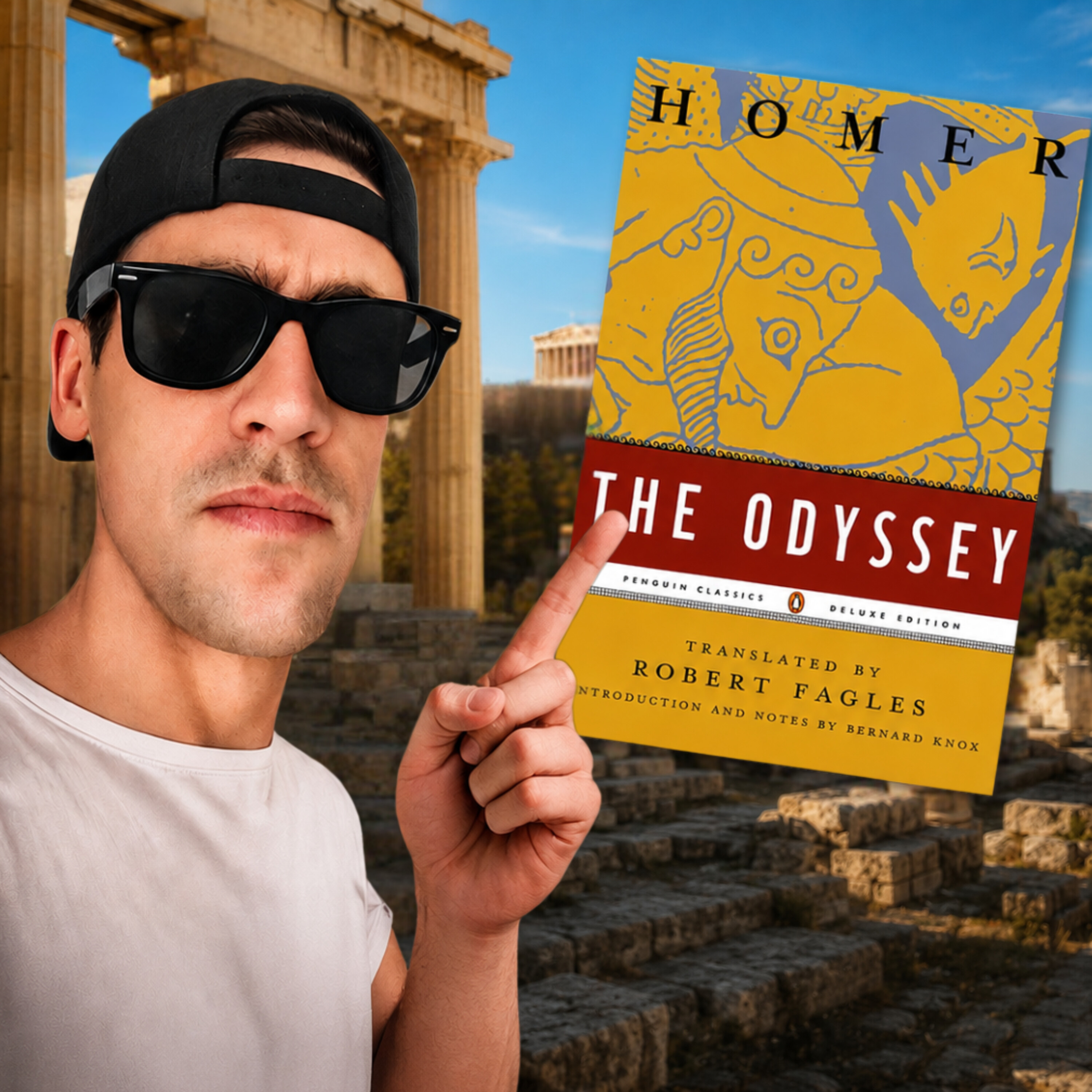
For nearly 3,000 years, it has reigned as perhaps the greatest story ever told. It is a story that has been told and retold, adapted and changed. It's inspired poems, it's inspired paintings, it's inspired music. I'm talking, of course, about the Odyssey, and it's a favorite of many people, but most of all the Stoics. There is no work that the Stoics reference more than the Odyssey. I'm Ryan Holiday, the author of the Daily Stoic, and I traveled thousands of miles, not just to ancient Greece, where, of course, the Odyssey is set, but to Ithaca itself, where it begins and ends, to find out not just what the Odyssey is about, what it can teach us about life, but also why it so resonated with the Stoics and why it's resonating again today. Odysseus would not have survived his Odyssey without the help of Athena, but his son Telemachus would not have survived without Athena either. And I think it's illustrative, the form that Athena takes, particularly when she is aiding Telemachus. She pretends she is an old family friend named Mentor. Basically, Odysseus and Telemachus are a product of their Mentors, as we all are. Perhaps this is where the word comes from, but the idea is that we are guided by the people who teach us, who have been further ahead than us. Marcus Aurelius is mentored by Antoninus. Zeno is mentored by Crates. I was mentored by the great Robert Greene. The idea that you want to learn these lessons by painful trial and error is insane. You want to benefit from the experience of others. That's. That's the joke. Any fool can learn by experience. I want to learn from the experience of others. And Odysseus does this. He. He is aided constantly throughout the Odyssey by Athena and then Telemachus as he is coming of age. This is when he is approached by Mentor as she is organizing the homecoming. You have to figure out who your mentors are in life. We are a product of our mentors. This is a valuable lesson inside the Odyssey. I think it's one of the great warnings against ego from ancient literature. That's Odysseus behind me, Right? So Odysseus has defeated Polyphemus. He stabbed him in the eye. He's escaped the cave, and he's gotten away with it, right? He's not just gotten away with it. But Polyphemus the cyclops has no idea who Odysseus is, because when Polyphemus had asked Odysseus his name, he'd said, my name is no man, or my name is nobody. So when the other cyclops had said, who'd hurt you? Who done this? Polyphemus said, nobody did this. Nobody has hurt me. So Odysseus has gotten away with it. And as he gets safely to his ship and he's sailing away, what does he do? Though in an act of hubris, needing to get credit for his brilliance, he shouts out, you want to know who did this to you? Odysseus, sacker of cities, did this to you. And it is in this moment that he seals his fate, that he prevents himself from getting back to ithaca for another 10 years, because Polyphemus is the son of Poseidon. And now Poseidon knows who's injured his son. And Poseidon becomes Odysseus's sworn enemy, and he creates all these obstacles on his way home. So the point is, if Odysseus hadn't needed credit, if Odysseus hadn't bragged about what he'd done, he would have gotten away with it. He would have gotten home safely. And so, to me, this is a classic ego is the enemy type story. It's our desire for what Marcus Realis would call the third thing, for needing recognition, for needing credit, for needing getting attention for what we've done, that gets us into more trouble than we could possibly deal with. Look. It would be wonderful if life was easy. It would be wonderful if things went the way that we planned, if we never ran into obstacles, if the gods were always on our side. But that's not how it goes in life. It's not how it goes in the Odyssey, either. One of my favorite poems is a poem about the Odyssey called Ithaca by CP Cavafy. And there's this part at the end where it says, keep Ithaca always in your mind, because arriving there is what you're destined for. But don't hurry the journey, better if it lasts for years. So you're old by the time you reach the island, wealthy, with all you've gained along the way, not expecting Ithaca to make you rich. It says, ithaca gave you a marvelous journey, and without her you wouldn't have set out. She has nothing left to give you now. And then it ends. If you find her, poor Ithaca won't have fooled you. Wise as you will have become so full of experience you'll have understood by then. What these Ithacas mean, I guess that this is a long way of saying, like, the journey is the destination. It's what we learn along the way. It's what we learn about ourselves. That is what we're actually after. When the Stoics talked about how the obstacle is the way, they didn't mean that you would always arrive at the Ithaca you hoped for. It might take longer than you expect. It might throw you wildly off course. You might end up somewhere very different than you ever would have liked to go. This is, of course, what happens to Zeno, who is traveling in the same Mediterranean as Odysseus. And he suffers this shipwreck. He washes up in Athens, not his destination. He loses one career, but he gains another. He becomes a philosopher. And later he would say, he, you know, I made a great fortune when I suffered a shipwreck, right, because it drove him to philosophy. So sometimes we think Ithaca, and this is Ithaca behind me. Sometimes we think Ithaca is one thing, or we think Ithaca is supposed to be a certain way, but we don't know. We're not in control. The gods are in control. Fate is in control. Some timing we don't understand is in control. And so that's a good thing, or rather, we can make it a good thing in how we respond to it and who we become as a result of it. And most of all, of course, what we learn from it. Everyone knows about the Sirens on the rocks. It's one of the most enduring images in all of literature. Beware the Sirens on the rocks. The Sirens Call. Chris Hayes just wrote a book with that exact title, the Sirens Call. But what most people don't understand about the Sirens, and I didn't even get myself at first, the Sirens aren't singing this song that is. Is beautiful to everyone. No, they are singing a very specific song to each and every person. What their song is doing is telling people what they want to hear. Every sailor's song is different. And I think this image applies very much to where we are today. And actually what Chris Hayes's book is about, where the algorithm is personalizing, where AI can generate incredibly specific things, where we can so easily fall into an information bubble. The Sirens call. The Sirens on rocks are this misinformation and disinformation, us being told the world is the way we want it to be, or the world is the opposite of the way we want it to be. And isn't that engaging and aggravating and incredibly triggering? And so we have to learn to resist this call to Resist the call of our apps, of our phones, of the algorithm. We have to know that people are trying to deceive us and activate us and aggravate us. In Meditations, Marx really says that one of the things he learns from his philosophy teacher Rusticus was not to fall for every smooth talker. That's what the sirens are. The sirens are demagogues. The sirens are influencers. The Sirens are the CEOs of tech companies that monetize and sell and package your engagement. And so, yeah, the sirens are this idea in the Mediterranean Sea almost 3,000 years ago, but they're also something incredibly modern and perennial. And that's why it's such a powerful image. And that's why it's something we must remain aware of, we must beware of, even up and through. Today, Odysseus leaves Troy after 10 years of war. Does he have any idea what lies ahead? Does he have any idea what the gods have in store for him? 10 more years of obstacles and difficulties, 10 long years of travel. That he would come so close to the shores of his homeland, of his queen, of his young son, and then at the last minute, he'd be blown back again. He'd face storms and temptations, Cyclops, deadly whirlpools of six headed monsters, that he'd be held captive, that he'd suffer the wrath of Poseidon. Could he have known in those dark moments as he was suffering, that back home in Ithaca, that his rivals were circling, trying to take his kingdom and his wife? It's unimaginable. How did he get through it? How did he make it home despite it all? The Odyssey is a story about creativity, of course, and craftiness and leadership and discipline and courage. It's a story of warning against hubris. It's a story about the power of the gods and the traditions. But I think most of all, the Odyssey is a story about perseverance, persistence. Was Odysseus in the Trojan War, right, Trying everything until he finally gets something that works, Till he chances upon the idea of the Trojan horse, right? But 10 years of trials and tribulation, of disappointments and mistakes, without giving in, having to check your bearings every day, not just not inching closer to home, but getting further away, knowing that back at home there are all these problems laying in wait for you. Enduring the punishments of the gods, doing everything it takes to make it back home. There's obviously at some point when persistence bleeds in to perseverance. Persistence is hammering away at some difficult problem. Perseverance is something Larger, something deeper, something more profound. It's the long game. It's not what happens in round one, but round after round after round. As you're burying people, as you're getting older, as you're getting more and more exhausted, that to me is the, the primary message of the Odyssey. Because life isn't about one obstacle. Life is about obstacle after obstacle after obstacle. And that's what Homer is showing us about Odysseus, that we are all on our own kind of odyssey, right? Persistence is an action. Perseverance is a kind of will. One is energy, one is endurance. Right? It's the famous line in the Tennyson poem, may weak by time and fate, but strong in will. To strive, to seek, to find and not to yield, not yielding. That's what endurance is. I think about this famous summary of the teachings of Epictetus. He says persist and resist, right? That's what Odysseus is doing in the Odyssey. I think people are too soft these days. We give up too easily. We tell ourselves that something is impossible because it's hard, because. Because it's taking a long time, because vested interests are working against. But Odysseus doesn't do this. He's stout hearted, he's intense. He never gives up. He's always looking for a way forward. He's willing to put up with setbacks that last for years. And even when he's retreating, even when he is blown wildly off course, there's always the final direction that he's never losing sight of. And that determination, that perseverance, that's what the Odyssey is about. And ultimately that's what stoicism is about. So apparently everybody that works for us at the bookstore and Daily Stoic is, is using whatnot.
- [12:23]
Ryan Holiday
And I guess I'm out of the loop. But once you flip open the app, you, you see why there's something like super exciting about live sales. Like, whoa, you can get this right now, that they're talking about it right now and the sellers look like they're having fun.
- [12:39]
Podcast Co-host or Guest
And you know, it's not edited photos and videos.
- [12:41]
Ryan Holiday
Like you see it right there in the seller's hands.
- [12:44]
Podcast Co-host or Guest
It's like a really cool estate sale or like the coolest fair you've ever been at. And that's just like not what the
- [12:52]
Ryan Holiday
online shopping experience is normally like. Check it out today. Just search whatnot.
- [12:57]
Podcast Co-host or Guest
W h a t N o t
- [12:59]
Ryan Holiday
in the App Store, download it and
- [13:00]
Podcast Co-host or Guest
you can start selling right away.
- [13:02]
Ryan Holiday
Your customers don't want to wait around for a callback. They don't want to call three times. They don't like getting a message, they don't like not being able to get through to someone or do what they are trying to do. Right? They're trying to book an appointment, they're looking for a quote. They just need a little help. The point is, if nobody answers, they're calling somebody else or they're going to forget about it. And that's why today's episode is brought to you by Quo Q U O the business phone system. Built so you never miss a call. It is the number one rated business phone system on G2, trusted by over 90,000 businesses who rely on it to stay reachable and look look professional. Every day, all your calls, texts and voicemails live in one place. So anyone on your team can pick up the conversation, see the full history and respond fast. And Quo integrates with the tools your team already uses. HubSpot, Zapier, Claude, whatever. And it helps you save time, stay organized, and spend less effort chasing down information between systems. Money is on the line. Always say hello with Quo. Try Quo for free. Plus get 20% off your first six months when you go to quo.comdailystoic q u o.comd/daily stoic.
- [14:09]
Podcast Co-host or Guest
One of the most famous stories in the Odyssey has Odysseus lashing himself to the mast so that he won't be tempted by the sirens. The sirens being there on the rocks, not just singing beautiful songs, but telling people what they want to hear. So Odysseus is tempted by this. He wants to hear it, but he doesn't want to crash. So he lashes himself to the master, he plugs the ears of his men and he tells him, no matter how much I cry or struggle, don't let me go. Don't listen to me until we are well past the Sirens. Now, a couple of years ago, I was interviewing the behavioral psychologist Dr. Katie Milkman on the Daily Stoke podcast. We actually talked about this very example because she said it was one of the first examples in ancient literature of a forced commitment. You know you're going to do a thing, or you know you're not going to do a thing. And so you find a device that forces you to do it or prevents you from doing it right? You don't buy the Oreos or you lock the Oreos in a cabinet and you throw away the key. And actually, this has become known as a Odysseus pact or a Ulysses pact. And that's when you make an agreement with someone or you create a Device that in some way limits you from doing the thing that you might otherwise be inclined to do. And it's actually a pretty ingenious, if not rudimentary, bit of basic psychology, right? You know, you're tempted to eat something, so you don't buy it or you lock it up or you give it away, right? I heard someone say that what you can do when you. When you order an entree at a restaurant, you don't eat all of it, is you tell the waiter, hey, I want you to cook this item, then box up half of it for me to take home and serve me the other half. That's the same version of this very ancient device, right? There's apps that block the Internet on your phone. A bunch of writers I know use them. The idea being I'm going to be tempted, and I don't want to be tempted. So I'm going to take away that temptation. I'll give you one in my own life. I don't have social media on my phone. It's on my wife's phone. Because I know I shouldn't be using it, because I know it'll only get me into trouble. It'll only distract me. So if I want to use it, I have to ask permission from someone else and I can tell her, hey, don't give it to me today. Don't let me do it today. I know other people, their assistant controls the password, but the point is, this is a. The reason the Odyssey has endured is because of little examples like this. It is this strange, epic poem about not being lured by these mythical monsters, and yet at the same time time, it's something eminently relatable to all of us. Look, the Stoics talk a lot about discipline, and it's good to have it. But part of discipline is also knowing when your discipline is going to be overrun, when it is no match for the temptation you're going to be set against. I don't know. The first time I read the Odyssey, I guess it was maybe in elementary school. Then we watched a made for TV movie. Then I read the Robert Fagel's translation in college. Then I read the Emily Wilson translation. Then I read the Emily Wilson translation to my son, and then we listened to a podcast about it. But each time that I hear the story of the Odyssey, I take something new out of it, which is this idea that we never step in the same river twice. The text is thousands of years old. It changes a little bit per each translation, but we change what we're looking for. Changes, what we're able to comprehend. Change, changes because we've gotten older, because we've experienced our own storms, our own difficulties, our own Odyssey. And so that's why the text has endured for as long as it has. The story has endured for as long as it has, because we're able to grow with it. It's able to be many things to many people, but also many things to each of us over the course of our lives. One of the best translators of the Odyssey is T E Lawrence. Now, what qualifies him to translate the Odyssey? Is it his education in the classics at Oxford, or is it his life experiences? He has this great quote where he says, you know, I have hunted wild boars, I have watched wild lions. He says, I have sailed the Aegean and sailed many ships. He says, I have lived with pastoral people, I have built boats, and I have killed many men. His point was that the Odyssey wasn't just this work of literature to him. It was a set of experiences, many of which he'd had, which, of course, informs his understanding of the text and his understanding of what the word mean in one language and another. We're told that with his philosophy teachers, Arian and Rusticus, that Marcus Aurelius isn't content to allow them to remain mere pen and ink philosophers, Meaning he wanted them to have real world experiences. He wanted them to be engaged in politics and life and business. And I think this is essential for all of us. We can't just remain with our books. We can't just remain with our stories. We have to be out there in the world. We have to be engaged in the world. This is something, something that Plutarch talks about too, who is both a writer and a politician and a priest at the temple of Apollo. He would say that it might seem strange to some, but it was not so much by the words that he came to an understanding of things, but it was his experiences that helped him come to understand what the words mean. I think by traveling here, I have a deeper understanding of the Odyssey, of course, having my own experiences leading people, having my own experiences with adversities and difficulties in my life. Having met some great men and women in my life. You come to understand the ideas in the Odyssey. You come to understand the ideas in the text. You come to understand the ideas from the Stoics in the philosophy better, which is why we have to remain a Stoic student of them, which is why we also have to remain a disciple of experience. We have to be going out and experiencing and learning new things. And coming back to the text and of course, bringing our texts to those very things. So one of the more mysterious lines in the Odyssey is where Homer refers to the wine, dark sea. The Odyssey is filled with beautiful images. The rosy finger dawn, or a dawn with fingertips of rose. I've, I've seen that. I, I get that. But the wine dark sea is perplexing, not just to me. I've been all over Greece and I haven't seen one drop of ocean that looks like wine. But to scholars too, you know, it. Is that because he's blind? Is that because the ocean looked different back then? Or is it something a little bit more mind blowing? Which, which is like the way Homer saw colors is different than how we see colors. There's this German term, an umwelt. Like, what does the world look like to someone else? Particularly like to animals? And what is it like to be a bat? What is it like to be a rat? What is it like to be a Greek? 2500 years ago? We. We don't know. And so I've always been fascinated by that idea of people who describe and understand and see things very differently than we do. It's not that they're right or we're right or they're wrong and we're wrong. It's. It's that we all see things very differently. This is one of the things Marcus talks about in Meditations, about how you want to really get inside people's minds and see things from their perspective.
- [21:45]
Ryan Holiday
What.
- [21:45]
Podcast Co-host or Guest
What was it to them? Why did he describe it that way? I don't know exactly with Homer, but I've always found that to be very fascinating. The violence at the end of the Odyssey never sat super well with me. Odysseus gets home, he finds the suitors have overrun his house. He proves that he's Odysseus, and then what does he do? He hides all the weapons, and then he and his son Telemachus kill them. He kills not just the hundreds of suitors, but all the servants who cavorted with them. But it is. Is shockingly violent and bloody and vicious, and I think fundamentally unstoic. And we know this because a similar thing happens to Marcus Aurelius. Marcus has this chronic health condition. So rumors spread that the emperor has died. And his most trusted general, Avidius Cassius, names himself Emperor, which puts Marcus's children and his wife in danger. It puts the future of the empire in danger. I tell the story in the obstacles of away. We know how a Stoic would respond to this and it's not with violence. Marcus does have to deal with it, but he. He tells his men that he wants to use this as an opportunity to teach future generations that there's a right way to deal even with civil wars. And Cassius is assassinated. We're actually told this happens over Marcus's objections, that he weeps when he's brought the head of his enemy because he has been deprived of the chance of granting him clemency. And then we're told that Marcus writes a letter to the Roman Senate and says that he wants everyone involved in this pardoned. He says, do not stain my reign in their blood. He says, may it never happen. There's this quote in Meditations about how the best revenge is to not be like that. And we find that Odysseus, over the course of his travels and then his arrival home, he has hardened, he has lost a part of himself. He has become vicious, he has become brutal, he has become cruel, he's become desensitized. And that's how sort of like that, he's able to order the killing of dozens and dozens of people. He stains his palace in blood. He stains his reign in blood. And so I've always thought of that scene. How could Odysseus have handled it differently? Obviously, you can't let people, people walk all over you. People have to be held accountable for their excesses and their abuses, and in his case, for enormous expenses they levied on the kingdom. But there was probably some punishment between letting them walk all over you with impunity and murdering them in what is effectively cold blood. Odysseus is not a hero. He is a man to be pitied. He is tragic and flawed. His 20 year journey home, we find it inspiring, but we miss what he does almost the second he gets home, which is that he leaves again. He finally makes it back to Ithaca. He makes it here and what does he do? He almost immediately thereafter leaves to go on a series of raids to replenish his coffers. Odysseus is not a tragic figure because he is cursed by the gods. Odysseus is a tragic figure because he has cursed himself. He is endlessly restless. He can never, ever, ever be still. Actually, when you read the Tennyson poem Ulysses, you get a sense of this. He says, I cannot rest from travel. The whole poem is about him sort of handing the reins over to his son Telemachus because he's going to travel again. How dull it is to pause, he says, to make an end, to rest unburnished. Not to shine in use. He is a machine. He is human doing, not human being. Right? In the poem, he says, you know, to my son, who I leave this kingdom to, you're better than me, you're wiser than me. He envies his son because his son can be still. His son can be king, not a wanderer. And the Stoics pitied these kinds of people, Seneca most of all. He talked about how many people travel, not unlike the man who is flipping his pillow over and over again, trying to find the cool side as he tosses and turns and is unable to sleep. The Stoics understood that many people, when they travel, are traveling to flee themselves. Too many of us in our travels are running from something. Too many of us in our ambitions are hoping that on the other side of a hill, on the other side of some accomplishment, we'll finally feel good, we'll finally feel sated. But we won't. We are subjecting ourselves to the same torture that Odysseus subjected himself to. It's. It's worse than what the gods can inflict on us. When Marcus Aurelius says that life is warfare and a journey far from home, he is describing again the tragic nature of his fate as the emperor. And that is the cautionary tale of the Odyssey, something we might miss in the first readings. But as we go over it over and over again, we start to see that, yeah, we wouldn't want to trade places with Odysseus. In fact, we don't want to be anything like him. When was the Odyssey written? Was Homer blind? Is Homer the guy that wrote it? Did Odysseus exist? Is this place Ithaca? Is this where it actually happened? And is this what it was all about? Seneca says it doesn't fucking matter. We get so obsessed with trivialities when it comes to literature and history. He says it doesn't matter where these things happened to Odysseus. He says, where he ran into these storms. He says, what matters is that we are running into our own storm, our own spiritual storms, that we have more trouble than Odysseus ever had to deal with. And. And we should take from this a reminder that the purpose of history, the purpose of literature, is about moral questions. It's about how to be a good person. It's about how to deal with life. What matters is that we learn from Odysseus hubris. We learn from Odysseus cunning. We learn from Odysseus determination and perseverance. We learn about his love of country. We learn about his creativity. We learn how he he outsmarts the sirens. We learn from the terrible dilemmas and betrayals that he makes along the way. That is the purpose of learning. That is the purpose of history. That's what a place like this teaches us. Whether this is literally the place that it happened. Whether it literally happened or not doesn't matter. What matters is what we learn from it, and whether we apply that to real life. Every day I send out one stoic inspired email totally for free. Almost a million people all over the world. If you want to take your stoicism journey to the next level, I would love for you to subscribe. It's totally for free. You can unsubscribe at any time. There's no spam. Just go to dailystoic.com email. Love to see you there. SA.