← The Daily Stoic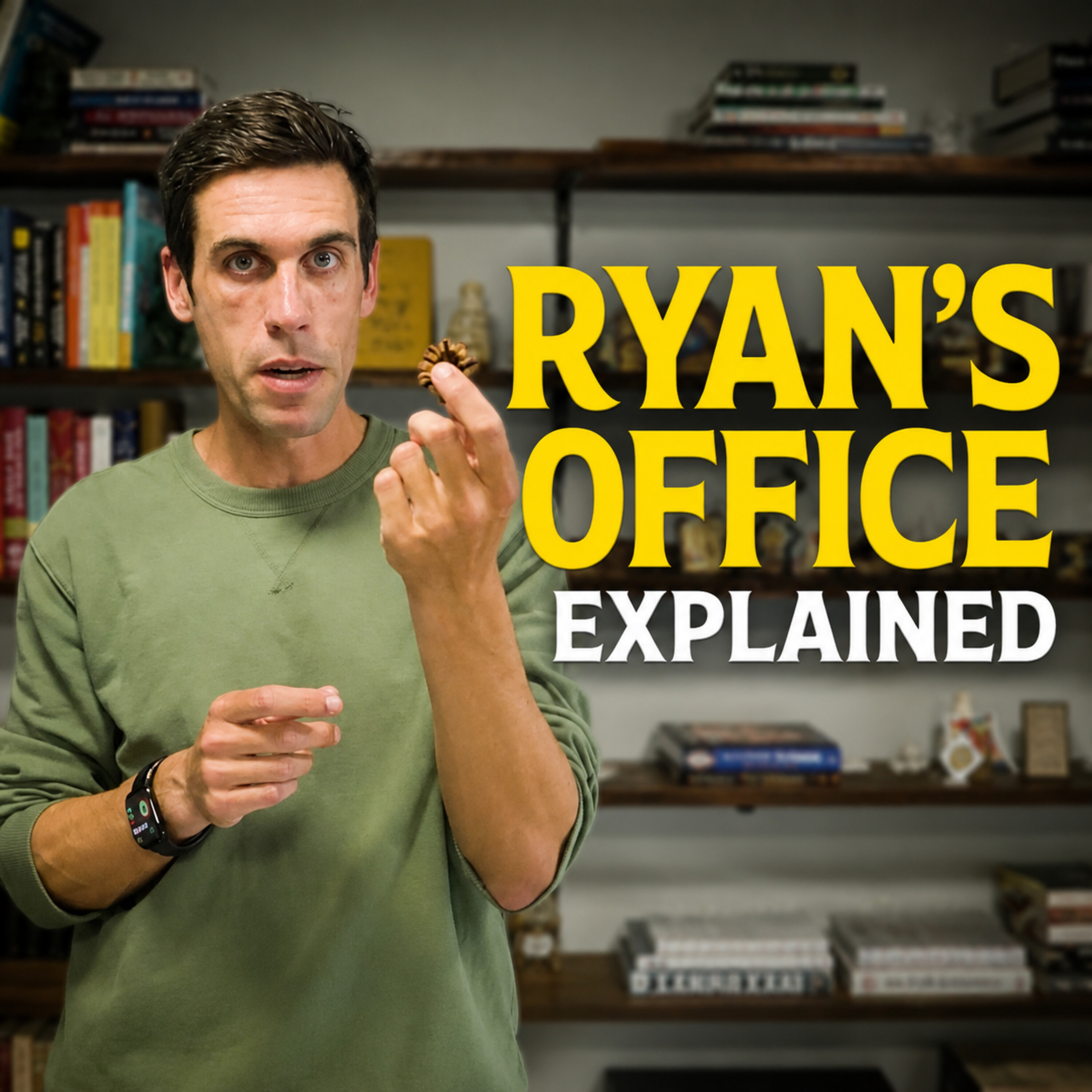
The Daily Stoic
BONUS | Ryan Holiday’s Office Tour: Books, Stoic Artifacts, and Daily Rituals
00:19:53
Loading summary
Transcript12 lines
- [00:00]
A
Welcome to the daily Stoic podcast, designed to help bring those four key Stoic virtues, courage, discipline, justice, and wisdom into the real world.
- [00:15]
B
I'm Ryan Holiday. I'm an author. I have a bookstore here outside Austin, Texas. And I'm going to take you through my office today and show you a couple of things I think explain how I work, how I think about what I do, and how I think about life. The most important reminder I have on my wall sits between two pictures of my kids, here and here. I don't show their faces, but that's Dr. Oliver Sacks. And behind him is a sign in his office that just said no. This was given to me by the sports psychologist Dr. Jonathan Feder. You develop a career by saying yes to everything, but you can only keep a career by getting good at saying no to things. And he told me that there's something similar in baseball. He's a team psychologist for a bunch of baseball teams. They have a saying in the Dominican Republic, for instance, with baseball players, that you don't walk off the island. You only get there by hitting, by swinging at pitches. But once you get to the to the majors, you have to learn pitch discipline. You have to learn when not to swing. And so this is a reminder to me that it's really important. As I sit here, I check my email. I'm working on stuff that I not only have to say no to be really good at my job, but that when I'm saying yes to stuff, I'm saying no to these two people who I've already prom my best time to, who I've already promised my best self to. Actually, I have another reminder of this that I keep here from the great Shu MacLeod. He sent me this in 2020. It's just a little drawing. It says, like an asshole, I took him her it for granted. You got to remember that when you are saying yes to things, you are saying no to things. And most importantly, when you're saying no to things. Marc Chariss talks about this in Meditations. You are saying double yes to the things that actually matter. And I have two other kind of reminders to say no. These are kind of co. This is a memo from the Truman administration. It's a. This is the interoffice communication the secretary is writing. Since the president will be out of office when the celebration will be held. How do you think that we should answer it? Should we say that because of many similar requests, the president must ask to be excused? And then here it is, underlined by Truman himself, it says the proper Answer is underlined that they should say, the President must ask to be excused. Then here's another one. I regret that I cannot comply with your request. It has long been my policy not to respond to questions. I received so many similar request to yours that I could not keep up with all of them. I hope you will understand. It's signed Harry Truman. I actually have a third one that someone gave me from Truman. It says here your question will be answered in the book. I am getting ready to publish as soon as possible. So you let the books do the answering for you. I think that's a pretty good policy as well. I don't keep all my books in my office, but I keep some of them. These are all books for the book I am working on right now. Those are international editions of my books. Those are some signed books. These are all my philosophy books. In here is biographies. Books are made out of books. So I try to keep the books that I rely on or use the most here in the office. I keep most of my novels at home because I like to reread them. But part of the attraction of setting up this bookstore and office space is I told my wife I'd take some of my books out of our house so we'd have a little more room. But I have books here. Balcony got Civil War and war books here. These are books you can see from downstairs in the bookstore, but you can't touch because they're just mine. Ebooks are nice, audiobooks are great, but I like books that I can keep on my shelf as trophies. I like to be able to go back to them, pick them up, to be able to refer to them. I like the ongoing relationship with the physical form. These are books that I've pulled off the shelf and used over and over and over again when I'm looking for something going through my note cards. So these are my philosophy books over here. These are biographies. If I don't want to keep the book, if I have no interest in keeping it, it says something to me about why I was reading it in the first place.
- [04:25]
A
It all comes down to hiring. You got to find the right people for your team and you got to bring them on board and you got to onboard them quickly. You know, just throwing up a job posting and hoping you get lucky. I've just found. Well, you don't get lucky enough. If you want to find quality hires. Well, you should check out Indeed right now. People are finding quality hires on Indeed right now. In just the 30 or so seconds we've already been talking People have made dozens of hires on Indeed. According to Indeed data worldwide, their sponsored jobs posted directly on indeed are 95% more likely to report a hire than a non sponsored job. So join more than 3.3 million employers worldwide that use Indeed to connect with quality talent that fits their needs. Spend less time searching and more time actually interviewing candidates who check all your boxes. Less time, less stress, more results when you need the right person to cut through the chaos. This is a job for Indeed Sponsored Jobs and listeners of this show get a $75 sponsored job credit to help get your job the premium status it deserves@ Indeed.com stoic that's Indeed.com doic right now and support the show by saying you heard about it on this podcast. Indeed.com stoic terms and conditions apply. As a business owner, I'm super familiar with how important a strong Internet connection is to keeping everything running smoothly.
- [05:50]
B
A slight delay in the Internet connection
- [05:53]
A
in the store, it could mean missed sales. A lag in a zoom call or a podcast recording could mean you lose everything you were doing. When every minute matters, every transaction, every customer, you cannot rely on a subpar Internet connection. You need a provider that's reliable. You need Spectrum Business. Spectrum Business keeps businesses of all sizes seamlessly connected with fast, reliable Internet, advanced
- [06:17]
B
wi fi, phone, TV and mobile services.
- [06:20]
A
They offer 100% US based customer support 24. 7 to help you stay up and running and are sure to have the right plan for you. With tailored connectivity solutions and packages built for every business budget, millions of business owners rely on Spectrum Business to keep them connected. Visit spectrum.combusiness to learn more Restrictions apply Services not available in all areas.
- [06:45]
B
I keep some little note cards here on my wall, one of which is kind of my why. To me this is like a guiding principle that I want to think about. This says, am I being a good steward of Stoicism? Look, I didn't invent the philosophy that I write about. It's not mine. I possess no ownership of it. But I am associated with it because of the success of the books, because of social media. I just try to remind myself that like somebody else will be sitting in this chair at some point, right? Somebody else will be associated with the philosophy in the future, that it's a long tradition. I think it's important that you take the job you do seriously, but not yourself. And I just try to remind myself that like this isn't mine. I don't own it. I have to represent it as well as I can. I have to try to live up to it.
- [07:28]
A
Marx.
- [07:28]
B
Chris talks about fighting to be the person that philosophy tried to make you. That's what I'm doing here. This guides the kind of content I will and won't make, the kind of products I will and won't make. How and when I publish my books, the effort that I put in. Am I living up to the expectations and the standards of what I talk and write about? That's one of the things I want to think about. And then I have a couple more that sort of guide me. I try to have a why or a through line on each of the projects that I'm working on. Somehow this one got wet. This is Hemingway. It says, do not worry. You have always written before and you will write again. All you have to do is write one true sentence. Write the truest sentence that you know. That was one project I was struggling with. Another one from Martha Graham. Never be afraid of material. The material knows when you are frightened and will not help. This is. I'm doing this work of nonfiction right now. Historical writing, which is not literature, is subject to oblivion. That's Paul Horgan. This is from a different novelist. The sidelights on the life of every great man are interesting. It's a reminder to me to go down different rabbit holes. This is an Italian writer who in our day can penetrate the hearts of the ancients, who can bring life and light again to a mind long since removed in death, who can elicit their meaning, a divine task that not human. And he says, it is therefore my plan of interpretation. First to write what I learned from the ancients. And when they fail me, or when I find them inexplicit to set down my own opinion, I feel like that's kind of what I'm doing. And then here I have one. This is an exchange with me and the great General Mattis. I was writing here at some moment when felt like the world was coming apart. He said John McCain used to joke to him that it was always darkest just before it turned darker. Keep the faith, hold the line. So I try to have some. Like a sports team. I try to have reminders of the values and principles that I'm trying to live and write with. Okay, so this is it, technically, my office. We keep it in the studio. Cause someone asked me about it on the podcast. In 2017. I was a producer on an album. I worked on the liner notes. I'm not good at music at all, but I was a producer on an album that won a Grammy. Like, I literally went to the Grammys. Walked the red carpet, and then our album won. We went on stage and accepted it. They only gave us one Grammy. And then you could apply for, like, a certificate. There are so many producers. They don't give everyone a Grammy. And also, there's two different Grammy Awards. There's, like, all the ones you see on tv, and then there's a smaller ceremony for the hundreds of other Grammys before. The point is, I could have gotten this paper Grammy and put it on the wall. Instead, I was like, you know what? I'm gonna get my own Grammy. And I'm gonna say what it actually means. And so it says, national Academy of Recording Arts and Sciences, Ryan Holliday, best Large Jazz Ensemble Album, 2017. And then I says, when you die, this will go in the trash alongside all your other accomplishments. You know, it can be easy. My publisher sends me little plaques and things, right? Like, this is. This is from my UK publisher when I sold a million and a half copies in the UK. This is spring 2023. Like, I think it's cool. It's a cool accomplishment, but, like, what are my kids gonna care about that? Maybe it's one of the ones they'll keep, but maybe it won't, right? Here's a hundred thousand orders from Daily Stoics store. Or, you know, there's my YouTube plaques. I guess my kids were vaguely impressed when I got YouTube plaques, so maybe they would actually keep those if something happened to me. But the point is, when you achieve and accomplish things, it's a very privileged problem to have. But. But the things start to stack up, okay? You hit a bestseller list, and then they send you a framed thing. Like, I literally have more. More of them than I know what to do with. My wife does not want any of them in her house. And so I was just trying to remember, as kind of a joke that, like, all these things are cool, and it is cool to walk down the hall and go, I did that. That accomplishment was a lot of work, and there was payoff for it, and that's great. But it's also a reminder that at the end of the day, not only is it junk at some level, it's forgettable. It doesn't mean as much as you think it means. And that if that's why you did it, if that need to be recognized and removed, remembered and celebrated for the thing that was the. The. The motivating factor, the Stokes would say you're going to be sorely disappointed when you realize what it's actually worth, which is not much. So I sit in a little bit of magic every day. This is Joan Didion's chair next door. I'll show you. I also have Joan Didion's table. He's from Sacramento. I'm from Sacramento. I just like objects that have a story to them, something with a little bit of history and sacredness to them. And so it feels good to sit every day in the chair of someone who is one of the best to ever do it. I know it doesn't really mean anything, it doesn't convey any magic, but it went up for auction and I thought it was pretty cool. So it's not the most comfortable chair, to be perfectly honest, but maybe there's a little stoic lesson in that. Marc Shrilius would famously sleep on a hard mattress. I sit on this hard ass chair and I try to think about who sat in it before me. So I do all my research on note cards. We have a book on Stockdale right now. These are the note cards from that. When I did my My Four Virtues book, I printed out these note cards. And for almost 20 years now, I've kept a commonplace book in these note cards. Each book I do has note cards. So like, this is the project I'm working on now. My stuff's here, laid out on the table. This is the book I'm doing. This is the layout for the book. Every time I read a physical book, I go back through it. I put the ideas that I need to take out from it onto my note cards. And then those note cards come with me when I'm traveling and I'm writing, or those note cards sit on my desk here and I'm writing. So for me, the note cards are the building blocks, the pieces of the puzzle that go into each book. And I have one for each book. Here, I'll show you next. This is Future projects. Here's the courage book. Here's the justice book, here's the discipline book. There's Ego is the Enemy, Wisdom books down there, that's stillness, that's Growth Hacker, I think, trust me, lying's in here somewhere. So each one of the books is one of these boxes. And there's even a beautiful Joan Didion essay called On Keeping a Notebook where she talks about that she would keep note cards not only when she's doing a script or a screenplay, but she would write down things that she found in the course of her life. And she talked about how a journal or notebook is a way to keep on in touch with who you used to be. Right. And sometimes I Go back through these note cards. Some of these books, like this one here, these are note cards. Some of these are 20 plus years old of just different notes that I've kept since I was in my early 20s. I pick up these cards and see things that I took pains to write down. How long ago, What I was thinking about, why I was thinking about it, why I decided to write down this note about dogs or the animals killed at Nero's games in Rome. Or this is Pliny. It's true that what he wrote will not be eternal, or at least I didn't think so. Still, he wrote them as if they would be. It's a great line. These are notes about writing. This is Marshall, the Roman poet. Forgive me, it's not worth my while dying to earn your critical smile. Oh, here's Joan Didion. That's so funny. People tend to forget that my presence runs counter to their best interest. She was saying as a journalist, and it almost always does. That is the one last thing to remember. Writers are always willing to sell somebody out. Maybe she wrote that down sitting in that chair. Kind of crazy. So I have this print here. We actually made this for the bookstore a couple of years ago. I don't know if we still sell it, but it's a great line from Hemingway. He famously said that the first draft of anything is shit. And here it is sort of illustrated as an idea. It's very tempting or easy to accidentally compare the thing you're in the middle of to something that's finished, either that you finished or that somebody else has finished. And that's just not fair. Let's. That's not how it works. You have to remember that everything was terrible at some point. Everything was partially done at some point. Everything was a blank page at some point. And if you remember that first drafts are supposed to be crappy, you're supposed to be working stuff out on the page. I try to remember where this bookstore, or Daily stoic or the YouTube channel, where it was at the beginning, where it was for the first several years. You're getting better as you go. And this hourglass talks about the taste and talent gap. Often your taste is better than your talent in the early days of what you do, or even in the early days of a project. And so you have to get comfortable being bad. You have to trust the process. And if you can't, you get stuck. And that perfectionism becomes a kind of paralysis. Those high standards actually prevent you from getting better and better because you're so convinced that what you're doing right now isn't good. It's not supposed to be good. So I try to remember what a first draft is supposed to be, which is a part of the process, a step along the way to getting to where I want it to go. Okay, so this pine cone, this is a pine cone from a lodge pole pine. And it looks like an ordinary pine cone. That's because it's opened up. It's called a serotoninous pine cone. It's covered in this waxy resin. For it to work as a pine cone is supposed to work, it has to be exposed to. To heat. I don't just mean, like, everyday heat. I mean, like the heat from a forest fire. So basically, the thing that you would think would be the worst thing to happen to a tree, which is a fire, is actually necessary for this tree to recreate for the next generation of trees to come. It is, to me, a perfect metaphor of both creative destruction and the idea that the obstacle is the way you think. You want to avoid adversity and difficulty. You don't want to be put to the fire, but in fact, the fire is there to help you open up, to melt off that covering, to make new growth and new things possible. This is just a lovely reminder. I also think it's funny. I bought this. I've never actually seen a lodgepole pine in person that I know of. Some lady just sells these on Etsy. She puts the pine cones in the oven. They open up. I just think that's hilarious. So I bought a couple of these just as a reminder. So this is also, to me, a great embodiment of the stoic idea of Amor fatih. Right. Marx Realis talks about how what you throw on top of a fire becomes fuel for the fire. Right? That it turns everything to flame and bright brightness and heat can also turn it into something beautiful and new and fresh. This is a picture of me and my grandfather. I may be 12 or 13 there. I had some other pictures. Let's see. I have some other pictures in my house and in my office of me as a kid. My therapist told me I should do it. She says, you know, it's easy to lose touch with your inner child. And part of what we're trying to do as adults is heal that inner child, be a better parent to ourselves so it can be a better parent to our kids. Because you so easily lose track of who that person was, what they look like, what they felt like, what it was like to be 5 or 6 or 15. And those reminders are helpful to me. So I have a couple of those. And then it's also, to me, a reminder of the passage of time, how recent that was, and also how long ago that was. And that's a powerful reminder as well. Okay, so this is a reminder on the way up to the office. I took this from the creator of Per Se. It says sense of urgency, which is his reminder. That book. You don't want to rush things. We also don't have unlimited time. To me, that. That tension of Festina Lente, like, make haste slowly. And then also, like, hustle, hustle. I think about this going into, like, fulfillment and stuff, like, how long are we going to make people wait before we put their package in the mail? How. How long am I going to wait to answer that email that I need to respond to? How long are we going to wait until we ask the best for ourselves, as. As Epictetus talked about. So a sense of urgency is something that's got to shape who you are and what you do. And it's one of our values here at Daily Stove. I have this chunk of a tombstone here I keep behind my desk. I used to keep this on the mirror in my bathroom, but we changed our bathroom. There wasn't space for it anymore. I don't know how this came to be sold on the Internet. I don't want to know. I just know that at some point, a dad, a parent, a living person, they passed away. And this is all that remains from that memorial. It's a memento mori. Right? The Stoics want to remind us that life is short, that life is unpredictable, that none of us are here forever. That's what memento mori means. And in ancient art and in philosophy, these reminders are everywhere. Here's an illustration by Salvador Dali of Montaigne doing a memento mori, staring at death for a second. The idea is that you reflect on your mortality. You put up things that humble you and remind you of the fragility and the shortness of life, to give you perspective, to give you urgency, a sense of urgency. And that these reminders are important and powerful. And this is, to me, a reminder in the end, of all the things that really matter to you as well. So, anyways, that's my office and a dozen or so objects. I thought, as I wrap up, I'll give you rapid fire, some other cool ones. Maybe we'll do another video about this if you guys like it. What do we have here? This is the last page of Steven Pressfield's manuscript for Gates of Fire, which is pretty incredible. This is the first manuscript page from Walker Percy's Lancelot, one of my favorite novels. That's a memento moria, a ticket from General Grant's funeral there. I've got a print or a wax painting of Sherman. One of my heroes who I wrote about in Ego is the Enemy. The great Garland Robinette, who was on the Daily Stoke podcast, painted me this little portrait of Walker Percy, one of my favorites. There's my Marcus Aurelius. One Marcus Aurelius reminder. Waste no more time arguing what a good man is like. Just be one. This is a fossil my son found. I got some money. This is the first little bust I bought of Marcus Aurelius. It's from the 1800s. This is a hand chipped tool or axe from a Paleolithic man. Think about the passage of time. That's pretty cool to hold. This is a Roman pen knife. Just think about somebody opening mail or a package or cutting something with this 2,000 years ago. That's pretty cool. That's a chunk of a White House that Truman took down to the studs. This is a signed edition of the Road Knot taken by Robert Frost. And then the final thing I have, like in a a locker room or right before you run out on the field in a sports stadium. You have the four virtues of stoicism, courage, discipline, justice, wisdom. I like to see it as I go up and down the stairs every day.
- [22:10]
C
You're listening to this podcast, so I know you've got a curious mind. Here's a helpful fact you might not know. Drivers who switch and save with Progressive save over $900 on average. Pop over to progressive.com, answer some questions and you'll get a quick quote with discounts that are easy to come by. In fact, 99% of their auto customers earn at least one discount. Visit progressive.com and see if you can enjoy a little cash back. Progressive Casualty Insurance Company and national average 12 month savings of $946 by new customers surveyed who saved with Progressive between June 2024 and May 2025. Potential savings will vary.
- [22:49]
D
Support for this podcast comes from Progressive, America's number one motorcycle insurer. Did you know? Riders who switch and save with Progressive save nearly $200 per year. That's a whole new pair of riding gloves and more. Quote Today, Progressive Casualty Insurance Company and Affiliates national averaged 12 month savings of $197 by new customers surveyed who saved with Progressive between October 2024 and September 2025. Pot will vary.