Loading summary
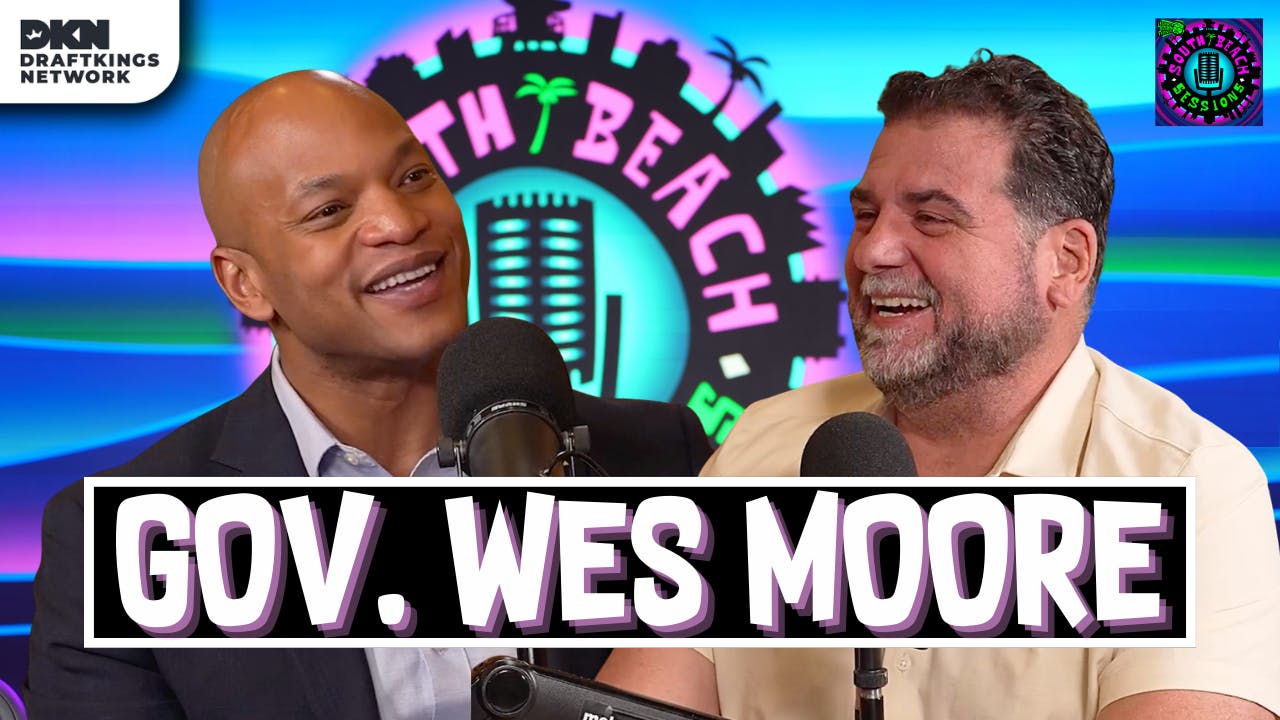
Transcript120 lines
- [00:02]
A
You're listening to DraftKings Network.
- [00:11]
B
Zootopia 2 has come home to Disney. Let's go get ready for a new case.
- [00:16]
A
We're the greatest partners of all time. New friends, Gary the snake and your last name, the snake Dream team. New habitats. Zootopia has a secret reptile population. You can watch the record breaking phenomenon at home. Zootopia 2, now available on Disney. Rated PG here. Right now you can get Disney plus and Hulu for just $4.99 a month for three months with a special limited time offer. Ends March 24. After three months, plan auto renews and $12.99 a month, terms apply.
- [00:57]
B
So if I take the W in Wes and I make it an L, then I can have the campaign slogan of Less is more. Less. Do you like that? Less is more. I feel like you're just sort of.
- [01:12]
A
Yeah. I think we should stick with Wes.
- [01:14]
B
Okay, we're gonna stick with Wes. It sounds like a lisp if I make it. Wes is Moore. Wes is more. He's Wes Moore. He's the governor of Maryland. And I'm thrilled to hear you're a sports fan. I'm thrilled to hear that you're here. I was wondering why you'd be a part of this ramshackle operation.
- [01:30]
A
It's because I'm a fan. And I've been a fan for long time. The only thing I am mad about, I thought papa would be here.
- [01:35]
B
Yeah, everyone's always disappointed when Papi's not around. I've always been surprised by the popularity of that television show and specifically the fact that my father stole it from me. I mean, he's doing it in his second language. And so many people love him and feel like they know him just from watching him on television.
- [01:52]
A
Well, because you know why? It's like, you know, I feel like for all of us, and particularly those of us who come from immigrant families, like, we all have a poppy, right? There is. There is that that person in our life that really helps to lead us and mold us and guide us. And the thing I loved about what y' all did is you took two things I'm very passionate about and put them both on display. Right? One is sports. I love sports. And I feel like in many ways sports helped to not just change my life, but just really help to give a set of direction to my life. And I love family. And as someone who comes from an immigrant family, someone whose grandmother was born in Cuba, raised much of her life in Jamaica, came to this country, you know, with my grandfather who she met in Jamaica. And then they built a life here in the United States, which also included helping to raise not just their kids, but helped to raise me and my siblings. It was. Your show is really meaningful because it took a lot of passions and it put all into one.
- [02:54]
B
Thank you for that. You lost your father when you were three, though. So did your grandfather sort of play that role?
- [03:00]
A
Absolutely. When my dad died in front of me at three, my mother called up her parents and my grandfather was a minister in the South Bronx. My grandmother was a schoolteacher in the South Bronx. And I say their house was barely big enough for them, but they figured out a way to make it big enough for all of us. And when my mom said that she needed help, you know, that house, for a lot of us, you had that one house in your family that no matter what people were going through, whether it was a breakup, whether it was losing a job, whether it was someone who was coming to the country, that house was the healing balm for the family. And that was my grandparents small home in the Bronx. And that's where we went. My grandfather really helped to take on that paternal role for me. And in fact, to show just how important he was, I was deployed in Afghanistan. I led soldiers with the 82nd Airborne when, when, when he died. And usually they never let you leave theater unless it's the death of a child, a sibling, a spouse, or a parent. But because he really did take on that paternal role for me, that was when the Red Cross got involved and made the exception to say, you know, that they. So that's how I got, you know, permission to go and bury my grandfather.
- [04:27]
B
I have a lot of follow up questions about everything you just said, but you said sports saved your life or changed the direction of your life.
- [04:33]
A
Absolutely.
- [04:34]
B
How's that?
- [04:35]
A
Well, because, you know, it was a few things, right? One is when I first moved from Maryland to New York, you know, I'm now in a new neighborhood, in a new place, and frankly, in a place that I was still getting to know. And this was the Bronx during the 1980s, and the place of refuge. And for folks coming up in the Bronx in the 1980s was the basketball court. That was where I learned so many life lessons, you know, about how folks interact with one another, about who to trust and who not to trust, about all the rules and the laws of the neighborhood and the community. A lot of them were built out from what happened on basketball courts. And so I saw the role that basketball played in my life much through, you know, high School, et cetera. And then I found this passion for football, which I never played in high school or anything like that. The first time I ever played football was when I went to college.
- [05:33]
B
Is that right? You were a wide receiver, Right, I
- [05:35]
A
was a wide receiver. And the football coach came and watched me play basketball. A guy named Jim Margraf, who this year I'm very proud, he's getting inducted into the College Football hall of Fame. And he comes and he's like, after, you know, after, after, you know, he comes up to me and he's like, have you played football? I said, no, sir, I haven't. And he's like, you know, you got good hands and good speed. And he's like, do me a favor, if it's okay, maybe after practice tomorrow, why don't you come out and we'll have you run some, some patterns. So I went out, I did the 40 yard dash, I did a vertical elite test and I ran a couple patterns and, and then when I finished that up, he's like, what do you think about being a wide receiver? And that was my introduction to football, which really has now, that's been my lifelong passion.
- [06:17]
B
As a kid. What were you like as a kid, like before you got, did the military sort of straighten you out?
- [06:23]
A
Oh, yeah. I mean, like, listen, I think I was a kid who, I was a kid who had a lot of anger issues. Cause I was dealing with a lot and I was trying to process a lot, right? It's like, you know, your dad dies in front of you when you're three, your mom has a really difficult time dealing. A woman who's, who's an immigrant from Jamaica coming to this country you're now living with, you know, with your, your, your, your grandparents and your siblings and your mom, and there's aunts and cousins and everybody all under one roof. There was a lot of anger that I was just dealing with and I think it showed itself. And so my mom had been threatening me with military school. I think I was like 8 years old. Literally getting me like, you know, brochures and showing me she was going to send me away. And every year she didn't. But it wasn't because she makes empty threats, because my mother doesn't make empty threats. It was because she couldn't afford it. And finally, guess When I was 13 years old, my mother thought, once again, my son's having real challenges. I mean, I'd, I'd handcuffs my wrist by the time I was 11. And finally when she was like, I think it's gonna be another year. I'm just not gonna be able to do it. I. I found out that it was my grandparents who, with that home in the Bronx that they had, were able to help my mom be able to. To be able to afford that first year of military school. And in many ways, that. That sending me to that military school really helped to save my life.
- [07:53]
B
You've mentioned now a couple of times your father dying in front of you. I don't have any memories from that early in life. Is that your first memory because you were three, right?
- [08:02]
A
Yeah. Honestly, like, I only really have two memories of him. And the first was when my mother always had the cardinal rule about putting your hands on women. And I think part of it goes back to her past where, you know, she has been in abusive relationships. And I hit my sister. I have an older sister. I have a younger sister, and I hit my older sister. And my mother just lost it. And it was my father who helped to come save me and was like, you know, and I kind of, you know, kind of hear him. And I'm after now talking to my mom about it. Basically, he's saying he's like, you know, this, and he doesn't. He's too young. He doesn't understand. But my father really was my protector in many ways. And the only other memory that I have of him was when my protector died. And so it was something that still very much sits with me. It soured me because even when he died, my mother tells a story about how even at his funeral, I actually went up to the casket and asked him if he was going to come with us, because I didn't understand what was going on. And so I think as I got older, it just got more. More confusing. And I think that confusion just turned to a lot of anger.
- [09:26]
B
How was the anger manifesting itself?
- [09:28]
A
It was manifesting itself in the ways I was with other people. Violent, the amount of fights I just got into. And I think what I did was I hurt a lot of people who didn't deserve it. I think there's a lot of people who, I think ended up becoming the recipients of the fact that I was not processing this well. And I think it showed itself in my grades. It showed itself in the fact that I started picking and choosing which days were worthwhile to go to school and which ones weren't. And unfortunately, I had a lot of educators who were enablers to it, where they weren't letting my mom know and they weren't notifying anybody, because as I had One teacher who told me the class worked better when I wasn't there. And so I think that that continued to watch this spiraling of bad behavior. And then finally when my mom said, I'm going to send you away, I first thought she was kidding. I was like, all right, Mommy, I know I'm going to work harder. And then finally she's like, no, you're going next week. And that's when she, dec. Decided to send me away.
- [10:37]
B
And. And you were. That. You were very young. What was the culture shock? Like, how long before you became acclimated? That had to be fairly stunning.
- [10:45]
A
It was. It was crazy. I mean, I still remember like that first morning, it was like 5:30, 5:45 in the morning. And they. They were all in. Were in the barracks or the place where we all lived. And they start flicking lights on and off, on and off, on and off. And they're. And they're playing welcome to the Jungle by Guns N Roses. So I know the song, but it's like, it's like, da da da da.
- [11:12]
B
So it's an aggressive early morning. It's aggressive.
- [11:15]
A
Good morning.
- [11:16]
B
Yes.
- [11:16]
A
And then so they're playing welcome to the Jungle. They're flicking lights on and off. They're beating trash cans with sticks, and they're just screaming, get out of your racks. Get out of your racks. Da da da da da da. So I am on. I'm in a bunk bed. My roommate, who's from Brooklyn, was on the bottom bunk and I'm on the top bunk, and he jumps out of bed and his. I just remember his legs were shaking. And he looks at me and he's just like, we got it, we got to go, we got to go, we got to go. And so I look at my roommate and I look at the clock and the clock says, you know, 5:45 in the morning. So I look back at my roommate and I'm like, dude, it is 5:45. And I said, tell him to come get me right at 8 o'. Clock. Cause she ready to go right now. Like this was an optional wake up call.
- [12:05]
B
You actually said that. Where did you think you were? Like this was an option.
- [12:11]
A
So I literally said that you hit
- [12:13]
B
the snooze alarm on the military academy.
- [12:17]
A
This is my first morning. So he thinks I'm crazy. He runs outside with all the other people, but he's scared.
- [12:26]
B
His knees are shaking. You're annoyed?
- [12:28]
A
I'm annoyed. I'm like, yo, it is. I was like, Tommy Kong gave me around eight. So we're Out. So he's outside. I just curl back over, and I put my pillow over my head, so I'm blocking out the noise because the noise wasn't for me.
- [12:39]
B
Where did you think you were?
- [12:41]
A
This was my mindset. You know what I mean? And then finally, I hear someone yell, why is there only one person outside this door? So then my door. Then I hear the door slam open. So they must have kicked the door open. And then they come in the room, and I think it was my first sergeant, who's, like, screaming and yelling and cursing at me. And, like, I kind of got my back to him because I was curled over to block the noise out. So then I slowly take the pillow off, and I'm looking at him, and I look at him, and I say, man, if you don't get out of my room, I'm like, 13, 12, whatever I was. He's like a high school senior, so I just remember him looking at me and smiling, and he walks out of the room. And so my first thought is, this thing's gonna be easier than I thought.
- [13:35]
B
I scared him off.
- [13:36]
A
I scared him off. And then next thing I know, probably 15 seconds later, boom, door slams open again. And the entire chain of command walk into my room, all of them, and they just pick up. They pick up my mattress, and they take it off the rack, and they just flip it over, and then I just slam to the ground. That was my first morning.
- [14:02]
B
So how long before you get acclimated does the slam on the ground alert you to? Now I know where I am. I'm not gonna do any of that again. Like, how long did it take for you to.
- [14:13]
A
It still took a little bit. I mean, I ran away five times in the first four days. Cause they would always tell us. They're like, you know, there was gates around the campus, and they would always tell us, there's a train station right in Wayne. Right? Wayne, Pennsylvania. Where the school is. There's like. There's a train station right in Wayne. If you want to go, you can go. So I would just take them. Take them up in their offer. And I just run out of the gates, and they kept on catching me and bringing me back because I had no idea where the train station was. I was just gonna go run up on the train station. The. The. Maybe three nights in, or four to four nights in, whatever. My squad leader comes up to me, and we call the room to attention. I'm standing at attention. And my roommate, because of me and my roommate together. And he tells my roommate he Says, get out. I gotta talk to Moore alone. So I'm like, damn. I was like, whatever he's about to say, he doesn't want witnesses. Or whatever he's about to do to me, he doesn't want witnesses. So my roommate grabs his stuff. He runs out of the room, and I'm staying at attention, and he tells me to sit down, and he says, listen, Moore, it's obvious you don't want to be here, and quite honestly, we. Quite honestly, we don't want you here. So I've drawn you a map on how to get to the train station. And he hands me a map, like, handwritten, with, like, a legend at the bottom. Like, pace counts. I'm literally looking at this thing like, dude just handed me a lottery ticket. And I'm like, yo, I'll never forget you. When you get out, let me know. We'll grab lunch. And that night, I had this whole big, great escape, and I left and said goodbye to my roommate, and I ran out other thing. And the map was fake. The map literally took me to the middle of the woods. They just were cracking up, watching me doing donuts in the woods, looking for the train station. And that's when they realized that, you know what? You know, if we don't make an exception, we're. We're. This. We're going to lose this kid. And so they let me make one phone call, and I called my mom, and I was just begging her, just like, mom, can you please come get me? Like, this is not. This is not cool. And I'll do whatever you want me to do. Just let me come home. And she's just like, too many people have sacrificed in order for you to be there. And too many people are rooting for you, and it's not all about you. And you got to figure it out
- [16:16]
B
how long before you sort of found the gratitude for any of that.
- [16:20]
A
I felt like I really started to better understand the system. Probably I would say a month in. And it's because I started to develop this brotherhood and this bond where we needed each other and we relied on each other. And then eventually they gave me a little bit of responsibility. And that's when the military started kicking in in a way that the military normally does, which is it's going to break you down as the individual because they're going to build you up as a collective. And it started to work, and I think that mattered. But I would honestly say I don't know if I had a full appreciation for how tough a decision that was for my mom to make and how she had to sacrifice in order for it to happen. It took years for me to really like to tell her thank you, because she helped save my life and she sacrificed her own.
- [17:16]
B
When did you take to the discipline? Like, when. When did you start to like it?
- [17:21]
A
You know, actually, and this is maybe where sports comes back into it, where, you know, when the discipline. When it started to feel a little better was because I was. I was always on probation, so I couldn't really play sports when I was younger. This was the time when, like, my grades were getting better. My military performance was actually pretty good. Once I just gave into the system and I could play sports because I wasn't on probation anymore. And when people ask my mom, they're like, how's Wes doing? She could say, he's doing well and not be lying about it. And so I got a chance to play. That was eighth grade, so I got a chance to play basketball. I was MVP of my basketball team. I got a chance to play baseball. I was the team captain.
- [18:10]
B
Oh. So you start to get confident. You start to feel like you belong. You start to. You're not just a bad kid anymore. Yeah.
- [18:19]
A
You weren't this consistent problem that everybody was just attacking and blaming and where every classroom you walked into, whatever, like that, like, they knew you before you walked in.
- [18:31]
B
And it's the first thing that you feel like you're good at.
- [18:33]
A
Yes. Like, I feel like I'm like, oh, wow. Like when I get on a baseball field, like, I'm actually. I'm the team captain. Like, I'm a leader on the team. When I play basketball, I'm the leading scorer, and I'm like, the people, when the game's on the line, they throw the ball to me. And that felt good. And I think it's just something that feeds into not just how you dealt with sports, but also I just like, that was a good feeling for life. That it's like when people. When you realize that people are relying on you, whether it's your family, whether it's your friends, whether it's your community. Like, when people are like, no, like, we need you to succeed, because when you succeed, we're all going to be better because of it. That's like. That's dopamine. You know what I mean? That's addictive. And I think it's just something that you then continue to put in the work because you realize that. That you're necessary and that matters.
- [19:25]
B
How do you come by your optimism? It's a very difficult time to be optimistic.
- [19:29]
A
Yeah. Honestly, for me, I think a lot of my optimism comes from my understanding of history, where it's a difficult time. But I know this country has been full of difficult times. I know this country's been full of difficult times for my family, where I think about my grandfather, right? Where some of his earliest memories was watching this country reject him when he is just a child. And his father, my great grandfather, leaves the country because the Ku Klux Klan runs them out and they go back to Jamaica. And for much of my family who've always said that we won't go back to the country, it's the reason why I still have so many family members still in Jamaica right now. And my grandfather, though, decided to come back here. And he comes back. He goes to Lincoln University, Historically Black College, University in Pennsylvania, gets. Becomes a minister like his father becomes the first black minister in the history of the Dutch Reformed Church. And the threats that were coming to his father start coming to him because it's not like everybody was happy that he was making history in this way. And he stuck. And he spent his whole life devoted to family and God and community.
- [20:49]
B
Also optimistic.
- [20:51]
A
And also optimistic. In fact, I always. This is a man who had a deep Jamaican accent his entire life and is maybe the most patriotic American I've ever met. And so I'm like, so what right do I have to be bitter? Amongst his first memories was his country rejecting him. What right do I have to be afraid when amongst his first memories was watching the Klan attack his family and then watching racist slurs thrown at him by members of the clergy when he became a minister? And so I just.
- [21:35]
B
These are all stories, right? You're not. You're hearing them from him, but you're not seeing it, correct?
- [21:40]
A
Yeah, no, no. Because all this happened before I was even an idea, right? Before I was even a thought. Like, these are things that he had to deal with as a child. And then when he became a young man before, you know, as he was just having kids, forget grandkids, that's when he continually sees this bitter and brutal face of racism that shows itself at him. And he never lost his optimism and he never lost his belief in this country. And he always fought for this country, and he fought for God and he fought for his family. And so these are the stories that I grew up with. These are the stories that were shared to us, but they were shared not because they were looking for pity. They were shared to us because they wanted us to remember our strength and listen, life is not going to be simple and it's not going to be easy. And you're going to have all the stuff that comes that life is going to bring you, but that God has prepared you for it. And that's the thing that I think my grandmother and grandfather and everybody who came before me, that they wanted to make sure that we understood your story
- [22:56]
B
seems a bit impossible. So when I give you that bit of history and I say, okay, he suffers that rejection, and then his grandson grows up to suffer both the indignity and the rejection of the President of the United States, saying you're not worthy of being invited to a White House dinner. How do you absorb that? Do you absorb the insult in it? Does it make you furious? Do you look at the history and calm yourself? How do you manage all of that? That.
- [23:23]
A
You know, I remember when the president, you know, disinvited me from a National Governors association dinner where I served as the vice chair. And I actually thought about my grandfather and what he would say. Where my grandfather always used to say, never let someone take something away from you when they never gave it to you in the first place. And the president could not. Didn't make me a member of the National Governors Association. The people of Maryland did. When they elected me with the highest vote count in the history of Maryland gubernatorial politics and made me the 63rd governor, the president didn't make me the vice chair of the National Government Association. The other governors did, where Democratic and Republican governors pick and decide and vote who should be the leaders of the organization. And they picked me. The president can't take my power because he never gave it to me. And so frankly. And I've told the people of my state that there is nothing I will not do to fight for them. I will work with anybody. I will do anything in my power to make sure that my people are good and that they are protected and that their futures are secured. And there is nobody who can take away a power that came from God or a worthiness that came from God.
- [25:03]
B
But it's meant to hurt you. It's meant to insult you, does it not?
- [25:06]
A
Meant to. It's meant to insult me. But here's the thing. It's meant to hurt me. And it doesn't. Because if it hurt me, it means that he won. I think that what he wanted more than anything else was for me to beg, was for me to feel slighted and for me to attack and for me to. So I did the thing that not only comes naturally to me and the thing that comes from my family and my family's history, but also the thing that I know hurt him most, which is ignore it. Which was understanding that if the idea is to go there and just to take these insults, the message that I sent to the presidents very clearly is I don't have time for foolishness and I'm not going to give you what you are looking for that if you know my family's history, you know, we're built different and we're not going to give you that one.
- [26:18]
B
Do you believe he's racist?
- [26:21]
A
I think it's a question for him. I think it's. I think it's something that he needs to answer to and I think it's something that I would hope that the people who are close to him are asking him to be a little bit more self reflective. I know his actions, I know how his actions hit me and frankly how many of his actions, especially when he did things like disinvite me, how it hit members of my community, how it hit many members of immigrant communities, how it hit many members of communities of color all across this country and how they heard it and how they, how they saw it. You know, I am the only black governor in this country. Not a title frankly that I'm proud of. I still find it wild that in the 250 year history of this country that I'm only the third African American ever elected governor in the 250 year history of America. And I think it is a bit troubling because I know I'm not the third African American ever qualified. But I think the president. I think the president has to answer that question because I think it's important for him to wrestle with it and wrestle with the fact that why do so many people say the same thing?
- [27:44]
B
But you can't just say yes, he is right, because then that gets aggregated, it becomes too absolute. It's a tricky question for me. I don't think it's tricky. I think he is racist and I think he's also an opportunist above all else. And so he will take all the isms and use them if they present him power. But you can't answer that question just yes or no. Right. Cuz it puts you in a bad spot. Like it puts you in an impossible spot where now you're giving him some of what you just said you don't want to give him.
- [28:12]
A
Yeah. And I think the weight of the question shouldn't sit on your back, it should sit on his. The weight of the Question shouldn't sit on my shoulders. I should be free of that weight. Right? You should be free of that weight. All that weight belongs on his shoulders. And he should be the one to be able to answer that. And I think that there are many members of our community, and not just. I'm not saying it's community of Americans and people who are here who. They've gotta wrestle with that question. I shouldn't have to wrestle with that question alone. You shouldn't have to wrestle with that question alone.
- [28:51]
B
No, I get what you're saying.
- [28:52]
A
I should wrestle with it.
- [28:53]
B
I just don't understand how you come about summoning any respect for a man that not only is that, but also feels the way he does about the military or all of the things that have been reported about his disdain for the military. I don't know how it is that you summon. I don't know what your relationship is with this country at the moment.
- [29:12]
A
You know, it's. My relationship with this country is I love it, and that's why I'm willing to fight for it. And I know it needs healing. And I think that we all have a shared responsibility to heal it. You know, if there's one thing I know about this country is we're not perfect and our history hasn't been perfect. You know, there's a great song by. By Donny Hathaway where there's a. And it's called A Song for your. But there's a line where he says, I know your image of me is what I hope to be. And I feel like in many ways that's America. Right? I know your image of me is what I hope to be. Where we haven't fulfilled the greatest promise of what this country hoped for when it was first created. That it's still. It's still a work in progress. That this country, I still believe, is the greatest experiment in world history, yet it's still an unfinished experiment if we're going to live up to all of our great ideals. But I do think a lot about my family, like a family who's willing to fight for this country even when this country wasn't willing to fight for it back. A family that was willing to sacrifice on behalf of the hope of what America could be, even though for many of them, they knew that they might not see it in their own lifetimes. That I stand here as the realization of a promise that for generations who made far before us, that they fought for the hope of us. I mean, like, could you imagine for your great grandparents and great, great grandparents, if they could see you now, that's a realization of everything that they fought for. I am my ancestors wildest dream.
- [31:17]
B
Yeah, so am I.
- [31:18]
A
You know, and that's a beautiful thing that they were willing to sacrifice for something that they wouldn't see themselves, but maybe their legacies would. And I think that's what makes this country worth fighting for and that's what makes us unique.
- [31:35]
B
In my particular case though, right? So me and my brother make our lives in the arts, right? Which is not something they could have fathomed coming from a place that didn't have freedom, a place they had to escape in order to get freedom. So the idea of that is just the starting point on that is all nuts. But what I'm presently seeing happening in America are the stories my grandparents told about how Cuba fell to communism when it fell to. Like the stories are similar. Neighborhood watches. You give power to certain people who don't deserve power. And now they are. They're ice or whatever else. Like the stories are. This is how, this is how this creeps upon freedom. This is when you're fighting in the military, risking your life, it's to protect us from what is presently like, it's obvious, if you have any sense of history.
- [32:26]
A
Yes. And that's the thing I want everyone to wake up to. I was talking with a member of our General assembly who's a Chinese immigrant, and she said, this is what we escaped from, the things that we are now seeing this administration doing. And I want people to wake up to what's happening. You know, when we're talking about things like the nationalizing of elections, or when we're talking about things like taking control of the voting booths, or we're talking about things like telling certain states that they need to redistrict, or when we're talking about things like the Voting Rights act, which is gonna be the largest ability to be able to take away black political power that this country has seen. We have to remember this is all very intentional and particularly for those of us who come from immigrant families, it's just deeply familiar, this country. And the joy of the experiment of this country was to say that what could it look like if we could have a representative democracy that doesn't behold to a king or a familial legacy structure that could actually have people who had a chance to vote every two or four or six years, depending on the office that we actually had balance of power, that the legislative branch was not the boss of the executive branch or the other Way around that the judicial branch wasn't the boss of any of them. All of them have distinct powers, but also there's checks and balances. What could it look like if we could have a country that does peaceful transitions of power and said, let's try it all out, and, by the way, have a country that doesn't exclude people from around the world, but welcomes them because they say they will all be part of our larger glory and our larger grace. This country is such a bold and wild experiment that has worked. And so when we're watching this pushback and this creep against it, when we're watching the administration who's using the Constitution like it's a suggestion box, when we're watching our highest courts make decisions and the executive branch pretending like nothing even happened, unfortunately for a lot of immigrant families, this is looking deeply familiar.
- [35:00]
B
Well, I'm beyond exhausted. I'm overwhelmed. I'm consistently overwhelmed by. You say peaceful transition of power was one of the things you said. There's no way that's what's gonna happen in 2028 if he's still alive. So, like, I'm scared that this isn't more overt, more obvious to everybody, that this is an infringement on almost all
- [35:24]
A
American ideals, and that for all these people who are just sitting on their hands and just moving goalposts and being aiders and abettors of this and coming up with every single reason why we shouldn't act. You know, I tell people all the time, like, I'm always gonna fight for our democracy, and I'm always gonna fight for this country. Always.
- [35:43]
B
But how do you not feel defeated?
- [35:45]
A
Because I know our history reminds us not to. Like, you know, I think about it this way, Dan, where if you look at our state of Maryland, we have probably, arguably one of the most complex histories when it comes to race relations. For example. Right. I mean, like, the Mason Dixon Line runs through the state of Maryland. Maryland is the northernmost Southern state in this country. The bloodiest battles of the Civil War were not fought in Alabama or Mississippi. They were fought in Maryland. Right. Antietam was the bloodiest battle of the Civil War. It's a home of Harry Tubman is the home of Frederick Douglass. Right. And I think about what our state alone had to endure. And you don't have American history if you don't have the history of Maryland. Like, the country needed Maryland in order to heal. That's why our state flag is actually just. It's literally a contradiction. It's two competing ideas being put together. Right. Because it is a Union symbol and a Confederate symbol in one flag. But I think about that in context of this moment because it's a reminder to me that we've seen hard times before, guys, and the only thing that's got us through before have been God's grace and moral leadership. That's it. And I just think that that's what's going to be necessary and required right now. So the reason I don't feel defeated is Harriet Tubman never felt defeated. Frederick Douglass never felt defeated. They spent their entire lives fighting for a better future. And so what justification would I have to feel defeated when the people who came before us never gave up? And so if they didn't give up,
- [37:33]
B
neither am I. I would imagine, though, that at no point has. By leaps and bounds, at no point has your optimism been as tested as it is right now.
- [37:43]
A
Yeah.
- [37:43]
B
Like these last few years, if I go back 10 years ago and we're talking, there's no way you could have fathomed that this is where the country would be.
- [37:52]
A
Well, and it's just. But I think that's where it takes the introspection to understand that after the first four years of this administration, what happened that we opened the window to allow them to crawl back in. And I think that there needs to be a certain level of introspection that has to happen amongst society, amongst, you know, the Democratic Party, where, you know, again, I don't. I don't come from a political background. This is, you know, this is literally the first elected office I ever held in my life. I don't come from a political family. So I'm not one of these, you know, like, you know, oh, the Democrats this or the Republicans that. Because, like, that's not who I am.
- [38:29]
B
Your party is sort of preachers and teachers. Right?
- [38:32]
A
Preachers and teachers. That has been my life. That's been my background for many members of my family. They don't. They are not die hard anything. They are people who are like, you know what? You got to convince them to vote because they're just not into this stuff. And that's very much my background. Right. So I think that the Democratic Party honestly needs to have a bit of introspection about. For all these people who've been doing this for their whole life and the career folks who just go from job to job to job to job to job, like, what was happening when you guys are in charge, that allowed this to happen again. That allowed us to have to go through this again and now to have to Think about what does the aftermath look like. But to somehow think that you can just wash your hands of the fact that we're here in the first place is just absolutely wild to me. But I think even with that though, I know that we are going to be tested. I'm a very faithful person. I think about things like, you know, the book of Job, where in the book of Job there was a natural testing that happened all throughout the entire book where God tested Job not because God pushed him away, but God tested Job because he loved him. I think about, you know, the book of Matthew, where, where, you know, where Jesus for 40 days and 40 nights was sent into the wilderness and was sent into the wilderness the entire time because he was going to be tested. And when there were rocks there and then Satan said to Jesus and he said, well, you should just turn the rocks into, into bread because you're hungry. And then Jesus said back and he said, well, you know, a man cannot survive on bread alone. And then by the end of the book, by the, you know, by the, by the end of the, the book, you look at the, the fourth chapter where Jesus says to Satan, he says, be gone. And Satan left. And then God surrounded Jesus with angels. We know we're going to be tested, like as a person of faith, like that's part of our background, our training that God doesn't promise us simple. He promises us salvation as long as we stay faithful.
- [40:49]
B
You said, be gone. And they came back and turned the mattress over and threw you on the floor.
- [40:56]
A
Weren't angels.
- [40:58]
B
But how do we go? What were you dreaming about when you were in the military? It wasn't this, right? It wasn't like, what, what, what were you going to come out and do?
- [41:06]
A
Make it home. Make it home. I mean, and that's the thing. It's like, you know, when, when you're deployed, the only thing you care about is am I going to make it home? And I'll make sure that my folks make it home. That's the only thing on your mind. And I remember when, so when I came back, I was a White House fellow. And so it's basically, it's a year opportunity for you to serve as a senior level advisor to a cabinet secretary or agency head in the federal government. Bipartisan and actually nonpartisan. And I remember when I was deployed in Afghanistan, my deputy brigade commander was a former White House fellow. And he came up to me and he's like, listen, I think you should apply for this White House fellowship when you're done out of this because you're now spending a year seeing how policy is made. You should spend your next year seeing how. Sorry, Seeing how policy implemented. You should spend the next year seeing how policy is made so you can at times understand where's the disconnect between the policy we hope for and what actually gets implemented on the ground. And I remember kind of going back and I kind of listened, but I didn't really fully process because we're in the middle of a deployment and the deadline was coming up for the fellowship. And he calls me back and he's like, have you started working on it? I said, no, sir, I haven't. And he's like, get working on it. Like, direct order. Get working on it. This is what you need to do. I ended up applying for it.
- [42:40]
B
So it was no longer a suggestion.
- [42:42]
A
It was like, this is a direct order. Get it done. So I got all my essays done. I'd literally go on missions, come back, start working on essays. Finally got the application sent off, and I ended up having my finalist interview probably weeks after I redeployed, weeks after I came home, which was a total. That was an experience just trying to prepare as you're still very much emotionally and intellectually and transitioning back home. But I'm really glad that I did it, and I'm really glad that my, you know, at that time, Major. Major Frenzel and then, you know, just. Just retired as Lieutenant General. Why he made that suggestion? Because he was right. Yeah.
- [43:30]
B
Ordered. It wasn't.
- [43:31]
A
This is what you were going to do.
- [43:33]
B
You very much ignored a suggestion, and it stopped being a suggestion, and then
- [43:37]
A
it stopped being a suggestion. This is what you are going to do, Captain. I was like, yes, sir, I got it. This is what I'm going to do.
- [43:43]
B
I have a number of follow ups on all of that. You've written a number of books. Does it start in there? Does it start with the writing there? Were you writing before then? Like, taking up writing is not for everybody.
- [43:56]
A
No, it's a good question. You know, it's not. And honestly, it's not my background, because I really am more of a. Of an. Of a quantitative thinker than qualitative. Like, numbers come very easy to me. Words don't. I gotta work a lot harder on words than I do numbers.
- [44:11]
B
There's no proof of that. I mean, you gotta be kidding me. Nobody watching this would say that. You have trouble with words.
- [44:19]
A
Words are. I mean, I really have difficulty with getting ideas and thoughts and process together. And also the thing about, for me why? Numbers are easier for me. Numbers don't have opinions, right? Numbers don't have a partisan bend. Numbers are numbers. It's like, what does the data say? And the data can very clearly let you know whether you're on the right track or wrong track, whether you got it right or wrong. You know, words can be fudged. Numbers don't lie, right? And so I never had any background in writing, ironically, because, like, my mom was actually a writer. My dad was. And so when I first started writing and my first book was called the Other Westmore, and when I first started writing this book, back to your story, I was talking with my. With my editor, and I said, listen, my mom, because she was real questioning whether I can do this. And I told him, I said, listen, my mom doesn't think I can do this. She says she doesn't think if I'm a good enough writer. That was unique for me because it was the first time that I ever had done writing before in that way. But I found out that I loved it and I really enjoyed it. And now, even still to this day, I'm constantly writing and journaling and. Because I feel like it's very therapeutic for me. And I also love the fact that outside of, like, academic work, the ability to tell your story and the ability to have something to share with your family about the way you saw the world through your lens and your eyes, I actually think is a very powerful tool.
- [46:03]
B
What did your mother say when you sent that to her? What did she have to. What was her assessment then?
- [46:08]
A
I still don't think she believed it, but I think she's. You know what she said when I first got the whole book out and she read it and she saw the response that it got. I mean, it did well. I remember once she said to me, she said, well, you got it honestly. Because she was like, you know, again, this was not your academic training, but you got it honestly.
- [46:33]
B
What are the scars you wear from war?
- [46:39]
A
You know, I think the thing about. I think one of the reasons that I am so skeptical of war is because I've seen it up close. I'm very clear of its limitations. I'm very clear of what it can accomplish in the long term. It's the reason that I'm also very skeptical of things like regime change, operations and all that. I just think war is messy, and unfortunately, the people who have to execute it are the ones who are never thought about when the decisions are being made. I just really believe when a lot of these decisions were being made about Afghanistan and what was going to happen. They weren't thinking about me. They weren't thinking about the soldiers that I had to lead. They weren't thinking about the corporals and the sergeants and the private first classes and how this could turn around and impact them and their families and their hopes that it felt like a bigger chess game. And it's part of the reason, because I've seen it up close. I think it's one of the reasons that I'm so. That I'm so cautious of it and skeptical of it. And I think that those scars, though, are scars that I have. Not just in terms of the things that we had to see and endure and the sounds and the smells, but also it reminded me that we have some pretty remarkable men and women who are willing to raise their hand because this country asked. We have some pretty remarkable public servants who would be willing to give their life on behalf of this country if the country requested them to. That we do have the most amazing military in the history of the world. There's not an assignment that our military couldn't execute. If there is a person that our US Military wanted out, there's nothing that could save them. Nothing. I also, though, think that's why we should be very careful about how we're using that tool and about what the impact is going to be on the people whose job it is actually to execute the operations. Because oftentimes the people who are executing the operations are not the ones who are making the decisions.
- [49:07]
B
How introspective are you about what might be, must be, could be, and always should be PTSD with life or death situations, or do you just don't look there, move on, gotta get to the next thing. If I spend too much time looking at that, what my trauma is, what am I doing, I don't know how you'd cope.
- [49:29]
A
I actually think that in many ways is one of the. Is one of the symptoms of it is the people who don't take the time to process. I just think. I think it's impossible to go through what we went through and think that you came back unchanged. I just don't think it's. I mean, I could be wrong, and I'm sure some psychologists could tell me you're wrong. And here's why. You're just never going to convince me of that. I think that everybody who I served with, we've come back changed. Now, I'm not saying we've come back irreparably damaged. And even for those who have come back I think that that's the reason that we want to over index on the healing, because I do think people can be healed. And I've seen this firsthand. I just don't think you can ask people to go through what we went through and think that they just like. And everything's okay. And particularly where I think you'll find soldiers, sailors, airmen, Marine coast guardsmen, et cetera, Marines who will go overseas and because they come back with no physical injury, that everyone thinks it's okay, like, oh, thank God you're back. Without having a full appreciation of. Sometimes the most damaging injuries are the ones that people can't see. Like, when I came back, I spent time with doctors and I needed to. When I came back, I had, for example, I had problems with white lights. And like, to anyone else, that kind of wouldn't make sense. But I'm like, when you're in an environment where white lights were essentially prohibited because, you know, the reason that we use the red or the green camera lights, because you can't see those from far. A white light. I can see a white light from miles away. And so if you are in a. If you're in your fob, your forward operating base, and you got white lights all the place, guess what it's going.
- [51:27]
B
Yeah. You have underneath everything in your life, anywhere you would go, I would imagine still is the undercurrent of white lights are danger.
- [51:36]
A
Correct.
- [51:37]
B
Like it's just embedded in there. I don't know how you get that out of there.
- [51:40]
A
That's right. And when you come back and you spend your time deployed and then a week later you're, you know, you're in a downtown area or you're in Times Square, you know, and I remember, and I remember once specifically, a doctor said this to me where he's like, you know, you. He actually phrased it well, probably better the way I'm going to phrase it. But he said, you have to give your brain grace. And he's like, you have to understand why this is difficult for your brain to process it. And you have to give your brain grace. Why Going from Coast Afghanistan to Times Square in the process of a week might be a little bit a lot for your brain to be able to ease back in.
- [52:21]
B
Well, I edited a question because I thought it might be stupid to ask you. But as you talked about it, I feel a little safer asking this because you say you were changed. So I don't know if the man who was changed got so good at the disciplines that his life and death Situation became so normal, that somehow when you talk about the challenges of getting out, oh, now what am I gonna do with my life? That somehow that would be scarier in any way. I thought it was a stupid question asked. Cause how could it possibly be scarier than what he was doing? But the way you framed it made me think maybe he did think that now he had to use his mind. His future's out in front of him, and now what does he do with his life? He's just been protecting it the entire time.
- [53:02]
A
Absolutely. And it's one of the reasons why when people talk about things like ptsd, you know, people think, well, you know, let me just watch them for the first couple months. And if things like, everyone's okay the first couple months and things are fine, it's like, no, guys, you have to understand, folks are going to be wrestling with this for the remainder of their life. I saw people who seemed fine years after deployments and then took their own life in year four, where it's just like. Because you don't. It just looks like we're not hurting without a full appreciation, understanding of what it's like. And then particularly for people who are coming back into a world or coming back into a situation where the dynamics are just different. Your family needs are different. How your kids respond to you is going to be different. How your spouse responds to you is going to be different. How your friends respond to you is going to be different. And for a lot of people also, when we. And I think I see it a lot with employment, you're in a job while you're deployed. Oftentimes, you know, depending on what your MOS or your specialization was, where every single day, you ramp up, ramp down, right? Every single day. Every single day, when you put on your gear and you leave the wire, it's like. And then when you get back, that's dopamine. That's essentially a human production of an adrenaline accelerant that you just. That was kind of the op tempo for how you do your life, right? And then you go back home and you don't have that same spikes. You don't have it anymore. You don't need it. You know, every. When you go to. When we're deployed and we're driving in a convoy, once the convoy is moving, you're just moving. We're not following stop signs or whatever like that. No, it's like once you. Once we go, we go, right? And then you come back home, and now you're stopping at red lights. When we were Instructed why you don't stop at red lights when you go under an underpass and the place you enter the underpass that you have to exit the underpass in a different part. So no one is dropping things on there like and then. But you're. Now you're driving on i95 and you just keep going. For a lot of people that is an addiction, that dopamine kick. It's an addiction, right? And if you can't find that addiction
- [55:36]
B
naturally, you know, you're quitting cold turkey,
- [55:39]
A
you're finding it someplace else. And so I do think that's why for a lot of veterans and why it's an issue that we've been very involved in. I was very involved in this before I became decided before I started run for office a couple years ago and with, with now our administration in Maryland, why we've been so involved in supporting veterans and making sure veterans are getting what they need and veterans and their families are getting what they need is because this is not a short term thing. This is a lifelong commitment we gotta make.
- [56:08]
B
So how do you do this one? Because it sounds like your environment. Okay. When you talk about, well, it just looks like we're not hurting. Okay. The military's always wearing that disguise. Men are always wearing that disguise. Black men are always wearing that disguise. So how, how do you, how do you manage when you're hurt? Is it yours and yours alone who gets it? Who, who are you? Are you capable? I mean, you're capable of vulnerability, obviously, but are you aware and introspective about being vulnerable? Given that your entire training you're in, everything that's always surrounded you makes you hide hurt feelings.
- [56:50]
A
What's that poem? We Wear the Mask by Paul Lawrence Dunbar? It says, we wear the mask that grins and lies and it hides our teeth and it shades our eyes. This, I think this debt we pay for human guile with bleeding and broken hearts we smile. I think part of the way that I've dealt with it is I know what my triggers are and I know what my healing needs and I'm unapologetic about it. So like, for example, you know, people think, you know, part of the reason I'm pretty obsessive when it comes to my workout schedule, right?
- [57:31]
B
Where well, knowing what you need is huge. Like knowing yourself enough to know how you can self love yourself is enormous.
- [57:39]
A
It's enormous. And honestly, it's like. And you got to make sure you protect it because if you don't protect it, other people will take it and they're not being malicious. They just don't know any better. And so when I say, okay, listen, at 5:30 06 every morning I head to go work out, that's because it's as much mental health for me and it's as much healing as anything else. Like, you know, yeah, it feels good to kind of throw a lot of weights up and whatever like that. But it's my healing that when I say, like, listen, you know, I, when I, I like kicking back and traveling or I like, you know, I'm. I'm always a fan of a good Cuban cigar. You know, it's not, it's not, you know, it's not because it's a, it's a fun thing. It's like for me, that is, it's. It's my healing, right? When I, when I, you know, there, there are things that I have and I do that I know I need and has helped me throughout my journey. And I'm okay with that. And I'm unapologetic about it because I know that if you were to continue to take those things away from me, you're not allowing me to heal. And if I'm not doing that consistently, then I'm no good to anyone else either.
- [59:07]
B
I have to let you go, unfortunately. I've got a million more questions. I'm married by an Elvis impersonator. Like, I've got a bunch of questions. If you want, if you want to just tell us that you're going to run for president in 2028. It would help the pod, you know, anything, anything on the way out that you want to give us is a gift. It was lovely talking to you, though. Thank you for the time.
- [59:26]
A
I tell you what, man, I'm really inspired by you and I'm inspired by your family. I'm inspired by your commitment to your family. You guys are. You're the American dream. And for a lot of families like mine, watching you and your family gives me more inspiration than you know, and you've inspired more families than you.
- [59:49]
B
That's very kind of you. I try to remind my father of that all the time that he doesn't know. Even though we were on airport televisions and the sound might have been down, that he doesn't know where he connected with people. If it was just a father, adult father and son loving each other, clearly loving each other on television, like, if it. I will have no greater professional blessing than having done that with him. Given where he came from and given what, you know, given the opportunities that he provided for me because they made all the sacrifices. It's not unlike. It's not unlike you don't get here. You could be tough. You could be somebody who can be a military leader. You just don't get here. If those people weren't an uncommon, kind of more tougher than you were.
- [60:34]
A
That's right. That's exactly right.
- [60:36]
B
Thank you, sir.
- [60:37]
A
Please tell Papi I said I will.
- [60:39]
B
Thank you.