Loading summary
Transcript234 lines
- [00:02]
A
You're listening to DraftKings Network.
- [00:11]
B
Close your eyes. Exhale. Feel your body relax and let go of whatever you're carrying today. Well, I'm letting go of the worry that I wouldn't get my new contacts in time for this class. I got them delivered free from 1-800-contacts. Oh, my gosh. They're so fast.
- [00:28]
A
Breathe.
- [00:28]
B
Oh, sorry. I almost couldn't breathe when I saw the discount they gave me on my first order. Oh, sorry. Namaste.
- [00:36]
A
Visit 1-800-contacts.com today to save on your first order. 1-800-contacts.
- [00:42]
B
Where's your playlist taking you? Down the highway to the mountains or just into daydream mode while you're stuck in Traffic? With over 4,000 hotels worldwide, Best Western is there to help you make the most of your getaway, wherever that is. Because the only thing better than a great playlist is a great trip. Life's the trip. Make the most of it. At Best Western, book direct and save@bestwestern.com Jackson Hewitt handles your taxes and your stress. Inhale our no surprise price of $1.49 or less. Exhale. Paying more for complicated taxes. You won't Inhale new tax law knowledge. Exhale. Missing out on your biggest refund. Certain not don't miss paying £1 49 or less. Rest easy. Jackson Hewitt Scott Taxes guaranteed limited time offer for new clients on the draw turns. Participating locations only. Turns@jackson hewitt.com 149.
- [01:58]
C
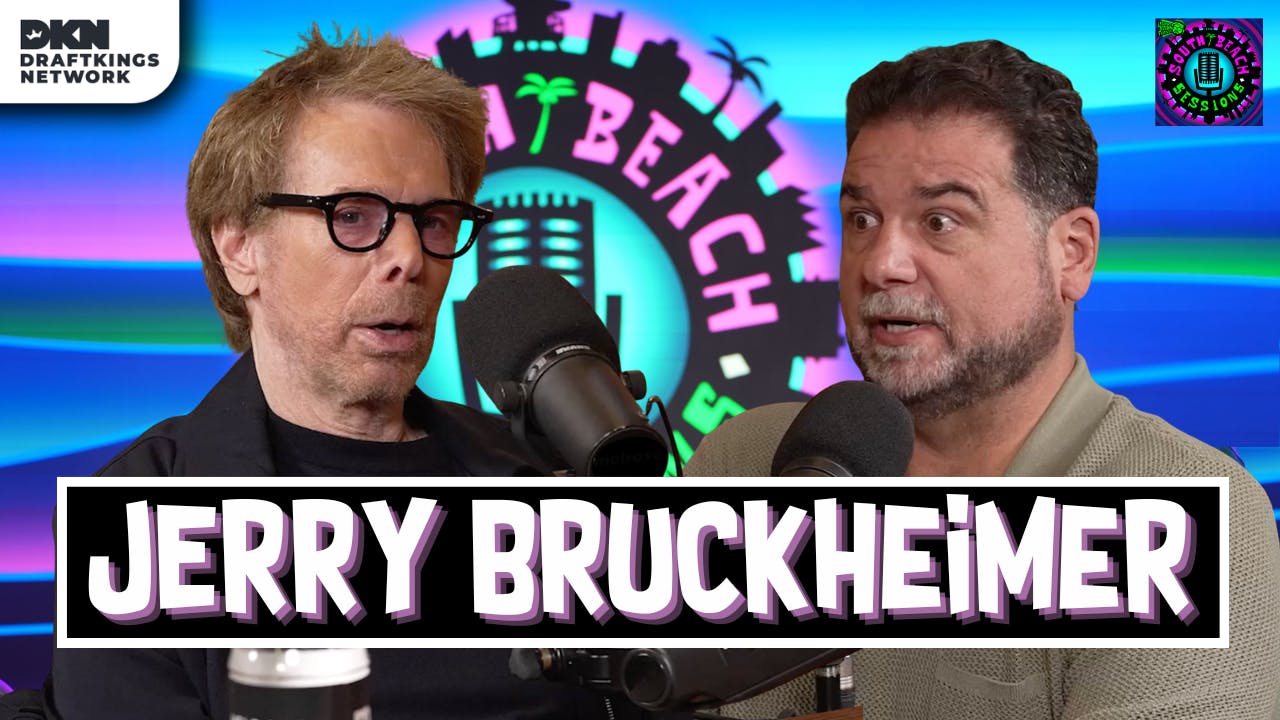
Thrilled to have an industry giant here with us today. Today, you've done this a lot over 50 years, but today we're going to crack open your soul. Jerry Bruckheimer. You've made a number of different blockbusters five decades in the business. Presently you have out F1, the movie. It's four Academy nominations. Thank you for being with us.
- [02:19]
A
It's a pleasure to be with you, Dan.
- [02:21]
C
Do you enjoy this here, this process? Do you enjoy somebody wanting to know the entirety of your life? You've left quite a quite the legacy here.
- [02:31]
A
It depends on the interviewer. Some of them are really good and some of them you want to go home.
- [02:37]
C
Okay, we're not going to do that here. But I would like to go back to the beginning of where it is. Like, how does somebody get from the mail room in an advertising agency to the top of Hollywood? Like, how does that happen?
- [02:48]
A
It's hard work. That's what it is. Hard work and taking advantage of opportunities that present themselves with you. And those are things that I did. I never worried about the money because I figured the Money would come when you're successful and if you always bet on myself. So when I moved to, first of all, New York, I wasn't paid very much money, lived in a small apartment, and then I had an opportunity to come to California to work on a movie and was getting 200 a week. So doesn't that never stopped me from doing what I wanted. I didn't come from a wealthy family. We were lower middle class. My dad was a salesman all his life. And so it's not like somebody whose parents, you know, bankrolled them to come to Hollywood.
- [03:35]
C
You're covering a lot of ground though, with hard work. What does that mean? Like, if you're working hard, there are plenty of ambitious people out here.
- [03:43]
A
I wish I could tell you it's just focusing on what you're doing, doing the best job you can, working long hours. Always be the first one there and the last one to leave and then they start to notice you.
- [03:56]
C
But you're not still like that, Are you still like that? Do you still have to be like that?
- [04:01]
A
Well, I'm not the first guy there anymore. I'm a lot of times the last guy to leave too many obligations in the morning. But I still try to be there and be present as much as possible.
- [04:15]
C
How do you do with satisfied?
- [04:19]
A
I'm never satisfied.
- [04:21]
C
Really.
- [04:22]
A
You always have a way to make things better and it's never good enough.
- [04:29]
C
Is that right? Because that. That seems like that could be a little bit joyless.
- [04:32]
A
Well, you know, I love what I do. And once I finish a movie and it's in the theaters and I've gone through the first couple weeks of it, I'll never see the movie again usually because I. I always look at it and say, I could have made it better. There are things we could have, we missed and we didn't do. So I. That doesn't bother me because the movies are done and I'm very proud of them when they come out. I think the joy of watching an audience be entertained by something that you were a part of is for me the thrill. That's what makes me keep doing it.
- [05:09]
C
Have you explored where you're not enough comes from? Like how much I have some not enough. That comes from parental imprints and patterns and upbringing. Have you explored that?
- [05:19]
A
No, not at all. No. I just. It's. You work on with people and you want to get the best out of the people you work with. You want to inspire them. You want to make sure that they are focusing on what needs to get done and do it in the most professional, best way.
- [05:38]
C
Are you a tough boss?
- [05:40]
A
You'd have to ask people to work for me. I don't think so.
- [05:43]
C
But you don't. You're. Is it. Is it hard to meet your standard? If it's hard for you to meet your standard, if it's hard for you to think anything's enough, it might be difficult for somebody else who doesn't have your standard.
- [05:54]
A
Well, you want people to work with you who has your standard. You only hire people that you think will make you look better and work as hard as you do or as talented as you think they should be. What I do is I'm a talent picker. That's what I do. I find people that I believe in that are really talented and support them. That's what you do with writers and actors and directors. You make sure that you hire the best you can possibly hire.
- [06:23]
C
Are you yourself very creative? Do you feel like you're a creative, or do you feel like you're creative at getting deals done and allowing others the support to be creative?
- [06:34]
A
No, I'm creative. I certainly add to the package sometimes in the right way, sometimes not. But I always believe that the best argument wins. And so if we're talking about a scene in a movie and there's controversy, we just. We'll talk it out.
- [06:52]
C
Do you still feel about the job the way that you always have? When you say you love it, what is it that you're saying that you love?
- [07:00]
A
I love the end result. I love the fact that we make people feel better for a couple hours and we get them. We want them to get lost in that magic on the screen. That's the key to everything that we try to do. At least I try to do well.
- [07:17]
C
But when you say you love the end result, that makes something fulfilling. I love the end result of. Of having written something well. But the process of writing it is not necessarily a joy. You like the applause. You don't put it in a drawer. You want people to see it. But when you say I love the end result, that doesn't mean you necessarily love the grind, although it sounds like you love the grind.
- [07:37]
A
I love the process. I mean, there's certain things I don't like about the process, so I just don't do them. Like scouting locations. That's just boring. You got 10 people in a van and you're driving around for eight hours. I'll look at the pictures, so I'll miss that part of it.
- [07:51]
C
But.
- [07:51]
A
But everything else is really a lot of fun.
- [07:55]
C
When did you feel like you made it?
- [07:59]
A
I'm still working on it, but I mean, that's not quite accurate. But I still look forward to the next one always. I think after Flashdance, I got the joy of having a very successful movie coming out of nowhere. And the same thing with American Gigolo. And as I. Well, I think the, the breaking point was I had a partner for many years and he was always thought of as a creative one and unfortunately he passed away. So I felt like I had to re. Establish myself and make my own way rather than through the partnership, which, I mean, he taught me a lot and I'm certainly standing on his shoulders for all the things that he gave me and, and I accomplished that. I think with. I think Conair started it and then Pirates kind of solidified it.
- [08:54]
C
But when you go back to American Gigolo and Flashdance, what was your life immediately before that happened? Those are what you consider sort of the big breaks, right?
- [09:04]
A
Yes.
- [09:05]
C
What was the five years before that? What did they look like?
- [09:08]
A
I was in advertising. I was in for about three and a half years. I was working in New York selling Pepsi Cola broadcast. So I had, I did radio and TV for Pepsi Cola.
- [09:20]
C
You made a commercial?
- [09:21]
A
Commercials.
- [09:22]
C
You did Pontiac as well, right?
- [09:24]
A
That was back in Detroit.
- [09:26]
C
And so was that stuff fulfilling? So that's before five years. So what was that? Were you enjoying that or was that, Were you. You weren't dreaming of any of this then, right?
- [09:34]
A
Well, when I was in. When I was in Detroit and I was working in Bloomfield Hills for an advertising agent to handle Pontiac, Pontiac and Cadillac and, and I worked on accounts, there was a producer who left there and came to Hollywood and made a movie. And I said, well, if he can do it, why can't I? So that kind of pointed me to say, hey, somebody else from Detroit got out there and did well.
- [09:59]
C
Do you think you have a special set of skills?
- [10:04]
A
I think other people have to say that. I think my skill is. Is again understanding people, communicating with people and creatively. I have an eye, I certainly have an eye for things.
- [10:18]
C
You must have an eye for seeing talent, obviously. But when you cite hard work, I would imagine most people who have reached a level of success, nobody's lucking their way into this position. You're mentioning hard work. That isn't necessarily a gift. But do you think your ambition and desire and your work ethic is stronger than the average person? Persons?
- [10:42]
A
I can't speak for the average person. All I know is what I do. That's what. But I, I Have an aesthetic. I try to have the movies and the things that we do look different, feel different. So that's something that, that, do you explore where it came from, that, that gift? Well, I was a photographer as a kid so I would my. I got trained by watching other people do, taking pictures and learning. I had a dark room as a kid.
- [11:12]
C
So what age are we talking about there?
- [11:15]
A
10, 11, 12.
- [11:17]
C
And at that point you're dreaming of becoming a photographer? Yes. No, no, no.
- [11:22]
A
It was purely obby. I had no idea what I was because I was watching other kids do it and they were so much better than me and I, I can't compete with those kids.
- [11:30]
C
And what were you seeing in the house? Like what can you, what are the places where you can point to that? Here are the imprints my parents left and, and the things that they, that I experienced that sort of got me to move onto a path where I was chasing some things that I loved.
- [11:50]
A
Well, my entire family were really hard workers. I mean my dad would leave at 6:30 in the morning, come home at 9 a night. So I, and my uncles, my aunts, everybody really worked hard, they were really ambitious. I just had a strong work ethic
- [12:10]
C
that would make for what kind of relationship with a child to have a dad who's working really hard but not around?
- [12:16]
A
Well, he came home at night and it wasn't every night he worked late. So it was a very good relationship. Look at. I come from an immigrant family. Both my parents came over here. I'm a first generation American. They came over and were brought over by. My mother was brought over by her brother who brought. My mother was one of 14 and she was the youngest of the second seven. My grandfather, his first wife died, he had seven children with her. He married an 18 year old girl, had seven more children and my uncle, they had a kind of a grocery store and they grew all their own beef and produce and everything. And so he came to America with a pregnant German shepherd and he sold the puppies and bought a Hinda beef because that's what he knew. Sold the hind of beef, bought two more, became the biggest restaurant supplier in Detroit. It was called Chicago Packing. And he brought the second seven over, six of them over and they all joined his business. My mother was his bookkeeper, my uncles worked for him and then they all branched off and started their own businesses. So that's how my mother got here. My dad was brought over by a cousin and he got him a job at a very exclusive women's store. Kind of like Maxfield's here in. In California. So he worked there for a while. Then he worked for a very exclusive men's store. And he would tell me stories about some of the guys from the Purple Gang would come in and would have to. To adjust their jackets to. So their guns could fit in there. And he would tell me stories like that. So he always was in sales his whole life. That was kind of. That kind of beginning, being first of all, first generation American. Towards the end of the war, my parents wouldn't speak German around me very much, only when they didn't want me to hear something because they didn't want me to learn the language. Because people were prejudiced because of the war, even though they were Jewish and they were persecuted. In fact, the first seven, Hitler got a lot of them. They passed away. They were very fortunate to get out when they did.
- [14:46]
C
Those are big, sprawling families. But you're an only child. Correct. So what was your childhood like? The dark room was a bit of an escape for you?
- [14:57]
A
Absolutely, absolutely. And that was part of my. I guess my freshman was a little older when I did, but I always had a camera around my neck since I was 6 years old. One of my uncles was an amateur photographer, and when he got tired of a camera, he'd give it to me. So for that, that gave me. So I was always looking through that lens. I was the sports photographer for the paper in high school, so I always. That was something that I love doing.
- [15:26]
C
Well, you have an artist's eye, obviously, from a very early age. But not great at school, right?
- [15:33]
A
No, no. I was not particularly a good student. I'm dyslexic. But when I grew up, you didn't know what that was. You were just a poor reader and a poor student. The way I see things, I invert words and letters. It takes me a while to correct it. So that held me back. But fortunately, you get compensated. So I was compensated in the visual area, even though I. It took me a lot to read something.
- [16:05]
C
Were you made to feel dumb by the lack of a diagnosis on something like that?
- [16:10]
A
I was always in the poor reading group. I was in, like the third group in Reading, where the first and second group were. So it's. It. Unfortunately, it's. It's. It holds you back, but you find other ways to excel.
- [16:24]
C
Well, I was going to say, though, did it put a chip on your shoulder? Because I imagine, like, the hard work might be tied in there somewhere.
- [16:32]
A
I never had a chip on my shoulder. No.
- [16:35]
C
You didn't want to prove Anything to anybody?
- [16:37]
A
Not really. I just followed my own path, but it wasn't here.
- [16:41]
C
When you say you followed your own path, like, when did you start dreaming about, no, I can be somebody. Like, what did the wildest dreams of Hollywood looked like? What?
- [16:50]
A
Like doing what I'm doing. The wildest dreams were when I would sit in a theater when I was a kid and I watched some of David Lean's movies and Sturgis movies, and I'd say, wow, that's so exciting. How do you become part of that now? I knew I couldn't be an actor. That's not my skill. And a writer is not something I can do. So I had to figure out, where do I. How do I end up? And when I was a kid, I was always an organizer. I had to organize a baseball team. I got a sponsor and baseball time. Put together a hockey team when I was a kid, when I was 11 or 12 years old, got all the neighborhood kids and organized them to play and signed up and did all the kind of.
- [17:34]
C
Oh, so you were always a builder of teams.
- [17:36]
A
Yeah. So that kind of motivated me into. Into knowing that I could get things done.
- [17:43]
C
You seem like somebody who might not be spending a whole lot of time thinking about the past because there are things to accomplish right now and where's the next thing?
- [17:52]
A
Exactly. Okay. I never look back. I only look back to not redo the mistakes that I made.
- [17:59]
C
Were you confident? Were you confident as a kid?
- [18:04]
A
I wouldn't say I was confident, but I was certainly tenacious.
- [18:08]
C
But you are. You seem very confident now, like you seem.
- [18:11]
A
I'm glad you're saying that, because I never know, but.
- [18:14]
C
Okay, you never know if you're giving off confidence or not.
- [18:18]
A
Hopefully I am.
- [18:20]
C
I would think that stacking the successes on top of each other, pouring your identity into this thing that you're exceptional at, I would think that that would be something that would ooze confidence. Because you dismissed my chip on the shoulder thing. You're like, no, that wasn't an issue for me.
- [18:36]
A
When I look at the accomplishment, what I think about is all the people that made that work. I think about the writer that gave me great words. I think about the actors that had the great performances. I think about the director that made such a terrific movie, and I was part of that success. So I always look at them as the ones that kind of guided my career, those choices.
- [19:03]
C
When was the last time you walked into a room insecure?
- [19:09]
A
I think I still walk into a room insecure. I don't think about the past, I think about what's the next mountain we gotta climb? It's always very difficult.
- [19:20]
C
Well, you mentioned the loss of your partner, Don, your business partner, when you. That was a confidence test, correct?
- [19:31]
A
Yes.
- [19:32]
C
Beyond the grief, which would be difficult enough. Cause you lived with him right after your. If I have the history right. You lived with him for a while as part of your starting of your career and you did a lot of learning there, right?
- [19:43]
A
Yeah, I went. When I got divorced, I moved. He had a. He had a house in, in Laurel Canyon and he had one of his roommates and just moved out. So I kind of moved into that room.
- [19:53]
C
And. And so what happened? Like, so you've done a number of different successes, but it's with a partnership. So you can't totally be sure if it's your skill set or if you, if you can't totally be sure how much he's responsible, how much the teamwork is responsible for it.
- [20:10]
A
Yeah, I mean, he had a lot of things that I lack. He's a great salesman, he's a great orator, he's got a phenomenal memory and he's got an amazing way with words. He used to study vocabularies. I mean, when you walked into his bedroom, you could barely get to his bed. There were books stacked everywhere. So he was an avid reader where reading was struggling was something I struggled with.
- [20:33]
C
And what was the nature of the connection? Like, how is it that you were able to realize fairly quickly that you were a good team?
- [20:39]
A
Well, he had. I mean, we had really similar tastes when we sat down and started talking about movies and things and books and clothes and everything, politics. We had a very similar outlook on everything.
- [20:55]
C
What kind of stories were the ones that drew you as a kid? Like you mentioned some of them, but was there a common thread where you were sort of feeding this appetite? And.
- [21:06]
A
And they were character based stories with big operatic backgrounds.
- [21:13]
C
And so how do you make the leap from photography, which is visual but quiet, to no, I'm gonna. I want to make big things. I want to make the biggest things expansive things.
- [21:28]
A
Well, you know, it started with advertising, started when you did commercials. So you had to, whether it's 15 seconds or 30 seconds or 60 seconds, you had to communicate an idea, a good sales point, and you had to get that when you. The way commercials work is you work with a team, you work with a writer and an art director, and you come up with the idea, then you have to go sell the idea to your bosses, head of creative. Then you have to sell to the client. So you start getting, when you start making these sales, you get more and more confident, and then you have to create it, then you have to shoot it, and then the client always has things they want to fix. So you have to work as a team. And then you got to put it together with an editor by yourself because the director moves on to something else. First you got to choose the director. So you got to make the right choice on a director. Then you, you get lumped with a ton of film, and you got to put it together and make it cohesive and have a unique sales position, and you got to sell it to the art director and the writer, and then you have to sell it to the client.
- [22:34]
C
But you were saying that Don was the salesman among you, right? That you didn't feel like you were as good a salesman?
- [22:40]
A
No, he would take over a room where I was more quiet and shy. And when we broke up, he was the one who was going to go on to do great things. And they didn't know what I was, what was going to happen with me.
- [22:53]
C
Are you still shy?
- [22:54]
A
Yeah, in certain ways, sure.
- [22:56]
C
Help me with that. Because you, you do give off confidence, and I don't think it's just your work preceding you. So, like, how does that work with your shyness if, if you haven't gotten rid of it as at 82, like, you're not going to get rid of. I don't know that you necessarily want to get rid of it either.
- [23:12]
A
It's. It's when you. In a crowd of people you don't know, I'm a little shy. I'm not the kind of guy walk up to and stick my hand. Hi, I'm Jerry Bruckheimer, and that's not me.
- [23:25]
C
Do you think at all about not working, like stopping?
- [23:30]
A
No, no, until they stop me. But as long as I keep making movies that people want to go see, hopefully I'll keep doing it.
- [23:38]
C
Explain to me the feeling, if you would, of the nature of inspiration, how it, how it works for you. Because five decades is a long time to do something.
- [23:48]
A
You know, I'm an avid movie fan, avid theater goer. So what I want to do is capture something that motivates people and gives them a great ride. My partner used to say, we're in the transportation business. We transport people from one place to another, and that's what we do. And that's the thrill of what I do. And, and how do you. You're going to ask me, how do I make choices? How do I pick the movies that I make, it's simple. Do I want to see it? Is that something. I spend money and go to the theater and have to get a babysitter and park my car and spend money. Is that something that would draw me out of the house? So it's got to be something that's unique, fresh, different. It's got to be packed with. With a great story, great characters, great themes. And you have to get great actors. In order to get great actors, you have to have a good director. And it all starts with a. With a terrific writer. So once it's on the page, that lures everybody in. It lures in the director. It lures in the actors if they have a great part that they want to play. So. And that's not easy because they're not. They're not thousands of talented people in. In our business that can deliver a great screenplay. It just isn't. The old Hollywood method was they would have multiple writers. First of all, they were under contract, so they would go to the writer who developed the plot, and they would give it to a character writer who embellished the characters. Then they give it to more of a comedy writer to spruce it up. And there are very, very few writers that can do all those things. So what you end up doing is you hire. If you have to hire multiple writers, somebody that can give you a good, basic, great script, and then you want to pepper it with better characterizations, or you want to hire a female, like we did on F1, to embellish the female character. But Aaron Kruger, who wrote it, gave us an amazing screenplay. But they move on to other things instead of writing other things. So you have to bring in other people to embellish it. And every actor has a point of view on their character, and they would like to have a writer that either maybe they worked with or somebody you've worked with that can embellish what they feel is missing on the page.
- [26:00]
C
Do you have a writer that you've wanted to work with that you've never been able to get your hands on?
- [26:07]
A
There are tons of them. There are a lot of them. I couldn't name them for you, but there's a lot of writers that we still would love to work with.
- [26:13]
C
It sounds like you're a bit like a veteran music producer to the ear. Can just know when something is good music. It would seem that at this point in your career, if you're holding a script and it speaks to you, you follow that intuition anywhere, right? Because you trust you're not Often wrong there, right where you're reading something and you're like this, I'm gonna, I'm gonna get this one wrong. I. This, I think it's great, and then it isn't.
- [26:42]
A
I, you know, you have years of experience that tells you what works and what doesn't. And then you've the experience of making movies and seeing things that don't work, and how do you fix them? And you, hopefully you don't make that mistake again.
- [26:54]
C
How do you feel about conflict?
- [26:57]
A
I think it helps. You know, you need conflict sometimes. You need people to say, wait, this doesn't work. We got to fix this. This is not right. You want, you want that. You want. As long as it's not something that becomes physical or you don't want that kind of conflict, but you certainly want intelligent conflict with it, with intelligent adults.
- [27:18]
C
What was the best of the decades to work in Hollywood from among the five you've worked in?
- [27:26]
A
That's hard. I think the 80s were great, the 90s were great. 2000's been terrific for us. I mean, we're hitting a bump in the road right now because we're losing more buyers, unfortunately, so you have less places to take your, your films or television shows, too, to get made. And we've, we've been hurt by Covid. We've been. So what happened is a lot of theaters went out during COVID and then we had strikes, unfortunately, so we don't have the amount of product available to the theaters. But hopefully that this year will catch up.
- [28:02]
C
This sounds like the worst of it then. It sounds like we're presently in the worst of it as you've seen it, right?
- [28:07]
A
Yeah. And also, you always like to work at home. You prefer to work in Los Angeles and California, but other states and countries give you better rebates. And so if you, if they. Let's say I'm using an example. Give you $10 million to make a picture, and it's going to cost you 10 to make it here, and you go somewhere else, you make it for 8 and add $2 million more to make the picture better. And that's a choice you have to make. It's unfortunate.
- [28:38]
C
What are the changes that you like and don't like that are being brought about over the last five years? Are there changes that you like or do you see the absence of options and the fact that there are only a handful of buyers, even though you still get blockbusters made to be so stifling that you would say, no, I don't like the Changes of the modern day.
- [28:58]
A
Well, look, we always want more buyers. That's. You need that because we want to make more pictures. And the way you'd make more pictures, you have to have more people making them or funding was really what it is on making them. And hopefully that this will settle down. And. And because I think people still want to go to the theater, I always use the analogy that you have a kitchen in your house, but you still like to go out to eat. So it's our job to really give them a great meal. So you don't go back to a restaurant that doesn't give you good food. And that's what happens when we make pictures that don't embrace an audience. And that gets difficult. So what happened over Covid? There was. Theaters were dark, studios were dark. So we lost a lot of product getting out. And it takes time. You just don't turn the lights on and have five movies open. It takes time to build them and write them and. And get them going again. And then the strike stopped us. I mean, we were two strikes. We were shooting in. We shot four days in London in. Outside of London for F1. And then they shut it down. The actor shut it down, the writer shut it down. So we went ahead and filmed a lot of the action in nine different places, nine different countries, and then came back a year later and put the actors back into it. So that slowed the business down too. It's unfortunate, but we want our crews and people and writers and actors to get paid appropriately. So I understand their. Their quest, but then there's a price to pay.
- [30:32]
C
What has been the cost of you arriving at the success? It doesn't come without costs.
- [30:37]
A
Of course, I think, you know, your family life is not where you come home at 6 o' clock and have dinner with your family. And it's not with the life I've had. I'm either on location room. But I have a wife who is very understanding. She's a writer and a photographer and a builder of things. And so she has her own passions. So she doesn't rely on me to come home and sit at dinner with her and say, tell her how my day went. So she's got a lot of ambition and things that she wants to do. So that helped. I mean, and she was a good mom. She was home for our daughter and, you know, took care of her. Growing up when I was away and whenever I traveled, it was during the summer I'd bring everybody with me. So we, we had. We had a family unit and even When I did a picture in Chicago and our daughter was young, we put her in school in Chicago and she loved it. She was so that's part of. You miss part of those years growing up with your, with your kids.
- [31:36]
C
Are you ever not thinking about work? Like, do you have trouble being present outside of work, wherever it is that you might be?
- [31:44]
A
You call it work. To me, it's not work work. My dad worked. He looked forward to two week vacation. I don't look forward to that. I look forward to getting up in the morning and trying to accomplish something. And I'm very fortunate because some of the things that I've loved, like I love hockey, I mean, played it as a kid poorly, started a game here in California, started taking skating lessons and you know, for like 25 years we had a game which still goes on. I stopped playing after Covet and then I met with some individuals who had a similar dream. And we, we put a friend NHL franchise in Seattle that I was one of the founders of, which was a lot of fun. So I try to invest myself in things that give me joy or a feeling of accomplishment. And it's. Putting that hockey together was like putting a movie together. It's the same thing. You gotta get funding. You have to have a great idea. You have to find the right people and populate that organization with really interesting people who are really good at what they do.
- [32:57]
C
Did I hear you correctly? Were you playing hockey into your late 70s? You were, you were still playing?
- [33:03]
A
Yes.
- [33:04]
C
And Covid's the only thing that shut that down.
- [33:07]
A
And, and, and, and F1 because we were traveling for two years around the world. I spent over 200 days, the last, over two years ago and year before out of the country. And last year was over 100 days. So I, I'm not, I just wasn't here. And I have a farm in, in Kentucky and we have a rink there. So when I go there, I'll skate and fool around.
- [33:31]
C
I used the word work. You said, you say work. What do you call it?
- [33:35]
A
I call it, I call it just trying to accomplish something every day and push that ball up the hill. But it's not, you know, we're, we don't lose patience. You know, it's not something where you're, you're operating on somebody and it's life or death. That's not it. And it's not something where you're dying of boredom, where you're sitting in a store waiting for a customer to come in. There's always something you can do there's always somebody you can talk to to push whatever you're doing forward.
- [34:05]
C
That amount of travel though, that amount of time away from home, that amount of effort. It sounds like you have an insatiable avarice about conquering, about accomplishing. But does it end up feeling enough to you like accomplishment? Because if you're going years, this is an awes awful lot of grind in the making of the product so that you can be in the theater and enjoy the community that is enjoying what it is your work has been. That's a lot of, if you don't want to call it work, that's a lot that's going into it.
- [34:42]
A
Yeah, but it's fun. It's something that at the end of it, you can be hopefully really proud of and that makes you feel good. Look at when I talk to kids and I say, always look for something that gives you joy. Look for something that you get a glow inside when you accomplish whatever it is, whether it's a three pointer or whether it's something you wrote. And always kind of focus your career around that. Now there's certain things that, look, I'd love to be an actor, but I'm not good at it. So you got to find out what gives you the glow and what are you good at. And when you find that, then you're off to the races.
- [35:24]
C
Can you put me next to you in the theater or wherever it you're feeling? I don't know if it feels the same every time, but the most of the accomplishment where you're most moved and loving yourself correctly by being like, this is why I do it. It has to be a little bit different each time, right? Depending on what the movie is.
- [35:43]
A
But when we move you, when we give you a good emotional ride and that's what Top Gun did, that's what F1 did. He had a great emotional ride. You felt emotion. You had tears in your eyes, you laughed, you had joy at the end, you felt that you watched something that the characters on the screen transcended that screen and gave you something special. And that's why they become successes because you want that feeling over and over again. You want to feel that. And people came to CF1 and time. They saw it multiple, multiple times because they felt something at the end and they want to, they want to replicate that or they want to bring their friends. You got to come with me and see this. It's so good.
- [36:28]
C
How often will you be moved to tears on the viewing of a completion of one of these things? Will that happen to you?
- [36:34]
A
Yeah, absolutely. Absolutely. You're well up? Sure.
- [36:39]
C
Any in particular that you think of when you're thinking of just what is
- [36:42]
A
the most fulfilling Young Woman in the Sea. Did a lot of those pictures really? I mean, something like Bad Boys? No, it's just a big fun right. Movie. But those other pictures really emotionally move you and it moved audiences. Otherwise, people wouldn't have paid the money they did to see them.
- [37:04]
C
BMF championship. Truly the stuff of legends. To let the world know who's the baddest mother. That's a real warrior. That's a BMF. Saturday, March 7th on Paramount. Plus here we go. Two legends. Two of the most exciting men to ever fight will meet again.
- [37:19]
A
I'm right here. Let's go.
- [37:20]
C
One legacy. The famed BMF belt is on the line. Max Holloway. Charles Oliveira, welcome to the history books for the BMF title, Saturday, March 7th on Paramount. Plus, what do you regard as the most challenging part of what it is that you do?
- [37:39]
A
Getting a good screenplay. That's the hardest thing to do.
- [37:43]
C
So you'll read how many before you get one in your hands that feels good?
- [37:47]
A
Well, I think we develop them. It might take years to develop something that you feel you're close to getting made.
- [37:54]
C
I'm going to play a game with you here before the end of this because I'm not sure everybody knows just how many amazing movies you've made. Where I'm going to embarrass me. That's not embarrassing. I'm going to ask you to sort of give me an interesting fact or just something because there are too many of them. We can't have spooling stories for each of them. I want to do it with you, but when I ask you about a film that you regard as the most challenging but most fulfilling, like it took you the longest to get it made. You wanted it the worst, and it just had a lot of obstacles. But then at the end of it, the challenge is what made it most fulfilling.
- [38:34]
A
They're all that way. They're all so difficult. The bigger they are, the harder they are. Just you just as an example, you take F1. Okay? Joe Kaczynski had decided we're doing finishing Top Gun. He said, I have this. I've been watching Drive Through Survive, and what they're focusing on is the last place teams, which are interesting. He said we should try to make a movie about F1 and focus on a team that just needs to get one point or one win. And so he had a relationship or knew Lewis Hamilton. And he called Lewis and said, I wanna. Here's the story I'm thinking about telling. We had lunch here in town. He came in town, we had lunch with him. And Joe told him the story he wanted to tell. And Lewis said, I'd love to help you. I'd love to produce it with you. And then we called Aaron Krueger, who wrote Top Gun Maverick. And Joe told him the kind of story that he was. He'd laid out. And then air Aaron embellished it. And then Joe called Brad Pitt, who he had worked with previously on Something that Didn't Happen. And he got together with Brad and said, here's the movie that I want to make. And Brad said, I'll do it under one condition. I have to drive. Joe said it's the only way I would make it. And then we lined up, I think it was nine different studios. And Aaron had worked out the pitch. And we went and pitched this story that we had with Brad to the nine. And they all bid on it. Apple came forward with a big theatrical run and allowing us to make the movie the way we wanted with Brad and Damson actually driving. And then we had to go to F1 thanks to Lewis introduced us to F1. And then we flew to England to meet with Stefano, who's ahead of it. But we brought Brad with us. So nobody turns down meeting with Brad. So we pitched the movie to him and he was really interested. But we had to go and talk to the 10 teams. So we got all the 10 different team owners together and team principals.
- [40:42]
C
So a ton of logistics. There's just a lot of details that aren't glamour, that aren't glory, that aren't just.
- [40:48]
A
And then Joe did this video where he showed how he made Top Gun and how he would insert convert our car into an F1 race. And then we had to get Mercedes to build the car for us and designed it along with Joe. And besides that, you. You have to. You have to make a deal with F1. How do you make a deal where you want to go to nine of their races and film live. So you had to get them to buy. And then it's not only F1. Then you have to go to the FIA, which controls the races and pitch them what we wanted to do.
- [41:22]
C
It's a big giant pain in the ass.
- [41:24]
A
It's a lot of work. And then you have to get a script that works. All this telling a story and then putting it on the page is not easy.
- [41:31]
C
You're not picking that just because it's the latest one, right? You're saying they're all hard. There's no such thing as an easy one. But this one sounds like it's got a bunch of red tape.
- [41:41]
A
Think about Top Gun. Think about what you had to do, get a Top Gun to go to the Navy. And the first one, we went down to Miramar, California, where the Top Gun school was at the time, and we pitched it to the base commander. And he says, no way you're coming on my base. Somebody gets hurt, it's on my record. I can't do it. So Tom and I flew to Washington and met with the Secretary of the Navy, John Lehman. And John said, I understand if you do this right, what it could do for the Navy. And that admiral was replaced. And we went down to Miramar and shot. Shot the movie. But it's not quite that easy because then you have to get the cameras onto the planes, and it has to go through the lawyers and the engineers because it changes the balance. And the same thing with the F1 car. We had, I think, 15 different camera positions. And that could change the balance and the vibration. It just. You can't imagine the technical difficulties. You have to do it, but you
- [42:40]
C
don't take no for an answer, right? You say you're not good at sales. That's not one of the skills. But also, that admiral has now been replaced.
- [42:47]
A
You push. You keep pushing. That's what they say in F1. Keep pushing.
- [42:52]
C
So you're not good at no for an answer, right?
- [42:55]
A
That's. It doesn't work.
- [42:56]
C
Is that something? Does it make you want it all the more? Like, I would think there are stopping points along the way.
- [43:04]
A
You figure out a way around. Around it. You figure out a way. Okay, you can't do it that way. What about this way? So you try to figure out other angles to get rid of the no.
- [43:15]
C
This is the part you sound excited about, Jerry. It sounds like at this point you like to hear no's so that you have to figure out how it is that you're going to get to the yes, because it's not going to stay no.
- [43:26]
A
You don't make as many movies as I've made and take no easily.
- [43:32]
C
The insatiable thing is interesting to me, though, because you have all of this success with all of these blockbusters, and then you say, you know what? I want to try television, too. I want to do the Amazing Race. I want to do CSI. I want to have in the top 10, at one point, three of the television shows that Transition. Why?
- [43:49]
A
I watched years ago, I watched ER and I said, this is good. We can do this. I mean, this is really well done. So, you know, I hired somebody and. And we started developing television. We got a, like a little independent show made, and then I hired somebody else. And then we really started to roll. A writer came in and pitched a story. He was living in Vegas and he was enthralled with the csis and he convinced them to let him ride around with them. And he gathered all this information. In fact, one of the. He went to a motel which was a crime scene, and the CSIS were leaving and the police were leaving. They processed the scene. So he walked in the room and then a hand comes out from under the bed. The perpetrator was still in there and he missed it. And he. His name is Anthony Ziker and he's a terrific writer, a great storyteller, and a great guy who can enthrall a room with a pitch. And so he went to all the networks and pitched it, and CBS was the one who raised their hand. It was the last place we went to, and it was the last thing they picked up too. And fortunately for us, they put together such a great team that it became a huge success.
- [45:12]
C
That's the story of it. But it doesn't explain the insatiability of, hey, you've had success in movies, and now there's something over here I'd like to accomplish, and I'd like to not accomplish it small. I'd like to do it at large.
- [45:24]
A
Well, I think people like large stuff. They just do. And if you can get it done, why not? I mean, we have a show called Fire country, which is a big, big show, and Boston Blue and Sheriff country and still the amazing.
- [45:38]
C
But I just would think that some people would get satisfied. I guess you're saying if you're going to work the. The entire way, if you're gonna. If you're. They're gonna have to drag you out of here, then. Then you're not going to do satisfied. Like you've. You've rejected the idea of it. You've rejected the idea of. Of. Of comfort. Really?
- [45:57]
A
Well, this comfort. For me, it's comfort for. For different people for different reasons.
- [46:03]
C
Well, but wait a minute. That's not. You're saying you're comfortable in the uncomfortable. This all sounds like. This is all. There's a lot of details here. There are a lot of. When. When I've talked to, let's say, directors, they say, you know what a director is it's just the place that. That all the problems go. So it's CEOs, the same thing. I'm the place where all the problems go. All my day is just solving problems. And so I imagine it's similar for you.
- [46:25]
A
Yeah.
- [46:26]
C
And so at some point, you could. You could get satisfied. It's something that could happen.
- [46:33]
A
Unless you're telling me another audience that you want to entertain, there's always somebody else. We. We were fortunate that we got them entertained in theater, and now we get them entertained at home, so that's good.
- [46:43]
C
What are you proudest of?
- [46:46]
A
The fact that we've moved audiences for many, many years and entertain them.
- [46:52]
C
If I make it some of the materialistic stuff. If I say choose from among these, on the Pride scale, over $16 billion made with your movies. 113 Emmy nominations, 22 Emmys, five Grammys, seven Oscars. Like the awards, the money, what on. On that list of things. Am I doing it too superficially for that to be a thing that gives you great pride?
- [47:16]
A
No, it's great when. When our artists get. Get nominated by their peers and win, that's a. That's a terrific recognition.
- [47:23]
C
But is any one of those something that causes more pride than the others or. Or. Or off the board? Would you go. Would you go with what you're saying? I move people. That's what makes me proud.
- [47:34]
A
Yeah, that's it. And each, like an Emmy is great for television, so that's a great accomplishment. An Oscar is great for the film business. A Grammy is great for the music business.
- [47:45]
C
Do you find that there are many people that you work with that are a headache, and yet you still work with them because they're that talented? Or are you at a point of freedom that you don't have to bother with that anymore?
- [47:59]
A
I think there's certain people that. I think it's pretty much for everybody that you come at a point in your career where you say, life's too short and there's so many talented people out there that sometimes you don't have to go through what you might have to go through with somebody. And by the way, what artists don't understand is it's a very small community, Hollywood. And when you don't get work or whether you're an actor or director or a writer, you better look in the mirror and say, something's wrong here. I think people unfortunately get to a point where you don't need the aggravation that you might have to go through because there's always somebody else you've Worked
- [48:51]
C
with the director, Tony Scott, at least six times. Why does that one work?
- [48:58]
A
First of all, he's a great guy. He's a guy. He's a great guy. He's funny, he's intelligent, he's enormously talented, and he makes making a movie fun. You want to go to work and have fun. That's what you try to do. You try to work with people that really are. They make something great and you have fun doing it.
- [49:23]
C
You, I would imagine, are at least a little numb to celebrity. Right. Like, you're around famous people quite a bit. When's the last time you were awed by somebody just because you were in the presence of somebody who awed you?
- [49:39]
A
I'd have to think about that. I can't shoot that off the top of my head.
- [49:43]
C
It's been a while, though, I would imagine, right? Like, because it's your normal now, Right. Like it's when you say, I'm going to here and there with Tom or Brad, like, that's what you have to do to get movies made. So it's your normal. I don't know. When you say you have to think about it, I would imagine it doesn't happen to you very much anymore. There might have been a first time back when it's, you know, American Gigolo, flashdance, but that's 40 years ago. Like that. I would imagine some of that would. Would fade or numb because it's your real. It's your daily.
- [50:13]
A
That's right.
- [50:14]
C
You're not. You're not picking up a call from somebody and being like, wow, I can't believe this person's calling. Right.
- [50:21]
A
Yeah. Sometimes you say, why is he calling me?
- [50:23]
C
That's not the same thing. That's not awe. That sounds more like. Or I guess you're. That's a little bit of surprise. Why is this person calling me? But there must be a reason.
- [50:33]
A
Sure.
- [50:34]
C
All right, let's play our game. I'm gonna. I'm gonna just name some of these movies and we'll do some word association here where you just throw me a couple of facts. Whatever it is you want, perhaps if you can aspire to this, maybe something that you know that others might not know.
- [50:51]
A
Beverly Hills Cop, that was an interesting movie to get made because you go through, the studios, have politics. So we turn a script in and we say, this is for Eddie Murphy. And the studio had her pay and play commitment to Sylvester Stallone, meaning they would have to pay him whether he did a movie or not. So they said to us, we're giving it to Sly. And we said, okay, he's a talented actor. We understand it, but Eddie is the one we wrote it for. And he said, well, we have financial commitment here. We have to live up to that. So we met with Sly, and he was engaged with the character, and he said, I got to rewrite the script for me. So he rewrote it, and it got very expensive. So the studio came to. To Don and myself. He said, what are you guys going to do? We're not going to spend this kind of money on this movie. I said, we told you we wanted to make it with Eddie Murphy. I mean, he wrote a really good script. If you don't want to pay him, fine. So they went to Sly and said, look, we can't afford this. We'll give you your material back. And he went and made a movie called Cobra based on what he wrote. And we went back to Eddie and made Beverly Hills Cop.
- [52:08]
C
You're playing this game. Well, this is the way that we're going to play this game.
- [52:11]
A
They're not always like that.
- [52:12]
C
Well, I don't think they're all going to be like this, but that. That. That's a totally different movie if Sylvester Stallone is doing Beverly Hills Cop. And I did not know that. Blackhawk Down.
- [52:22]
A
Oh, that was. That was an interesting one. We were. We were making the movie in Morocco, and it was a change of administrations, and what we needed to do is we needed to bring in a Ranger unit and some Delta Force guys into Morocco. And the attache there said, you're not bringing guns and ammunition into Morocco. The government will not allow it. And I'm not going to put my career on the line to do this. So we had a lobbyist, and one of the people working with me wrote a letter. I can't remember the congressman or senator. And he was a big proponent of the story.
- [53:11]
C
And you're not taking no for an answer. You're not taking no to the answer. You can't bring guns or helicopters.
- [53:17]
A
They wouldn't give us a Blackhawks.
- [53:19]
C
Well, that's a problem.
- [53:20]
A
That's a real problem. I forgot that part. So he writes a letter to this attache in Morocco and says, you're going to be in Zimbabwe unless this thing happens.
- [53:34]
C
Oh, wow, you love these stories. This is where I get the smile out of you when you get your yes, and someone gets transferred to another. Another unit.
- [53:45]
A
So needless to say, we went through a bunch of, you know, obstacles, but we got the movie made.
- [53:54]
C
Bad Boys.
- [53:55]
A
Bad Boys was going to be Dana Carby and John Lovitz.
- [54:04]
C
I mean, that would have been. That would have been funny also, probably, but very different.
- [54:10]
A
So we did a test and it was well done. And the studio at the time looked at it and said, no, we're not going to make it this way. So then we. We had. I had met Will and. And we. I guess we took it. Developed it at Paramount and then we took it to Sony. And then I'd met Will and they liked Martin Lawrence a lot. They didn't want Will. They wanted to Arsenio hall, but they had confidence in Martin because he was a big TV star. Will was a TV star, but they felt Arsenio was a bigger star at the time.
- [54:56]
C
Is Will Smith Enemy of the State? Is that the first time that you
- [54:59]
A
worked with Bad Boys?
- [55:00]
C
Okay, Bad Boys was the first time. So I've got the, the order wrong. Let's do Remember the Titans.
- [55:08]
A
God, that was a hard one to get. Made a change of management at Disney. First management didn't want to make it. Second management came in, said, if you make it without any bad language, we'll do it. And we're fortunate to get Denzel to
- [55:25]
C
lean in Crimson Tide.
- [55:29]
A
It was hard casting it. We had a bunch of different iterations of it. We had Pacino and Warren Beatty. So Warren said, look, it's good, but I want to work on the script. And I said, we're starting in August. We'll work on the script until August. And so he fell out. We're fortunate enough to get Denzel and Gene to. To lean in the Rock. That was hard to get a director to do that. Sean was very particular about who he worked with. And I really believed in Michael Bay. He. Because he. He did Bad Boys for us. He's. He's a visual genius and an amazing filmmaker. And I had had to have a meeting with Michael and Sean and Michael did a great job convincing Sean that he could make a terrific movie.
- [56:27]
C
When you think difficult actors, is there one that comes to mind or particular? You said particular. Difficult sounds more pejorative than I'd like. But is there one?
- [56:37]
A
All of them have their. All of them have the different elements. Some of them are very particular on script, particular on directors, particular on promotion. There's all different. They have all different avenues. But I couldn't. I wouldn't go forward and tell you which ones are. Do what.
- [56:57]
C
Days of Thunder.
- [56:59]
A
Days of Thunder was a long process getting. Getting it made. We had a script that we liked and we brought another writer in to get it made. And the studio said, we're not spending another penny on another writer. And Don and I put up the money. And Warren Skerron wrote, Rewrote a terrific. Added a lot of motion to it.
- [57:23]
C
How often have you done that? How often have you believed in something so much that you put your own money in? And that's also because it was earlier, right? That's not something you're likely to do very much now, right?
- [57:34]
A
Well, if you have really good executives, they know that what's on the page usually ends up on the stage. Pearl harbor, that was a. A big budget issue. The. The movie was at around 200 million, and the studio said, we want to make it for 150. And the line producer quit, so you can't make it for a nickel under 200. And we got it down to 150. And then new management comes in and says, we want it for 135. So we figured out a way to make it for 135. The director quit, but we got him back and he made the movie he wanted to make.
- [58:10]
C
You've got people quitting all the time, right? Artists are temperamental, and it's the emotion business. And there's. And you don't mind conflict, and you think conflict is good, so. Right. Because, yeah, Con Air.
- [58:25]
A
Conair was the first picture I did without Don. And again, it was getting the words right on the page. That was the struggle. And we got there. We got a great cast.
- [58:34]
C
Armageddon.
- [58:36]
A
That was Bruce Willis. And Bruce said to us, I'll do the movie, but I have to die at the end. Don't change. It was in the script. And I said, I know you're going to have a preview and they're going to want me to live. You got to promise me that you don't change your script. I promised him and we delivered.
- [58:56]
C
You never have to break those promises, right?
- [58:58]
A
Well, a studio certainly can say, you better change it. It's our money.
- [59:02]
C
I think famously, in Seven, Seven was so dark. You didn't do seven, but seven was so dark that I believe he put in his contract. You're not allowed to change this ending. It's got to be. There are more, but we're out of time. Amazingly, there are more. You have any? I forgot. Would you like to volunteer one on the way out? You didn't ask me. Whatever it is. American Gigolo, the Flash Dance, the best
- [59:26]
A
story I have that American Gigolo was. Was again for. For John Travolta. And he at the last minute, decided he wasn't going to do it. And then we. We went to him, Paul Schrader. And I went and said, richard Gere. And Richard Gere wasn't a big movie star at the time. So we had to cut the budget to fit it in the box for Richard Gere. It certainly didn't hurt the movie, did it?
- [59:54]
C
It did not. Glory Road.
- [59:56]
A
Glory Road. It was. How do you get the story right? You're talking about a period of time that. What's interesting about that movie is when we showed it to audiences, they had no idea that there was that kind of prejudice and especially African American audiences. And that was the big shock for me. The people just didn't know the history of that team. I mean, that was the breakthrough in college for African American athletes to be able to go everywhere and play. And so that was a. I mean, and Pat Riley told me that after he lost that game, because the big game was against Kentucky, I think he was the only one who went in the other locker room and shook everybody.
- [60:42]
C
He was one of the few. Yeah. To go in and shake the hands. A pleasure, Jerry. Thank you for sharing your gifts with the world and sharing this hour with us, sir.
- [60:52]
A
Well, you're a great interviewer, so you made it fun.
- [60:54]
C
Okay, nice. I accomplished something. I now get to feel the feeling of accomplishment that you feel in the back of a theater after you've done all of these bullshit logistics. I should tell people that on Apple+F1 is a fun movie. It's a giant movie. And this man, as you can tell, wildly insatiable. Will not stop. Cannot stop. Cannot stop.
- [61:14]
A
And we're up for some Academy Awards, so that's four of them.
- [61:17]
C
Correct.
- [61:17]
A
That's great.
- [61:18]
C
Congratulations on all your success, sir.
- [61:21]
A
Thank you so much, Dan.