← Determined Society with Shawn French | Adversity & Mindset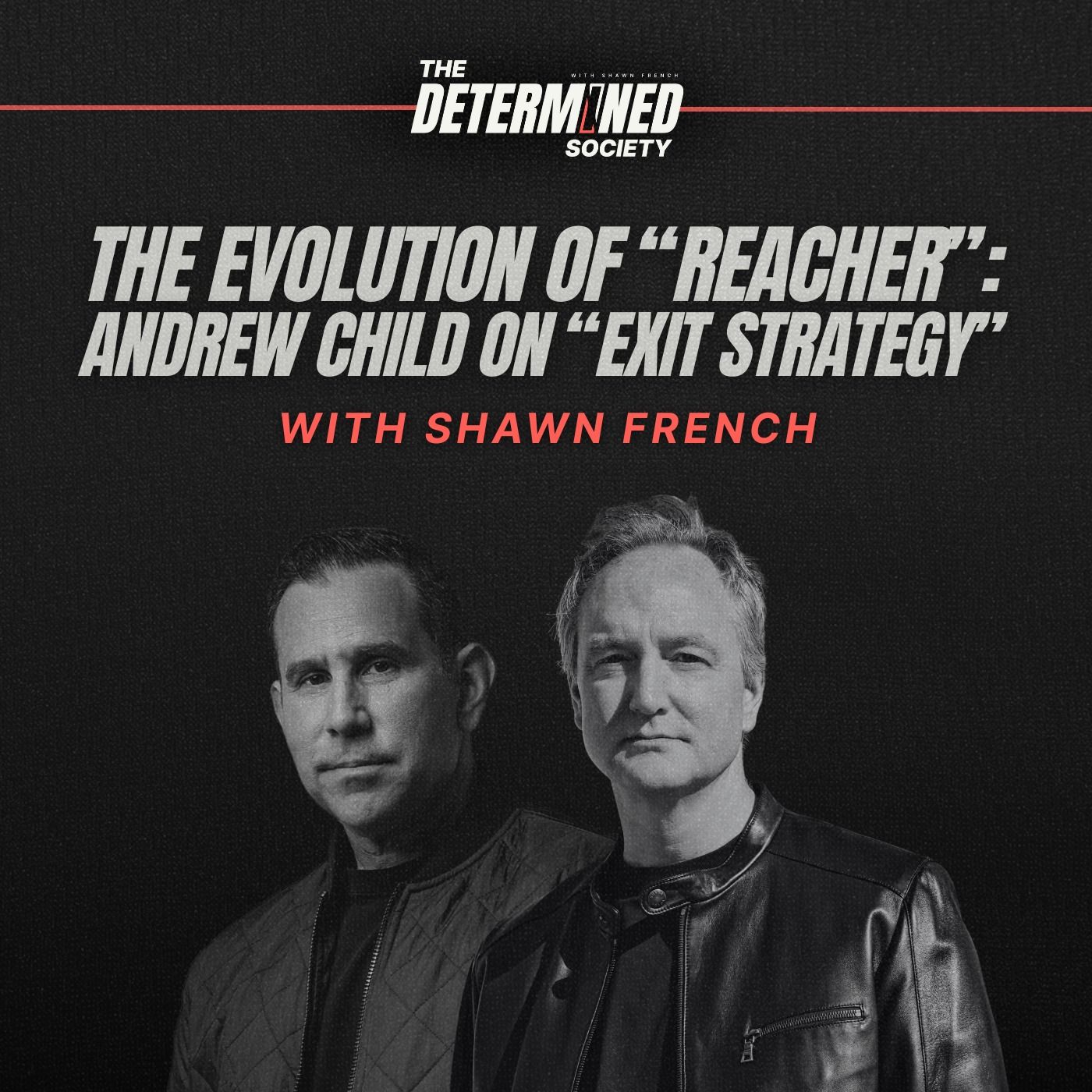
Determined Society with Shawn French | Adversity & Mindset
The Evolution of “Reacher”: Andrew Child on “Exit Strategy”
00:50:54
Loading summary
Transcript87 lines
- [00:00]
Sean
Exit Strategy. The gentleman that made that first phone call requesting for help. There's more to this guy, and he's actually a little bit of a badass.
- [00:08]
Andrew Child
Exit Strategy is the 30th in the series, which is mind blowing, really. We came up with the idea of having this person essentially reach out to Reacher for help. That's something that I think people can relate to, you know, because despite everything that's going on in the world, people fundamentally still want to help one another, want to be decent to one another.
- [00:30]
Sean
You brought a lot of current things into this novel.
- [00:33]
Andrew Child
You know, Lee, my brother, started the series. He wanted me to help, to kind of nudge reach it more into the current world. If you are existing in the world today, doing the kind of things they're doing, what else would be involved? The social media, the monetization, all of that would. Would be part of it.
- [00:51]
Sean
It takes the book to another level. That right there just grabs me even further and pulls me into the pages. And that's what you've done for me so far in this book.
- [01:01]
Andrew Child
Foreign.
- [01:04]
Sean
What'S up, everybody? I'm here today with Andrew Child. He is the author of the Reacher series. What I'm talking about is book today called Exit Strategy. And I've had the pleasure to preview this book before it's out. I'm going to tell you what this. This man, this writer had me going from word 15. So, Andrew, welcome to the show, man.
- [01:25]
Andrew Child
Well, thank you, Sean. It's an absolute pleasure to be here. Thank you for having me as a guest.
- [01:29]
Sean
Oh, it's a pleasure to have you. I've been looking forward to this for quite some time. Right. So when I get the opportunity to talk to people like you that have done amazing things and written amazing books that kind of twist the mind a little bit, and what I've found is really kind of crazy because I get a chance to preview a lot of books, all right. And some of them I just can't get into. Right. But there's been a specific set of books that I'm always able to latch onto right away. And it's in the genre of your writing. And I looked at my wife last night and she goes, are you still reading? I'm like, yeah, I am. And she goes, well, you know what? That's really odd for you because you'll lose interest really quickly and you don't really stick to books much. I said, yeah, but these types of books really simulate my mind, and it makes sense because when I watch tv, I like to watch the True crime stories. I like to watch all the stuff that most people get really, really scared about.
- [02:27]
Andrew Child
Yeah, I can understand that. And I think in terms of why somebody either gets drawn into a book or doesn't, I think it really comes from two angles because part of it is down to the reader. It's just whatever interests you, whatever you are drawn to. And if you come across somebody that says, oh, I don't like to read, what that really means is they haven't found the right books yet. Because especially at school when I was growing up in England, there were certain books that you were supposed to read, certain books that you were supposed to like. And if you happen to not like those, you know, the teachers would be. Would be mad at you. It would be as if you were, you know, letting yourself down in some way and you were kind of forced to keep going down that path. And it was the wrong path for you. It was just all about just, just keeping looking around. There are so many different kinds of books, you know, out there. So many different authors, so many different genres. There's something out there for everyone. And so, you know, people will find books they like if they, if they keep looking. But it's also, in terms of the kind of books that we write, you know, it's a delight to hear you say that because, you know, I think it doesn't happen by accident. It's something that we work very, very hard to make happen. It's part of the kind of craft of what we do is making it so that, you know, the words, you know, they're the little squiggles on the page, but they also, they're like little hooks. You know, the idea is that they hook into you and take hold and they drag you through the story from page one through through to the end if, if you're doing the job right. So it's, it's wonderful to hear that once you, you know, once you, the book open and you, you look at that first page, that there's something that, that grabs you.
- [04:09]
Sean
Well, I appreciate that because, you know, like you said with school, you know, you, you go to school especially, you know, here in America, like, here's the books you're reading this year, right? You're going to read To Kill a Mockingbird, which honestly bored me. I know it's a great book, but I didn't really like it. The only book that I really enjoyed was Catcher in the Rye.
- [04:26]
Andrew Child
I.
- [04:27]
Sean
Right. So, like, because it was edgy, you know, like, I could see myself somewhat in that story. And when I'm previewing exit strategy. It's visual to me, Andrew. It truly is. And that, that is a gift that you have in, in these, in these series. Because I'm reading through the first eight chapters and I'm seeing everything that goes on. And when I can see it. Right, because it makes sense. It's very, it was broken down, it was very obvious what the scenes were. But when you're able to give the reader the art of visualization, it takes the novel, it takes the book to another level. And that's what you've done for me so far in this book.
- [05:07]
Andrew Child
Well, thank you. Yeah. And I mean that some what I try and do, I didn't, I didn't invent this, so I can remember who did. Somebody described one way of writing as being as if you are. It's as if you're a journalist reporting on scenes, but the scenes only happen in your head, you know, so you, you, you, you start off by imagining it, seeing what you see. And then you try to get that, that down on the page for, for, for other people. And then the, the, the trick is getting the correct amount because too much detail, absolute nightmare. Everybody's bored. Not enough detail, then people can't picture it fully. So it's trying to get just that, that exact sound. Right. I think it might be in Stephen King who said that it, it. The detail that you put in is like the spice that you put in a recipe. You know, you don't, you want just the right amount. Too little, you don't taste, it overwhelms you. So, and that sort of thing, there's no golden rule to it. There's nothing that you can, that, that you can formally learn. It just, it's almost an instinctive thing that just comes from years of reading because every author is firstly a reader. That's how you decide that you want to be an author. You don't decide that you want to write books if you don't enjoy reading. And so, you know, learn over the years, you kind of absorb almost like some kind of osmosis, you know, the, the, the amount of detail that is going to be just right to, to portray the scenes that way.
- [06:33]
Sean
Well, it's truly an art form, right? It's surely an art form. And the one thing, the other thing that I want to edify you on is you brought a lot of current things into this novel. Or you talk about social media, right? And you talked about, you know, the DoD and potential types of way to monetize live fees. That's what's going on in our world. So that. That right there just grabs me even further and pulls me into the pages. Because social media and media is my world. That's what I do. And I can. I can see where you are going with it. I'm like, oh, my gosh, this is so applicable. This is how people think right now. How can we monetize this?
- [07:12]
Sponsor Voice
Right.
- [07:13]
Sean
Whether it's patches on a uniform. Right.
- [07:15]
Sponsor Voice
Or.
- [07:16]
Andrew Child
Or.
- [07:16]
Sean
Or product placement. You really start touching on that in this book.
- [07:22]
Andrew Child
Yeah, well, you know, one of the things, you know, Lee, my brother, started the series and then he wrote 24 books. Yeah, this is amazing because actually Exit Strategy is the 30th in the series, which is. Which is mind blowing, really. But after 24 books, he asked me to come on board with him and we did a few together. And then one of the ones that I did on my own, well, the only thing he really said to me when we started working on together was that he wanted me to help to kind of nudge Reacher into more into the current world with technology. Because, you know, all of those years ago when Reacher started, there wasn't social media. You know, people barely had email back then. People really didn't know what the. What the Internet was. And so that part of the world has really, really moved on. And Lee was feeling after he was 24 that maybe Reacher had fallen a little bit. He liked Reacher being a little bit behind the curve because it kind of makes. It makes readers feel good if they know a little bit more about certain things than the. Than the hero. But he felt it had gone too far and had fallen too far behind. And so he asked me to kind of nudge him in that direction. So, yeah, one of the things I was thinking about with Exit Strategy was really not just behavior of. Not just the everyday behavior of the characters, but, you know, more the sort of the bigger picture for them. If you are existing in the world today, doing the kind of things they're doing, what else would be involved? You know, and it's. It's strumming that all of the things that you mentioned, the social media, the monetization, all of that would. Would be part of it. So was almost essential to put it in, I thought, because otherwise you would feel like you weren't writing, you weren't setting the story in the real world. You were setting it in, you know, some vacuum that didn't really exist.
- [09:15]
Sean
And I think it's important, Andrew, because when you read something you want to escape a little bit, you Want to have some imagination, but you also want it to apply to what you can wrap your mind around. And that was one of the special things about the first eight chapters that I've gone through is it's like, man, he's really tying this all together. But the other thing outside of the visualization and the connectedness to our actual society that we have here in America is, you know, it was emotion. Like I could feel. I don't want to ruin it. One of the characters emotion with that note, right, that the, you know, all this stuff and then the please like that one word, that one word. And actually shifted Reachers mindset during the actual meeting to take action and put himself at risk.
- [10:08]
Andrew Child
It did, yeah. And I mean, that is really one of the crucial kind of mechanisms of, of any book like this because you've got your hero. Every book he has to get involved in some, you know, some crazy scheme that some bad guy is. Is running. And so the most difficult thing, and particularly after 29 other books, is how do you do that in a new, different way? The. There's the old joke about agatha Christie's character, Ms. Marple. You know, everybody says that if you were checking into a Hotel and Ms. Marple was in line ahead of you, you would just turn around and leave, wouldn't you? Because you knew somebody who was getting murdered that weekend. And so, you know, how do you come up with a scenario that reach a plausibly gets drawn into some bigger scheme? And we feel that, you know, there's always going to be a coincidence of some kind. You know, reach is sitting on a bus next to someone who's in trouble, sees somebody getting kidnapped. He walks into a room. It's a kind of wrong place, wrong time dynamic. And we feel like readers will kind of give you one pass. You can have one of those coincidences in the book to get the ball rolling. That's all you get. And generally that's how you get the character drawn into the story. And so this time we came up with the idea of having this person essentially reach out to Reacher for help, even though he actually had. It was mistaken identity. He thought Rachel was something else. But he, you know, he needed help. And that's. That's something that I think people can relate to, you know, because despite everything that's going on in the world, it really does seem that people fundamentally still want to help one another, want to be decent to one another. And the idea that somebody, some stranger asks you for help, you know, what would you do? I think most people if they were capable.
- [12:01]
Sponsor Voice
You ever notice how one of the hardest things to do in fitness isn't the workout, it's hitting your protein goal with clean options that actually taste good. I used to think grabbing a quick drive through meal was no big deal. I tell myself I'd eat clean later, but later never came. Then I found cachava and everything changed. It's the ultimate whole body meal that actually tastes amazing. With 25 grams of 100% plant based protein and 85 plus superfoods, nutrients and plant based ingredients, it fuels my body the right way. Energy, digestion, metabolism, strength and even focus. My go to this fall. The Chai flavor. It feels like a clean warm reward after a long day. Toss it in the blender with almond milk, a little ice and boom. Real nutrition that fits your life, not the other way around. So skip the drive through and feel like you mean it. Your future self will thank you. Go to kachava.com and use code TDS for your 15% off.
- [13:03]
Next order.
- [13:04]
That's K A C H A V A.com code TDS for 15% off.
- [13:16]
Americans spend an average of 90% of their time indoors. But did you know indoor air can be up to 100 times more polluted than outdoor air? Breathe Easy with Air Doctor, the award winning air purifier that eliminates 99.99% of dangerous contaminants like allergens, viruses, smoke, gases, mold spores and more. Air Doctor was voted best air purifier by Newsweek. So it's no surprise that 98% of Air Doctor customers agree their home air feels cleaner, safer and healthier. Unlike other purifiers, Air Doctor captures invisible particles a hundred times smaller than standard HEPA filters. Head to airdoctorpro.com and use promo code TDS to get up to $300 off today. Air Doctor comes with a 30 day money back guarantee plus a 3 year warranty in $84 value for free. Get this exclusive podcast offer only now@airdoctorpro.com a I r d O C T O r p r o.com using promo code TDS HELP.
- [14:30]
Andrew Child
And I think that's something that people can relate to.
- [14:33]
Sean
Using the words out of my mouth that was going to be my next point. Right Is, you know, at the very core of a human being, if we see someone in trouble, we want to help. Like true want to help to a point of maybe even putting ourself at risk. So I love, I love what you did there. The other thing that I saw early on was an evolution of a character, right, with the gentleman that made that, that text message, that first phone call requesting for help, and then slid the note at the very beginning. I looked at that character. I'm like, okay, he's very fragile, he's very scared, he's very timid. But wait a second, there's more to this guy. And he's actually a little bit of a badass.
- [15:16]
Andrew Child
Yeah. I mean, when you first meet him, you know, he's at a really low ebb. He's in trouble, he's frightened, he doesn't know what to do. He basically just wants to run away and disappear. But, you know, Reacher just steps up and, you know, maybe having Reacher at his side gives him that opportunity to get back to his real self. You know, not be a, not be timid and frightened and actually, you know, not only stick around and stay in the fight, but actually participate and really contribute. Because there are certain things, certain skills Reacher doesn't have. He's not great with technology, he's not great with computers. So somebody there that does know how to do that kind of thing really added something to Reacher, I think.
- [16:03]
Sean
Well, yeah, and it plays on that word called collaboration, which is so important in everyday life. Right. You know, and again, the thing that, that I want to ask you because I've been really thinking about this over the last month and a half. You know, as you said, Lee started, your brother started the series and then you're now working with him and this is one that you, you know, you did, I think you said you did this one on your own, right?
- [16:25]
Andrew Child
I did, yeah.
- [16:26]
Sean
There was a show created from this series. I mean, that has to be something that you guys, I hope you look back and be like, wow, this is something that we did together and it's a pretty amazing feat.
- [16:42]
Andrew Child
It is. And particularly for my brother, I'm delighted. Because he started out in television, behind the scenes stuff in TV in England and he wound up writing because he got fired from his job and couldn't work in TV anymore. So it's actually lovely for him. We have gone almost full circle. You know, he's, he's now, you know, I can focus on the, on the books and his focus is more on the, on the TV universe because there's the show about Reacher himself, which is just doing a magnificent job with and very surely there'll be a spin off show involving one of the subsidiary characters. So, you know, the TV universe is starting to, to expand as well.
- [17:28]
Sean
That's really cool. And I want to Edify Lou real quick because you know, what he did in that moment where he was let go from his job, he found a way to still put out art, and then years later, he's back in that tv. So I want the audience to understand that no matter what you're going through, no matter what is happening in your life, it could only be temporary. And you never know if you're going to be led back to that point. So don't burn the bridge. Just move forward and do what you can do at that moment. What are your thoughts on that?
- [17:55]
Andrew Child
Yeah, I think you're absolutely right on that. And I think Lee's a great example because what seemed like potentially the end of the world at the time. You know, I remember back, you know, all of those years ago, you know, he was. He's married, he's got a kid, he has. He's got a mortgage. He's got to put food on the table and he gets fired. You know, he was a complicated situation. The TV corporation had taken a different direction. Really. They were. They were not doing things that he approved of or that he liked. New technology had come in which squeezed the number of people that they needed to. To produce the shows. So it was just a bad, bad situation that wound up with him being. Being discarded. And so, you know, suddenly faced, you know, I think he was maybe 40 years old. He's. He's got all of these commitments and responsibilities and on the face of it, no way to. To fulfill them. I mean, that could seem like the end of the world. It could seem like an absolute disaster. And it, you know, it certainly was a difficult situation to be in. But you're right. If you, if you look at it positively, then you can say, well, rather than looking at which doors have closed, you know, which doors have opened as a result, you know, and so he took a huge leap of faith. He, you know, bought a pad of paper and a pencil and decided is reinventing himself as an author. And, you know, it worked spectacularly well for him. And as you say, back to kind of where he was and great that you don't burn the bridges because, you know, it might feel satisfying in the moment, but longer term, you know, is that really paving the path to success? That's probably not. So it does show that, you know, it's the attitude that you. That you adopt when you face these kind of bad situations that goes a long way to determining the outcome.
- [19:42]
Sean
I love that because that's the basis of this show. Right. I really want, no matter who I interview I want to bring some level of real life adversity and how to overcome it. And we don't always have to know how it's going to turn out. Right. A lot of times when people say they're going to do something, I'm going to do this, but I expect this. And it's a quid pro quo. And that's not how it usually works. Right. You gotta make sure that, okay, I'm gonna do this because I have a passion for it and I'm gonna fight through this and not judge what the outcome is. But those moments that Lee had and that you've had, you know, throughout your career, you know, the, the books and the bestsellers, that's great. But the gift is right here, is the journey of it.
- [20:22]
Sponsor Voice
Right.
- [20:23]
Sean
I often look back at certain milestones that I want the show to hit and we hit it. And all of a sudden, for that brief moment, Andrew, I'm lost. Like, what, what now? Because the fun was the cha. Was the pursuit.
- [20:37]
Andrew Child
Yeah. And I remember it was different scenario entirely. But the first house that I bought in England, years and years ago, it was a real fixer upper, you know, it was, it was. The bones were great, but it was in. It was in terrible, terrible shape. So I worked on that house every available moment, you know, every weekend, every evening when I got home from my job, everything went into fixing up that house, room by room, floor by floor. And I remember so clearly, the first weekend after it was finally finished, I was just sitting on the couch thinking, well, what do I do? Because for three or four years, every moment I had had gone into this project. And then when you don't have that project is finally done, years and years, you think it's never going to finish. All kinds of things go wrong along the way. Obviously, you learn a lot along the way, hopefully. But you get to the certain point, I can completely appreciate what you say because you've then got to kind of decide, okay, you've got to shift your focus, haven't you, and say, what's next? Where's the new horizon?
- [21:39]
Sean
I absolutely love. It's loving. This conversation is just so deep. And it's something the listeners can really relate to because not everybody can relate to writing, you know, all these different books and doing something so publicly, they maybe do something privately and they'll refer you to get it out. So, you know, don't be afraid, you know, move forward and, and put your artwork out because the world needs more great artists. I don't care what it is. I don't care if it's a musician, an author, you know, a show host, whatever it is, get that out there, right? Because it helps you along the way find out who you truly are. Because a lot of times people look at, you know, some say, andrew, what are you? I'm an author. No, that's something that you do. Right. And there has to be a massive opportunity to detach from who you really are to what you do.
- [22:22]
Andrew Child
Right.
- [22:22]
Sean
And I just feel that people do struggle with that.
- [22:25]
Andrew Child
That is a huge point. You're absolutely right. You know, in our society, we're slow conditioned to kind of define ourselves in different ways. And one of the main ways is by your job. You know, you're in a bar, you're at a party, even at a bus stop or something, people will always say, oh, what do you do? And then, then, you know, you say, you know, whatever, whatever your job, your job is. And you're right, it's not who you are, it's what you do. But it's actually something that I found a useful stepping stone along the way because other jobs that I had towards the end, I mean, I had some really fun years in previous careers, but towards the end I was fed up with it, I was disillusioned and I wanted to change, I wanted to become an author. And so if people asked what I did, I'd say, oh, well, I work in telecoms, but I'm going to be an author. And then not only was I thinking, well, you don't really want to be defining yourself by what you do, but I also started thinking, well, if you say things, people, this is what I'm going to do, so really I ought to actually do it or else, you know, shut up about it. So it was, it was, it was like a spin off of that, of that process. But you're right, I mean, what you do should be. You could use it as a way of expressing yourself rather than defining yourself.
- [23:38]
Sean
It's very well said. You know what I ponder a lot? The question of what is it that you do? What do you do for a living? Sometimes I feel it's a measuring stick to see if you're above somebody on par or they're below you. What are your thoughts on that?
- [23:52]
Andrew Child
Yeah, I think you're right. Because people, in a way, they like to sort of have that kind of social hierarchy in their head and they, you know, if they're like, oh, you only do such and such, you know, and not many, not many, but I've met a few people over the Years who have, you know, they're super intelligent, super well educated, very, very talented people. And they have realized that if they get a mainstream job, you know, that pays a good wage and gives you a company car or whatever, that is just going to take up all of their time and mean that they cannot devote the time to whatever artistic or creative thing they want. So they have deliberately taken jobs that a lot of people, the truth is, it's wrong, but the truth is a lot of people would look down on, like driving a bus, for example. You know, I know a guy who's extremely talented in two or three different fields and he chooses. He could do anything else that he wanted to do, but he chooses to drive a bus because then he has time to do other things that are more fulfilling creatively. And not many people have really got the courage to do that because you feel yourself drawn into that trap of someone's going to ask you what you do and it has to be the right answer. It has to be respectful. My parents were very much like that. You know, they, I, I think, you know, if, if that attitude had been different, you know, I really love, I like making things. I like, you know, making things out of wood and metal. I like repairing things. I like machines, I like how machines work. I like, you know, fixing stuff up around the house. And I think without, you know, my parents had this enormous urge for me and my brothers to be respectable and do professional type jobs, you know, and they, I think with that it was just so, it was so, you know, deep seated when I was growing up. It was one of those things I couldn't really see beyond it. I didn't really recognize that that could have been an alternative. So it's kind of pushed down the road that they wanted. But I think I would have done, you know, done better and been happier if I could have done something more, more practical and more, more, you know, but, you know, it was delayed by the time I figured that out. So this is, you know, this is the going on. But yeah, that, that there is certainly a pressure in society to, to have the right kind of job, you know, so that, and you're absolutely right when you say that a lot of the time when people ask that is because they're looking to sort of, you know, say, oh, yeah, well, I'm, I'm, I'm, I'm higher up the pyramid than he is.
- [26:27]
Sean
It's really funny because, you know, I frequent the same coffee shops and everything like that at different times of the day. And it always comes Up. What do you do? Like what, like you're here. What do you. What do you do, man? And I tell them, I tell him, this is what I do. Here's my show. Go check it out. And it's so funny because I went and got a coffee before I came here, right?
- [26:46]
Andrew Child
And.
- [26:46]
Sean
And the gentleman working the drive through, I said, have you listened yet? He's like, no, but I searched you and I found you. When you left that day, I had to figure out, is this dude really legit?
- [26:55]
Andrew Child
And it's almost like, yeah.
- [26:57]
Sean
Once you tell somebody you have a podcaster, they're like, okay, dude, who doesn't. Right? Who doesn't have a podcast? Anybody with a phone or anybody with a laptop can create one, but it. But it is a special thing to create a successful one. So always feel that. Even when I say, hey, I'm a show host, I have this podcast called the Determined Society. This is the kind of guest we have. This is what we cover. They're still like, all right, dude, as soon as I turn my back, the Google search, who was this guy? Because there's that. That thing, like, is this person really who he says he is? And it's kind of a weird thing in society.
- [27:33]
Andrew Child
It is. But, you know, I can relate because we. We get exactly the same thing as authors. You know, my wife is also an author. And if we're. If we're out somewhere, you know, on a. Maybe you're on vacation or you just at a party or something and people ask you, yeah, you can see. But oftentimes we barely kind of walked away before they're pulling their phones out and, you know, exactly.
- [27:56]
Sean
Is this guy real? Yeah.
- [27:58]
Andrew Child
Yeah. But that's another funny thing about society now, isn't it? Unless it. Unless somebody can verify it on the. On the Internet, then they don't, but they don't believe it. But we were. Where were we? We were. We actually visited the Galapagos Islands a couple of years ago.
- [28:11]
Sponsor Voice
Beautiful.
- [28:12]
Andrew Child
And we were on a boat, you know, traveling around the islands, and there was no. There was no Internet on the boat, so there were only 16 people on the boat. So you got to know the other people pretty well. And, you know, you'd be at dinner, at lunch, or walking around the islands and chatting, and it was. It was everybody.
- [28:31]
Sponsor Voice
You ever noticed how one of the hardest things to do in fitness isn't the workout. It's hitting your protein goal with clean options that actually taste good. I used to think grabbing a quick drive through meal was no big deal. I tell myself I'd eat clean later but later never came. Then I found cacava and everything changed. It's the ultimate whole body meal that actually tastes amazing. With 25 grams of 100% plant based protein and 85 plus superfoods, nutrients and plant based ingredients, it fuels my body the right way. Energy, digestion, metabolism, strength and even focus. My go to this fall. The Chai flavor. It feels like a clean, warm reward after a long day. Toss it in the blender with almond milk, a little ice and boom. Real nutrition that fits your life, not the other way around. So skip the drive through and feel like you mean it. Your future self will thank you. Go to kachava.com and use code TDS for your 15 off next order. That's K-A C-H-A-V A.com code TDS for 15% off.
- [29:47]
Americans spend an average of 90% of their time indoors. But did you know indoor air can be up to 100 times more polluted than outdoor air? Breathe easy with Air Doctor, the award winning air purifier that eliminates 99.99% of dangerous contaminants like allergens, viruses, smoke, gases, mold, spores and more. Air Doctor was voted best air Purifier by Newsweek. So it's no surprise that 98% of Air Doctor customers agree their home air feels cleaner, safer and healthier. Unlike other purifiers, Air Doctor captures invisible particles a hundred times smaller than standard HEPA filters. Head to airdoctorpro.com and use promo code TDS to get up to 300 off today. Air Doctor comes with a 30 day money back guarantee plus a 3 year warranty in $80 dollar value for free. Get this exclusive podcast offer only now@airdoctorpro.com a I r D O C T O r p r o.com using promo.
- [30:59]
Andrew Child
Code TDS took a couple of days. I felt very weird and disjointed because you'd be having a conversation, there'd be some question would come up, you know, who was it that was in such and such a movie or you know, who scored the goal in whatever match. And every first couple of days everybody's just whipping out their phones instinctively, you know, by habit. It didn't do any good because there was no signal. And so just going back to that way that we used to live where you everything, everything that you interacted around was based on something that you'd already known or something that you'd read or something that you'd thought about. As opposed to something coming from outside of you, you know, on the. On the Internet or, you know, on social media or wherever else.
- [31:42]
Sean
It's like the, Your.
- [31:44]
Andrew Child
Your.
- [31:44]
Sean
Your social media or your Internet presence is your currency.
- [31:49]
Sponsor Voice
It's.
- [31:49]
Sean
It's interesting. I real quick, though, because my wife is from Quito, Ecuador. How beautiful is that country?
- [31:57]
Andrew Child
Absolutely stunning. I absolutely love. Oh, yeah. And we've been. We've been back since because we. We loved it so much. And I felt a little guilty because I didn't before. The first time I visited, I didn't really know much about Ecuador, and in fact, it was the first time I've been anywhere in South America. So we arrived and I couldn't believe it. It was absolutely gorgeous. And we. We spent as much time as we could there and then have been back since. And, yeah, if anybody has the opportunity to visit Ecuador, you should absolutely do it. It's beautiful.
- [32:29]
Sean
I remember. So again, we went for the first time in July. We have, like, what, three kids, dude. I mean, I hadn't been to Ecuador, and there are times where it's a little bit more dangerous in South America, and you don't want to go there at those given times. So my wife was always telling me these stories of, you know, bad things that happened there when she was a kid. And then, you know, the roads, they're mountainous, and I'm like, dude, I'm scared to go here. I didn't. I didn't want to go, Andrew. I was like, can we go somewhere else? Can you please go somewhere else? I don't want to do this. But when I got there, as soon as I hopped in the Uber and I saw all the Andes Mountains, and it was just this big weight lifted off my shoulders. And I think next, next year, this coming summer, we're going to do the Galapagos. So thank you for the warning that there's no Internet.
- [33:16]
Andrew Child
Yes. Well, actually, I think this was a couple of years ago, but I think with everything. I think they probably do. But, yeah, it was. It was just a fun experience. But the Galapagos, you're gonna love it. It's fantastic.
- [33:28]
Sean
I didn't want to come home. Yeah, I really loved it there.
- [33:33]
Andrew Child
Yeah. I think Ecuador has done an amazing job running, like, managing or protecting the Galapagos Islands, because clearly they could totally commercialize it. You know, they could have hotels all over the place. They could have more. More ships. They could have so many more things to. To generate money, but they don't. They look at it in terms of what what does, what, what does the nature need? What does the wildlife need? They, they know how many people that each island can sustain visiting, and they, they control it. You know, ships can only go to certain islands a certain number of times every two weeks. A certain. Only a certain number of people can go on. You have to have a qualified guide from Ecuador with you to. To shape. So they were. They're really working hard to. To protect that natural environment. And, you know, there are moments when you're there where you think just shows what the. What the world could be like if people could just stop ruining it.
- [34:25]
Sean
Oh, absolutely. There's so many different regions, right? There's so many different regions of that country, and there's the beaches, there's, you know, the, the rainforest. There's just so many different things to go see. So anyway, we're getting sidetracked, but I had to. I had to comment on Ecuador because it's beautiful, man. It's absolutely gorgeous. So there's one question I always like to ask every author, because, you know, people when they're writing, you know, even, you know, mostly amateurs, you know, that are just writing a paper, they talk about this writer's block. And I always like to ask this question, and every author has a different answer to it. I've heard some say I never get it because I prepare so long and so hard for these books. What is your take on writer's block and if you've ever had to deal with it and how did you work through it?
- [35:11]
Andrew Child
Okay, so the sort of. There's. There's two. There's two sides to that for me. And the first side, you know, the sort of. You sound. It can sound a bit harsh, but the truth is, if writing is your job, then you can't afford to have writer's block. I mean, can you have. Can you have podcast show host block? You know, you can't. You can't. I don't. I don't feel like hosting my show today. No, you can't. You have to do it if this is what puts food on the table. So first thing is, you know, you've just got to. Writing is a job. You've got to view it as one. You've got to take it seriously. And even if you don't feel like it, even if it's difficult, you've got to show up and you've got to do it. So that's part of it. But the other thing that I've discovered, which is. Which makes this a very delicate balance because there's A. There's. There's a degree to which you have to just push yourself. You wake up in the morning and say, not feeling it today. And you have to just say, well, too bad. Get on with it. But you also have to be sensitive. There are certain times where I've found that your kind of subconscious is. Is helping you and stopping you from making horrendous mistake. And the first time it happened to me was. Was writing my very first book. And I. Before my corporate life, I'd actually had a spell in theater. So. Well, and not acting, but, you know, producing and writing. And so theater is really all about dialogue, right? So I really enjoy the parts in novels where you're writing the dialogue. So this particular day I finish, you know, I finish my day's work. And I know that the next scene, the one I'll be starting the next day, is going to be all dialogue. So I'm really looking forward to it. It's going to be a really easy, fun scene to write. So the next morning, I get up and I sit down at my computer and I can't write a word. I cannot write a single word. And it's driving me crazy. And I'm ready to beat my head on the desk. It's so annoying. Why can I not do this? That I really thought was going to be fun. So in the end, I get up, I go make a cup of coffee, and it dawned on me that this particular dialogue I was talking about was going to take place on the phone, right? The hero had to have phone conversation. And a couple of days earlier, there'd been a scene where he'd lost his phone. So how could he be having a conversation on the phone? He didn't have one. And so I realized that when, you know, when I wasn't thinking about it, when I was focusing on just setting up the coffee machine. And so then I went back, I wrote an extra little scene where he got hold of a phone from, you know, you could have fun little interlude where he, you know, steals a phone from some bad guy, you know, somehow and then he can have the conversation. And then it all flowed perfectly. And what I realized was that in this weird way, your brain, brain, even though it can't quite articulate it straight away, it can't say to you, the problem is that he's lost his phone. But what it can do is it can just kind of put his hand on your collar and say, don't go down that road yet because you're going the wrong way. And so over the years I have had to sort of really be honest with myself. If there are days when I. When I'm finding it difficult, I have to really say, is it because there's one of these problems that my subconscious is warning me about, or am I just being lazy, in which case I just got to push through and get on with it. And what a lot of people will say is that sometimes those days where it seems really difficult and you really don't want to do it, sometimes you actually come up with your best stuff. You know, you can't predict. You know, there's no link between feeling really good and feeling positive and feeling energetic and enthusiastic and feeling miserable and fed up and grumpy and the quality of the work, some, you know, they don't relate at all. So you just got to show up.
- [39:00]
Sponsor Voice
That's awesome.
- [39:01]
Sean
You mentioned something very important, right? Those days that you don't want to. You come up with your best stuff. I've experienced that as well. You know, sometimes for me, it's. It's disconnecting, like going to make another cup of coffee, going for a walk around the block and completely disconnecting and allowing my mind to free up. You know, I just wish that more people would subscribe to that because a lot of times they'll feel a certain way, maybe, you know, a down, an emotionally down day, so they have a zero day. What's. What's some advice you would give that person that's struggling, that's listening right now, that doesn't want to move forward today, but they. They probably should.
- [39:42]
Andrew Child
Yeah. And I mean, I think you've. I mean, you got to be. You can't be too hard on yourself because you just wind up in a spiral, beating yourself up and, and not getting anywhere. But, you know, you do have to. You do have to show up. You know, Stephen King, in his book about writing, he always said, you know, the key to writing a book is, you know, sitting down in your chair and getting your fingers on the keyboard. You know, you just have to do it. And you can. If you are struggling, if you are stuck, there are good ways around that. Like you were sitting there, you know, get out, get some fresh air, walk around the block, you know, take. Take 30 minutes, do something else. Because there's something about how people's brains work. You know, if you. If you've. Trying to approach a problem head on, sometimes you can't get there. But if you are looking at it out of the corner for your eye because you're doing something completely different Sometimes the answer, the answer shows up. So, you know, do something else for a little while if you need to, to kind of clear your head or to try and get a new perspective. But ultimately, you know, no excuses. You've just got to, you've got to. Who was it? I can't remember. Who said? They said, get up, dress up, show up, but do not give up. That's, that's all you can do. And honestly with writing, I'm sure it's, it's the same for a lot of other fields, but so much of writing is just not, it's just not giving up. You know, there are so many times that you, some parts of it are very solitary and it feels really hard. Feel like you're walking through treacle. Be so easy to give up. You just got to keep going. There are times that the industry throws weird curveballs at you and you, you know, things just, you know, knock you down and you just have to keep on getting up and keeping on going. And, you know, somebody said once and it's absolutely true. You know, the only difference between a published author, a successful author, and one who is not published yet, the only difference is not giving up. You know, the people that have got all the way to the finish line, they just didn't give up. And so even if it feels hard, even if it feels terrible, if it's totally, you know, dark and miserable, you've just got to keep going. Because the thing that makes the difference at the end of the day is simply not giving up. Which I guess is, you know, appropriate for a show called the Determined Society. You know, determination.
- [42:01]
Sean
Well, I mean, yeah, I mean, here's the thing. I think people get hung up on prejudging what their effort needs to look like for that day. Because what I, you know, what I found is there's a lot of times where I'll get in my head, I'm like, well, I can't do what I did yesterday because I feel like this. But everybody has to understand that their 100% is going to look different every day. You know, my 100% today could be 100%, but yesterday could have been actual 50%. But as long as you do something and do with intention, right, like you're gonna move forward a little bit. So I think people need to drop the judgment and drop the bs. But like, every day doesn't have to be an all out effort. You just have to, some days a crawl and some days a sprint.
- [42:46]
Andrew Child
Yeah, that's right. And you've got to be Flexible. And you gotta be, you know, gentle with yourself if it is one of those days. And in writing, you know, what a lot of authors will do is they'll set themselves, you know, daily. Word counts, you know, how many words must you write every day? And you can see the sense of it, because a manuscript has to be a certain length, and you have to turn it in on a certain day. So it, you know, becomes a point where you have to, you know, people think, well, that means I got to write this number of words every day in order to get there on time. But, you know, some days they're not going to flow as well. Some days they're going to be actually really good. You might write a fabulous scene, but it might just not be a very long scene, you know, so adding some flexibility just because six months ago you thought it would be a good idea to stick to this routine and this number of, you know, if. If that's not working, then be flexible, change it. Do something different. And I think the key is, is really just making sure that you're keeping the momentum. You know, as long as you're moving forward, that's what counts. And some days you'll move forward. But as long as you're moving forward, it's like you do something every day that if positive and that contributes. And that can look really odd when you're talking about writing, because some days what you do is you actually delete words. You know, you look back at something that you've written and you realize it's no good or that it, you know, you want, it needs to go in a different direction. So your positive contribution on a particular day might be actually getting rid of stuff, pruning stuff, you know, and in a way, it feels horrible because you put effort into doing. Then here you are, getting rid of it seems wrong, but sometimes that is the right thing to do. And it is, in its own way, a sign of progress.
- [44:24]
Sean
That's really awesome. You know, another question I always ask is about your process, right? Because I truly feel that gifted authors are able to paint a picture on paper for the mind to see. And that's what I've experienced with exit strategy. I'm interested in your. In your process, though. How much planning? How many is it months? Is it a year? How does that look for you, specifically?
- [44:49]
Andrew Child
Well, generally speaking, you get a year to write the book. So theoretically it takes a year. But what I find is that a lot of the stuff that goes into the book isn't stuff that you have researched or thought about. Or come across during the year that you're writing that book is stuff that has come probably from a long, you know, long time in the past because, you know, you come across so much information, particularly with the Internet, there's so much information available. And say you decide that you want to write a book about. A couple of books ago, we did one that was about. That involved private prisons. So you could decide, okay, let's find out all about private prisons. Read a bunch of books, read online. You might even get to go to visit one. You know, you can get all of this information and you'll think, great, I've got all of the details that I need. Well, the thing is, you've got too much. There's too many details. And how do you figure out which ones are the useful, relevant ones, alpha ones, and which ones are just noise? And the way that you do that is it's just time. All of that stuff has to be sitting in the back of your brain, fermenting away until the useless parts disappear and the important parts remain. And that takes a period of time. So that particular book, as an example, we didn't set out and say, let's write about private prisons. Let's find out about them. Just years ago, for whatever reason, I've become interested in him. You know, both. We're. Both we're very curious about all kinds of different things. We're always reading about just random, bizarre topics. And at some point I've become interested in it. And so it kind of refined itself to the point that when it was time to start thinking, okay, what's this next book going to be about? It just thought, oh, that. You know, that seemed like the right thing. That seemed like it had become, you know, fertile ground for a story. And so that's. That's what we ran with. So some of a lot of what you're doing at the beginning is thinking. You know, you look like you're not doing anything. You know, you're lying on the couch, you know, with your eyes shut. It looks like you're serving a nice nap. But really, you know, you're doing all of that background thinking. It's a bit like filling a tank. You know, if you're filling a water tank, if you've got a water tank with a. With a faucet on it, if the tank is empty, it doesn't matter how wide you open that faucet, nothing's coming out. So you need a period of time where you're filling that tank with the rough ideas, the general theme of what you want to do so that you've got the material there so that when it's time to start writing and you open that faucet, there's something to come out. And then from there, the planning process, it really varies. A lot of authors are very, very detailed and meticulous in their planning. They will outline the whole book from start to finish. Sometimes tens of thousands of words go into these outlines and everything is mapped out. But Lee and I tend not to do that. What we will do is do all of that. Same amount of planning still goes into the book, but not all in one go. So we'll have a general idea exit strategy. I have the idea that somebody reach is going to get drawn in based on somebody needing help and mistaking his identity. That was the starting point. So you write the opening scene. How does that happen? How does the guy get in touch? How does this misidentification happen? So you write that. Then when you see you're not sort of reaching for index column tells you what happens next, you're having to think about it, okay, what, where do we go from here? What would Richard do? What would the other characters do? What would the villains do? Then you write the next scene and you. Each time you finish a scene, you talk about the next one. And for me, I think it's really important to do it that way. Because if you outline in the beginning, the ideas are not totally specific yet because you haven't written them down. You don't know all of those funny ones that appear only when you're writing. It's like you're looking down at a map and you're working a route, working out a route. And each you're going to have hundreds of different kind of course adjustments out of that route. And if you're one degree off with each one of those before, before long your story is going to be going completely the wrong direction. But if along the way you're actually taking a. Making a pause and saying what happens next, what would reach you do? Another few books ago, we did one called Better Off Dead. And there was. I've sort of roughly thought ahead and thought, okay, what would Reja do in this particular situation? I was thinking about what kind of information he was trying to gather, how he was trying to put all the clues together to solve this puzzle. And I'd thought of it almost from kind of intellectually, you know, Reacher would be working through the puzzle like this. But then once we got to that part in the story, unexpectedly, some character had really annoyed Reacher he was angry. And so I realized you wouldn't go looking and prodding around the edges. He would just. There was a situation with this particular building and I thought, yeah, he's not going to just sort of sneak around and poke and look through the windows. He'd burn the damn thing down because he's mad. And so that's what he did. And it worked really well in the story, you know, but it wasn't obvious beforehand. So that process of breaking it down scene by scene and then at the end of each scene planning the next one, I think works great. And then from a writing point of view, every morning what we do is look back at what we wrote the day before. So the first thing you do is review what you wrote the day before, make any changes and corrections you want, and then push forward to the next day. So by the time you get to the end, you've got a manuscript, it's in pretty good shape because each part of it has been written and then reviewed. And you know, and so you wind up with something that is, you know, ready to send in and you know, your editors then get to work on it. So, you know, the process in some ways I think looks to outsiders like it's kind of a little chaotic and disjointed, but there's a method to it and you know, it's, it, it works for us. And that's the other thing is every author has. You could have 10 authors and ask them the question and you get 11 different answers, you know, so you, you, you don't have to do it the same way as other people do it. You do it the way that works for you. And you mustn't worry about it. If you find out that somebody else gets up at 4:00 in the morning, you know, runs 10 miles and then writes X number of words and you hate getting up in the morning, you can't run and you know, you like to work in the evening and that's totally fine. Do it the way that works for you. You know, there's no right answer to it. It's just finding what works for you.
- [51:43]
Sean
I absolutely love that because I'm just fascinated by the creative process of great writers minds. Because I look at and I'm reading the book, I'm like, dude, how's this guy coming up with this stuff? Like, this is, this is some twisted thing. I'm like, I don't know if this guy likes to walk in the neighborhood of his own mind alone.
- [52:01]
Andrew Child
Well, you know, when I had little when my kids were little, you know, if I went to collect them from school, you know, I kind of almost worried I'd be looking at you and like, stay away from my kids. Exactly.
- [52:10]
Sean
This guy Andrew's a little twisted. One more question here. I know we're running down to, you know, time, but, you know, I always like to ask the question because this is the determined society. How would you define the word determination for your life?
- [52:24]
Andrew Child
For me, I mean, it's, it's an absolutely critical part, I think. You know, and I say this to my kids sometimes. You know, the, the thing if, if I sit back and I look at what I've managed to achieve over the years, you know, some of it comes from, you know, if you're fortunate enough to be born with, with any talent of any kind. But for me, it was not really so much that I had any talent. For me it was just that when I decided to do something, I would never ever stop. I'd never give up. I would keep going through, you know, through thick and thin. It is that, you know, determination to. Determination for me is like, you know, just not giving up, however hard it is. And, you know, that has been the key. You know, you, you can't help whether or not you're the most talented person in your field, but you can control whether, how determined you are. That's your choice, whether you keep going. I remember when I was a kid at school, I'd go upstairs, you know, in the evening, I' up to my room to do my homework. And if I ever came downstairs and my dad would say to me, have you, have you done your homework? If I ever said, well, I couldn't do this or I can't do that, he would say to me, there's no such word as can't get back up there.
- [53:40]
Sean
The ugly C word.
- [53:44]
Andrew Child
Remember him saying that to me over and over. There's no such word as can't. And actually years later, when my wife sort of when, when, you know, years ago when she first met him, we were visiting, they were living in Wales at the time and he was, he was having a tough time getting to grips with computers, you know, because he was an old fashioned guy, that's everything on paper. And I've been trying to show him that there were things that you could do quicker and easier on a computer. And he wasn't really interested. And at one point he said, well, I can't the word man. My wife was horrified. She was like, you cannot speak to your dad like that. And I said, well, you don't understand where this is coming from. That was always his mantra. No such word as Kant. So I think I really took that to heart. So, yeah, determination. And then that's why I was so delighted when you invited me to come on the show because determination has been the bedrock of everything for me. So the idea that someone would think to have an entire show about it, absolutely fantastic. So thank you for doing it.
- [54:50]
Sean
Well, it's been, it's been delightful to have you. I really enjoyed speaking about your mind, your book and just interacting with you just on a human standpoint, like you're just a great human being. And I, I'm so happy to see all the success you've had, all the success your brother's had and is it now having again in tv. And it's just, it's nice when I can connect with people that are good, that want to get a message out, that are giving good to the world and you know, getting to talk about it here. Man, this is not a bad day at work.
- [55:19]
Andrew Child
No better at all. It's been a fantastic.
- [55:22]
Sean
Absolutely. Well, thank you again and the audience. Listen, share this episode with somebody you know, love and trust and. And don't forget November. A great book is coming out called Exit Strategy. You need to pick it up. You won't be disappointed. You'll be locked in from word 15. And I am not over exaggerating. That locked me in. And it is a fun book to read and I know you'll love it too. So until next time, guys, stay determined.