← The Digital Executive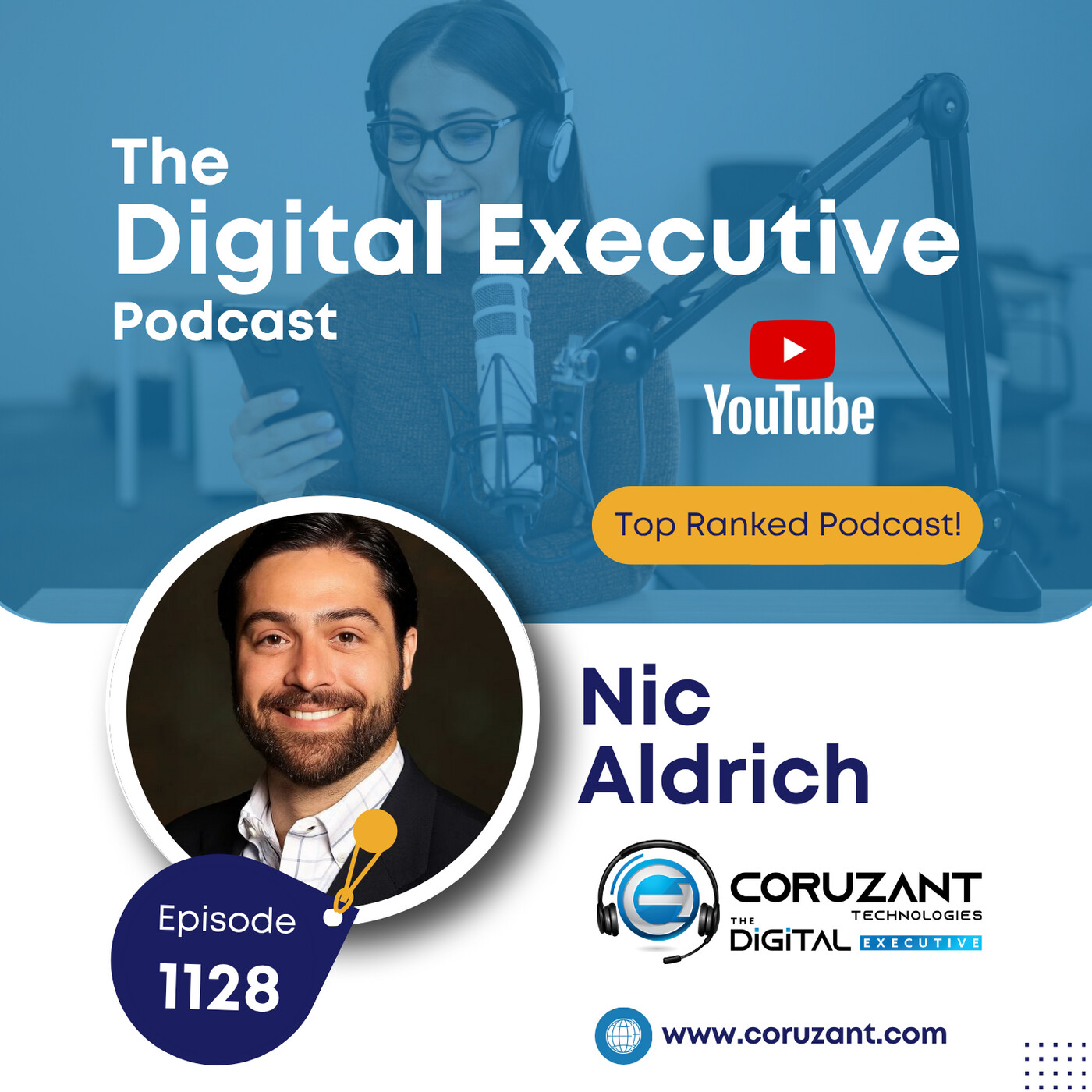
The Digital Executive
Amplifying Surgical Intelligence: Nic Aldrich on Innovation, Data, and the Future of MedTech | Ep 1128
00:12:26
Loading summary
Transcript13 lines
- [00:00]
A
Foreign welcome to Coruscant Technologies, home of the Digital Executive Podcast. Welcome to the Digital Executive. Today's guest is Nick Aldridge. Nick aldridge has over 10 years of experience in the medical device industry. Most recently, he managed a global marketing team at Stryker focused on Revision knee, hip and limb salvage implants, and was involved in several key 3D printed product launches in the Primary and Revision knee space. Prior to joining Stryker, Nick was part of the marketing team at Ansel Healthcare, where he focused on strategic planning and mergers and acquisitions. Prior to Ansel, Nick worked in finance for two Johnson and Johnson companies, Cordis Corp. A cardiovascular endovascular company, and Ethicon Inc. A suture and surgical technologies business. Nick has a proven track record of developing strategies and driving efficient and effective marketing campaigns that deliver results well. Good afternoon Nick. Welcome to the show.
- [01:04]
B
Thank you. Thanks Brian. Thanks for having me.
- [01:07]
A
Absolutely, my friend. I really appreciate it. You're in New York this today and I am in Kansas City, so just an hour apart, but I appreciate highlighting a guest location every time and just part of my, I guess my podcast every time I start. So anyway, Nick, let's jump into your first question. As someone who moved from managing marketing at major device companies like Stryker, Johnson Johnson into a leadership role at a growing medtech innovator, how has your approach to marketing changed in an environment where the end user is a surgeon, but payers, hospitals and value metrics also matter?
- [01:41]
B
Yeah, Brian, this is a great question. You know, when you, when you work at some of the large strategics like Stryker or J and J, marketing tends to be pretty structured and scaled and supported by some pretty massive systems and resources, which often means you're managing global campaigns with big infrastructure. You've got the playbook, the budget and the brand equity. But when you step into a company like Orthline, you trade that infrastructure for intimacy. You're a lot closer to your customer into the outcomes that our technology is actually delivering. And when I think about, you know, the marketing side and the my career, I think the biggest change for me is thinking more holistically about influence in the space. You know, the searching is still at the center of what we do every day. But the conversation now includes ASC administrators, hospital committees, and even the payers to some extent. And each have a different definition of value, which is really what we're all chasing. So, so we've had to evolve from, you know, selling a product to really building that value narrative. So instead of just messaging features or outcomes, we're telling stories that connect across the ecosystem accuracy that builds the surgeon's confidence, efficiency that increases case volumes in an ASC, and that economics that really strengthen the ASCs or the hospital's bottom line. So, you know, that's really how we build trust and relevance in the space where, you know, technology seems to be advancing faster than adoption itself. But it's funny because, you know, I tell my team all the time that medtech marketing today isn't about the loudest message anymore. It's about the clearest value and aligning that value across every decision maker in the room.
- [03:22]
A
Thank you. Appreciate you kind of unpacking that for us here. You know, you had a lot of exposure at some very large companies where they've got large marketing departments and money and infrastructure behind it. But I like your approach here. On this smaller scale, you've got to look at things more holistically. You're more intimately involved with the customer, of course, but also in that marketing, communications, operation, sales, et cetera. But again, at the end of the day, the word I took away is value. And I really appreciate that. Nick Worth a line recently hit a milestone of 300,000 surgical cases using its handheld navigation system. What were the key product, regulatory and commercialization challenges you faced in scaling from early adopters to that volume, and how did you overcome them?
- [04:06]
B
Yeah, I mean, reaching that milestone and now having surpassed 400,000 procedures globally represents a huge validation for our mission. You know, we're driven by that belief that everybody deserves exceptional health care, and we're committed to making the empowering technologies accessible to all. And that, you know, making the precision accessible to every surgeon in every setting is just a huge validation of our mission statement over time. And obviously that kind of growth doesn't happen overnight. It's a result of more than a decade of focus, doing really one thing exceptionally well, and that's delivering accurate, reliable navigation without that friction cost or complexity of some of those large capital systems. You know, when, when you rely on a robotic tower or a cart based setup, you know, when you don't have those sorts of things, your technology has to earn its place in the operating room. And you have to really prove yourself every single time. And that comes through consistency, accuracy, and really the ease of use of our system. So, you know, when I think about how we built trust in the space, we've sort of done it the hard way, you know, case by case, surgeon by surgeon, but really by keeping the technology simple, precise, and ready to perform in any of these environments, from the major hospitals to the high efficiency ACs to remote locations, really, really around the world. And when I think about like early on in Ortholine, our biggest challenge, it really wasn't technical. I would say it was more psychological. Surgeons had been conditioned to really trust the large capital based systems as the gold standard for precision. So we really had to prove that a handheld disposable device could deliver the same or even better accuracy, but also do it faster, simpler and at a fraction of the cost. So, you know, earning that trust required us to have obviously great clinical data, a lot of peer reviewed public validation and publications. But most importantly, I think it's a surgeon led advocacy and that real world experience that demonstrated those consistent and reproducible results is what's build the trust with that surgeon base. And when I think about how we've gotten there, I'm most proud that we didn't grow by chasing the hype and the competitive features. We grew by staying true to our mission, making that precision accessible through a technology that was accurate, simple and cost effective. And really it's that consistency that's earned us our credibility and our position in the marketplace. So now that we've, you know, eclipsed 400,000 procedures, you know, we're really entering a new phase in what we're doing. You know, one that's not just focused on volume, but starting to think more about the connection, the data, the insights and the digital engagement that we can extend beyond just the procedure itself.
- [06:50]
A
Thank you, really appreciate that. And yeah, 400,000 cases globally is a great number, but what I highlighted out of that is it's really the quality. It's not just about scaling the numbers there. You did stress pretty clear that you were making this technology accurate, reliable, and this precision navigation for all people. Right. It's not just people that maybe can afford it. And trust was the word I took away. You built that trust with every surgeon along the way. And because of your consistency, your quality and that trust level, I can certainly see why you're so successful. Nick, in surgical navigation, how are you leveraging data, software, automation and connectivity to evolve from a hardware centric device company into a more tech enabled service provider?
- [07:35]
B
Yeah, I mean, for a long time navigation was viewed just as a piece of hardware, you know, tool that's used in the OR that really just ended when the incision closed. Right. But now we're building towards something that is more connected and continuous. You know, our, our handheld platform already captures valuable procedural data. I mean, we got things like alignment, time, efficiency, accuracy, trends, and we're expanding that information so that we can sort of inform decisions for both the surgeon and the facility. You know, we've our, our team has sort of evolved from a hardware company to a software company to some degree. And we're building software layers and connectivity features that bring that data to life. So turning some of that raw information that you're getting from the procedure into actionable insights for the surgeon and facility. So think of it as like evolving from navigation to, you know, navigational hardware tools to smart navigation and smart tools, handheld devices that can communicate, learn, and continuously help improve outcomes, streamline the workflows, and demonstrate value across the entire healthcare system, not just within the procedure. When I think about, you know, our upcoming launches, for example, we will continue to introduce different aspects of technology that are going to help us grow. But, you know, some of the market's chasing automation, and we're not chasing automation for automation's sake. We're more focused on augmentation, helping the surgeons operate at their best with better information and less complexity. You know, the technology should fade into the background and let the surgeon's skill shine during a procedure. And that's really what we're aiming to do. You know, I like to say that, you know, we're not augmenting surgery, we're amplifying surgical intelligence.
- [09:21]
A
Thank you so much. I appreciate that. You know, you are building something that is more connected, accurate, and safe. And I really took that away is what you said here in the conversation. But the data does inform the decisions, right? You said it informs your company with those actionable insights and continuously improves those outcomes. And I liked how you said it's augmentation more than the automation. Let the surgeon do their best work. And I think that's pretty cool. And Nick, the last question of the day. Given that surgeon workflows, hospital purchasing dynamics, and regulatory constraints are slow moving in healthcare, how do you instill agility, innovation, mindset, and faster iteration cycles with ortholines, marketing, product and organizational culture?
- [10:05]
B
You know, I'm a firm believer that that agility comes from clarity. You know, when everybody understands the mission, they can move fast in that direction with purpose. So, you know, we think about agility a lot, and healthcare doesn't always move fast, as you mentioned. But, you know, what we've learned is that it's not about moving recklessly, it's about moving with clarity in that direction of our mission. And when everybody understands that mission, which we, you know, deeply believe here at Ortholine, you know, making precision and empowering technologies accessible to all, it's really that that's allowed people to make decisions quickly and confidently without having to go through layers of approval. Right. That mission alignment is huge for us. We've also built a culture around curiosity and collaboration. I think collaboration is probably one of the most used terms in our industry and in most. But, you know, just like many other organizations, marketing's working side by side with RMD operations, our surgeon partners, and now administrators as well. I think that kind of proximity is what keeps us grounded in what's real and lets us move quickly when it matters. And honestly, you know, our customers really are the ones that keep us agile. You know, when you work with ASCs, you're dealing with entrepreneurial surgeons who really value efficiency and that immediate impact that something can deliver to either their facility or their practice and their expectations are really what force us to iterate faster, think creatively, and sort of stay ahead of the curve. And that kind of energy, the more we work with our surgeons and our customers, that's the kind of energy that permeates our culture. So, you know, agility, to me, it's really more about connection. It's connecting the people to the purpose and those feedback loops so we can continue to adapt without losing that overall direction for the organization.
- [11:53]
A
Thank you. I really appreciate that. And I'll highlight just a couple things you mentioned. Agility comes with clarity, moving in that direction of your mission, empowering technology for all. And I can just tell there's a lot of energy and excitement around your mission and what you're doing to help people. So I really appreciate that. And Nick, it was certainly a pleasure having you on today, and I look forward to speaking with you real soon.
- [12:15]
B
Absolutely. Brian, thank you so much for the time today.
- [12:18]
A
Bye for now.