← The Digital Executive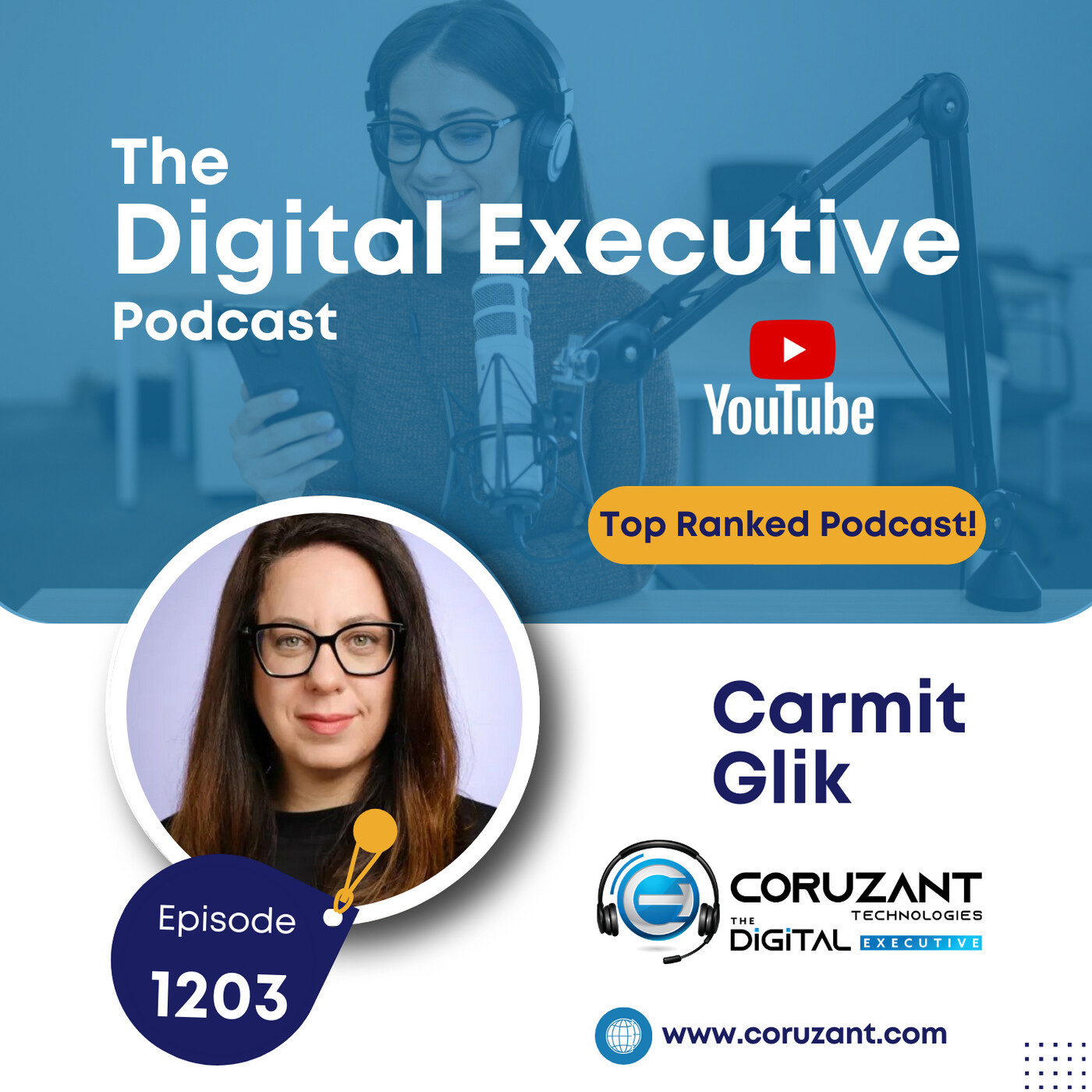
Loading summary
Transcript17 lines
- [00:01]
American Psychiatric Association Representative
The sun shining, birds are singing and all feels right in the world until
- [00:06]
the season changes and suddenly you lose your motivation to get out of bed. In fact, one in five people experience some form of depression no matter the season or time of year.
- [00:16]
At the American Psychiatric association foundation, our vision is to build a mentally healthy nation for all because we want you to live your best life and be your best you all year round.
- [00:26]
Please visit mentallyhealthynation.org to learn more.
- [00:30]
Podcast Host
Foreign. Welcome to Coruscant Technologies, home of the Digital Executive Podcast. Do you work in emerging tech? Working on something innovative? Maybe an entrepreneur? Apply to be a guest at www.corazon.com brand welcome to the Digital Executive. Today's guest is Carmet Glick. As the CEO of Shift Forward, Carmet Glick stands at the vanguard of digital transformation within the global freight industry. With over 22 years of multifaceted experience, she has dedicated her career to simplifying the complexities of international trade, helping businesses mitigate risk and seize global opportunities through a digital first. Best in class freight solution. Carmen is a visionary leader known for spearheading high profile projects in digital freight marketplaces and delivering end to end transportation solutions that prioritize both customer centricity and long term sustainability. Well, good afternoon Carmen. Welcome to the show.
- [01:39]
Carmet Glick
Thank you. Happy to be here.
- [01:41]
Podcast Host
Absolutely my friend. I appreciate it. Today I'm in Kansas City so we've got about an eight hour difference at least anyway and I know that it's hard to traverse the globe and make times and calendars. So I really appreciate you. Carmen, I'm going to jump into your first question. As CEO of Ship Forward, you're leading a digital first approach to global freight. What are the biggest pain points in international trade that technology is finally ready to solve?
- [02:09]
Carmet Glick
I think what happened in the last five days are really a good example to the pain point that we are raising. We are looking at the US and all the terrorist situations, Supreme Court and just or at least made a ruling that the tariff are illegal few minutes after Trump raised the tariff in a different way by a different ruling. This type of sudden changes that have never experienced before. It's kind of situation that if you don't have digital tools you are probably in a really really really difficult situation as a company, as SMB or even as a corporate. For those type of changes that comes rapidly and make a significant impact on your balance sheet, on your cash flow, it's in parallel that you will have the right tools to manage it and to be able to calculate immediately those type of impacts. So I think today or even since COVID time, we must use digital tools. The kind of irrational environment that we are living in as businesses really force us to be on top of things immediate online, have access to all information at a point of time that could be weekend or could be half hours. We cannot be any more dependent on on traditional way of working in the logistics world.
- [03:44]
Podcast Host
Thank you, I appreciate that. You did talk a little bit about the recent changes in tariffs. Obviously tariffs have always ebbed and flowed. Just depends on where you're at. But if you are a company especially that does international shipping or business, you need to be prepared. Now Covid showed us that we need to be prepared and we had to do some major pivoting during that time and I think we've learned a lot from that. Again, to your point, having the right tools or the right technology to be able to manage quick changes in the market is most important today in the way the global economy works. So I appreciate your insights Carmen. Digital freight marketplaces promise speed, transparency and efficiency. But adoption can be slow. What cultural or operational barriers still hold the industry back from full digital transformation?
- [04:33]
Carmet Glick
It's definitely a mindset, certain behaviors that we don't change if it's not broken type of thinking. I think it's related to every avenue in our world and the way we are doing things. Especially we are very risk diverse in everything related to logistics and trade. And I think that mindset, even though reality showing us how helpful this type of tools are into our businesses, that's not an easy thing to change. Saying that I think today we advanced so far to really talk to any risk on the small businesses side. I will talk specifically about what we are doing that we are enabling them to to access the platform 247 to reach out and do their sourcing via our platform to secure their payments, secure their communication and building the trust element that is required with every logistics partner but especially also with a digital one having 247 support, human support and really really wrap all type of concern that they might have with interaction with the logistics company. And in this way I believe that we are able to change that mindset because you clearly giving something that is better than what is out there.
- [06:12]
Podcast Host
Thank you, I appreciate it. There's a lot that goes into it. Obviously culturally it's hard a lot of change management, a lot of messaging, a lot of putting that message behind the we generally as humans business owners generally risk averse as you mentioned and if things aren't broken, don't fix it right in Order to improve and transform, we do need to take risks. And I think that's important. And I love your messaging on that. So thank you. And Carmen, risk mitigation is a recurring theme in global trade today. How can digital freight platforms help businesses navigate volatility from supply chain disruptions to geopolitical uncertainty?
- [06:53]
Carmet Glick
I think first of all it gives you all the transparency. So in essence when you understand as a business owner that you need to be prepared, for example, in the case of China will not be any more a strong partner for trade, then you must know the cost related to such shifts. So I think having transparency on pricing, on services, on route, on transit time, everything is open to you. You don't need to ask for by email like three other freight forwarders, you don't need to try to collaborate information online. You log in, you have free access, you search for various options out there for you to diversify your supplier portfolio. In the case of shift forward, you can log in and also look for product and source and have a very, very secure pattern to source with wholesale rates directly from China as well. If that's the case you would like to. So I think what digital platform give in our space in that immediate ability to research and to look very broadly and to find the answer that otherwise you would need various partner and not all of them have the access for the full information. And in that aspect, I think that's your first step to working with a digital partner in a logistics space. So that's very, very important. Then you have the accessibility to asset logistics. Assets and services like consolidation at origin, at various origin and shipping and maybe starting with samples or starting with less than full containers or even sent by air freight and everything is accessible within seconds. You don't need to look for various partners for that. On top of it, if you decided that you go with a certain product that you would like to source through us, for example, and ship it, you see everything online, you see the full operational flow. You can pay online as well. You don't need to start complicated onboarding or requesting a wire transfer that takes days. You can even pay with your credit card. So all of those little by little, those type of changes that the digital world give you, you cannot find anywhere else. And that's a little bit imitating the way we operate in our personal life that we got used to very fast and it saves us time. The same it is within the business environment at least achieve forward. And I think this is critical today. I think it's critical that somebody has access to those services 24.7that it can be heard of, ask question 24.7that is not dependent between 9 to 5 when most likely as business owners you are very busy with your customers, with your suppliers and with your ongoing businesses. The fact that today SMBs are very lean companies, they have lots of various digital tools around them that support them in a way. Five years ago, 10 years ago, they wouldn't have the same thing within the logistics space.
- [10:29]
Podcast Host
Thank you, really appreciate that. You talked a little bit about being prepared right for these shifts in the market and when you need to find things to support the business and the changes, transparency basically and the prices, transit, time, routes. And you talked about your platform shift forward and having that full capability to be able to search and find everything, to be more efficient, especially around those available services, to be able to adapt quickly within this volatile global market that we work in on a daily basis. So I appreciate your insights. Carmen, the last question of the day as we look ahead, how do you see the future of freight evolving over the next decade and what capabilities will businesses need to compete confidently in an increasingly digital supply chain ecosystem?
- [11:13]
Carmet Glick
I think that when I was asked that question four years ago, it was let's say mid of COVID people mindset was that okay, we will be past Covid and everything will go back to normal pre Covid time when situation were more or less stable. And then we are four years ahead and nothing went back to normal, at least not in the terms of supply chain and global trade. And I think that will continue be the case. Unfortunately that we have so many issue on our geopolitical side. There's so many issues that impact us within the government themselves and areas themselves that prevent us to go to kind of a steady route. And that mean that global trade logistic company, freight forwarders, we need to adapt very fast and we need to make sure that we are providing our customers the ability to move as fast as the world is moving because otherwise you will not be competitive in the market. And I think that is critical. We're seeing shifts of supply chain moving around the world that we have never seen before that require quite a lot. And from a small businesses point of view that's even worse because they don't have the backbone to support them on that. So they need to be really, really thorough in choosing the right partner that can provide them that global scenario overview and that they will be able to access those type of logistics assets everywhere they need at any time and that will keep them in the competitive world safer than the rest.
- [13:04]
Podcast Host
Thank you appreciate that. And you did highlight again, Covid was a great example of how we need to shift quickly and adapt to the changes. Global business is very volatile and when you need to move as quickly as the world supply chain moves, especially if you're in that international trade and choosing the right strategic partner, you highlighted that is very important, someone that can actually help be two steps ahead of the market. As we know, things change very rapidly. So thank you, Carmen. It was such a pleasure having you on today and I look forward to speaking with you real soon.
- [13:39]
Carmet Glick
Thank you. Same here. It was true pleasure and appreciate your time and looking forward for our next time.
- [13:46]
Podcast Host
Bye for now.