← The Digital Executive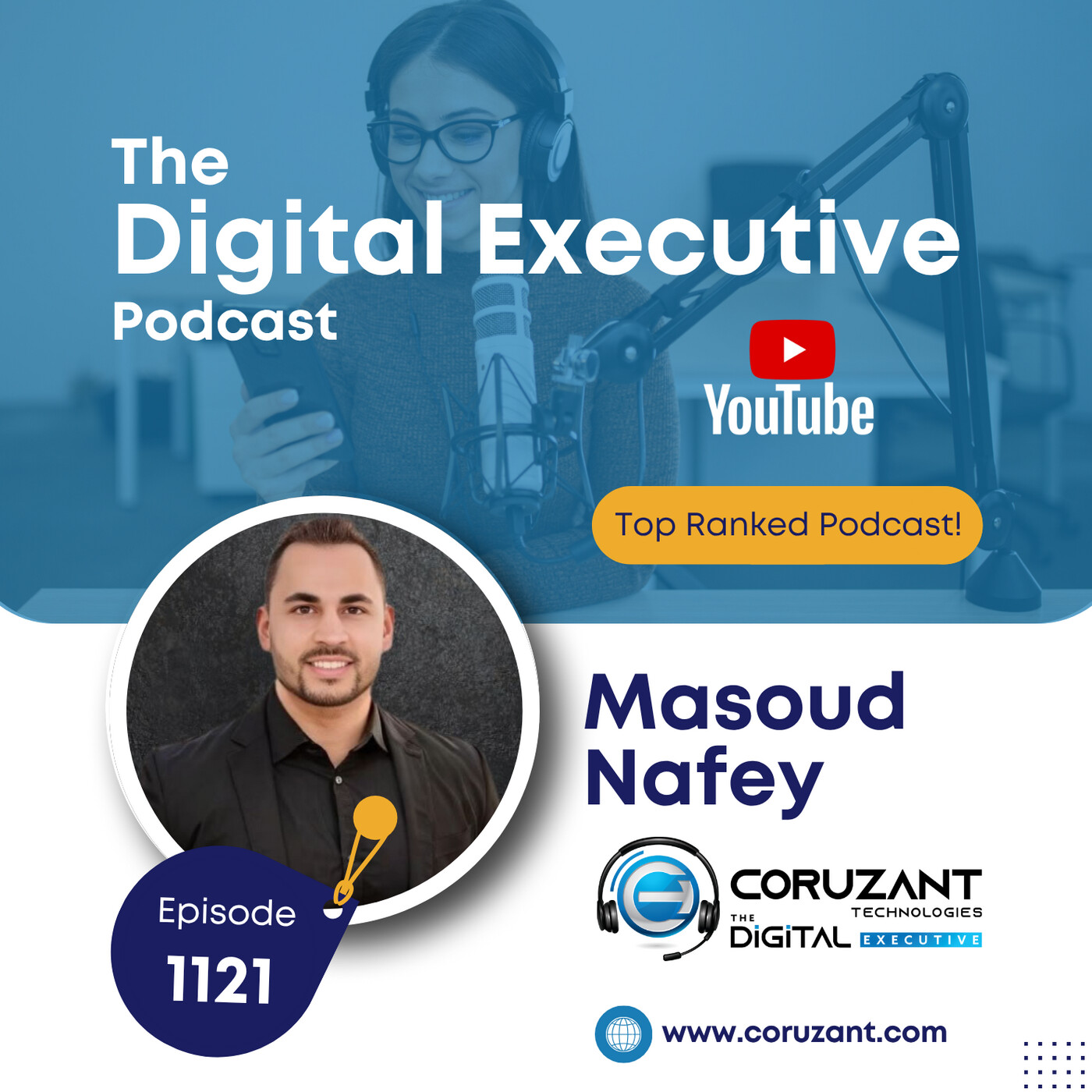
The Digital Executive
From Refugee to AI Innovator: Dr. Masoud Nafey on Privacy, Health Tech, and Human Connection | Ep 1121
00:11:04
Loading summary
Transcript13 lines
- [00:00]
A
Foreign welcome to Coruscant Technologies, home of the Digital Executive Podcast. Welcome to the Digital Executive. Today's guest is Dr. Masoud Naefe. Dr. Masoud Naefe is a three times AI founder, a senior consultant to several enterprises, holds several board positions in innovative tech companies and and helped build the Stanford University Vision Performance center at the Human Centered AI Institute. He has a proven track record in innovating, productizing, commercializing and scaling tech businesses. He is a founding board member of ment, an AI driven privacy first app designed to empower professionals to create deep, meaningful connections, transforming every interaction into a moment of impact. Well, good afternoon, Masoud. Welcome to the show.
- [00:53]
B
Thank you. Great to be here.
- [00:55]
A
Absolutely. My friend, I appreciate it. You made the time today to jump on a podcast from Silicon Valley area in California and I am in Kansas City. So just a two hour difference. And again, I'm so appreciative of my guests making the time to do this. So was you jumping into your first question? You've shared that your family came here as refugees from Afghanistan and that's shaped your journey in meaningful ways. How has that early experience influenced your appetite for risk, innovation and, and the kinds of problems you've chosen to solve in AI and health tech?
- [01:26]
B
Well, it's funny, I mean, nobody signs up to be a refugee. I don't think anyone really plans for that. And then it was during the Cold War and we made our ways to made our way to the slums of Delhi. We lived there for two years. Hamburg, Germany. Lived there for two years with my mom's uncle and then found our way to New York, became citizens and then we settled in the Bay Area. So I've been in the Bay Area since before it was Silicon Valley. I think that journey just teaches you that through adversity there's two. Two. You can make a decision at some point, an inflection point, where you go, how will I face that adversity? And think for me, I just always looked at it as it's my second chance at life. And I came to a country that I love and admire because of the opportunities it creates for people like me. And I came here and I said, well, I want to make sure it counts and to make the impact on the world and hopefully leave it in a better place than when I got here. So that's my goal. And of course that comes with a little bit of risk appetite because if you dream that big, you got to take some risks. And, and I've always been looking to solve problems, even when I was practicing as an optometrist to then trying to solve problems. So that's what turned into my first health tech venture. And then again one more time to the second one. And now here I am building platform that helps humans with their relationships. And I was hoping that technology can help us become more humane and work and more focused on the relationships that we built.
- [02:51]
A
That's amazing. Your story as a refugee was so impactful to me just now. And that's why I generally like the first questions on the podcast here, because everybody's got a story. And just really touched me knowing that you've had to move around, work through adversities, multiple cultures, multiple languages, multiple countries. My hat's off to you. That's just amazing. And I like what you said about that second chance. Right? And this is the land of opportunity. I agree. America is blessed. Just about everybody that has come here in one some form or fashion. And I think that your message about taking advantage of that and making the world a better place, giving back, you know, working to really put into this great system that we have here. So thank you. And Massoud, you founded multiple AI companies, you serve as a consultant to enterprises, sit on several boards, et cetera. You advise big platforms. What patterns or best practices have emerged for successfully moving from early stage innovation to scale in enterprise settings. What differs most when you're inside those large orgs versus running your own startup?
- [03:57]
B
Yeah, large organizations, they just function so, so different from startups. I always say the bigger you are, the slower you move. Always got to get through that red tape and multiple approval processes just to move around and get around. So there's always that. And then a lot of these arts companies that are starting to have their technology arm or technology line of business, they didn't start off being a tech company, so they want a digital product, but they started as maybe selling physical products or doing other things. So it's also a culture shift for a lot of those enterprises to start thinking like a tech company. Which means, nope, you don't necessarily have to wear the beautiful blue suit. You could just wear the polo and jeans. And you know, it's a different culture when it comes to tech. But what I've seen consistently is that yes, it's the innovation doesn't necessarily move the fastest, but the distribution is there. So they have access to customers at scale from day one. So you just got to make sure you solve that problem really well and you have all the customers ready to go. And a lot of times you also have revenue that you can big borrow and steal from other lines of businesses or the parent company. So there's a huge difference between a startup where you count every dollar you have, you always have about three months of Runway left when it comes to cash. And then you're also making sure that every customer means so much more to you because that's the foundation that will allow you to scale at some point. So those are some of the similarities and differences.
- [05:28]
A
Thank you. There's really. We could talk for hours about that, talk to a lot of tech founders here that have played on both sides of the fence, as you mentioned. There are a lot of pros and cons, obviously, and the bigger you are, the slower, sometimes you can move. But when you've got something that's ready for production, you can scale really quickly. And you do have that customer base. But certainly I appreciate your insights there. And then Massoud, let's talk about mend. You're building an AI driven privacy first app to empower professionals in meaningful connections. What are the hardest trade offs you've encountered between building deep intelligence and preserving user privacy? How have you mitigated risks in that ethical, regulatory, technical space?
- [06:10]
B
Yeah, and I think that's really important. I mean, part of it is just when you, it depends at what point do you address privacy? When we build men, before we actually even built our first line of code, we wanted to address privacy. So we created our technology and architecture behind our technology with privacy by design. And of course the problem we're solving for is, you know, people do business with people they like. People have a lot of relationships, not enough time, There's a lot of data, it's not all relevant. The tech is there, but it's not secure for all this, what I call sacred information between me and my relationships. So what we do is we of course our technology goes and gathers open source information, information that we bring in and that's already out there in the world wide web. So that's not something that needs to have a whole lot of security around it. Yet we do still make that really secure and private by design. But what we do then is say, okay, here is a person that you are about to meet, here's all the information about them. So then you can have a better initial meeting with that person or the first time you meet them, you have icebreakers. You can talk about common points of interest, those types of things. We also by design, and it is a trade off by design. We said we can be so much more accurate and faster if we have people integrate. Let us integrate our technology with their Instagram, with their LinkedIn, with their emails, with their text message. We decided not to do that. We decided not to integrate with anything. Give us a first name and last name and then let meant do its magic. So we did that to ensure again, privacy is at the forefront of our technology.
- [07:53]
A
Thank you. I've done so many podcasts on AI ethics, privacy, all that stuff, and just recently had someone on, we talked about safety for humans in the healthcare space. But I really like how again, you're doing this a little bit backwards than Silicon Valley. You're out there in Silicon Valley, but you're doing different. You took privacy and you thought of that first. That was deliberately by design. And that's what I really appreciate you sharing with our audience today and Massoud. Last question of the day, as we look ahead, what do you hope will be the biggest positive impacts in AI in health and vision care in the next maybe five to 10 years? What's the legacy you want your work to leave, especially in terms of empowering practitioners and improving patient outcomes?
- [08:39]
B
So when I think about the healthcare side of me, which is where I started, that's where I tell people that the vision industry, as an optometrist, as a healthcare professional, that's the industry that gave me my wings. And from that standpoint, I think AI is going to help remove the burden upon physicians. And today, you know, a lot of times all doctors in their training, they're taught to be data collectors, but that's never why they went to go become a healthcare professional. They wanted to take care of people. I think with the help of AI that can identify trends, patterns and those types of things that can help and assist with clinical decision support to the doctor. It will allow the doctor to do more of what they love, which is be the empathetic person that takes care of another human being. And on the mend side, as you know, this is a relationship intelligence platform built for any leader in any industry. We're trying to do is technology over the last decade or two decades has really, I would say hurt the human to human interaction and probably maybe has been has created some limitations around how people connect. I wanted to flip that upside down. So with men's, the team essentially is building technology to help humans be together with other humans. Because we always say inside our four walls we're meant to be together.
- [10:03]
A
I really like that plan words, meant to be together. And you're absolutely right. We talk about technology a lot here and we've talked about robotic process automation and AI and all these machines. But at the end of the day, it's what matters the most is that human to human interaction, people are the center of the world. And I would like to highlight one thing that I think is important is you really talked about the hope for AI and how that will help make better clinical decision and support for healthcare providers so that they can focus more on that. Again, human to human interaction with their patients. I think that's so important. And me coming from the healthcare industry for many, many years, I can certainly appreciate that. And Massoud, it was such a great, awesome time with you today and I look forward to speaking with you real soon.
- [10:52]
B
Likewise. Thank you so much for having me. It's an honor and privilege.
- [10:56]
A
Bye for now.