← The Digital Executive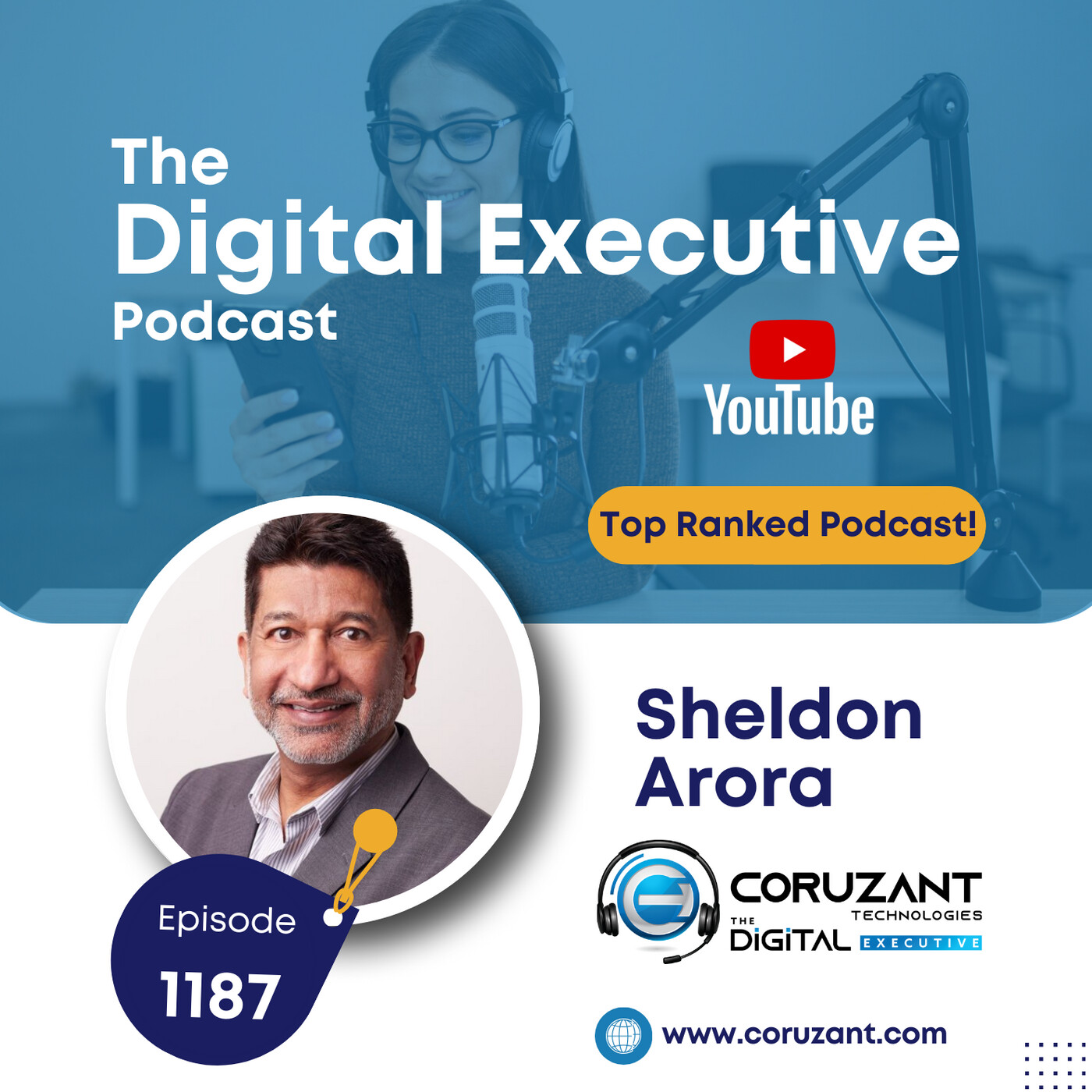
Loading summary
Transcript13 lines
- [00:00]
A
Foreign. Welcome to Coruscant Technologies, home of the Digital Executive podcast. Do you work in emerging tech? Working on something innovative? Maybe an entrepreneur? Apply to be a guest at www.corazon.com brand welcome to the Digital Executive. Today's guest is Sheldon Arora. Sheldon Arora is the CEO of Staff DNA and Liquid Agents Healthcare. For over two decades, he has established and grown companies as a visionary leader in the healthcare staffing and technology sectors. StaffDNA is the first industry marketplace for healthcare hiring and holds 20 patents on its technology and more. Coming with the United States Patent and trademark office, over 2 million healthcare professionals have downloaded the Staff DNA app to help them find a job they love. Well, good afternoon Sheldon. Welcome to the show.
- [00:57]
B
Well, thank you so much, Brian.
- [00:58]
A
I really appreciate you making the time, my friend. I know you're in Dallas or in the same time zone. I just know that sometimes calendars are challenging. So thank you. And Sheldon, if we could. I'm going to jump right into your first question. You've spent more than two decades building companies at the intersection of healthcare staffing and technology. What fundamental problems in healthcare hiring originally motivated you to create platforms like Staff DNA and Liquid Agents?
- [01:26]
B
Brian, anybody who goes into healthcare discovers that healthcare is very complicated. There's so many different professions. So like on the clinical side it would be the physicians, nursing. And if you're not on the physician side or nursing side, you go into a third category called ally, which elect over 200 specialties. So you're talking about professions, specialties, job types, job types that you and I would know would be simple as a staff position or temporary position. They'll have local contract per diem contracts as well. On top of that then you're talking about. You see in the healthcare industry there's a lot of demand, a very small amount of supply of candidates that exist out there. The only industry that's like that. So if a healthcare institution posts a job, really no one will apply. I'm exaggerating to make the point, but like if you're in a financial industry, IT industry, you post a job, hundreds of people will apply. So it's really very different than all the other industries in terms of staffing. The staffing model that started about 80 years ago has not really changed. So we still do the business the same kind of way. So we were looking for ways to create something that was very different, that was very fast and a very fluid, self service based marketplace that would actually take the friction out of what employers feel and what employees feel when they're looking for a new job or when they're looking for a new candidate.
- [02:48]
A
Thank you, I appreciate that. And I didn't know that staffing hadn't changed that much in that many years. But you did highlight some things that I'm very familiar with. I was in healthcare for 20 years and in technology, so I know it's complex and challenging for sure, but that high demand. And I do know on the healthcare side when you do post positions, it's hard to find talent or good talent even. So I really appreciate the insights. And Sheldon Staff DNA is described as the first true marketplace for healthcare hiring and holds 13 US technology patents. What makes a marketplace model so powerful in healthcare compared to traditional staffing approaches?
- [03:29]
B
When we were trying to build a technology, we wanted to make sure it was like a closed system. So it was built from ground up, it would be fast, efficient and work in real time. And as we were building it, we wanted to go obviously protect that technologies. So over a period of time, I think we filed a little over 50 patents. I think over 20 of them have been granted to us. Now it's just to protect the what we spend time on. You see, the power of this technology is so amazing because a candidate in the healthcare field can see all the all jobs, not the jobs that they know about, all jobs that they're qualified for. The details, the certification requirements and pay, completely transparent for a client. You can go out there on your own, see any candidates applying to you, you can look at that information, their resumes, the certification requirements in real time. So really it's creating a technology that goes end to end in real time and works together.
- [04:27]
A
Thank you, I appreciate that. And I know that you put a lot of blood, sweat and tears into your platform from the get go. It was robust, scalable, closed system. But what I like to hear is when you're leveraging the technology in your system, it allows people, candidates to see all jobs are qualified for, but also organizations to see really all the different available candidates as well. So I really appreciate that. And Sheldon, with deep experience in both operations and technology, how do you decide when to automate versus when human judgment is still essential in healthcare hiring?
- [05:03]
B
You remember when the computers came out, everybody wanted to go out there, just do some degree of automation that was like rule based stuff that was repetitive tasks and everybody did that and they realized computers are really good at that. And now we're really talking about in the supply chain from one end to the other for healthcare staffing. There are a lot of people that are in the middle Like a hospital will give an open rec to the hr. HR will reach out to staffing companies, salespeople, salespeople will talk to recruiters, recruiters will talk to candidates. So you say like a long, longabelled way of reaching out to the candidate. And every step of the way there's confusion, there's friction that exists out there. So we wanted to go out there, take the necessary non value tasks and free those up and automate those as well. So really the computer that's really good at doing things, let it do all the work that it needs to go do. Making a recruiter or client or suppliers time available so they can do the thing that they're really good at, which is problem solving, building better relationships. So really we're looking at ways where if software can go do that, we want software to go do that and we want to free up the time for humans to do human things that they're really good at.
- [06:14]
A
Thank you, Appreciate that. I just love that the way you explained kind of that analogy of there's so many different touch points with humans and this whole candidate and hiring process and some of that stuff is repetitive, mundane, doesn't require a human. But I like that your technology is leveraging some of that newer technology like AI to free up humans to do more higher level thinking and critical tasks. I appreciate that. And Sheldon, the last question of the day as we look ahead. How do you envision the future of healthcare staffing over the next decade? And what role will AI marketplaces and data driven matching play in reshaping how clinicians find work they love?
- [06:56]
B
I think matching is mainly done for hiring via people and some software. So it's basically what you and I know. We program into the software and the software does that work for us. When AI is coming along as it's moving at the speed of light, it knows that if Sheldon has certain charting experience, certain level experience, and I'm working at a certain hospital, if I have a successful outcome or not. So we want the software to automatically go out there, show Sheldon the jobs that he will be better qualified for their better match jobs first before other jobs that I may not have a successful outcome. And you can just see where the technology is going today. So in matching specific area we're going to be able to go out there, find the job that you and I both will have a really good end results, really good life if we worked in that kind of role, that kind of job, that kind of environment. And I think AI can help us go do that. Now what's going if I just go a little bit forward, a little bit past that. In the, in a healthcare environment, hospitals cannot predict when you and I will get sick. So they have to have a certain level of staff, regardless whether any people are, whether any of us are in there or not in there. I think in the future you're going to see just like the automotive industry went in, just in time. I think you'll see more and more, take more and more. Staffing will be done just like that, just in time, on demand. So when a hospital is scheduling surgeries, they'll schedule our surgeries, People will show up, do the surgery, they will go home, thus reducing the cost for facilities as well, because they don't have to have a staff there all the time, whether we're there or not there.
- [08:34]
A
That's great. And that would be amazing as, as I mentioned earlier, being in health care for a lot of years, I saw a lot of that where it is hard and, and there's a lot of expenses, especially in the hospital side. But you know, using the combination of software and humans to find those right candidates, AI can actually take that a step further and find the right job with the right candidate. And again, moving towards that just in time staffing model, I think that's really where we need to head. So I really appreciate your insights. And Sheldon, it was such a pleasure having you on today and I look forward to speaking with you real soon.
- [09:09]
B
Oh, thank you so much, Brian. I had fun.
- [09:12]
A
Bye for now.