← The Digital Executive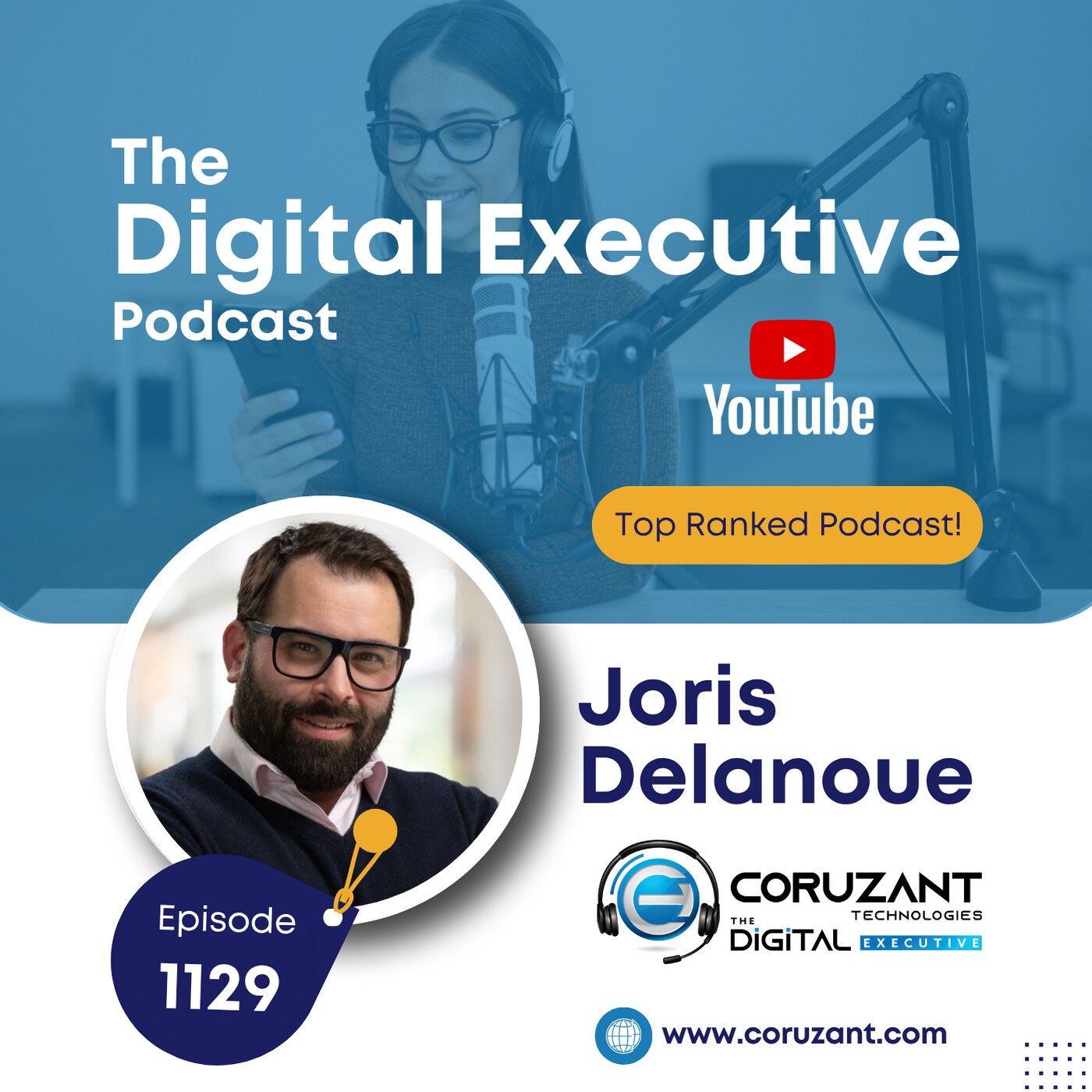
The Digital Executive
Tokenizing Equity: Joris Delanoue - Building Fairmint and the Future of On-Chain Capital Markets | Ep 1129
00:19:32
Loading summary
Transcript15 lines
- [00:00]
A
Foreign welcome to Coruscant Technologies, home of.
- [00:11]
B
The Digital Executive Podcast.
- [00:13]
A
Do you work in emerging tech? Working on something innovative? Are you an entrepreneur? Apply to be a guest at www.corazon.com brand welcome to the Digital Executive. Today's guest is Joris Delano. Joris Delano is the co CEO and co founder of Ferman, a fintech company pioneering the tokenization of startup equity. With nearly two decades of experience as a founder, investor and operator, Joris has dedicated his career to building financial infrastructure that makes fundraising more transparent, efficient and founder friendly. Before Fairmint, he founded NexTeam, a cloud computing company serving Europe's leading banks and e commerce firms, with which he successfully scaled and sold. He also invested with Goodwill Ventures and the Family, advising startups on fundraising, business development and operational growth. Well, good afternoon George. Welcome to the show.
- [01:07]
B
Hey Brian, how are you today?
- [01:09]
A
Great. Great to have you my friend. I appreciate it you're hailing out of New York today. I am in Kansas City. So I appreciate you traversing the time zones today. And if you don't mind George, we're going to jump into your first question. What was the aha moment or pain point that led you to start fairmint? How did you how did your experience founding and scaling Next team feed into your vision for embedding equity on chain?
- [01:35]
B
Well that, that's a very interesting point to identify what's the genesis of a project or a new company. I would say that my main frustration came from my inability to onboard a lot of people to my cap table in my previous business and for context I had no vc, I had no jet fuel to finance this growth in these previous businesses. And so the frustration came on both sides like the one where I try to onboard people to my cap table. Also I was investing as an angel in many company at that time and I felt it was weird to see how things were illiquid for years and years and years even if the company trajectory was good. And so after I sold my previous company, I joined the US to literally be in the US to be in the heart of capitalism and try to fix it in a sense that there should be a better way to democratize the access to the financial upside. So I would say that this has been one of the main driver to start fairmint. And initially when I started it was completely tradfi like I was building an exchange for a startup using SPVs. We are in 2017 and I would say the goal was really like finding ways to spread better this financial upside. The funny Part is that in 2018, that's when my co founder, Thibault CTO of Fairmint, introduced me to the blockchain. And I was like, oh my God, that's fantastic. Because I see a groundbreaking technology that the whole industry will at one point use because it's inevitable. It's simply a better tech, it's simply superior tech. And the analogy with my previous business Next team on cloud computing was so obvious. And I think that has been one of the best way to start the company. Like knowing that the time you don't control it, how long the market will need to accept this new tech. On top of that, you are in a regulated market with the crypto technology. And so all the things made us literally wait for a long time. But I would say this has been like the reason why Fermi starting as it is and the reason why also after seven years, we never defocused ourselves. We build equity securities on chain, we bring equity on chain, we turn cap tables into smart contract. And that has been a driver for the last seven years.
- [04:18]
A
Thank you. Love the backstory, really do. Early on, you talked about your initial challenges with not having that investment or venture capital in the things that you were doing. But once you got out of that and came to the US you saw an opportunity really to democratize this part of the business. And what was really cool is we talk a lot about the blockchain here, but your colleague, your partner, introduced you to blockchain. You kind of had that aha moment like I'd asked. And I just really appreciate the backstory and chorus. Fairmint is an SEC registered transfer agent built specifically for blockchain equity. How do you balance the demands of regulatory compliance with the flexibility and innovation native to crypto and smart contracts?
- [05:03]
B
Oh, that's. Yes. I think this is part of the vision between people trying to grind and people trying to showcase things. If I look back at fairmint, we spend years building a business and that's probably a legacy of building businesses without VC in the past. Because when I arrived to the states, so I didn't speak English very well, I didn't know about the US securities laws. So I had to go through this whole learning curve that many people don't have in their industry. But on top of that, I was also seeing how the day you become a regulated agent, it completely changed your perspective in terms of innovation. So the two licenses that were very important in our market were indeed the transfer agent that we became in 2023, early 2023, and the broker dealer license. And I saw the last seven years, many companies raising a lot of money to become a broker dealer, raising a lot of money to become an alternative trading system. And all those companies were valued billions of dollars. The reality is that years after they have no business so they line up all the licenses, they are completely tight when it comes to innovating because they already got the approval from the regulators and then they can't really innovate. At fairmint we decided to flip the script. We said, okay, what if we don't monetize, we don't do anything that is in the realm of the regulated agent, but we build the rails, we build the business. And yes, that's a grinder approach. More probably for people that are able to know that it would be hard time, it's harder to raise with that. But this is the path that we went through. And the reality is that after four or five years we became a transfer agent and we accelerated at that time, but still we couldn't really monetize all the flows that we had because of the lack of broker dealer license. And over the last 10 months we onboarded more than 1.2, $1.3 billion of asset. And this is now that we feel that our flows, our rails are strong enough to on top of being compliant for years, being exposed to the regulators, so that tomorrow we can have a fee under the broker dealer activity and we apply to become a broker dealer in that sense. So I think it's very important to always like identify how a license can prevent you to really innovate. And in that case it's your role to make sure that maybe you should start earlier. It might be a harder path, but at the same time it gives you an opportunity to be much stronger with a strong business the day you decide to go after the licenses.
- [08:18]
A
Thank you. Appreciate that. You certainly had some challenges as you mentioned coming to the US you had to learn a language, the business landscape, the laws here. But you dove in and this gave you a different perspective when you were looking at business in this environment, which inspired some creativity. And I just love the asset growth that you had. It's been amazing and I appreciate you sharing that. And chorus. What have been the steepest technical or legal hurdles you've encountered in deploying Fairman's infrastructure? For example, token standards, settlement, investor rights, how did you overcome them or are you still working through them?
- [08:54]
B
So yeah, it's obviously is something that we have to deal with every day, but maybe there is an inflection point when we started Fairmint, we were among the first doing equity securities on chain. And at that time the people were trying to reduce that to are you a token? Yes, no. And if you are a token then you are not a security. When obviously we were. And we never hide the fact that we were building securities. So during the first three years of Fairmint, all the activity we had, we were trying to see it in the cap tables of our customers. And at that time we were really focused on a small part of the cap table, the fundraising part, the capital formation part that was done on chain. And for the first three, four years of Fairmint, none of the capable vendor were letting our customer add all the operation they were doing on fairmint on their own systems. They were saying to the lawyers of the customers that for example we were doing nqi, the non qualified investment. And they were trying to justify the fact that if it's a token, it's not an equity. And that was very frustrating. Because of that we couldn't really exist. We couldn't sign most of the customer that were interested and we missed like very big customers, perplexity beacon like many customers that were sold on the vision, on the tech, on the product. But at one point this legal aspect of the cap table compromised us. This is when we started to see the cap table as an enabler in a sense that we didn't understand how some companies were able to say that this is qualifying for the cap table and that this is not qualifying for the cap table. And we decided to team up with many law firm in the U.S. securities law firm to build a standard for cap table to a break the moat of those vendors and b give the power back to the right people, which is the investors on one end and the founders, the board of the company on the other end. Because it was not normal that some people were despite dozens of memo from top US securities law firm rejecting a new form of equity securities. And so since we released the open cap table format, which is the new commoditization and open source format for cap table in the US the whole industry is now using that as a common language for cap tables. And that has completely changed the trajectory of fairmind. Because now not only we are integrated into the cap table, but we are literally turning the entire cap table into a smart contract by bringing the format and turning it into a protocol on chain, you see. And so that has been probably one of the biggest shift that allow now a lot of our customers to come to us and say hey guys, I'm paying $25,000 to Carta. How can I use you? And what would be the cost? And in our model, literally we try to make it almost free. We try to onboard very easily. And the fact that now we talk the same language between the two products, it offers us like a great compatibility with the rest of the industry. So that has been one of the biggest points I think over the last seven years of fairmint that we overcome and turn into our advantage now. And of course then we have plenty of other detail. But you understand that if you are not able to bring the cap table, the lawyers and to make the founder trust you enough, your business will never scale. And that has been a game changer for us over the last years.
- [13:19]
A
Amazing story. And your resilience, I really just love that part of it. The first three years you talked about really focusing on the capital part of it, but it was challenging because your company was essential essentially, right? Discriminated against because the way they didn't recognize tokens as a true financial asset. And you had to work through a lot of challenges to get there. But your perseverance again, you know, out on top. So I really appreciate the backstory. Thanks. Brian and Joris, the last question of the day. In your view, how the line between private and public capital markets evolve with blockchain infrastructure? Do you foresee a day when early stage companies issue equity fully on chain with continuous trading and compliance baked in?
- [14:01]
B
Well, that you you point to one of the reason why I love capital market, the blockchain era. If you think about it today, there is two world. There are two world. The private companies are in one world and then you have the public one. And the difference, the cost, the mindset are so different on these two part of the market that it's extremely hard for many people to imagine a shift. My vision is that blockchain technology, and more particularly and specifically the composability of defi will completely blur the line between these two world. And let me explain on this. In the world that everyone knows, you launch your company, you scale and you raise a lot of money and at one point you have enough traction to say, hey, let's do an ipo. That's when you have a whole new set of people, intermediaries, underwriters, national exchanges, investment banks and all that start to work and prepare your liquidity event to effectively become a public company. On one end, the regulator prepared a specific exemption called the REG A and the REG D506C as well within a raceway station. But Rege specifically I think is a very good one today because it's like the mini IPO exemption. So you have the regulator that prepare the world for a smoothest path for being public. But they never really prepared what the crypto industry has been building and all those smart contracts that automate these. One of the biggest reason why it is so hard to move from a market, the private one, to the public one is the cost, the cost of making your equity move. It is so high that because of that and by cost I mean money. But I also mean time, effort, compliance, you know, all the things that comes with letting your company shares being moving, being able to move. And with defi we get an opportunity, a unique opportunity to literally automate things to the point where these costs will drop so much. And I envision that even if we still have a very happy few companies that are going public that are able to get sufficient liquidity and enough from underwriters to go public, we'll have a lot companies trying to just say I want my community to own something. I want people using my product being able to hold something and capture some of my financial upside. And this is what we are building right now. We want to make sure that whatever your stage, you could have an opportunity. And I like to break down my industry or my target into three different type of companies. The tier one are the pre ipo, Everyone fight for them, everyone try to get a some holdings on those and position on those companies. It's really cool. But we still need to offer them a cheaper rail to go public. But what I like is really like the other one, like the tier two, tier three, the one that are making enough revenue but not enough to do like an IPO or to get underwrited. And so those companies are leaning to tender offer, they are leaning to do all those secondaries. We need to ease their life. We need to make it so much easier to do that. And finally we have all the very early stage company same. Sometimes you need to do some cash out, sometimes you need to allow your employee to capture something out of all their holdings. This is what we are building with Fairmint right now. We plug the cap table and all the holding of the investor to defy for private companies. And thanks to that, yes, we can finally see a world where function of the traction of the business. Of course liquidity can happen because we made the rail possible and because we decreased significantly the cost of each transaction.
- [18:34]
A
Amazing. Thank you so much. And I really loved how you really broke this apart, talked about the two worlds, private and public, totally different. Right. But moving into blockchain defi. Right. It will actually blur the the line or the differences between these market. Between these markets, which is promising. It is very costly moving from private to public. You talked about that. But again, you talked about the technology and defi, where you can automate this transition to a point that it will absolutely lower the cost and it'll be more really a non, a non deal for people trying to do that. So I appreciate that, sharing that information with our audience today. And, Jors, it was such a pleasure having you on today, and I look forward to speaking with you real soon.
- [19:19]
B
Thank you so much. Ryan, super question. Thank you so much.
- [19:23]
A
Bye for now.