Podcast
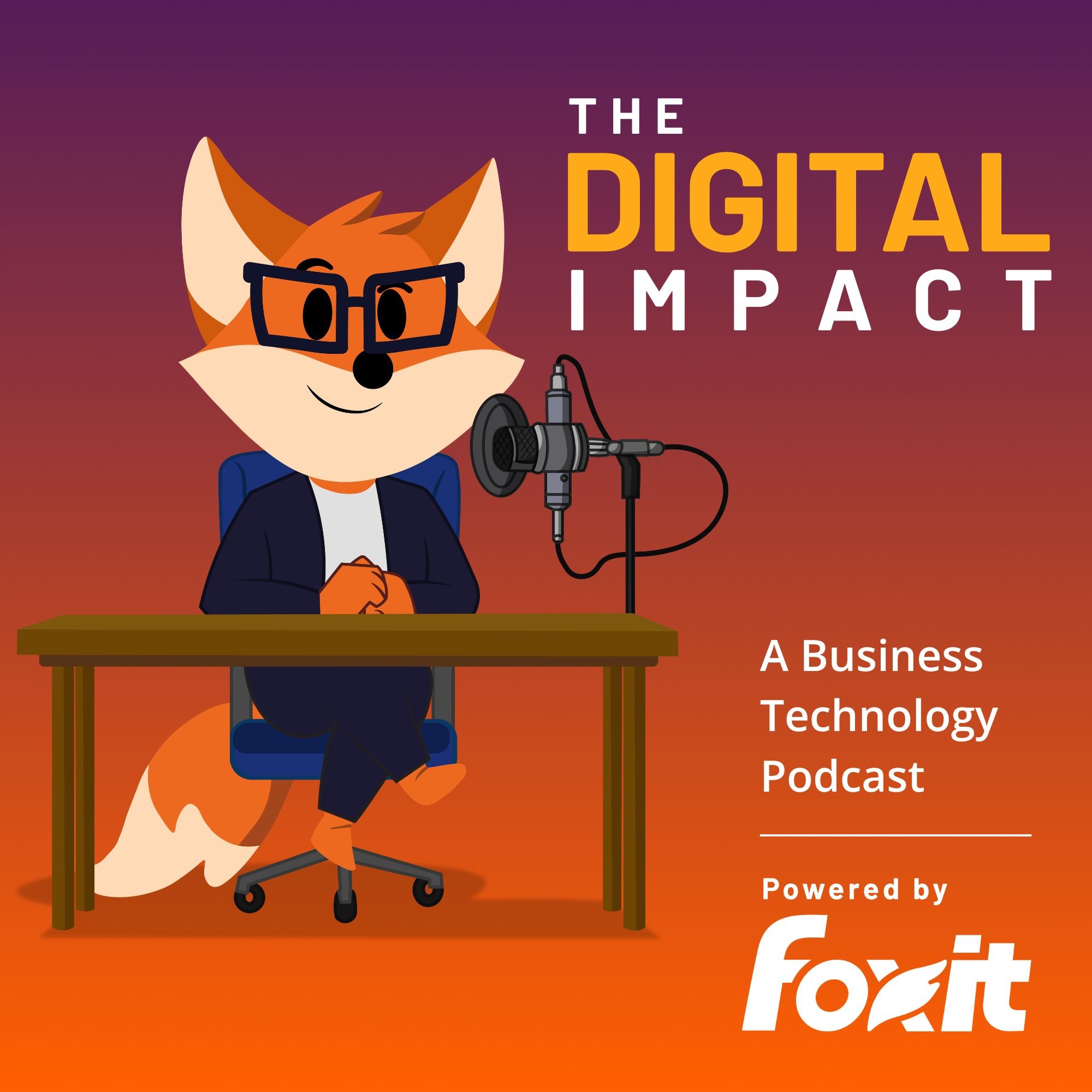
The Digital Impact | Business Tech and AI
Hosted by Charles Verhey · ENGLISH
New episodes every Friday.
The Digital Impact, powered by Foxit Software, is a business technology podcast spotlighting the thinkers and doers shaping the future of work. Each episode features candid, intelligent conversations with CIOs, CTOs, tech strategists, and innovation leaders driving real change inside modern organizations.
This isn’t a surface-level tech news recap. It’s a platform for senior leaders to share hard-earned insights on how they’re solving complex problems with AI, automation, cybersecurity, cloud infrastructure, and workflow modernization. From navigating hybrid work to leading digital transformation initiatives, we explore what it truly takes to adapt, scale, and lead in today’s fast-moving business landscape.
Hosted by the team at Foxit—an industry leader in document productivity and AI-powered workflow solutions—The Digital Impact serves as both a thought leadership platform and a sounding board for enterprise innovation. We cut through the noise to bring our audience real stories, expert perspectives, and actionable strategies.
Whether you're a listener looking to stay sharp or a guest ready to share your story, The Digital Impact is where business technology leaders meet to talk about what’s next—and what actually works.
20episodes
Episodes
Newest firstAll episodes
Why AI Can't Tell a Joke: Comedy, Creativity & The Future of Work | Michael Zois
Nov 2100:28:11Tap to summarizeCan AI ever actually be funny? In this episode, host Charles sits down with actor and internet comedian Michael Zois to dig into why machines keep failing the vibe check. From awkward punchlines to hallucinated “facts,” they break down the gap between computational pattern-matching and human comedic instinct.The conversation quickly widens into the bigger, messier questions behind AI’s rise: What happens when algorithms begin replacing creative work? Why are writers disappearing faster than coders? How much AI-generated content is quietly plagiarized? And what happens to society when automation advances faster than people can adapt?Charles and Michael trade stories from media, marketing, and healthcare—everything from AI inventing fake historical events to the surge of mediocre generative content flooding social feeds. They explore why audiences are suddenly gravitating toward unfiltered, human-first creators, and why authenticity is becoming the last scarce resource in an automated world.They also look ahead: the economic fallout of rapid automation, the future of work, the bizarre trend of AI-invented recipes, and how far machine intelligence could push into fields like medicine. The question isn’t whether AI will reshape culture—it’s whether it can do so without hollowing it out.If you care about comedy, creativity, or the future of human jobs, this episode pulls no punches.Topics CoveredWhy AI can structure a joke but still can’t land oneThe Star Trek and Short Circuit tests of artificial humorAI hallucinations: When the “wrong answer” is funnier than the jokeArt, soul, and whether machines can ever express emotionThe vanishing copywriter and the rise of generic AI contentEconomic upheaval and mass unemployment risksWhy audiences are craving human authenticity againAI inventing fake history and the dangers of automated misinformationTraining models on Reddit, Twitter, and the “worst of humanity”The AI cooking/recipe fiasco taking over social mediaAutomation in healthcare and the thin line between help and harmPredictions for the next five years of AI-driven disruptionGuestMichael Zois – Actor, comedian, and creator of Public Disservice YouTube: @MikesPublicDisserviceLearn More🦊 Foxit: https://www.foxit.com/?utm_source=youtube&utm_medium=social&utm_campaign=podcastSeason 1, Episode 20
Transcribe →
How AI is Rewiring Business, People, and the Future of Work | Artie Chang
Nov 700:28:06Tap to summarizeAI is not just about doing things faster—it may be the best tool for making people better.In this episode of The Digital Impact, we explore how AI is transforming leadership, collaboration and human development.In Season 1, Episode 19, host Charles Verhey sits down with Artie Chang (CEO, PanTerra Networks) to explore a provocative question: Is AI’s true power teaching us how to be better — not just faster?We dive deep into why generative AI is reshaping teams, up-skilling workforces, and building smarter collaboration frameworks. Learn how to adopt AI strategically using a “crawl-walk-run” approach, why job displacement may not be what you think, and how to put effective guardrails around document-intelligence systems in distributed workflows.What you’ll learn (key takeaways):🚀 How AI differs from the PC and Internet eras (0:01:03)Why AI may become the engine for human development & up-skilling (0:02:58)How to adapt to AI’s exponential pace of change (0:03:34)Why AI alone won’t break the job-displacement trend — and what will (0:04:31)Using generative AI as a coaching/training tool (0:06:38)The critical need for fluid AI guardrails in modern workflows (0:09:06)Finding the balance between oversight and autonomy (0:11:51)PanTerra Networks’ success story: consistent results via AI summarization (0:14:13)The “crawl-walk-run” AI adoption model explained (0:17:42)How document intelligence streamlines distributed work (0:18:56)Rapid-fire segment: biggest AI misconceptions + must-have leadership skills (0:23:31)Guest info: Artie Chang | CEO, PanTerra Networks LinkedIn: https://www.linkedin.com/company/panterra-networks/ Website: https://www.panterranetworks.com/Resources & links mentioned: 🦊 Learn more about Foxit: https://www.foxit.com/?utm_source=youtube&utm_medium=social&utm_campaign=podcast 📺 Related videos:“Are We Losing Our Human Edge in the Age of AI?” https://youtu.be/eRdxFJIia3c?si=cloxRXJN2y1bQd1M“What is Foxit AI Assistant? | Summarize, Translate & Automate Your PDFs” https://www.youtube.com/watch?v=OnvWKAv11Bo&list=PLrq9xhAyMyJZIPb1U9isKFMcxLbwgB9oz&index=12👉 If you found this episode valuable, subscribe to The Digital Impact on your favorite podcast platform, and leave us a 5-star review—your support helps us bring in even more insightful guests.
Transcribe →
Are We Losing Our Human Edge in the Age of AI? | Carrie Goetz
Oct 3100:41:04Tap to summarizeWhat if our rush to embrace AI is quietly eroding the very skills that make us human? In this episode of The Digital Impact, host Charles Verhey talks with tech veteran Kerry Gortese about how automation, AI, and digital transformation are reshaping the way we think, work, and innovate.With over 45 years in technology leadership, Kerry offers a grounded look at how we can balance innovation with critical thinking — and why developing human-centered skills is the key to thriving in the age of AI.👉 Listen now to explore:The hidden cost of automation and over-optimizationThe growing digital skill gap and how to bridge itWhy critical thinking and creativity still matter more than ever🎙️ The Digital Impact is a thought leadership podcast by Foxit Software, exploring how technology shapes the human experience.🔗 Learn more about Foxit: https://www.foxit.com 💬 Join the conversation: #Foxit
Transcribe →
The Future of AI Isn’t What You Think | Daniel Rasmus
Oct 1700:38:47Tap to summarizeWe’re told that an AI-powered future is inevitable — that it’ll revolutionize every industry and change life as we know it. But what if that’s only one version of the future? In this conversation, futurist and scenario planning expert Daniel Rasmus joins us to explore alternative AI futures, where technology quietly fades into the background instead of taking over.From the microwave analogy to the principles of resilient strategy, we unpack how leaders can stop chasing certainty and start preparing for the possibilities ahead.💡 What You’ll LearnWhy most predictions about AI’s “inevitable” future miss the pointHow scenario thinking helps organizations prepare for uncertaintyThe difference between reactive and future-ready organizationsHow technology’s biggest shifts often become invisible over timePractical steps to build resilience in your business strategy🧠 About the GuestDaniel Rasmus is a futurist, strategist, and author known for his work on scenario planning and organizational foresight. He helps companies anticipate change and make better long-term decisions in complex environments.🔗 Connect & ResourcesLearn more about Daniel Rasmus: https://www.seriousinsights.net/Learn more about Foxit Software: https://www.foxit.com/?utm_source=youtube&utm_medium=social&utm_campaign=podcastWatch the video version on YouTube: https://www.youtube.com/watch?v=6fPzOqwujL0🗣️ Join the ConversationIf you enjoyed this episode, rate and follow the show on Spotify, Apple Podcasts, or wherever you listen. Share your thoughts on social media with #Foxit or tag us on LinkedIn, Facebook, X (Twitter), or Reddit — and let’s talk about what kind of future you want to build.
Transcribe →
From AI Slop to Strategy: Building Smarter Content Workflows | Nick Matar
Oct 1100:47:47Tap to summarizeAI content strategy isn’t about writing faster — it’s about building smarter workflows that scale results. Marketing and AI expert Nick Matar breaks down how to move past “AI slop” and create systems that actually drive growth.In this 47-minute episode, we explore how brands can leverage AI tools, automation, and strategic workflows to produce content that’s not just efficient — but effective. Nick shares how marketers can go beyond prompt engineering to develop repeatable, intelligent processes that integrate AI from ideation to analytics.You’ll learn:Why most AI-generated content fails to deliverHow to stack AI tools for smarter marketing workflowsThe difference between using AI and integrating it strategicallyHow to transform “AI experiments” into sustainable systemsCommon mistakes teams make when scaling AI-driven contentIf you’ve ever felt your AI tools are underperforming — or that your content sounds like everyone else’s — this conversation will show you how to shift from AI chaos to content clarity.🎙️ Guest: Nick Matar — author, professor, and AI-driven marketing strategist 📘 Featured topics: AI content strategy, workflow design, marketing automation, GPT-4, and prompt optimization 💡 Hosted by Foxit Software
Transcribe →
How AI Cuts 40 Hours of Manual PDF Accessibility Work to Just 3 | The Accessibility Guy
Oct 300:40:56Tap to summarizeCan AI truly make content more accessible — or are we still designing for the few, not the many? In this episode, we explore how automation, AI, and accessibility intersect in modern content creation — and what it takes to make technology genuinely inclusive.From video auto-tagging to workflow optimization, you’ll discover how creators and educators can use AI not just to save time, but to open doors for every audience. Whether you’re a marketer, teacher, or digital storyteller, this episode dives into practical strategies and future trends that will redefine how you build and share content.💡 What You’ll LearnHow AI automation is reshaping content creation workflowsThe role of auto-tagging and metadata in accessibilityWhy inclusion by design matters more than everPractical ways to integrate AI tools into video and education projectsHow educators are using AI to support diverse learning needsWhere accessibility fits in the future of digital storytelling🧠 Key InsightsAI isn’t just about speed — it’s about reach. You’ll hear how creators are leveraging AI for smarter video content, building accessibility into their workflows, and designing experiences that resonate with every learner or viewer. From presentation tips to educational use cases, this episode offers a roadmap for anyone ready to make their content intelligently inclusive.🔗 Resources & MentionsFoxit Software: https://www.foxit.com/?utm_source=youtube&utm_medium=social&utm_campaign=podcastThe Accessibility Guy: https://www.youtube.com/@TheAccessibilityGuy🎙️ Hosted by Charles Verhey — exploring the intersection of content, creativity, and technology. 💬 Follow the conversation: https://www.linkedin.com/company/foxit-corporation/#AI #Accessibility #ContentMarketing #DigitalStrategy
Transcribe →
Digital Kaizen: Harnessing AI for Continuous Personal and Professional Growth | Christopher Hensley
Sep 1200:41:06Tap to summarizeDiscover how AI, voice, and data can transform your business and personal life in this insightful episode of the Digital Impact podcast. We are joined by Christopher Hensley, an author, financial advisor, and podcast host, to dive into the core concepts of his new book, "Digital Kaizen."The video version is available on YouTube: https://youtu.be/grZm4zkN_To?si=XAuFfaY0Y2GwJiPdEpisode Highlights:What is "Digital Kaizen"? Chris explains how the concept of continuous improvement (Kaizen) can be applied to our digital lives using AI.The Power of Voice: Learn why voice-driven AI is the fastest and most convenient way for humans to interact with this technology and capture "raw data" in its purest form.AI in Finance: Chris, with two decades in financial services, shares real-world examples of how AI has been a "gift for compliance" by efficiently identifying red flags and customer complaints at scale.Balancing Reliance on AI: Chris addresses the risks of over-reliance on AI and highlights the importance of humans acting as editors and maintaining their own voice and meaning. He discusses the need for guardrails and a "positive form of skepticism" when using AI models.Personal Application: Chris shares how he has invited AI into his personal life, using voice notes and wearable tech to gain insights into his own patterns and relationships. His ultimate challenge to listeners: "just start capturing, just start recording."About the Guest:Christopher Hensley is an established voice in podcasting and the author of the book, "Digital Kaizen." He has spent two decades in financial services and is an early adopter of AI and voice technology.Where to find Christopher Hensley:LinkedIn: https://www.linkedin.com/in/christopher-hensley-9584449/Company: houstonfirstfinancialgroup.comPodcast: moneymatterspodcast.comDisclaimer: The views and opinions expressed by guests on this program are their own and do not necessarily reflect the views or positions of Foxit Software Incorporated. Guest appearances do not constitute an endorsement of the guest or their statements by Foxit. This content is for informational and entertainment purposes only.
Transcribe →
CRM Meets AI: Building Smarter Automations & Dashboards | Vitaly Kan
Sep 500:31:57Tap to summarizeIs AI the magic wand for your CRM? Discover the real power of AI.In this episode, host Charles chats with Vitaly Khan, a Certified HubSpot Strategist and founder of ProfitPad. They discuss how a clean, structured data foundation is key to successfully integrating AI and CRM systems, and how AI can provide strategic insights for better decision-making. Vitaly also shares common pitfalls teams face when adopting AI for CRM management and how to avoid them.Key Topics:00:00 - Introduction00:54 - The Importance of a Clean Data Foundation03:41 - Understanding Structured Data06:25 - The Enemies of Clean Data08:41 - Can AI Fix Messy Data?09:46 - AI-Enhanced CRM Dashboards12:35 - AI as a Strategic Tool15:35 - AI in Document Workflows20:51 - Fragmented vs. Holistic AI25:05 - The Future of AI in Sales27:50 - AI Trust and Transparency29:18 - Common AI Adoption PitfallsConnect with Vitaly Khan:LinkedIn: https://www.linkedin.com/in/vtly/DO MORE WITH FOXIT As the #1 Alternative to Adobe Acrobat, Foxit empowers businesses with AI-driven document intelligence platforms that accelerate digital transformation. From secure eSignatures to intelligent redaction, our solutions are built for the modern enterprise. Learn more about Foxit: https://www.foxit.com/?utm_source=youtube&utm_medium=social&utm_campaign=podcastDisclaimer: The views and opinions expressed by guests on this program are their own and do not necessarily reflect the views or positions of Foxit Software Incorporated. Guest appearances do not constitute an endorsement of the guest or their statements by Foxit. This content is for informational and entertainment purposes only.
Transcribe →
A Tech Leader's Guide to Building Real-World AI Systems | Matthew Jones
Aug 2900:35:38Tap to summarizeIs your AI strategy just a "vanity project"?In this episode, we talk with tech leader Matthew Jones, Chief Technology and Communications Officer at Greenhouse Group, about moving past the hype to build AI systems that actually work. He breaks down the importance of solid data and a clear plan over the race to be first, and shares his checklist for evaluating new tech. Matthew also discusses why human connection is more valuable than ever in a world of automated responses and what true, measurable innovation really looks like.Watch the video version of this podcast: https://youtube.com/playlist?list=PLrq9xhAyMyJZld0Kj7IjPfcXMAIcWoNN-&si=oEhHEfgQPJqco7nuEpisode Chapters0:00 – Introduction & Guest: Matthew Jones0:47 – AI: Just Another Tool, Not the Solution3:35 – The Danger of Marketing Hype & FOMO5:59 – The "Chatbot Craze" and What It Teaches Us9:09 – How to Manage Executive Expectations for AI11:21 – Why You Don't Need to Be First in the AI Race13:11 – The Importance of Good Data and Infrastructure14:20 – AI and Document Workflow in the Automotive Industry17:21 – The Rising Value of Human Connection24:57 – The Advantages of Building In-House Tech Systems26:12 – The Tech Leader's Checklist for Adopting New AI27:51 – What is True, Measurable Innovation?31:12 – The Most Exciting AI Tool for Developers32:33 – The Silliest AI "Vanity Projects"Connect with Matthew JonesLinkedIn: https://www.linkedin.com/in/matthewjonescto/Website: https://www.greenhous.co.uk/
Transcribe →
AI Is Not a Silver Bullet | The Human Side of Digital Transformation | Rupali Kumbhani
Aug 2200:41:24Tap to summarizeRupali Kumbani argues that true innovation is about aligning people with purpose, not just adopting the latest tech.On this episode of The Digital Impact, host Charles and guest Rupali Kumbani discuss why true transformation isn't about technology alone. They explore how aligning people, purpose, and priorities is crucial for success, whether you're implementing AI or other digital solutions.Where to find Rupali Kumbani:LinkedInChapters:The Human Reality of AI TransformationAligning People, Purpose, and PrioritiesThe Value of DocumentationSpeed vs. Strategic AlignmentConfronting Resistance to ChangeThe Danger of Implementing Tech on Broken ProcessesA Recipe for Disaster? Incremental AdoptionEmbracing Failure and Managing RiskInnovation in an Uncertain EconomyData-Driven Decision MakingDoubling a Nonprofit BoardEliminating Waste Through TechnologyWatch the video version of this podcast on our YouTube channel. https://youtube.com/playlist?list=PLrq9xhAyMyJZld0Kj7IjPfcXMAIcWoNN-&si=f8dEUMNIVvebbrtPMore from Foxit: As the #1 Alternative to Adobe Acrobat, Foxit empowers businesses with AI-driven document intelligence platforms that accelerate digital transformation. From secure eSignatures to intelligent redaction, our solutions are built for the modern enterprise. Learn more about Foxit: https://www.foxit.com/Disclaimer: The views and opinions expressed by guests on this program are their own and do not necessarily reflect the views or positions of Foxit Software Incorporated. Guest appearances do not constitute an endorsement of the guest or their statements by Foxit. This content is for informational and entertainment purposes only.
Transcribe →