Podcast
The Discover India Podcast by Professor Pankaj Jain: Bhārat Darśan
Hosted by Prof Pankaj Jain · EN
Bhārat Darśan: The Discover India Podcast is about Indian Culture, Indian classical music, Sustainability, Hindu/Buddhist/Jain Studies, Film Studies, and Diaspora Studies. Episodes also include presentations at various conferences and webinars. Dr. Pankaj Jain is the Director of The India Centre and the Head of the Department of Humanities and Language at FLAME University.
#India #Indology #IndianClassicalMusic #IndianCulture #IndianTraditions #India #Hinduism #Jainism #Buddhism #Dharma #Jainology #ReligionAndEcology #FilmStudies #Bollywood #IndianDiaspora #Dharmic #ManojGovindraj
36episodes
Episodes
Newest firstAll episodes
From Śarkarā to Sugar — The Ancient Indian Word in Your Fuel Tank
3w ago00:01:07Tap to summarizeIndia's internet is arguing about E20 petrol — the 20% ethanol blend. That "E" is ethanol, and ethanol comes from sugarcane. Which makes it, quietly, one of the most Indian things in your tank.In this short Bhārat Darśan decode, I trace how the Sanskrit word śarkarā — which first meant "gravel," for the shape of the crystals — traveled the world: Persian shakar → Arabic sukkar → Latin succarum → English "sugar." Sugarcane was first refined into crystallized sugar in the Indian subcontinent, and in the seventh century, China sent missions to India to learn the art. Every time the world says "sugar," it's speaking a little Sanskrit.This isn't a take on E20 fuel policy — it's about where the word comes from.🎥 Watch the video version: https://youtube.com/shorts/McDu-MKFuEs?feature=share📖 Read the full essay on my Times of India India Centre blog: The India Centre Blog - Times of India BlogSources: standard etymological dictionaries; Joseph Needham, Science and Civilisation in China, Vol. 6. The Ikṣvāku–ikṣu link is offered as a traditional etymology.
Transcribe →Two Kinds of Freedom: Vivekananda and the Fourth of July
3w ago00:00:59Tap to summarizeEvery Fourth of July, the world remembers a nation declaring its freedom. There is a second kind of freedom tied to the same date.On July 4, 1902, Swami Vivekananda passed away — the monk who, nine years earlier, had introduced Vedanta to the West at the Parliament of Religions in Chicago. The freedom he spoke of was not political. It was moksha: the liberation of the spirit.And four years before his death, on July 4, 1898, he sat on a houseboat on Dal Lake in Kashmir and wrote a poem for the American friends traveling with him. He titled it "To the Fourth of July." It hails a nation's liberty, then turns inward, toward the freedom of the soul — a nation's freedom and a person's, held together in a single date.In this short piece, I trace that connection: the two freedoms, the man who lived between two worlds, and the poem almost no one remembers.The poem closes:Till men and women, with uplifted head,Behold their shackles broken, andKnow, in springing joy, their life renewed.— Swami Vivekananda, "To the Fourth of July," Kashmir, July 4, 1898 (Complete Works, Vol. 5)Watch the video version: [paste YouTube link]Discover India: Bhārat Darśan — connecting today's questions to India's civilizational knowledge, philosophy, and heritage. Follow for more.
Transcribe →Fakiri — The Seeker's Search | A Poem in Kabir's Spirit
3w ago00:00:50Tap to summarize"मन लागो मेरो यार, फ़कीरी में" — my heart is set, O friend, on the fakir's way.Fakiri isn't poverty. It's vairagya — the freedom of wanting nothing and belonging to all; not renouncing the world, but holding it lightly. A short poem of search and surrender, in the spirit of Kabir: beyond the stars, there is something each of us must find.Fakiri (in translation below, original Hindi is in the podcast episode)Who knows what my heart still seeks in this life of grace,Who knows whose silent presence I pursue in restless chase.Beyond the stars there waits a truth I long to claim,A treasure no worldly fortune ever could contain.If that One would dwell within the landscape of my mind,New life would fill each verse and song my soul could find.If that One would walk beside the passions of my heart,Love and faithful devotion would gain a deeper art.At every step I strive to reach the radiant sun above,Though I am but a speck before its boundless light and love.कबीर — traditional depiction (no verified likeness of Kabir exists); stamp: India Post, 1952.— Prof. Pankaj Jain · Discover India: Bhārat Darśana
Transcribe →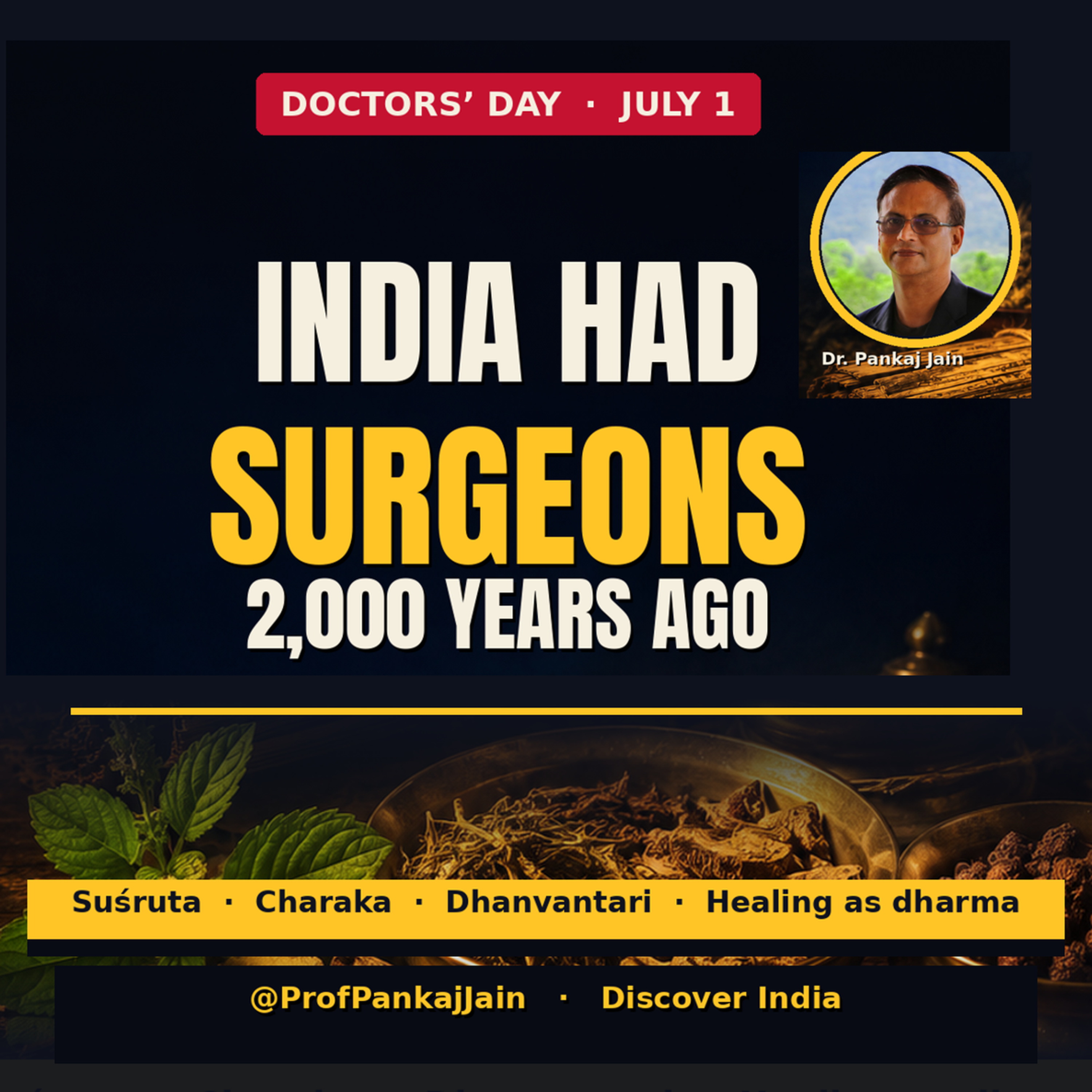
India Had Surgeons 2,000 Years Ago — The Roots of Doctors' Day #Shorts
3w ago00:00:50Tap to summarizeJuly 1 is India's National Doctors' Day — marked on the anniversary of Dr. B.C. Roy, Mahatma Gandhi's physician. But India's story of healing runs far deeper.In this short reflection: Dhanvantari, venerated as the divine physician; Suśruta, whose Saṃhitā describes surgery; and Charaka, who bound the physician to an oath of compassion centuries before the modern one. Here, medicine was never just a technique — it was seva, it was dharma.A note on framing: this honors the ethic and lineage of healing, not a claim of medical efficacy; the dating of these figures is debated by scholars.— Prof. Pankaj Jain · Discover India: Bhārat Darśana
Transcribe →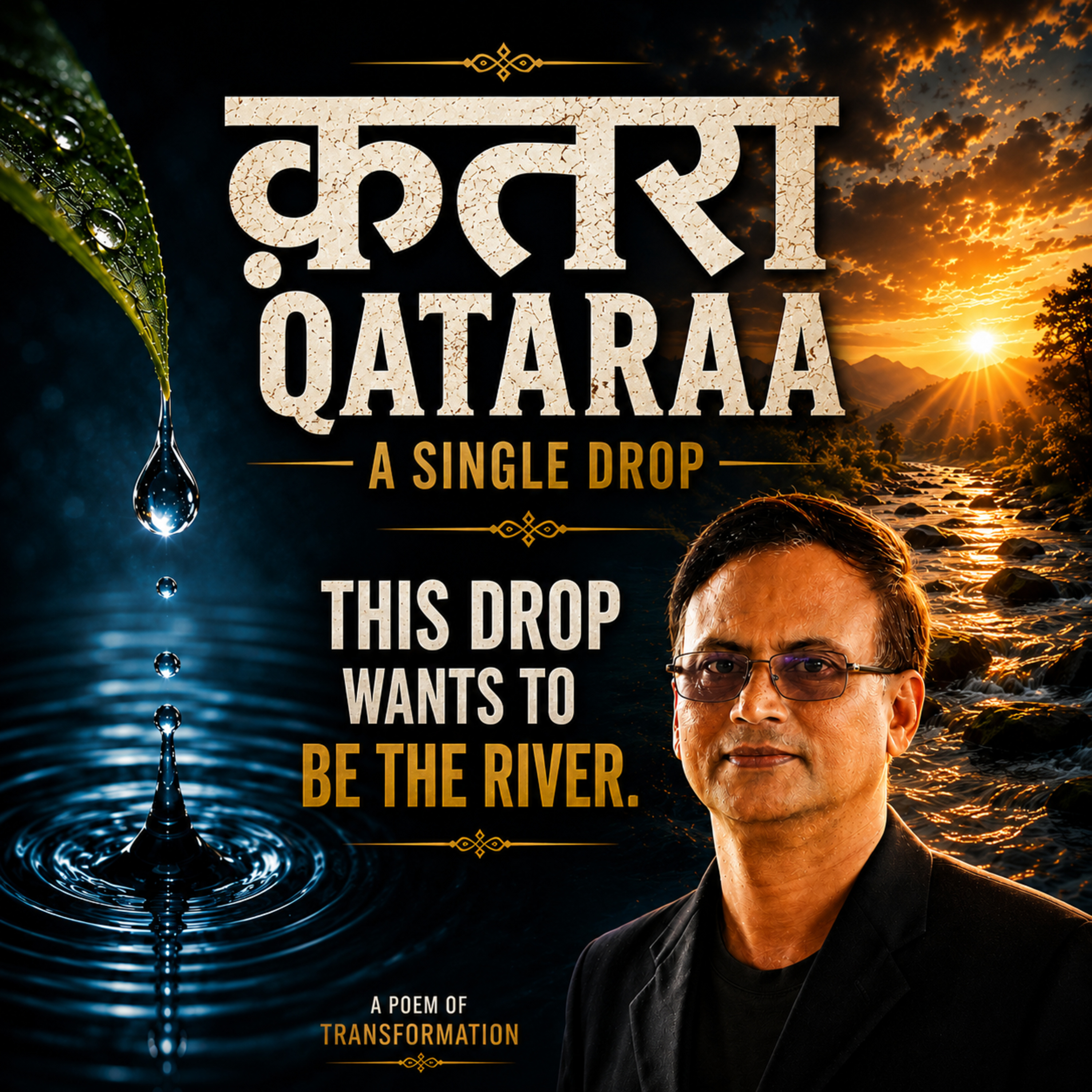
Qataraa — A Single Drop That Wants to Be the River | #ProfPankajKavita
3w ago00:00:48Tap to summarizeA single drop refused to stay a drop.Qataraa (क़तरा) is an original Urdu poem by Prof. Pankaj Jain, written in conversation with Gulzar's "Qatra Qatra" from the film Ijaazat (1987). Where the classic savors love arriving slowly — drop by patient drop — this poem answers back: a drop not content to be sipped, but burning to become the whole river."Qismat se mila hai ek qataraa-e-shabnam,ise gahare dariya mein tabdeel karna hai…"(Fate gave me a single dewdrop — and I mean to turn it into a deep river.)From there, the verse keeps reaching — a lone flower out to scent the whole garden, one star to light an entire sky, a small lamp set against all the world's dark. The infinite, carried inside something tiny.Part of #ProfPankajKavita — original poems in conversation with the tradition, from the Bollywood lyricists to the Bhakti-Sufi root.Written and recited by Prof. Pankaj Jain.Anchor work: "Katra Katra," Gulzar / Ijaazat (1987).Follow for more: Instagram @profpankajjain · YouTube "Discover India with Professor Pankaj Jain"
Transcribe →
Bengal's Egg War: What "Sattvik" Really Means
4w ago00:01:41Tap to summarizeA boiled egg has become a political flashpoint in Bengal — they're calling it "Dimocracy." But the word at the center of it, sattvik, isn't political at all. In this short decode, I trace the origins of the idea of "pure" food: the Bhagavad Gita's threefold classification of food (sāttvika, rājasika, tāmasika) and the Chandogya Upanishad's striking claim that "the mind is made of food." The deeper you go, the clearer it gets — this isn't Hindu tradition versus Bengali culture. It's one Hindu tradition in disagreement with another, as it has been for two thousand years.A note: this episode explains the tradition behind the headlines. It doesn't endorse or oppose any government policy or party, and it doesn't adjudicate the (genuinely contested) science of nutrition.Sources: Bhagavad Gita 17.8–10; Chandogya Upanishad 6.5.4.I'm Dr. Pankaj Jain — professor and Indologist. Follow Discover India: Bhārat Darśan for accessible, rigorous takes on India's living traditions. 📷 Instagram: @ProfPankajJain
Transcribe →🌾 मिट्टी और सोना · MITTI AUR SONA — "Soil and Gold"
4w ago00:01:38Tap to summarize🌾 मिट्टी और सोना · MITTI AUR SONA — "Soil and Gold"I had just landed in America. At a party, an NRI stood and recited a poem mocking India. I said nothing that night — I went home and wrote this instead. Nearly thirty years on, it's still the poem I love most.My homeland lives in the memory of its soil; this new land is known by the shine of its gold… That land is the wellspring of every tongue, every faith, every learning; even this land is but a token of our search for that motherland.That last line hides 500 years of history. Stay till the end. 👇#MittiAurSona #मिट्टी #HindiKavita #HindiPoetry #NRI #DesiDiaspora #Watan #भारत #SpokenWord #poetryreels #DiscoverIndia #ProfPankajJain #Kavita #Columbus #motherlandThat last line isn't a metaphor. Columbus sailed west in search of India — and called the people he found "Indians." Five centuries later, the name still holds. This whole land is a footnote to the search for the motherland. 🌍Save this one if it stayed with you.
Transcribe →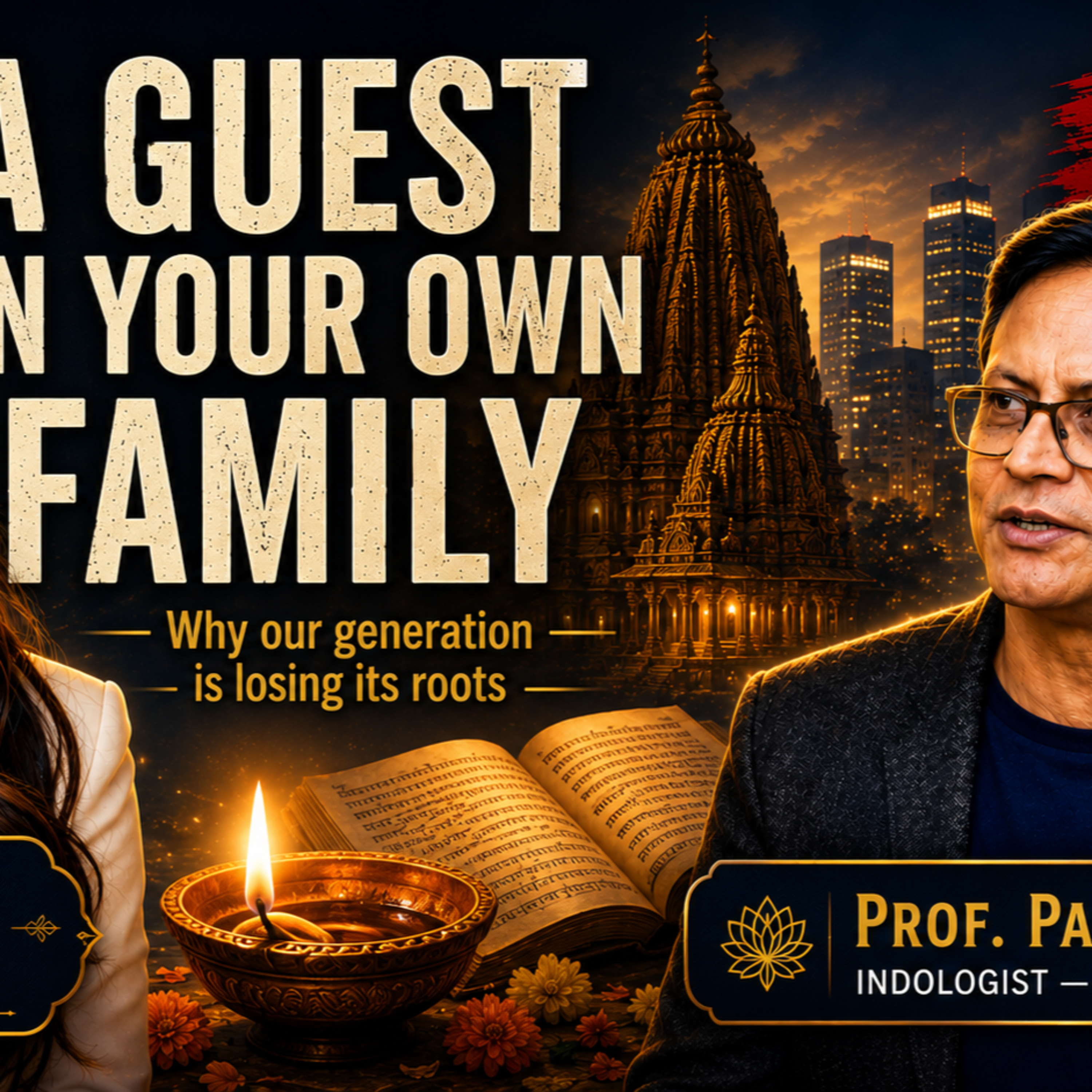
Finding Your Roots: Prof. Pankaj Jain on Dharma and Identity (Part 1)
Jun 2100:29:48Tap to summarizeWhat happens to a generation that does yoga and celebrates Diwali — but couldn't tell you what the Gita actually says?In Part 1 of this conversation, Indologist Prof. Pankaj Jain sits down with Shailee Prajapati to talk about reconnection: his own leap from a computer science career into the study of Indian traditions, why so many second-generation Indians come to feel like "a guest in their own family," what we tend to abandon first, and where the journey back to our roots actually begins.A warm, honest conversation for anyone raised between two worlds.🎙️ Interviewed by Shailee Prajapati — watch the full version and subscribe to her channel: https://www.youtube.com/@UCkFjeG8R5vZ0BQwi4nZqqqw 📺 Part 2 coming soon.🎧 Video version on the Discover India podcast https://youtu.be/XTMsa15veAE⏱️ CHAPTERS (Part 1)— Introduction — From IT to Indian traditions: the pivot, and the pressure we all face00:00 — Where reconnection actually begins — What the second generation abandons first — and the cost they don't see until later— Dharma and identity: stop asking who you are, start asking what's yours to do📖 ABOUTProf. Pankaj Jain is an Indologist and scholar of Indian religions and environmental ethics, and the host of Discover India: Bhārat Darśan.🔗 ConnectYouTube: @ProfPankajJainSpotify: https://open.spotify.com/show/5jSL5qrjKmgYHQhMGLUdJ2Instagram: @ProfPankajJain#BhagavadGita #IndianPhilosophy #Diaspora #Dharma #Hinduism #NRI #DiscoverIndia #PankajJain #Spirituality #SecondGeneration
Transcribe →Ardhanarishvara in 75 Seconds
Jun 2100:00:52Tap to summarizeArdhanarishvara is more than devotional imagery. It is a sculpted metaphysical thesis on the unity of consciousness and energy. This short explores the philosophical depth of Shiva–Shakti integration within Hindu thought and non-dual traditions.Indian iconography as ontology. Dharma as intellectual civilization.#InternationalYogaDay #Ardhanarishvara #ShivaShakti #HinduPhilosophy #SanatanaDharma #IndianWisdom #WomensDay #IndianCulture
Transcribe →अग्नि · Agni, in homage to Dr. Harivansh Rai Bachchan's Agneepath
Jun 2000:00:46Tap to summarizeStarting a new series — my original Hindi & Urdu poems, each in conversation with the voices that shaped me. 🔥First up: अग्नि · Agni, in homage to Dr. Harivansh Rai Bachchan's Agneepath.बरसों पहले बच्चन जी की "अग्निपथ" ने राह दिखाई थी। यह मेरी अपनी "अग्नि" है — उन्हीं ज्वालाओं को नमन।From the land of fire I come, on the path of fire I walk. I am the child of fire-born warriors, the decree borne in fiery scrolls. My resolves are struck from fire's own sparks; my vows, steel tempered in flame. Like fire, the road of life rises ever upward — the mind a mass of blazing light, the body drenched in the sweat of toil.कौन सी पंक्ति ने आपके भीतर की आग को छू लिया? 👇#Agni #अग्निपथ #Agneepath #HarivanshRaiBachchan #बच्चन
Transcribe →