← DR. GUNDRY PODCAST: GUT HEALTH, WEIGHT LOSS, AND NUTRITION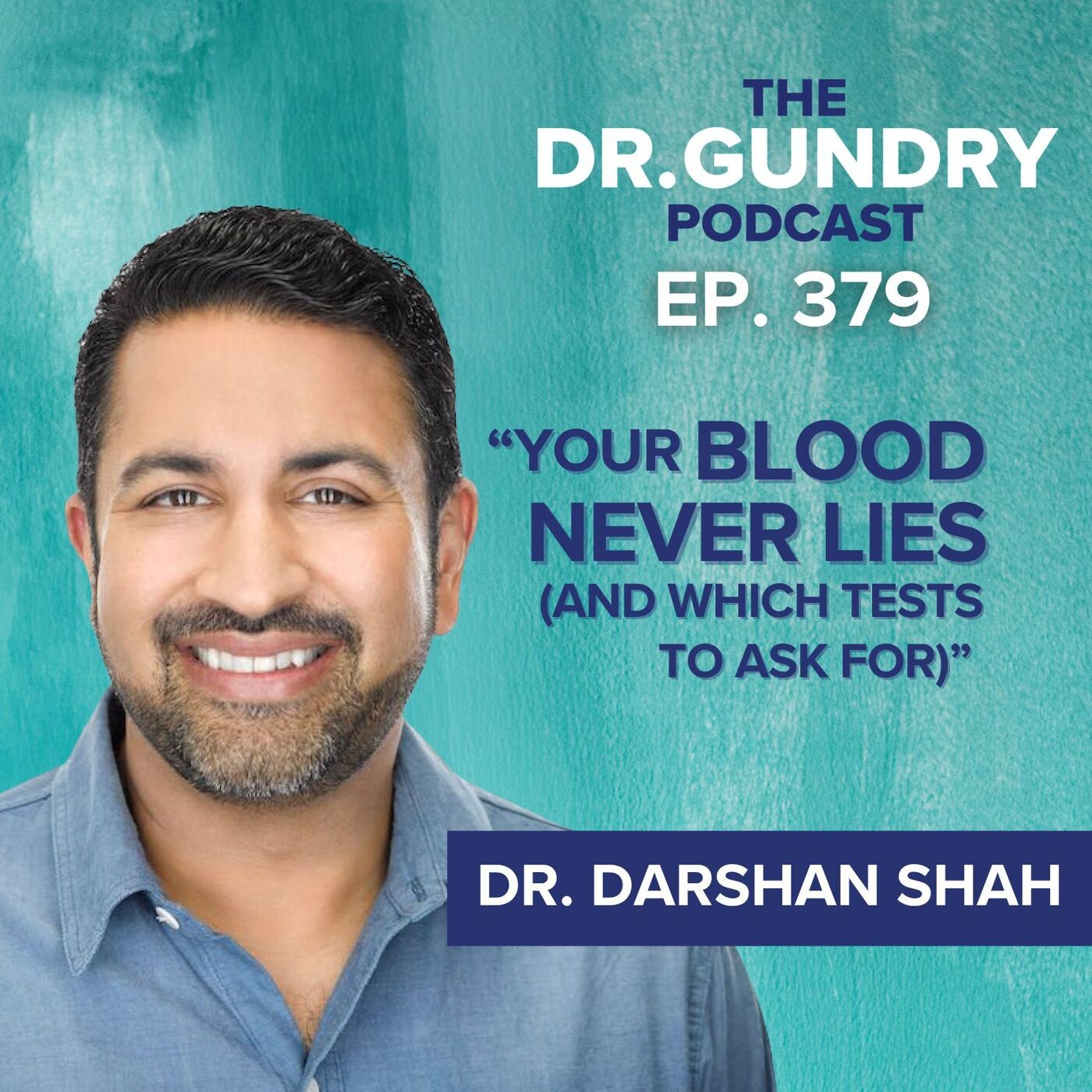
DR. GUNDRY PODCAST: GUT HEALTH, WEIGHT LOSS, AND NUTRITION
7 Blood Tests You Need to Catch Disease Early, According to Dr. Darshan Shah | EP 379
00:44:03
Loading summary
Transcript125 lines
- [00:00]
Ross Brand Voice
Every holiday shopper's got a list. But Ross shoppers? You've got a mission like a gift run that turns into a disco, snow globe, throw pillows and PJs for the whole family. Dog included. At Ross Holiday Magic isn't about spending more, it's about giving more for less. Ross, work your magic.
- [00:17]
App Store Game Night Announcer
All the games you loved growing up are on the App Store looking to spark some friendly competition with friends and family. No matter where you're at, turn your phone into the ultimate game night. You can bankrupt your brother in Monopoly, go shout out hilarious clues to family and heads up. Challenge your best friend to a game of Uno, or get on a lucky streak in Yahtzee with Buddy Stice. Discover tons of classics you already love. It's all the laughter and connection of game night right in the palm of your hand. So what are you waiting for? Relive the games you grew up with. Now on iPhone. Search for your favorites on the App Store and let the games begin.
- [00:58]
Dr. Steven Gundry (Podcast Intro)
Welcome to the Dr. Gundry podcast where Dr. Steven Gundry shares his groundbreaking research from over 25 years of treating patients with diet and lifestyle changes alone. Dr. Gundry and other wellness experts offer inspiring stories, the latest scientific advancements and practical tips to empower you to take control of your health and live a long, happy life.
- [01:22]
Dr. Steven Gundry
Welcome to the Dr. Gundry podcast. Well today I'm joined by Dr. Darshan Shah, board certified surgeon, long longevity medicine expert and co founder CEO of Next Health, a fast growing health optimization clinic. Dr. Shah finished medical school at 21, trained at the Mayo Clinic, later earned his Harvard MBA degree and has helped thousands extend their health span. He also hosts Xtend, a top five.
- [01:50]
Podcast Sponsor/Ad Voice
Apple charting podcast with 25K monthly listeners.
- [01:53]
Dr. Steven Gundry
Now we'll dig into his XTEND Biomarkers.
- [01:57]
Podcast Sponsor/Ad Voice
Guide, what to test, how often and.
- [01:59]
Dr. Steven Gundry
How to act on results and the overlooked role of toxins in aging.
- [02:05]
Podcast Sponsor/Ad Voice
You know, these days there's a subscription for just about everything. But what if you could roll all those into one and actually save money? That's exactly what I do with Thrive Market. Thrive is my one stop shop for high quality grocery staples, non toxic cleaning supplies, everyday supplements, skin care and so much more. Instead of bouncing between stores or websites.
- [02:25]
Dr. Steven Gundry
I can get everything I need in.
- [02:26]
Podcast Sponsor/Ad Voice
One place and it's all carefully curated for healthy living. And here's the best part. Thrive Market members save up to 30% off top health brands and it's all delivered straight to your door. No lines, no hassle, just smart healthy shopping.
- [02:40]
Dr. Steven Gundry
So here's the deal.
- [02:41]
Podcast Sponsor/Ad Voice
When you join Thrive market today, you'll get $80 in free groceries. Just go to thrivemarket.com gundrypodcast that's thrivemarket.com gundryPodcast.
- [02:55]
Dr. Steven Gundry
So, Dr. Shaw, welcome.
- [02:57]
Dr. Darshan Shah
Well, I'm so honored to be here. Dr. Gundry, thank you for having me.
- [03:00]
Dr. Steven Gundry
And it's great to see you again. You know, you created the Biomarke Extend guide, so what problem were you trying to solve for patients and clinicians?
- [03:12]
Dr. Darshan Shah
So, you know, I think the biggest problem that I see with a lot of my patients, and you would agree with this, is that people just wait until they have a disease before they see a doctor. And then by then it's pharmaceuticals, it's surgery, it gets really complicated, really expensive. But the reality is if you take a look under the hood of someone's health, and by that I mean looking at their blood test results, you can spot these diseases 10, 20, 30 years before they actually become a problem. And there's thousands of blood tests out there, but I really believe there's about 10 to 15 critical biomarkers that everyone needs to know, number one, what they are, how to optimize them, and what the optimal number is. And I think that once you know those 10 or 15 for yourself, you can spot disease first of all, decades before it happens. But also you start changing your routines, your day to day habits so that you avoid disease completely in the first place. And the side effect of avoiding disease is you start feeling great too. So I just try to arm my patients with, look, I'm your doctor, I'm going to be looking at these anyway with you. But there's no one that's going to care more about your health than you. And so once you understand what these markers are, you can make adjustments yourself. And I call that concept becoming the CEO of your own health. You know, as a person that owns a business, many people are running businesses and they are looking at numbers every day. You see what your revenue is, you see what your profit is. You should be doing that for your health. You should know what the numbers, the key performance indicators of your health are so that you can make adjustments a lot sooner before you go into bankruptcy and disease. Right?
- [04:48]
Dr. Steven Gundry
No, that's a good point. I tell my patients, look, this is the only house that you're ever going to live in. And if we spent as much effort on taking care of this house as we do in our domicile, our law and our cars, then imagine the effort you would actually put in realizing this is it. That's all you get. So yeah. CEO of your own.
- [05:15]
Dr. Darshan Shah
CEO of your own health. Right.
- [05:16]
Podcast Sponsor/Ad Voice
I like that. I like that a lot.
- [05:18]
Dr. Steven Gundry
The concept of Next Health. And you're expanding all over the country. In fact, you just opened an office in Montecito very near.
- [05:26]
Podcast Sponsor/Ad Voice
Very near me.
- [05:27]
Dr. Steven Gundry
Yeah. How are you accomplishing that with next? Walk us through the process.
- [05:33]
Dr. Darshan Shah
Yeah. So when someone comes to Next Health, usually they've one or two people. Either, number one, they've gone to a regular doctor and they are having all these symptoms and they don't know what's causing it. And the traditional medical establishment has told them, well, everything's checking out okay, so we don't know what it is. Or number two, we see a lot of patients that they go to their doctor once a year, or maybe they don't even go to a doctor once a year because they know what they're going to get. They're going to be told, everything's fine, come back and see me when you're sick. And they know there's much more than that out there for them. And so what we have is a membership program where for a year you get to see our doctors and our practitioners at all of our locations. And you get armed with a quarterly blood test. Now, I know this is what you do in your practice as well. I really believe that quarterly testing is critical to understanding what's going on inside your biology, to learning about your biology, and also to make changes soon enough so you don't get into where there's a problem. Right. And so that's what you get. And you also get access to our locations where we have really cool therapeutics like hot cold contrast therapy, hyperbaric oxygen, and we even do some advanced things like IV therapies, plasma exchange, stem cells. You have access to all of that at our locations. But really, the core fundamental philosophy is health is not a once a year visit. Health is a routine, a habit that occurs daily, monthly, quarterly. And we can enable people to make health a habit at our next Health locations.
- [07:00]
Dr. Steven Gundry
So for most of our listeners, what are they missing with their regular doctor blood work? I think you and I both know, but I want to hear it from you first. What are you looking for that people are missing?
- [07:12]
Dr. Darshan Shah
Many doctors credit. They are checking for more things. I'm actually surprised now when people come in with their blood work, they actually have a vitamin D level on. And finally, after decades. Exactly. Like, who would have thought, right? But still, there's a lot missing in regular Western medicine. Blood work, I would say hormone levels are missing for sure. I would say that inflammatory markers are not checked unless there's a major problem going on. They are getting some biomarkers of metabolic disease checked now because, you know, metabolic disease affects 90% of Americans, unfortunately right now. But normally it's just like a hemoglobin A1C, which is a three month average of your blood sugar level that doesn't change until you're, you've developed metabolic disease for about 10, 15 years. And so we like to check fasting serum insulin, which is one of the first biomarkers that change when you're developing metabolic disease. So those are some kind of the major categories. We're also checking homocysteine levels, which is being missed a lot of times with traditional blood work. And then we're doing deeper cardiovascular assessments with markers like lpob. We're also checking particle sizes with cholesterol as well. So we go a lot deeper. And I think you don't want to wait until you have a problem before you do deep analysis. You know, blood testing now is becoming cheaper and cheaper, is becoming more and more ubiquitous, more and more available to people. We have the ability to do these markers way sooner before you get a disease.
- [08:36]
Dr. Steven Gundry
I get the opportunity to having a third year family practice. Residents rotate through my clinic in Palm Springs for a month. So these are guys who are about to go into practice. This is their final year. And what's amazed me is that not one of them to this day and age has ever been told to measure a fasting insulin level. They're going out into practice. They've never heard of looking at insulin resistance like measuring a homa ir. They've never actually been taught to look for oxidized LDL or oxidized fossil lipid apple B, which is my favorite. They're unaware of this. Plus, you and I both know Mark Hyman and Mark, now his daughter is a 4th year medical student at a very prestigious university and, and she has not had a course in the microbiome.
- [09:29]
Dr. Darshan Shah
I mean, this is so incredible to me that medical schools still are just not catching up to the modern science. And so these are doctors are going to be out there practicing 30 to 40 years and if you don't even hear about these concepts like the microbiome, oxidized LDL, etc. You're not going to go out there and learn about it. You haven't even heard about it. Right. And so it's a big problem.
- [09:50]
Dr. Steven Gundry
In fairness to them, they don't have the time the way our medical system is set up, because a lot of These, these young people will go back after being in my clinic for a month and go, oh my gosh, this is what I went into medicine to do. Oh my gosh, this is what I want to do. And their counselor says, well, good luck with that. I'm sorry. You've got $300,000 in medical school bills and you're going to have to see 40 patients a day for seven minutes each to break even. And you can't sit there and do an in depth history and physical and look at blood work for an hour. Are you craz? And they're right with the current system.
- [10:33]
Dr. Darshan Shah
That's why it's my contention, that's why we started Next Health. Really, Because I really believe that, you know, this is a trillion dollar system that we've created to diagnose disease and take care of people that are really sick. Right. So, I mean, thank God we have this western medical system. You get hit by a bus or you get diagnosed with stage four cancer, you need a bypass surgery, you know, thank God a valve replaced. We made that system for that. But it really was never built to reverse chronic disease or to diagnose problems early, earlier than when it actually becomes an issue. Right. And so my whole philosophy around creating Next Health was we need a new system. Let's stop trying to fix this broken system that is not made for these types of problems. And the Next Health Clinic concept is really this new system that's centered around functional medicine, hyper preventative medicine, I call it as well, centered around lifestyle medicine. You know, doctors, even though we're taught in medical school that lifestyle is a, is one of the major, you know, reasonable disease, we're not even taught how to fix. Listen, there's like zero nutrition education. So the four core pillars of Next Health are lifestyle medicine, functional medicine, hyper preventative medicine, and longevity medicine, I call it. And that's where we kind of focus our efforts for people.
- [11:46]
Dr. Steven Gundry
That's exactly what I do. I call what I do restorative medicine.
- [11:49]
Dr. Darshan Shah
There you go.
- [11:50]
Dr. Steven Gundry
Yeah. Because the nice thing is that the body does have great ability to restore all these systems back to normal. It takes some work, but first of all, you got to figure out what's broken. The great news is that we now do have the tools to find out what's broken really at a microbiome level, at a gut level, at a vascular level, and particularly with like every three months, people can learn to fine tune and say, let's see what happens to this marker when we do X, Y and Z. So do your practitioners Then say, okay, here's what we got, and then go away, goodbye, good luck, or how do you fix it?
- [12:39]
Dr. Darshan Shah
The reason we have members is because we really believe that we need to see our patients more than just once in a while. Right. And so we are constantly working on what we put together for them called the health optimization plan. And every week we have our patients coming into our offices. We have beautiful offices that people love to come into. They can come talk to their practitioners whenever they want. They have full access to nutritionist, they have full access to health coaches. And we are really trying to move the needle for our patients. And we believe that's going to take more than one visit a year. Right. And so we really try to arm them with information, we give them a ton of information. We also have a ton of therapeutics that we can use at Next Health that people can utilize at any time during their membership as well. And then every quarter there's a sit down visit with our medical practitioner, just do a once again, another biomarker check and a review and a sit down to really start making changes.
- [13:30]
Dr. Steven Gundry
Let's suppose that like 90 plus percent of people, you find metabolic derangement as one of the underlying problems. Where do you go from there? Do you then look at the gut? Do you then look at their eating habits? Do you look at their exercise program or walk us through the steps?
- [13:51]
Dr. Darshan Shah
Yes, we do all of it. So at every location I have a infographic that I've created that we put on the wall and I just showed it to you when we were downstairs. It's called the Wellness Wheel. And so those four pill of medicine, we have 12 aspects of health that we focus on in each one of those pillars. So there's 12 different aspects of health and there's four pillars. So there's three aspects per pillar, basically. And so for lifestyle medicine, that includes nutrition, exercise and movement, overall movement and sleep and recovery. So we first start there and see what they're doing and put into place routines and habits and fixes in those three major buckets. And that kind of forms the base of the pyramid because we know without getting your lifestyle in order, you're not going to be able to make major changes. Now, what's important about metabolic disease, it's a great example because it really hits every pillar of medicine. Not only do you need to get your diet right and we give you a continuous glucose monitor to see how you're handling sugar intake and carbohydrate intake, but metabolic disease has a lot to do with sleep and Recovery has a lot to do with how much you're moving every day. So you have to fix all of those categories to really make a difference. Then we move on to functional medicine and to me that includes stress and emotional management, hormones, gut health as well, and toxin exposure. And so we really take people down. The evaluation of gut hormones, toxins and stress and emotional health. And then once we got all that as the next layer of the pyramid, then we move into hyper preventative. Because if you have metabolic disease, you are also at risk for cardiovascular disease, Alzheimer's disease and even cancer. And so when I say hyper preventive medicine, we talk about not just how to fix the problems that are causing cardiovascular disease, neurodegenerative disease and cancer, but also how to detect early. And so doing tests like the Grail test for cancer Biomarkers, full body MRIs, clearly scans for the heart, we're really trying to catch things early when we can still make a change. And then lastly, once we have all of that addressed, then we can talk about some of the advanced therapeutics and longevity medicine, things like peptides, stem cells, exosomes, plasma exchange, and we bring that in last as kind of like the icing on the cake. Once you have everything else organized.
- [16:01]
Dr. Steven Gundry
The cherry on top.
- [16:02]
Dr. Darshan Shah
Exactly. With the cherry on top, do most.
- [16:04]
Dr. Steven Gundry
People need the hyper wellness stuff or is there a bottom line where most people can do well without the cherry on top?
- [16:17]
Dr. Darshan Shah
Yeah, I think what you're trying to ask in a nice way is how many people are coming in just wanting a peptide to cure the problem?
- [16:23]
Dr. Steven Gundry
I guess that's my question exactly.
- [16:25]
Dr. Darshan Shah
Well, I could tell you about 80% of people think that there's a quick, easy fix, right? And so they're like, give me the peptide protocol, give me the plasma exchange. It's going to fix everything. And we always have to have the discussion with them that, look, if you start there, you're going to be wasting not just your time, but also a lot of money because that stuff costs money and you're wasting it. Either you're going to get no effect or you're going to minimize the effect of what we're doing. You know, there's a really great example going back to metabolic disease with GLP1s, right? We have so many people on GLP1s now and GLP1s have gotten a little bit of a bad rap. And the reason is, is because people are just given GLP1s with no lifestyle modifications. If you combine lifestyle modification with GLP1s, it's fantastic because you can build skeletal muscle, you can reverse metabolic disease and once you get off the GLP ones because I don't believe these are lifetime drugs for people, then you have reformed your relationship with food and you've changed your habits so you won't gain the weight back and it's and you've fixed your gut to your point. You know, I think if you come at it with an upside down mentality, you're gonna fail with peptides and what with with all these advanced longevity therapeutics. But if you start from the bottom up, it can be extremely successful.
- [17:40]
Podcast Sponsor/Ad Voice
Let's be honest, most holiday gifts are forgettable. But comfort, real physical, instant comfort. That's something people remember and actually end up using. And that's exactly why I keep going back to Cozy Earth for people on my holiday gift list. Their Vico from Bamboo pajama set feels like nothing else. Lightweight, cool and perfectly soft. The kind of fabric that makes you wonder why you ever settled for anything less. And their Bubble Cuddle blanket. It's not just warm, it's indulgent. The texture, the plushness, the weight turns any room into a retreat. And here's what I love. Cozy Earth stands behind every stitch. You get a 100 night sleep trial and a 10 year warranty because true comfort should last. Right now, Black Friday has already started. You can stack my Code Gundry on top of their site wide sale for up to 40% off. Just go to cozyearth.com and use code Gundry before these deals disappear. This episode of the Dr. Gundry podcast is brought to you by Progressive Insurance. Do you ever think about switching insurance companies to see if you could save some cash? Progressive makes it easy. Just drop in some details about yourself and see if you're eligible to save money when you bundle your home and auto policies. The process only takes minutes and it could mean hundreds more in your pocket. Visit progressive.com after this episode to see if you could save Progressive Casualty insurance companies and affiliates. Potential savings will vary. Not available in all states.
- [19:15]
Dr. Steven Gundry
I love the way you put that because I, you know, I I don't do the hyper stuff in my clinics. Jimmy Buffet used to have a song that a tattoo was a permanent reminder of a temporary feeling. And I tell my patients who want to start with the top stuff that that's going to be a temporary fix that isn't going to address the permanent problem.
- [19:45]
Dr. Darshan Shah
Exactly.
- [19:46]
Dr. Steven Gundry
And I'm to going glad to hear you say that because an infusion of whatever may give you a wonderful feeling for a few minutes, but it's not going to change the underlying process unless you address that.
- [19:59]
Dr. Darshan Shah
It all has to be done simultaneously, and not even simultaneously starting with the foundation and working up. And then even if you do make it to the top of the pyramid, you have to simultaneously be making sure everything else stays well. Right.
- [20:13]
Dr. Steven Gundry
Since I run a supplement company, a lot of people through the years have said, well, I'll just take a bunch of supplements and that'll solve the problem. They're called supplements for a reason. They supplement what you're doing with your lifestyle and diet. Believe me, I used to think supplements made expensive urine, and they don't. I mean, we can see it with these tracking. We can watch homocysteine, for instance, and someone will be. Is a, you know, an MTHFR mutation, a mother effrogen. And we've got them on methyl B12 and methylfolate. Their homocysteines, you know, go down, and then three months later, I'll see them and their homocysteine's up, and maybe their B12 is down a bit. And I said, you stopped taking your B12? And they go, no, I didn't. And I said, yeah, you did. Look, your homocysteine's up, your B12's down. This is a true story. The guy said, yeah, I take it every day. And I said, you put it under your tongue, right? And he said, no, no, no, it's so sweet, I sweeten my coffee with it. And so I said, well, you can't do that because a lot of people don't have intrinsic factor to absorb B12. They swallow it. I said, put it under your tongue. I'll see you in three months. And of course, when he came back, B12 was up, the homocysteine was down. But if you didn't measure those things, you would never know. And if I. I didn't say, hey, you're not taking that. Yes, I am, but you're not taking it the right way. And that's, you know, that's personalized medicine.
- [21:42]
Dr. Darshan Shah
I guess that is. Absolutely. Yeah. And it highlights also how important it is to keep measuring. For physicians and practitioners that are listening to this, and also for patients that are listening to this, you can spot a problem so much sooner if you measure right.
- [21:57]
Dr. Steven Gundry
And, you know, and a lot of people, I think all of us fall into that trap, okay, I've got everything fixed now, and I got everything right where I want it. And then something falls off and you don't catch it. I'll have people who have homes in various places or go on extended vacations and they'll either, for instance, not take as many supplements or their lifestyle changes while they're on vacation. I'll have a lot of patients purposely either schedule their blood work right before major holidays, but preferably schedule it a few weeks after major holidays. And they're so shocked with what the major holidays that are coming up right now does to them. And the next time they go, geez, I'm going to work because I don't want to show up like this the next time I get measured. And it's fascinating.
- [23:00]
Dr. Darshan Shah
It really is. It's so funny you mentioned that, because being in la, we have patients like in Hollywood, right. And they know when there's going to be a big Grammys party or something. And they're like, I want to make sure I get my blood work done the day before the Grammys, because I know after it's not going to be.
- [23:17]
Dr. Steven Gundry
It'S going to be ugly.
- [23:19]
Dr. Darshan Shah
And that's actually a good thing. I think now people are realizing that the blood work does show what's going on in your biology. And so the reason we're measuring it is to see what your lifestyle changes are doing to your blood work. And that's something brand new, like, not this has just happened in the last five years. I know you've been doing it this way for decades, but I really have seen a mindset shift in our patients at NEXL in the last five years.
- [23:43]
Dr. Steven Gundry
It's fascinating that people, once they get scorecards, and I even, believe it or not, I have gold stars and silver stars in my clinics and I'll give them a gold star for, you know, an insulin of 2 or oh my R. Less than 1. And they love it. And you know, some of them say, put it right on my forehead. You know, I want to walk out with my, with my gold star. And so we're, we're motivated that way.
- [24:11]
Dr. Darshan Shah
Right.
- [24:12]
Dr. Steven Gundry
And they really do want to say, how do I get this there? What's the next step? What's the next health step?
- [24:20]
Dr. Darshan Shah
Right. I think for decades, doctors have been gatekeeping this information to some degree. Right. And it's really great to see people have more access and more knowledge around their blood work now too.
- [24:33]
Dr. Steven Gundry
So what do you do? And maybe you're not seeing that patient because this is a membership. What do you do, particularly with the guy who, the wife drags the guy to you and basically says, fix him. How do you motivate this person?
- [24:50]
Dr. Darshan Shah
I see that a lot, actually, believe it or not. And, and the way I motivate the. Let's just say we have executives that come here all the time. Their wives usually bring them in, push them in. You and I do a lot of speaking engagements and it's always a wife nudging the husband. Like I told you, I told you, men love data. And when you show them the data in their blood work and give them the numbers they need to focus on, then I find that there's a shift because for whatever reason, there's a little bit of a competitive mentality, I think sometimes with I want to get, get things optimized. I don't want to be here. I want to be here like I want to. It's a scorecard, like you said earlier. And so for me, just getting that blood panel on them and showing them what it means has been a game changer for many men. I just had a conversation two days ago actually where I went over some blood test results of a long term member of ours that let things slip, you know, over summer vacation, to your point. And his hemoglobin A1C was 5.8 and his HSCRP was 2.5. And he's like, oh, I got some work to do. I'm glad I checked. I actually put together, you know, a lot of people don't have access to some of this blood test through your practice or through Next Health. And so I put together a guide to the most critical biomarkers at my website, drshaw.com biomarkers people can get a guide to the top 20 biomarkers. Now, to be clear, there's 15 of them. If so are blood work that any doctor should get for you. Just bring the guy to your doctor's office and say, these are the ones that I want you to do for me. If they don't do it, you can get them online on your own. You know, our friend Dr. Hyman has function Health. You can get them. We do them at Next Health. And even if you go into a quest, they'll get them for you. And then there's four or five other ones that I really like. I like for people to get a scale that can give you your skeletal muscle mass and your fat mass. I don't care what your weight is, but I do want to know what your skeletal muscle mass is. And do you check the grip dynamometer on people, their grip strength?
- [26:45]
Dr. Steven Gundry
We used to and we stopped because they didn't like it. But we do use a scale that gives the whole fat percentage and muscle percentage.
- [26:54]
Dr. Darshan Shah
Yeah, yeah. I find people are very Surprised with lack of strength. It's really incredible that people don't.
- [27:01]
Dr. Steven Gundry
Yeah, they hate it.
- [27:02]
Dr. Darshan Shah
People hate it, right? It's almost like they get called out of their workout routine. But you know, I think it's important to know if your grip strength, which is a marker of upper body strength is low. You need to start hitting the weights. You know, we know muscle mass is so important not just for staying strong and maintaining mobility, but muscle is where your metabolism lives. People have poor metabolic health because they're under muscled.
- [27:23]
Dr. Steven Gundry
Oh yeah, absolutely. And one of the things that shouldn't have surprised me, but it doesn't surprise me now, people talk about sarcopenia. Well, it turns out that sarcopenia is driven by leaky gut. Hippocrates was right, all disease begins in the gut. One of the things that Valter Longo and I, who said, head of longevity at usc, we've become good friends. He, I guess myself and Christopher Gardner at Stanford are kind of the lone voices that we are over proteinized in this country. We eat too much protein. He used to say that. Well, yes, that's true, but when you turn 65, your protein needs go up. And I always kept saying, well that's funny because I actually cut protein in my patients who are or older and I repair their gut and lo and behold, their total proteins go up and their albumins go up. How's that? It's because our gut surface area is at least a tennis court, probably two tennis courts. As we age, as we damage our gut, we now have a ping pong table of absorptive area. So if you repair the wall of the gut and stop leaky gut, all of a sudden you'll absorb that, that little bit of protein that you need. And the last time I saw him, I said, you know, I learned so much from you every time I see you. He says, well, I've learned something from you. He's like, oh, come on. He says, we're now coming out with a lectin free version of our anti inflammatory prolong.
- [28:55]
Dr. Darshan Shah
Oh, amazing. Oh, that's fantastic. Yeah, I had Dr. Long on the podcast too. I do the Prolon every quarter. Once a quarter I do it. It's this fasting, mimicking diet and it's such a game changer for me and my patients and I found it actually helps to heal the gut too.
- [29:11]
Dr. Steven Gundry
Right? Yeah, absolutely. You gotta rest your gut, you know, that's a good point you brought up. We know now how important sleep is and we know that nobody can go without sleep. You really have to have deep sleep where you do the brain cleaning, and that's now a given. But what we don't think is that normally our gut should have a period of rest.
- [29:38]
Dr. Darshan Shah
That's true as well.
- [29:39]
Dr. Steven Gundry
Where it does the repair work, it does the cleaning work. And you know, like out of San Diego, we now know that the average American is now eating 16 to 18 hours a day from the second they get up to the minute. They go to bed now. And there's never any time for repair. So I think that's the next frontier we finally figured out. Yeah, sleep's pretty important to repair our brain, and yet we've never approached that. Yeah, you know, maybe our gut needs some rest too.
- [30:15]
Dr. Darshan Shah
Exactly, exactly. You know, one important tie in there too is I see you're wearing an OURA ring. Right.
- [30:21]
Dr. Steven Gundry
And also a whoop band.
- [30:22]
Dr. Darshan Shah
Yes, yes, I wear them both too. But I have my aura ring on too. And we really have all of our patients monitor their sleep. And one of the things I can tell you that is almost 100% of the time is when patients are eating a late dinner, like 8pm, their sleep is horrible. And the minute they go to a 6pm dinner and they don't eat anything after that, they just get their deep sleep into an hour plus range. And it's one of the biggest changes that we've made for people is just bringing their dinner time a little earlier. And I think some of that has to do with, with obviously the gut gets some time to rest, so the brain doesn't need to be active during that time. And you can get some rest up here too, right?
- [30:59]
Dr. Steven Gundry
Well, yeah. And the other, I learned this from my mother long ago. We were told that we couldn't go swimming for an hour after we ate lunch because we would get cramps and die. And you and I know that after we eat, digestion takes a lot of blood flow. And so we divert a huge amount of blood flow to our gut during digestion. And so the wives tale was correct, but taken to an extreme. But what Bredesen and I have proposed is the same thing happens with our.
- [31:31]
Podcast Sponsor/Ad Voice
We have to have a lot of.
- [31:32]
Dr. Steven Gundry
Blood flow during deep sleep to produce. To do wash out the toxins, the lymphatic system has to go through a wash cycle. And if you eat close the time you go to bed. And deep sleep usually happens in early stage sleep. If you've eaten all that blood flow, which should be heading up to your brain is down in your gut.
- [31:50]
Dr. Darshan Shah
Exactly.
- [31:51]
Dr. Steven Gundry
And it's exactly the wrong, wrong place for It, Yeah. Since you brought up a whoop band, I wear both for comic relief because they agree on a few things but they totally disagree on sleep.
- [32:05]
Dr. Darshan Shah
They do sometimes, yeah.
- [32:07]
Dr. Steven Gundry
Oh, I believe you today. No, you're pretty good to see day.
- [32:11]
Dr. Darshan Shah
And I sleep on an eight sleep mattress which also does some sleep tracking.
- [32:15]
Dr. Steven Gundry
Oh no.
- [32:16]
Dr. Darshan Shah
I know, it's like different, lots of different data points. So I just try to track overall trends, you know, when sleep.
- [32:22]
Dr. Steven Gundry
For the most part this brings up a good question. Is there a problem with having too much information? Is there a point where seeking out all this information becomes detrimental?
- [32:34]
Dr. Darshan Shah
I think it becomes a problem if you become obsessed with it and it affects your day to day. Right. And so I have a lot of patience patients that they get obsessed with their sleep score and if their sleep score is not over 80, they're bummed for the rest of the day. It actually affects their productivity for the day. And so what we like to do with our patients that are our members is we tell them, look, don't look at the data, don't ever open your aura app until you come and see us here and then we'll look at it with you. And we're just going to go straight to the trends section and we just look at trends and then that gives us all the information we need. I think, you know, the day to day is a little bit too much data for people but I think the trends over weeks and months makes a huge difference and we look at it with them. So, you know, there's some interaction with the health coach and with our doctors, with the patient to understand what is making the big, the big picture changes.
- [33:23]
Podcast Sponsor/Ad Voice
If you followed my work for a while, you know, I'm obsessed with one thing, extending not just lifespan but health span. And one of the most over overlooked organs in the equation is your skeleton. Yes, your bones are a metabolic powerhouse involved in immune function, hormone balance and even communication with your muscles. The problem with our modern sedentary lifestyle, Most of us aren't giving our skeletal system the mechanical input it needs to stay biologically young. And the easiest, safest way I've found to deliver it is the Juvent micro impact platform. This isn't a vibration plate, those high frequency devices that actually harm soft tissues.
- [34:04]
Dr. Steven Gundry
No.
- [34:04]
Podcast Sponsor/Ad Voice
Juvent uses patented NASA informed micro impacts that are gentle, precise and clinically shown to support bone metabolism, circulation and mobility. When I'm in town, I stand on my juvent plate for 10 to 20 minutes a day. Usually while catching up on my emails on my phone or reading a research paper. I've noticed better flexibility and stamina on my hike. Try it out for yourself, just as many patients have and also experience great benefits. Right now you can get $300 off of Juvent.comGendry with code GUNDRY. There's even a six week buyback guarantee, financing options and a 10 year limited warranty included. Head to Juvent.comGendry and use code Gundry. Your longevity plan isn't complete without mechanical nutrition. I love longevity products that actually work and Bon Charge is one of those brands that just gets it. They've created science backed products designed to help you thrive in a modern world that's constantly working against your health, sleep, energy, hormones, you name it. They've thought of devices to help support each of these vital aspects of living well. My current obsession is their red light face mask. I first started using using it because I wanted to support my facial microbiome and tackle a few stubborn fine lines. And now it has become a key part of my nightly routine. Just 10 to 20 minutes a day and I can use it while answering emails or watching tv. It's super lightweight, doesn't get hot, and uses both red and near infrared light to help boost collagen and support skin repair at a deeper level. Plus no EMF radiation, no flicker, and.
- [35:44]
Dr. Steven Gundry
None of that blue infrared green light that can disrupt sleep.
- [35:46]
Podcast Sponsor/Ad Voice
Trust me, other masks don't even come close and it makes a great holiday gift too. Bon Charge ships fast, worldwide, offers easy returns, and yes, these devices are even HSAFSA eligible. Head to boncharge.com and use code GUNDRY to save 15%. That's B O N C H A R G E.com code GUNDRY.
- [36:14]
Dr. Steven Gundry
Before I let you go, I really want to get into toxins since you and I are both interested in that. Since we live in a toxic environment, why should we even start measuring toxins in us? So what?
- [36:30]
Dr. Darshan Shah
Great question. So I think you and I probably use the same urine toxin test from Vibrant. Yes, I love that test because I think that people, once they see the results of that test and they understand what toxins are accumulating in their body, they can start making lifestyle changes that can reduce their exposure. Now, we all live in a toxic environment for sure, but some of us live in a toxic environment that has 95% less toxins than everybody else does. And the way you do that is by understanding where are your exposures. The exposures are invisible, visible. You don't see them, you don't feel them until it's too late. And I really believe that toxic exposure is that kind of fourth leg of the stool of overall health after sleep, nutrition, and exercise. Minimizing toxic exposure is going to become more and more in the forefront of what we do from a lifestyle medicine perspective, I think we need to live a detoxified lifestyle. So toxin testing is helpful. But, you know, I think that it becomes overwhelming for people because to Your point, there's 150,000 toxins in our environment that weren't here 50 years ago. And what I try to tell people is let's use the Pareto principle here. There's literally 20% of the actions that give you 80% of the results as far as detoxifying your life. And I break it down for people into their air, water, food and skin air. I tell them, where do you spend the most time in the day? Usually it's your office where you work, the place where you sleep at night. Night. Get a good quality air purifier for those two areas. Your water. Get a reverse osmosis system installed in your sink at home and in the office. Your food. Don't eat anything in packaging. Definitely don't eat something with a giant ingredient list of, you know, that you can't pronounce half the stuff. And your skin, you know, most of us don't realize it, but every day that we put lotion on our skin, women put their makeup on, we use deodorant, we're lathering our body with toxic. There's so many toxins like endocrine disrupting chemicals and microplastics in all these products. And so scan the products with an app like Yucca or Think Dirty. It'll tell you the toxin level in that product and you can just switch. And I don't know about you, but I haven't switched my soap around that I use in my body for like a decade now, ever since I scanned it and made sure that I found a detoxified version. And now I just use the same skincare products that are all detoxified. And by those simple four or five changes, you can live. 80%. Less toxins than your neighbor does. Is not that hard to do, actually, believe it or not.
- [38:56]
Dr. Steven Gundry
What do you tell your patients who are golfers or live near a golf course?
- [39:00]
Dr. Darshan Shah
It's a tough one because, you know, there's a big study that just came out showing a higher rate of Parkinson's disease for people that live around a golf course.
- [39:07]
Dr. Steven Gundry
Right, yeah, I see that.
- [39:08]
Dr. Darshan Shah
Unfortunately, I think it's time to consider moving to a new environment. You know, I mean, the, the glyphosate and the pesticides they put in the golf course, they're in the air, they leach out into the water systems. They're everywhere. And, you know, we really got to rethink kind of where we're living. And then there's the other thing you can do is talk to the other members of the golfing community and insist on detoxified pesticides. There are lower toxin versions and you can switch to them. And so you can, you can come to them as a group and say, we need you to switch.
- [39:42]
Dr. Steven Gundry
Yeah. In fact, years ago, I think one of my early, early podcasts, I had a environmental landscaper for golf courses and, you know, try and detoxify the golf course. And he was, he showed me how to, how to do it. You can do it. Because I do have a lot of golfers who are patients or who live.
- [40:03]
Podcast Sponsor/Ad Voice
On a golf course.
- [40:04]
Dr. Steven Gundry
And it is scary when we look at. And they come in with mild cognitive impairment or Parkinson's and their wife usually drags them in and their levels are sky high of all these pesticides and glyphosate because that's. It's just constantly around them. Next question. And we probably don't have the time to answer that.
- [40:23]
Podcast Sponsor/Ad Voice
So.
- [40:23]
Dr. Steven Gundry
Okay, what do you do if you got all these toxins in there?
- [40:27]
Dr. Darshan Shah
So, you know, the big picture techniques toxins is avoidance. Avoidance. Avoidance is the top three things you're going to do. Right.
- [40:35]
Dr. Steven Gundry
I agree.
- [40:36]
Dr. Darshan Shah
By the way, I have another free guide for your listeners if you. Drshaw.com toxins 52 things. You can do one thing a week to detoxify your environment. And so you just put it up on your refrigerator. Pick which one you're going to do with the family that week. And some of them are easy, some of them are a little bit more energy and effort, but it can really help to detoxify your life. So avoidance of toxins is massively important. But then we do have therapies now that can help you detoxify. One of those is very familiar to people is the salt sauna. The sauna. You know, there's some people out there that say a sauna is going to become required installation, just like the shower is in every home soon. Because, you know, not only does it help you sweat out the toxins, but it helps mobilize the toxins through the heat that is lodged in your organs as well. So heat has been shown to mobilize toxins so your body can eliminate it through sweat, through peeing through your liver. But then there's other newer therapies, like one we're doing here in Next Health called plasma extract exchange and plasma exchange. What we do is it's a one and a half hour procedure where basically, like, if you're donating plasma, we do that for three liters of plasma. And a lot of these toxins live in your plasma, especially after you've mobilized them through a sauna or through taking, like a pill, a supplement called dmso. We can mobilize these toxins in your plasma, and then we can remove all of that plasma through this giant centrifuge machine that we use. And it's really a comfortable procedure. It's like an hour and a half long. And we can pull off about 3 liters of plasma filled with toxins and basically throw it away and replace it with albumin. And what that does is it gives your body a break from massive levels of toxins inside your biology. So your liver and your kidneys can catch up. And we call it kind of like an oil change for your body.
- [42:22]
Dr. Steven Gundry
But if you go back to doing what you used to do.
- [42:25]
Dr. Darshan Shah
Exactly, exactly. It's always hand in hand with. With fixing the problem in the first place. Just like we started this conversation.
- [42:32]
Dr. Steven Gundry
Exactly.
- [42:33]
Dr. Darshan Shah
It's the base of the pyramid, and we need to add to the base of the pyramid, like I said, it's going to become that fourth thing we add to the base is detoxifying your lifestyle.
- [42:41]
Dr. Steven Gundry
Well, that's great, great information, and thank you for putting out easily accessible information for free.
- [42:49]
Dr. Darshan Shah
Right, exactly. All of these things that we talk about in health and wellness and, you know, there's so many biohackers out there now. It's amazing how well the free stuff works first. Right? So, yes, all my resources are free, and a lot of the stuff you can do is free.
- [43:04]
Dr. Steven Gundry
Well, thank you for doing that.
- [43:06]
Dr. Darshan Shah
Well, thank you, Robin.
- [43:07]
Dr. Steven Gundry
Thanks for coming on the podcast. You've already kind of told us where people can find you. But what about Next Health? How do you find Next Health? Yeah.
- [43:14]
Dr. Darshan Shah
So Next health is at next-health.com and we're in many cities throughout America now. New York, L.A. miami, Chicago, Nashville, Tennessee, and we even have a Dubai location now. And we're opening everywhere where people can get this type of information and get their blood test done quarterly and do all the things they need to do.
- [43:32]
Dr. Steven Gundry
Well, thanks a lot. Thanks for coming on.
- [43:33]
Dr. Darshan Shah
Thanks so much for having me. See you again. Thank you.
- [43:38]
Podcast Sponsor/Ad Voice
Now it's time for the review of the week. The review of the week comes from arcsimon8393 on YouTube about the dangers of dark spots. He said you look great doctor. I have been listening to Dr. Gundry for over over five years now and I look and feel great. Thanks Dr. Gundry. If you put in the work it will change your life. Well thanks Mark Simon couldn't have said it better. You gotta put in the work and when you do, you'll get results.
- [44:04]
Dr. Steven Gundry
Thanks for writing.
- [44:07]
Pluto TV Announcer
Just when you thought summer couldn't get any hotter, Pluto TV is turning up the heat with thousands of free movies presenting Summer Summer of Cinema. Stream your favorite blockbuster films like Gladiator.
- [44:19]
Dr. Steven Gundry
I will have My Vineyards, Good Burger.
- [44:21]
Dr. Darshan Shah
This is what I do.
- [44:22]
Pluto TV Announcer
Fast Food, Beverly Hills Cop, the Girl with a Dragon Tattoo and Julie and Julia.
- [44:28]
Dr. Darshan Shah
Bon Appetit.
- [44:29]
Pluto TV Announcer
All for free on your favorite devices. Pluto TV Stream now pay Never.
- [44:38]
Dr. Steven Gundry (Podcast Intro)
I hope you enjoyed this episode of the Dr. Gundry podcast. If you did, please share this with family and friends. You never know how one of these health tips can completely transform someone's life when you take the time to share it with them. There's also the Dr. Gundry Podcast YouTube channel where we have tens of thousands of free health insights that can help you and your loved ones live a long, vital life. Let's do this together.
- [45:02]
Dr. Darshan Shah
Most people would rather assemble a 300 piece cabinet than search for insurance. That's why the Zebra search is for you. Comparing over 100 insurance companies to find savings no one else can compare. Today at the zebra.
- [45:14]
Dr. Steven Gundry
Com.