← DR. GUNDRY PODCAST: GUT HEALTH, WEIGHT LOSS, AND NUTRITION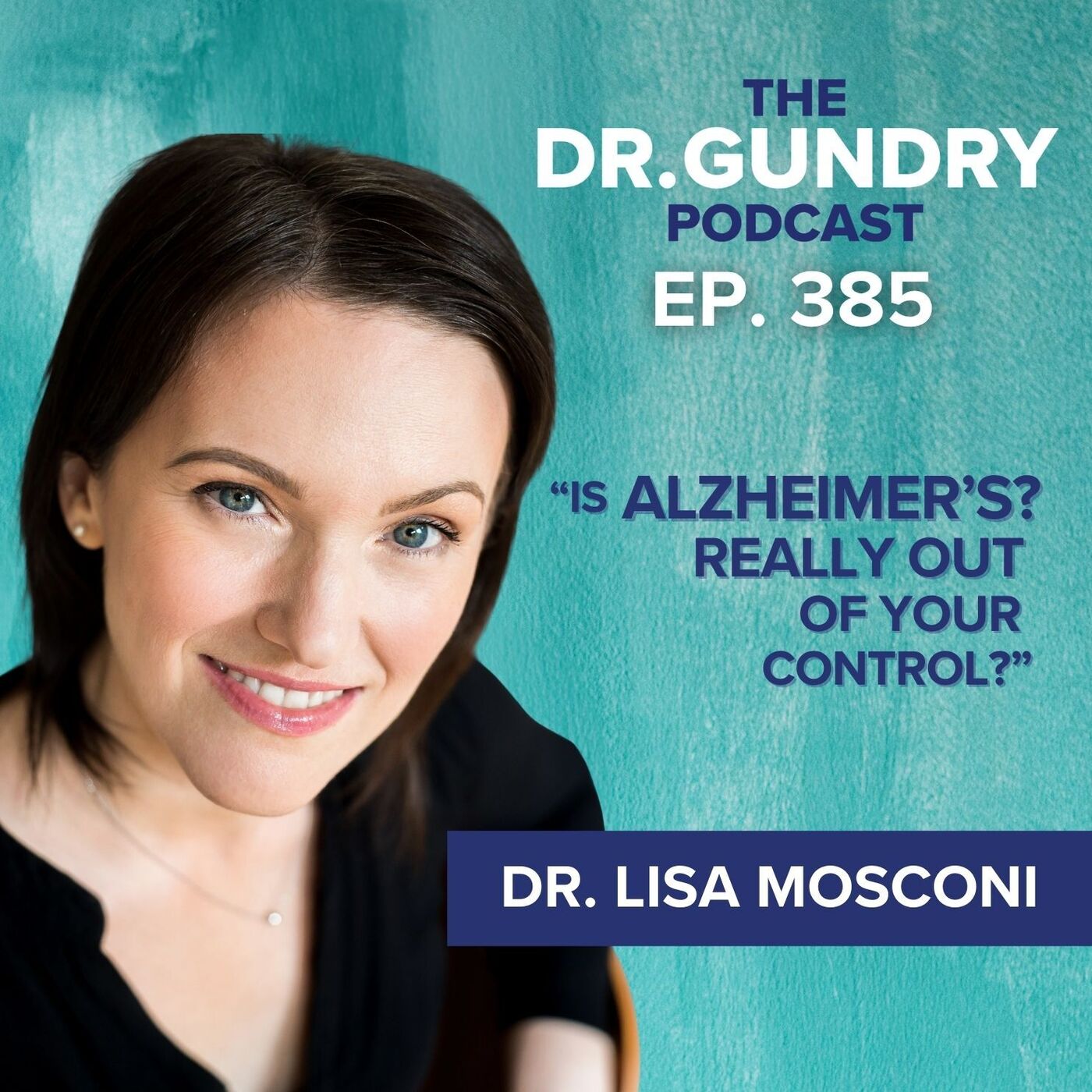
DR. GUNDRY PODCAST: GUT HEALTH, WEIGHT LOSS, AND NUTRITION
Alzheimer’s Isn’t Inevitable: What Science Says You Can Control Starting Now | EP 375
00:34:14
Loading summary
Transcript56 lines
- [00:00]
Dr. Lisa Moscone
Vrbo's last minute deals make chasing fresh mountain powder incredibly easy. With thousands of homes close to the slopes, you can get epic pow freshies, first tracks and more. Find last minute deals with the last minute filter on the app. Book a private vacation rental now@vrbo.com this.
- [00:15]
Progressive Insurance Announcer
Podcast is brought to you by Progressive Insurance. Fiscally responsible financial geniuses, monetary magicians. These are the things people say about drivers who switch their car insurance to Progressive and save hundreds. Because Progressive offers discounts for paying in full, owning a home and more. Plus, you can count on their great customer service to help you when you need it. So your dollar goes a long way. Visit progressive.com to see if you could save on car insurance, Progressive Casualty Insurance Company and affiliates. Potential savings will vary. Not available in all states or situations.
- [00:45]
Dr. Stephen Gundry
Welcome to the Dr. Gundry podcast where Dr. Stephen Gundry shares his groundbreaking research from over 25 years of treating patients with diet and lifestyle changes alone. Dr. Gundry and other wellness experts offer inspiring stories, the latest scientific advancements and practical tips to empower you to take control of your health and live a long, happy life.
- [01:09]
Podcast Host / Interviewer
Most people, I think the general public assumes that men get dementia more than women. But in fact the opposite, like you say, is completely, you know, it's exactly the opposite.
- [01:23]
Dr. Lisa Moscone
It's exactly the opposite. Yeah.
- [01:24]
Podcast Host / Interviewer
The vast majority of people who get dementia Alzheimer's are women. And you guys are so much healthier than us men.
- [01:32]
Dr. Lisa Moscone
I mean, you would assume, right? You would assume. And also what I think is really interesting is that Alzheimer's disease is the only age related neurodegenerative condition that affects more women than men. Like Parkinson's, more men, vascular dementia, 50. 50. So there seems to be something specific to women that increases risk of Alzheimer's.
- [01:54]
Podcast Host / Interviewer
So what is it about women's brains that are unique that this, this seems to be a problem more for women than for men?
- [02:05]
Dr. Lisa Moscone
Yes. There are many things that make women's brains really unique and I think a big determining factor is really hormonal health. Because I think it's very helpful to think of brain health as impacted by a number of factors. Like you have your genes, you have your DNA, you have your lifestyle, you have your medical health, you have your environment, you have your hormone. All these factors really act synergistically to determine a person's risk of Alzheimer's. But at the same time, a person comes with allies. There are things that reduce your risk and other factors that can increase your risk, like the apolipoprotein E, the APOE4 gene. You mentioned before, hormones are actually incredibly powerful allies that protect you against Alzheimer's and brain aging at large. The difference is that men have a lot more androgens like testosterone. Women have a lot more estrogens like estradiol. All these hormones are very powerful. They're very energizing, and they really keep Alzheimer's plaques at bay. They're anti inflammatory, they support neuronal growth and plasticity. But they have different lifespans. Right. Testosterone levels don't really decline that much until later on in life, whereas female estrogens really drop pretty dramatically during menopause. And menopause is midlife. So when we started looking into that, we found that women's brains change quite a bit in midlife during menopause. And that for some women, and we looked at their brains using their brain scans, once, twice, over time, over the years, what we found is that for some women, the drops in estrogen levels correlate with the formation of Alzheimer's plaques, which is counterintuitive because we associate Alzheimer's with old age and menopause with middle age. That is a little bit like a paradox. Speaking to you about paradoxes, but it is true. What my work and other people's work has shown is that Alzheimer's disease starts with changes in the brain years, if not decades, prior to clinical symptoms. And for women, that crucial time seems to overlap with menopause. So you don't start worrying about your risk of Alzheimer's when you're 70 as a woman. You better start thinking about it when you're 40 and 50.
- [04:45]
Podcast Host / Interviewer
Okay, so that's the bad news. That's the bad news. So are you saying that. Let's just generalize that every woman should think about hormonal replacement to prevent Alzheimer's or what are you saying?
- [05:04]
Dr. Lisa Moscone
What I'm saying is that there are many things that one can do to reduce risk of Alzheimer's and hopefully prevent it. And what our data is given us as a timeline, we now know that women tend to develop Alzheimer's earlier than men in their brains, and that we can catch these signs of increased risk very early on in life. We're looking at women who are in their 40s, and we can really find signs of an increased risk of Alzheimer's. And then I think it's really. That's really the key to prevention. I think it gives us a timeline. And it also suggests that perhaps hormonal replacement therapy, which you mentioned, could be helpful. We don't know for sure. We don't know for sure. And I Think a lot more research is needed to test the preventative potential of hormonal therapy.
- [05:59]
Podcast Host / Interviewer
Okay, so nobody should go away from this saying, Dr. Moscone says I have to get on hormonal replacement therapy when I'm 40 or it's the end.
- [06:12]
Dr. Lisa Moscone
No, no, no. I would not say that. Actually. I'm very cautious in recommending medications for Alzheimer's prevention. I think. I believe in clinical trials. I believe that drugs should be tested very thoroughly for efficacy but also side effects. And we really need to understand who's eligible for it and who would benefit from these drugs. So something I want to clarify is that not all women who go through menopause develop Alzheimer's plaques, and not all women with the plaques develop dementia later in life. So I think phenotyping is very important. It's very important to have a solid baseline, and it's important to understand our own risks. And like what we were saying before, there are many risk factors for Alzheimer's that we can control that can also really help improve hormonal health. So instead of jumping to a pharmacy with a prescription in hand, there are other things that I would recommend doing first which really speak to lifestyle, like diet, exercise, other things that we know impact our hormones. Stress reduction is a big one.
- [07:26]
Podcast Host / Interviewer
So that's a good segue into this. Cause, yeah, everyone who comes into my office does not get a prescription for estradiol and progesterone and testosterone, quite frankly. In fact, most don't.
- [07:41]
Dr. Lisa Moscone
Right.
- [07:41]
Podcast Host / Interviewer
And I agree with you, and I actually just did a podcast on this. There are certainly well recognized effects of estrogen on women, particularly vascular reactivity. And I have a subset of women who even small amounts of estrogen replacement as a patch make a huge difference in the way their brain functions. And I was taught this by a gynecologist. He said, you know, believe it. You know, there are women who absolutely have to have a small amount of estrogen or their brain will not work and their vascular reactivity will not work in their brain. Is that what you guys are finding?
- [08:24]
Dr. Lisa Moscone
I think the response to estrogen replacement therapy is variable for some. For some women is a godsend. Some women really swear by it. Other women swear at it. So their response is very highly individualized. And I think that we need better tools and better tests to really predict whether or not each individual woman will benefit from the therapy. And we're working on developing that. And it's something that is very dear to my heart as a scientist, because in clinician, because we can measure hormones in blood but there is no correlation between those peripheral hormones and the hormones inside the person's brain. So we need to be able to quantify estrogen levels in the brain, to really dose the therapy correctly, and to refine the timing so that we. We can better understand when to start and when to stop. Like, do we want to wait until a woman is menopausal to give her the patch, which is kind of common practice, or would it be better to perhaps start earlier and see we can delay menopause? Would that be better? So I think there's a lot of research that really needs to happen and hasn't happened yet, which is honestly offensive. You know, women have been going through menopause forever, and everybody's complaining of hot flashes, night sweats, depression, mood swings, brain fog, memory lapses. And we haven't really done the research that we need yet, and that's half of the population.
- [10:01]
Podcast Host / Interviewer
So you say in your book that the idea that women have no control over menopause is a myth. Can you elaborate on that?
- [10:11]
Dr. Lisa Moscone
Yeah, there are many myths surrounding menopause. There are many things that we don't fully understand or that perhaps are not being explained thoroughly or accurately to women. So many women don't actually know how menopause works. And I find endearing in some ways when I. When I do explain that menopause starts in the brain, and so many women are not aware of that, and they feel so relieved when I mention that, because any woman can tell you that, like you were saying before, that something is happening inside their heads and they're worried that they might be going crazy or that maybe it's happening only to them and not to the other 850 million women around the planet who are not going through menopause and that are, you know, experiencing exactly the same level of confusion or changes. So that. That's something that really made a point of clarifying in the book. Then there is a lot of stigma around menopause in 2020 is still quite a taboo. But there is so much that we understand now that we really need to talk about and discuss with women and, you know, between women and with men, honestly, because it's a family thing in the end. And going back to your point, menopause is partially genetically mediated in that if your mom went through menopause when she was 43, chances are you're also going to menopause at the same age. If your mom went through menopause at 55, then you're very fortunate because there's a good chance you may also go through menopause later than average. However, there are things that are known to precipitate menopause and other things that are known to delay the onset of menopause. The bad things are definitely smoking, which is the number one cause of early menopause, an unhealthy diet, and a very high level of chronic stress. So if your mom went through menopause at 58, right, but you've been smoking for 20 years, chances are that you'll go through menopause much earlier than she did.
- [12:21]
Podcast Host / Dr. Gundry's Assistant or Co-host
What if your wellness journey didn't feel like a series of sacrifices? The first week of the new year is the perfect time to reevaluate your eating habits. But that doesn't really mean giving up everything you love. It's just about swapping out ingredients. That's where Thrive Market comes in. Thrive Market takes the guesswork out of eating well. It makes it easy to find healthy alternatives like pantry staples that align with your health goals. Their AI powered cart even remembers what you like. So shopping gets easier over time. Everything on Thryv is curated with trusted ingredients, and more than 600 sketchy ingredients are automatically filtered out, which means every choice you make is intentional and safe. If you want to make healthy living easier and more affordable, head to thrivemarket.com you'll get 30% off your first order plus a free $60 gift. Start the year off right with swaps that make wellness effortless. The Dr. Gundry podcast is brought to you by Progressive Insurance. You choose to hit play on this podcast today. Smart Choice Progressive loves to help people make smart choices. That's why they offer a tool called Auto Quote Explorer that allows you to compare your progress Car Insurance quote with rates from other companies. So you save time on the research and you can enjoy savings when you choose the best rate for you. Give it a try after this episode@progressive.com Progressive Casualty Insurance Companies and affiliates not available in all states or situations, and prices vary based on how you buy.
- [14:06]
Dr. Lisa Moscone
And then there are all the good things that actually delay menopause, which are the good things we always talk about.
- [14:12]
Podcast Host / Interviewer
Oh, let's hear it.
- [14:13]
Dr. Lisa Moscone
Let's talk about. Well, a healthy diet is a big deal. There are many studies, including an examination of hundreds of thousands of people, showing that the more fish you have in your diet, the later the onset of menopause. As a woman, of course. And on the other side, if you eat a lot of refined sugar and refined grains, that seems to accelerate the hormonal decline that leads to menopause. It's good to think about diet in terms of something that can actually impact the health of your hormones as well as the health of your brain. There's evidence that dietary patterns like the Mediterranean diet, for example, also really promote hormonal health in women, also support fertility, and they're associated with fewer hot flashes in the later onset age and menopause, as well as a number of other things. So better cognitive health, reduce cardiovascular issues, reduced depression in women. So a healthy diet is very crucial, I think, for overall health. And, you know, everybody's on a different diet. But I think that on average, just staying away from processed foods would be a really good positive change in everybody's life.
- [15:39]
Podcast Host / Interviewer
So let me back up for a second. Is there any evidence, then you're the expert on this, that if you go into menopause early, let's say in your 40s, early 40s, versus going into menopause in your 50s, that you're better off the later you go into menopause? Number one. And number two, if you go into menopause early, do you throw up your hands and say, I'm screwed. Oh, my gosh, now what do I do?
- [16:15]
Dr. Lisa Moscone
The first answer is yes. The second answer is no.
- [16:18]
Podcast Host / Interviewer
Ah, okay, good.
- [16:21]
Dr. Lisa Moscone
So there is increasing evidence that a longer reproductive lifespan is protective against dementia in women, especially in women. And by longer reproductive lifespan is kind of a metaphor for the longer your body is exposed to your estrogens. So women who develop and go through puberty at the average age or a little bit earlier, like when you're 12, and go through menopause later on, like Maybe around age 55, 56, they really seem to have the lower risk of dementia as compared to women who have a shorter reproductive lifespan. So they start menstruating later in life. And to go through menopause earlier, whether genetically or because of medical interventions. And I would like to mention hysterectomies and oophorectomies are the number one cause of early menopause for American women. And those are surgical procedures in which the uterus and or the ovaries are removed. And unfortunately, there is evidence that having the uterus and more so the ovaries removed prior to menopause correlate with a much higher risk of dementia later in life for women. So I think it's really important to talk about this, and it is depressing news and it is upsetting news, but it's really important that we talk about it because so many women are not aware and so many doctors are not aware. So Many obgyns just don't know. And so if you go to your doctor because you have fibroids and they're like, well, you know, you're suffering so much, maybe we should take out the uterus. Let's talk about keeping the ovaries. Because one of the major reasons for removing the ovaries is that they just happen to be there while we're in there.
- [18:18]
Podcast Host / Interviewer
Yeah, yeah.
- [18:19]
Dr. Lisa Moscone
So I think it's really important to raise awareness of the fact that reproductive organs are there for a reason and they can't just be taken out that easily because there's a connection with your brain that is not the inner conversation material, but it's true. Your brain is in constant interaction with your ovaries as a woman, and the ovaries talk back to the brain, influencing brain health in return. So it's a network that we really need to nourish. And that's a big part of my book, is really about understanding this system and these interactions and how to really nurture them.
- [18:56]
Podcast Host / Interviewer
Now, another part of that is, okay, so what about pregnancy? Where does that come in in the picture?
- [19:03]
Dr. Lisa Moscone
It's a very good question. It looks like the number of pregnancies is just not associated with Alzheimer's risk. There are some studies have shown that the more pregnancies, the more children you have, the higher your risk of Alzheimer's, whereas other studies have shown absolutely the opposite. So at this point, we don't know. What we do know is that the more the number of pregnancy does not correlate with your age of menopause. It doesn't seem to, because some people think, well, I haven't had my cycle for nine months, so I'm going to catch up. You know, it's going to be. Menopause is going to be delayed by at least nine months. But that doesn't seem to happen.
- [19:44]
Podcast Host / Interviewer
Ah, interesting. So is there any correlation between pregnancy or no pregnancy and developing Alzheimer's or dementia?
- [19:55]
Dr. Lisa Moscone
I think the research is not clear on that. And this is something that we're looking into right now, clearly at the Women's Brain Initiative, because it's such a big deal for women's brains. And my friend, one of my friends, she's a psychiatrist, and she got pregnant years ago when having kids was not even a thing for me, not even on the radar. And she was telling me that she felt like she had postpartum dementia, that she couldn't. She could not remember things. She was having such a hard time just getting through the day mentally. She's one of the smartest, most capable women on this planet. And that was like, yeah, yeah, yeah, you just need to sleep. Then I had my baby and it was like, oh, my God, what is happening to me, to my head? And so I think this is something I really want to look into. There's this beautiful study in nature neuroscience that came out just a few years ago showing women's brains after pregnancy, throughout pregnancy and after pregnancy, really go through a remodeling where the brain kind of loses gray matter that you can see on MRI scans, which sounds like a negative thing, right? I'm losing something inside my head. But a lot of people believe that these changes reflect a maturation process, like something that, like what happens in puberty, that the brain just starts going through this pruning phase where a lot of connections are discarded because you don't need them anymore. And it's much more efficient to have a very efficient, very compact brain. And it looks like something similar might happen to women's brains as we become moms, because all the attention needs to be on the baby that is better from an evolutionary perspective. And that leads to discarding other connections that are no longer needed. And I find that to be very insightful. And I wonder if something like that can also explain menopause. Because, you know, women, we actually humans, we're just one of the very few species that go through menopause at all. There are just two species on the entire planet that go through menopause, and these are women and killer whales. And I find that so cool. But if you think that all other species, in all other species, the female dies when she's no longer fertile, where for us is an advantage to become grandmothers at some point, or at least that that's what nature intended for us, and no longer be fertile, but still be around and help the family really thrive and grow. So I find that very. I find it beautiful in some ways.
- [22:44]
Podcast Host / Interviewer
Okay, so let's talk about exercise. Since we've been talking about food. How important for women is working out for brain health?
- [22:55]
Dr. Lisa Moscone
It is very, very important. And I think there's quite enough convincing research showing how women don't exercise nearly as much as they could or should. And they most certainly exercise less than men do for a number of reasons, which is not to blame women for it, but it's really a number of reasons that go from, you know, just being a mom mom and holding full time jobs and taking care of the family and taking care of your parents and your husband's parents. Perhaps there's Just so much that's going on in a woman's life and the men's life as well. But for some reason, women, and I think any woman would acknowledge that we're just so good at putting everybody else and everything else before us. And then the downside is that we don't get to move our bodies as much as we could. But there's a lot of evidence that exercise is not just good for overall health, it's also specifically helpful for your brain and is really a well established preventative against Alzheimer's and dementia. So the fact that women don't exercise as much as they should raises concerns because that could also be one of the reasons that more women than men end up with dementia later in life. There is very encouraging research showing that exercising reduces the risk of dementia for both men and women, but more so for women than for men. There was just this wonderful study published. It was over 200 women. They were followed for over 40 years, which I found was incredible. And they showed that your cardiovascular level, your fitness level in midlife is really predictive of future risk of Alzheimer's disease. So the women with the highest level of fitness basically did not decline to Alzheimer's disease. The decline rate was close to zero percent, whereas women in the lowest percentile of fitness declined to Alzheimer's at the rate of 30%. Which means of every three women who don't exercise, at least one is going to get Alzheimer's disease. So that's not convincing enough. I don't know what could be. And I also want to mention because I don't want anyone to feel bad about not exercising. We have so much guilt around not doing everything thing we could, which is clearly unsustainable. You know, you only have that much time in a day or a week. But there's very encouraging evidence that you don't have to run a marathon. You know, we think about exercise mostly in terms of running, jumping, aerobic exercise, and a lot of women just can't do that. Maybe they're too tired or they're going through menopause. There's so much else going on. But there's a lot of evidence that lower intensity exercise, if done consistently, is just as good as high intensity exercise done once in a while and is also less likely to cause inflammation in the body. For women who are going through menopause or perimenopause and have a lot of cortisol and have trouble sleeping. So slow and steady wins the race as long as it's consistent.
- [26:12]
Podcast Host / Interviewer
Yeah, I agree. In fact, I write prescriptions for many of my patients to get a dog because dogs actually make you exercise twice a day whether you want to or not.
- [26:25]
Dr. Lisa Moscone
Yeah, that's a lovely idea.
- [26:27]
Podcast Host / Interviewer
I actually write a prescription company, lower your stress level.
- [26:32]
Progressive Insurance Announcer
Cat poodle.
- [26:34]
Podcast Host / Interviewer
It's really interesting. I have a number of people who come back with that prescription frame that it was the best prescription adoption doctor had ever written for them. So I'm going to keep doing it.
- [26:43]
Dr. Lisa Moscone
I love that. If it's okay, I'm going to mention that you do that because it's such a good idea.
- [26:47]
Podcast Host / Interviewer
Yeah. No, please.
- [26:50]
Podcast Host / Dr. Gundry's Assistant or Co-host
The first week of the new year is when we're thinking about resets. Better sleep, better skin, less inflammation and habits we can actually stick to. One of the simplest upgrades I've made is using products from Bon Charge, a science backed wellness brand designed to support health how our bodies are meant to function. My personal favorite is the Bon Charge red light face mask. Red light therapy has been reviewed in over 4000 peer reviewed studies with no negative side effects reported. And it's been incredibly helpful for fine lines, breakouts, jaw tension and even relaxation. It's lightweight, doesn't get hot and uses both red and near infrared light to support collagen and and elastin production. What really sets Bone charge red light mass apart is that they remove sleep disrupting blue and green light. Something many other brands ignore and their devices have zero EMF and zero flicker. If you're ready for a simple science packed reset, head to boncharge.com and use code GUNDRY to save 15%. That's boncharge.com code GUNDRY. The new year is here with new intentions and goals to improve our lives. But it really starts at home. For me, that means Cozy Earth. Their Baja bedding and luxe bath towels aren't just soft, they transform your space. There's nothing like slipping into sheets that feel like a hug or wrapping yourself in a towel. That's impossible. Impossibly plush. After the holiday rush, what I crave most is rest and reset. Cozy Earth gives you that everyday luxury so you can start the year feeling truly refreshed. Right now you can upgrade your home and start the year off right with up to 20% off. @cozyearth.com use my code GUNDRY. With a hundred night sleep trial and 10 year warranty, it's completely risk free. Make this week and this year the one where home feels like the best part of life.
- [28:59]
Podcast Host / Interviewer
So can you reverse dementia?
- [29:05]
Dr. Lisa Moscone
Reverse is an interesting word for a scientist. You know, I know it has Been used with books, podcasts, and magazines. For me, reversing Alzheimer's means that you're getting rid of the symptoms and you're getting rid of the pathology. The Alzheimer's plaques are gone, the tangles are gone, the inflammation are gone, your neurons are growing back, and your symptoms are gone. So far, I haven't seen that happen. The hope is that it will. Right now, I think we're, as a field, the Alzheimer's field is coming together in finally accepting that prevention is feasible. We got so much pushback for so long that we couldn't even publish a paper with the word prevention in it. Just recently, we had to cross it out at the title.
- [29:55]
Podcast Host / Interviewer
Really?
- [29:57]
Dr. Lisa Moscone
Yeah, absolutely. There were. I think we had six reviewers, which is a lot of reviewers, and at least three raised concerns about the word prevention. And so we had to cross it off and just replace it with risk reduction. You do what you're going to do. But the point is, a lot of people still don't believe that prevention is feasible. The risk reduction is more like, okay, it's not as strong a word, but obviously, I'm the associate director of the Alzheimer's Prevention Clinic at Weill Cornell, which I thought was brave. So obviously I believe that prevention is feasible. And there's a lot of data showing at the very least, one third of all Alzheimer's cases are potentially preventable. So I do believe in prevention, and I most certainly hope that Alzheimer's disease would be reversible.
- [30:51]
Podcast Host / Interviewer
All right, well, that's a good place to end all this.
- [30:56]
Dr. Lisa Moscone
As for getting in touch with me, I'm on Instagram. I'm not big on social media, but I am on Instagramsconi doctormascone, and I have a website which is lisamascone.com and I actually answer direct messages. Wow. Yeah, for now. No, I really do my best to really respond and make friends, to really be in touch with everybody because it's so informative. I find that all the questions really inform my research because as a scientist, there are a lot of questions that I have on my mind and a lot of things I wouldn't think about.
- [31:35]
Podcast Host / Interviewer
All right, well, thanks for joining us. Good luck with the book. I know it's going to be great. And thanks for, you know, bringing this attention to women. For some obscure reason, we've got to get the word out that, you know, women are the main sufferers of Alzheimer's disease.
- [31:55]
Dr. Lisa Moscone
Yes. All right, thank you so much. Thank you for having me.
- [32:00]
Podcast Host / Dr. Gundry's Assistant or Co-host
Now it's time for the Question of the week. The question of the week comes from 329 on my YouTube episode about cheap proteins. They asked Dr. Gundry, what about papaya seeds? Are they healthy or not? Well, as a matter of fact, papaya seeds actually have a lot of proven health benefits in peer reviewed papers. They certainly are an antioxidant, they reduce reactive oxygen species and there are some interesting anti parasite, anti worm antiviral effects. But perhaps the most important thing is that they are an excellent source of soluble fiber that your gut buddies love. So yeah, papaya seeds are great for you. So don't throw them out. You can grind them up in a smoothie, you can swallow them whole if you like. Or you can of course get papaya seed powders in capsules or powders. Interestingly enough, there is some evidence that fermented papaya seeds naturally are even better for you. But what a great question. Now it's time for the review of the week. The review of the week comes from on my YouTube episode about matcha. They said. I'm sorry. Glad you're talking about this. I'm from Japan. The most reasonable authentic ceremony matcha is about $35 for a 20 gram can. Matcha sold in supermarkets here are less in quality. Thank you very much. Well, thank you for that review. You know, oftentimes the old saying you get what you pay for is correct. And having had ceremonial matcha tea by a matcha tea master, I can tell you that you're right. It really does make a difference the quality of matcha. So let's be careful out there on buying Matcha.
- [34:05]
Dr. Lisa Moscone
Pluto TV has thousands of free movies and TV shows. With movies like Joe dirt, pixels and 51st date, this is awesome. And TV shows like Survivor, SpongeBob SquarePants, the fairly odd Parents and Ghosts, Pluto TV is always free.
- [34:29]
Podcast Host / Interviewer
Huzzah.
- [34:30]
Dr. Lisa Moscone
Pluto TV stream now pay Never. You're welcome.
- [34:37]
Dr. Stephen Gundry
I hope you enjoyed this episode of the Dr. Gundry podcast. If you did, please share this with family and friends. You never know how one of these health tips can completely transform someone's life when you take the time to share it with them. There's also the Dr. Gundry Podcast YouTube channel where we have tens of thousands of free health insights that can help you and your loved ones live a long, vital life. Let's do this together.