← The Duct Tape Marketing Podcast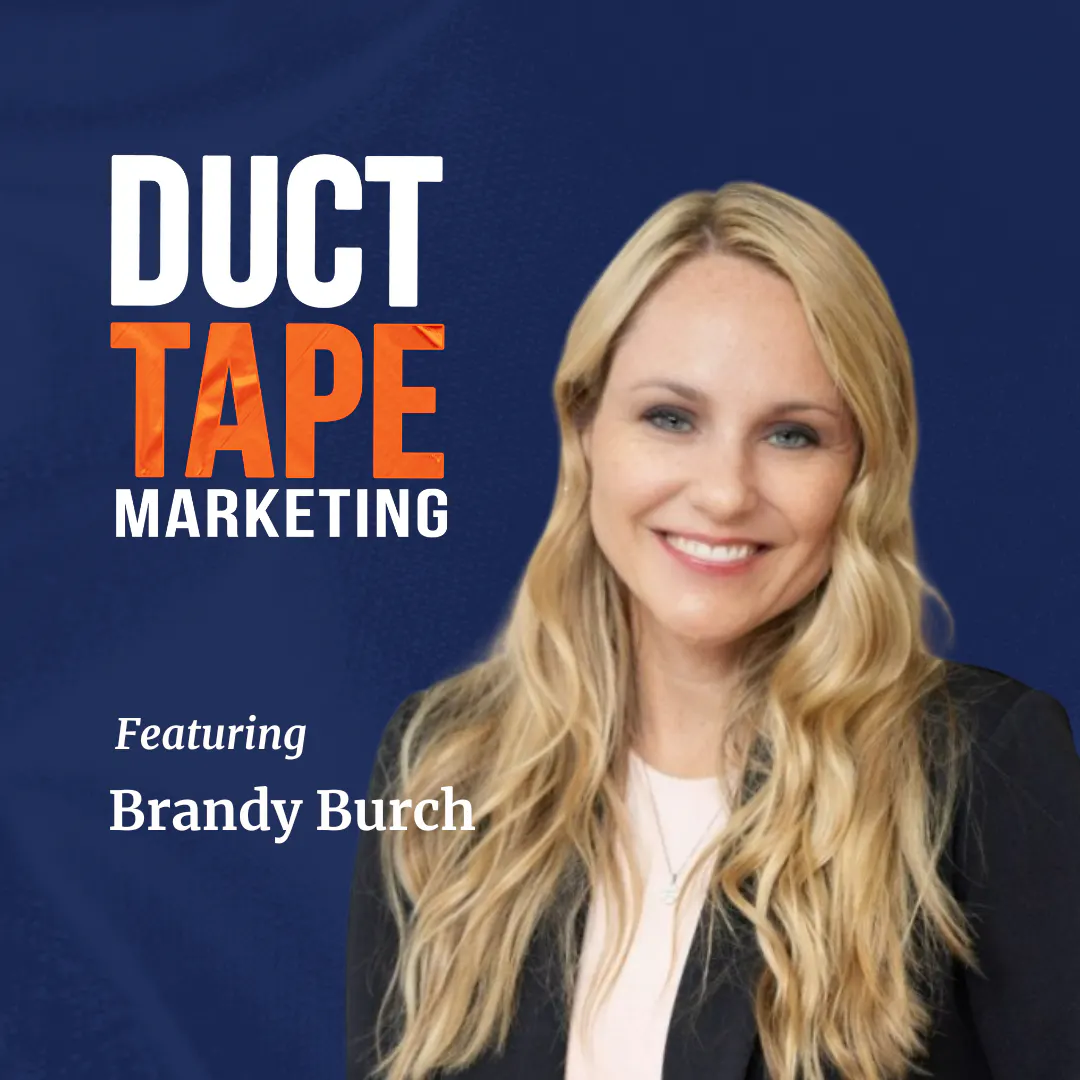
The Duct Tape Marketing Podcast
Personalize Employee Benefits By Granting The Right To Choose
00:26:35
Loading summary
Transcript52 lines
- [00:00]
Brandi Burch
Can you hear my dog?
- [00:01]
John Jayce
I can. This is a dog friendly show.
- [00:04]
Brandi Burch
It's a live dog friendly show. There are a lot of rules around ensuring that individuals aren't discriminated against and ratios are met and affordability calculations based on what's available in their market and ensuring that their employer is not classing people unfavorably and everyone's getting equal and fair purchasing power. So it is complex, but really what it means is we're going to be able to access our benefit of dollars and make the choice that's right for our family.
- [00:32]
John Jayce
Hello and welcome to another episode of the Duct Tape Marketing podcast. This is John Jayce. My guest today is Brandi Burch. She is a CEO and co founder of BenefitBay, a Kansas City based company innovating the employee health benefits industry through individual coverage health reimbursement arrangements. That's a mouthful. Hopefully we'll unpack it. With a vision to make health health benefits more accessible and customizable, Brandy has led Benefit Bay's rapid expansion and helped redefine how employers approach employee health care coverage. So, Brandy, welcome to the show.
- [01:08]
Brandi Burch
Thanks John. Thanks for having me.
- [01:10]
John Jayce
So was there, I mean we. I definitely want to unpack an Ichra because I usually talk about marketing and not necessarily insurance, but a lot of my listeners are business owners and employers and it's certainly a topic that will be of interest. Before we get into that, I'm. I'm just curious, was there something that had you sitting around one day and said I need to start a company that does ichras?
- [01:38]
Brandi Burch
No, that was not a. That was not something I was envisioning or thinking about. I was actually at a different software company and was really introduced to the idea and asked to join this startup vision and actually started as the operations lead, not the CEO. So I was part of the founding team and got to build it from the ground up, but our CEO left a year in and then I've been leading the reins since then. So it wasn't something I was sitting around on my couch thinking about, but it absolutely was something that I was solving throughout my career because I was a business, I was in business, I was a business operator for my entire career and I was a purchaser of benefits which are one of your largest spend sense when you're running a small company or any size company.
- [02:23]
John Jayce
Yeah, so. So we have, as part of our employee benefits, we have a health insurance coverage for employees. So. And I imagine most listeners are fairly familiar with how those work. There are different arrangements that you can do and different pays and things. But so, so how significantly different is an individual coverage, health reimbursement or maybe before we even get into the difference, like what is it?
- [02:46]
Brandi Burch
What it is really defined contribution. So it is an employer's ability to set a bucket of dollars aside for the health benefit and allowing the individual to choose. It's much more complex than that because there are a lot of rules around ensuring that individuals aren't discriminated against and ratios are met and affordability calculations based on what's available in their market and ensuring that their employer is not classing people unfavorably and everyone's getting equal and fair purchasing power. So it is complex, but really what it means is we're going to be able to access our benefit dollars and make the choice that's right for our family. That's the definition of what it is. A large acronym.
- [03:28]
John Jayce
Yeah, yeah. So, so you hit on really probably what's a key part of it. I mean most, at least in my experience, I could be wrong on this. But most benefit plans are like, here it is, you know, do you want it? You know, do you want it? How many do you want your spouse in it? You know, I mean, that's pretty much the decision. So, so what you're suggesting is this is vastly different in that you have a lot of choice.
- [03:49]
Brandi Burch
Yeah, you have a lot of choice. And you know, I know you mentioned you're in Colorado, I'm in Kansas City. The average market has 68 to 133 plans to choose as an individual. So you're to the market of all the carriers and you're a plan design. You have HMOs and EPOs and PPOs and you have HSAs and you have the flagship brands and the Aetnas and the Cignas and the Kaisers and the United Healthcares. But you also have option to be in a community health related product. And so maybe you have a Denver Health plans, maybe you have a Connecticare. If you're in Connecticut now, you have an ability to purchase that and your employer likely wouldn't have purchased that because they would have needed something that fits everyone in all 50 states. So they would have had to have purchased a larger network product that is more expensive. You may decide to buy something that is more community based, direct primary care driven, something that you're really passionate about that's driven by a hospital system. There are a lot of hospital system carrier plans that are out there and so that allows that individual to be put back into the driver's seat, but also make a more conscious decision with those dollars that matters more to their family for access to care.
- [04:58]
John Jayce
All right, so theoretically, and I'm going to come back to that, that's a better idea for the, the employee because it gives them choice. I mean, we can argue maybe like I'm the employer and I've done all the research and I'm telling you this is the best plan. You know, maybe that's, you know, an option. But what's the benefit for the employer? Is this cheaper? Is this easier? You've already said it's complex. So what's the benefit for the employer?
- [05:21]
Brandi Burch
I mean, in the Colorado market, it's cheaper. In the Kansas, Missouri market, not necessarily so in 34 of the states right now, individual products are priced competitively to a large margin to group insurance. So the employer would benefit by going to this model because the employee has higher purchasing power with lower dollars. So that drives the budget down. In addition, it allows you to budget because you set a defined contribution model. You know, it's always $800 or $450 or $650 for that employee that's seated in that class that you've modeled out. It's not, oh, does that employee have seven children? Now they're going to break the bank because I'm doing something over here that's going to be different. Right. It's going to be a set defined contribution and there may be a per additional child add on that. You could decide as a, as an employer, but you can budget and I think that's the biggest piece. And if you budget significantly higher than lower cost silver products, you do not have to change your budget every year as an employer, they're having to change it every year because the rate's going up 6, 10, 19, 31, 51. I mean the types of rate increases we're seeing are pretty significant. And then if you were an employer in self insurance, you're now getting out of that risk pool because self insurance, although it sounded really exciting for employers to manage their risk and manage their cost and drive care saving behaviors of their employee populations, that's a lot of administration. It's also a lot of work. And then if you end up with one or two laser claimants, you're suddenly in a balance sheet risk problem. And so that allows that employer to budget and just stay out of the risk game.
- [07:03]
John Jayce
So speaking of risk, I mean, are there, obviously you just pointed to one, but you know, this versus sort of the traditional, you know, one carrier path. Does this approach actually aid in reducing risk for employers as well.
- [07:17]
Brandi Burch
It does. I would say the only area of risk for employers in ICHRA is choosing the wrong partner.
- [07:25]
John Jayce
Right.
- [07:25]
Brandi Burch
There are. Anytime there's a new market, you're going to have a lot of startups, you're going to have a lot of people wanting to disrupt it from different ways. However, not all startups are created equal from a compliance perspective or from an insurance acumen perspective or from an ability to become licensed and appointed with a carrier. Right. Your technology tool set has to meet a certain level of guidelines. Your engineers need to be in the U.S. right. Right. There are various types of risk that exist out there when you decide to go with something that's new and a disruptor and you don't vet your technology providers. I also would say a lot of the technology providers are going direct to the employer and cutting out the broker. I feel there's a risk there because who is going to be the consultant in that situation? Who is providing that advice and who is holding that technology provider accountable? Now the employer's back in that business of trying to manage something. So I would recommend that to eliminate a risk, you're always working with a broker still, and you're not trying to just go with a technology provider who's trying to now become an insurance agency and now become, you know, a direct employer sales agent. Because the insurance acumen and knowledge that needs to be at that table needs to include those other pieces.
- [08:42]
John Jayce
It.
- [08:43]
Brandi Burch
It needs to be that they're bringing a quote every year to the employer of what is best for you this year. And ichra, even though I'm an ICHRA provider, may not be best for you every year. Maybe you suddenly are in Kansas and Missouri and you have 300 employees because you acquired a company. Kansas and Missouri is about 10 to 15% higher unless there's a certain geographic population that works out there on individual rates. So you need an honest person at the table with you who's not trying to just cut your consultant out of the conversation to win those dollars.
- [09:18]
John Jayce
So do you consider BenefitBay a broker or do you consider yourself a marketplace or a software? I mean, how do you characterize yourself?
- [09:26]
Brandi Burch
Yeah, we consider ourselves to software as a service and we consider ourselves the chosen partner of those employers and brokers. So we add value in this chain where we're taking away that administrative lift, that decision making at a large pop. Imagine you've got 2000 employees. Your broker nor your HR team can handle 2000 employees going through a decision that they've never had. To they've never had the permission to make themselves. They've traditionally just had a carrier, an HSA and a ppo. Right. Or maybe a buy up and a buy down. Right. So I've got two choices, I've got one carrier, I got two paycheck choices. That's all I'm deciding on now. You've got the paycheck choices, the carrier choices, the type of plan choices. So benefit based steps in that gap as a partner to the broker. Because these brokers as well haven't been selling individual products. So they were selling group products and they've become experts in their states and now they have to be experts in every state. And so we stand in that value chain there and then we solve the technology gap for the carriers on taking a large group population in individual products.
- [10:35]
John Jayce
So are you suggesting then that there's a certain size company that this makes sense or does it make sense for a 20 person company?
- [10:44]
Brandi Burch
It makes sense for the sub 50 in a certain way. Benefit Bay does not specialize in the on exchange market enrollments. That's an under 50 lives. You are subsidy eligible. You could remain subsidy eligible for your employees. So there may need to be a non exchange enrollment that's dealing with healthcare.gov or that's dealing with an on exchange product. There's a lot of long wait times and hold times. We are looking to service those larger employers. So I would say for us it's more of a 200 plus employer size that we service up into the thousands. What we do see is there is a great company called Stretch Dollar that's doing the sub 30 really well. And so we refer any groups that try to come to us in that area to them. But they don't utilize a broker. Right. Because it's a smaller group it's not going to have enough commission for a broker. And so they're able to play as the broker and as the technology system. But in the same respect they don't service up over 50 because there's a lot of compliance laws around the over 50 employer space. Those are called applicable large employers and we service those well. So we have a partnership they're sitting in. Well actually I think they sit in Pennsylvania and San Francisco. Can you hear my dog?
- [11:59]
John Jayce
I can.
- [12:00]
Brandi Burch
This is a dog friendly show, Live dog friendly show.
- [12:05]
John Jayce
I can't hear your dog. I was actually going to tell you because I was, I could see you were starting to fidget about it like so. So let me ask you this then. Let's, I don't know Pick a number. Anything over 100. To me, migrating to this would seem like, you know, chaos, right? And so I assume that, you know, I would think that would be one of the reasons a big company might actually go, you know, the maybe I see some benefit, but like, the chaos to change isn't worth it. So how do you mitigate that?
- [12:34]
Brandi Burch
Yeah, we mitigate that by speaking to how we've solved the problem and we've thought about it. How does a group insurance experience work? And this individual experience really is similar. The only difference is when they get to that dis enrolling in your benefits, we've all done it, right? We've all enrolled in our benefits and have been administered. When they get to the enrolling in their benefits, it's just that they get to put in their healthcare providers and they get to search for things that matter to them and they get to decide, I want a gold product or I want a PPO or I want an HSA or I want to only go to this carrier because it matters to me and they take care of me. And so they actually get to filter down what it is that matters to them. Once they select that product, we submit the application to the carrier for them through technology and then we facilitate the payments in a lump sum for the business. So the business is able to just have one deduction via ACH that we pull. And then each of these payments are individual on behalf of the individuals, but we expose all of that the way the employers used to. So our largest group right now enrolled is 3430 employees. Imagine 3430 employees sitting across 49 states. Actually, those employees are going to make vastly different choices than they would if they were on group. This employer thought about going back to group. They surveyed their employees because they were having a technology solution that wasn't doing a great job. They ended up just switching technology solutions, which was significantly important for us because we were able to deliver a better experience. But in that scenario, they looked to go back to group and their employees were like, no way. We get to choose now what are you going to dump us in? Right? I get to be in the plan that matters to me here and I get to have a better product than if you would have narrowed us down to a larger network. It would be more expensive. So we have seen it's a little stickier. Once it gets going, though, once you give someone a right to choose, it's kind of hard to be like, no, I'm just going to decide for you now. Right?
- [14:29]
C
I was like this. I found it. I found it. This is what I've been looking for. I can honestly say has genuinely changed the way I run my business. It's changed the results that I'm seeing. It's changed my engagement with clients. It's changed my engagement with IT team. I couldn't be happier. Honestly. It's the best investment I ever made.
- [14:46]
D
What you just heard was a testimonial from a recent graduate of the Duct Tape Marketing certification intensive program for fractional CMOs, marketing agencies and consultants just like them. You can choose our system to move from vendor to trusted advisor, attract only ideal clients and confidently present your strategies to build monthly recurring revenue. Visit DTM World Scale to book your free advisory call and learn more. It's time to transform your approach. Book your call today. DTM World Slash Scale.
- [15:24]
John Jayce
Well, benefits play a large role in attracting and retaining talent. So would you say that companies would even have the ability to maybe promote that as a differentiator, as a benefit, I mean, and play a role in retaining and attracting?
- [15:39]
Brandi Burch
Yes, I would say that is true. I see that a lot in our northeast clients because Ichra has been around a little longer and competing well in that market. And so we see that they're advertising that on their websites. They're saying you get to choose by over X number of health plans, you know, that they've given back two and a half million of cost share from the employees paychecks, you know, with this program. And so they also, most of the employers, when they do see this savings, they invest in other benefits. So then they improve the benefits package overall. They're adding additional, you know, disability payments paid by the employer or life insurance at X of your salary or they're allowing you to spend those dollars in some other, you know, product that you, that matters to you and your family, whether it's pet insurance or something else. So I find that's a motivating product to employees to be able to have access to that.
- [16:31]
John Jayce
Yeah, yeah. So since we mentioned pet insurance, are you seeing it? Are, are there some trends that you're seeing in employee benefits that, that are, you know, people are really trying to like push the boundaries on.
- [16:42]
Brandi Burch
Yeah, I feel like employers are trying to have a more engaged employee population or trying to offer a lot of, you know, new mom or new parent type benefits. They're trying to offer infertility for those that have concerns with infertility. They're offering mental health, virtual mental health, virtual care, zero access to those types of programs as add ons. I think all of that's really important to have access to as an employee. And then individuals can choose which piece of it matters to them. And if they would have tried to add infertility to an entire population, it would have been insurmountable. But if they're able to just add it for those who need it, then it is something that matters. And there's a lot of really great startups out there in these types of spaces. Kansas City has a couple marma and leave a apps that are around surviving. You know, that first year as a mom or a nursing mom or a new parent. And those are really engaging and keep your employee feeling like you care that they're returning to work and they're not sleeping and all the things, how do you survive that? Where's the network online that can help me get those materials? So seeing a lot of those types of engaging and rather than our employer knowing our health outcomes, which happens in current traditional group insurance, they're able to access through a lot of the big Brother tools around drug usage and claims, they're able to know what's going on in our family rather than them having that type of overbearing access in the individual side, you just get to make an individual decision with your dollars. They don't get to know, you know, that you're maybe getting cancer treatments if you don't want them to know. Right. So there's a little bit of that that I'm seeing as an evolution of this personal choice also holding carriers accountable to deliver actual customer service and to deliver payments on our claims timely to approve services that we need. Because if we're in the driver's seat of our benefit dollars, we could be brand loyal or not. Yeah, right. But if our employer is or our broker is, we really are voiceless in those types of service outcomes.
- [18:52]
John Jayce
Yeah, yeah, yeah. And you know, while you talked about the positive benefits of working with a broker, there probably are some negatives where, you know, a broker is like, I get more commission over here, I'm going over here and so are you. Right.
- [19:07]
Brandi Burch
I mean, every industry there's going to be motivators that are driven by greed, there's going to be motivators that are driven by fear. And I think that we have carriers that are motivated that way, we have brokers that are motivated that way, and we have employers that are sometimes motivated by just doing what's easiest. And if I change carriers and get a better outcome, that's even noisy. And I'm nervous about that because Susie or Tom may be Mad. And so sometimes getting that better outcome requires a little friction. And that's why benefits have kind of evolved to where they are. I think a lot of people just keep status quo even if it goes up year after year because it's all that fear around personal benefits and changing them and causing any type of outcome to anyone on your team. And recruiting has been hard the last five years. It's been an employees market. No one wants to upset the apple cart.
- [20:01]
John Jayce
Right, right. Hard to replace people. It really is. So I kind of hear you saying that if there's an overarching trend, it is personalization of the benefits. Right? I mean, is that a good way to say it?
- [20:13]
Brandi Burch
Yeah, I think it's personalization of the benefits. I think it's the last area that we haven't been able to personalize. Right? We do, yeah. I describe this as favorable legislation like when pensions move to 401k and allow your investment dollars make your decisions after a few poor decisions based on lifelong, you know, service to a company and your retirement's gone. We were able to move to individuals have the accountability to invest their benefit dollars and to invest those appropriately. Now some don't do what's right with their actual benefit dollars and don't access those. And that does happen on the healthcare side. They may not use all the do available to them. They may go with the lowest price product because they don't use their benefits or they don't want anything out of pocket and that it goes back to a personal accountability. And I think we need to get there especially for our own health and improving health outcomes. Right? Yeah.
- [21:09]
John Jayce
I'm curious if there you and I talked before we started. I grew up in Kansas City. I'm curious, is there any reason that Kansas City is a good place for Benefit Bay to be? Was it started there for a reason or that just happened to be where the players were?
- [21:22]
Brandi Burch
You know, it really was founded in Omaha by Zach Harris, the CEO and when I took the seat a year later In April of 22, I moved it to Kansas City. And the reason why I moved it to Kansas City is one, I'm here, but two, there's a great tech hub in Kansas City around health tech. We have a ton of health techs that are evolving. We have a lot of investment from larger ecosystem players in this market. It's a great market to have a work from home role and recruit. There aren't as many companies in Kansas City allowing the flexibility of working remote. And when you have a remote first company and you're in Kansas City. I feel like the recruiting is really easy for us. I wasn't having as much luck in Omaha and I think it's because there's a long tenure of large insurance ecosystems there and a lot of enterprise business where people are very comfortable and confident in their compensation, in their benefits and in their retirements package. To go to a startup I think was a little more risky in that market. In Kansas City. I'm not feeling like people have that aversion. They're saying, oh it sounds fun, like I want to be a part of this. You mean I get shares, I, I get to be remote. I get to, you know, do the commute with my family or handle to school drop off. And the motivation here we've been able to hire 26 people people in market. So now we do kind of have a hybrid work location downtown and people can come if they want. But Tuesdays and Thursdays tends to be when we're all heading in there. No one wants to deal with the commute. Monday, Wednesday, Friday I guess. But I do think the recruiting, the tech ecosystem was really important and the investment ecosystem is really great here. Kasey Rice just introduced me to a great partner within CVS Aetna and you just never know when those types of networks can really support your growing startup. And I feel like everyone's here to lift each other up in this community.
- [23:21]
John Jayce
I would agree with that sentiment. My final question really is there probably aren't a lot of CEOs that are females in your particular industry. Has that, Is that first off, is that correct? Is that changing? Has that presented a hurdle? How have you navigated that?
- [23:37]
Brandi Burch
It is correct.
- [23:38]
John Jayce
Four questions by the way. So answer any one of them you want. It is correct.
- [23:42]
Brandi Burch
Across all industries there are limited female CEO in insurance, even less so in venture backed companies, even less. Right. So we are a venture backed company. It is tough to raise capital as a female in a VC world. It is tough to raise capital in a non original founding role of an organization. You have to survive that transition of a founder, you know, nuisance that people may feel that's on the cap table and they have to believe that you are the one leading the company and that you can, you can do this and you didn't lose team members talent, right. The tech didn't serve it and you were able to keep your customers. So that has been some things that I've had to overcome. I think the biggest thing is there's one other female CEO in this industry right now. I think the biggest thing is being able to transfer experience rather than I haven't been a part of the Facebook or or some other tech startup and I wasn't necessarily an Ivy League grad. So those two things have been hard in a tech startup world. What I think has allowed us to be successful is that we are operators as an overall team and our VP of engineering was in large insurance carrier technical developments and then cancer research technical development. So we come with the expertise to the technology solution and rather than come with the technology skill set or background of being in serial startups, we come with various small business, medium sized business grit and experience. So I think that's made us successful. It's made it hard though to start that journey from here to here. Now here everyone loves us. But you've already got your proof point. So 400% growth. Right. And so it's a little better when the numbers are black and white and then they can't really go to all those other things to make a decision.
- [25:41]
John Jayce
The intangibles.
- [25:43]
Brandi Burch
Yes.
- [25:45]
John Jayce
Well, Brandi, again I appreciate you taking a few moments to share the story with the Duct Tape marketing podcast. Is there anywhere you'd invite people to find out more about Benefitbay and your work?
- [25:54]
Brandi Burch
Yeah, I'd go to benefitbay.com or you could follow us on LinkedIn, Benefitbay or Brandi Burch, CEO and founder of Benefitbay on my profile.
- [26:04]
John Jayce
Awesome. Well, again, appreciate you spending a few moments. Hopefully I'll run into you one of these days when I'm back in Kansas City.
- [26:10]
Brandi Burch
For sure. John Icras hot and now you're going to be hearing about it all the time. It's hot in Colorado so now you'll have a little experience there. We are going to grow 300% in Kansas City so it's starting to move. But that 300% is based on. We used to have one to two customers and now we have a right. So pull an uphill climb.
- [26:30]
John Jayce
Yeah, it's harder to do that every year.
- [26:32]
Brandi Burch
Exactly. Yeah. Thanks John.
- [26:34]
John Jayce
Take.