
Podcast
The Effortless Podcast
Hosted by Dheeraj Pandey, Amit Prakash · EN
Join longtime friends and entrepreneurs Dheeraj Pandey, founder of DevRev, and Amit Prakash, co-founder of ThoughtSpot, on The Effortless Podcast as they explore the art of building, innovating, and thriving in tech—without losing sight of what really matters. With decades of experience scaling companies and navigating risk, Dheeraj and Amit tackle tough questions for modern entrepreneurs: How can startups feel effortless in the face of endless challenges? What does “long-term greedy” mean when aligning personal growth with team success?
Whether you're a seasoned founder, a new entrepreneur, or just curious, The Effortless Podcast offers something for everyone in the journey of building with purpose.
11episodes
Episodes
Newest firstAll episodes
Vertical Memory. Shared Memory. Local Memory - The Effortless Podcast – Episode 23
Jul 1101:12:49Tap to summarizeIn this episode of The Effortless Podcast, Dheeraj Pandey sits down with co-host Amit to dissect the dramatic acceleration of AI over the last few months and map out its next major frontier memory. Moving past prescriptive frameworks and simple prompt-engineering, they unpack how autonomous agents are shifting the industry's focus from "token maxing" to "impact maxing," forcing a complete rethink of computing architecture. The conversation explores how memory within AI agents cannot remain a flat, horizontal file. Instead, true enterprise intelligence requires a tiered hierarchy of memory spanning episodic, semantic, and procedural layers that mirrors human psychology and classical hardware caching. Drawing a striking parallel between token anxiety and electric vehicle range anxiety, they make the case for a hybrid CPU-GPU future where structured data, governance, and safety rollbacks are critical to preventing autonomous systems from breaking the bank or deleting databases. Key Topics & Timestamps 00:00 – Summer updates and AI's recent "quantum jump". 01:00 – Token maxing vs. impact maxing & autonomous React loops. 03:00 – Model reliability & using Grep, Sed, and Awk for dynamic context. 07:00 – Terminal text-matching tools explained simply. 08:00 – xAI, data center builds, and Neocloud disruption. 10:00 – Cursor’s acquisition & the shift to autonomous harnesses. 12:00 – Desktop hurdles: Sandboxing, Docker, and local firewalls. 14:00 – Coding for the "paranoid path" and failure modes. 18:00 – The Core Thesis: Memory as AI's next major frontier. 21:00 – Caching tiers: KV cache vs. CPU/GPU caches and DRAM. 25:00 – Personal vs. enterprise memory: Turning data into goal-oriented meaning. 32:00 – Enterprise memory grammar: Ontology, identity, and work. 41:00 – Psychology of memory: Episodic, semantic, and procedural structures. 45:00 – Hybrid CPU-GPU needs & the EV range anxiety metaphor. 53:00 – Agent safety: Rollbacks, versioning, and transaction protection. 58:00 – Team intelligence: Bringing AI context to Slack and Teams. 1:01:00 – State vs. skill versioning: The derivative of human intelligence. 1:03:00 – Summary: Memory as data reduction & reinforcement learning. 1:09:00 – Final thoughts: Managing atoms vs. bits & the future of labor. Hosts: Amit Prakash – CEO and Founder at AmpUp, former engineer at Google AdSense and Microsoft Bing, with extensive expertise in distributed systems and machine learning. Dheeraj Pandey – Co-founder and CEO at DevRev, former Co-founder & CEO of Nutanix. A tech visionary with a deep interest in AI, systems, and the future of work. Follow the Hosts: Amit Prakash LinkedIn – https://www.linkedin.com/in/amit-prakash-50719a2/ Twitter/X – https://x.com/amitp42 Dheeraj Pandey LinkedIn – https://www.linkedin.com/in/dpandey/ Twitter/X – https://x.com/dheeraj Share Your Thoughts Have questions, comments, or ideas for future episodes? 📩 Email us at EffortlessPodcastHQ@gmail.com Don’t forget to Like, Comment, and Subscribe for more conversations at the intersection of AI, systems, and product design.
Transcribe →
Quantum, AI & Data: In Conversation with Dr. Abhishek Bhowmick - Episode 22: The Effortless Podcast
Feb 2201:15:23Tap to summarizeIn this episode of The Effortless Podcast, Dheeraj Pandey speaks with Dr. Abhishek Bhowmick about how quantum mechanics reshaped our understanding of determinism and why that shift matters for AI today. From the Einstein–Bohr debates to the idea that nature is fundamentally probabilistic, they explore how the collapse of “if-then” thinking began nearly a century ago. The discussion draws parallels between quantum superposition and modern LLM behavior. At its core, the episode reframes AI as a rediscovery of how reality computes. The conversation then moves from physics to computing architecture, tracing the evolution from scalar CPUs to GPUs, TPUs, tensors, and eventually quantum computing. They examine why probabilistic systems and vector math feel more natural than purely deterministic software. Hybrid computing models show that classical systems still matter. The episode also unpacks what quantum computers are truly good at, especially in cryptography and simulation. Ultimately, it reflects on whether the future of computing lies in embracing probability rather than resisting it. Key Topics & Timestamps 00:00 – Welcome, context, and how Dheeraj & Abhishek met 04:00 – Abhishek’s journey: IIT, Princeton, Apple, Snowflake 08:00 – The 1927 Solvay Conference and physics at a crossroads 12:00 – Einstein vs. Bohr: determinism vs. probability 16:00 – Superposition and the collapse of the wave function 20:00 – Fields vs. particles: what is an electron really? 25:00 – Matter particles, force particles, and the Standard Model 30:00 – Transistors, voltage, and the rise of deterministic computing 35:00 – From scalar CPUs to vectors and matrices 40:00 – Tensors, linear algebra, and modern AI systems 45:00 – Principle of Least Action and gradient descent parallels 50:00 – Hallucinations, probability mass, and LLM behavior 55:00 – Vector databases, embeddings, and KNN search 59:00 – GPUs vs. TPUs: matrix vs. tensor architectures 1:05:00 – What quantum computers are actually good at 1:10:00 – Post-quantum cryptography and the future of computing Host - Dheeraj Pandey Co-founder & CEO at DevRev. Former Co-founder & CEO of Nutanix. A systems thinker and product visionary focused on AI, software architecture, and the future of work. Guest - Dr Abhishek Bhowmick Co-Founder and CTO of Samooha, a secure data collaboration platform acquired by Snowflake. He previously worked at Apple as Head of ML Privacy and Cryptography, System Intelligence, and Machine Learning, and earlier at Goldman Sachs. He attended Princeton University and was awarded IIT Kanpur’s Young Alumnus Award in 2024. Follow the Host and Guest - Dheeraj Pandey: LinkedIn - https://www.linkedin.com/in/dpandey Twitter - https://x.com/dheeraj Abhishek Bhowmik LinkedIn – https://www.linkedin.com/in/ab-abhishek-bhowmick Twitter/X – https://x.com/bhowmick_ab Share Your Thoughts Have questions, comments, or ideas for future episodes? 📩 Email us at EffortlessPodcastHQ@gmail.com Don’t forget to Like, Comment, and Subscribe for more conversations at the intersection of AI, systems, and product design.
Transcribe →
Alex Dimakis: The Future of Long-Horizon AI Agents - Episode 21: The Effortless Podcast
Jan 601:32:12Tap to summarizeIn this episode of The Effortless Podcast, Amit Prakash and Dheeraj Pandey are joined by Alex Dimakis for a wide-ranging, systems-first discussion on the future of long-horizon AI agents that can operate over time, learn from feedback, adapt to users, and function reliably inside real-world environments.The conversation spans research and industry, unpacking why prompt engineering alone collapses at scale; how advisor models, reward-driven learning, and environment-based evaluation enable continual improvement without retraining frontier models; and why memory in AI systems is as much about forgetting as it is about recall. Drawing from distributed systems, reinforcement learning, and cognitive science, the trio explores how personalization, benchmarks, and context engineering are becoming the foundation of AI-native software.Alex, Dheeraj, and Amit also examine the evolution from SFT to RL to JEPA-style world models, the role of harnesses and benchmarks in measuring real progress, and why enterprise AI has moved decisively from research into engineering. The result is a candid, deeply technical conversation about what it will actually take to move beyond demos and build agents that work over long horizons.Key Topics & Timestamps 00:00 – Introduction, context, and holiday catch-up04:00 – Teaching in the age of AI and why cognitive “exercise” still matters08:00 – Industry sentiment: fear, trust, and skepticism around LLMs12:00 – Memory in AI systems: documents, transcripts, and limits of recall17:00 – Why forgetting is a feature, not a bug22:00 – Advisor models and dynamic prompt augmentation27:00 – Data vs metadata: control planes vs data planes in AI systems32:00 – Personalization, rewards, and learning user preferences implicitly37:00 – Why prompt-only workflows break down at scale41:00 – RAG, advice, and moving beyond retrieval-centric systems46:00 – Long-horizon agents and the limits of reflection-based prompting51:00 – Environments, rewards, and agent-centric evaluation56:00 – From Q&A benchmarks to agents that act in the world1:01:00 – Terminal Bench, harnesses, and measuring real agent progress1:06:00 – Frontier labs, open source, and the pace of change1:11:00 – Context engineering as infrastructure (“the train tracks” analogy)1:16:00 – Organizing agents: permissions, visibility, and enterprise structure1:20:00 – SFT vs RL: imitation first, reinforcement last1:25:00 – Anti-fragility, trial-and-error, and unsolved problems in continual learning1:28:00 – Closing reflections on the future of long-horizon AI agentsHosts:Amit PrakashCEO & Founder at AmpUp, Former engineer at Google AdSense and Microsoft Bing, with deep expertise in distributed systems, data platforms, and machine learning.Dheeraj PandeyCo-founder & CEO at DevRev, Former Co-founder & CEO of Nutanix. A systems thinker and product visionary focused on AI, software architecture, and the future of work.Guest:Alex DimakisAlex Dimakis is a Professor in UC Berkeley in the EECS department. He received his Ph.D. from UC Berkeley and the Diploma degree from NTU in Athens, Greece. He has published more than 150 papers and received several awards including the James Massey Award, NSF Career, a Google research award, the UC Berkeley Eli Jury dissertation award, and several best paper awards. He is an IEEE Fellow for contributions to distributed coding and learning. His research interests include Generative AI, Information Theory and Machine Learning. He co-founded Bespoke Labs, a startup focusing on data curation for specialized agents.Follow the Hosts and the Guest: Dheeraj Pandey:LinkedIn - https://www.linkedin.com/in/dpandeyTwitter - https://x.com/dheerajAmit Prakash:LinkedIn - https://www.linkedin.com/in/amit-prak...Twitter - https://x.com/amitp42Alex Dimakis:LinkedIn - https://www.linkedin.com/in/alex-dima...Twitter - https://x.com/AlexGDimakis Share Your Thoughts Have questions, comments, or ideas for future episodes?📩 Email us at EffortlessPodcastHQ@gmail.comDon’t forget to Like, Comment, and Subscribe for more conversations at the intersection of AI, systems, and product design.
Transcribe →
The Structured vs. Unstructured Debate in Business Software - Episode 20: The Effortless Podcast
Dec 1501:22:29Tap to summarizeIn this episode of The Effortless Podcast, Amit Prakash and Dheeraj Pandey dive deep into one of the most important shifts happening in AI today: the convergence of structured and unstructured data, interfaces, and systems.Together, they unpack how conversations—not CRM fields—hold the real ground truth; why schemas still matter in an AI-driven world; and how agents can evolve into true managers, coaches, and chiefs of staff for revenue teams. They explore the cognitive science behind visual vs conversational UI, the future of dynamically generated interfaces, and the product depth required to build enduring AI-native software.Amit and Dheeraj break down the tension between deterministic and probabilistic systems, the limits of prompt-driven workflows, and why the future of enterprise AI is “both-and” rather than “either-or.” It’s a masterclass in modern product, data design, and the psychology of building intelligent tools.Key Topics & Timestamps 00:00 – Introduction02:00 – Why conversations—not CRM fields—hold real ground truth05:00 – Reps as labelers and the parallels with AI training pipelines08:00 – Business logic vs world models: defining meaning inside enterprises11:00 – Prompts flatten nuance; schemas restore structure14:00 – SQL schemas as the true model of a business17:00 – CRM overload and the friction of rigid data entry20:00 – AI agents that debrief and infer fields dynamically23:00 – Capturing qualitative signals: champions, pain, intent26:00 – Multi-source context: transcripts, email threads, Slack29:00 – Why structure is required for math, aggregation, forecasting32:00 – Aggregating unstructured data to reveal organizational issues35:00 – Labels, classification, and the limits of LLM-only workflows38:00 – Deterministic (SQL/Python) vs probabilistic (LLMs) systems41:00 – Transitional workflows: humans + AI field entry44:00 – Trust issues and the confusion of the early AI market47:00 – Avoiding “Clippy moments” in agent design50:00 – Latency, voice UX, and expectations for responsiveness53:00 – Human-machine interface for SDRs vs senior reps56:00 – Structured vs unstructured UI: cognitive science insights59:00 – Charts vs paragraphs: parallel vs sequential processing1:02:00 – The “Indian thali” dashboard problem and dynamic UI1:05:00 – Exploration modes, drill-downs, and empty prompts1:08:00 – Dynamic leaves, static trunk: designing hierarchy1:11:00 – Both-and thinking: voice + visual, structured + unstructured1:14:00 – Why “good enough” AI fails without deep product1:17:00 – PLG, SLG, data access, and trust barriers1:20:00 – Closing reflections and the future of AI-native softwareHosts: Amit Prakash – CEO and Founder at AmpUp, former engineer at Google AdSense and Microsoft Bing, with extensive expertise in distributed systems and machine learningDheeraj Pandey – Co-founder and CEO at DevRev, former Co-founder & CEO of Nutanix. A tech visionary with a deep interest in AI, systems, and the future of work.Follow the Hosts:Amit PrakashLinkedIn – Amit Prakash I LinkedInTwitter/X – https://x.com/amitp42Dheeraj PandeyLinkedIn –Dheeraj Pandey | LinkedIn Twitter/X – https://x.com/dheerajShare your thoughts : Have questions, comments, or ideas for future episodes?Email us at EffortlessPodcastHQ@gmail.comDon’t forget to Like, Comment, and Subscribe for more conversations at the intersection of AI, technology, and innovation.
Transcribe →
Abhay Parasnis on Betting Big on AI and Building Typeface from Scratch - Episode 19: The Effortless Podcast
Nov 2001:20:06Tap to summarizeIn this episode of The Effortless Podcast, Amit Prakash sits down with Abhay Parasnis, Founder and CEO of Typeface, to explore how AI is reshaping marketing, creativity, and entrepreneurship.Abhay reflects on his incredible journey from building foundational internet technologies at IBM, leading Microsoft’s Azure transformation, driving Adobe’s shift to the cloud, and now launching Typeface to personalize content creation at scale through generative AI.He opens up about what it really means to start over after corporate success, the evolving definition of product-market fit in the AI era, and why speed, curiosity, and the beginner’s mind are the most important superpowers today.Amit and Abhay discuss the “AI slop” problem, steering powerful models with context, unlearning corporate habits, and how the next generation of AI agents will move from orchestration to closed-loop intelligence.Key Topics & Timestamps 00:00 – Introduction01:15 – Abhay’s journey: from IBM & Microsoft to Adobe and Typeface05:40 – The beginner’s mind and the art of reinvention10:25 – Leaving Adobe to start from scratch15:30 – Risk, ego, and the emotional side of entrepreneurship21:10 – Redefining product-market fit in an AI-driven world27:45 – The “continuous recalibration” mindset for startups33:30 – Solving “AI slop” with brand context and personalization39:20 – Engineering challenges behind Typeface’s AI platform46:00 – Why social engineering is as hard as technical innovation51:15 – Lessons from Adobe & Microsoft: what to keep and unlearn56:40 – Steering AI systems: the new critical skill1:02:05 – Counterintuitive truths about creativity and automation1:07:10 – Democratized AI vs. expertise — the paradox of access1:11:00 – The future of marketing AI and closing thoughtsHost:Amit Prakash – CEO and Founder at AmpUp, Co-Founder CTO at ThoughtSpot,former engineer at Google AdSense and Microsoft Bing, with extensive expertise in distributed systems and machine learning.Guest:Abhay Parasnis –Abhay Parasnis is the founder & CEO at Typeface.ai - a leading Enterprise Generative AI company. Abhay is also a board member at Dropbox & Schneider Electric. Additionally, abhay is an active early stage investor & advisor for various AI startups including Common Sense Machines, Perplexity.ai, Pecan.ai, Pindrop, Spawning & others. Previously, Abhay was the CTO, CPO & EVP of Adobe, from 2015 to 2022 & was General Manager at Microsoft for a decade from 2002-2011.Follow the Hosts and the Guest:Amit PrakashLinkedIn - https://www.linkedin.com/in/amit-prakash-50719a2/Twitter/X - https://x.com/amitp42Abhay ParasnisLinkedIn – https://www.linkedin.com/in/abhayparasnis/Twitter/X – https://x.com/parasnisShare Your Thoughts:Have questions, comments, or ideas for future episodes? Email us at EffortlessPodcastHQ@gmail.comDon’t forget to Like, Comment, and Subscribe for more conversations at the intersection of AI, technology, and innovation.
Transcribe →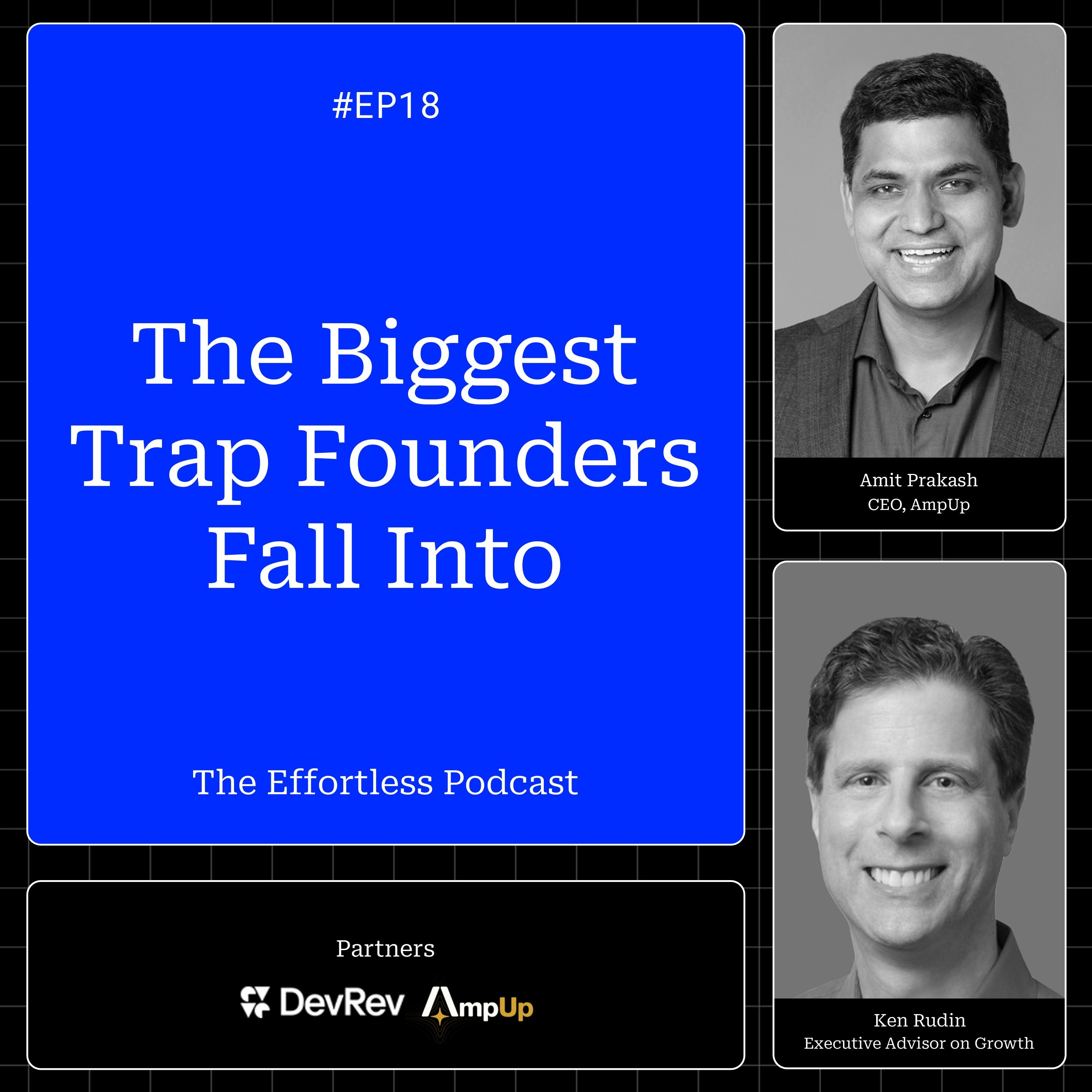
Ken Rudin on Retention, Startups, and Building Growth Teams - Episode 18: The Effortless Podcast
Sep 2701:25:14Tap to summarizeWhat drives real product growth—launching new features, or helping existing ones land? In this episode of The Effortless Podcast, Dheeraj Pandey and Amit Prakash sit down with Ken Rudin, former Head of Growth at Google, Facebook, Zynga, and ThoughtSpot, to unpack 15 years of lessons at the intersection of analytics and product.Ken shares the story of how a simple nudge doubled Google Search engagement, why retention curves are the truest measure of product–market fit, and how startups should think about growth before and after finding PMF. Along the way, he introduces frameworks like ARIA (Analyze, Reduce, Introduce, Assist) and MUD (Meaningful, Unique, Defensible) to help founders systematize growth instead of chasing hacks.From cross-selling in corner-store SaaS to the surprising power of changing a Google Ads hyphen into a vertical bar, this conversation shows why growth is less about tricks and more about rigorous, creative experimentation.Key Topics & Timestamps00:00 – Introduction: Ken’s career journey across Zynga, Facebook, Google, and ThoughtSpot02:00 – The Google “Sports Scores” story: Nudges that doubled engagement08:00 – Launches vs. Landings: Why most features stall without growth focus15:00 – When to invest in growth: Signals post-PMF and small-team leverage22:00 – Corner-store SaaS case study: Cross-sell, pricing insights, and awareness gaps27:00 – Counterintuitive nudges: Google Ads and the “– vs. |” experiment32:00 – Growth as a scientific process: Hypotheses, experiments, and iteration35:00 – Retention curves as PMF: Engagement as the strongest proxy43:00 – Common traps: Acquisition obsession and vanity metrics55:00 – Differentiation with MUD: Meaningful, Unique, Defensible advantages01:03:00 – The ARIA framework: Analyze, Reduce, Introduce, Assist01:10:00 – Fun Q&A: TED Talks, awkwardness, posture, and Peter GabrielGuest:Ken Rudin – Growth and analytics leader with senior roles at Google, Facebook, Zynga, and ThoughtSpot. Advisor to startups on scaling growth and building data-driven teams.Hosts:Amit Prakash – Co-founder and CTO at ThoughtSpot, former engineer at Google AdSense and Microsoft Bing.Follow the Host and Guest:Amit PrakashLinkedIn – https://www.linkedin.com/in/amit-prakash-50719a2/Twitter/X – https://x.com/amitp42Ken RudinLinkedIn – https://www.linkedin.com/in/kenrudin/Share Your ThoughtsHave questions, comments, or ideas for future episodes? Email us at EffortlessPodcastHQ@gmail.comDon’t forget to Like, Comment, and Subscribe for more conversations at the intersection of growth, analytics, and innovation.
Transcribe →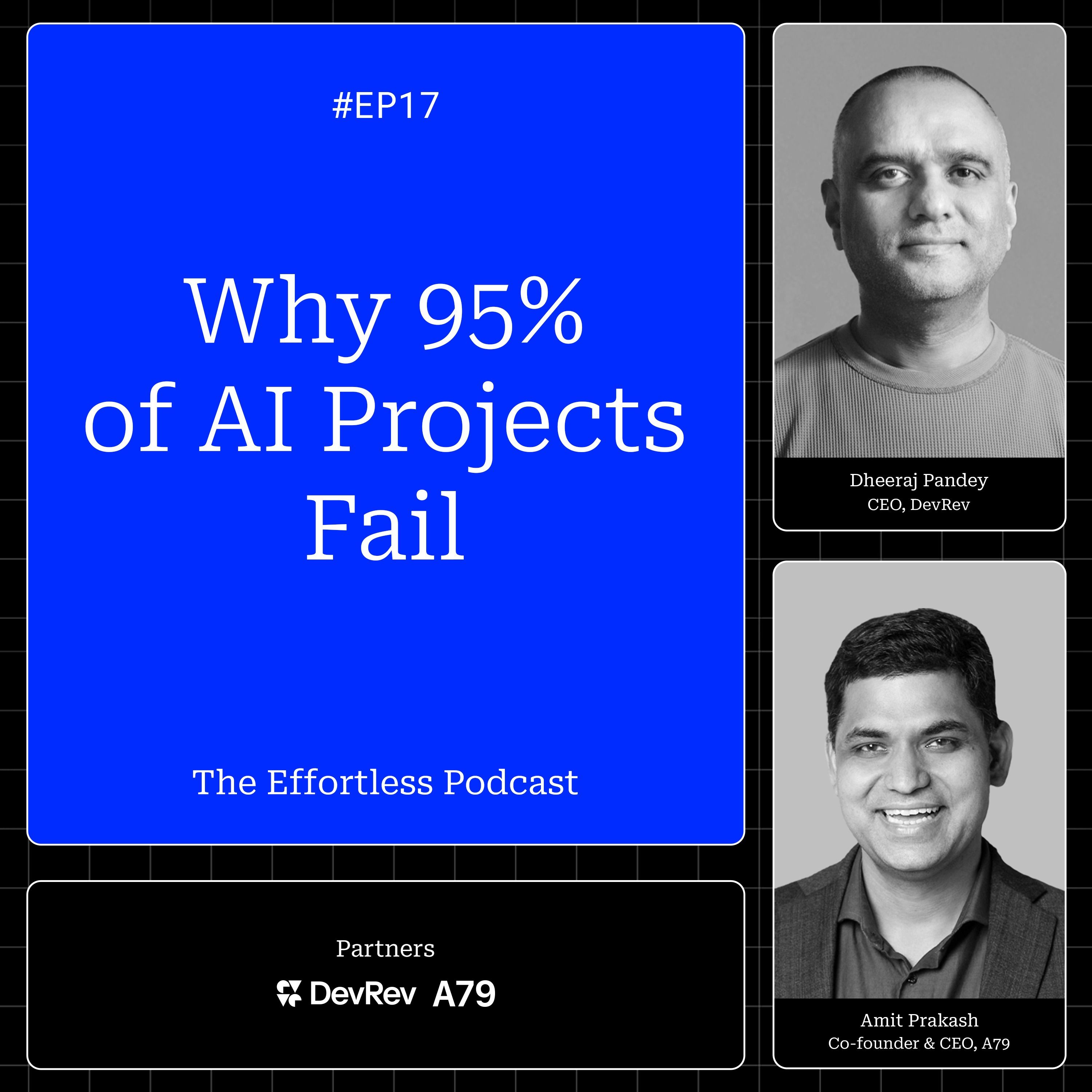
Will the AI Bubble Burst, or Last Longer Than We Think? - Episode 17: The Effortless Podcast
Sep 201:00:45Tap to summarizeIs AI truly delivering ROI, or are we just “burning tokens”? In this episode of The Effortless Podcast, Amit Prakash and Dheeraj Pandey unpack the MIT report that sparked debate on AI’s real impact and revisit the timeless dilemma of whether to build or buy.They frame the conversation through a pyramid of adoption—from global enterprises with engineering armies, to mid-market firms that buy and configure, to SMBs seeking plug-and-play simplicity. Along the way, they explore the economics of “Supernovas” vs. “Shooting Stars” in AI startups, the integration struggles holding back the mid-market, and the consulting-heavy pitfalls of enterprise “project thinking.”This candid discussion reflects on lessons from the dot-com era, the stubbornness of leaders like Jeff Bezos and Reed Hastings, and why iteration—not initial insight—defines whether AI experiments evolve into durable products.Key Topics & Timestamps00:00 – Introduction: Framing “Agent Season” and the MIT report02:00 – The ROI Question: Burning tokens or building value?03:00 – Why Iteration Matters More in AI Than Traditional Software04:30 – The Pyramid of Adoption: Enterprises, Mid-Market, SMBs08:00 – SMBs, Plug-and-Play AI, and Startup Archetypes12:00 – Supernovas vs. Shooting Stars: Startup Economics15:00 – Dot-Com Parallels and the Role of Cheap Capital18:00 – Disillusionment and the Stubbornness of Leadership21:00 – Infrastructure and Iteration Speed: Microsoft vs. Google30:00 – Mid-Market Struggles: Integration and Context Problems36:00 – A Warehouse for Work: RAG, Indexing, and Workflows41:00 – The Consulting Trap in Enterprises46:00 – Projects vs. Products: The Cultural Divide51:00 – Internal Apps, Workflows, and the “Build” Mentality53:00 – Adoption, Habits, and the Design Challenge55:00 – Design Partnerships as Lifelines57:00 – Final Reflections on the MIT Report & AI’s FutureHosts:Dheeraj Pandey – Co-founder and CEO at DevRev, former Co-founder & CEO of Nutanix. A tech visionary with deep interest in AI, systems, and the future of work.Amit Prakash – Co-founder and CTO at ThoughtSpot, former engineer at Google AdSense and Microsoft Bing, with extensive expertise in distributed systems and machine learning.Follow the Hosts:Dheeraj Pandey:LinkedIn – https://www.linkedin.com/in/dpandey/Twitter/X – https://x.com/dheerajAmit Prakash:LinkedIn – https://www.linkedin.com/in/amit-prakash-50719a2/Twitter/X – https://x.com/amitp42Share Your Thoughts:Have questions, comments, or ideas for future episodes? Email us at EffortlessPodcastHQ@gmail.comDon’t forget to Like, Comment, and Subscribe for more conversations at the intersection of AI, technology, and innovation.
Transcribe →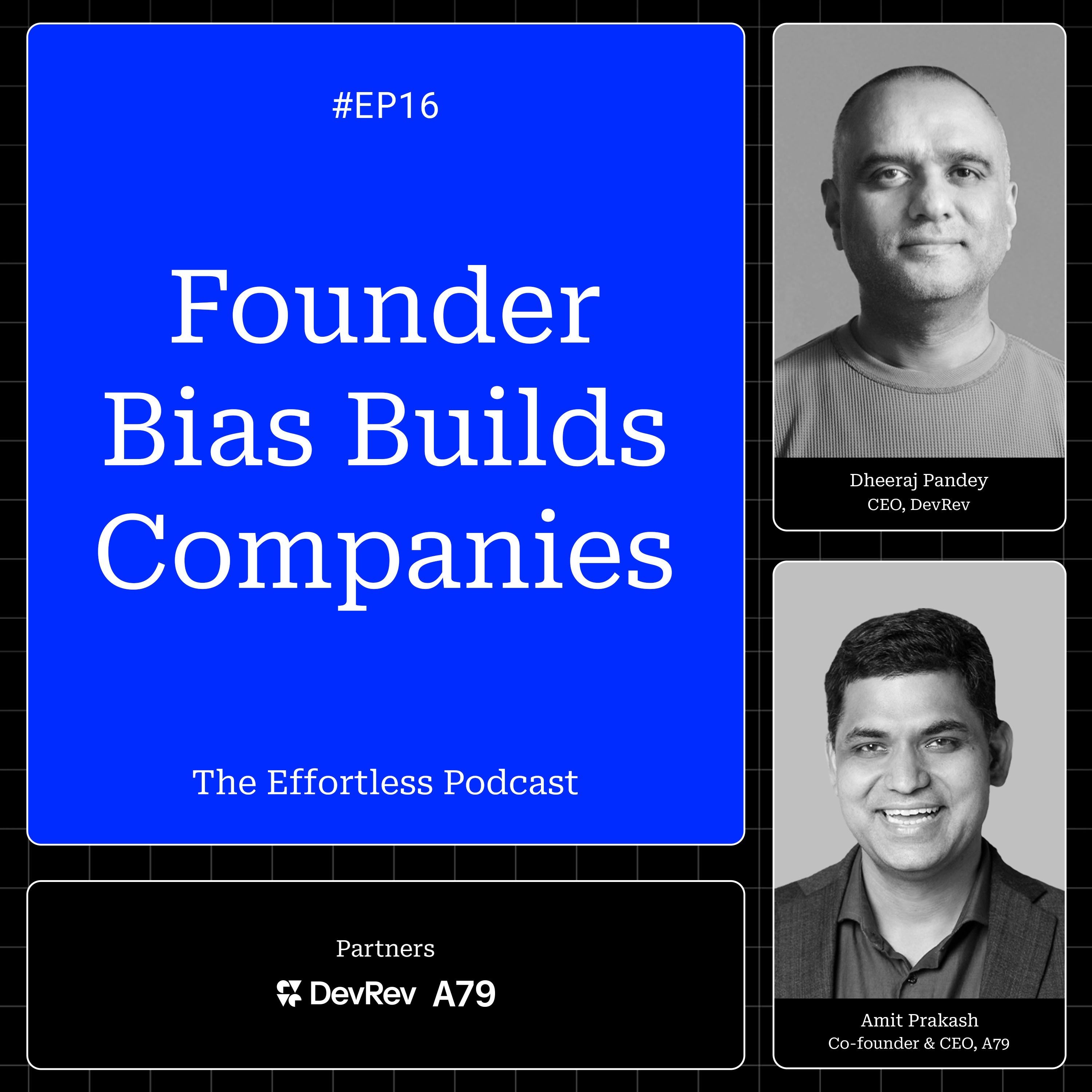
Building T-Shaped AI: The Founder's Dilemma of Horizontal vs. Vertical - Episode 16: The Effortless Podcast
Aug 2601:12:13Tap to summarizeHow do you build a successful AI company in today's landscape? Do you go broad and build a horizontal platform for everyone, or do you go deep and create a vertical solution for a niche market?In this episode, Dheeraj Pandey and Amit Prakash dive into one of the most critical strategic challenges facing founders today. They explore the paradox of needing broad context for AI to be intelligent, while also requiring sharp focus to find a buyer.The discussion covers everything from distribution models (Product-Led Growth vs. Sales-Led Growth), the role of founder bias, the rise of the citizen developer, and why the most successful AI companies of the future, like the most effective leaders, will need to be "T-shaped."Key Topics & Chapter Markers[00:01:28] Welcome & Summer Recap[00:08:04] Introducing the Core Theme: Breadth vs. Depth in AI[00:10:28] The Technologist's Dilemma: Building a Horizontal Platform vs. a Vertical Solution[00:12:05] The Paradox of AI: Needing Broad Context for Narrow Problems[00:15:00] The Persona Problem: Building for a Builder vs. an End-User[00:27:21] Go-to-Market Models: PLG vs. Forward-Deployed Engineering (SLG)[00:32:40] Founder Bias: How Personal Ambition, Laziness, and Experience Shape Strategy[00:42:55] The Hourglass Model: Let Chaos Reign, Then Reign in the Chaos[00:49:19] Why Every SLG Company Must Have a PLG Motion to Prevent Churn[00:50:21] The "T-Shaped" Metaphor for People and AI Products[00:51:30] Context and Memory: Prompt Engineering vs. Fine-Tuning Models[01:01:20] Finding Your Serviceable Addressable Market (SAM) vs. Total Addressable Market (TAM)[01:04:40] The Power of "Unreasonable Hospitality" in Customer Focus[01:06:00] Teaser for the Next Episode: A Deeper Dive into MCP vs. A2A ProtocolsHosts:Dheeraj Pandey: Co-founder and CEO at DevRev, formerly Co-founder and CEO of Nutanix. A tech visionary with a deep interest in AI and systems thinking.Amit Prakash: Co-founder and CTO at ThoughtSpot, formerly at Google AdSense and Bing, with extensive expertise in analytics and large-scale systems.Follow the Hosts:Dheeraj Pandey:LinkedIn - https://www.linkedin.com/in/dpandeyTwitter - https://x.com/dheerajAmit Prakash:LinkedIn - https://www.linkedin.com/in/amit-prakash-50719a2/Twitter - https://x.com/amitp42Share Your Thoughts:Have questions, comments, or ideas for future episodes? Email us at EffortlessPodcastHQ@gmail.comDon’t forget to Like, Comment, and Subscribe for more in-depth discussions on AI, technology, and innovation!
Transcribe →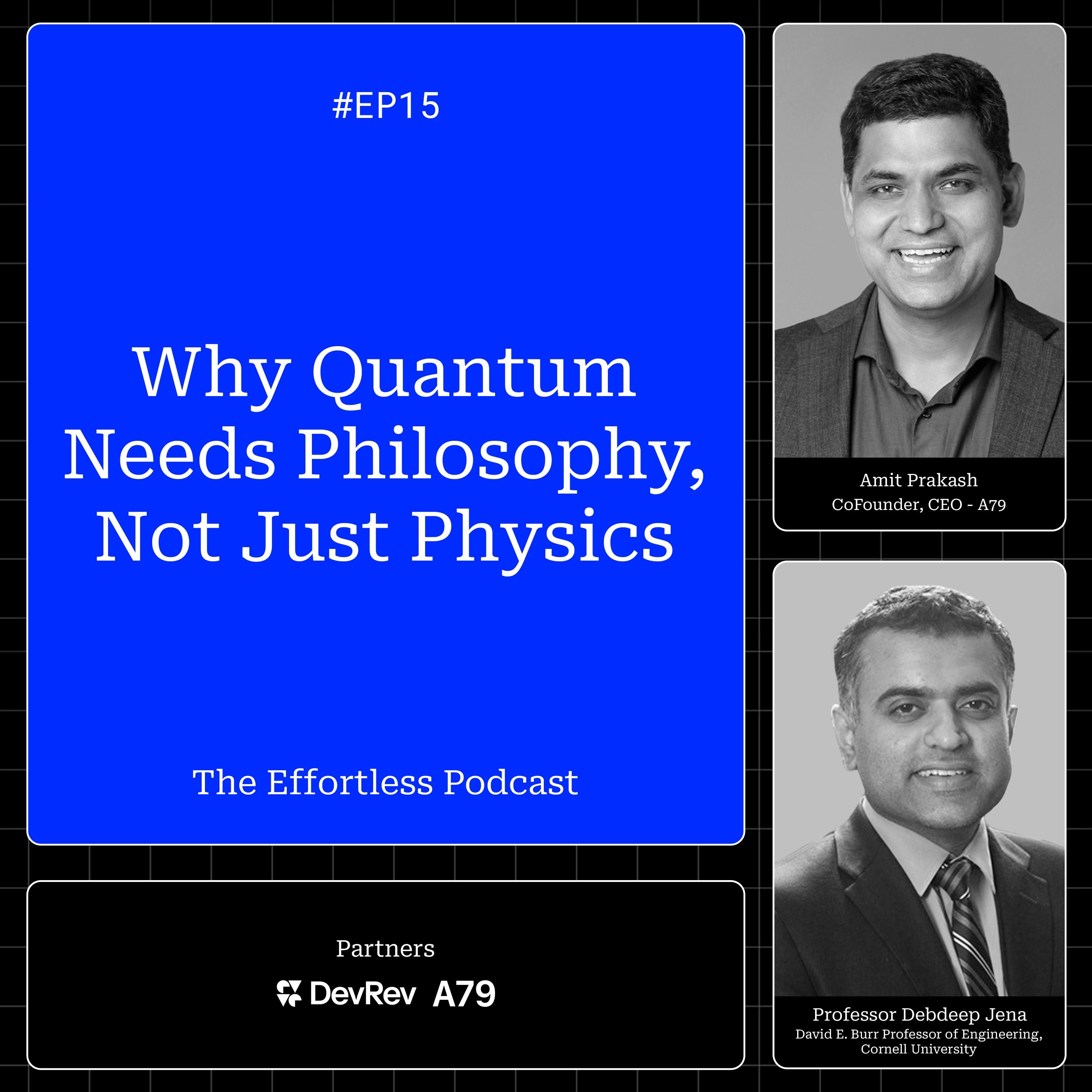
Debdeep Jena on What It Really Takes to Build a Quantum Computer - Episode 15: The Effortless Podcast
May 15, 202502:24:21Tap to summarizeIn this episode of The Effortless Podcast, host Amit Prakash sits down with Professor Debdeep Jena, a leading expert in semiconductors, superconductors, and quantum devices at Cornell University. They explore the fascinating world of quantum computing, from its early 20th-century origins to its transformative potential in modern technology.Professor Jena delves into key concepts of quantum physics and quantum computing, shedding light on quantum systems, qubits, and the challenges and promises of quantum hardware. With decades of experience in semiconductor research, he explains how quantum computing could revolutionize industries, from computational speed to energy efficiency.In this conversation, they discuss:The birth of quantum mechanics and its evolution into quantum computingThe role of qubits and superposition in quantum devicesHow quantum computing is tackling complex problems beyond classical computingCurrent advancements in quantum hardware and the roadblocks still aheadProfessor Jena's perspective on the future of quantum technology and its potential impact on industries like AI, communications, and beyondThis episode is a must-watch for anyone curious about the future of quantum technology and its applications in modern science and industry. Professor Jena provides unique insights into how quantum systems are poised to transform computing, energy efficiency, and even artificial intelligence. Whether you're a tech enthusiast, a student of physics, or a professional exploring the frontier of quantum technology, this conversation is packed with invaluable knowledge.Key Topics & Timestamps:00:00 – Introduction to Quantum Mechanics, Entanglement, and the Role of Information in Physics05:00 – Classical Computation vs. Quantum Computation: Understanding the Basics of Classical and Quantum Bits12:00 – The Role of Information Erasure and Its Link to Energy Loss in Classical Computing18:00 – Superposition and Entanglement: The Basis of Quantum Computation25:00 – Bell's Theorem and the EPR Paradox: Understanding Quantum Nonlocality32:00 – Quantum Measurement and the Challenge of Formulating the Right Questions in Quantum Computation40:00 – Shor’s Algorithm and the Promise of Quantum Speedup for Prime Factorization45:00 – Practical Quantum Computing: Grover’s Algorithm and the Search Problem52:00 – The Need for Quantum Error Correction and the Problem of Decoherence in Quantum Systems58:00 – Superconducting Qubits: The Technology Behind Quantum Hardware1:05:00 – The Challenges of Packing More Qubits: Coherence Time and Integration of Quantum Systems1:12:00 – Temperature and Cooling Requirements for Superconducting Qubits1:20:00 – Advances in Quantum Error Correction and Strategies for Scaling Quantum Devices1:28:00 – Future Directions for Quantum Computing: Materials Science, Algorithms, and Hardware Innovations1:35:00 – Schrödinger’s Cat: Exploring Quantum Superposition in a Philosophical Context1:45:00 – The Double-Slit Experiment: Quantum Interference and the Nature of Quantum Systems1:50:00 – The Future of Quantum Computing: Overcoming Challenges and Expanding Practical Applications2:00:00 – Concluding Thoughts on the Impact of Quantum Mechanics on Modern Technology and the Future of ComputingHosts:Amit Prakash: Co-founder and CTO at ThoughtSpot, former engineer at Google and Microsoft, and expert in distributed systems and machine learning.Guest:Professor Debdeep Jena: David E. Burr Professor of Engineering at Cornell University, expert in semiconductors, superconductors, and quantum devices.Follow the Hosts and Guest:Amit Prakash: LinkedIn | XDebdeep Jena: LinkedInHave questions or thoughts on AI? Drop us a mail at effortlesspodcasthq@gmail.comDon’t forget to like, comment, and subscribe for more insightful conversations on the future of technology and innovation!
Transcribe →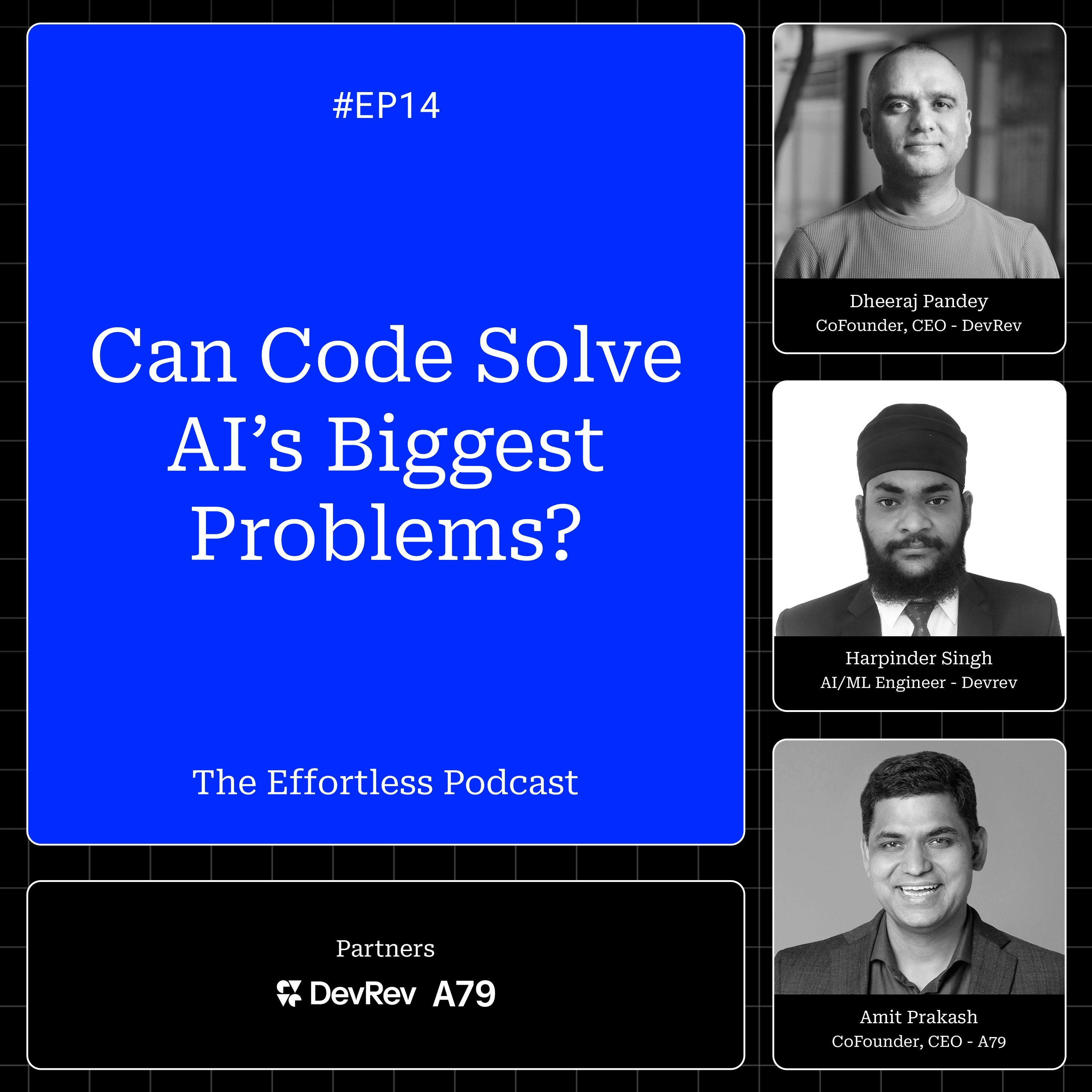
MCP Is Less Software Engineering And More Social Engineering Ft. Harpinder Singh- Episode 14: The Effortless Podcast
Apr 30, 202501:19:03Tap to summarizeEpisode 14 | The Effortless PodcastIn this episode of The Effortless Podcast, hosts Dheeraj Pandey and Amit Prakash sit down with Harpinder "Happy" Singh, AI/ML Engineer at DevRev, to explore the future of AI and machine learning in business automation. Happy, who joined DevRev in 2021, shares his journey from computer science to AI, discussing how DevRev is leveraging cutting-edge technologies like large language models (LLMs) and function calling to streamline enterprise workflows.Happy breaks down the key concepts of AI-driven workflows, the debate between federated and integrated systems, and the growing importance of Python in AI. He also shares insights from the CodeAct paper, which proposes using Python code execution for more efficient and flexible LLMs. The conversation highlights the transformative potential of AI in enterprise automation and how it is reshaping industries.They also cover:The evolution of AI at DevRev: From workflows to AI-driven automationThe role of Python in executing complex tasks for LLMsUnderstanding the user-agent-environment model in AI systemsHow federated vs. integrated systems impact AI performanceThe future of AI in enterprise automation and DevRev’s innovationsHappy’s decision to stay in India and the growing tech ecosystem in IndiaThis episode provides valuable insights into how AI is transforming business operations, making complex workflows more efficient and accessible. Whether you're an AI enthusiast, a developer, or a business leader, this conversation is a must-listen for anyone interested in the next wave of AI-driven innovation.Key Topics & Timestamps:00:00 – Introduction to Harpinder "Happy" Singh & His Journey into AI03:00 – Happy’s Early Background: From Shahjahanpur to BITS Pilani06:30 – Transition to AI at DevRev09:30 – Bangalore Life and Growing with DevRev13:00 – AI in India vs. the US18:00 – Federated vs. Integrated Systems: Which Approach Works Best for AI?25:00 – The Role of Python in AI32:00 – User, Agent, and Environment Model in AI39:30 – The CodeAct Paper: Replacing Tool Calls with Python Code Execution47:00 – AI in Enterprise Automation: How DevRev Uses AI to Streamline Workflows54:00 – Looking Ahead at DevRev’s AI Innovations1:00:00 – Final Reflections: The Future of AI in Business and AutomationHosts:Dheeraj Pandey: Co-founder and CEO at DevRev, formerly CEO of Nutanix, a tech visionary passionate about AI and systems thinking.Amit Prakash: Co-founder and CTO at ThoughtSpot, former engineer at Google and Microsoft, and expert in distributed systems and machine learning.Guest:Harpinder Jot Singh: AI/ML Engineer at DevRev, working on the cutting edge of large language models (LLMs), AI-driven workflows, and integrating AI into enterprise systems.Follow the Host and the Guest:Dheeraj Pandey: LinkedIn | XAmit Prakash: LinkedIn | XHarpinder Singh: LinkedInHave questions or thoughts on AI? Drop us a mail at effortlesspodcasthq@gmail.comDon’t forget to like, comment, and subscribe for more insights into the future of AI, business automation, and enterprise technology!
Transcribe →