← The Everyday Millionaire and Mindset Matters Podcast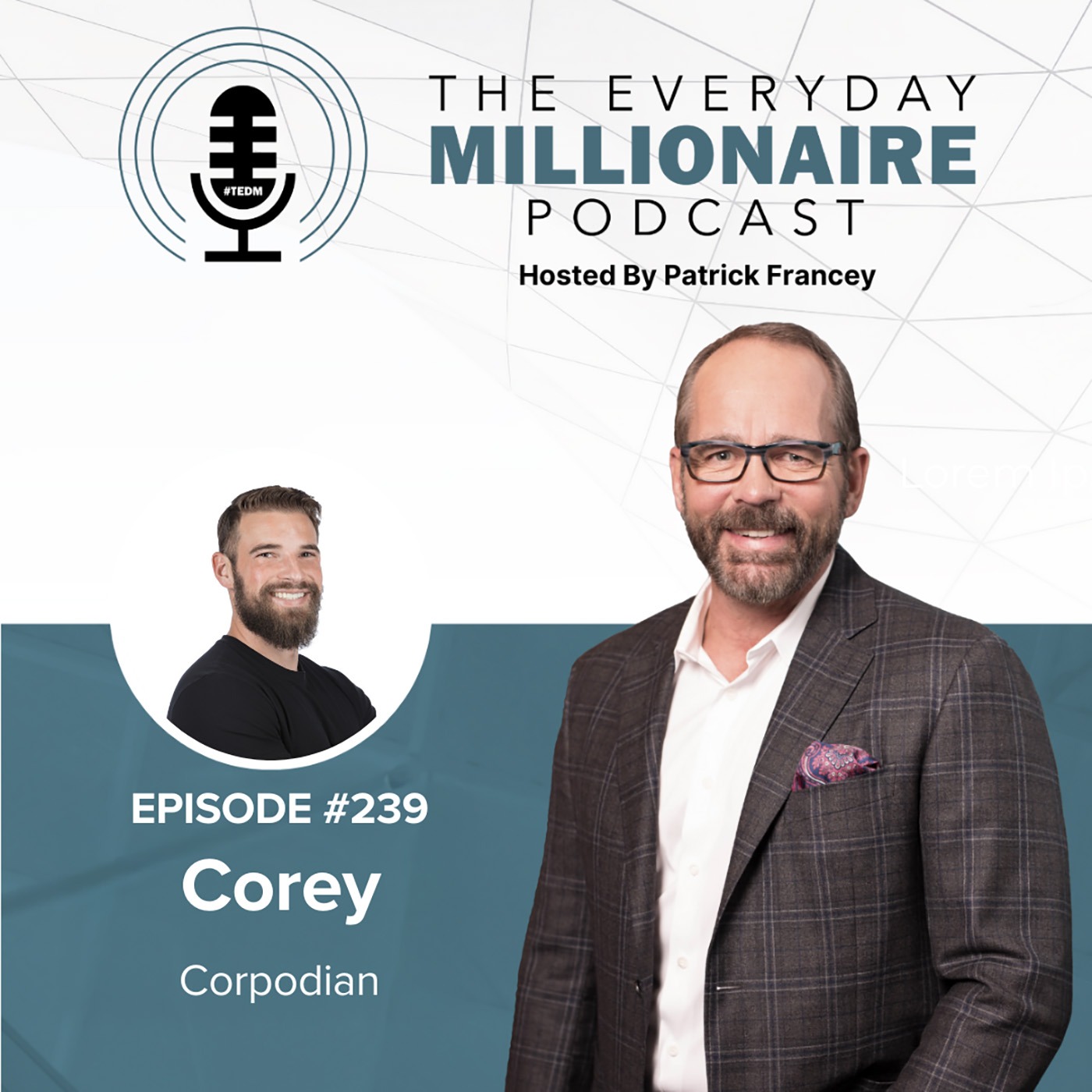
The Everyday Millionaire and Mindset Matters Podcast
TEDM – Corey Corpodian on Being Busy vs Being Productive: How High Performers Protect Time and Win (Episode 239)
01:28:55
Loading summary
Transcript108 lines
- [00:00]
A
Foreign Hi there and welcome to the Everyday Millionaire podcast. My name is Patrick Francie and I am your host. And I want to begin by saying thank you for listening. On this show, I am having conversations with seemingly ordinary individuals who have achieved some amazing and extraordinary results in both their life and business. My intention is to inspire and help you learn and grow by having my guests share their journey of how they face and overcome their challenges, but also how they celebrate their. Their many wins. And now let's get on with this show and have a conversation with today's guest. Most people don't fail because they lack effort. They fail because they don't know how to convert clarity into action, especially when the pressure's on. Today's guest has spent decades in the trenches helping leaders, entrepreneurs, and sales professionals do exactly that. Corey Korpodian is the founder of Unleash Success, which is a high performance sales and leadership consultant trusted by organizations that don't have the luxury of guesswork. Corey doesn't teach hype. He teaches execution, how to think clearly, how to communicate powerfully and perform when it actually matters. Now, his work sits at the intersection of mindset, strategy, and real world sales psychology. And today, we're going to unpack what separates average performers from people. People who consistently win. If you're serious about results in business, leadership, or life, this conversation will sharpen your edge without any further delays. Let's get this show started. Corey Corpian, welcome to the Everyday Millionaire podcast. Thanks for joining me.
- [01:51]
B
Appreciate it, Patrick. I'm excited to be on.
- [01:54]
A
Hey, listen, I'm excited to have you on because we align a lot in, you know, some of our thought processes and some of the work you're doing overlaps with some of the work that I've been doing over the years. But, you know, your bio is really impressive. But, you know, if I've learned nothing else over the past nine or ten years I've been doing a podcast is bios are never or they don't quite do justice to the guests that I'm interviewing. And they're never up to date because most of my guests are kind of moving and shaking and doing stuff and expanding. So they're. Unless they're updating them, you know, kind of monthly, it seems that they change. All of that is a prelude to say, if somebody walks up to Corey today and says, what do you do? What does Corey. You answer that question. How do you answer that question?
- [02:36]
B
Yeah, so I'm the host of the podcast Unleash Success, where I also interview entrepreneurs who have Built million and even billion dollar companies. Through that, I started to build a platform and I wrote a book called Emotional Fitness. Emotional fit is something I'm very proud of. And I think this is where we align a lot. It's just on that mental game. And, and what I do now is I help entrepreneurs tackle that mental game to be able to grow themselves and their businesses. At the end of the day, you know, one of the things that I found through my own journey and I kind of get into that a little bit. So emotional fitness is something that really is to me, the defining factor between people who are successful and people who fail. Because everybody fails. It's what you do when you fail. Mike Tyson says, you know, everybody's got a plan until you get punched in the mouth. Now what? And for me, you know, my plan was similar to what a lot of people will grow up in. They'll have a blueprint for success. My blueprint from my parents was go to school, get good grades, go to college, get a good job. And in my family that meant get a higher level degree, become a doctor or lawyer. Must have heard that a bunch of times from my dad. You got to be a doctor or a lawyer. Well, guess what? I was an orthodontist and my sister's a lawyer. So what, what happens is, is that, that, that blueprint became our roadmap for success. Now here I am, I go to dental school, I graduate high school year early, I do college in three years, I get to into NYU dental school, do four years of NYU dental School. Three years after that for orthodontic residency, I graduate as a board certified orthodontist, which at the time only 20% of us were board certified. As a whole certification thing, you know, I like to try and achieve everything I can. And I, I wake up six months after graduating going, is this really all that it was about? Is this what it is? Is this what my life is going to be like? And I had this moment where I was like, I got to do something more. I was trying to figure it out. And you, you wish it happens in a single instant, but it took a couple years for me to just kind of run through the, and get, get my ass kicked, right? So I start competing in Men's Physique, a physical fitness competition similar to bodybuilding, but a little bit lower rung, very popular in the bodybuilding space. And this is, you know, 2014, 2015. And as I'm going through this process, I'm trying to get my pro card, I'm trying To figure out what life is all about. And I noticed this mole on my chest that, you know, I'm looking at my body all the time as I'm working out and I see it's changed a bit. So I decided to go to a dermatologist to get it checked out. Hadn't been to a dermatologist in 10 years. Come to find out it was melanoma. So if you're not familiar, melanoma, skin cancer is the most aggressive form of skin cancer. I was very, very lucky that I caught it where I did because they basically took out a little larger than a golf ball sized chunk out of my chest. But I remember sitting there talking to the dermatologist. And I was sitting there, I'm like, I'm trying to get my pro card. You know, I, I'm trying to find happiness somehow and success somehow. And I said, can I wait six months? I'm about to go get my pro card at this next event. She goes, no, if you wait six months, you can lose half your chest. If you wait a year, you might not even be here. And that is what I always talk about, where that was my momento mori. You know, remember that one day you will die at 27, 28 years old. You know, you think you're going to live forever. You think you got a lot of opportunity. But that really caused me to snap out of it. But I didn't know what to do, so I started reading books. I started going to personal development seminars and started to understand this world. And I'm not one to follow one guru and say, this is my whole life. I'm going to follow everything they do. I like to learn from everybody and then figure out what works for me. And that's ultimately what I did. So fast forward about six to nine months later, my entire life has changed, right? I meet my, the woman of my dreams, who's now my wife and mother of our two beautiful children. I am doubled my income while working less. And I even bought this dream beach house, which, you know, was like a pipe dream. And six months ago I wrote it down on a piece of paper and, and made it happen. And everybody from the outside, you know, I can tell them I feel good, but all of a sudden they see the results and they go, okay, okay, what are you doing? That's different because I read those books, I went to those seminars. I've been doing the things you do, but it's just like working out, right? People say I followed everything you did. Did you? Or are you lying to yourself. Did you try it for three days, three weeks, even three months, and then give up because you didn't see the results? So one thing that I do that's. It's difficult, right, to pull what the future you looks like and bring it to the present so intensely that it forces you to do things that are uncomfortable in the moment. And out of this entire experience, I started doing public speaking, and I realized the best way to reach a lot of people was podcasting and writing a book, because I would have the same conversation with individuals. I'd have the same conversation on stages with 100 or 500 people. And ultimately, it comes down to this. You know, emotional fitness is the defining difference between success and failure. If you can't handle failure, what do you do when you fail? Do you give up? Do you pack your bags, do you go home? Or do you reroute yourself to success? And understanding how to do that in a moment, understanding how to do that habitually every day to then become who you are, your behaviors and character and even your identity is what emotional fitness helps build people into. And as I transitioned out of that, I really. And sometimes people talk about, you know, I want to find my purpose. I want to, you know, figure out what I'm supposed to do. And I don't think about finding my purpose. It's not something I lost when I was born. I think about creating my purpose and designing it, and that's what I did slowly over time. So that's who I am. And, you know, love to dive in deeper, wherever you feel it fits. But, you know, at the end of the day, my goal is to help people transform their lives, to live with more freedom, more passion, and more purpose.
- [08:52]
A
Okay, So I love that. Now let me take you back a little bit, because I had a. Not the same. I had a. I had an experience of a. We'll call it a cancer scare. Now, it wasn't cancer, but it was definitely head in that direction. And we don't need to get into the story, but the point of it was, is when I got the diagnosis for what happened in my case was familial history of colon cancer. I went in, got screened, they went, hey, we're going to have to remove your colon. And it's not a case of if you will get cancer. It's a case of when you will get cancer. And so that was, again, it was a genetic predisposition, blah, blah, blah. My point is, is that when I got that prognosis, when I got that, okay, this is what's going on? Remove your colon. It was like, holy. Like, it took me and it spun me on my head. Like I went, holy crap. You know, my wife, my daughter, I'm going, you know, my whole life kind of unfolded in front of me and what am I going to do? Right? And. And there was not even a prognosis of cancers. You know, like, you got time, but you're gonna have to, we're gonna have to remove your colon. There's just no choice because of the condition. So all good, all good. But I'm thinking about what you were talking about, emotional fitness. So when you got your diagnosis, when he looks at you and goes, melanoma, this goes back to what, what you brought up, I think is in terms of emotional fitness. When you reflect on that moment emotionally, how did it hit you? Like, what was your reaction in that moment? Did it wake you up, did inspire you? Did it shut you down? Did you. I went through about a three week kind of spiral down before I kind of came up and went, okay, get your shit together. You got this. You know, you're good. You know, don't start living into the future and telling stories about stuff that could happen, it's not there, blah, blah, blah. My point is, but it took me about three weeks. I was like scared the crap out of me because I'm going, what am I going to do? So how was it for you? I want to go back there first and kind of give a benchmark of, at that young age, getting that diagnosis. How did that hit you emotionally?
- [10:57]
B
Well, very similar to you. You know, I wish I, for the purposes of story, to keep it short, it's boom, boom, right? But the truth is, I probably got that it must have been August because I was trying to go compete again in September, October, and I, I did not, I did not immediately snap back. I probably spent even longer because I got. I had battled with depression for many years and, you know, it just came to a point, it was probably about December, November, December, where I just, I was in such a bad place mentally after this diagnosis that to me, I just didn't see the reason to live. And I thought, you know, at this point, I'm, I'm in desperation. I need to change something in my life. I don't know how, I don't know what, but it needs to change and it needs to change now. And so I, I jump on. It's funny enough, I. This is kind of crazy. So this is. But my personality, I find out about Tony Robbins, right? And I remember hearing about Tony Robbins as a kid, because my dad was, you know, into sale. He owned his own business, he was in sales. And he's like, tony, Tony Robbins is a great guy who should listen to his motivational tapes. And he was in that one movie, shallow. Hell yeah. Where he lies about everything and. And Tony Robbins convinces him to see the inner beauty. So Tony Robbins event does this one event called Date with Destiny every year. And I have no idea. I've never read a book from Tony Robbins. I've never seen a seminar or anything. And there's a series of things. I actually bought a book about finance. It was called Money Master the game. And they charged me for a hundred dollars coaching session. I was like, no, no, no, I can't afford that right now. I don't want it. In the process of getting my refund, I actually inquired, what's the state with destiny thing? And this person kind of sold me on the idea. And of course, you know, there wasn't a lot of marketing like there is now, But I started to research it. I was like, maybe, maybe not. And again, out of desperation, I. I didn't know what else to do, but they basically sold me land on the idea that this could change your life. And I just said it. I dropped $5,000. I took a week off work, I flew to Florida. And my first day in the seminar, Mind you, I've never been to a personal development development seminar. I've never been to a Tony Robbins event. Never even. I don't have no idea. I get in there.
- [13:26]
A
You jumped in the defense.
- [13:27]
B
I sure did, man. And people are jumping up and down the, oh, whoa, Tony Robbins. And I'm like, what the is going on? But an hour into this seminar, I said, I give it the day. I thought I was going to leave. I swear to God, I thought I was going to leave. An hour into the seminar, he says something I'll never forget. He said, success without fulfillment is the ultimate failure.
- [13:52]
A
And I was like, wow.
- [13:53]
B
Because everybody told me how much I should be happy. The more they told me I should be happy. After graduating as valedictorian in high school, after doing college in three years, going to NYU for dental school, becoming a board certified orthodontist at 26 years old, they're like, you are on paper. You should be so happy. The more they told me that, the more miserable I became. And he described me, right. I was very successful on paper, making more money than I ever dreamed of as a kid. And yet at the same time, I had zero fulfillment. And My life felt like the ultimate failure. And so I stayed for the entire time and, you know, definitely believe in the, in what Tony Robbins preaches and, and his methods. But after that, I said, okay, wow, I, I can change my life. That. But the thing is, thousands of people go to that event. The difference is what you do when you get home. Same people, same environment, same routines. So I created new routines. I created daily exercises, daily things that I would do every day to snap myself out back into this state where mentally and emotionally I was feeling successful, I was conquering the world. I felt motivated instead of falling into old habits, because it's easy to fall into old habits. You go home friends like, hey, do you want to go out for a couple of drinks?
- [15:17]
A
Sure.
- [15:17]
B
You wake up the next day, you're kind of like, oh, I could be lazy and just watch TV or scroll or whatever it is. And suddenly before you know it, you're back in the same place. And so changing those emotional habits every day was the difference for me.
- [15:33]
A
So there's a couple. I got so many questions. Corey so when you think about. First off, define from your, in your definition, let's define emotional fitness, what it means for you, how you would define it, and for the listeners so that we have a strong context for where we're going with this.
- [15:52]
B
And I want to be clear, especially for men who are like, I, I don't want to deal with my emotions. No, this is not that. It's not saying you have to cry on someone's shoulder. Emotional fitness is the ability to control your emotions instead of letting them control you. Something bad happens, you get angry. Do you yell in outrage and make a mistake or upset somebody or cause even more problems? Or do you pause, assess the situation, and then make a rational decision? Now, we think about that as in a moment where someone cuts you off in traffic, no big deal. But what are these little things every single day that your emotions are slowly pushing you away from your goals? So specifically, when you're trying to accomplish a goal, I talk about a figure eight, where when people want to accomplish a goal, they're driven by two main emotions. Faith that they can accomplish the goal, or fear that they can, that they can't fear that they're worried about somebody. Way people are going to perceive them that they're going to fail, that they're not good enough, that they're not going to be loved if they do this, or faith that they can accomplish that they have the skills that if they don't have the skills, they can find A way or find someone to teach them, to help them that there is opportunity out there. And out of this crazy eight people choose one of two options. Distraction. Which distraction could be in the form of going out with friends, even tv, social media, doing something else that might seem productive but doesn't help you accomplish your goals.
- [17:22]
A
Right.
- [17:22]
B
People are like, well, I had to hang out with my family or my friends. That's good. You do. But if that's what you're choosing every time you're thinking about what goal you want to accomplish, it's not going to help you. So they either choose distraction or they choose action towards their goal. Right. And the best time to take action is immediately after setting a goal. Keep that momentum going. And so these emotions, especially when we're as entrepreneurs trying to accomplish goals, trying to make more out of our life, feel success, feel happiness, feel purpose. This is what drives us either towards our goals or away from our goals.
- [17:56]
A
Sure. Love that. So I want to keep going back a little bit. Like I said, there's so many questions that you kind of opened up with in your opening that I want to unpack a little bit because I think it really serves us. And when you talk about emotional fitness, what you mentioned that you. Dealing with depression and given the work that you've done, given your experience as a young man and that depression, you know, one of the. And I'm. I'm certainly no expert on depression at all, so I'm not minimizing. And please, you know, don't be any. Nobody be offended if you've got. You're struggling with depression. But short of some kind of chemical mismatch or unfolding in your head, you know, there's a. There's a common theme or a common phrase that I've heard from professionals who, when I say professionals at Tony Robbins as an example, or Joe Dispenza, you can name any number of them. And really they're saying is that it's impossible to be depressed if you're not focused on yourself. So when you think about your depression and you think about emotional fitness and you think about how you kind of got out of that depression, did you find that as you kind of entered this world of understanding yourself and having a bigger view, a bigger vision again, you talk about habits and habitual shifts in what you do on a daily basis and your environment. My point is that is it safe to assume that as emotional fitness improves, as you get into these habitual actions that you do on a daily basis that are moving you towards your goals that your environment changes, and the next thing you know, it isn't about you. It isn't just about you. It's about people that you're now involved with. It's about bigger picture. It's about something outside of you, and depression kind of fades away. But I'm just riffing off of a thought process that you triggered for me. For me, what does any of that land for you in a way? Corey?
- [20:03]
B
Yeah, And I gotta, I'll be honest, it absolutely does. Right, because there's the poor me mentality. My life's so hard. I mean, sure, what I went through wasn't easy, but people have it way harder. I, I've interviewed paraplegics, I've interviewed people, you know, lost limbs, lost the ability to use their body know. So all these methods that I teach. A lot of times start with the physical. Like, you can't run a full sprint or bench press your body weight or squat your body weight and be depressed. You can't focus on any of that because you're just trying to breathe. Like, if I'm at a full sprint, running for my life, I'm not worried about depression. I'm just trying to breathe and survive. And so I think, you know, and, and that's why a lot of times that part of emotional fitness training is exercise, is getting out there. But I've talked to people who can't do that, and then I'm like, what do you do? And interestingly enough, they talk about how they help people. They talk about the people in their lives and how things change and they've adapted, and they do shift that focus away from themselves. And for me, I look at it like this, and this is why I say I see two sides to that coin. And I've said this all the time about leadership. It starts with yourself, because if you don't take care of yourself, you can't help anybody else. So you gotta make sure you're taking care of yourself. You know, when I first had kids, obviously no time. My second's very young right now, only eight months old, nine months old. And so just even that, there's no time. But one of the things, it was like, I gotta go to the gym at least three to four times a week. And my wife, she likes to work out too. It's just part of our routine. When we negated that or just didn't focus on it at all and said, okay, we just won't go to the gym for two months, we noticeably are a little bit shorter with each other. And you know, there's just that stress that you just can't get out. You need to physically exercise. So it talks about how depression is, you said a mental imbalance at times. But there's a lot of evidence that shows that even the way we hold ourselves, how we feel after we work out releases different endorphins and different chemicals in our body to be able to show, hey, like, this is a positive physiological reaction based on what you are doing, that mentally changes your attitude. So I talk about power posing, which Amy Cuddy, Harvard psychologist, proved in two minutes, if you power pose, pose like Superman or Wonder Woman with your hands on your hips, chest up, shoulders back, chin up, eyes forward, and you hold this for two minutes. I mean, just even me sitting up, now we're sitting down. Just even me doing this. If you're at home listening this, just you try this. This will change the way you feel in two minutes. And they showed increases testosterone, decreases stress hormone cortisol, and says you're a third more likely to go after your goals. Wow, that sounds great to me. Why don't I start every day with that?
- [23:05]
A
Sure. Right.
- [23:07]
B
And so for me, it definitely was going back to your original question about was it focusing on me? Well, I had to focus on me. I had to get better. I had to at least fix my daily problems. But what you'll notice is right after I did that, I immediately said, okay, well, now I want to take care of the people around me. And then I was like, you know, I do want to help people, because what I realized, and this is the crazy thing, I bought that beach house, right? And at the time, it was a million dollar beach house, which is just crazy to me. And I could not believe that I was able to accomplish this goal. And I remember sitting on the deck and I had this little peekaboo view of the ocean, right? A little slice of heaven. And I was watching, looking at the ocean, and I was watching it and I said, man. And I'm all by myself. So I call my girlfriend now my wife at the time or my girlfriend at the time now my wife, and she doesn't answer. I call my mom, my dad, they don't answer. I call both my sisters, they don't answer. It's in a moment that you can only understand sometimes when you experience it, because they always say, you know, you never see anybody crying in a Ferrari. And I was, I always joke about that, but I was sitting there, I was like, man, I wish I had somebody to share this with. What a great goal to Accomplish. But at the end of the day, if I don't have anybody to share with, it's meaningless. And so that really changed my perspective on life. And one of the reasons that I do what I do, that I like to work with people, I like to help people. And so to your point, focusing just on myself, I accomplished a great goal. Meaningless. Now when I have people, entertain people or have people over or help people one on one or, or speak to people and, you know, at a personal development seminar and they come up and Corey, what you said right there, that changed my life, that changed the perspective I have. Thank you so much. Or months later, listening to my podcast, how it changes their life or their business, man, that's fulfilling. And so to your point, focusing on other people, what you can do for the world, what you can contribute, because as human beings, you know, people are such big consumers these days, but really, it's what you can build, what you can contribute to the world that's going to give you fulfillment and purpose.
- [25:25]
A
I love that. So, you know, I'll go back a little bit. Just a really brief story. You know, when you think about, how do you react under pressure? How do you react in different situations? You know, many years ago, my now, my wife of now 30 years, 35 years together when we were dating, you know, she used to, we jokingly, you know, she referred to me as her favorite Neanderthal and, you know, my own evolution. Listen, I married up, no question about it, at least, you know, intellectually, for sure. Sure. But I responded certain ways to certain situations, and there was a pattern. And she would sometimes say to me, she would go, why is it that you respond that way? What is it about you that you come at things this way, you say these things, and I go, it's just the way I am. And one day, however many times I had repeated that mantra to her, it's just the way I am. She looked at me and she said, you know, it's a choice. Right. I went, what?
- [26:31]
B
What?
- [26:32]
A
That had never occurred to me. So, you know, that was really kind of a fork in the road moment. You talk about those things that kind of hit you between the eyes, and that was one of them. The understanding, though, is that, you know, my point of that is that when you talk about emotional fitness is what. How it translates for me, and really how we respond in situations is a choice. And the first part of it is the development of, number one, having the awareness of your pattern, whatever it may be, it's often a blind spot. You often can Justify however you react in that negative reaction. So when you think about the work that you're doing with the entrepreneurs, in your experience, what do you see that actually breaks down first when people are in those pressure situations, you know, emotionally. Got it. But is it skill, confidence, is it their decision making? How do the best in your experience with the entrepreneurs you work with, how do the best performers prevent that collapse? Yeah, this happens and this is how I'm going to react. You know, this is unacceptable. Whatever the story is that you justify the reaction. What's your kind of, what's your experience in that?
- [27:48]
B
Well, to start, I think you people have to realize what most people do experience in entrepreneurship. You know, most entrepreneurs experience some sort of form of mental health, stress, anxiety, depression. It's something along the lines of 2/3, I think of entrepreneurs out there will at some point in time experience this. And anybody who's grown a business understands that the stress is there, that it's very difficult. And it's also building a business can be lonely. Right? You're doing it on your own. And so that's tough to adapt to. What I see the best of the best do is that they, they create a very, they're very disciplined in creating a routine for themselves. They're very protective of their time. Time is the most valuable asset we have. We all have 24 hours in a day. So do they let everybody else control their time? Do you run from fire to fire to put it out? No. So they're very protective of their time. They typically have a ritual that involves either goal setting or journaling in the morning. Almost all the entrepreneurs I know do some sort of physical activity in the morning and they block their time. So time management is critical to understanding that. Why is that so important when it comes to mental and emotional fitness and the mind game is because, you know, a lot of times if you're so focused and worried about everything else going wrong, always worried about putting out different fires, then you're never able to grow your business. You're able to focus on the things that do actually matter, that move the needle. So a lot of these people will spend even the first four to six hours of the day focused on what's going to grow their business. A lot of me time, a lot of important meetings, stuff like that. And then at the end of the day they go in, okay, what can I do now? And I will say that every single, I mean this like uber successful entrepreneur I've ever interviewed, people who have built a hundred million billion dollar businesses. They are Constantly training their mind and emotions, they're constantly working on it. Because as human beings we have this propensity to avoid pain, right? It physiologically and you know, going to the gym, painful, especially at first, getting rejected a bunch of times when you're trying to grow your business, painful, you know, things not working out painful. But the ones who are able to turn that around and say, understand that rejection means I'm learning different ways that don't work and I'll find a way that does work, that even though the gym is painful, that soreness that I feel afterwards, it feels good, right? Or I get that runner's high afterwards, right? They're able to change that pain pleasure principle that we have to be able to shift it into something that works for them. And I will say the last thing that every single entrepreneur that I know, this is mental and emotional fitness. This is emotional fitness to a T. And I draw this like gp. I associate emotional fitness as a GPS system, right? When you don't have emotional fitness, you could be running around in circles for five to 10 years trying to accomplish a goal, going up, backwards, sideways, all around, and you never get it done. And then maybe you create like this really strategic plan and you do pretty good, but you get stuck at these plateaus constantly and you don't know why. You just can't understand why you can't be more successful. And you don't realize that you might be self sabotaging, right? Spending your time and energy on things that you think are important, but you haven't really set these goals properly to understand why it's happening. You know, I want to be super successful, but every weekend you spend with your friends, I want to be super successful. But family is the most important thing. And so you spend more time with your family. And I get it, but there are sacrifices that need to be made. Family is the most important thing to me. But man, if I can't provide for them financially, does it just get me? And I'm like, I got to go to work, right? So that's a big driver for me. Comes from as a child we weren't financially stable. And so I am hell bent on making sure my kids are 100% taken care of. And so you look at that and you say, okay, what do the best entrepreneurs do in times of fear, times of worry, in times of like Covid, where businesses shaped in a moment's instance shut down for months, what did they do? What did the best ones do? They pivoted. And because emotional fitness is a GPS system, you hit a roadblock. Your GPS system reroutes you to your final destination. Doesn't say, go home. It doesn't say, hey, you're screwed, Stop, get out of the car, sit there for five years and wait for something better to come along. No, it just reroutes you around the block to the, to your final destination. It might take a little bit longer, but how do you pivot in that moment to be able to find the answer to get you to solve your problem, to get more sales, to grow your business, even when people are failing?
- [32:45]
A
You know, there's a phrase that we coined a couple of years ago. It became a theme for us and we've just carried on the theme. It was a theme, I think, going into 2024, which was clarity equals velocity. And the realization, of course, is that as much as we think we're clear and clear clarity is always. The clearer you are, the clearer you get and it becomes like these layers of clarity because you get a level of clarity and then all of a sudden you get another layer of clarity. But when you're starting to work from the space of clarity equals velocity, you start to understand that you're always seeking clarity in terms of then making a decision, getting additional clarity through that decision. You're always working through that process. But when you look at clarity versus activity, back to your point, you worked and have worked with a lot of high performers. You know, what do you think is the difference between that disciplined, what we'll call disciplined waiting, and avoidance or even fear. Maybe it's disguised as being busy. This goes back a little bit to what you're saying, where you hit these. You know, it looks like self sabotage from an outsider looking in. But I'm really busy. I got so much going on. But it's activity and it's the fear or the lack of discipline that is disguised as being busy as opposed to being productive or a meaningful kind of steps towards your goal. Does that make sense?
- [34:14]
B
A hundred percent. You're really. I mean, the problem is that people think being busy is the same as being productive, and it's not. And so I always talk with anybody I work with, anybody I talk to, and even on my podcast, it's all about the 8020 rule, which the Pareto principle kind of coined. The idea that, and the way I use it is that 80% of our results come from 20% of our actions. The key is knowing which actions to take. Now, sometimes you got to do trial by error, right? So I'm going to try everything I can I'll see what works. If I'm doing, you know, a hundred different marketing efforts and 50 of them fail in the first three months, I'll double down on the other 50. I don't know. That's a lot of marketing efforts. We'll say 10, right? And then five, I go to the five and then I find the ones that work and I double down and double down. Now how do you do this on a daily, weekly basis? The way you do it is you want to know what's going to move the needle. So what action are you going to take that if you do this? Everything else in your business is going to kind of fall into place.
- [35:19]
A
Right?
- [35:20]
B
So, you know, maybe it's for some entrepreneurs, it's hiring somebody else. Okay. I might lose money in the short term, but now I've leveraged somebody else. Human. Yeah, the human workforce is one of the most powerful sources to leverage. Right. Because that gives you more time and then eventually you'll be able to grow. Maybe it's okay. What, what's the one thing that if I do this.
- [35:42]
A
All right, great.
- [35:42]
B
I'm gonna, I'm gonna revamp our sales process, right? I'm gonna make sure that our follow up is so insane that people are gonna, they can't believe it's true. You know, how many touch points you have. It's funny because, you know, as an orthodontist, I'll talk to doctors and they're like, well, we followed up with the patient to see if they wanted to start this forty thousand dollar veneer case. What did you guys do? Well, we called them and then we sent them like an email. I'm like, that's it. And you look at how many times you have to touch somebody, it's seven to 10 times before they even register, before they're even willing to say yes. And, and even with a, you know, something like a forty thousand dollar veneer case, it's no different. And you know, it's just understanding, especially now that people are so distracted all the time that you have to constantly remind them about it. Now are you doing that? Is that the most important thing? Could you, could you change your follow up process today and rewrite it and implement it this week? And would that change the trajectory of your entire business for the next three months? Probably. Right? And so a lot of people don't even know their measurements or their metrics. Right. They don't know where they lose people at. Whether it's at this phone call or this follow up or they show to the Appointment, do they not show? And you know, you got all these KPIs and people who do pay attention to that, you know, are really on top of it and very organized and know how to what lever to turn to be able to grow their business more significantly. So that's just an example of the 8020 rule. The way I do it is I like to wake up in the morning. And honestly, the way I do it is I'll wake up, I like to go work out first. Because the minute I told you in the beginning of this interview, set your physical right, and then your mind will follow, right? The power pose. I'm power posing for two minutes, my mind will follow. I go work out. I got the blood flowing. Okay, now I'm ready to sit down. And I personally like to hand write my goals. I don't know if there's a study on this. You know, people, they say there. Well, I should say there's a study that shows that people who write down goals are 40% more likely to accomplish them. And especially with us going in the new year 2026, people are sitting there, oh, you know, I want to. I got all these New Year's resolutions. Well, did you know that only 9% of people actually accomplish them by the end of the year? 50% fail by January. So what I don't know is whether writing by hand or writing in your phone has any difference. I can only tell you what I've experienced, which is that every goal I've written down by hand has somehow been achieved. I write down goals on my phone a lot, but if I write it down by hand, it's something about the physical nature of doing it. I do it and it just, it just happens. But the other thing about writing down goals and when you. I have a, like a power action list. That power action list is just three goals. One, two, three. I don't want to put on. Oh, I got to do laundry on there. I don't want to, you know, I gotta, I gotta talk to this employee about what the numbers are for this and that. No, no, no. If the more important aspect is to change the sales process, that's what I should focus on. So what's going to move the needle?
- [38:47]
A
You know, it's so interesting about writing goals or journaling. There's a fundamental, you know, that I share and I've journaled for years. And you know, when we talk about journaling and people kind of resist it and they don't know what to write and all the stories and, you know, for the value that this little insight might give somebody is that when you write something, your brain's really interesting, and back to your writing goals. This all connects. I don't know if you refer to those goals that you write down, or do you write them and just let them go? Maybe come back to them in a week later, three weeks later, whatever your goal might be. I don't know how you operate, but the point of writing anything down is the brain is very interesting. We have reoccurring thoughts. That's, you know, that's the way our brains fire. So we think that we're thinking a lot. There's a lot of things, but most of them are stuff that we've thought about many, many times. They just keep circulating in our head. The brain. When you write something down, your brain goes, oh, cool, I don't need to remember that. And it lets it go. So it all happens in nanoseconds, of course, but ultimately what happens is you're, you know, back in the old days, where you used to have to defrag a hard drive, that's actually a part of what you're doing. When you write something down, you're. You're dumping the hard drive and increasing the capacity for new ideas, new thoughts, new creativity to show up. So that is one of the powers of not only journaling, but writing your goals. Your brain then goes, oh, I don't have to remember that. Then it frees up capacity for the creativity to show up, for the actions to show up, for the opportunities to show up. It is a very powerful exercise. So I just put that there to stress your point. It's so powerful.
- [40:35]
B
I. I love it. And sometimes I do go back to them. I mean, I have a. I have a process for goals where, you know, I have big, major goals I go back to every six months. You know, my daily goals I might go back to at the end of the week, right? Just to make sure, okay, did I accomplish this? Did I not accomplish this? Where do I need to shift my focus? Because if you don't measure it, how are you going to figure out what's going to work better for you next week? But it's interesting, too. It's just, I think, you know, sometimes we. When we say out loud, when we write down that this is something we want to focus on, the unconscious mind jumps in and says, okay, I'm gonna find ways. Because now we've said this is important. I'm gonna find ways to make this happen, take actions, right? It's just like when you go Buy a new car or get a new outfit or something. All of a sudden you're like, man, how many people have Teslas in this world? Like, this is crazy.
- [41:25]
A
Yeah, yeah, yeah.
- [41:26]
B
And they're everywhere, right? So it's just. It's just the way our brains work. But can we use that to our advantage? And so, you know, emotional fitness, we talked a lot about things, but one of the things I always say is that it is the ability to rewire our brains for success.
- [41:40]
A
It is 100%. And that. That becomes though, you know, a. I don't know if I don't want. What do we call it? You call it a focus. So we talk about time management. You know, I. I always say there is no. There's no such thing as time. We. We assigned something so that we can measure it. But ultimately there. All we have is focus management. We don't actually can't manage time. We all have the same amount of what we call time, and it's focus management. So where do we put our focus is really what we have to manage. Not the time itself. You can't. But you can manage your focus, and that becomes a really critical part of it. There's something that you said earlier as well, that when you think about comfort, we seek comfort. The human. The nature of humans is to seek comfort. There is no growth in comfort. The growth comes in the discomfort. In other words, you can lift and stay quite strong if you're lifting the same weight every day, but if you want to gain strength, you have to lift more than you're comfortable lifting. And that is kind of, for me, it's a bit of a metaphor or an analogy for how it is with anything that we take on. If you're seeking comfort all of the time, you're not stretching, you're not pushing yourself. There is no growth in comfort. That's just the reality of what it is. Now, you may be comfortable in the discomfort, so I'm not here to kind of get on that, but it was interesting, I think it was David Goggins said, if you don't hate it, it's comfortable. And if you're going to the gym, you should be fine going. I hate going to the fucking gym. I hate working out, but I do it because I hate it. And that is where the growth actually lives. And I go, that's pretty profound, actually, when you think about it. And so it leads me to the question, you know, as I said, I believe that the human nature is to seek comfort, but there's lots of hidden Costs of living in the world of comfort. So when you look at your clients, in working with and, you know, coming across clients, is there a common comfort behavior, we'll call it that, you see, that gets in people's way of, you know, they're generating the income or having the impact they want, even though they think they're doing everything right.
- [43:55]
B
It's different for everybody in the sense that what is their. What fulfills that comfort, right? So for some people, it's food. These are the. The heart surgeons that are £250 out of shape. For a lot of entrepreneurs, it could be alcohol or other, you know, controlled substances, where, you know, well, I drink because I'm. I'm doing sales. And this is part of the sales process. And now all of a sudden, it's a coping mechanism. Some people are really into friends and family, right? Relationships are everything to them. And I'm not saying that you shouldn't be really into friends and family, but I do see that a lot of times, especially with. Because family doesn't want you to get hurt, so they control you, right? A little bit, right? Where you're not, hey, we don't want to see you get hurt. So, like, are you sure you want to, you know, buy this building? Are you sure you want to buy that business? Are you sure you want to invest $20,000 into this program? Like, that's a lot.
- [44:49]
A
You're.
- [44:50]
B
You're risking a lot. You might not make it right. Is it worth it? And the problem is, when you live in that fear is that you're never going to be able to give yourself the opportunity to have success. And, you know, I believe that, you know, people talk about being lucky, and I believe that luck is when preparation meets opportunity. So you've got to be prepared for it. So what people do that? I mean, everybody, I guess there's a realm of comforts that people go to which, you know, alcohol, food, family. And nowadays, honestly, it's scrolling social media. I mean, this is a huge problem. Death scrolling people, they get this feeling of accomplishment or in connection to these people they don't even know, and they're like, oh, tell me, tell my friends about all these other people. And so they invest all this time and energy into nothing that helps their current life. And I'm not saying you can't be on social media. I'm not saying you can't watch Netflix. I'm just saying, like, if that's getting in the way of your goals, then you got to cut it out. So people go to These different comfort levels. And food is one of the ones that's so tough, right? And I think food is obviously in America, it's like a pandemic of issues where we just eat and eat more and more and more, and it becomes a safe comfort, right? Like, we have safe problems. Well, I gain five pounds. I lose five pounds. I gain five pounds, I lose five pounds. And so, you know, instead of growing, you know, and becoming more successful as an entrepreneur or, you know, growing your own personal development in deepening the depth of your relationships with your wife or husband or your kids, instead you're just staying in the safe problem. Up five pounds, down five pounds. Very easily manageable. You know exactly why it happens. You know how to solve it, and you spend years doing that. That's why the yo yo diet. So at the end of the day, you know, what's going to get you to change? How can you create leverage to change? And I talk about it all the time. It's about bringing. It's about doubling the motivation so we.
- [46:52]
A
Can use pleasure, right?
- [46:53]
B
Well, it would feel good if I could fit into these pants or feel good if I have my shirt off at the beach. But pleasure only drives us so much. They say that pain will drive us two times more than pleasure will. Right? So you talked about comfort is where people, human beings love comfort. So, you know, let's pretend we're in caveman days and I've got all this food. I'm in my cave with a nice warm fire, and I'm eating my food and I'm comfortable. And I might stay there for two weeks, four weeks, but all of a sudden, my food runs out. I'm not uncomfortable yet. I'm okay. And then four more weeks ago, and now I'm starving. And the pain of staying in there, which was once my comfort zone, now I'm dying because I haven't eaten anything, forces people to do crazy things like go hunting animals and stuff. That where they put their life on the line. Well, how do we bring that to today's world? And I look at, okay, pleasure. I want to look good when I take my shirt off at the beach, but, man, I really don't want to have. And unfortunately, I come from a family that was very overweight. I don't want to have certain problems like heart conditions or heart failure, congestive heart failure, obesity, diabetes, Right? I don't want to die at 55. I don't want to die at 65. And, you know, I say this very recently. My father had to be Hospitalized due to an issue that. Luckily the surgery was very successful. And my dad was very into lifting weights. He played football in college, but unfortunately, over the last several years and decades, didn't take care of himself. And these are the ramifications. And he's made a lot of changes in the last couple years due to health issues, which I'm very proud of him for that. But at the same time, you know, it's like these things catch up to you, and I see that and I bring it to the pain. I'm like, I can't live like that. I got to be here for my family and my kids. And so I use both of those things. Pleasure of what I want and why it makes me feel good. I want a nice car. I want a nice house that makes me feel good. I feel accomplished. I'm providing for my family. And the pain of not having that, like, I gotta make sure my kids have a roof over their head, that they got money for education. I don't want them to go to any debt. So these are ways that we can play with that motivation.
- [49:03]
A
It's interesting when we look at something you brought up earlier, and that is there's a quote, of course, that you'll be familiar with, which is it's not about the goal. It's about who you have to become to achieve the goal. This is living into the future state of who you see yourself as and. And living that today, you know, one of the hacks. So, you know, back to, you know, workouts and all the rest of it. So I've trained like you. I didn't ever compete. I was never that that way. But I. I've trained all my life, you know, and at 67 years old, I still train two, three, four times a week. I'm very active, you know, in. In what I do. I live on five acres of land, so I'm very engaged in my property, and I love it. It's very cathartic for me to get out because there's always lots to do. The point of it is, is that there's a lot of pain working out. Like, I'm going, what the hell is going on? You know, I've trained all my life. I've stayed, you know, fit, but it hurts. But I keep going and I keep doing it. But one of the hacks, and I'll share it with you and to the value that you might see in it, Corey, is that I had a hack. And the hack that I learned a few years ago was to look at somebody that I admire. Whether I know them or not is irrelevant because all I want to do is look at the character traits of that individual. Not what they've achieved necessarily, but who is that person? What is it I admire about them? Now? I don't know them, so it's all what I see publicly or what I see, you know, in their biography or some social media thing. And I look at those characteristics and I go, you know something, I really admire that. And I just kind of write those characteristics down. Those personality, how I see it, the way they operate, how I see it, it's all, it's my filters. And then I put that into play. When I turned 65, Robert Kennedy Jr. Came into my consciousness. Of course, he's out there a lot, and I really like him. I like how he shows up. I like the fact that he's, you know, I think he's 70 now or very close to it. And, you know, here's a guy still doing push ups, still doing pull ups, very physically active, very well spoken, very works his ass off, does his thing, making a difference in the world. And I go, I admire that guy. So I started looking at those qualities of those individuals. So now my hack around it is what would Robert Kennedy Jr. Do? So when I start to talk myself out of it, I'm going, no. My future state is being 70, still being able to do three sets of a dozen pull ups or push ups or benching my weight, whatever the case is. That is a really, really cool hack, but it also gives me a picture of who I want to be at 70 years old. And so I only share that with, as a hack, is that because you got to get through the pain, the discomfort, the pushing yourself. And that was one of the hacks that I came up with. And I just thought I'd share it with you.
- [52:01]
B
I love that. I do that all the time too. Call it future pacing, where we take that vision of the future, we bring it in, we want to make sure we're working towards that goal. It's, it's really funny. I saw a post of yours, I was doing some research, just about you doing pull ups at 66, and I was like, all right, right on. I like this.
- [52:16]
A
Right? Yeah.
- [52:18]
B
That's what you gotta do though, right? I mean, at the end of the day, you know, one of the reasons that I got more involved personally giving interviews, I, I interview a lot of people. I, I didn't do as many interviews in previous years, but after having kids and especially having a son, I realized I want to make sure that, you know, the world needs more leaders. And the problem is that a lot of people are not, they're not emotionally fit. You know, a lot of young men are soft, they're physically strong, but mentally weak. And you know, I have a free training for emotional fit. It's just seven days to be able to help people if they meet what they're interested in it. But I will say that the biggest thing that I look to in instill in the younger population, especially young men, is confidence. And how do you attain confidence? How do you build confidence? It's very interesting because like, I mirrored my dad, my dad was a very confident man, you know, spoke very loudly, was a very large individual, was always the life of the party. And I mirrored his actions, what he did to learn how to be confident. I wasn't always very confident, but I learned how to do it. But my dad also forced me to do things like, we're gonna go play and if you're gonna play football or basketball, you're gonna start like, this is, this is what you got to do. You got to train, you got to spend summers, you got to work out two times, three times a day. These were slowly changing the fabric of what I believe about myself. And I realized that people who do hard shit consistently builds confidence. Yeah, and that means waking up early. That means doing, you know, three sets of 10 pull ups or whatever it is even at your age. For example, I just started doing jiu jitsu. My brother in law, he was big in jiu jitsu and big college wrestler, really wanted me to get into it and I was like, you know, I'm kind of like, I'll try something else. I, I needed competition. Being in the gym by myself all the time, I enjoyed the competition of doing it with somebody else and all right, I'm gonna learn. And you know, it's a lot of chess, but it's a lot of physical stuff too. What's crazy is, obviously I've been very strong, but I, I went in there and you know, I'm getting my, my ass kicked, right. I'm getting choked out and just like, I have no idea what I'm doing, but I have the confidence to go in there. But the humility to realize, like, hey, I'm, I'm definitely going to get my ass kicked and that's okay, but I'm going to learn. But it's crazy because I, I walked in there with a lot of confidence into something I don't know. I, and I think that that translates that physicalness physicality, the ability to know, like, hey, I'm the guy that I can wake up at 4 o' clock in the morning. Maybe it's 5 o' clock in the morning for you or whoever's listening, but. Or I'm gonna stay up late and work really hard. I'm gonna sacrifice different areas of my life over time. I'm gonna do the hard thing. I'm gonna take the hard route. Or they say it's an anecdote or scripture or something where it's easy choices, hard life. Hard choices, easy life.
- [55:09]
A
Yeah, yeah, yeah.
- [55:10]
B
So what are you going to choose? You. Every day you get to decide.
- [55:14]
A
So I don't often ask guests how they define success, but for some reason I want to ask you the question, do you have a definition for you for how you measure success? Because often. And the reason I don't ask the question, and actually the title of this show, the Everyday Millionaire, came from the fact that there's lots of people out there and it's all about you being 100 million and a billion. And I've had some over the top successful guests, but it wasn't about success being measured as dollars and cents. It's something certainly on a scorecard that looks great. I'm sure you've met them. I've met them. People that are worth tens of millions, hundreds of millions, and they're an absolute shit show. Now if I only looked at their house and their cars and their bank account, I'd go, wow, are you ever successful? But to be honest with you, in some of the individuals that I've gotten to know who are quite wealthy or are that level of wealth, I wouldn't want their life, to be honest with you, I'd be okay with their money, but I don't want the rest of their life. So how do you define for you success or do you have a definition?
- [56:22]
B
I do. And before I give it, I'd love to just give some insight. Before my definition for success. This is one of the reasons that I was depressed and just mentally screwed up was that my definition for success was that, you know, I, I needed $10 million in the banking. I remember writing this down. If you've never written down what you want and what defines success for you, I absolutely encourage you to do it because it'll be shocking. I wrote down, I want $10 million in the bank account. I want, I want to be worth 100 million. I want a house on the beach, I want a, a yacht. Right. And, and then the, this is the crazy Thing is, when you write down your different values, and I valued success at the time. I also wrote down value for happiness, and it said if I, in order to be. Feel happy, I need to be successful. And what's crazy is I. I needed $10 million in the bank. I need to be worth a hundred million dollars. I mean, the amount of people that actually ever accomplish this is crazy. Now, I'm not saying money doesn't drive me. I'm just saying that that should not be my measurement for success or happiness. And I went through a process where I rewrote the definition of my values and my goals. And the truth is, success, I have a definition, but it's not one of my top values at all. Because if I'm happy, if I have love in my life, if I do these things that are important to me, I will feel successful. And so I flipped it around and changed the way I felt in my life. But for me, success really comes down to freedom. And that's why I went into entrepreneurship. That's why, you know, I love business. It's. It's about creating the freedom in my life to do what I want to be able to do with who I want to do it with. I was interviewing the. The former CEO of Seven Eleven and Blockbuster. And we're sitting there, and it's a Sunday afternoon, right? And I'm like, you know, he's like, thank you for taking time out of your day. I'm like, thank you for taking time out of your day, right? And here we are on Sunday. Why? Not because we should be off on a Sunday. Not because we shouldn't be working on a Sunday, but because this is what we both love to do. And I sat there interviewing him. We had a great interview. It's coming out, coming out in the next couple months, and just, you know, just learning from people and enjoying that. That. That to me was success. The ability to go do that on a Sunday. Don't get me wrong, I got businesses I run. I've got two kids, two young kids, which everybody who's had, you know, two young kids knows that you're in the thick of it, right? So it's little sleep, a lot of things going on, very little time. And to be able to create a life that you truly enjoy living, that doesn't mean I need $10 million. That doesn't mean I need a hundred million dollars. You know, I. If you've got freedom and you're able to live, do whatever you want, that. That is success to me.
- [59:20]
A
I love that. And there's a part of it which really boils down to happiness doesn't live outside of us. And success is really, if we define it by the money, then what and when is enough enough? And when are you going to be happy? So happiness doesn't become a goal. It really is how you live your life. I share just a quick one of the best to this day. It's the best definition of success, the best I was ever that somebody shared with me. I was a guest on the show years ago, and I asked him how he defined success, and he just said, I define success. I wake up in the morning, before I even open my eyes, I ask myself, am I living the vision I have for my life? And if the answer is yes, that's it. And I went, that's really good. Because visions change. Goals change, bank accounts change. Are you living the vision for your life and doing the things that you love to do, being in the relationships that you want to be in, nurturing and building new relationships? And I went, that's pretty profound. I thought it was a really, really great kind of open book of how to define success. So I share it with you, and I just thought it was great.
- [60:32]
B
Yeah, love it. I love it. And I think Steve Jobs said the same thing. If I wake up too many days in a row and the answer is, am I enjoying what I do with my life or living the vision of my life? The answer is no, too many days in a row. I know I need to change something.
- [60:43]
A
You got to change something. So I don't have a, you know, kind of back to the work that you do. You know, I. I don't have a direct quote from you, but in. In my own research, I think you've said something along the lines that sales is less about persuasion and more about the nature of how people think. I think that's what I picked up from you. But so what do the top sales guys understand about human decisions and human decision, I guess, making, if you will, that many or many salespeople or most people miss.
- [61:16]
B
I mean, at the end of the day, people buy things based on emotion, and they back up that emotional decision with logical reasoning. Right. And so I think if. If you're a master of persuasion, a master of sales, you're getting people emotionally engaged and then backing that up with logical reasons for it. Like, oh, wow, Tesla, this thing is so fast, it'll feel like you're in a rocket ship. You hit the gas and it's, boom, it's gone. It's got self Driving everything. By the way, did you know it's the safest vehicle on the road? Did you know you're gonna save $5,000 a year on gas? Right? So now all of a sudden people are click, click, click, click, right? Okay, I'm sold. Like, why, why wouldn't I buy it? And at the end of the day too, like, if, if people are, there's also too sometimes, you know, in sales, right. What I love is that people jump into their pitch before they ask questions. So I think take a step back, find out what their pain points are and then you can craft your pitch to whatever it needs to be. Right. So if you say somebody, like, somebody's at, you know, my pain point is, you know, because you're selling Teslas and like, well, I, I don't have a place to charge it. Well, you're, you're barking up the wrong tree, right? So how do you fix that?
- [62:37]
A
There's a, there's a quote, of course, Covey, you know, with his Seek first to understand and then to be understood, which, which then allows you. And this is, for me, you know, sales 101 or communication 101, if you're in that leadership role is enter the conversation where the person is, then bring them into your conversation. Don't try entering the conversation where you're at, especially if you're, you know, kind of, if you're leading something that you're not getting a result, you got to go into where they're at to bring them up to where you're at. It's just a different way to look at things in terms of that emotional, like tap into where that person is at. Seek first to understand, then to be understood. It's just a great way to look at it. I love that, that thought process though.
- [63:23]
B
Absolutely. And I just want to expand on a little bit is just where when you ask questions, you understand why they are there, why they are interested in buying something. And you know, even if you're in door to door knocking, you know, it's like some of these, some of the best sales guys I've seen are, you know, hey, I noticed these windows are broken. Or, you know, did you know your neighbors got solar panels? I got pitched the other day for a guy doing. And this is hilarious because I got tons of friends who own these bug spray businesses, right. And he comes in and he goes, hey, you know, I'm, I'm just in the neighborhood, I'm doing your neighbors and we're offering a great deal because I'm going to Be here tomorrow anyways. Would you like to sign up for bug spray? And I was like, well, that's not bad, but I'm good, actually. We've already got some. And so, you know, just how you can learn to get what. Get information out of people. Some people walk in and be like, oh, you know, have you ever noticed that your neighbors have solar panels on there? You know, and just how do you get that information? And then that pain points to. To be able to pitch them on how your solution solves their pain points, because then you're not trying to tell them what they need. You're trying to solve their problem.
- [64:31]
A
You know, I've been. I've been in business just over 40 years now, multiple businesses, and still operate, but the. It. It is interesting. I love being sold. Like, I love a good sales guy. You know, if you're a good sales guy, you know, you had me at hello. Because I just love good sales guys. They're. They're so. They're engaging. They know what to say, when to say it. They know how to roll it out. Anyways, I just love good sales guys. That's, you know, it's a real art, and it's phenomenal.
- [65:00]
B
But the other thing is, what's crazy is how bad people are. And I just. I don't understand. I had a guy when we went to go get a car who, honestly, I just love negotiating them down. And I'm so. I don't want to say I'm so good at it because I'm gonna, like, shoot myself in the foot. But, like, you know, seven different cars down, I'm like, all right, I'm pretty good at this stuff, right? Because I'm willing to do just enough to push them to walk away. But this guy tried to tell me to change my. My phone plan to save a hundred dollars a month on the car. I'm like, bro, it's not about the hundred dollars a month. It's just about me getting a good deal. Make me feel good. And, you know, it's funny, because I go in there and this was. This was a car for my wife. And so I was just like, let me. Let me do this. And she's just like, let's just take the car. It's. It's a hundred dollars. What's the big deal? I was like, no, no, we're. We're getting them down. And it's a game. It's a game. You got to be willing to play it.
- [65:53]
A
You got to be willing to game.
- [65:54]
B
But the guy. The Guy told me like, oh, just cancel your plan. You can go to Mint. And I was like, what? What are you talking about? It has nothing to do with what I can afford or not afford, but it has everything to do. What deal are you willing to give me and can you make me see the value in this car? And he just really missed. He missed the boat. On understanding why we wanted this car, it was just like it was an interim car for us to be able to go with the kids, to have more space, right? If he had kind of gone into those pain points. But no, he was focused only on the numbers. I could afford the car. That wasn't the problem. It was just, you know, he wasn't talking to my pain points.
- [66:33]
A
So kind of switching gears into something that, you know, showed up a little bit earlier. You know, when we talk about and start to understand human nature, you know, the biggest gift we can do is understanding ourselves. You know, self awareness is a big part of that. Yet you have observed, I'm sure, individuals where you're seeing signals all over the place about, you know, this is. This is the trajectory of this whole thing is going the wrong direction. There is a breakdown that's coming. You just don't see it. You're not seeing the signals in you, in your leadership and how you're showing up in your emotional fitness, your mental fitness, even in whether it be sales, in your leadership skills in business in general. Do you see common signals that people miss that might be saying, dude, you need to pay attention to what you've got going on? Like, is there something that shows up for you that you can identify really quickly in somebody?
- [67:31]
B
It typically revolves around burnout, where people, you know, start to lose their ability to control their time. They, you know, feel like nothing's kind of going the right way. They stop doing the habits that were good for them. Things like what we mentioned, working out or staying fit. They stop getting outside their comfort zone. And it's usually very slow at first, right? Death by a thousand cuts. It's not something that they made a really big mistake, which, honestly is a lot easier to deal with, right? You make a really big mistake. You own up to it, you pivot, you shift, you rectify it, it's done, it's over, and now you can move on. The problem is when you're slowly kind of deteriorating and, and. And moving away from your goals, what a lot of times I can. I can kind of gauge where people are at by asking them, you know, what are their current goals? How are they doing with those goals, because depending on how detailed their answers are and how well defined their goals are, it really tells me, you know, how much they are on it or off of it. Right. Sometimes people will say a lot, but not give you any real information. And you'll sit there and be like, okay, so you know, what's really going on in your relationship?
- [68:48]
A
Right.
- [68:48]
B
Sounded like that was a problem. And this is always kind of the hidden one, especially for entrepreneurs, because it's something that we always ignore right there. A lot of people, if they don't take care of themselves, they're usually not taking care of themselves. They're doing really good at business, and then they're not taking care of the relationship that slowly deteriorates, that blows up on them. And then all of a sudden, now they're managing their, you know, relationship status or their divorce or their second divorce and then trying to manage the business at the same time, and it just. It falls apart because they can't do it all, and they're not. They're not focused on it. And I think that you need. You need clear focus to be able to grow your business, to be able to continue to do great things. And it starts with making sure everything in your life has, you know, some sort of balance. And I. I say that with a grain of salt because I'm always about, you know, I have a shirt that says balance, right? And I just like. It's like, you do have to go all in on one thing intensely. But when you come out four weeks later, three months later, you've got to rebalance. You got to make sure you're giving energy into family, friends, into yourself. And so I think a lot of times what I see is that mismanage, you know, lack of clear goals, mismanaged time, equates to burnout. They feel like they're doing a lot, but they're not actually being productive, it seems.
- [70:03]
A
So, I don't know, obvious or trite. But, you know, if you're talking to somebody and they can't define their goals or what they want, you got a problem. That's definitely a huge signal. I think when you're talking to anybody, if they. If they can't really define what it is that they want or what they want to achieve or what that goal is, then you're kind of mindlessly just living life and you're. At some point, you're. You're bumping up against. This is not fun. There's no fulfillment in that, whatever that might be. I think that's probably that downward spiral that people can get into pretty easily. So that just goes back to your point earlier, that getting goals out in front of you, whatever they might be in the moment, is. And then commit to them. And at least then you're. Every day you're moving or having a purpose to move forward.
- [70:50]
B
And I will say this, too. I mean, I talk to people who make 500,000, 1 million, 2 million. Right. I mean, these are people that, you know, not necessarily guys are, you know, make it. You're making over 10 million, 100 million. You've got some really good systems in place. I'm not saying they can't fall off the rails. They just have really good systems in place. But people that are making 500,000 to a million, 2 million, you know, they're looking at it. They're going like they have this sense of confidence because they've kind of made it outside of their inner circle where they've made enough money to pretty much do what they want. But the problem is, it's just crazy how sometimes they're just so bad at business or managing their business, and they have just no idea what their. Their revenues are, what their conversion rates are. And I'm not saying, like, I'm not saying they have to exactly know every single sale that ever happens, but they're just kind of like, oh, I gotta talk to my. My accountant and figure out what's going on. They just. They've kind of grown a business done well somehow, and they just collect the checks and they're like, I don't really know how much I'm making. And that, to me, sometimes blows my mind. But it's. It's more common than you think.
- [71:57]
A
I know. Yeah, don't even get me started on that one. So listen, before we start to listen, you've been really generous with your time. I appreciate it, and it's been a great conversation. But as we start to wind down, I want to make sure that. Is there anything that we didn't touch on that you want to share? Is there a message or a thought process that you want to make sure that you would want to leave listeners with because you've been on the show?
- [72:21]
B
Yeah, I think one of my main goals is to help people transform their lives for the better. And I think that we've talked a lot about different ways to do that in moments, but people sometimes ask themselves, you know, I've been trying to lose weight, or I've been thinking about starting a business, or I've been wanting to grow my business, but they're missing the appropriate leverage to take that. Enough action says, you know, enough is enough. And I want you to know that today you can make that decision. Today can be the moment that changes your life forever. And I've done this many times throughout my entire life where I make one decision and it drastically changes the way my body is, the way my business is, the way my relationship is. And sometimes, you know, you make a mistake. But that's the power of making a decision is, you know, the results. And I think the reason that I went into entrepreneurship, the reason that I love working with entrepreneurs is because they're growth focused, they want to get better. I pride myself on striving for more. And you know, I love the idea of having this, you know, incredible amount of freedom and giving that to other people. So it starts with a single decision that you can make. Today takes follow up, it takes action. But eventually you can be on that same road to entrepreneurship and freedom if you choose.
- [73:49]
A
Yeah, I love that. I'll back that up as my wife. Stephanie is a world and Olympic class mental performance coach. She's on her way to her fourth Olympics in February in Italy. And in one of her businesses on the jersey, she's got one statement across the back. Decide. And it really is a decision. And so I love that you brought that up because it really hits home to what we resonate with and what we've learned over the years. Decide. That's it. Decide. It's a decision. And so it's so, it seems so simple, but it is. Decide. That's what it is.
- [74:26]
B
You know, the, the hardest things in life, people are they stay stuck in their own head and it is easy. It's just making sure that you focus on it. I should say the decision is easy. The work is hard, it doesn't feel good. Nobody likes waking up at 4 o' clock or 3 o' clock in the morning. Nobody likes doing 16 hour, 18 hour days. But you can make the decision. That is the easy part. You got to follow through. And that's where mental and emotional fitness is the game changer. Because all the, as your wife will know, all the top athletes, I do work with some athletes, but all the top athletes, they're, they're all physically gifted, they're all incredibly talented. The difference is not who shows up more conditioned, the difference is who shows up more mentally sharp, who's got their emotions in check, who's going to be, you know, able to flip it in a second. And you see this all the time with the greatest Football players ever, right? Like Tom Brady, you know, Kobe Bryant, Mamba mentality. Right. Michael Jordan. I remember there was a. I recently saw this video of Michael Jordan. Somebody said something to him. He'd been having a bad game and he's like, ah, not your game, huh? Fourth quarter hits like 20 points and wins the game. And he looks back and I'm like, gotcha.
- [75:47]
A
Yeah.
- [75:48]
B
So that's, that's the difference maker.
- [75:50]
A
Yeah, that is. Okay. So as we start to wind down, I do a little bit of. Have a little bit of fun with some, what we call rapid fire questions that are rarely rapid fire, but we'll ask them anyways. Just have a little bit of fun. We'll keep it simple, warm you up. Android or iPhone?
- [76:06]
B
IPhone.
- [76:07]
A
IPhone. Well, that's good. You know, not everybody is, but, you.
- [76:10]
B
Know, hey, you know, I, I just, I've had it for so many years. I had BlackBerry, believe it or not, back in the day. So, you know, it's iPhone for me. But yeah, old habit.
- [76:21]
A
Favorite book or a book that might have been a fork in the road for you and, or one that you really had an impact on you, that comes to mind?
- [76:29]
B
You know, I always talk about mental, the, the mindset, but one book that I, I just wish I read earlier was Rich Dad, Poor dad by Robert Kiyosaki. Just because growing up, not understanding what, really what an asset and a liability was, not understanding the power of cash flow. And you know, sometimes you're so stressed out about being, you know, having your finances in order. If I had just started that book 10 years earlier and, you know, just been buying property or investing in assets, that cash flow would have been a big game changer. But that's, that's one book. And it's, it's tough because money's not everything. But man, when you're struggling to survive, you need money.
- [77:16]
A
Listen, money is. It's an interesting one. I just had a conversation with a guy today and, and you know, he. We were talking about a bigger picture, but he said something that was really interesting, that resonated. And we know all this, but he just articulated it today, which is we all want freedom, we want sovereignty, but if we can't, we're not free until we're financially free. And that's the bottom line, because until you're financially free, you're at the effect of way more than those that are not. And are your. Those that are not are way more at the effect of what's going on in the world than you are. And so freedom really does. You know, as much as we don't want to be driven and everything about money, there is a part of it where if you totally want to be sovereign and free, you have to have the finances to accommodate that. That's. That was when I went. That's actually pretty, pretty true.
- [78:09]
B
And I will say, I mean, there's of course like Mother Teresa, you know, didn't have any money and there's people, by the way.
- [78:14]
A
Mother Teresa had millions. And that's. That's the untold story. So. And she was an amazing negotiator, by the way, of course, for getting money. So anyways, that's funny.
- [78:25]
B
Different. Yeah, different. But I will say too, it's just that, you know, you make better decisions when you have more money. When people have no money, it. You make. You don't know, right? You're in survival mode versus growth mode. And so. So I think that's the first step. But I will say another book that I've been currently reading and I wrote Emotional Fitness before ever really diving into stoicism. But it's just, it's 365 day stoic book, just quotes every day. I open it up, read it and you know, I've read some of these quotes before, but just to have this daily reminder, I'm like, this is great. And it's so crazy because I never read anything about stoicism before. And it just parallels a lot with emotional fitness. And so I think if you want something like Amy, it takes 30 seconds to read a page a day. So that's it.
- [79:18]
A
I did. That was Ryan Holiday, so the Marcus Aurelius diaries. But I started studying stoicism, I think about 10 years ago and I actually do a diary. And I didn't this year, but I was reading the Marcus Aurelius quotes and then diarizing at the beginning of the day, at the end of the day, it was really a cool exercise. And I did that. The reason I did that, and this might be an idea that comes to you, is that I look at Legacy and my grandmother passed away and she had the diaries and I was just like. So I had access to those diaries and she wrote into Scribbler and every day she would make a little notation and it would be the weather or who came by for a visit or a chicken that died or whatever. But my point was, it was really interesting for her when she made comments about her and my grandfather, something in the relationship or whatever happened. And I went, that's a really cool. I was like, I really enjoyed kind of going back in time and in history. So I thought, well, this would be really cool as a legacy, you know, to journal this. And then at some point, you know, we've got a couple of grandchildren now, and I go, at some point, you know, when I move on and they're cleaning out my drawers and the boxes of books, you know, this will be something that they can reflect and say, this is who, you know, my grandfather was or even my daughter, my, you know, who my father was back at that time in his life. And I thought, that's kind of. For me, that was kind of. Yeah, that's part of my legacy that I want to live. And that's back to the whole Marcus Aurelius and the, the, the, the notes. Marcus Aurelius notes. That's why I love that. That's right.
- [81:01]
B
Yeah. That's so cool, you know, like writing things down. So it's not just. Yeah, that is really, really cool. I love that.
- [81:07]
A
Yeah. So. And I share one book because I share it all the time. It was. I read it a few years ago now, but I think it's so powerful. Which was Jocko Wilnick's book Extreme Ownership. And that was a. I mean, I have my whole team read that book. And it changed even how we as a team communicate and how we show up, up. It's just that, you know, we, we, we, we joke. We're going, this isn't a complaint. I go, no, this is a complaint. I need to say it out loud. So. But don't blame, don't complain. Take 100 responsibility. And it really does change everything. So I recommend that book often. Do you have a favorite group, a favorite song that you listen to that you like? Are you a music guy?
- [81:49]
B
It's, it's just funny because with kids, we got into vinyl for the reason that everything was through our phone. So if we want to play music, it's through our phone. So my daughter grows up learning that everything's through the phone. So we're like, how do we make this tactile? So I, I bought a physical camera. I bought a vinyl set, but she is on a Mary Poppins kick. I mean, the old school Mary Poppins, 1960 something or 50 something. So I, I listen to that a lot right now. Pavement Artist is the one song I sing with her Chim Chim. But, yeah, you know, I've kind of. I've actually been enjoying the vinyl. My wife got me Bon Jovi, the. The Slippery When Wet album. And that's kind of been on my track lately, a little bit more. And, you know, I've listened to Bon Jovi my whole life, but man, what an album. Like, so many hit songs. Just on that first side, like, it's just, just incredible. I was like, oh, gosh. So, you know, it's been fun. Vinyl makes it a little bit more tactile. And so for young kids growing up, they see that there is a difference between. It's not everything in the phone. We just, we try to minimize screen time. You know, they don't have phones or iPads at all, but we, we minimize the, the television time. And so we'll listen to music or do puzzles and stuff like that. But yeah, it's been fun.
- [83:14]
A
That's cool. So I'll ask you another question and you're not, and I'm going to tell you the answer in advance. So the question is the favorite movie. Usually when I ask a relatively new dad the question, what's your favorite movie? He'll go, whatever the kids are watching. So you're not allowed to say that. So what is your favorite movie? Gosh.
- [83:32]
B
So I, I, you know, so many different movies. I can give you a couple, but, well, we'll say the Matrix. You know, the Matrix was, it was a movie that just, it mind blowing, mind changing, just an incredible movie. Always makes me rethink the world in life and especially nowadays with AI, I'm just like, we're just living in the Matrix, aren't we?
- [83:57]
A
Hey, yeah. Favorite swear word.
- [84:01]
B
That's definitely just, it seems weird to say it, like, randomly, but just. Yeah, yeah, yeah. And unfortunately, I've curbed it a lot with kids, but, you know, I still let it slip.
- [84:13]
A
Well, I've had guests that I go, favor swear word, and they go, no, I don't swear.
- [84:18]
B
Oh, wow. Yeah.
- [84:19]
A
Express yourself.
- [84:21]
B
I love it. My dad always says for, you know, he's like, why do they call it golf? He's like, all the other four letter words were taken.
- [84:27]
A
Yeah, exactly. That's true. There was a, there was a, One of my guests said that, you know, if you got, if you got to swear, you don't have a strong enough command of the English language. I go, no, I think this is for emphasis.
- [84:40]
B
Anyway. Yeah, I actually, you know, especially when I'm talking to people because, you know, I, I was an orthodontist. You know, I work with young kids and, you know, I, I can. There's a part of your brain you can turn off swearing, and it's so funny. Like the minute I'm outside Of that workplace environment, you know, I'll just be cursing like a sailor. And anytime I'm around my grandmother, God bless her, should just be like, language, Corey. And I'm just like, what?
- [85:08]
A
Why?
- [85:08]
B
Like, what the. What the. Yeah. And, you know, at the end of the day there. Yeah, I could. I could not use it sometimes for sure. But I also think, especially when coaching people and working with other people, sometimes tell them, like, you've gotta snap out of it in an aggressive tone. Like, they're not used to hearing that. They're not used to people talking like that. Or you're full of. And you know it.
- [85:29]
A
Yeah, right.
- [85:30]
B
Like, it just. It clicks in their mind a little bit differently than, like.
- [85:35]
A
No.
- [85:36]
B
Are you. Are you. Are you just full of it? Right? It's not. It's just not as powerful.
- [85:40]
A
It's not the same. Well, back to Tony Robbins. Tony Robbins says, you know, it's a way different impact of saying that really pisses me off or that's a little annoying. So language matters, you know, there's a totally different feeling around it. So if God exists, what do you want to hear him say when you get to the gates?
- [85:57]
B
Oh, man, nice job. I think my. My goal is I'm not perfect by any means. Stretch your imagination. But to. To have lived a fulfilling life, to have worked as hard as I can and enjoyed it, you know, and so hopefully at the end of the day, he says, hey, nice job, man.
- [86:18]
A
Good job. Yeah, welcome. Cool. And final question, Corey, is, what are you grateful for today?
- [86:25]
B
Oh, just my kids, man. You know, I'll do two things because family's tough, especially as a new father. Any new father, it's always kids, right? What's your favorite thing to do? Hang out with my kids, Even when they're being absolute lunatics. But it's so funny. I mean, my daughter loves just running around the kitchen, and I'm just sitting there like, it's been 20 minutes, man. Are we done yet? But the other thing I'd say that I'm grateful for is I'm grateful for opportunities like this to talk with people like you, to have a voice to share a message. And that message being, you know, changing people's lives, improving leadership, and kind of instilling emotional fitness into this next generation coming forward. You know, I think we're at a pivotal point in life in the world where people are consuming garbage content online that's so full of shit that people. And they believe it is the worst part that I'm just grateful for the opportunity to share a positive, empowering message that I know works and helps people in their personal life as well as their professional life.
- [87:33]
A
Beautiful. And I am grateful as always for the guests that I am blessed to have join me on the podcast. And I'm also very blessed. Grateful. Sometimes I look and I go. I'm observing myself aging and I love it and I'm very aware of it. But I am uber grateful for my health. And yeah, that's kind of where I'm at. So thank you so much for joining me on the show today. I appreciate your time and your wisdom and all the insights that you shared today. So thanks, Corey.
- [88:10]
B
Patrick, great interview. Then over 100 of these. I'm just really, really appreciate your time. Thank you.
- [88:17]
A
Ladies and gentlemen, thank you for listening. If you found value in the podcast, please take the time to rate and review and share with others. Share with your friends as it is my goal to always improve and to provide the highest value for you, the listener. If you have any comments, suggestions or questions you'd like answered, please email me@ceoraz. That's C E O at R E I N Canada. Com. I look forward to hearing from you. And until next time, Patrick.
- [88:50]
B
Oh.