Loading summary
Transcript138 lines
- [00:00]
A
You're listening to the number one podcast for nonprofit leaders, getting your nonprofit fully funded. This is the Fundraising Masterminds Podcast.
- [00:10]
B
If you are able to say to someone, no, we can't do what you need us to do, but such and such organization can. I had a partner who came to me and said, jim, I'm struggling because I'm getting so many requests. I don't know how to evaluate them. I helped him evaluate the organization, and unfortunately, crew was not one of the top three. But I said to him, here are the organizations I would recommend giving to. Not only did he give to those organizations, he came back to me and said, jim, I appreciate you so much. What are your needs and your desires? And he's been a partner with us for the last 35 years. When you put their interest first, that's when those people know that you really care about them more than your own mission.
- [01:03]
A
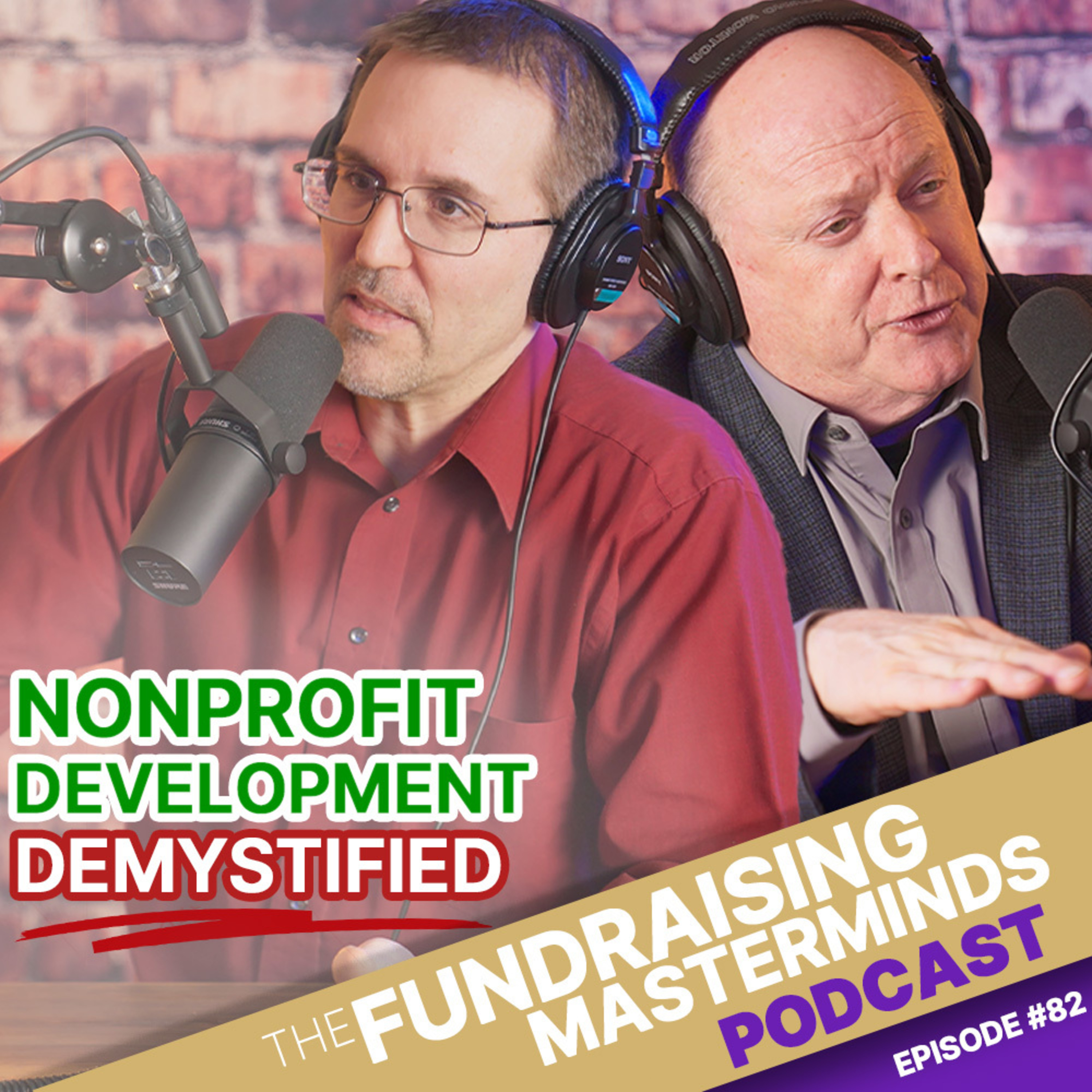
Welcome back to another episode here at the Fundraising Masterminds Podcast. We are so excited that you are with us today. We are going to be talking about the topic of development. In fact, the title of this episode, Jim, is what Does Nonprofit Development really Mean?
- [01:20]
B
Yes. Now, great topic.
- [01:22]
A
We usually don't say the word development. We usually talk about fundraising or fundraising masterminds or, you know, you know, how to get more funds or how to get more fully funded.
- [01:32]
B
Right.
- [01:33]
A
And the reason why we do that is really because of Google and analytics, you know, the algorithms out there that.
- [01:40]
B
Are searching for keywords and just a general understanding. It seems like people in the. In the nonprofit world understand fundraising more than development, but actually, development is much more accurate to what we do.
- [01:54]
A
Well, and if you search on YouTube for development, you usually find, you know.
- [01:59]
B
Architecture or coding or land development, whatever it is.
- [02:04]
A
Yeah. If you search for nonprofit development, you might find capital campaigns or things like that, but it's. There's just a lot of. It's not a term that's used very often, you know, nonprofit development not as.
- [02:17]
B
Understood exactly as fundraising is.
- [02:20]
A
And. And really, we've. We've done an episode, you know, in the past, called Fundraising versus Fundraising, where we really talked about, you know, that we're. That's really what development is.
- [02:31]
B
Yes.
- [02:31]
A
But we. We haven't actually done an episode specifically about nonprofit development. Like, what is nonprofit development? What does it actually mean?
- [02:40]
B
Yep.
- [02:41]
A
That's really the topic that we want to address in today's episode is just asking the question, what is nonprofit development?
- [02:48]
B
Well, I'm excited to share. My name is Jim Dempsey, and this is Jason Galasinski. We're co host for fundraising mastermind. Jason, you have brough up a topic that is so near and dear to my heart. And it was what I Learned on day one, 40 years ago in when I first started in development. I was introduced to the term when I was reassigned from the campus of Texas Tech University in the early 1980s. And I was assigned from that campus to our headquarters and they said report to the office of Development. And I had no idea what development was. Was it land development? As you talked about doing a Google search on things. And when I came in and found out that it included fundraising, public relations and recruitment, I was floored. I had no idea that that's what I'd be doing or what I would be involved in. And little would I know that that set the course for the next 40 years for me to be in this profession that I love dearly. Development of moving an individual who has an interest in your organization through a continuum and through a process of cultivation to the point where they actually make a decision to become a partner with you. But it is not a short term effort, which fundraising is. Development is a long term effort. It is a process of bringing a person along through a process that they become a long term, a lifetime partner with your organization. I have got individuals who have helped my efforts in the ministry for my own personal support for nearly 40 years. And some of those people have been with us since day one. And that is the long term process. Wouldn't we all, as nonprofit leaders love to have someone who's with us for 40 years and will be with us for the next 40 years? That's what we hope for any organization. So it is a process of bringing people along a continuum of understanding, of immersion, and then finally to the point where they are fully and wholly committed to your organization.
- [05:11]
A
Yeah.
- [05:11]
B
Now development, Jason, includes three key elements. Public relations, recruitment and fundraising. The public relations side of things is introducing your audience or your community to your organization, your publics. It's the general public, the general population. You are immersing, immersing them and exposing them to your ministry and what you do. It's getting the word out, taking every opportunity, using every avenue, using every medium that is out there to bring the message of what you do and how you do it to the general public. Then there's recruitment. We know that the lifeblood of any nonprofit organization is human resources. This recruitment element is raising up individuals who are going to come alongside and partner with you and they're going to partner with you with their labor, their influence, their finances. And expertise. We're finding people through this whole process of introducing them through public relations and development, we're raising up those people. Some will be volunteers and stay volunteers. Some will take the next step and become part time workers with us. Others will become full time leaders. Some will move into positions of responsibility like board members. Some will even move into positions of leadership in their organization as a result of being involved. And then lastly, it's that area of fundraising. It is the actual raising of the money that's needed to help accomplish your mission. And our partners play a role in every one of those three elements. So that's essentially the bottom line, Jason, of what development is.
- [07:02]
A
Yeah. The main thing that you said that stuck out to me is the difference between fundraising versus development is it's, it's about having authentic, real relationships with people. Right. You're actually developing a relationship with your donors. You're not just asking people for money and moving on and trying to get, you know, a lot of people. So the analogy that we've used in the past in different podcasts have been treating people like an atm.
- [07:30]
B
Right. You know, versus transactional versus transformational.
- [07:33]
A
Yeah. And so the, the main thing is that with development, we are not treating people like ATMs, which is you don't think about an ATM until you need it.
- [07:44]
B
Right.
- [07:44]
A
And then once you need it, you go to the atm, you get the money that you need and you forget about the atm. Right, Right. And that is not development.
- [07:54]
B
That's. And that breaks the heart of our partners more than anything else when they feel like they're ATMs, you only care about them when you need their money.
- [08:03]
A
That's the worst for someone who is running a non profit, they're a leader of a non profit and they're thinking, oh, gee, well, I kind of do that. How do I transition my thinking? Because a lot of it is a mindset very much. And so what is the mindset of someone who is thinking more development oriented versus thinking more fundraising versus development?
- [08:29]
B
Yeah. Well, it is mindset, Jason, and you have got to work on training your mind and shifting. And in fact, I'd even encourage you to shift your vocabulary away from fundraising and move it towards even another definition like friend raising. It puts the emphasis on the relationships when you call it friend raising versus on the money when you call it fundraising. And so it's so important that you put the emphasis in the right area and make sure that you're focusing in on the relationship building and the, the growing of that personal relationship.
- [09:07]
A
Yeah. So what do you mean by when you talk about having a relationship?
- [09:10]
B
Right.
- [09:11]
A
You know, I mean, I've already got a lot of friends, right. And I've already got, I'm already married, I have kids, you know, I, I've. How do I. What do you mean exactly by having a relationship with your donors? Define relationship.
- [09:25]
B
Define relationship. Yeah. Well, of course, just as with any relationship that we have, there's different levels of involvement. A relationship you have with a female in your life by the name of Jennifer is a very close, deep, meaningful relationship and she's your wife. You also have a relationship with 10 kids and you have a different kind of relationship with your kids. And then you have next door neighbors and you have a certain relationship with those people. You have individuals in small group and in your church, you have a different relationship with those individuals. You have co workers, you have a different relationship. So every different environment, wherever we work, wherever we're involved, we might have a different kind of relationship. The relationship that we are talking about with our partners really depends on them a lot. We've got to reach out to them and find out where are they comfortable in our relationship. I have some that have deep, meaningful relationships. I had one of my ministry partners called me about two weeks ago and said, we haven't spent any really good time together. I'd like to invite you to a hockey game and let's just go have some fun together. That is a deep, meaningful relationship. But I've also got some individuals who just prefer me to call them a few times a year. And I've also got some partners, some donors who say to me, jim, you know what, just send me a couple letters a few times a year, that's satisfactory. And you really need to determine where the person is in the relationship. So you may have a desire to get very close with someone, but they may put you at an arm's length.
- [11:13]
A
Yeah. So how do you go about figuring that out? You know, when you are trying to get to know them, a lot of.
- [11:17]
B
It is step by step, you reach out. Jason, there I. We've never really talked about this before, but I'm assuming you probably dated some girls before you met Jennifer and you did some exploration to find out, is this the one? Well, clearly those were not the ones. And you know, you probably had some one and done dates. You probably had a few where it was a couple dates. You may have even dated somebody for a few months or even a year or more. But clearly those individuals were not the right one. And it really is the same way you've got to step out to find out. You've got to, in a sense, extend the olive branch. And we're going to talk about this in different ways. But having genuine relationships with people, you need to go in there with the right motive to want to clearly have a genuine relationship with someone and find out how deep do they want to go. Some may want to go very deep. And in fact, it always amazes me how many of our partners trust us. And just time and time again I've had people tell me, I have never told anyone else this, but. And there's just something about, number one, being in ministry and number two, the fact that we actually deal with a very important and meaningful area of their life. And that's money. That's the one area that people struggle with more than anything for trusting God is money. I mean, they can trust for, you know, their kids going to come to Christ, are they going to find a good school, whatever it is. But money is that one thing. And so you've got to test that.
- [13:00]
A
All right, so, Jim, I have a practical question in terms of dealing with relationships.
- [13:07]
B
Okay. Okay.
- [13:07]
A
What happens if someone gives a meaningful gift to your organization and you know that you're supposed to have this relationship with this person, but, but this person is really different than you.
- [13:19]
B
Right.
- [13:19]
A
They have a completely different personality. They have completely different interests.
- [13:23]
B
Right.
- [13:24]
A
Like, you know, you're interested in movies and they're interested in football or they're interested. You're interested in.
- [13:30]
B
Yeah. Books and you're interested in YouTube videos, you know, whatever it is.
- [13:34]
A
Yeah. And you just have, you have such a wide different. And you're, you're a people person and they're an introvert, you know, and, and just every conversation you have with them is like a one word answer.
- [13:45]
B
Right.
- [13:46]
A
You're trying to extend.
- [13:47]
B
Yeah.
- [13:48]
A
You know, like, hey, you know, thank you so much, you know, we really appreciate. Well, did my best, you know, or I don't know. And it's just they don't really want to have a relationship with you. Or, or maybe they do, but they're just. So if your personalities are so different that it's just like.
- [14:04]
B
Well, Jason, I mean, that's a great question because trust me, you know, 40 years in doing this, I have run into that quite a few times and there's a couple things that I would say. Number one, you do have one commonality. And if they gave to that organization, to your organization, there's a reason why they gave. So I always start out with some investigative work, you know, what was it about our organization that caused you to give a gift? What was it that particular piqued your interest? Was there something, Was there a person? Was there a story? Was there something about what we do? Well, first of all, that opens, that turns the key, and then, you know, continuing to ask questions that are beyond that. Okay, if, if reaching people with the gospel is important to you, what are some other organizations that do similar things that you like? Tell me about those organizations. Tell me about what they do and get them talking about their favorite topic, which for most people is themselves. So if you can get them going, that will help. Now, one of the things that I will admit to you on this show right now is that I'm a kook. I'm a keeper of odd knowledge. And so I have over the years developed a wide variety on a lot of topics and nothing super deep on a lot. But believe it or not, that helps me in interactions with potential partners. Because, you know, if they say, well, I grew up in Sioux Falls, South Dakota. Well, let me tell you about some friends I've got, Sioux Falls, South Dakota, and they run a pregnancy center. Do you know them? Or. I, you know, I grew up in Chicago. I can talk about the Bears, the Blackhawks, the Bulls. I can talk about the Cubs. What, what. Whatever topic that is. I lived in the Northeast. I lived in the Washington, D.C. area. I can talk about what Washington, D.C. looks like. I venture tiptoe lightly into politics. My major was political science. I'm a sports nut. I love any kind of athletics and sports. But I have a son who is a software engineer and I can, I can talk my way through computers and technology. And so I think that is really important in any opportunity that you've got as a nonprofit leader is to understand a little bit about a lot of things.
- [16:38]
A
Finding out what made them interested in the organization, I think answered the question for me, you know, because you want to, you want to understand what makes them tick.
- [16:47]
B
Right.
- [16:48]
A
And really, I think using software or, you know, taking notes on people.
- [16:54]
B
Right.
- [16:55]
A
You know, is kind of the key. It is when I started Fund Easy a while ago and when we were getting started and we had all these people we were meeting for the first time and, and they were potentially going to be customers. And I knew that I had to call them. You know, there is any information that I could learn about them.
- [17:13]
B
Right.
- [17:13]
A
Was helpful in advance. You know, if they said that they had, you know, a dog or they were married, I would, I would write it down because then I could. When I called them back. I could say, how was your dog? Or how is your, you know, marriage going? Or whatever. And so just any information about them.
- [17:27]
B
Right.
- [17:28]
A
So when. When someone gives to your organization, I think one of the. One of the very first things we should do is give them a call and thank them and say, thank you so much for your gift.
- [17:41]
B
Yeah.
- [17:41]
A
What was it that motivated you?
- [17:43]
B
What prompted you to give? Yeah, yeah.
- [17:45]
A
And what. And learn about their motivations, learn about what makes them tick and learn about what makes them excited and try to find that common ground.
- [17:55]
B
Right.
- [17:56]
A
And then you can start to build that relationship off of that.
- [17:59]
B
One of the best things you can do is listen. You know, my father always used to say, and I'm sure there's other fathers and mothers said the same thing. God gave us two ears and one mouth so that we can listen twice as much as we speak. And you really need to just listen, Listen. And they will. You will be surprised how much people are willing to tell you about themselves if you're just willing to listen. And, you know, I watch people at times and I see them, we're having a discussion, but I know their mind is a million miles away. You need to just be. You need to learn to be a good listener if you're in development.
- [18:36]
A
Yeah. So another thing while we're on the topic of donor development is I hear this a lot in development circles, you know, nonprofit circles, that we need to cultivate donors.
- [18:47]
B
Right.
- [18:47]
A
You know, donor cultivation and donor cultivation strategy. And. But, like, sometimes it just. I don't know, my eyes kind of glaze over when I hear those kind of words. Like, what does that mean exactly? You know, like, in terms of, like, practical, real relationships. Like, when you're talking about someone gave a gift to our organization, I understand the role of reaching out to them, getting to know them as a person, taking notes, writing it down, actually caring about the person. But then when you talk about donor cultivation, what do you mean by that?
- [19:22]
B
Well, Jason, I am one of the last people to be talking about plants because I don't have a green thumb. I'm closer to a black thumb. I can kill plants very easily. But if I said to you, jason, I'm going to entrust a plant to you, would you please ensure that it continues to live and it continues to grow? Well, you're saying, sure, that makes sense, Jim. I'm going to water it. I'm going to give it some plant food. I'm going to make sure that it's in a pot that's the right size, that's essentially what we're talking about when we talk about donor cultivation. It's really the care and feeding of our partners. And what I mean by that is that there are seven stages for cultivation. That's the care and feeding of our partners. And I'm going to talk about those seven stages real quickly because I believe that may help you in getting a good understanding. The first thing I'm going to talk about is identification. Now it is so important for us in our process to identify who is it that is interested in our organization, who cares about what we're doing, and once we do that, who ends up as someone who is either a prospect or a suspect for organization that they could give. Secondly, you want to start to look at some exploration. What I mean by that is that you want to explore with that person a little bit, finding out what their interests are, what it is that excites them. And is there a connection between our organization and what God has placed on their hearts as a burden? I believe that God places on the hearts of every believer a burden to accomplish something for the kingdom. And I want to find those people who, where there is an intersection between their hearts and desire in our organization. And some of that involves the next element, which is called discovery. What is it that we find out about them? What is that their area of interest that we can give back to them? If we find that they've got an interest in human life, in the value of human life. If I'm a pro life organization, that means from cradle to grave or from birth to death, that that person has a value in that. And I want to show them how we can help them have a specific interest in that way. If their daughter died of cancer at 12 years old, and I am an organization that deals with cancer patients, there's going to be a connection there. So having that discovery, then there's the evaluation that means, okay, you take all the information that you have gathered about them. And what information can I use to help me have a better understanding of who that person is so that I can look for that connection between us, that intersection in there. I talked about, Jason, about when you asked me about how do we get to know someone who you have absolutely no interest in? What are the commonalities? Okay, we talked. We talked about the biggest commonality, which is that we both have an interest in the same organization because they gave to us. But are there other things that we have in common that we can connect up with? And then we work on this whole process of, of raising up and the overarching cultivation, which means connecting with people, providing them with information on who we and what we do. Asking them. What is it that you would like for me to find out more about our organization? Do you need an annual report? Are stats, statistics, figures important to you? Do you need some stories from me? Are you interested in hearing? Remember, we have logical givers and we have emotional givers. Those are the two types. And we need to find out is the person that we are cultivating a relationship with they emotional giver, a logical giver. If they're emotional, we need to give them stories. If they're logical, we need to give them facts and figures. So it's important.
- [23:52]
A
How do you know if they're emotional or logical? Can you. Do you have, like a quick litmus test?
- [23:57]
B
Well, I know pretty quickly by what they want from me and what they ask from me. If they ask. Well, if they ask me about specific stories of individuals whose lives have been changed that typically write off signals. Okay. They're going to be motivated by the emotional kinds of things. I had someone who was a personal supporter of mine early on asked me. What I need for you to do is I need you to send me your annual report. I need to know how many hours you work a week, and I need the name of your supervisor. And I'm going to call your supervisor to find out if you're doing a good job with your organization or not. That to me, told me very early on. And everything since then has solidified that logical. This is a logical giver. But what the beauty is is that typically every married couple has one of each. So fortunately, this man's wife is an emotional giver. And so there is a tremendous connection between his wife and my wife. And that works very well. And then you reach the point where.
- [25:05]
A
It'S interesting because your wife is a logical giver.
- [25:07]
B
It is very interesting. But my wife has become. Just as I have leaned towards understanding, I am the emotional giver. And so I give people facts and figures because I know that not everyone's like me. She knows that people like stories and think emotionally. So she overcomes her facts and figures by providing stories. So we've been able to find that balance. Then the second to the last area is number six is solicitation is actually getting to the point where you present the opportunity to people. So I've given you all this information. It seems like there's a connection between us. We found the things that seem to be. We are both on the same page with. Is now the time I'D like to ask you, would you like to partner with us? Now seems to be a great time to present the opportunities we've got. Are you interested in this specific thing? And that's that. Now, of course, then you wrap that up, as we've talked about in other broadcasts, is on that stewardship, which is the feedback and response back, letting them know the outcome and the use of their money. And so those are the seven stages once again. Identification, exploration, discovery, evaluation, cultivation, solicitation, and stewardship. The seven principles of donor cultivation. But overarching, if this term is tough to wrap your mind around, Jason, think about care and feeding of our partners.
- [26:38]
A
Yeah, well, I like the analogy of the plant. You know, I. I can understand that. You know, taking care of a plant.
- [26:44]
B
Right.
- [26:45]
A
Feeding it and cultivating it, making sure it has everything it needs. Yeah. I. I mean, this is just such a foreign concept to a lot of people.
- [26:55]
B
Very much.
- [26:56]
A
A lot of times when we get into a non profit, you know, it's because we were volunteering at that nonprofit or involved in the nonprofit, or we.
- [27:06]
B
Were impacted by the particular issue. Y. Yeah.
- [27:10]
A
And we care, we care deeply about the nonprofit and the issue and the issue. And, and so we get into a leadership position.
- [27:17]
B
Right.
- [27:18]
A
And then we just, we just think, well, everyone should care about this.
- [27:21]
B
Yeah.
- [27:22]
A
If I care about it, why don't.
- [27:23]
B
You care about it and have the same interest? So we level of interest, we kind.
- [27:26]
A
Of just go around and saying, well, don't you care about babies? Don't you care about homeless people? And, and we're, we're trying to almost like guilt people, right?
- [27:35]
B
Yeah. And it's making them feel bad that they don't have.
- [27:37]
A
And then when people. Well, what's worse is if people don't respond, then you start to feel that pressure of like, well, they must not. I must not be doing a good enough job, so I need to ratchet up more.
- [27:49]
B
Right.
- [27:49]
A
And then you start treating people more and more and more like ATMs.
- [27:52]
B
Yes. You know, you put the pressure on yourself, you put the pressure on them.
- [27:56]
A
Yeah.
- [27:56]
B
And it's not a good situation.
- [27:58]
A
No. And that's where we get into the scarcity mindset. Because, you know, people give less.
- [28:03]
B
Yes.
- [28:04]
A
Which means that we have less money to work with with. Then we start going down this spiral of scarcity, you know, well, I only have so much money and I. I gotta use my money carefully. And so really the secret here is it's all about relationships.
- [28:17]
B
Yeah, it really is. And Jason, one of the things that I would Say on a litmus test is have you, have you crossed the line? Have you gone too far? Is what I call the Miracle on 34th street test. If you, if you remember at all the movie Miracle on 34th Street, Kris Kringle was asked by a young child and mom, you know, do you have such and such toy? And he said, no, we don't have it, but Gimbel's has it down the street. And they sent the young, young boy and mom to the competitor to get the product at a better price. If you are able to say to someone, no, we can't do what you need us to do, but such and such organization can. That's when you know that you have the genuine heart and interest in what the partner wants. And I tell you, they know that. I had one great example. I had a partner who came to me and said, Jim, I'm struggling because I'm getting so many requests. I don't know how to evaluate them. I helped him evaluate the organizations and unfortunately CREW was not one of the top three if I looked at his interests and heart and desire. But I said to him, here are the organizations I would recommend giving to. Not only did he give to those organizations, he came back to me and said, Jim, I appreciate you so much. What are your needs and your desires? And he's been a partner with us for the last 35 years. So I, when you put their interest first, that's when those people know that you really care about them more than your own mission. And that's a tough thing to say.
- [30:09]
A
Well, here's another question that I have for you is this all sounds great. You know, when you're dealing with, you know, you, you got a non profit with the staff that can take the time to do all this stuff. But what do you do when you're, you know, a non profit leader of a staff of one? You know, you, you're the executive director, you're the development director, you're the cfo.
- [30:32]
B
You're a one person operation.
- [30:33]
A
Yeah, you're the director, you're the operation director, you're the, you know, you're doing everything right. And so you, you have the heart behind the ministry and you're doing all the ministry. So you're, you're consumed with the, with the work that needs to be done. And the last thing that you have time for is to go out to lunch with a bunch of people and care about people, you know, like, it's not, it's not like you don't like them or you don't care about them. But it's just like you were just so busy, right? How do you, how do you realistically juggle or what would you recommend for a small non profit? You know, like what's the recommended amount of time that you should be putting into?
- [31:11]
B
Well, ironically, Jason, I would probably say this with a small organization as well as a large organization, it's not all about you. You cannot be the sole relationship with someone. People need multiple relationships with any organization because if someone gets upset with you, they'll step away and no longer be a partner. But if they have multiple relationships, then they are going to see that as well. Jim and I may have a disagreement, but I like Jason a lot and that makes the organization validation. What I say about that is that as a small organization you do have board members. You hopefully have some volunteers that are part of things. Pull some of those individuals. Board members. Many board members would love to be part of helping to cultivate a relationship with a major donor. Many of them are emotional givers, are outgoing people who love to meet with others and ask those people to develop the relationship with some of these major donors that need that cultivation. Or if you've got volunteers, maybe there's some people who'd be willing to invest even an hour a day or a couple hours a week to be on the phone with your major donors, just not even asking them for money, but just calling them and saying, hey, this is Jim Dempsey from crew and I just wanted to thank you you for your gift and I just appreciate you so much. Is there anything I can be praying for you about? Don't need to be asking you for any money or anything. I just want to let you know we care about you and we appreciate you. That alone would make a world of difference. So to me it's not an excuse to say, not a good excuse to say that we are a one person operation. And. And so as a result I can't carve out the time.
- [33:09]
A
Now remember, it's part of the trap. I think a lot of nonprofit leaders who do have like a small team, they tend to take their job really seriously. Right. And the ministry does tend to get wrapped around one person.
- [33:24]
B
One person.
- [33:24]
A
And that one person might get a lot of meaning out of.
- [33:27]
B
Sure.
- [33:28]
A
It being around them, it gives them a lot of purpose. And so it can be a little bit of a trap, you know, to that that person might have a hard time letting go of. You know, they want to do everything themselves because they feel like that gives them meaning or purpose. And. But really, what you were saying is, you know, you have to be able to let others, you know, do some things, maybe let your board do some things and, and delegate some responsibilities.
- [33:57]
B
There was a terrific example, of course, in scripture when Moses was just taking on every judgment with the Israelites in the wilderness. And his father in law, Jethro, had to come up to him and say, you know, Moses, you're going to kill yourself. You're not going to survive. If this is all you're doing all day. You need to delegate. And that's when we started developing the 12 tribes. And each of those judges and all those tribal leaders were in charge of judging their. Their individuals within there.
- [34:32]
A
So delegating is.
- [34:33]
B
Delegating is critical.
- [34:35]
A
So, yeah, it was good to understand, you know, the seven stages of donor development now. Like, what are some ways that we can maintain these relationships?
- [34:43]
B
Yeah, well, you know, Jason, I, you know, going back to marriage again, what was it that helped you to woo Jennifer? What was it that helped you to capture her heart? And what keeps you guys married today? It's spending time with the person. It's consistently communicating with the person. It's soliciting their input and their say. We get so tempted as nonprofit leaders to get in our own little world that we forget that our partners want to be part of our world. If you are pulling them in, they don't want to just give you their dollars. They also want to find out about your organization. And don't keep them at an arm's length. We talked about them keeping you at an arm's length in relationships. Don't keep them at an arm's length. Don't say, we'll only accept your money, but we won't accept your input and your care for our organization. And you need to look for ways to have continuous and consistent communication. Jason, I have not missed a month of communicating with my partners in over it. I know it's over 25 years. And so it is so important to stay consistent in your communication with people and provide them with the information that helps them understand who you are. Continue to give them feedback and talk to them in the manner that they appreciate most. Do they appreciate phone calls? Do they appreciate texts? Do they appreciate notes and cards and letters and gifts? Give them those things. But you've got to find out, you know, all of us have. If we haven't read the book, we've at least heard the term love language. Finding out someone's love language, finding out what your partner's love language is, and speak to them in that way makes a huge difference. So those are some of the things that I would say are going to set you apart from every other nonprofit.
- [36:43]
A
Yeah. And it is a lot of work. It is, you know, it's not, you know, keeping in touch with 100 people a month is not an easy thing.
- [36:50]
B
But, Jason, I always say, you don't mind cashing their checks though, do you? And, you know, that may sound somewhat harsh, but I do say that to a lot of ministry leaders in that, yes, it is going to take some effort, but you don't mind that it takes them a little effort to write a check every month. Month. And that, that, you know, I think you gotta.
- [37:10]
A
I think in this day and age, there's just a big emphasis on like passive income. Passive income is kind of.
- [37:16]
B
Right.
- [37:16]
A
A big buzzword, you know, how do we get passive income? And yeah, and I think a lot of non profits just think, you know, well, if I can, if I can get people to an event, if I can give them a certain, you know, presentation, right, Then I'm gonna get them on my 35amonth list and I'm gonna have passive income. I'm never gonna have to, to talk to them again. And that's, you know, because we want to. Because human nature is we're lazy and we just want a bunch of people to come on and get them on board. And I don't want to have to deal with, you know, them. I want to be busy with my ministry. And. But that's really the opposite of what we're talking about.
- [37:53]
B
You know, Jason, development would be so easy if we didn't have to deal with people. But you know what, Jason? We do. Development is all about people. Yeah, they're the ones who write the checks. They're the ones who help us. They volunteer, they give us advice, they connect us with their friends. You cannot do development without people. So anytime you involve people, it means that you're gonna have to invest some time and energy in relationship.
- [38:22]
A
And when I, when you put it that way, I mean, I just, my mind just went to, you know, Jesus.
- [38:27]
B
Yes.
- [38:28]
A
Was the master development director. Really. I mean, because he, out of all the people in the world who could have just opened up heaven and revealed millions of angels and just spoke from the sky and said, thou shalt, you know, do this and that, you know, and scared people into whatever he wanted. I mean, he could do anything. Right? Right. But yeah, he chose to come in the flesh in the form of a baby, humble himself, leave all his glory, be born in flesh and have people not know who he is. I mean, that's hard, you know, if you think about it, you know, just. Even me going to Zambia in a mission trip. And, you know, you want people to know that you're from the United States of America because you want people to.
- [39:13]
B
Respect you and that we're a generous nation.
- [39:16]
A
Yeah. And for Jesus to be coming from heaven and have people say all kinds of bad things about them that were not true and, and just still kind of put all that off and be focused on developing relationships and not developing relationships with the wealthy and the, you know, astute minded. But he chose, like, fishermen and you know, the kind of like the uneducated people.
- [39:41]
B
Yeah. The middle class.
- [39:42]
A
But yet he really poured himself into these people.
- [39:46]
B
Right.
- [39:47]
A
And because he developed so much into them and put. And, you know, really poured into them, they went and changed the world.
- [39:54]
B
Yeah.
- [39:55]
A
And that's a good example to us of the power of developing relationships.
- [40:00]
B
I. I learned early on, Jason, that if God wanted to, he could have just poured out money for crew and we never would have to connect a person into the organization. But you know what? God doesn't want us to live in a vacuum. He doesn't want us to only receive the blessings ourselves. He wants us to share the blessings that we get from making a difference with his people. And he wants us to share that with as many people as we possibly can and as many partners. Because when people give, when we present them an opportunity to partner with us, we are sharing a blessing. You are a blessings broker. I'm a blessings broker. Everyone watching are blessings brokers. You've got an opportunity to allow someone to be blessed and don't deny them that opportunity to be blessed by God.
- [40:54]
A
Well, Jim, this episode has been really good. And you know, at the beginning of the episode, I asked you the question, what is nonprofit development?
- [41:02]
B
Right.
- [41:03]
A
And I think you did a good job answering the question. Thanks. And if this has been helpful to you, definitely subscribe to this podcast. Hit the little subscribe button if you're watching us on YouTube or subscribe on Apple or Spotify, because we have weekly episodes for nonprofit leaders where we talk about things like this. We talk about development strategy, we talk about fundraising techniques, we talk about ideas for how to grow your nonprofit. And speaking of ideas, with growing your nonprofit, if you want to learn more about how to get into more development related issues. But speaking of growing your nonprofit, if you're listening to this and you're thinking, I really need to learn more about development, how do I develop relationships with major donors, how do I get people to the next level? Or how do I get exposure to that? Well, we just finished a brand new course called Major Donor Mastery, which is also available on our website. And I'll put a QR code on the screen and a link in the description for that. But that course is an incredibly deep dive into these principles of development. But specifically in the areas of how do you develop major donor partners for your organization? How do you find them?
- [42:23]
B
How do you target the important ones? How do you. You find the critical few? Because when we talking about cultivation, you can't possibly have a relationship with everyone on your mailing list. Yeah, but if you can at least identify who's that 20%, that brings in 80% of your dollars and cultivate those people, you get a winning formula.
- [42:41]
A
Once you've cultivated them, how do you set up an appointment? How do you. What do you say at the appointment? What do you say? How do you present something to them? How do you ask for money? And all this is discussed in great detail in our Major Donor Mastery course. So you can check that out as well. Jim, any final words that you want to say to us about what development is?
- [43:02]
B
Yeah, Jason, it really is a privilege to get to work hand in hand with these partners. And we should never see this as a burden or a chore for us to do. These people love the Lord, just as you love the Lord and they love your organization. Pull them in, pull them closer. Don't push them away. Look for ways to go deeper with them and partner together.
- [43:30]
A
You're a blessing broker.
- [43:31]
B
You're a blessings broker.
- [43:33]
A
We'll see you next time.
- [43:34]
B
Take care.