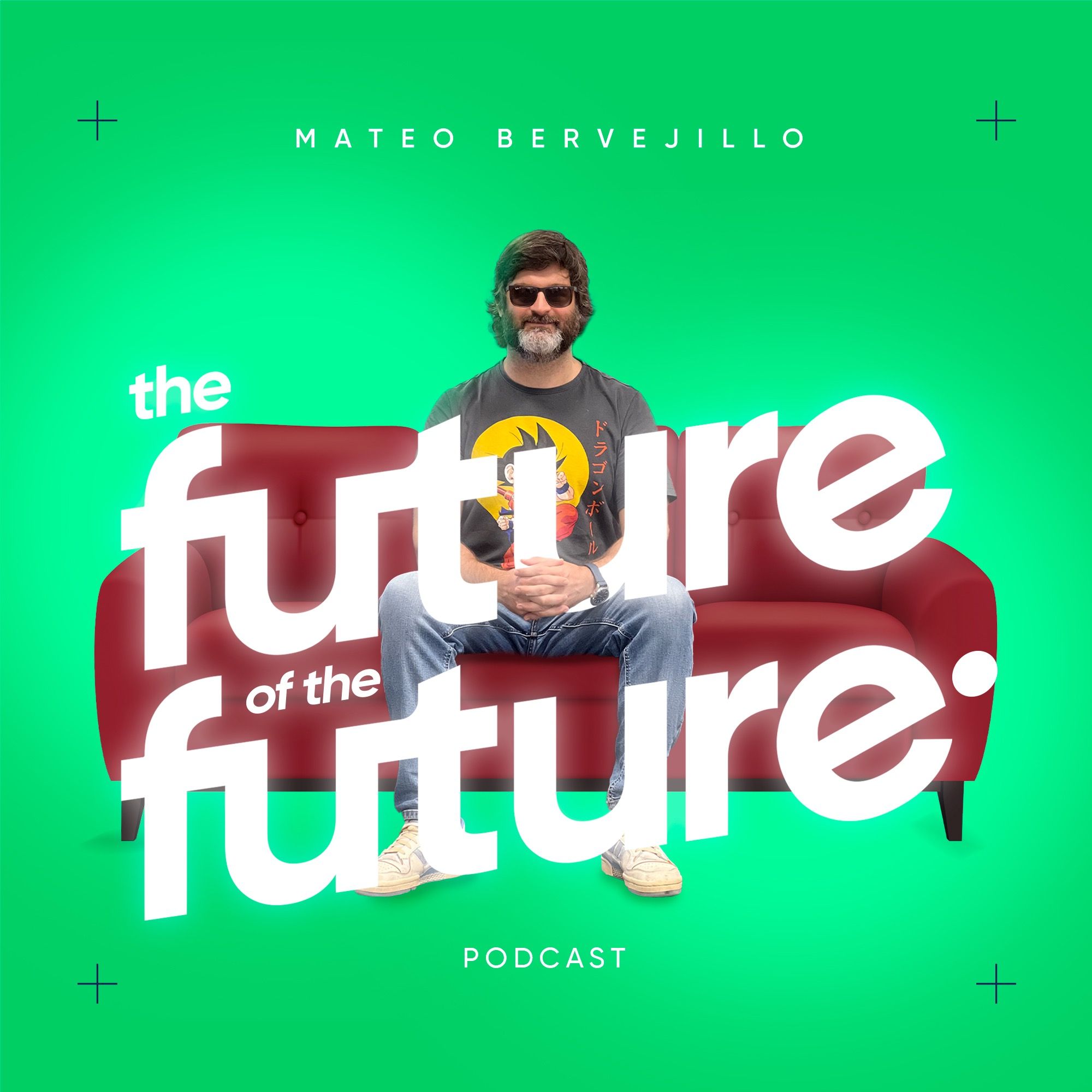
Podcast
The Future Of The Future
Hosted by Mateo Bervejillo · EN
Mateo Bervejillo interviews Technology Leaders to talk about everything and anything related to Technology and the Future. Guests open up about their stories and opinions on cutting edge topics, in an informal conversation tone.
40episodes
Episodes
Newest firstAll episodes
188. George Alexandrou. Technology Is A Business Leadership Function, Not A Support One.
3w ago00:29:51Tap to summarizeTechnology leadership is changing fast. Companies are under pressure to scale, adopt AI, modernize their systems, and make smarter technology decisions, often without the budget or need for a full-time executive. That's where the rise of the fractional CTO and CIO comes in. In this episode, we're joined by George Alexandrou, a technology leader who has sat in both the CIO and CTO seat and now helps organizations navigate complex technology challenges as a fractional executive. Whether you're a founder, executive, or aspiring technology leader, this conversation is packed with practical insights on leading through complexity and building technology that drives results.
Transcribe →187. Brian Fletcher. Building Is The Strategy.
4w ago00:34:58Tap to summarizeFor years, software was treated as a support function, something you built after strategy was decided. But that model is breaking. Today, the companies that win are the ones where building is the strategy. Where the ability to rapidly design, test, and ship products defines not just execution, but direction. And now, with AI, that shift is accelerating. If software used to be constrained by time, cost, and talent, those constraints are collapsing. So new questions emerge: If we can build anything faster than ever, what actually matters? What becomes scarce? And how do organizations need to rethink how they operate when creation itself is no longer the bottleneck? That’s exactly what we’re unpacking today, from the changing role of engineers, to whether product, design, and engineering are finally converging, to whether frameworks like Agile still make sense in a world of near-instant iteration. To help us navigate this, we’re joined by Brian Fletcher, an experienced technology leader who has spent more than two decades building digital products across agencies, and now, as a co-founder and fractional CTO, helping companies rethink how they build and scale technology teams in an AI-first world. Brian has a unique vantage point at the intersection of engineering, product, and business strategy, and today, he helps organizations move from “building software” to truly becoming software-driven businesses.
Transcribe →186. Jean Francois Cloutier. AgTech For The Underserved Small Farms.
Jul 900:31:47Tap to summarizeAgTech loves scale. But agriculture runs on small, family farms. In this episode, I sit down with Jean Francois Cloutier to unpack the massive disconnect between cutting-edge technology and the reality on the ground. If nearly 90% of farms in North America are small or family-run, why are they still overlooked, and what’s broken in the way we build for them? From the “invisible frictions” of daily ranch life to the real stakes for food security, we explore what happens if these operators remain under-digitized, and where AI, robotics, and fintech can actually make a difference. Most importantly, we get into what good technology really looks like for small farmers, and how JF is building with them, not just for them, but also shaped by his own family’s ranching story and a vision for the next generation.
Transcribe →185. John Linss. Maximizing Healthspan.
Jul 700:38:00Tap to summarizeToday’s conversation goes beyond just how long we live, and dives into how well we live. We’re exploring the powerful idea of healthspan vs. lifespan, not just adding years to life, but adding life to those years. While lifespan measures total years lived, healthspan focuses on the years we remain healthy, active, and free from chronic disease. To unpack this, I’m joined by John Linss, founder of CoreSpeed Health, who’s working at the intersection of science, supplements, and real-world outcomes. In this episode, we’ll get into how John defines healthspan, and why he believes it matters more than simply living longer. We’ll explore what sparked his mission, the problem he’s solving with CoreSpeed Health, and his take on what’s broken in today’s wellness industry. Enjoy!
Transcribe →184. Sid Bharath. Agentic AI In Practice.
Jul 200:19:16Tap to summarizeAI is forcing companies to rethink not just their tools, but their entire operating model. What does it actually mean to rebuild a company around AI, not as an add-on, but as the core? And if AI agents become part of the workforce, how do you design systems where humans and machines truly collaborate? In this episode, we go deep into the idea of “refounding” companies in the age of AI, and what an agentic way of working looks like in practice, day-to-day, decision-by-decision. To guide us, I’m joined by Sid Bharath, someone who’s been at the forefront of helping companies rethink how they operate in an AI-first world. From treating AI agents as employees to redesigning workflows and unlocking real ROI, Sid brings both the strategic lens and the practical playbook on what it takes to build the next generation of companies. Enjoy!
Transcribe →183. Deepak Shukla. On Endurance, Rapping And Technology.
Jun 3000:33:48Tap to summarizeThe path into tech is rarely linear, but what happens when you embrace that chaos instead of fighting it? From career pivots and creative detours to endurance sports and relentless experimentation, what are the real moments that shape a founder’s mindset, and what actually prepares you to build in an AI-driven world? Today’s guest, Deepak Shukla, is the embodiment of that unconventional journey. From his early days at Deloitte to rapping, traveling the world, and eventually building multiple companies under Pearl Lemon and LemStudio, Deepak has continuously reinvented himself. Along the way, he’s run marathons, competed in Ironmans, recorded over 150 rap songs, and built a philosophy around resilience, creativity, and execution. In this episode, we unpack the turning points that pushed him into tech, how he’s evolving the way SaaS gets built, and why the future belongs to those willing to experiment, endure, and adapt. Enjoy!
Transcribe →182. Lee Williams. The Age Of The Orchestrators.
Jun 2500:31:17Tap to summarizeWe’re living through a moment that feels bigger than just another tech cycle. From mobile to cloud to AI, each wave has changed not only what we build, but how we think, create, and interact with machines. But are we now crossing a deeper threshold, a true “Digital Renaissance”? One where interfaces disappear, systems collaborate with us, and the very identity of builders begins to shift. That raises big questions: Are we still “using tools,” or starting to work alongside them? What does it mean to design in a world where AI is a co-creator? And as roles blur, who are the new builders emerging in this landscape, and what do they actually do? To explore this, I’m joined by Lee Williams, Founder and CTO at Edelleye Digital, someone who has spent years building technology not just to function, but to feel something. His career spans over two decades of digital innovation, working across large-scale environments and transformative moments in digital media, mobile, and emerging technologies, giving him a front-row seat to how each wave reshapes both products and people. Enjoy!
Transcribe →181. Tim Serewicz. Everybody Is Vulnerable To The Hype Cycle.
Jun 2300:46:14Tap to summarizeAI is forcing leaders to rethink everything—from technology strategy and organizational design to governance, risk, and the future of engineering talent. Today, I'm joined by Timothy Serewicz, a veteran technology executive, CTO, and AI strategist who has spent decades building engineering organizations, leading complex technology initiatives, and helping executives translate technical complexity into business decisions. Drawing on experience that spans enterprise technology, open source, infrastructure, and board-level advisory work, Timothy brings a practical perspective on what it really takes to lead in the age of AI. In this conversation, we'll explore the biggest risks executives face when adopting AI, where smaller and on-premise models may outperform frontier systems, why many technical leaders fall into the player-coach trap, and what engineers need to do today to remain indispensable over the next decade. If you're interested in the intersection of leadership, technology strategy, and AI, you're going to enjoy this one.
Transcribe →180. Matthew Moran. Concept Over Process, Music And More.
Jun 1800:34:04Tap to summarizeIn today’s episode, we explore what it really takes to build a meaningful career in tech—one that goes beyond code and into impact. My guest is Matthew Moran, a seasoned IT strategist and executive, author, and career development expert, whose work has shaped how professionals think about long-term success in technology. Today, we will dive into his Concept Over Process methodology, unpacking how starting from business objectives can completely reshape the solutions you build. Along the way, we also get personal, talking about work life balance, creative outlets like music, and how those experiences influence leadership and problem solving. This is a conversation about thinking bigger, working smarter, and building a career with intention. Enjoy!
Transcribe →179. Pat Clarke. Clear Communication Makes For Great Leadership.
Jun 1600:30:19Tap to summarizeEngineering is changing fast, and with it, the definition of what it means to lead. Today, the path from individual contributor to engineering leader isn’t linear, and it raises big questions: How do you shift from writing code to leading people? What separates a great engineer from a great leader? And in a world increasingly shaped by AI, what does it really mean to build—, not just use, these new tools? As AI becomes more embedded in how products are developed, engineers are being pulled closer to data, models, and entirely new ways of thinking. So how should teams adopt AI effectively? What are the common pitfalls? And looking ahead, which skills will actually matter most in the next decade? To explore these questions, we’re joined by Pat Clarke, an engineering leader with over 17 years of experience in tech, currently at Lumen Learning, where he’s been at the forefront of building and scaling engineering teams. Pat brings a practical, hands-on perspective on leadership, AI adoption, and how engineers can evolve to stay relevant in a rapidly changing landscape.
Transcribe →